What is a chemical reaction A chemical reaction

- Slides: 25
What is a chemical reaction? A chemical reaction is a change that takes place when one or more substances (called reactants) form one or more new substances (called products). reactants products For example: + carbon + oxygen carbon dioxide
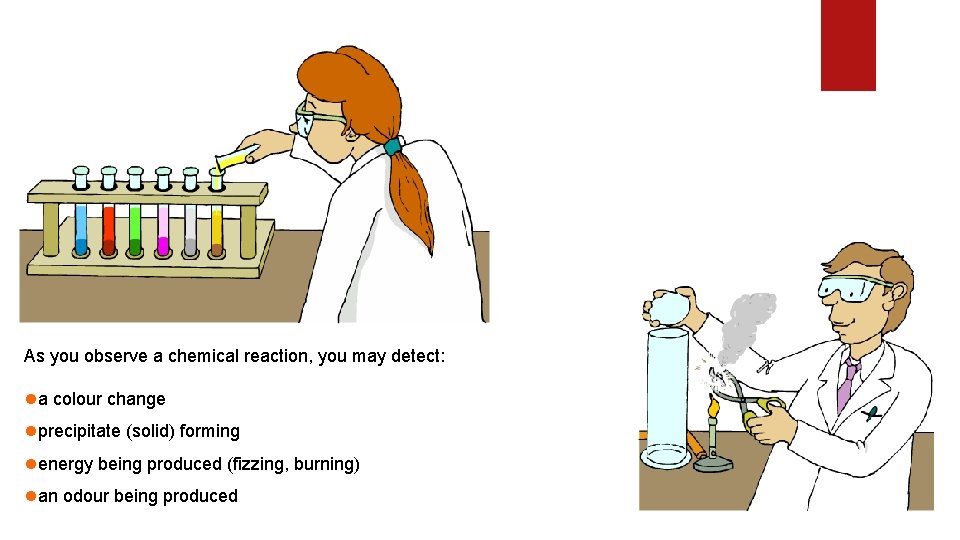
As you observe a chemical reaction, you may detect: la colour change lprecipitate (solid) forming lenergy being produced (fizzing, burning) lan odour being produced
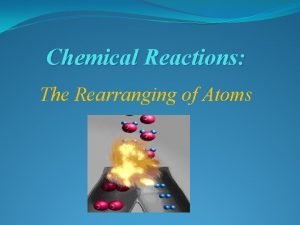
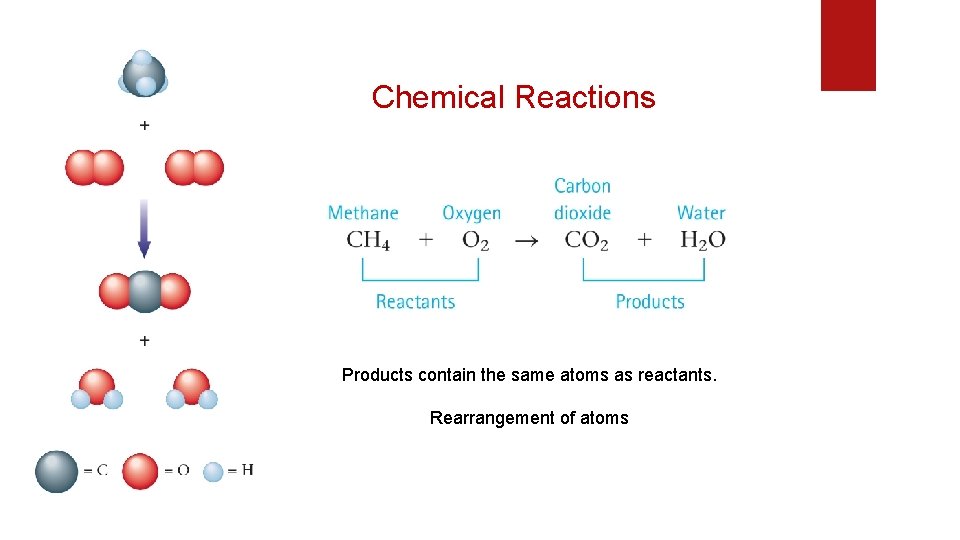
Chemical Reactions Products contain the same atoms as reactants. Rearrangement of atoms
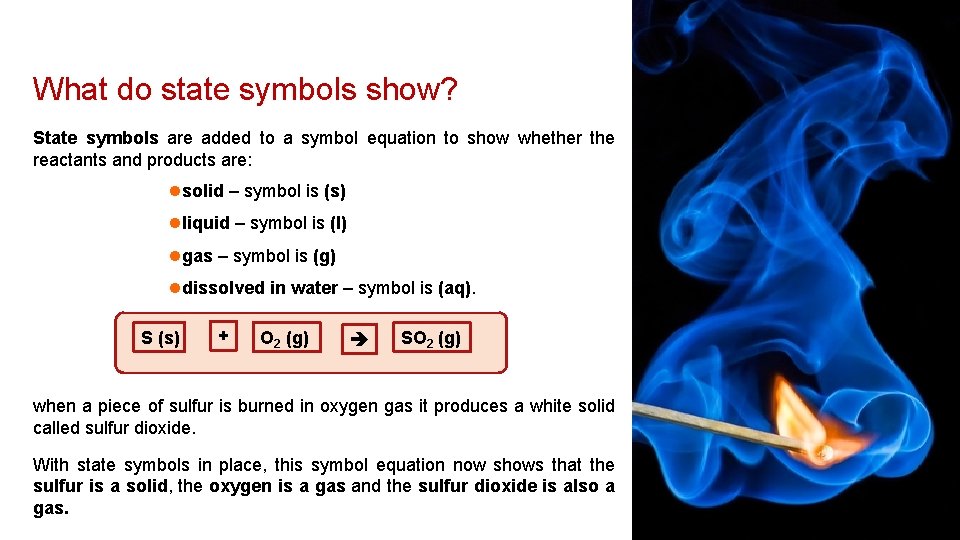
What do state symbols show? State symbols are added to a symbol equation to show whether the reactants and products are: lsolid – symbol is (s) lliquid – symbol is (l) lgas – symbol is (g) ldissolved in water – symbol is (aq). S (s) + O 2 (g) SO 2 (g) when a piece of sulfur is burned in oxygen gas it produces a white solid called sulfur dioxide. With state symbols in place, this symbol equation now shows that the sulfur is a solid, the oxygen is a gas and the sulfur dioxide is also a gas.
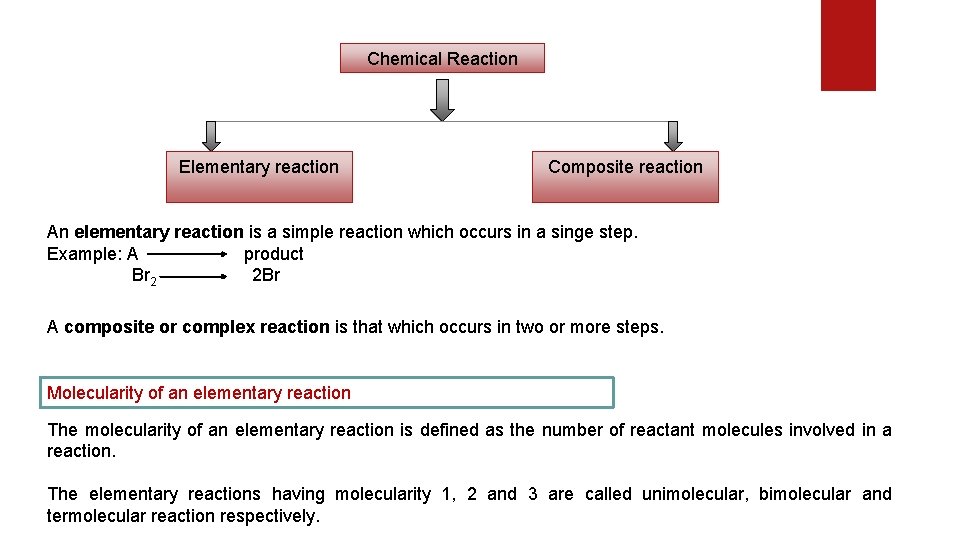
Chemical Reaction Elementary reaction Composite reaction An elementary reaction is a simple reaction which occurs in a singe step. Example: A product Br 2 2 Br A composite or complex reaction is that which occurs in two or more steps. Molecularity of an elementary reaction The molecularity of an elementary reaction is defined as the number of reactant molecules involved in a reaction. The elementary reactions having molecularity 1, 2 and 3 are called unimolecular, bimolecular and termolecular reaction respectively.
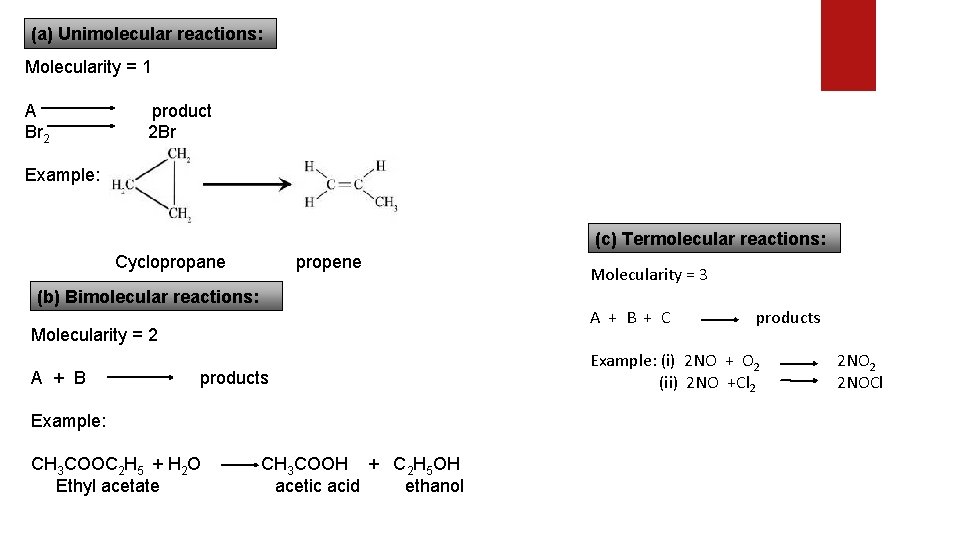
(a) Unimolecular reactions: Molecularity = 1 A Br 2 product 2 Br Example: (c) Termolecular reactions: Cyclopropane propene (b) Bimolecular reactions: A + B + C Molecularity = 2 A + B products Example: CH 3 COOC 2 H 5 + H 2 O Ethyl acetate Molecularity = 3 CH 3 COOH + C 2 H 5 OH acetic acid ethanol products Example: (i) 2 NO + O 2 (ii) 2 NO +Cl 2 2 NOCl
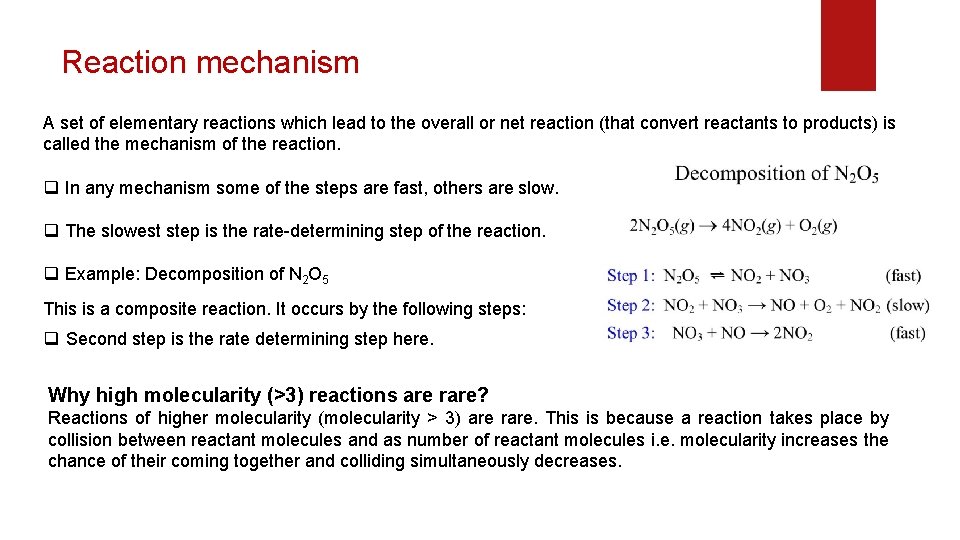
Reaction mechanism A set of elementary reactions which lead to the overall or net reaction (that convert reactants to products) is called the mechanism of the reaction. q In any mechanism some of the steps are fast, others are slow. q The slowest step is the rate-determining step of the reaction. q Example: Decomposition of N 2 O 5 This is a composite reaction. It occurs by the following steps: q Second step is the rate determining step here. Why high molecularity (>3) reactions are rare? Reactions of higher molecularity (molecularity > 3) are rare. This is because a reaction takes place by collision between reactant molecules and as number of reactant molecules i. e. molecularity increases the chance of their coming together and colliding simultaneously decreases.
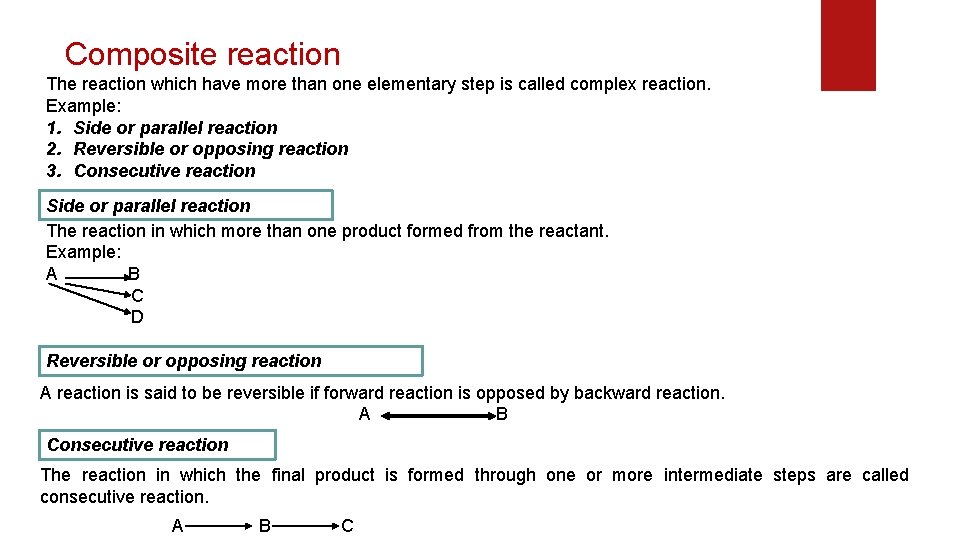
Composite reaction The reaction which have more than one elementary step is called complex reaction. Example: 1. Side or parallel reaction 2. Reversible or opposing reaction 3. Consecutive reaction Side or parallel reaction The reaction in which more than one product formed from the reactant. Example: A B C D Reversible or opposing reaction A reaction is said to be reversible if forward reaction is opposed by backward reaction. A B Consecutive reaction The reaction in which the final product is formed through one or more intermediate steps are called consecutive reaction. A B C
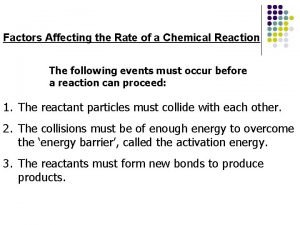
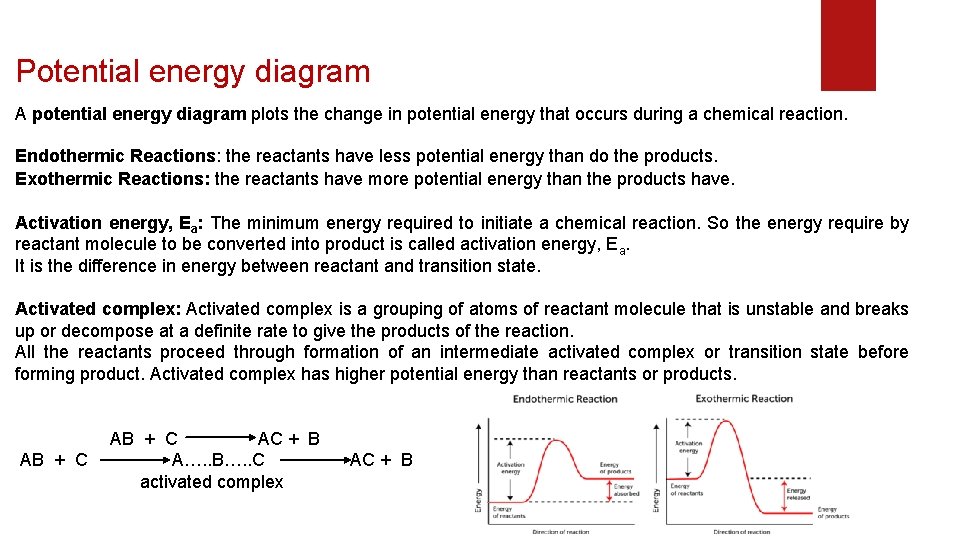
Potential energy diagram A potential energy diagram plots the change in potential energy that occurs during a chemical reaction. Endothermic Reactions: the reactants have less potential energy than do the products. Exothermic Reactions: the reactants have more potential energy than the products have. Activation energy, Ea: The minimum energy required to initiate a chemical reaction. So the energy require by reactant molecule to be converted into product is called activation energy, Ea. It is the difference in energy between reactant and transition state. Activated complex: Activated complex is a grouping of atoms of reactant molecule that is unstable and breaks up or decompose at a definite rate to give the products of the reaction. All the reactants proceed through formation of an intermediate activated complex or transition state before forming product. Activated complex has higher potential energy than reactants or products. AB + C AC + B A…. . B…. . C activated complex AC + B
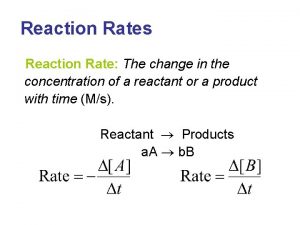
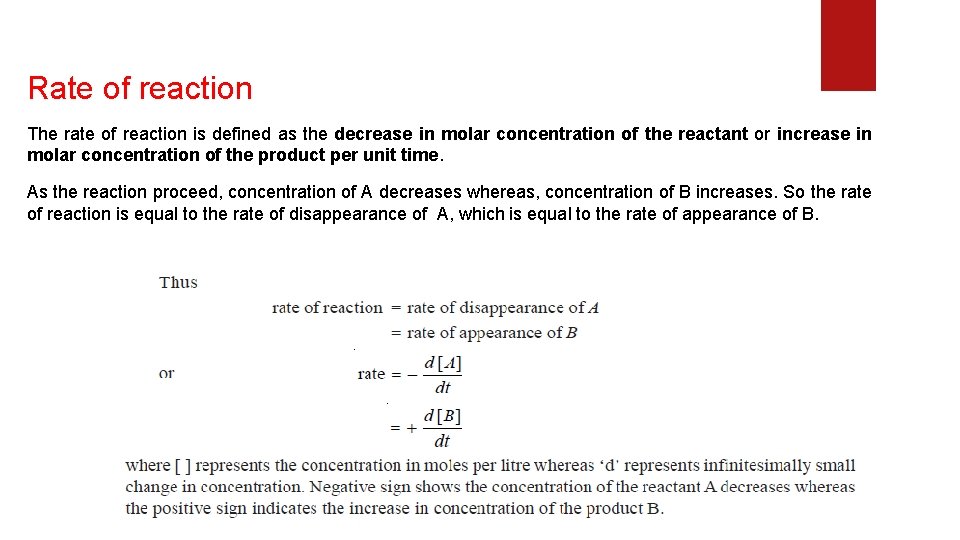
Rate of reaction The rate of reaction is defined as the decrease in molar concentration of the reactant or increase in molar concentration of the product per unit time. As the reaction proceed, concentration of A decreases whereas, concentration of B increases. So the rate of reaction is equal to the rate of disappearance of A, which is equal to the rate of appearance of B.
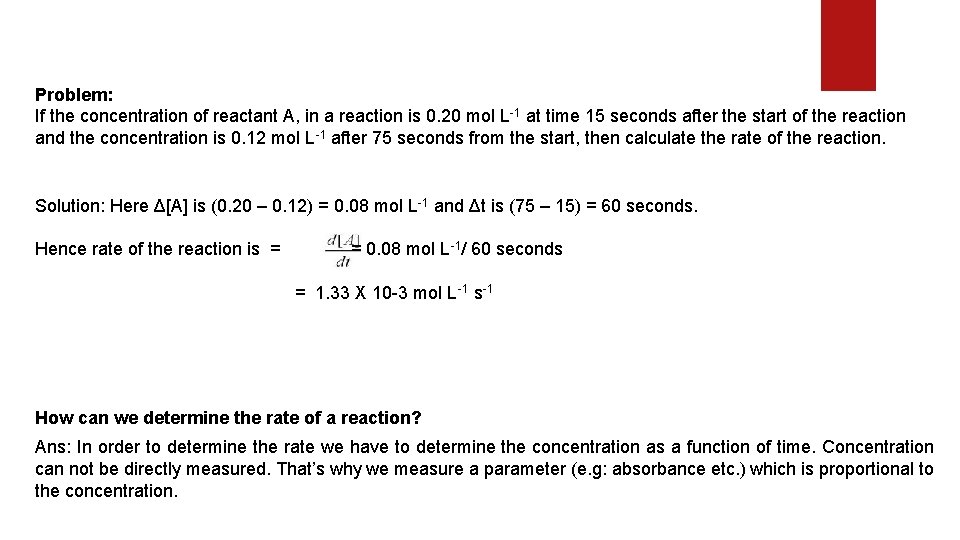
Problem: If the concentration of reactant A, in a reaction is 0. 20 mol L-1 at time 15 seconds after the start of the reaction and the concentration is 0. 12 mol L-1 after 75 seconds from the start, then calculate the rate of the reaction. Solution: Here Δ[A] is (0. 20 – 0. 12) = 0. 08 mol L-1 and Δt is (75 – 15) = 60 seconds. Hence rate of the reaction is = = 0. 08 mol L-1/ 60 seconds = 1. 33 X 10 -3 mol L -1 s-1 How can we determine the rate of a reaction? Ans: In order to determine the rate we have to determine the concentration as a function of time. Concentration can not be directly measured. That’s why we measure a parameter (e. g: absorbance etc. ) which is proportional to the concentration.
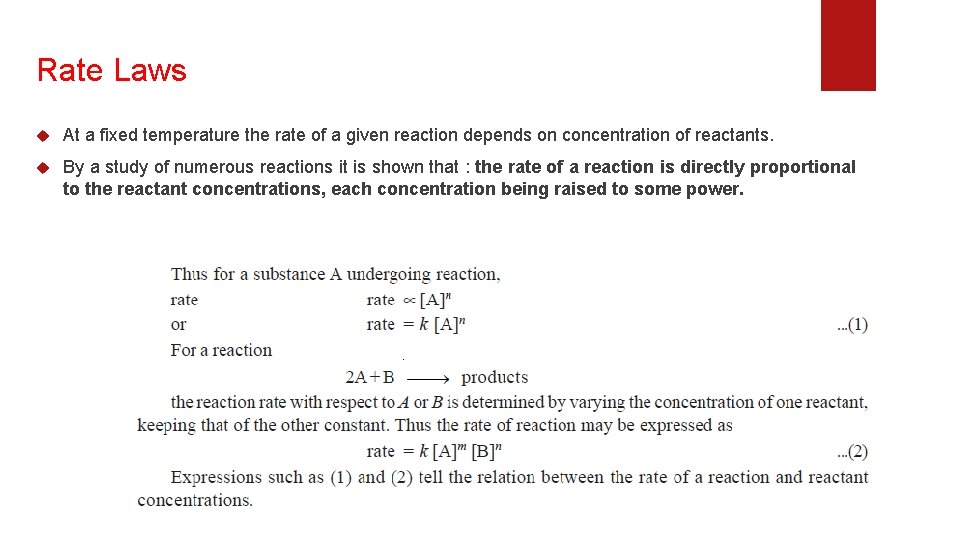
Rate Laws At a fixed temperature the rate of a given reaction depends on concentration of reactants. By a study of numerous reactions it is shown that : the rate of a reaction is directly proportional to the reactant concentrations, each concentration being raised to some power.
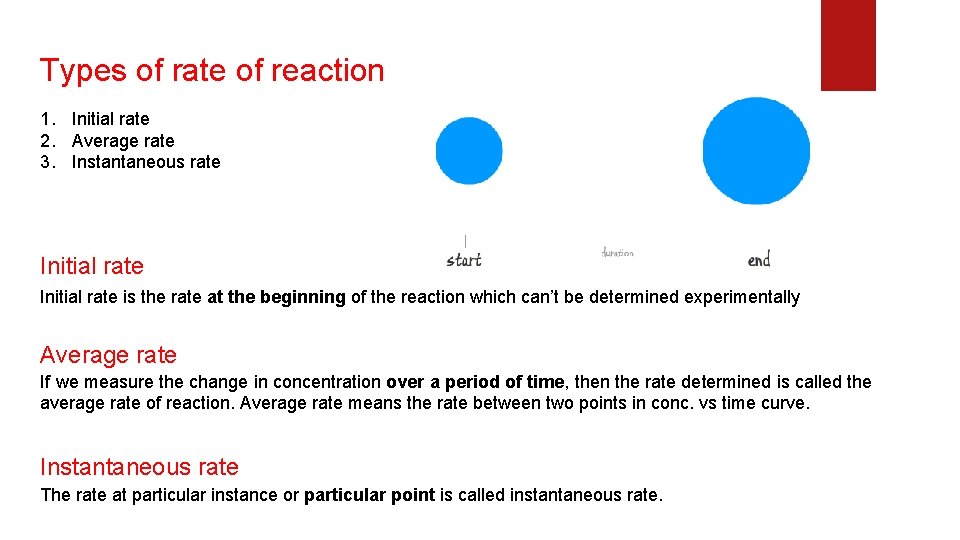
Types of rate of reaction 1. Initial rate 2. Average rate 3. Instantaneous rate Initial rate is the rate at the beginning of the reaction which can’t be determined experimentally Average rate If we measure the change in concentration over a period of time, then the rate determined is called the average rate of reaction. Average rate means the rate between two points in conc. vs time curve. Instantaneous rate The rate at particular instance or particular point is called instantaneous rate.
Factors affecting rate of reaction 1. Concentration 2. Pressure (in case of gases) 3. Temperature of reaction 4. Catalyst 5. Light (in some cases) 6. Surface area of solid reactant or catalyst)
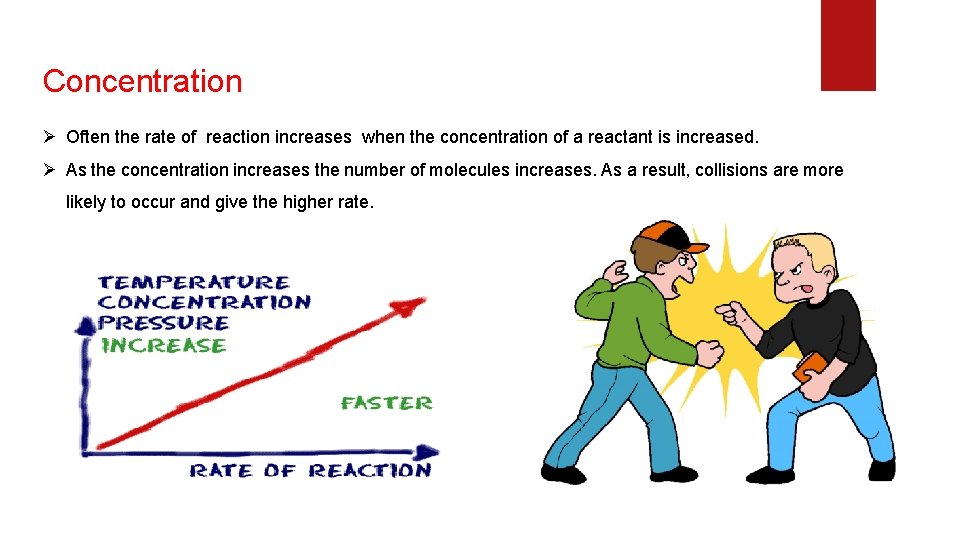
Concentration Ø Often the rate of reaction increases when the concentration of a reactant is increased. Ø As the concentration increases the number of molecules increases. As a result, collisions are more likely to occur and give the higher rate.
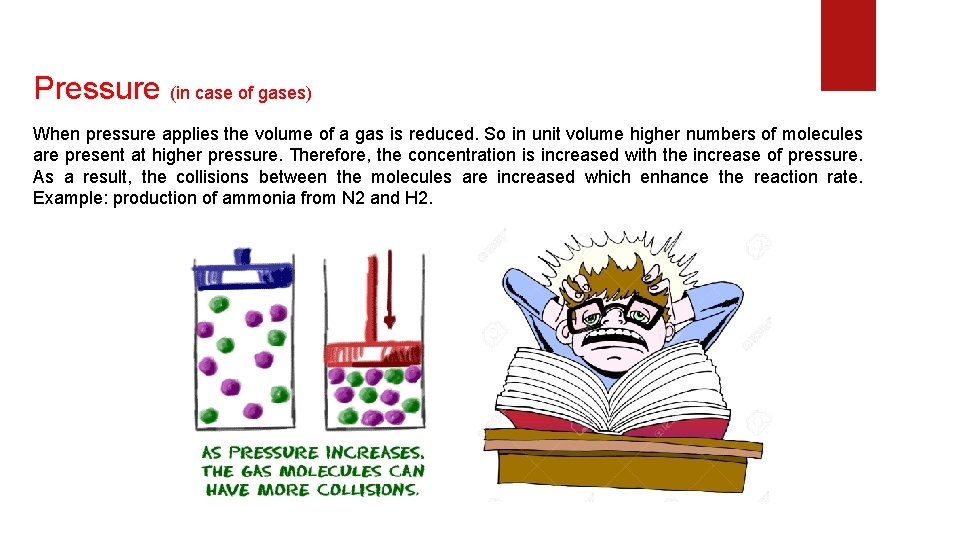
Pressure (in case of gases) When pressure applies the volume of a gas is reduced. So in unit volume higher numbers of molecules are present at higher pressure. Therefore, the concentration is increased with the increase of pressure. As a result, the collisions between the molecules are increased which enhance the reaction rate. Example: production of ammonia from N 2 and H 2.
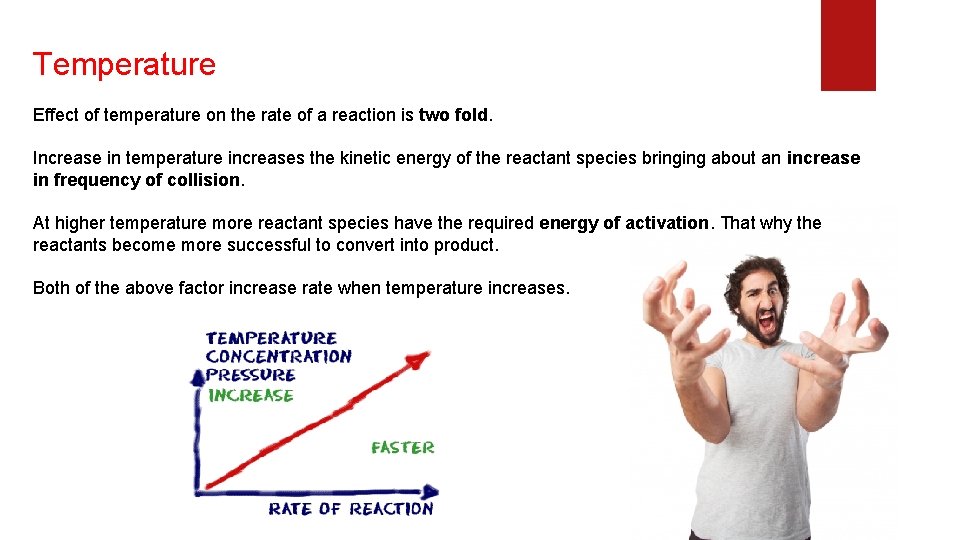
Temperature Effect of temperature on the rate of a reaction is two fold. Increase in temperature increases the kinetic energy of the reactant species bringing about an increase in frequency of collision. At higher temperature more reactant species have the required energy of activation. That why the reactants become more successful to convert into product. Both of the above factor increase rate when temperature increases.
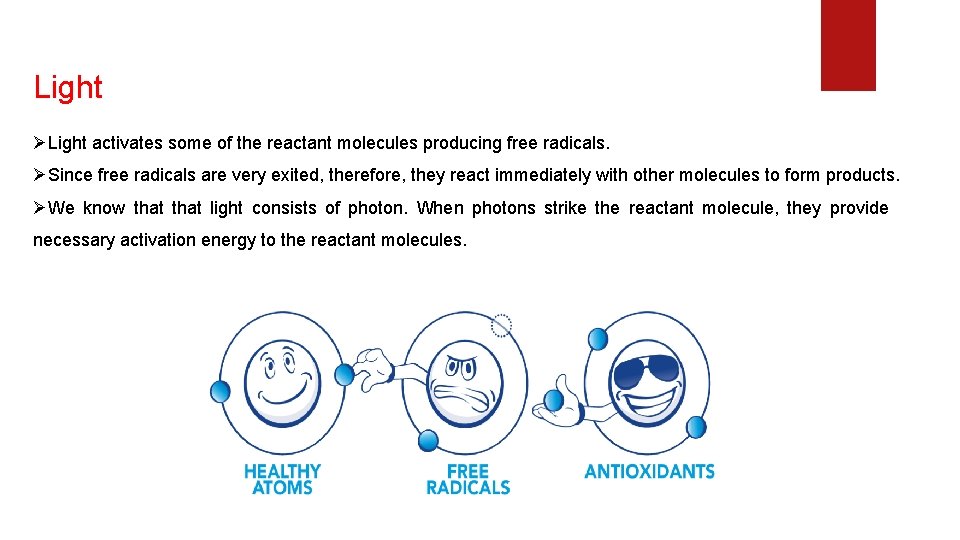
Light ØLight activates some of the reactant molecules producing free radicals. ØSince free radicals are very exited, therefore, they react immediately with other molecules to form products. ØWe know that light consists of photon. When photons strike the reactant molecule, they provide necessary activation energy to the reactant molecules.
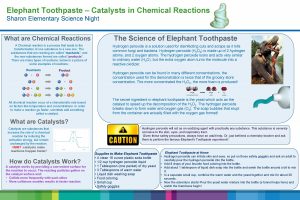
Catalyst q A catalyst is a substance that increases the rate of reaction without being consumed in the overall reaction. q Catalysts are of enormous importance to the chemical industry, because they allow a reaction to occur with a reasonable rate at a much lower temperature than otherwise; lower temperatures translate into lower energy costs. q The catalyst must participate in at least one step of a reaction and be regenerated in a later step.
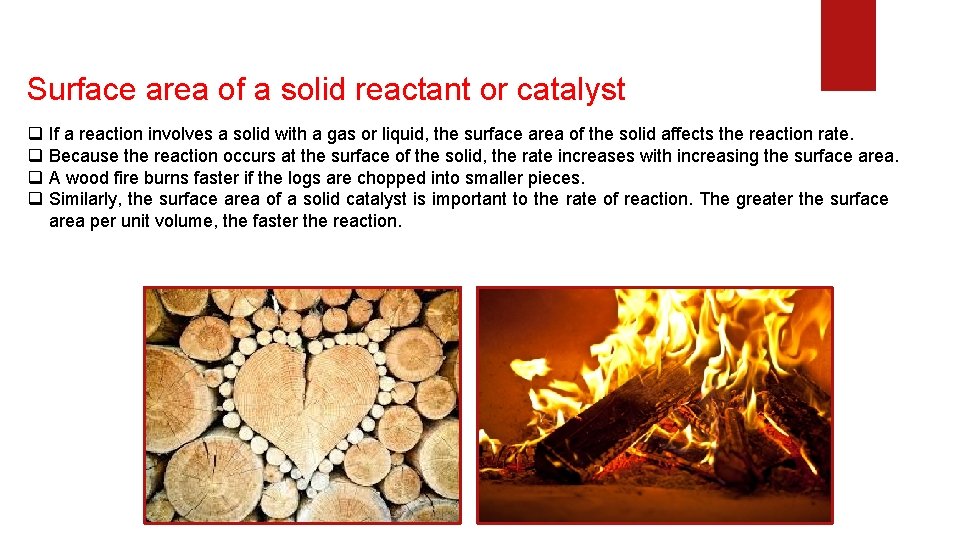
Surface area of a solid reactant or catalyst q q If a reaction involves a solid with a gas or liquid, the surface area of the solid affects the reaction rate. Because the reaction occurs at the surface of the solid, the rate increases with increasing the surface area. A wood fire burns faster if the logs are chopped into smaller pieces. Similarly, the surface area of a solid catalyst is important to the rate of reaction. The greater the surface area per unit volume, the faster the reaction.
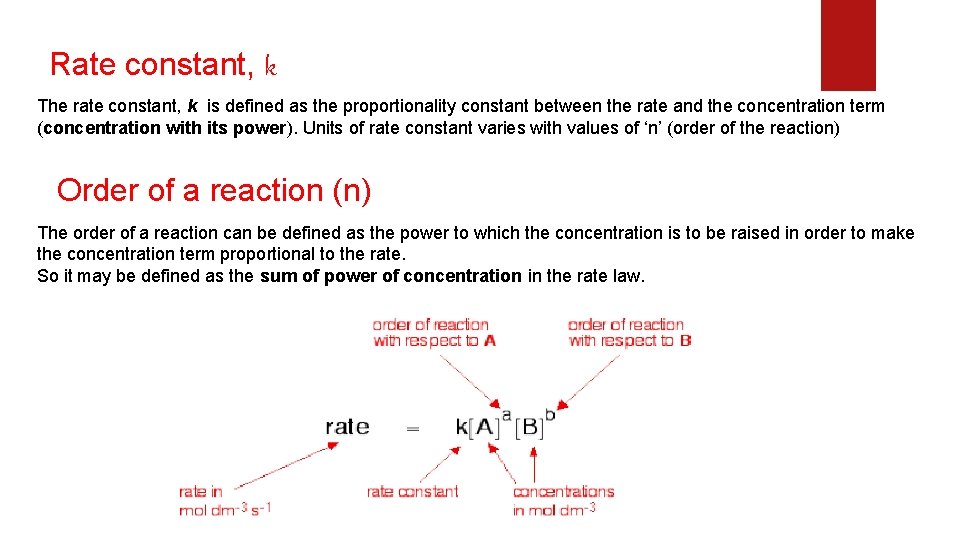
Rate constant, k The rate constant, k is defined as the proportionality constant between the rate and the concentration term (concentration with its power). Units of rate constant varies with values of ‘n’ (order of the reaction) Order of a reaction (n) The order of a reaction can be defined as the power to which the concentration is to be raised in order to make the concentration term proportional to the rate. So it may be defined as the sum of power of concentration in the rate law.
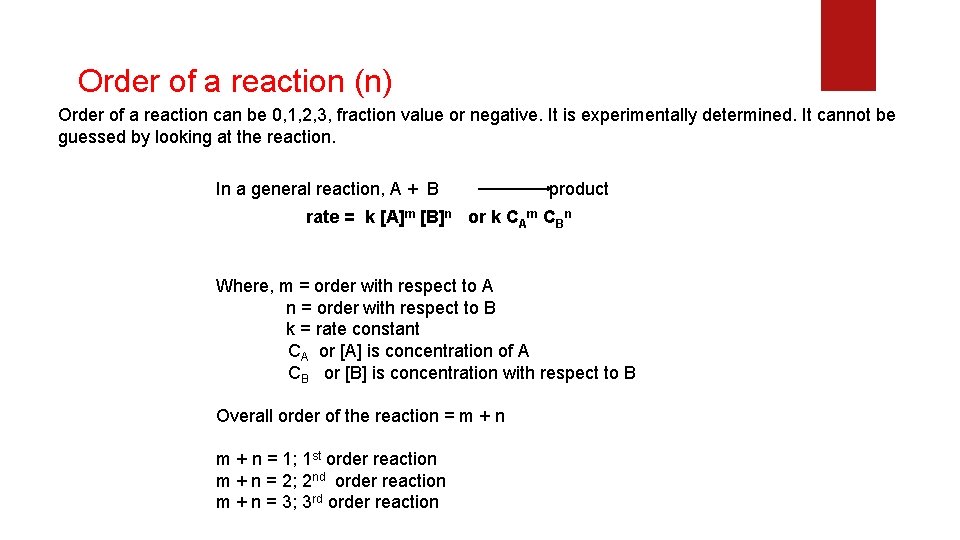
Order of a reaction (n) Order of a reaction can be 0, 1, 2, 3, fraction value or negative. It is experimentally determined. It cannot be guessed by looking at the reaction. In a general reaction, A + B product rate = k [A]m [B]n or k CAm CBn Where, m = order with respect to A n = order with respect to B k = rate constant CA or [A] is concentration of A CB or [B] is concentration with respect to B Overall order of the reaction = m + n = 1; 1 st order reaction m + n = 2; 2 nd order reaction m + n = 3; 3 rd order reaction
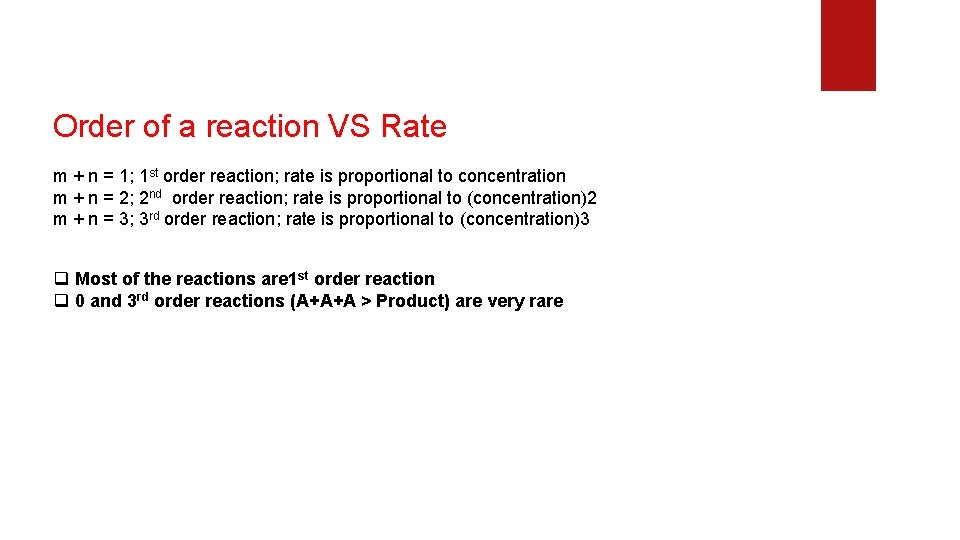
Order of a reaction VS Rate m + n = 1; 1 st order reaction; rate is proportional to concentration m + n = 2; 2 nd order reaction; rate is proportional to (concentration)2 m + n = 3; 3 rd order reaction; rate is proportional to (concentration)3 q Most of the reactions are 1 st order reaction q 0 and 3 rd order reactions (A+A+A > Product) are very rare
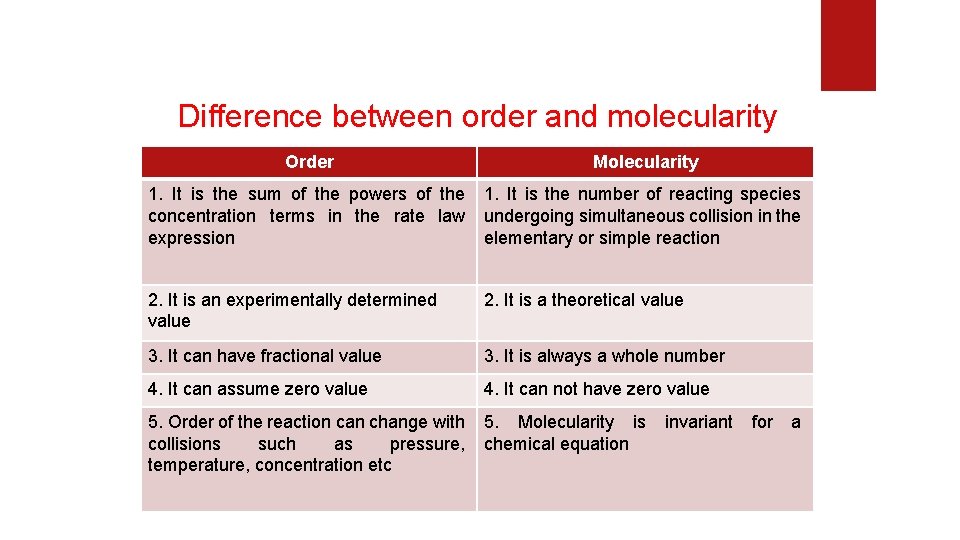
Difference between order and molecularity Order Molecularity 1. It is the sum of the powers of the concentration terms in the rate law expression 1. It is the number of reacting species undergoing simultaneous collision in the elementary or simple reaction 2. It is an experimentally determined value 2. It is a theoretical value 3. It can have fractional value 3. It is always a whole number 4. It can assume zero value 4. It can not have zero value 5. Order of the reaction can change with collisions such as pressure, temperature, concentration etc 5. Molecularity is chemical equation invariant for a
Thank You!