Welcome to Wollaston School We are so excited
- Slides: 33
Welcome to Wollaston School!! We are so excited to meet you
Notes to teachers This scheme of lessons aims to introduce historical skills and concepts that historians should be armed with when heading into KS 3. At Wollaston, we start teaching students about the Norman Conquest in 1066, but it would be beneficial for students to understand what Anglo-Saxon life was like. This will be achieved through intrigue surrounding the ‘investigative’ aspect of history using national and local sources. • These tasks are differentiated to Key, Boost and Aspire. Key is minimum expectation; boost is an additional challenge; aspire is an increased challenge. All students should attempt the key tasks to obtain knowledge however students can choose to complete boost/aspire tasks. • I would love for all of the students’ work to come back to us in September so that we can display this as part of our ‘Introducing History’ board in the department. • Any question, please let me know! hodsona@wollaston-school. net
Lesson 1 – chronology and local history Resources: • Powerpoint • My historical passport worksheet • Boost task (slide 10) • Draft paper • Internet access for boost task • A 5 sheet (slide 15)
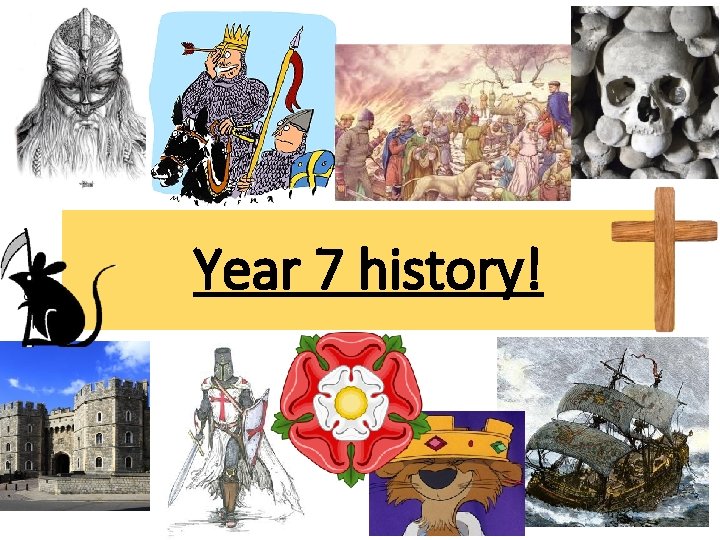
Year 7 history!
What is history? Clues: • Does it focus on the past, present or future? • Why do we study it? • What might we study? • Do you think it is an important subject?
What is history? History is the study of the past. We study the world, our country and even our local area. It is so important to learn about our history because we can learn about where we come from and reasons for our lifestyles. Most importantly, we can learn from history and learn about our mistakes so they never happen again. In Year 7, you will learn about: üHistorical skills – learning how to be good historians üThe Norman Conquest – including huge battles and building castles üLife in Medieval England – including the worst king of England, King John I, and the Black Death! üThe Tudors – including Henry VIII and his six wives and the Spanish Armada
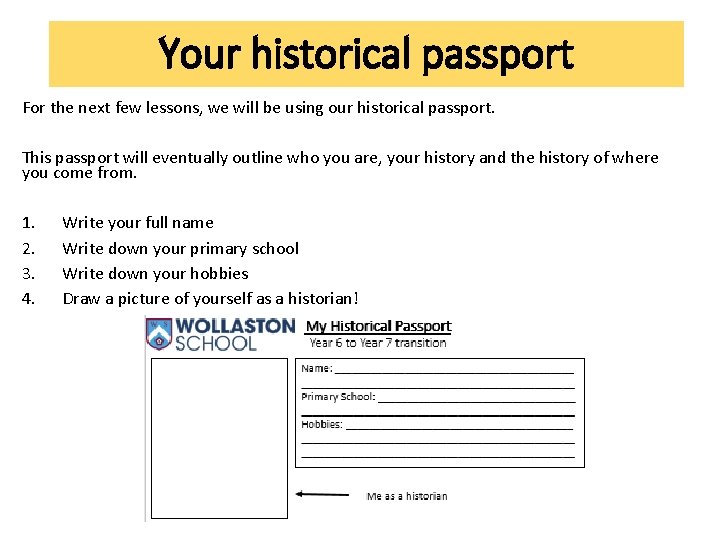
Your historical passport For the next few lessons, we will be using our historical passport. This passport will eventually outline who you are, your history and the history of where you come from. 1. 2. 3. 4. Write your full name Write down your primary school Write down your hobbies Draw a picture of yourself as a historian!
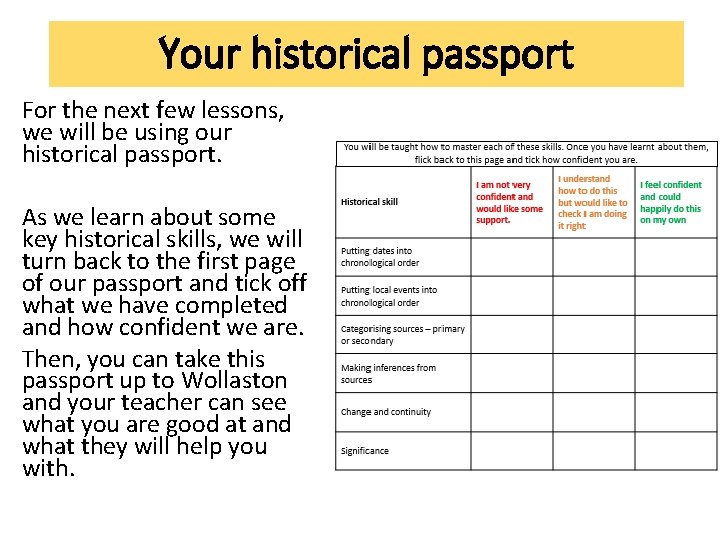
Your historical passport For the next few lessons, we will be using our historical passport. As we learn about some key historical skills, we will turn back to the first page of our passport and tick off what we have completed and how confident we are. Then, you can take this passport up to Wollaston and your teacher can see what you are good at and what they will help you with.
Skill 1: chronology If we are going to understand history, we have to understand how we order and measure time. In your books: Key: Come up at least five different ways that we measure time. For example, seconds. Boost: Match up the words to their length of time. Aspire: The Battle of Hastings happened 31 536 000 seconds ago. Is this a good way to measure time? Why/why not?
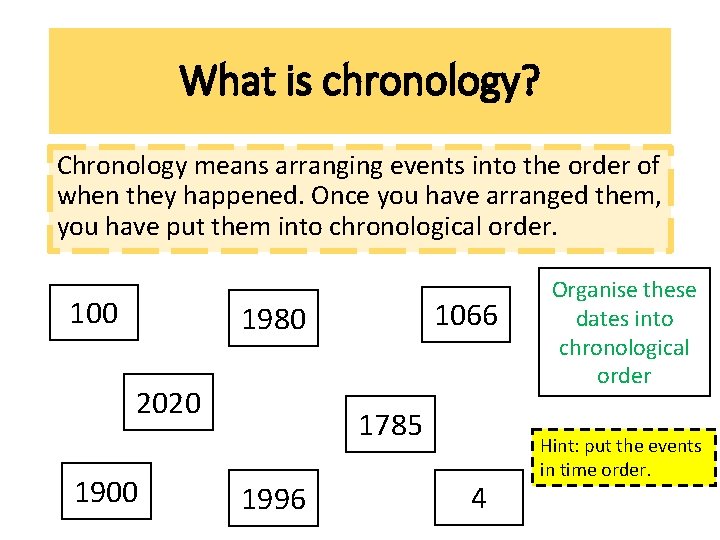
What is chronology? Chronology means arranging events into the order of when they happened. Once you have arranged them, you have put them into chronological order. 100 1066 1980 2020 1900 1785 1996 4 Organise these dates into chronological order Hint: put the events in time order.
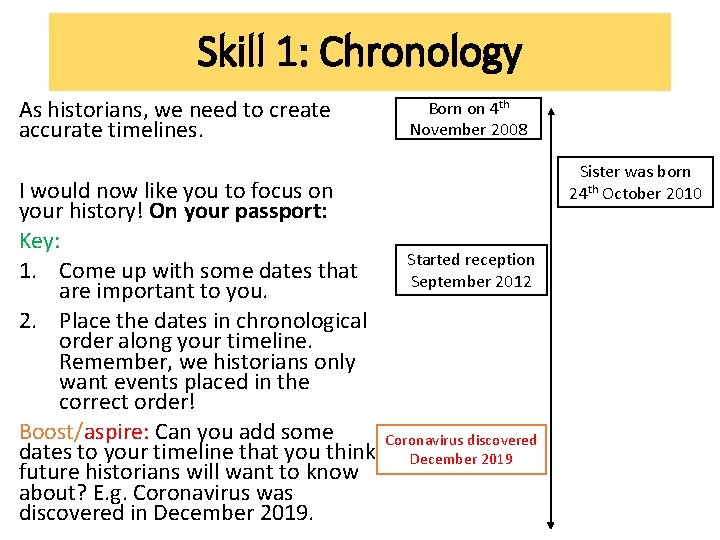
Skill 1: Chronology As historians, we need to create accurate timelines. I would now like you to focus on your history! On your passport: Key: 1. Come up with some dates that are important to you. 2. Place the dates in chronological order along your timeline. Remember, we historians only want events placed in the correct order! Boost/aspire: Can you add some dates to your timeline that you think future historians will want to know about? E. g. Coronavirus was discovered in December 2019. Born on 4 th November 2008 Sister was born 24 th October 2010 Started reception September 2012 Coronavirus discovered December 2019
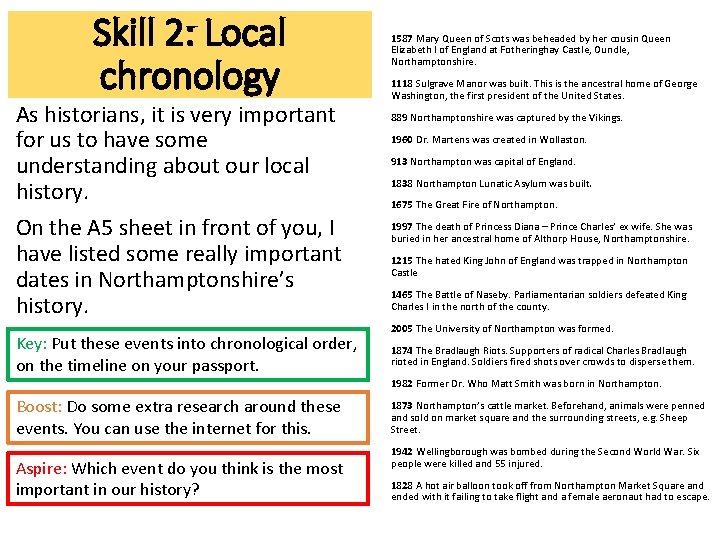
Skill 2: Local chronology As historians, it is very important for us to have some understanding about our local history. On the A 5 sheet in front of you, I have listed some really important dates in Northamptonshire’s history. Key: Put these events into chronological order, on the timeline on your passport. 1587 Mary Queen of Scots was beheaded by her cousin Queen Elizabeth I of England at Fotheringhay Castle, Oundle, Northamptonshire. 1118 Sulgrave Manor was built. This is the ancestral home of George Washington, the first president of the United States. 889 Northamptonshire was captured by the Vikings. 1960 Dr. Martens was created in Wollaston. 913 Northampton was capital of England. 1838 Northampton Lunatic Asylum was built. 1675 The Great Fire of Northampton. 1997 The death of Princess Diana – Prince Charles’ ex wife. She was buried in her ancestral home of Althorp House, Northamptonshire. 1215 The hated King John of England was trapped in Northampton Castle 1465 The Battle of Naseby. Parliamentarian soldiers defeated King Charles I in the north of the county. 2005 The University of Northampton was formed. 1874 The Bradlaugh Riots. Supporters of radical Charles Bradlaugh rioted in England. Soldiers fired shots over crowds to disperse them. 1982 Former Dr. Who Matt Smith was born in Northampton. Boost: Do some extra research around these events. You can use the internet for this. Aspire: Which event do you think is the most important in our history? 1873 Northampton’s cattle market. Beforehand, animals were penned and sold on market square and the surrounding streets, e. g. Sheep Street. 1942 Wellingborough was bombed during the Second World War. Six people were killed and 55 injured. 1828 A hot air balloon took off from Northampton Market Square and ended with it failing to take flight and a female aeronaut had to escape.
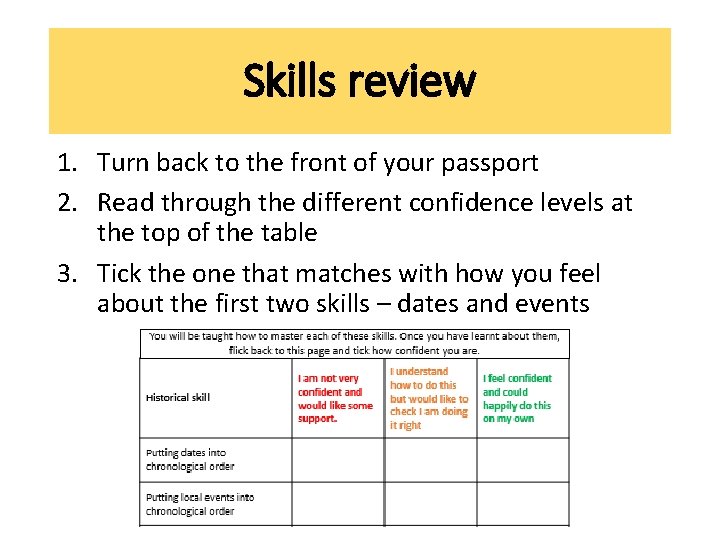
Skills review 1. Turn back to the front of your passport 2. Read through the different confidence levels at the top of the table 3. Tick the one that matches with how you feel about the first two skills – dates and events
Lesson 2 Resources: • Powerpoint • Historical skills passport • Source sheet – either with supporting questions or without • Primary or secondary source flow chart
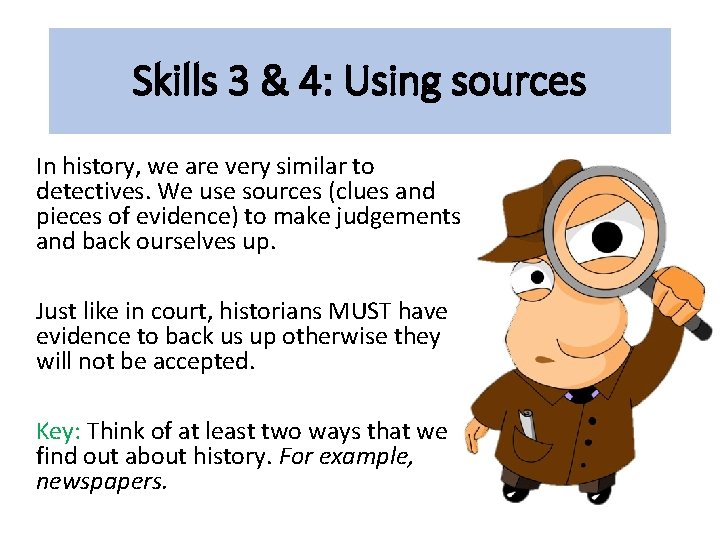
Skills 3 & 4: Using sources In history, we are very similar to detectives. We use sources (clues and pieces of evidence) to make judgements and back ourselves up. Just like in court, historians MUST have evidence to back us up otherwise they will not be accepted. Key: Think of at least two ways that we find out about history. For example, newspapers.
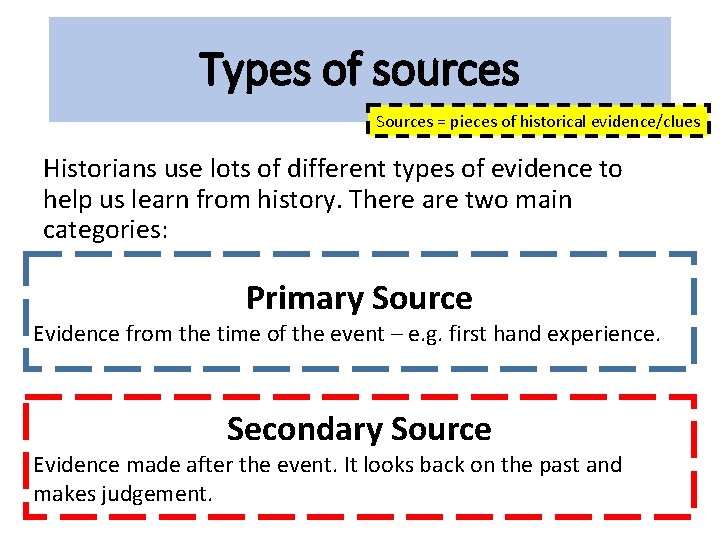
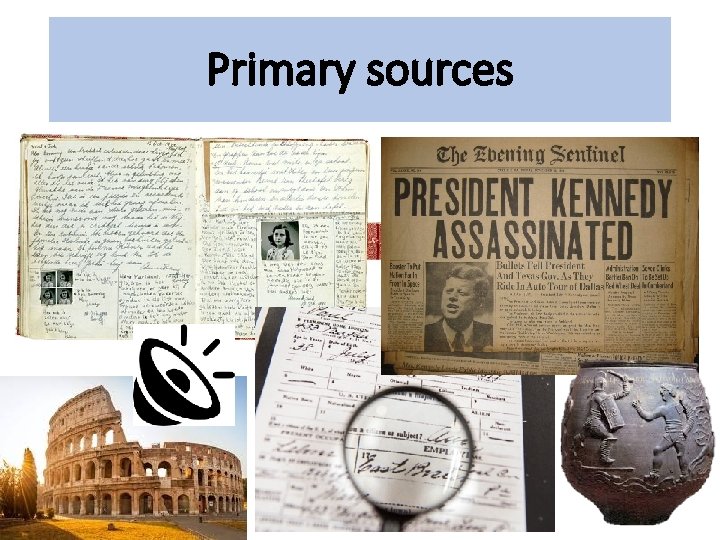
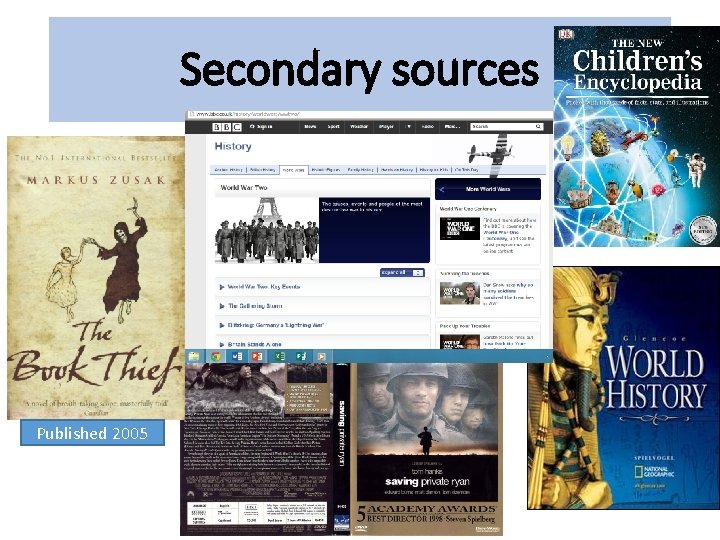
Types of sources Sources = pieces of historical evidence/clues Historians use lots of different types of evidence to help us learn from history. There are two main categories: Primary Source Evidence from the time of the event – e. g. first hand experience. Secondary Source Evidence made after the event. It looks back on the past and makes judgement.
Primary sources
Secondary sources Published 2005
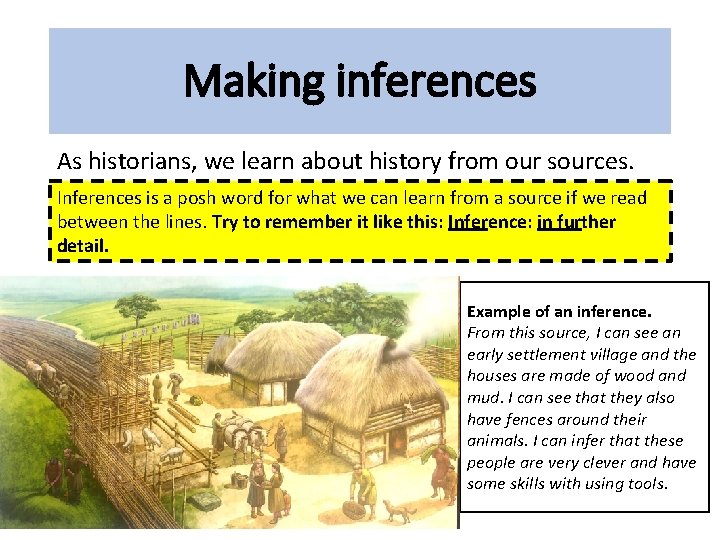
Making inferences As historians, we learn about history from our sources. Inferences is a posh word for what we can learn from a source if we read between the lines. Try to remember it like this: Inference: in further detail. Example of an inference. From this source, I can see an early settlement village and the houses are made of wood and mud. I can see that they also have fences around their animals. I can infer that these people are very clever and have some skills with using tools.
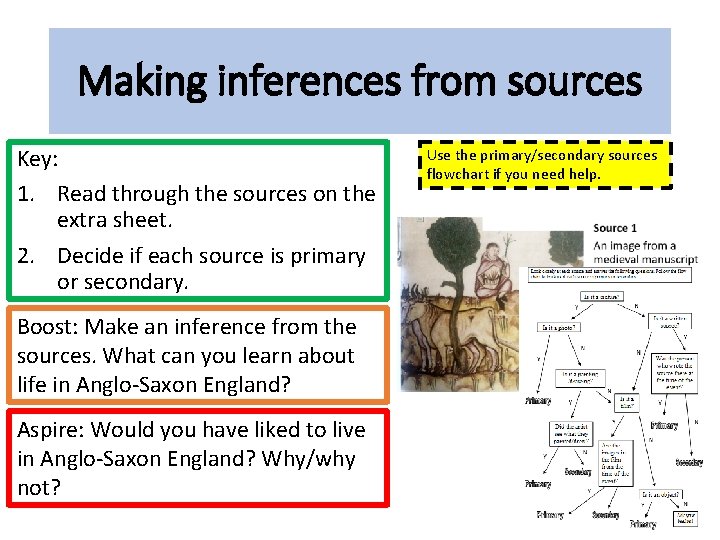
Making inferences from sources Key: 1. Read through the sources on the extra sheet. 2. Decide if each source is primary or secondary. Boost: Make an inference from the sources. What can you learn about life in Anglo-Saxon England? Aspire: Would you have liked to live in Anglo-Saxon England? Why/why not? Use the primary/secondary sources flowchart if you need help.
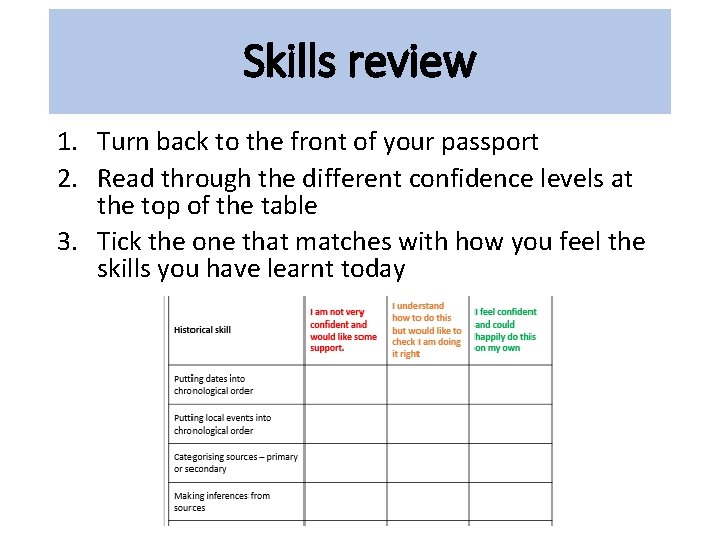
Skills review 1. Turn back to the front of your passport 2. Read through the different confidence levels at the top of the table 3. Tick the one that matches with how you feel the skills you have learnt today
Lesson 3 Resources: • Powerpoint • Historical passport • Print out of slide 31 • Highlighters • Computer access (optional – to research Northampton further) • Medieval and modern maps of Northampton (slides 35/36)
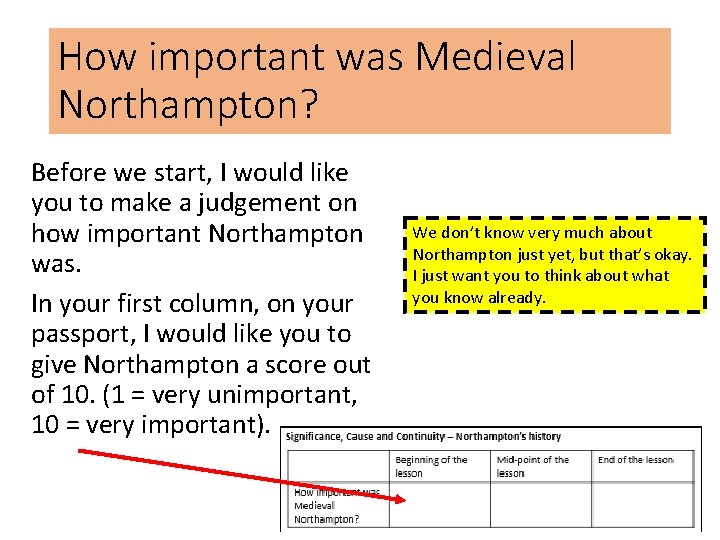
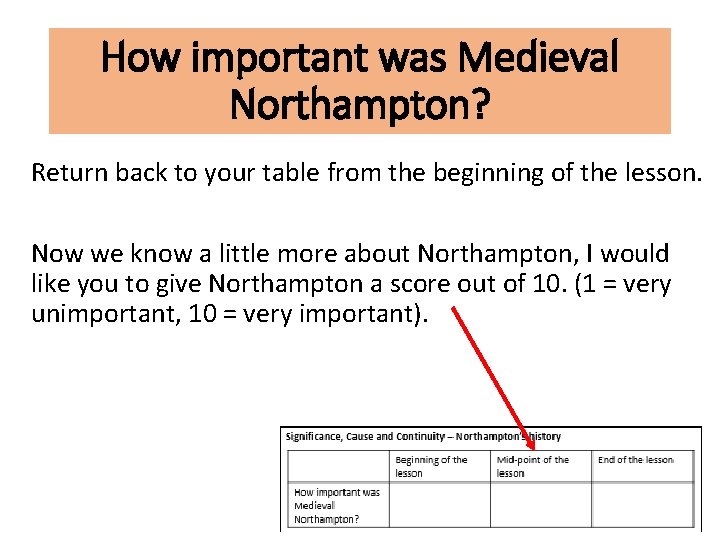
How important was Medieval Northampton? Before we start, I would like you to make a judgement on how important Northampton was. In your first column, on your passport, I would like you to give Northampton a score out of 10. (1 = very unimportant, 10 = very important). We don’t know very much about Northampton just yet, but that’s okay. I just want you to think about what you know already.
What makes a town ‘important’? When we look at something’s ‘significance’, we are trying to work out how important it is. If we, as historians, want to work out if Northampton was an important town, we have to think about what an important town would look like. Key: Think of two things an important town might have Boost: Think of three things Aspire: Think of four things
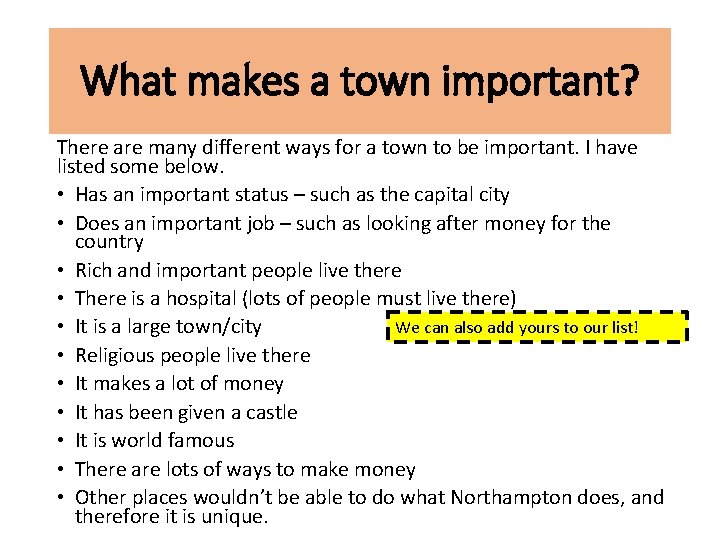
What makes a town important? There are many different ways for a town to be important. I have listed some below. • Has an important status – such as the capital city • Does an important job – such as looking after money for the country • Rich and important people live there • There is a hospital (lots of people must live there) We can also add yours to our list! • It is a large town/city • Religious people live there • It makes a lot of money • It has been given a castle • It is world famous • There are lots of ways to make money • Other places wouldn’t be able to do what Northampton does, and therefore it is unique.
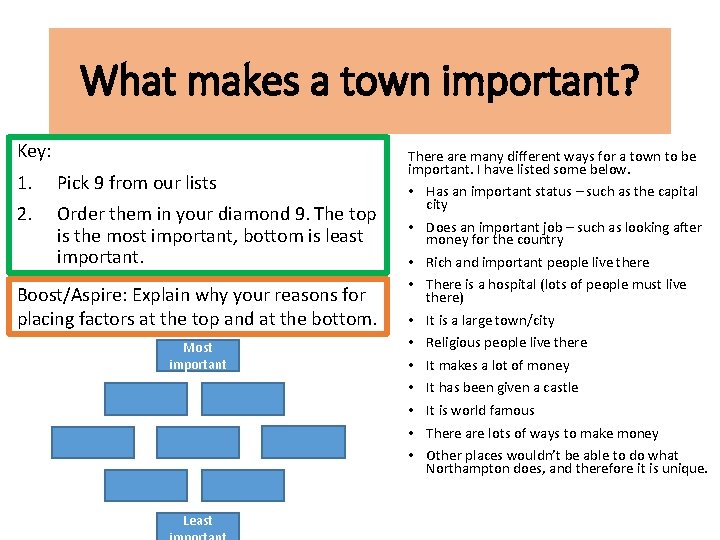
What makes a town important? Key: 1. Pick 9 from our lists 2. Order them in your diamond 9. The top is the most important, bottom is least important. Boost/Aspire: Explain why your reasons for placing factors at the top and at the bottom. Most important Least There are many different ways for a town to be important. I have listed some below. • Has an important status – such as the capital city • Does an important job – such as looking after money for the country • Rich and important people live there • There is a hospital (lots of people must live there) • It is a large town/city • Religious people live there • It makes a lot of money • It has been given a castle • It is world famous • There are lots of ways to make money • Other places wouldn’t be able to do what Northampton does, and therefore it is unique.
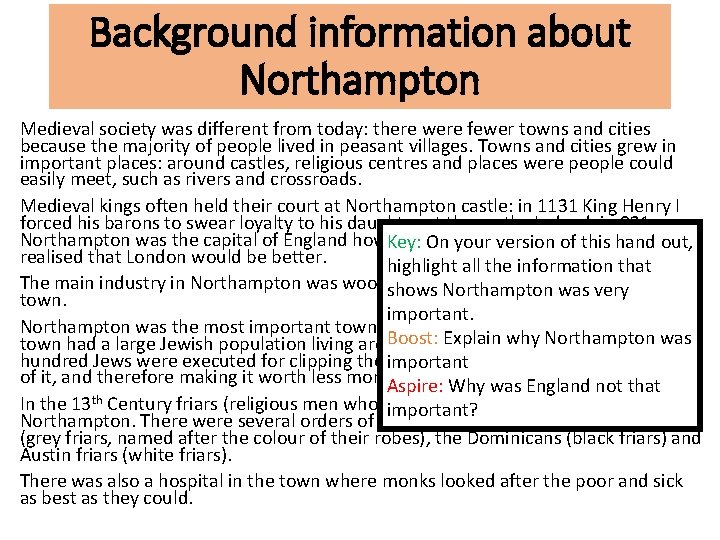
Background information about Northampton Medieval society was different from today: there were fewer towns and cities because the majority of people lived in peasant villages. Towns and cities grew in important places: around castles, religious centres and places were people could easily meet, such as rivers and crossroads. Medieval kings often held their court at Northampton castle: in 1131 King Henry I forced his barons to swear loyalty to his daughter at the castle. Indeed, in 931, Northampton was the capital of England however it was taken away the king Key: On your version of when this hand out, realised that London would be better. highlight all the information that The main industry in Northampton was wool, shows which Northampton was woven and dyed in the was very town. important. Northampton was the most important town in the Midlands in the 13 th century. The Boost: Explain why Northampton town had a large Jewish population living around Gold Street: in 1277, three was hundred Jews were executed for clipping the important king’s coin (taking valuable metal out of it, and therefore making it worth less money). Aspire: Why was England not that th In the 13 Century friars (religious men who went out to preach) arrived in important? Northampton. There were several orders of friars in Northampton: the Franciscans (grey friars, named after the colour of their robes), the Dominicans (black friars) and Austin friars (white friars). There was also a hospital in the town where monks looked after the poor and sick as best as they could.
How important was Medieval Northampton? Return back to your table from the beginning of the lesson. Now we know a little more about Northampton, I would like you to give Northampton a score out of 10. (1 = very unimportant, 10 = very important).
How important was Medieval Northampton? As historians, when we are looking at history we want to see what has changed or stayed the same. Historians look at change and continuity. It is really important for us to understand how history has shaped where we live. It also helps us to understand what was so important, as this would stand the test of time.
How important was Medieval Northampton? We are now going to look at a map of Medieval Northampton and a map from today. Whilst you are looking at the Medieval map, I would like you to make a note on your passport of these things: • Can you spot some street names that are the same? • What do you think happened on those streets? • Would the same thing happen on the streets today? • Can you spot anything that shows Northampton was important? • What has changed? Why might it have changed?
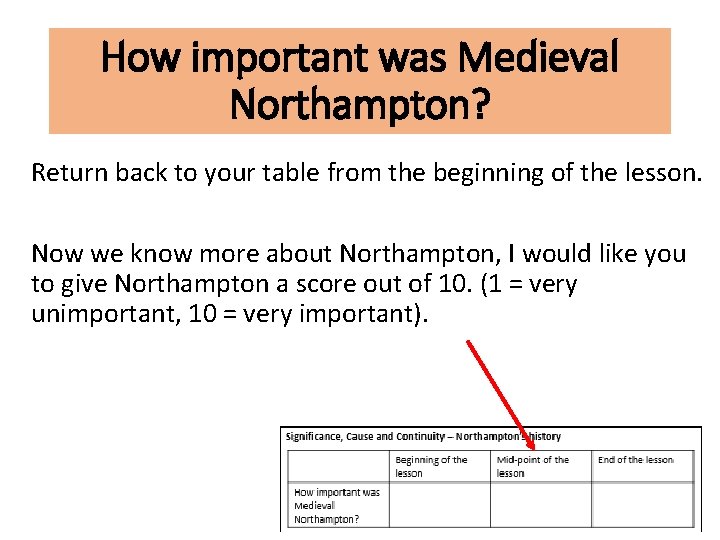
How important was Medieval Northampton? Return back to your table from the beginning of the lesson. Now we know more about Northampton, I would like you to give Northampton a score out of 10. (1 = very unimportant, 10 = very important).
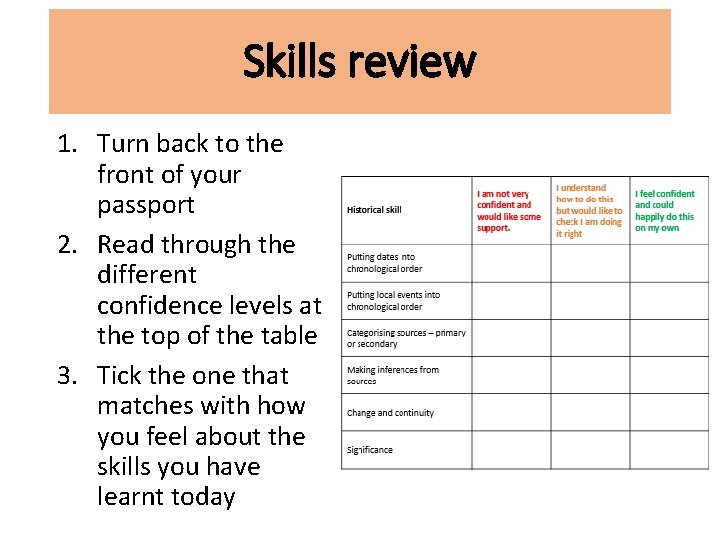
Skills review 1. Turn back to the front of your passport 2. Read through the different confidence levels at the top of the table 3. Tick the one that matches with how you feel about the skills you have learnt today
Optional additional activities • Create a time capsule about your life today that you could open on your last day at school in Year 11. What would you like your 16 year old self to remember? What do you hope to have achieved by the time you are 16? What is important to you? • Use your new historical skills passport to go on a virtual trip!! http: //www. bbc. co. uk/history/interactive/virtual_t ours/ https: //www. history. com/news/10 -best-virtualmuseums-tours-history-from-home