Virginia Alternate Assessment Program VAAP Instructional Manual and



- Slides: 61
Virginia Alternate Assessment Program (VAAP): Instructional Manual and Curricular Design Virginia Department of Education Office of Special Education Instructional Services John Eisenberg Educational Specialist in Severe Disabilities and Assistive Technology (804) 225 -2711 Virginia Alternate Assessment Program John. Eisenberg@doe. virginia. gov 2005
Flow of the Day n Instructional Components/Overview ¨ John Eisenberg n n Division of Special Education Instructional Services Assessment Components/Procedures ¨ Nathan Sparks n Division of Assessment and Reporting Virginia Alternate Assessment Program 2005 2
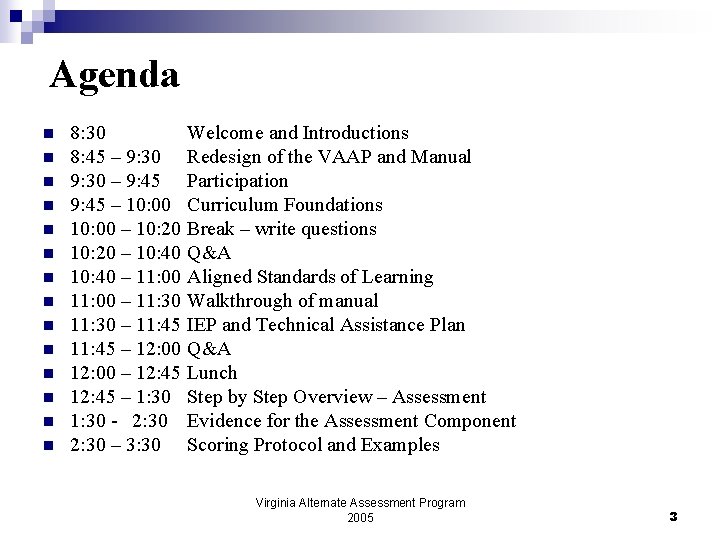
Agenda n n n n 8: 30 Welcome and Introductions 8: 45 – 9: 30 Redesign of the VAAP and Manual 9: 30 – 9: 45 Participation 9: 45 – 10: 00 Curriculum Foundations 10: 00 – 10: 20 Break – write questions 10: 20 – 10: 40 Q&A 10: 40 – 11: 00 Aligned Standards of Learning 11: 00 – 11: 30 Walkthrough of manual 11: 30 – 11: 45 IEP and Technical Assistance Plan 11: 45 – 12: 00 Q&A 12: 00 – 12: 45 Lunch 12: 45 – 1: 30 Step by Step Overview – Assessment 1: 30 - 2: 30 Evidence for the Assessment Component 2: 30 – 3: 30 Scoring Protocol and Examples Virginia Alternate Assessment Program 2005 3
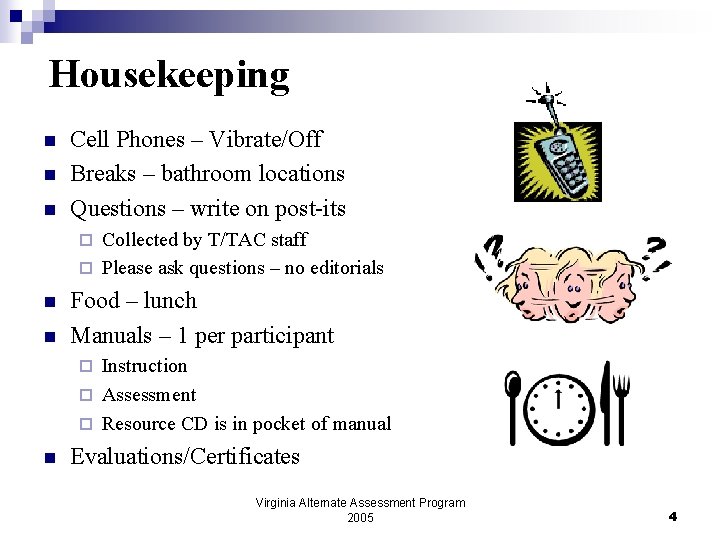
Housekeeping n n n Cell Phones – Vibrate/Off Breaks – bathroom locations Questions – write on post-its Collected by T/TAC staff ¨ Please ask questions – no editorials ¨ n n Food – lunch Manuals – 1 per participant Instruction ¨ Assessment ¨ Resource CD is in pocket of manual ¨ n Evaluations/Certificates Virginia Alternate Assessment Program 2005 4
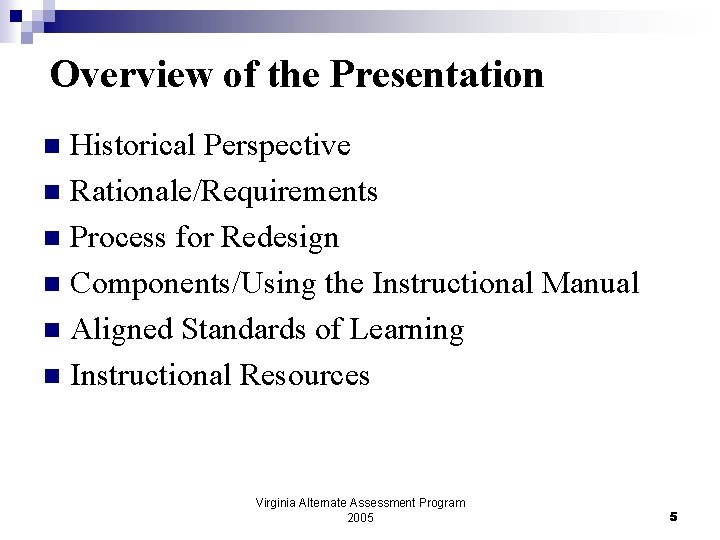
Overview of the Presentation Historical Perspective n Rationale/Requirements n Process for Redesign n Components/Using the Instructional Manual n Aligned Standards of Learning n Instructional Resources n Virginia Alternate Assessment Program 2005 5
Goals n Teach participants to use the Virginia Alternate Assessment Program Instructional Manual n Teach participants the instructional components of the redesigned Virginia Alternate Assessment Program 2005 6
“The direction in which education starts a man, will determine his future life. ” -Plato, (427 BC - 347 BC) Virginia Alternate Assessment Program 2005 7
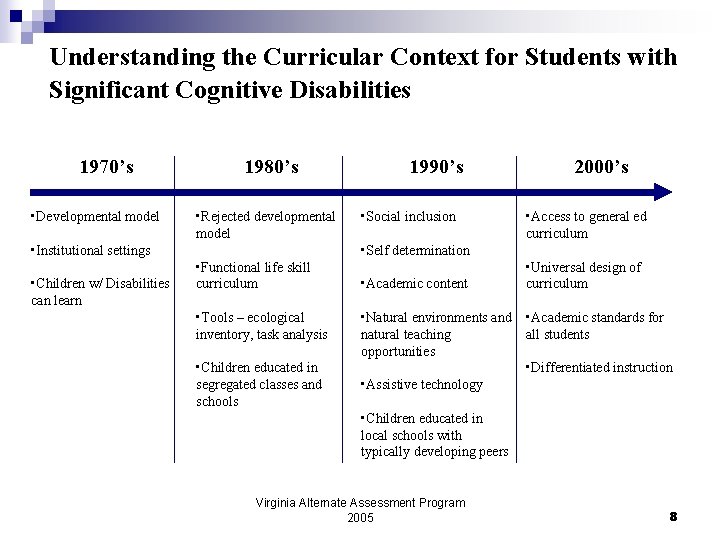
Understanding the Curricular Context for Students with Significant Cognitive Disabilities 1970’s • Developmental model 1980’s • Rejected developmental model • Institutional settings • Children w/ Disabilities can learn 1990’s • Social inclusion 2000’s • Access to general ed curriculum • Self determination • Functional life skill curriculum • Tools – ecological inventory, task analysis • Children educated in segregated classes and schools • Academic content • Universal design of curriculum • Natural environments and • Academic standards for natural teaching all students opportunities • Differentiated instruction • Assistive technology • Children educated in local schools with typically developing peers Virginia Alternate Assessment Program 2005 8
Why Did We Change the VAAP? Virginia Alternate Assessment Program 2005 9
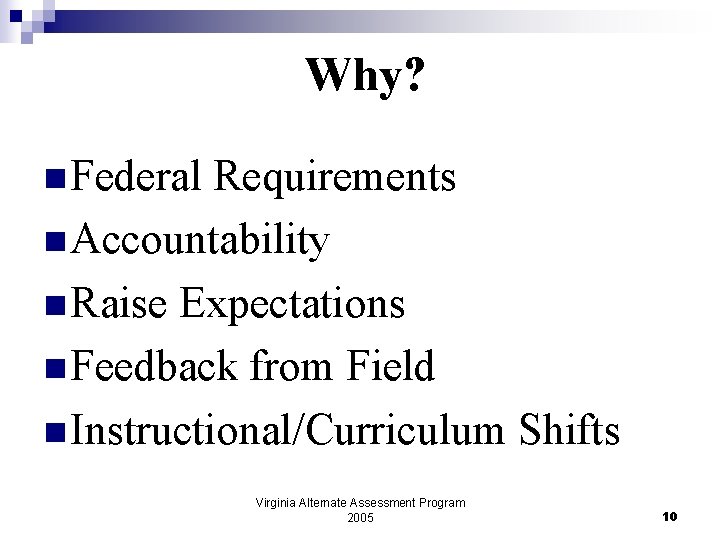
Why? n Federal Requirements n Accountability n Raise Expectations n Feedback from Field n Instructional/Curriculum Shifts Virginia Alternate Assessment Program 2005 10
Federal Requirements: n Individuals with Disabilities Education Improvement Act of 2004 (IDEIA) ¨ Students with the most significant cognitive disabilities may be assessed on state established content standards through an alternate assessment. n General grade level state standards must be accessible for all students. ¨ “Regardless of where students receive instruction, all students with disabilities should have access to, participate in, and make progress in, the general curriculum. ” Virginia Alternate Assessment Program 2005 11
Required Federal Changes: Authority n No Child Left Behind Act (NCLB) of 2001 ¨ “An alternate assessment is an assessment designed for the small number of students with disabilities who are unable to participate in the regular State assessment, even with appropriate accommodations. ” ¨ Final rules for NCLB found in the Federal Register, December 2003, section § 200. 1 (d) state that n For students with the most significant cognitive disabilities who take an alternate assessment, a State may, through a documented and validated standards-setting process, define achievement standards that - i) are aligned with the State’s academic content standards; and ii) reflect professional judgment of the highest learning standards possible for those students. ¨ Current Guidance from U. S. Dept of Education: n States must examine their regular state standards and explore how they might be “reduced in depth, breadth, and complexity or modified to reflect pre-requisite skills, ” as well as “show a clear link to the content standards. ” ¨ Yearly testing requirements in reading, mathematics, and science n Grades 3, 4, 5, 6, 7, 8 and 11 th Virginia Alternate Assessment Program 2005 12
Accountability n Linkage of IEP goals for VAAP will not be allowed in Assessment Systems (Non-Regulatory Guidance Document, Alternate achievement standards for students with the most significant cognitive disabilities: US Dept of Ed, August 2005: ) n B-5. May a State use student progress on IEP goals or an assessment of functional life skills to meet the Title I regulation requirements? No: ¨ First, IEP goals are individualized for each student, and a student’s progress toward each goal is measured for purposes of reporting progress to parents and for making individualized decisions about the special education and related services a student receives. In addition, for AYP determinations, test results must ensure consistency in the judgments made about schools. IEP goals are not designed for this purpose. ¨ Second, as required by Title I, schools are accountable for student achievement only in the content areas of reading/language arts and mathematics. Virginia Alternate Assessment Program 2005 13
“We don't focus on what we can't do; we focus on what we can do. And we do whatever it takes to get kids across the finish line. This principle is challenging the soft bigotry of low expectations, and that is the spirit of our education reform, and the commitment of our country. I believe every child can learn and I refuse to accept excuses when they don’t. We will leave no child behind. ” -George W. Bush Virginia Alternate Assessment Program 2005 14
Raise Expectations and Improving Outcomes n National Longitudinal Study 2 (NLTS 2) – What the data says for students with significant cognitive disabilities/multiple disabilities: n Graduation Rates n Employment n Post-Secondary Schooling/Training n Independent Living n Social Life Virginia Alternate Assessment Program 2005 15
Feedback from the Field Areas for VDOE Improvement: n VAAP needs to be a demonstration of student achievement not a program evaluation n VAAP needs to be a part of normal instruction n VAAP collections of evidence need to be relevant to instruction and not take so much time to compile n What we are being asked to teach must be clear Virginia Alternate Assessment Program 2005 16
Instructional/Curriculum Shifts: Best Practices n Because their learning is perceived to be so significantly different than typical children, their curriculum has not traditionally focused on academic content but encompassed a separate curricular focus. Indeed, in many cases it is thought that the student’s Individual Education Program or IEP is the curriculum for each individual student. While the IEP certainly represents educational priorities and supports to achieve those educational priorities for the individual student, it does not represent the entire range of curriculum; nor does it represent the academic standards upon which a curriculum should be based -(Giangreco, Cloninger, Iverson, 1999; Grisham-Brown, Kearns, 2001) Virginia Alternate Assessment Program 2005 17
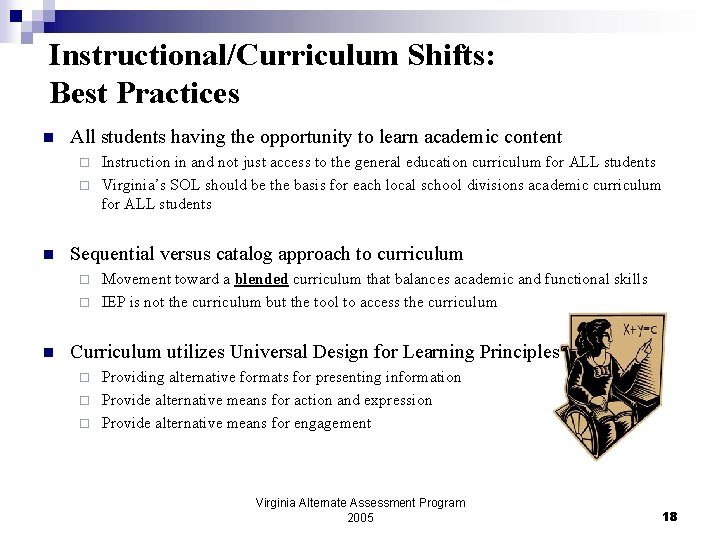
Instructional/Curriculum Shifts: Best Practices n All students having the opportunity to learn academic content Instruction in and not just access to the general education curriculum for ALL students ¨ Virginia’s SOL should be the basis for each local school divisions academic curriculum for ALL students ¨ n Sequential versus catalog approach to curriculum Movement toward a blended curriculum that balances academic and functional skills ¨ IEP is not the curriculum but the tool to access the curriculum ¨ n Curriculum utilizes Universal Design for Learning Principles Providing alternative formats for presenting information ¨ Provide alternative means for action and expression ¨ Provide alternative means for engagement ¨ Virginia Alternate Assessment Program 2005 18
Starting Points for the Redesign of the VAAP Virginia Alternate Assessment Program 2005 19
Collaborative Development n Over 85 professionals involved VAAP Stakeholder Committee ¨ Workgroups n Reading, Math, Science and History/Social Science ¨ T/TAC Priority Project ¨ IEP Stakeholder Committee ¨ n Membership: ¨ ¨ ¨ ¨ Special Education Teachers General Education Teachers Administrators: Special Ed Directors, Division Directors of Testing Instructional Specialists Consultants National Technical Assistance Providers Parents T/TAC Staff Virginia Alternate Assessment Program 2005 20
Organization of Manual n. Walkthrough n. VAAP Resource CD ¨ Standards Driven IEP Power. Point can be downloaded from VDOE Website Virginia Alternate Assessment Program 2005 21
Guiding Principles (Sec 1, pg 5) n Purpose ¨ Extend educational accountability and reform to students with significant cognitive disabilities ¨ Measure individual student achievement n Provides an equal opportunity for students to fully demonstrate knowledge and skills Virginia Alternate Assessment Program 2005 22
Guiding Principles (Sec 1, pg 5) n Highlighted Statements: ¨ Instruction and progress in the general education curriculum n n ¨ IEP team REQUIRED to use PARTICIPATION CRITERIA to determine eligibility for the VAAP n n ¨ New criteria Can’t use students disability or placement VAAP is focused on academic skills but does not limit instruction on functional skills n ¨ Aligned Standards of Learning Increase positive post-school outcomes: employment, independent living, etc. Blended curriculum is encouraged High expectations n Rigor & Relevance Virginia Alternate Assessment Program 2005 23
Which Students Should Take the VAAP? Virginia Alternate Assessment Program 2005 24
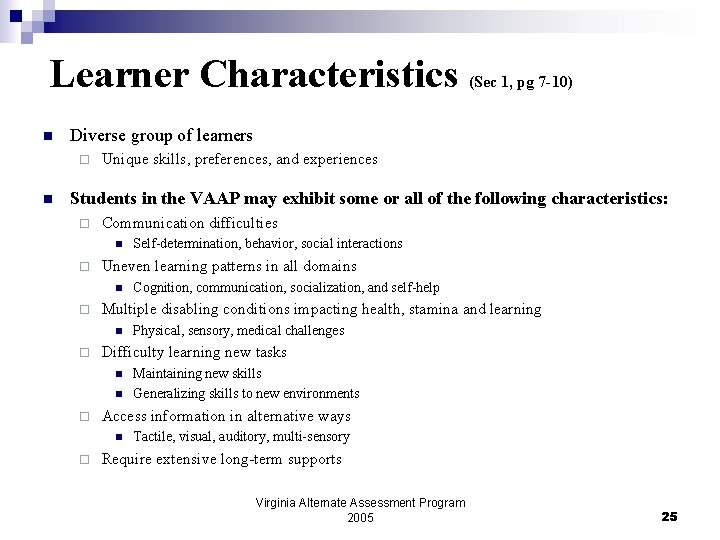
Learner Characteristics n Diverse group of learners ¨ n (Sec 1, pg 7 -10) Unique skills, preferences, and experiences Students in the VAAP may exhibit some or all of the following characteristics: ¨ Communication difficulties n ¨ Uneven learning patterns in all domains n ¨ n Maintaining new skills Generalizing skills to new environments Access information in alternative ways n ¨ Physical, sensory, medical challenges Difficulty learning new tasks n ¨ Cognition, communication, socialization, and self-help Multiple disabling conditions impacting health, stamina and learning n ¨ Self-determination, behavior, social interactions Tactile, visual, auditory, multi-sensory Require extensive long-term supports Virginia Alternate Assessment Program 2005 25
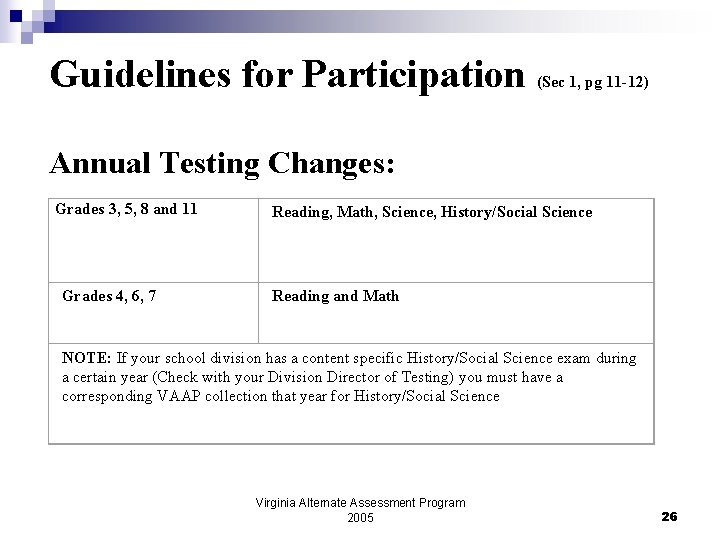
Guidelines for Participation (Sec 1, pg 11 -12) Annual Testing Changes: Grades 3, 5, 8 and 11 Grades 4, 6, 7 Reading, Math, Science, History/Social Science Reading and Math NOTE: If your school division has a content specific History/Social Science exam during a certain year (Check with your Division Director of Testing) you must have a corresponding VAAP collection that year for History/Social Science Virginia Alternate Assessment Program 2005 26
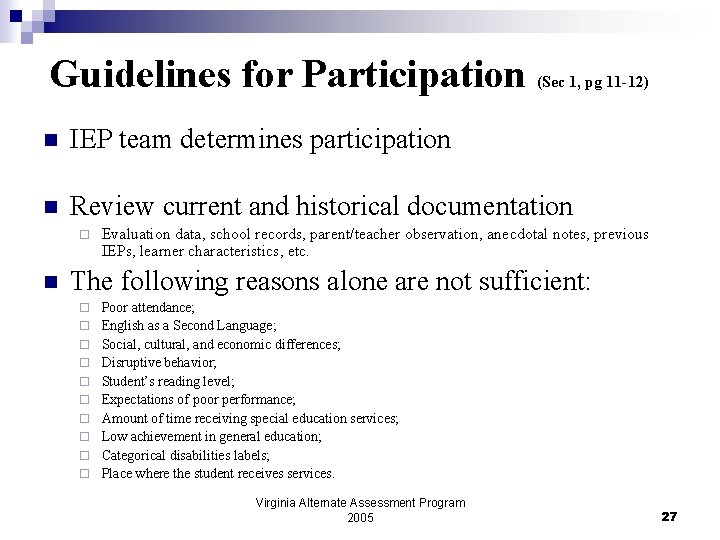
Guidelines for Participation (Sec 1, pg 11 -12) n IEP team determines participation n Review current and historical documentation ¨ n Evaluation data, school records, parent/teacher observation, anecdotal notes, previous IEPs, learner characteristics, etc. The following reasons alone are not sufficient: ¨ ¨ ¨ ¨ ¨ Poor attendance; English as a Second Language; Social, cultural, and economic differences; Disruptive behavior; Student’s reading level; Expectations of poor performance; Amount of time receiving special education services; Low achievement in general education; Categorical disabilities labels; Place where the student receives services. Virginia Alternate Assessment Program 2005 27
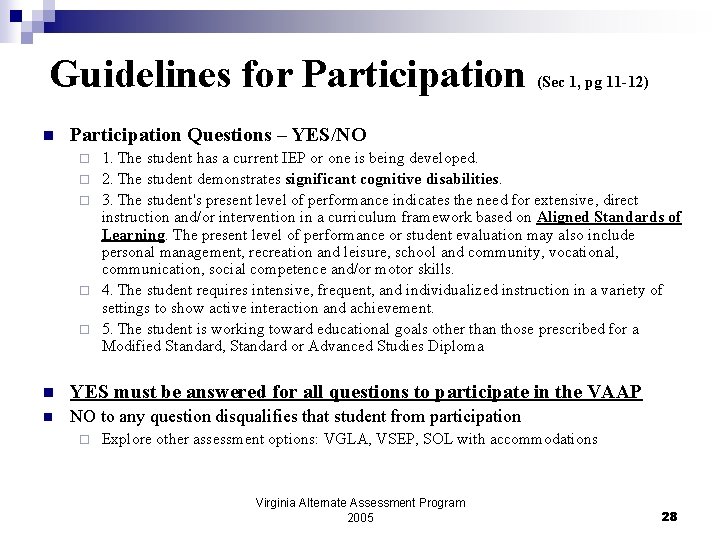
Guidelines for Participation n (Sec 1, pg 11 -12) Participation Questions – YES/NO ¨ ¨ ¨ 1. The student has a current IEP or one is being developed. 2. The student demonstrates significant cognitive disabilities. 3. The student's present level of performance indicates the need for extensive, direct instruction and/or intervention in a curriculum framework based on Aligned Standards of Learning. The present level of performance or student evaluation may also include personal management, recreation and leisure, school and community, vocational, communication, social competence and/or motor skills. 4. The student requires intensive, frequent, and individualized instruction in a variety of settings to show active interaction and achievement. 5. The student is working toward educational goals other than those prescribed for a Modified Standard, Standard or Advanced Studies Diploma n YES must be answered for all questions to participate in the VAAP n NO to any question disqualifies that student from participation ¨ Explore other assessment options: VGLA, VSEP, SOL with accommodations Virginia Alternate Assessment Program 2005 28
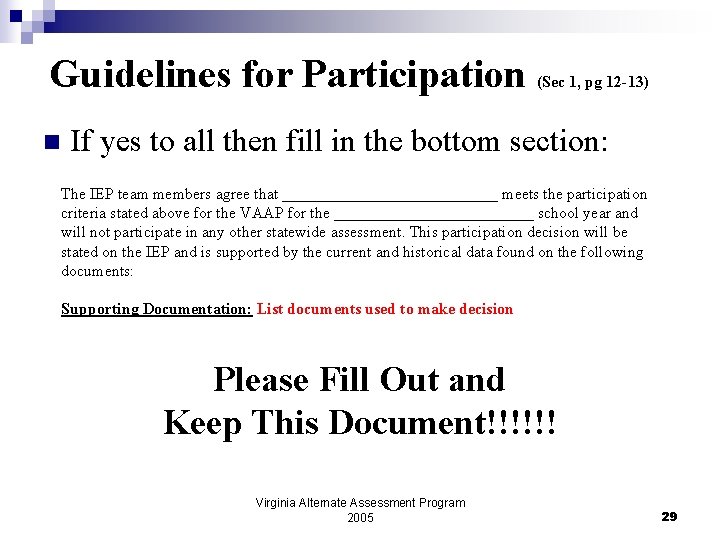
Guidelines for Participation n (Sec 1, pg 12 -13) If yes to all then fill in the bottom section: The IEP team members agree that ______________ meets the participation criteria stated above for the VAAP for the _____________ school year and will not participate in any other statewide assessment. This participation decision will be stated on the IEP and is supported by the current and historical data found on the following documents: Supporting Documentation: List documents used to make decision Please Fill Out and Keep This Document!!!!!! Virginia Alternate Assessment Program 2005 29
Curriculum Foundations Virginia Alternate Assessment Program 2005 30
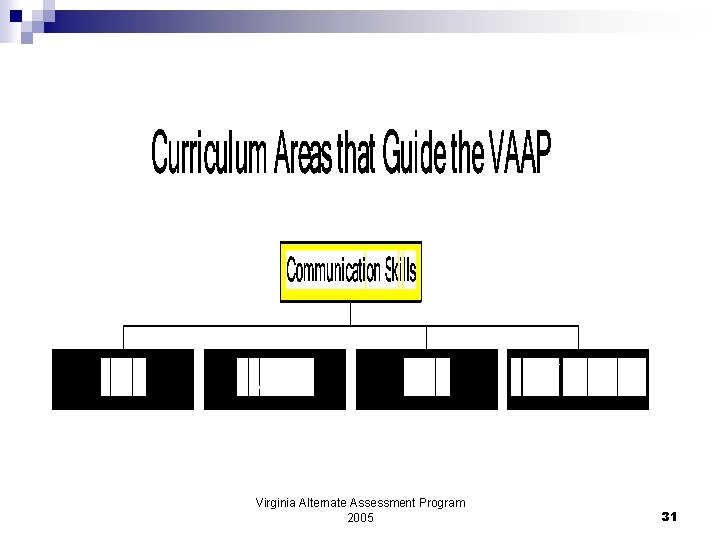
Virginia Alternate Assessment Program 2005 31
Where did the curriculum come from? Remember this? n “Regardless of where students receive instruction, all students with disabilities should have access to, participate in, and make progress in, the general education curriculum. ” ¨ What is the general education curriculum in Virginia? Remember this? n States must examine their regular state standards and explore how they might be “reduced in depth, breadth, and complexity or modified to reflect pre-requisite skills, ” as well as “show a clear link to the content standards. ” – US DOE, 2005 Virginia Alternate Assessment Program 2005 32
What is going to be assessed? n Aligned Standards of Learning ¨ Academic Skills n Communication Skills Virginia Alternate Assessment Program 2005 33
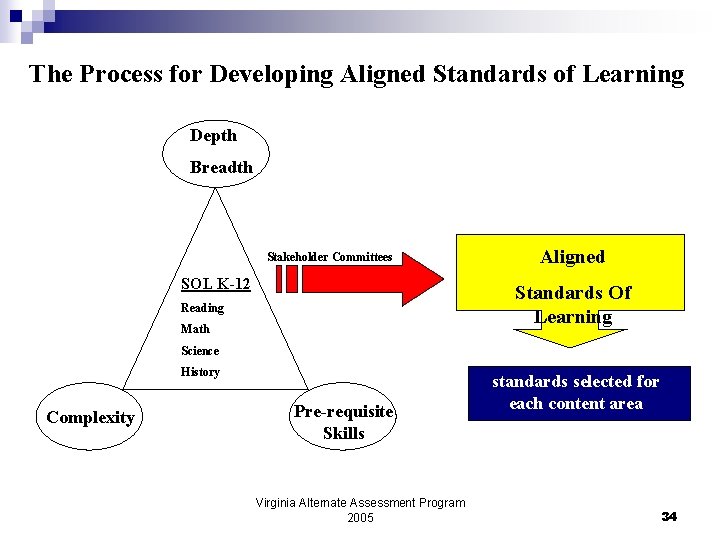
The Process for Developing Aligned Standards of Learning Depth Breadth Stakeholder Committees SOL K-12 Aligned Standards Of Learning Reading Math Science History Complexity Pre-requisite Skills Virginia Alternate Assessment Program 2005 standards selected for each content area 34
Q & A Virginia Alternate Assessment Program 2005 35
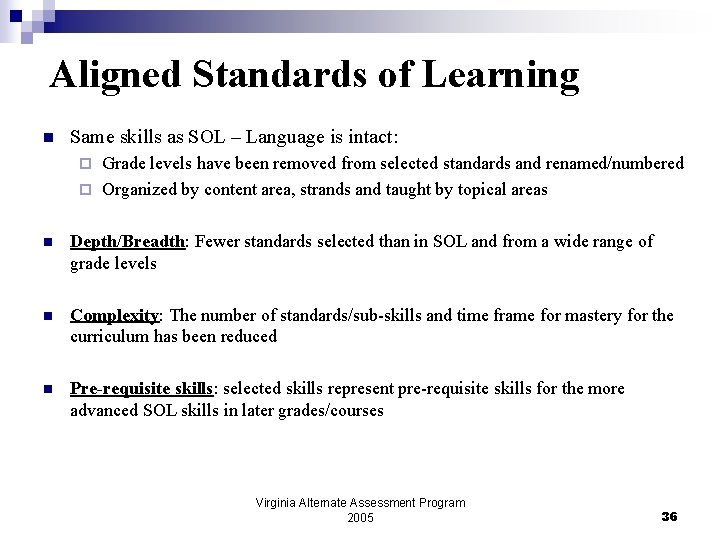
Aligned Standards of Learning n Same skills as SOL – Language is intact: Grade levels have been removed from selected standards and renamed/numbered ¨ Organized by content area, strands and taught by topical areas ¨ n Depth/Breadth: Fewer standards selected than in SOL and from a wide range of grade levels n Complexity: The number of standards/sub-skills and time frame for mastery for the curriculum has been reduced n Pre-requisite skills: selected skills represent pre-requisite skills for the more advanced SOL skills in later grades/courses Virginia Alternate Assessment Program 2005 36
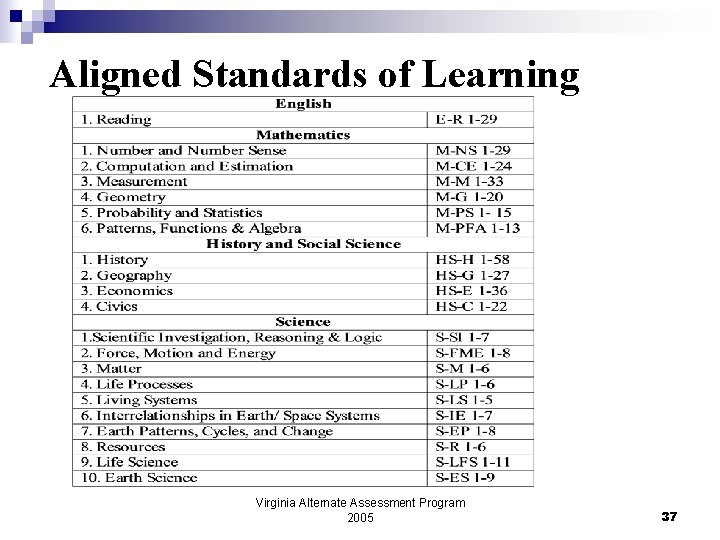
Aligned Standards of Learning Virginia Alternate Assessment Program 2005 37
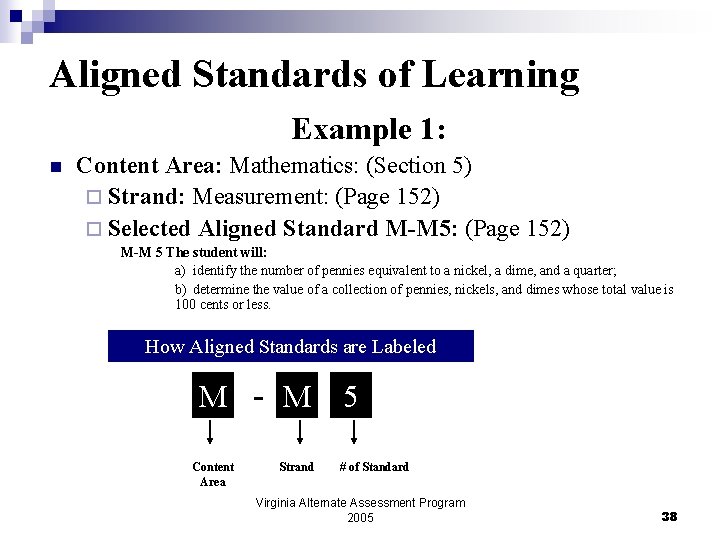
Aligned Standards of Learning Example 1: n Content Area: Mathematics: (Section 5) ¨ Strand: Measurement: (Page 152) ¨ Selected Aligned Standard M-M 5: (Page 152) M-M 5 The student will: a) identify the number of pennies equivalent to a nickel, a dime, and a quarter; b) determine the value of a collection of pennies, nickels, and dimes whose total value is 100 cents or less. How Aligned Standards are Labeled M - M 5 Content Area Strand # of Standard Virginia Alternate Assessment Program 2005 38
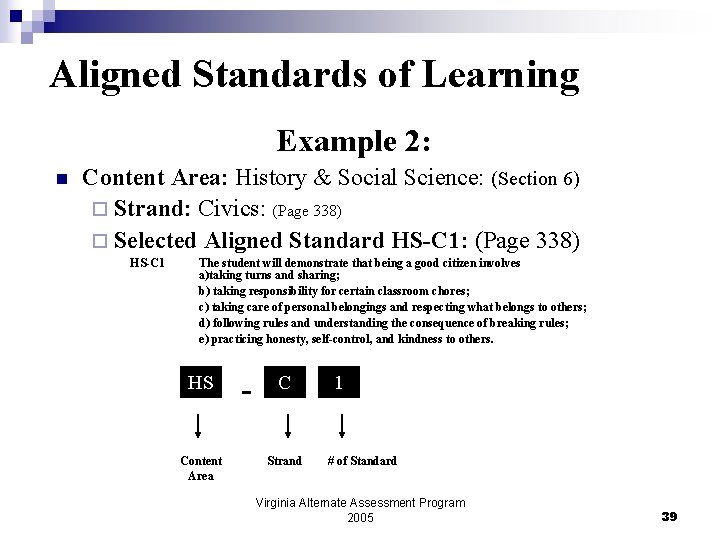
Aligned Standards of Learning Example 2: n Content Area: History & Social Science: (Section 6) ¨ Strand: Civics: (Page 338) ¨ Selected Aligned Standard HS-C 1: (Page 338) HS-C 1 The student will demonstrate that being a good citizen involves a)taking turns and sharing; b) taking responsibility for certain classroom chores; c) taking care of personal belongings and respecting what belongs to others; d) following rules and understanding the consequence of breaking rules; e) practicing honesty, self-control, and kindness to others. HS Content Area - C Strand 1 # of Standard Virginia Alternate Assessment Program 2005 39
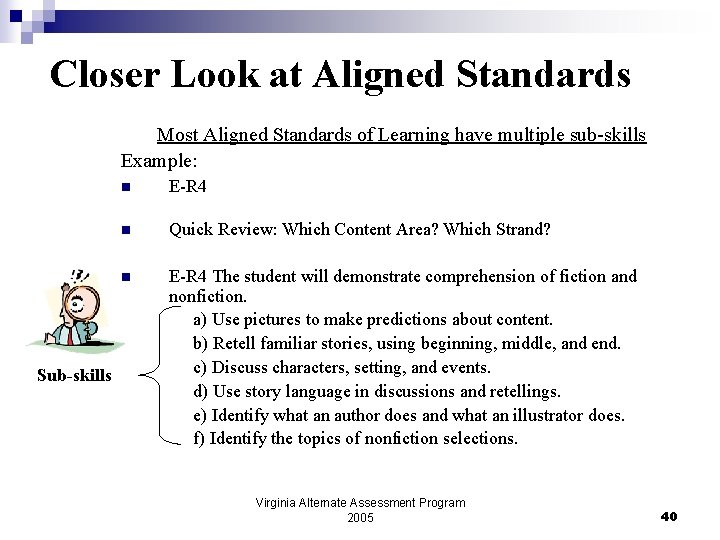
Closer Look at Aligned Standards Most Aligned Standards of Learning have multiple sub-skills Example: Sub-skills n E-R 4 n Quick Review: Which Content Area? Which Strand? n E-R 4 The student will demonstrate comprehension of fiction and nonfiction. a) Use pictures to make predictions about content. b) Retell familiar stories, using beginning, middle, and end. c) Discuss characters, setting, and events. d) Use story language in discussions and retellings. e) Identify what an author does and what an illustrator does. f) Identify the topics of nonfiction selections. Virginia Alternate Assessment Program 2005 40
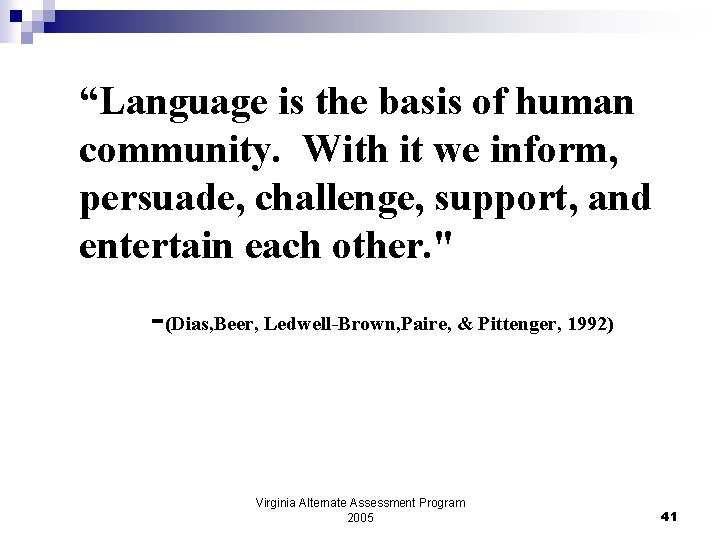
“Language is the basis of human community. With it we inform, persuade, challenge, support, and entertain each other. " -(Dias, Beer, Ledwell-Brown, Paire, & Pittenger, 1992) Virginia Alternate Assessment Program 2005 41
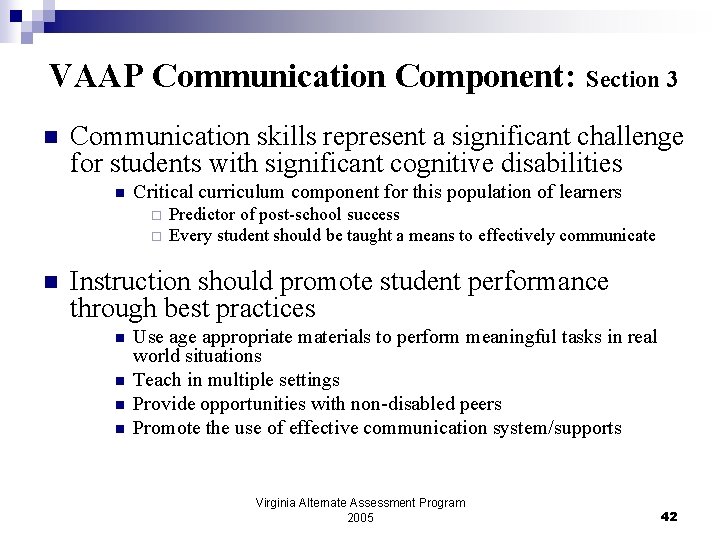
VAAP Communication Component: Section 3 n Communication skills represent a significant challenge for students with significant cognitive disabilities n Critical curriculum component for this population of learners ¨ ¨ n Predictor of post-school success Every student should be taught a means to effectively communicate Instruction should promote student performance through best practices n n Use age appropriate materials to perform meaningful tasks in real world situations Teach in multiple settings Provide opportunities with non-disabled peers Promote the use of effective communication system/supports Virginia Alternate Assessment Program 2005 42
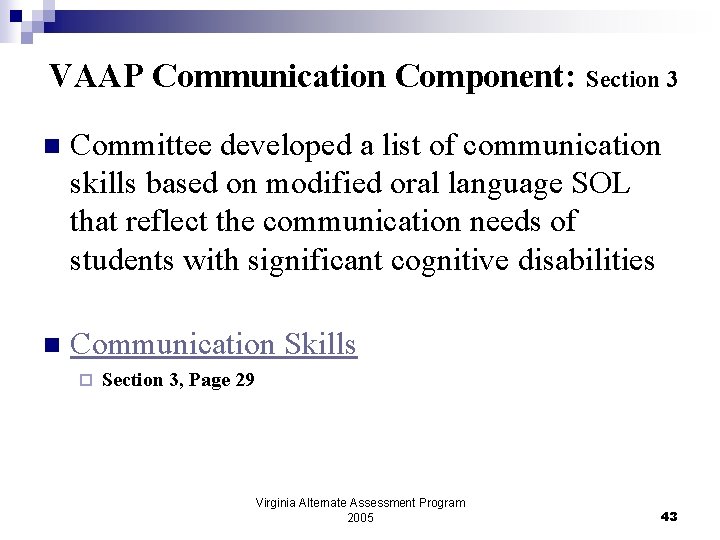
VAAP Communication Component: Section 3 n Committee developed a list of communication skills based on modified oral language SOL that reflect the communication needs of students with significant cognitive disabilities n Communication Skills ¨ Section 3, Page 29 Virginia Alternate Assessment Program 2005 43
Sections of the Manual & Instructional Tools Virginia Alternate Assessment Program 2005 44
Communication Skills n Section 3: Page 23 -29 ¨ Communication Resource Document ¨ Communication Skills Virginia Alternate Assessment Program 2005 45
English: Reading n Section 4: Page 31 -144 ¨ Reading Aligned Standards n Page 31 -37 ¨ Reading Enhanced Scope and Sequence n Page 39 -139 ¨ Reading Strategies n Page 140 -144 n Resource CD ¨ Reading Curriculum Framework ¨ Sample Activities Virginia Alternate Assessment Program 2005 46
Enhanced Scope and Sequence n Purpose: ¨ Overview of the curriculum n How aligned standards are organized n Understanding an overview of essential knowledge and skills n Examples of sample activities n How to map out classroom and child-specific instruction ¨ Determining instructional entry points for individual students n n n Which topics to address for instruction Which skill group a student might fall under Way to informally assess a student skills and previous experience with the content Virginia Alternate Assessment Program 2005 47
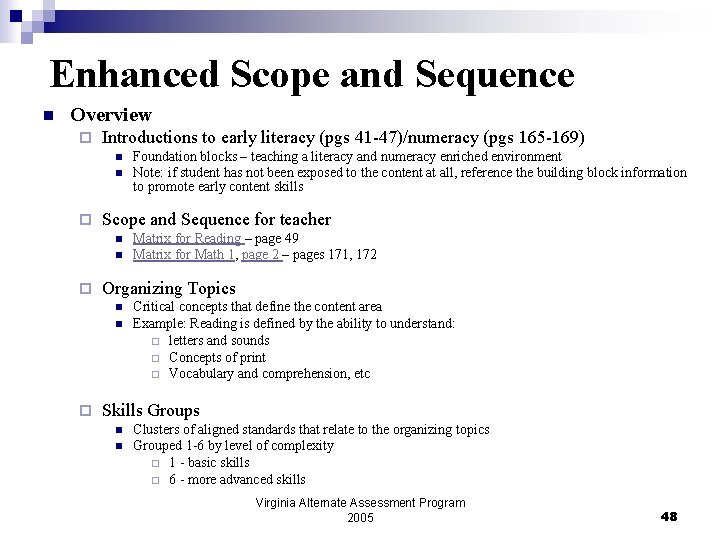
Enhanced Scope and Sequence n Overview ¨ Introductions to early literacy (pgs 41 -47)/numeracy (pgs 165 -169) n n ¨ Scope and Sequence for teacher n n ¨ Matrix for Reading – page 49 Matrix for Math 1, page 2 – pages 171, 172 Organizing Topics n n ¨ Foundation blocks – teaching a literacy and numeracy enriched environment Note: if student has not been exposed to the content at all, reference the building block information to promote early content skills Critical concepts that define the content area Example: Reading is defined by the ability to understand: ¨ letters and sounds ¨ Concepts of print ¨ Vocabulary and comprehension, etc Skills Groups n n Clusters of aligned standards that relate to the organizing topics Grouped 1 -6 by level of complexity ¨ 1 - basic skills ¨ 6 - more advanced skills Virginia Alternate Assessment Program 2005 48
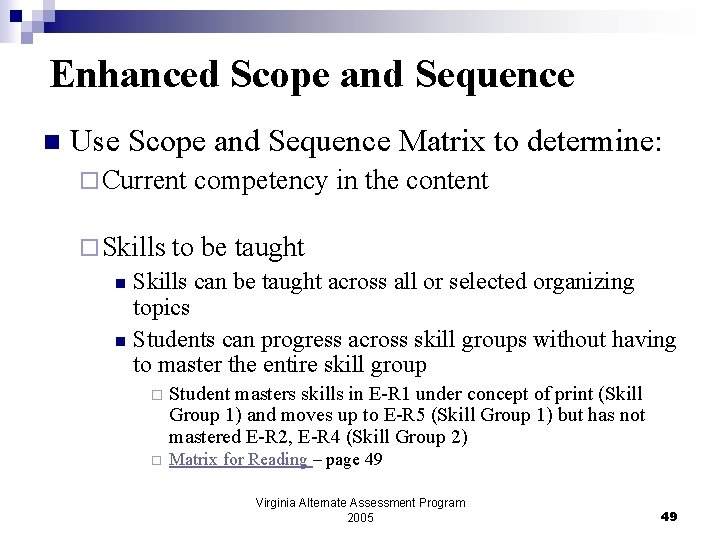
Enhanced Scope and Sequence n Use Scope and Sequence Matrix to determine: ¨ Current competency in the content ¨ Skills to be taught Skills can be taught across all or selected organizing topics n Students can progress across skill groups without having to master the entire skill group n ¨ Student masters skills in E-R 1 under concept of print (Skill Group 1) and moves up to E-R 5 (Skill Group 1) but has not mastered E-R 2, E-R 4 (Skill Group 2) ¨ Matrix for Reading – page 49 Virginia Alternate Assessment Program 2005 49
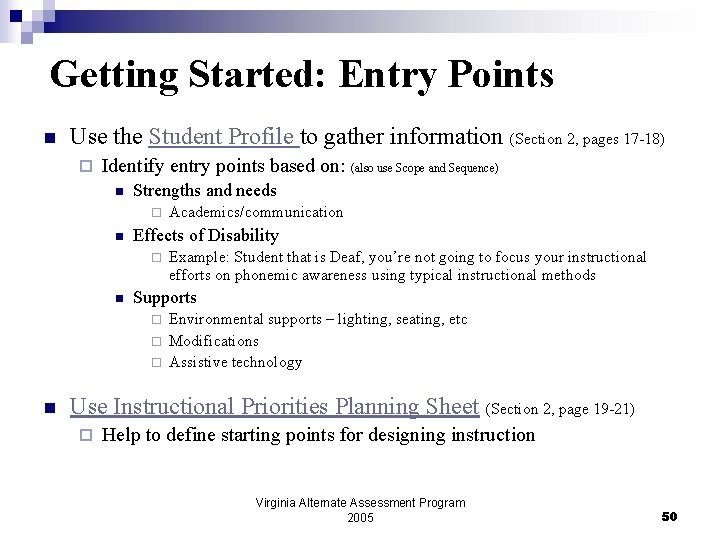
Getting Started: Entry Points n Use the Student Profile to gather information (Section 2, pages 17 -18) ¨ Identify entry points based on: (also use Scope and Sequence) n Strengths and needs ¨ n Effects of Disability ¨ n Example: Student that is Deaf, you’re not going to focus your instructional efforts on phonemic awareness using typical instructional methods Supports ¨ ¨ ¨ n Academics/communication Environmental supports – lighting, seating, etc Modifications Assistive technology Use Instructional Priorities Planning Sheet (Section 2, page 19 -21) ¨ Help to define starting points for designing instruction Virginia Alternate Assessment Program 2005 50
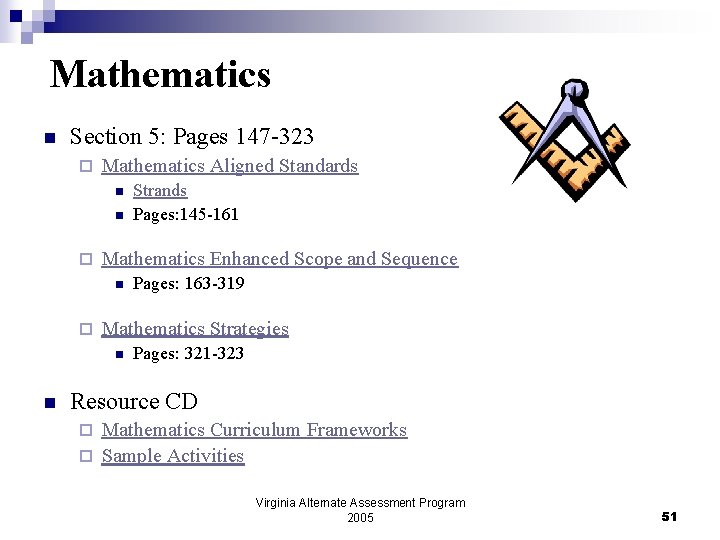
Mathematics n Section 5: Pages 147 -323 ¨ Mathematics Aligned Standards n n ¨ Mathematics Enhanced Scope and Sequence n ¨ Pages: 163 -319 Mathematics Strategies n n Strands Pages: 145 -161 Pages: 321 -323 Resource CD Mathematics Curriculum Frameworks ¨ Sample Activities ¨ Virginia Alternate Assessment Program 2005 51
History & Social Science n Section 6: Pages 325 -340 ¨ History and Social Science Aligned Standards Pages 325 -340 n Strands n ¨ Resource CD n History & Social Science Curriculum Frameworks ¨ Other resources to come Virginia Alternate Assessment Program 2005 52
Science n Section 7: Pages 341 -357 ¨ Science Aligned Standards of Learning Pages 341 -357 n Strands n ¨ Resource CD n Science Curriculum Frameworks ¨ Other resources to come Virginia Alternate Assessment Program 2005 53
Instructional Resources n Section 8: Pages 359 -366 ¨ Instructional Strategies n Pages 359 -364 ¨ Assistive Technology Ideas n Pages 365 -366 Virginia Alternate Assessment Program 2005 54
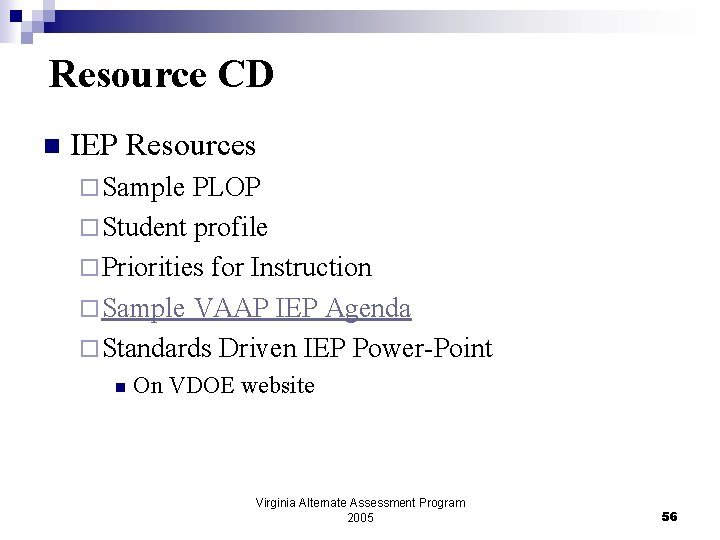
Resource CD n Curriculum Frameworks ¨ All 4 content areas by strand n Sample Activities ¨ Reading/Math n VDOE SOL Instructional Resources Virginia Alternate Assessment Program 2005 55
Resource CD n IEP Resources ¨ Sample PLOP ¨ Student profile ¨ Priorities for Instruction ¨ Sample VAAP IEP Agenda ¨ Standards Driven IEP Power-Point n On VDOE website Virginia Alternate Assessment Program 2005 56
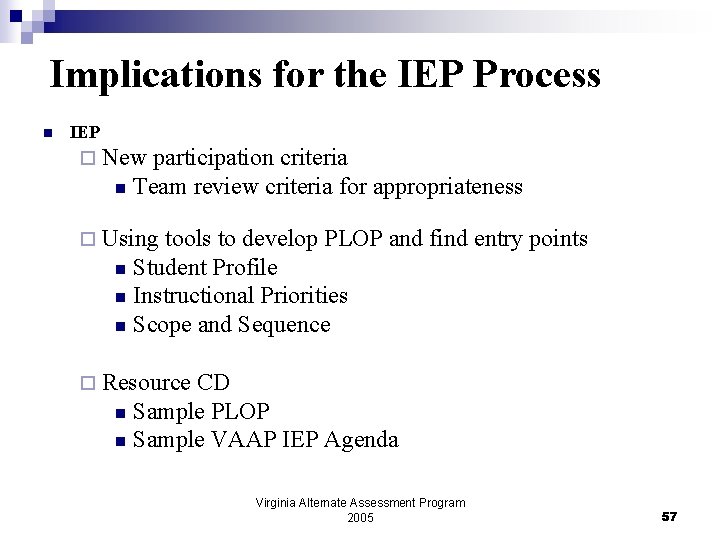
Implications for the IEP Process n IEP ¨ New participation criteria n Team review criteria for appropriateness ¨ Using tools to develop PLOP and find entry points Student Profile n Instructional Priorities n Scope and Sequence n ¨ Resource CD Sample PLOP n Sample VAAP IEP Agenda n Virginia Alternate Assessment Program 2005 57
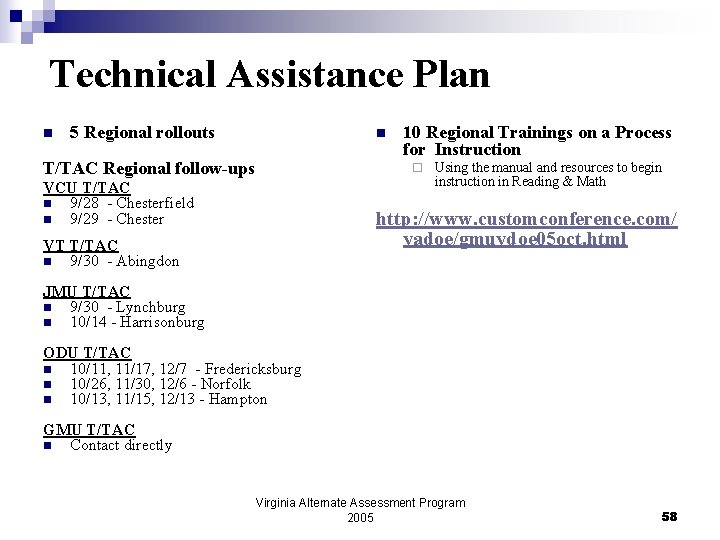
Technical Assistance Plan n 5 Regional rollouts n T/TAC Regional follow-ups 10 Regional Trainings on a Process for Instruction ¨ VCU T/TAC n 9/28 - Chesterfield n 9/29 - Chester Using the manual and resources to begin instruction in Reading & Math http: //www. customconference. com/ vadoe/gmuvdoe 05 oct. html VT T/TAC n 9/30 - Abingdon JMU T/TAC n 9/30 - Lynchburg n 10/14 - Harrisonburg ODU T/TAC n 10/11, 11/17, 12/7 - Fredericksburg n 10/26, 11/30, 12/6 - Norfolk n 10/13, 11/15, 12/13 - Hampton GMU T/TAC n Contact directly Virginia Alternate Assessment Program 2005 58
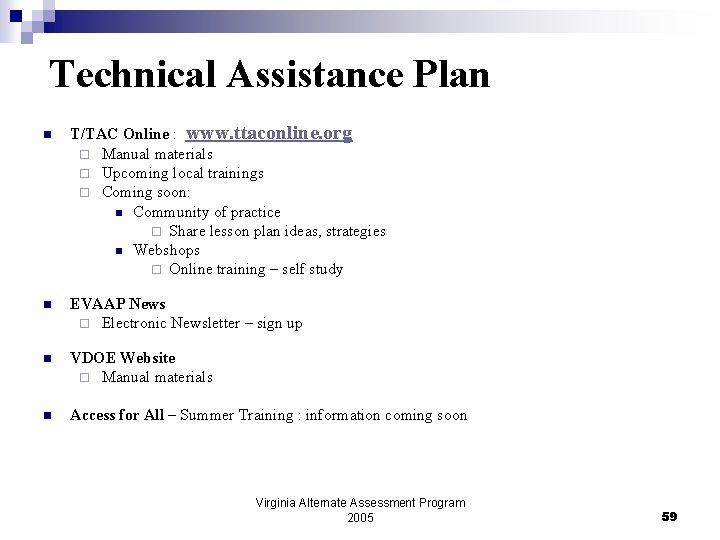
Technical Assistance Plan n T/TAC Online : www. ttaconline. org ¨ Manual materials ¨ Upcoming local trainings ¨ Coming soon: n Community of practice ¨ Share lesson plan ideas, strategies n Webshops ¨ Online training – self study n EVAAP News ¨ Electronic Newsletter – sign up n VDOE Website ¨ Manual materials n Access for All – Summer Training : information coming soon Virginia Alternate Assessment Program 2005 59
Who to Call with Questions: n n n John Eisenberg ¨ (804) 225 -2711 or john. eisenberg@doe. virginia. gov Nathan Sparks ¨ (804) 225 -3026 or nathan. sparks@doe. virginia. gov T/TAC Staff ¨ Kelly Ligon – VCU n (804) 827 -9993 or kligon@vcu. edu ¨ Angela Levorse – ODU n (757) 683 -5403 or alevorse@odu. edu ¨ Brad Bizzell & Diann Eaton – VT n (540) 231 -5167 or dweaton@vt. edu, bbizzell@vt. edu ¨ Debbie Yancey – JMU n (540) 568 -7924 or yanceymd@jmu. edu ¨ Kay Klein & Karen Berlin – GMU n (703) 993 -4496 or Mklei 1@gmu. edu , Kberlin@gmu. edu Virginia Alternate Assessment Program 2005 60
Q & A Virginia Alternate Assessment Program 2005 61