Validation for Confirmatory Methods Dr Richard Maguire Plan

- Slides: 38
Validation for Confirmatory Methods Dr. Richard Maguire
Plan n n n Speaker Background MBRS Background Disclaimer Forensic Toxicology Literature Resources Pre-Validation
Plan n Validation Protocol Validation Parameters Acknowledgements
Speaker Background n n n Analytical Sceince, DCU Ph. D. Analytical Science, Trinity College, University of Dublin 9 years as Principal Analyst Medical Bureau of Road Safety 6 years in National Drug Treatment Centre, 3 as Principal Analyst UKAS Assessor
MBRS Background n n n Based in Health Science Centre in UCD Responsible for testing intoxicants in drivers arrested under suspicion of driving under the influence of Alcohol and/or drugs Alcohol in Blood, Urine and Breath Drugs in Blood, Urine and Oral Fluid Results must be legally defensible
Disclaimer n n n MBRS approach to Validation is Industry specific (Forensic Toxicology) Different Industries have similar approaches but there are different norms in each industry Some industries have specific regulations and guidelines that must be adhered to Focus on quantitation, qualitative analysis may require less validation effort Stating the obvious
Forensic Toxicology n n Analytical toxicology is concerned with the detection, identification and measurement of drugs and/or foreign compounds and their metabolites in biological and related specimens Forensic Toxicology is the application of Analytical Toxicology for the purposes of Law Enforcement
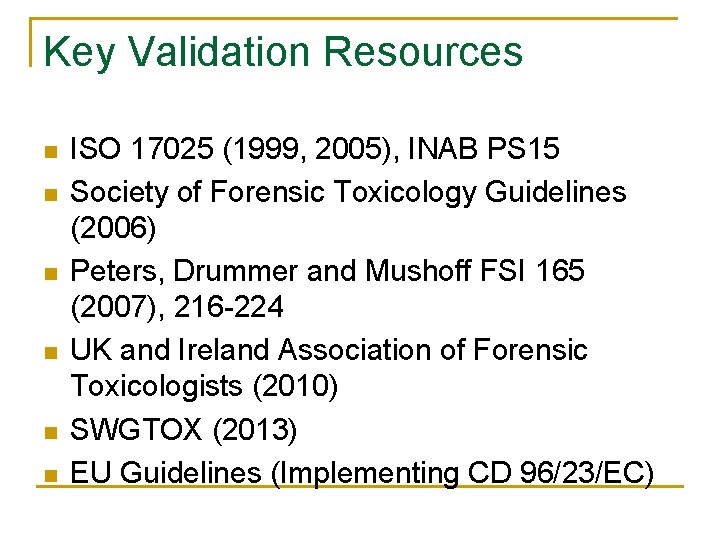
Key Validation Resources n n n ISO 17025 (1999, 2005), INAB PS 15 Society of Forensic Toxicology Guidelines (2006) Peters, Drummer and Mushoff FSI 165 (2007), 216 -224 UK and Ireland Association of Forensic Toxicologists (2010) SWGTOX (2013) EU Guidelines (Implementing CD 96/23/EC)
Validation Resources n ISO 17025 q States requirements only Section 5. 4. 5
Validation Resources n INAB PS 15 q q Fills gaps in ISO 17025 General and detailed
Key Validation Resources n Society of Forensic Toxicology Guidelines q q Overlap with ISO 17025 Good content on Validation
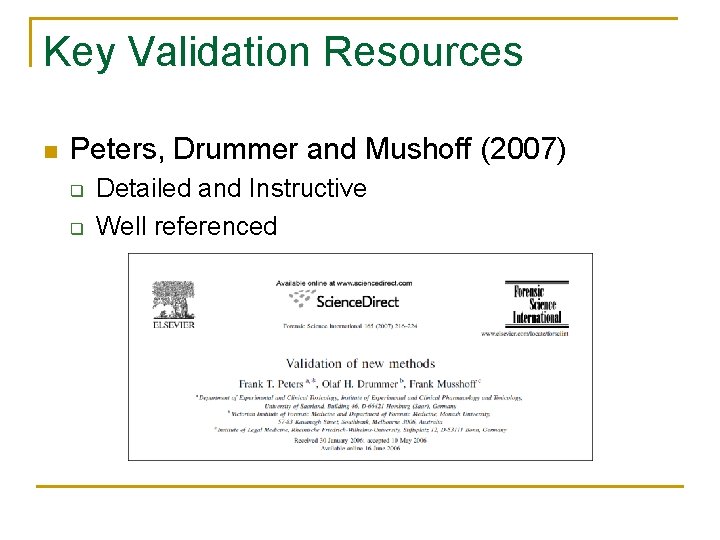
Key Validation Resources n Peters, Drummer and Mushoff (2007) q q Detailed and Instructive Well referenced
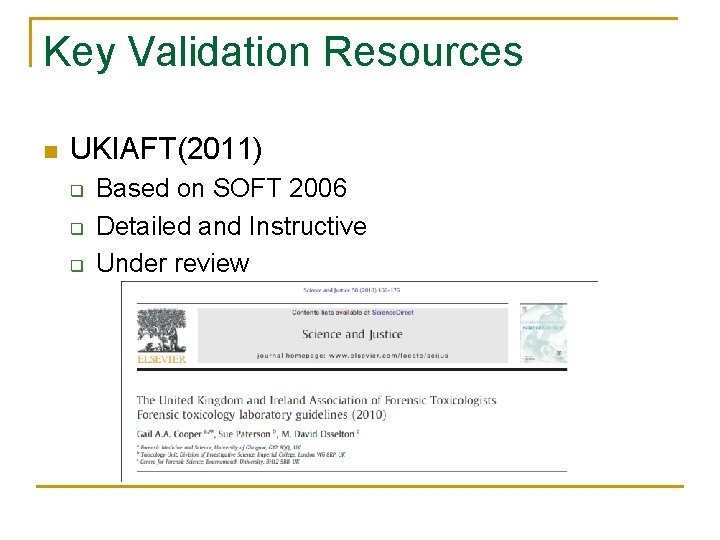
Key Validation Resources n UKIAFT(2011) q q q Based on SOFT 2006 Detailed and Instructive Under review
Key Validation Resources n SWGTOX q q American Standard Scientific Working Group Detailed and Instructive (Worked Examples) Very well referenced
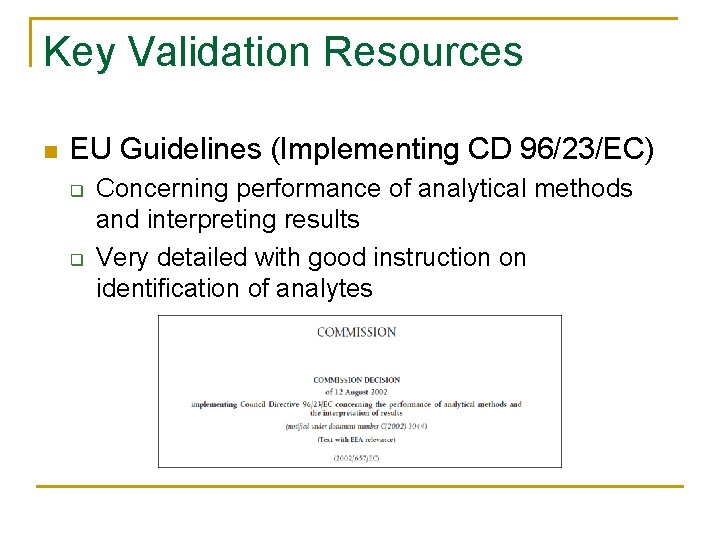
Key Validation Resources n EU Guidelines (Implementing CD 96/23/EC) q q Concerning performance of analytical methods and interpreting results Very detailed with good instruction on identification of analytes
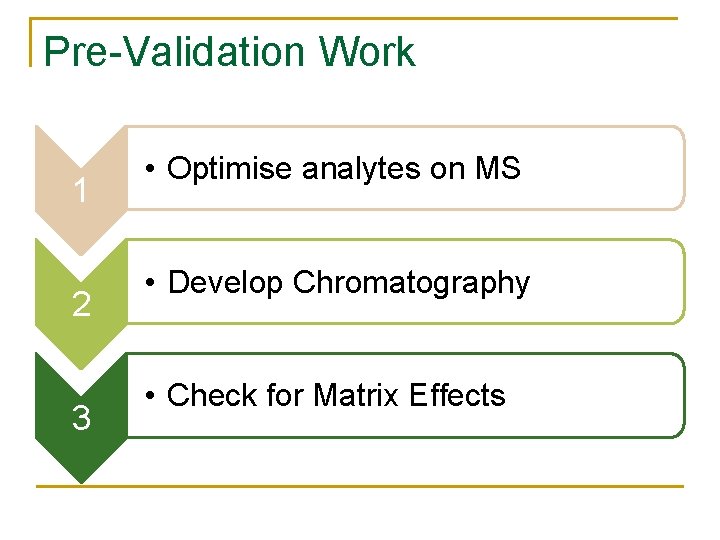
Pre-Validation Work 1 2 3 • Optimise analytes on MS • Develop Chromatography • Check for Matrix Effects
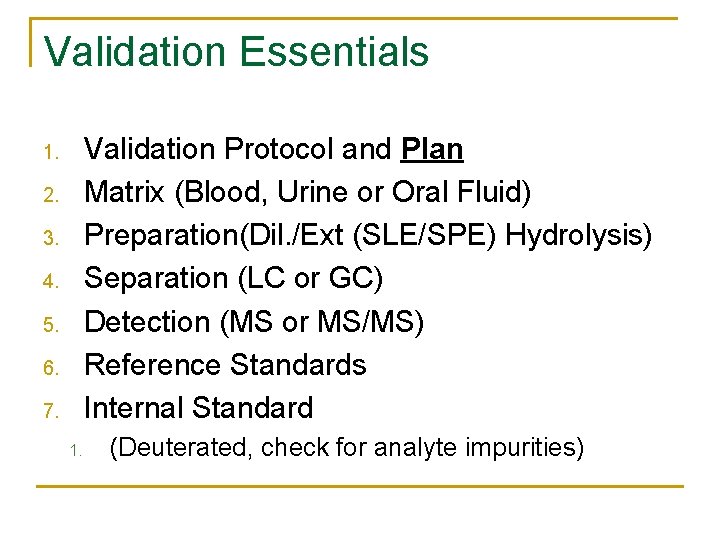
Validation Essentials Validation Protocol and Plan Matrix (Blood, Urine or Oral Fluid) Preparation(Dil. /Ext (SLE/SPE) Hydrolysis) Separation (LC or GC) Detection (MS or MS/MS) Reference Standards Internal Standard 1. 2. 3. 4. 5. 6. 7. 1. (Deuterated, check for analyte impurities)
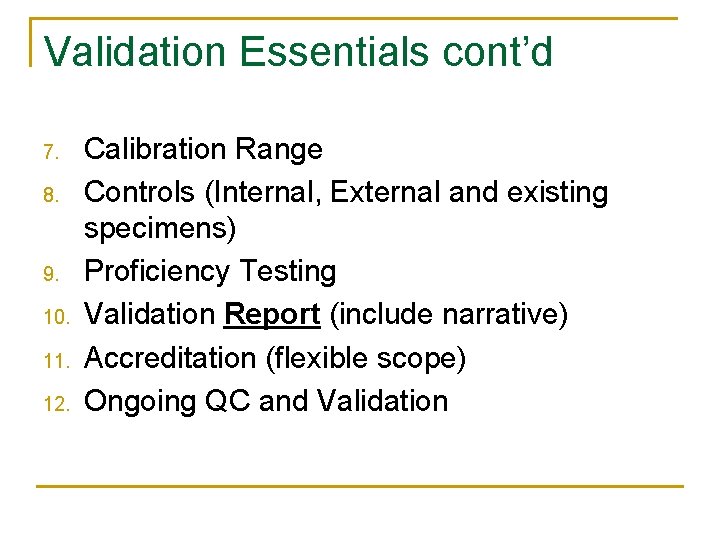
Validation Essentials cont’d 7. 8. 9. 10. 11. 12. Calibration Range Controls (Internal, External and existing specimens) Proficiency Testing Validation Report (include narrative) Accreditation (flexible scope) Ongoing QC and Validation
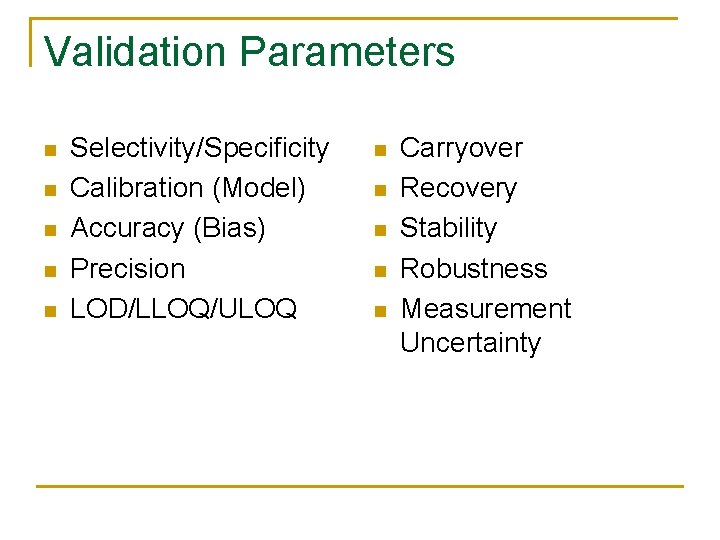
Validation Parameters n n n Selectivity/Specificity Calibration (Model) Accuracy (Bias) Precision LOD/LLOQ/ULOQ n n n Carryover Recovery Stability Robustness Measurement Uncertainty
Validation Protocol and Plan n Must cover all aspects of validation Must clearly outline what needs to be done for each parameter This should be broken down into q q What is required How is this to be done (n=x etc. ) Acceptance criteria Report Requirements
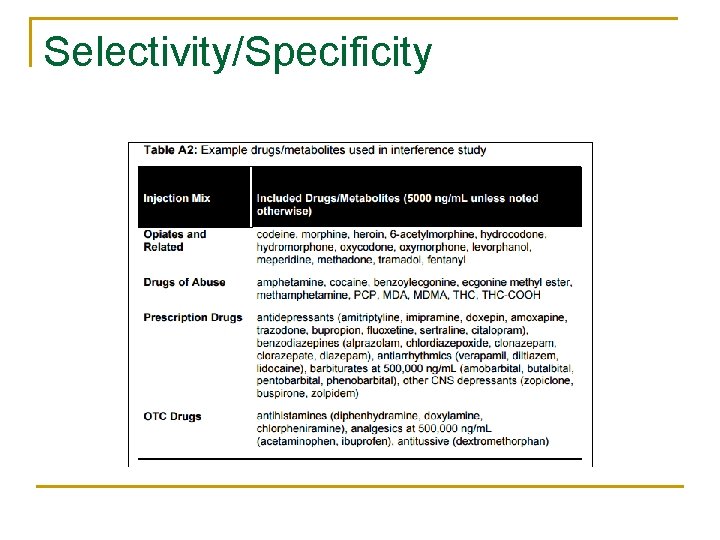
Selectivity/Specificity n n Any chemicals which are not of interest but we are likely to find in our specimens which will cause interference problems Prep and inject into system to see if there is any interference If there is a problem the method may need to be adapted Methods like MS/MS and HRMS are very selective
Selectivity/Specificity
Selectivity/Specificity n n Test at levels likely to be found in specimens May not need to put through extraction initially If a problem then can subject to extraction, if not extracted may not be a problem If extracted and interfering you may need to adapt method and repeat selectivity work
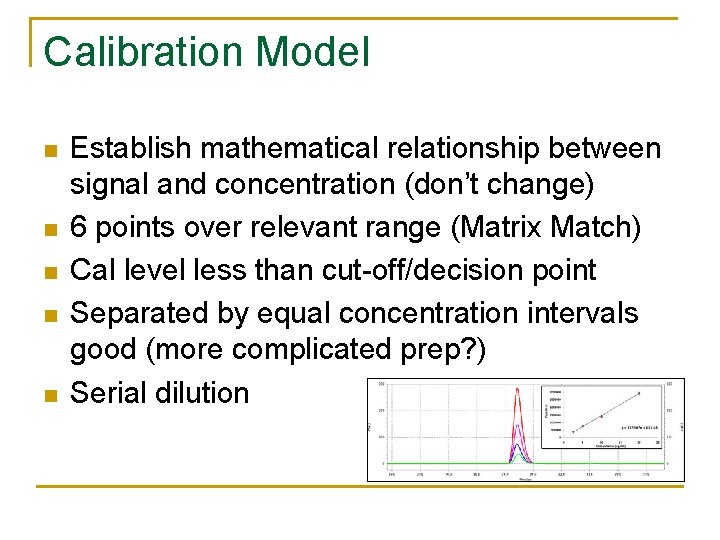
Calibration Model n n n Establish mathematical relationship between signal and concentration (don’t change) 6 points over relevant range (Matrix Match) Cal level less than cut-off/decision point Separated by equal concentration intervals good (more complicated prep? ) Serial dilution
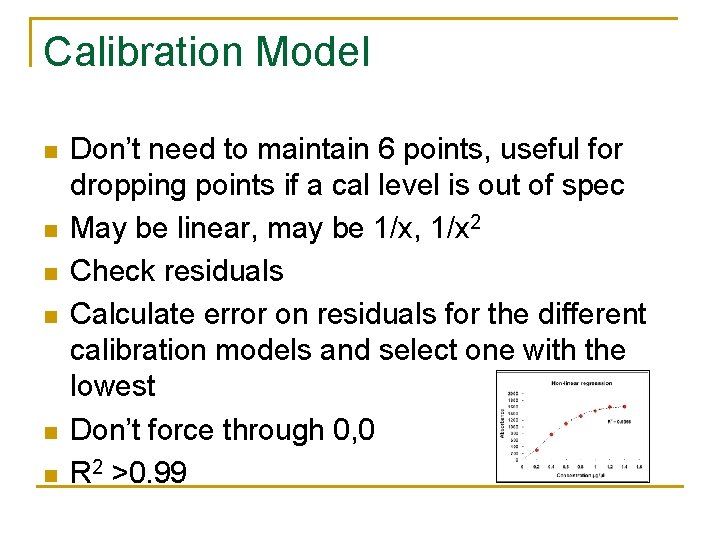
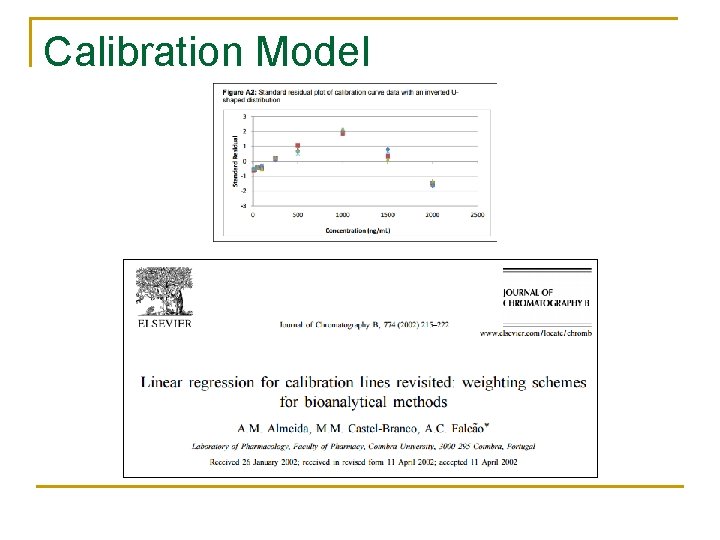
Calibration Model n n n Don’t need to maintain 6 points, useful for dropping points if a cal level is out of spec May be linear, may be 1/x, 1/x 2 Check residuals Calculate error on residuals for the different calibration models and select one with the lowest Don’t force through 0, 0 R 2 >0. 99
Calibration Model
Accuracy (Bias) n n Closeness to expected value Use spikes (fortified samples at least 20% and 80% of concentration range (at cut-off, at halfway point)
Accuracy (Bias) n n Matrix matched, n=7 at each concentration level (SWGTOX advocate n=3) Can utilize External Controls and PTs here also Compare observed and expected values and express as % SWGTOX allows ± 20% for drugs (10% for Ethanol)
Precision n n Ability to be accurate/biased consistently Check at each control level over cal. range 6 x 6, 2 x 11(UKAS), 3 x 5 (SWGTOX) 7 x 6 can drop a point using Grubbs Test and still have 6 data points
Precison n n Within and Between Run Calculate %CV at each level Can use one way ANOVA to estimate Grouping is batch to batch Would expect to get RSD less than 15% for within batch and also between batch
LOD/LLOQ/UPLOQ n n LOD (S/NRMS >3) Lower Limit of Quantitation; q n n Check at the cut-off (accuracy and precision should be acceptable). LLOQ (S/NRMS >10) Policy on out of range results q q q Report as greater than calibration range If diluting what to dilute with? Blank Matrix? Check accuracy and precision on dilutions
Carryover n n n Monitor with washes between specimens and cals, controls etc. Eliminate if possible Manage if not possible q q Carryover must be not more than 10% of lowest calibrator Results can be reported provided specimen after carryover has 10 times signal of carryover wash (SWGTOX)
Recovery n n Applies to methods with extraction Important where sensitivity of instrument is poor at desired LOD/LLOQ Spike solvent and don’t extract, evaporate and reconstitute, compare to same volume of matrix spiked at same concentration and reconstituted in same volume Peak Area Solvent and Extract compared as a%
Stability n n Need to take into consideration your turnaround time Can be checked using spikes over time frame and planned storage conditions (Fridge/Freezer) Post preparation stability should also be checked (instrument outages), sometimes called onboard stability Freeze/Thaw
Robustness n How resilient is method to expected changes q q q n n Change of column Mobile Phase Analysts SPE cartridge batch Environmental variations Build into validation plan if conducting validation over several weeks Treat like casework
Uncertainty of Measurement n n GUM Top down is quick but does not allow you to identify what the different parts of the method contribute to UM Bottom up allows you to do this, it is more time consuming to calculate, but helps identify main UM contributors Control data feeds into this
Acknowledgements n n Everyone involved in putting standards and guidelines together MBRS staff who carry out the validation work
THANK YOU!! richard. maguire@ucd. ie