
Infant Mental Health Ensuring quality starts at the

- Slides: 21
Infant Mental Health: Ensuring quality starts at the very beginning Catherine Maguire Senior Clinical Psychologist and Infant Mental Health Specialist Young Knocknaheeny Area Based Childhood Programme
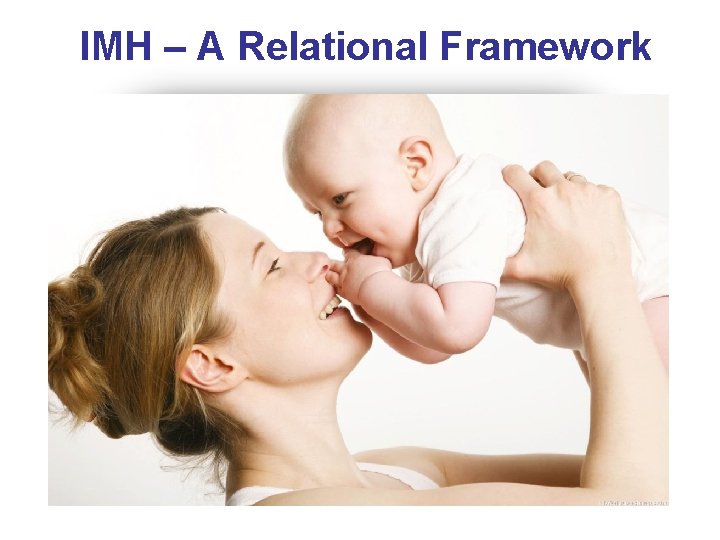
IMH – A Relational Framework
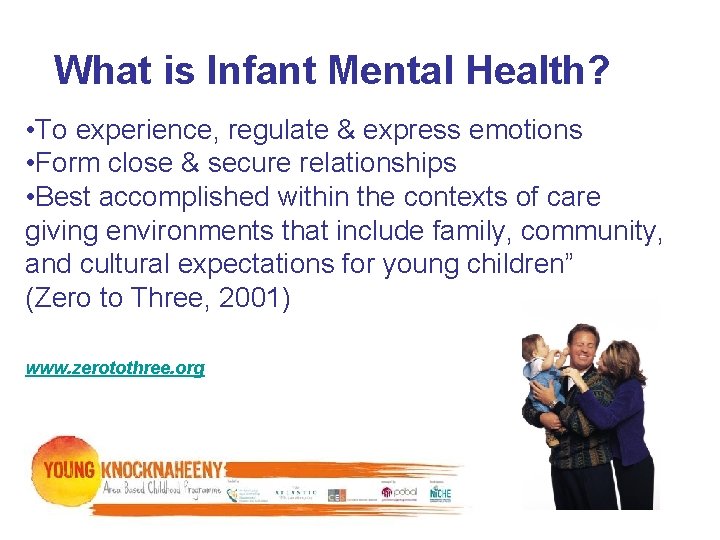
What is Infant Mental Health? • To experience, regulate & express emotions • Form close & secure relationships • Best accomplished within the contexts of care giving environments that include family, community, and cultural expectations for young children” (Zero to Three, 2001) www. zerotothree. org
What is Infant Mental Health (IMH) contd. ……and the growing field of research and practice devoted to the promotion of healthy social and emotional development, prevention of mental health problems and treatment of mental health problems in the context of families” • (Zero to Three National Center for Infants, Toddlers and Families, 2012)
Why is Infant Mental Health Important ? 1. 2. Compelling scientific evidence exists that early experiences and relationships matter. Preparation for Pregnancy, Antenatal and Neonatal Periods are critical periods influencing early development 3. Consistent, predictable, nurturing relationships that are “ good enough” enable the baby to grow its social and emotional health & wellbeing. 4. The nature and quality of the parent/caregiver lays the foundation for mental health across the lifespan: crucial role in Brain development, (Schore, the development of healthy attachment relationships, capacity for self regulation and ability to develop resilience 5. Recognition of absence of healthy IMH- Contribution of Adverse Childhood Experience's (ACE’s) and their impact especially in the prenatal and early years of an infant and toddlers life. 6. 7. Economics of early intervention Interdisciplinary field
What Has Science Concluded? • “Perhaps most important is the unequivocal conclusion that what happens during the first months and years of life absolutely does matter, not because this period of development provides an indelible blueprint for adult well-being, but because it sets either a sturdy or fragile base for what follows. • The early stages of life have the potential for being a rich and rewarding foundation that will support a child all the way into adulthood” (National Research Council Institute of Medicine, 2000)
5 Essential Ingredients for an Optimum Quality Start in IMH Development • Safe, healthy, low stress pregnancy • Opportunity to “fall in love” with a safe nurturing adult – • Nurturing, contingent and developmentally appropriate care • Support in learning how to mutually regulate • Support in learning how to self regulate (Brandt, 2014)
Without these 5 essential ingredients… • • • Developmental delay Poor Relationships Behavioural difficulties Poor school Progress Increased Physical and Mental Health Difficulties
Sensitive Developmental Period There are Two: • Pregnancy • First Two years of Life Sensitive developmental periods during which there is significant biological embedding of adversities” as a consequence of the infant’s early relationship experiences. (Marmot, 2010) ( Barlow, 2016) • “Promotion of health and the prevention of disease begins in the early years of life. Early years can affect adult health in at least 2 ways: by accumulating damage over time or by the biological embedding of adversities during sensitive developmental periods”. (Shonkoff, 2009).
Video Clip In. Brief: The Science of Early Childhood Development (3, 58) Jack P. Shonkoff M. D. Center on the Developing Child HARVARD UNIVERSITY
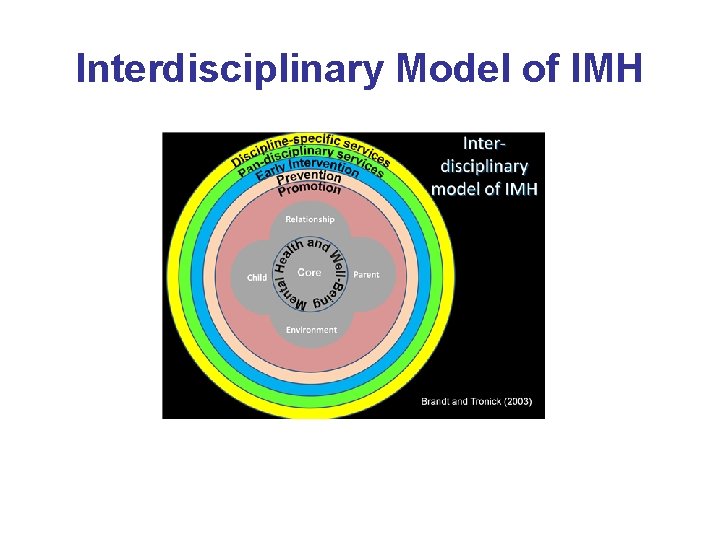
Interdisciplinary Model of IMH
Example of Universal Intervention “Pregnancy, the antenatal and post natal period potentially offer opportunities for intervention to improve physical, psychological and social well-being of children and their families”- and to make the next generation healthier in the broadest possible sense” (Barnett, 2005)
Antenatal and Perinatal Period • Journey to parenthood involves a a major physical and psychological transition • Health of the foetus impacted by: - health of the mother, access to good social support - maternal depression & toxic stress, exposure to teratogens during pregnancy, ( Marmot, 2010) alcohol and tobacco • Health of the baby impacted by: - Physical health promoted by good nutrition, breastfeeding, immunisation • Psychological health impacted by: - sensitive attuned predictable responsive caregiving relationships
Antenatal and Postnatal Education “Pregnancy and the postnatal period are key opportunities to preparents for their new roles” (Barlow, 2016)
What does the Evidence tell us about the Transition to Pregnancy Tt. P? (Barlow, 2016) • Many men and Women experience difficulties in the transition to parenthood • Key preparation periods for their new role are pregnancy and the post natal period • Biological embedding of social adversity emphasizes the particular importance in supporting parents experiencing social adversity. • Current antenatal education is not meeting the needs of many pregnant women. (Barlow, 2016)
What does the Evidence tell us about the Transition to Pregnancy Tt. P? What does this mean for Practice? (Barlow, 2016) 4 Key Areas on Which Antenatal Education Should Focus: • Preparation for New Roles • The Partner Relationship • The Partner-Foetal/Infant Relationship • Co-Parenting (Barlow, 2016)
• Take Home Messages for a Quality Early Start for Infant Mental Health Compelling scientific evidence exists that early experiences and the quality of caregiving relationships matter. Serve and Return interactions between baby and caregivers are essential • Preconception -3 year period require significant awareness and knowledge across all levels of society • Transition to Pregnancy requires support especially those experiencing adversity, Antenatal and Perinatal Periods are critical periods. They influence early development as do the sensitive developmental periods of the first 3 years. • Antenatal education must include preparation for new roles and relationships to facilitate a quality start for baby’s overall health and wellbeing • Promotion, prevention and early intervention is critical – also in supporting and repairing of parent-child relationships. • Future mental health of society can be changed through our universal community based programmes, through primary care promotion, thereby facilitating early and timely intervention, in building healthy communities and
Take Home Messages for a Quality Early Start for Infant Mental Health • Supporting Infant Mental Health and Giving Children the Best Start is all our Business • Involves a Multi-agency response • Building gaps workforce capacity/ skill building are key to achieving these objectives.
Contact Details Catherine Maguire Senior Clinical Psychologist Infant Mental Health Specialist IMH-E® (III & IV) catherine. ykabc@nicheonline. ie
References, Web Links, Textbooks • • Marmot, M. Fair Society: Healthy Lives: The Marmot Review London University College Barlow, J. (2106) Improving Relationships in the Perinatal Period: What Works?