USP 800 Mandatory Requirements and Changes for 2017
- Slides: 57
USP <800> Mandatory Requirements and Changes for 2017 January 20, 2017 New Jersey Society of Oncology Managers Willis C. Triplett, Pharm. D. Comply 797 & Comply 800
Learning Objectives 1. Understand USP’s purported role, scope, and authority; 2. Understand the purpose of General Chapter <800> - “Hazardous Drugs – Handling in Health Care Settings” and its implications for Oncology Practice; Understand the timeline for implementation of <800>; and 3. Understand implications and timeline of NJ “Hazardous Drug Safe Handling Act. ”
United States Pharmacopeial Convention (USP) • Recognized in federal law (FDCA) as the national compendium of drugs • Founded in Washington, D. C. in 1820 • Sets standards for strength, quality, purity, packaging, and labeling of drugs • Global reach – 140 nations around the world • Standards (3 -digit GCs) have been deemed enforceable by federal law
USP and Professional Practice • For 180 years, USP limited its purview to substances – drugs, excipients, additives, etc. • 8/1/2000 – USP published <795> • 6/1/2004 – They follow up with <797> • May-June, 2015 – revised <800> published in Pharmacopeial Forum to become official on July 1, 2018 • Days remaining until 7/1/2018 = 527
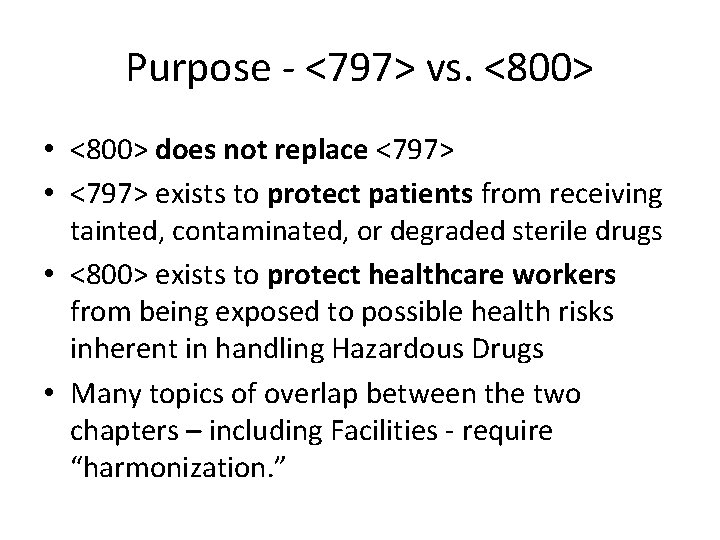
Purpose - <797> vs. <800> • <800> does not replace <797> • <797> exists to protect patients from receiving tainted, contaminated, or degraded sterile drugs • <800> exists to protect healthcare workers from being exposed to possible health risks inherent in handling Hazardous Drugs • Many topics of overlap between the two chapters – including Facilities - require “harmonization. ”
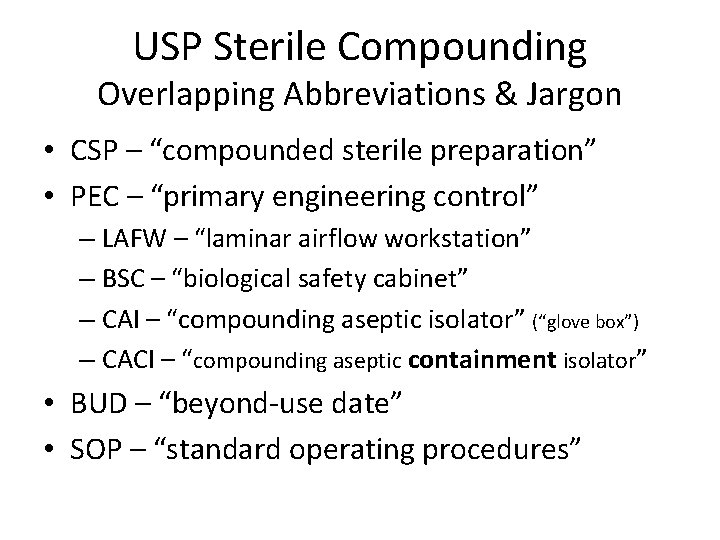
USP Sterile Compounding Overlapping Abbreviations & Jargon • CSP – “compounded sterile preparation” • PEC – “primary engineering control” – LAFW – “laminar airflow workstation” – BSC – “biological safety cabinet” – CAI – “compounding aseptic isolator” (“glove box”) – CACI – “compounding aseptic containment isolator” • BUD – “beyond-use date” • SOP – “standard operating procedures”
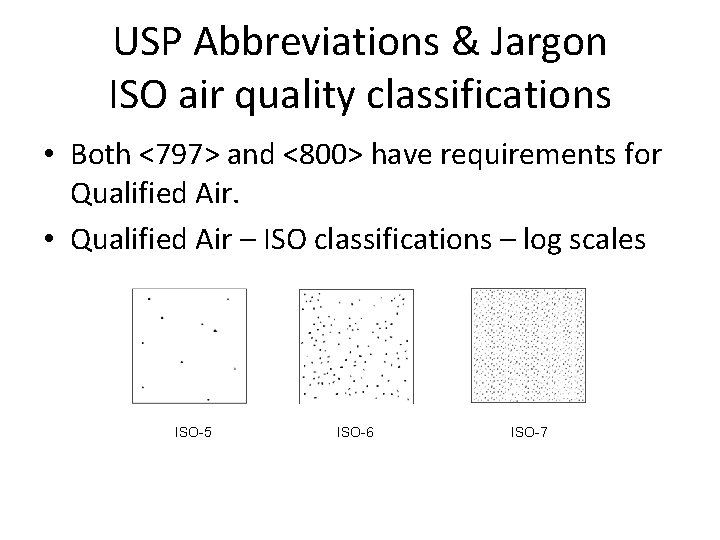
USP Abbreviations & Jargon ISO air quality classifications • Both <797> and <800> have requirements for Qualified Air. • Qualified Air – ISO classifications – log scales ISO-5 ISO-6 ISO-7
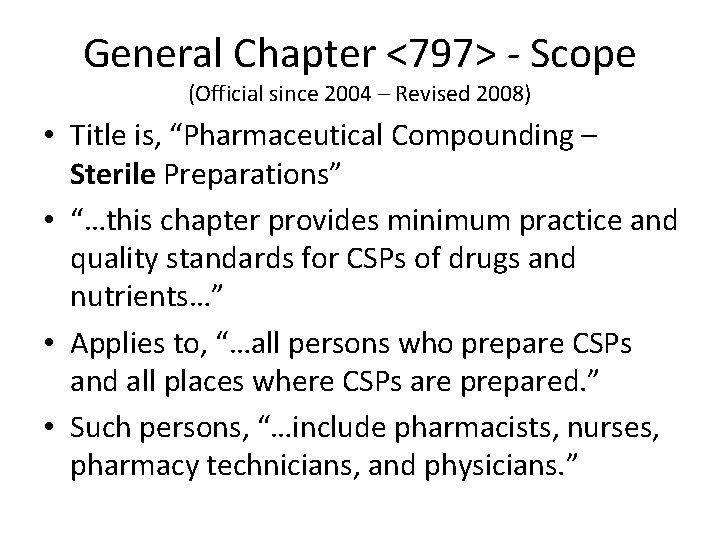
General Chapter <797> - Scope (Official since 2004 – Revised 2008) • Title is, “Pharmaceutical Compounding – Sterile Preparations” • “…this chapter provides minimum practice and quality standards for CSPs of drugs and nutrients…” • Applies to, “…all persons who prepare CSPs and all places where CSPs are prepared. ” • Such persons, “…include pharmacists, nurses, pharmacy technicians, and physicians. ”
General Chapter <800> - Scope (Becomes Official on 7/1/2018) • Title is “Hazardous Drugs – Handling in Healthcare Settings” • “…applies to all healthcare personnel who handle HD preparations and all entities that store, prepare, transport, or administer HDs. ” – (e. g. , pharmacies, hospitals, and other healthcare institutions, patient treatment clinics, physicians’ practice facilities, or veterinarians’ offices. ) – “…pharmacists, pharmacy technicians, nurses, physicians, PAs, home healthcare workers, veterinarians and veterinary technicians. ”
USP - Should versus Shall/Must • Even within a 3 -digit Chapter, there will be both “shoulds” and “shalls” • In USP language, “Should” or “May” is a recommendation • A sentence that uses “Shall” or “Must” is a mandated requirement
Why <800>? • Mustard Gas was used as a weapon in the World Wars • Among many effects on exposed soldiers, it dropped WBC count • Chemotherapy – Goodman & Gilman – 1946 – Mustard Gas -> Nitrogen Mustard (stable form) – Effectively shrank lymphoma, although the effect was short-lived • Sydney Farber tested folate antagonists against Acute Lymphocytic Leukemia and found it effective (1948)
Why <800>? • In early chemotherapy treatments, all of the focus was on the patient • Later, there was a realization that drugs which affect DNA and cell reproduction could be harmful to healthcare workers • Series of studies demonstrated exposure – Measurable cyclophosphamide from LAFW – Measurable antineoplastics in the urine of healthcare workers • Long-term effects? Still not clear.
<800> - Big Spotlight to Speed Progress • OSHA’s Controlling Occupational Exposure to Hazardous Drugs – evolved since 1986 • ASHP’s Guidelines on Handling Hazardous Drugs - evolved since 1988 • ASCO/ONS’ Chemotherapy Administration Safety Standards Including Standards for the Safe Administration and Management of Oral Chemotherapy – evolved since 2009
<800> broader than <797> • <800> scope is much broader than <797>’s: – Receipt, Handling, Storage, Disposal, Presence – Applies to everyone in the greater environment (nurses, receptionists, billing staff, executives, patients, waiting room, couriers, cleaning crew, etc. ) – includes staff who receive and unpack drugs – Apply to non-sterile (i. e. oral, topical, etc. ) drug forms
Chapter <800> Impact • “Motherhood and Apple Pie” • Massive cost – Uncertain benefits • Costs will include: – Increased energy consumption & CO 2 production – Increased drive to consolidate – only mega-entities can afford to construct and operate the required facilities – Limitation of patient access – Accelerated shift to automated approaches – Legal and Risk Management
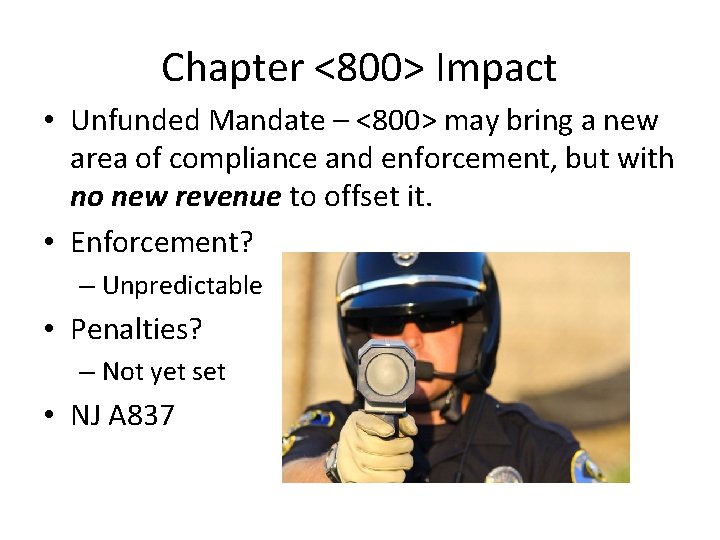
Chapter <800> Impact • Unfunded Mandate – <800> may bring a new area of compliance and enforcement, but with no new revenue to offset it. • Enforcement? – Unpredictable • Penalties? – Not yet set • NJ A 837
New Jersey “Hazardous Drug Safe Handling Act” – A 837 New Jersey A 837 “Hazardous Drug Safe Handling Act” b. The standards and regulations to be adopted pursuant to subsection a. of this section shall describe the hazardous drugs for which handling is to be regulated, the methods and procedures for handling such drugs, an implementation plan, and such other requirements as may be necessary to protect the health and safety of health care personnel, including, but not limited to: (1) written, site-specific hazardous drug control programs to avoid occupational exposure to hazardous drugs through transporting, compounding, administering, disposing, or other handling of the drugs; (2) hazard assessments to determine precautions necessary to protect health care personnel from exposure to hazardous drugs; (3) engineering controls to eliminate or minimize exposure to hazardous drugs; (4) personal protective equipment and the circumstances under which personal protective equipment shall be used by health care personnel; (5) safe handling practices related to hazardous drugs, including handling, receiving, storage, preparing, administering, waste handling, cleaning, housekeeping, labeling and signage, and maintenance practices; (6) spill control and response procedures; (7) training standards and training programs; (8) requirements for recordkeeping, including records related to training sessions, qualifications, incident reports, and other pertinent information; and (9) medical surveillance, which shall include provisions requiring, at a minimum, a medical evaluation for health care personnel who directly handle hazardous drugs, at no cost to the personnel, at the time of hiring, upon exposure to hazardous drugs, and upon request when such request is related to reproductive concerns.
New Jersey “Hazardous Drug Safe Handling Act” – A 837 c. The standards and regulations adopted pursuant to subsection a. of this section shall include a schedule of penalties for violations of the provisions of this act or its rules and regulations, which schedule may incorporate such factors as the commissioner determines are relevant to assessing penalties for violations, including any history of previous violations, the seriousness of the current violation, and any other factors which the commissioner may establish by regulation. d. The standards and regulations adopted pursuant to subsection a. of this section, to the extent feasible, shall be consistent with and not exceed recommendations in the NIOSH 2004 alert entitled “Preventing Occupational Exposures to Antineoplastic and Other Hazardous Drugs in Health Care Settings. ” The standards and regulations may incorporate applicable updates and changes to NIOSH guidelines, and shall be reviewed by the commissioner, in consultation with a stakeholder group as defined in section 3 of P. L. , c. (C. ) (pending before the Legislature as this bill), every two years. 5. Employers of health care personnel shall provide hazardous drugs training to all employees who have or are likely to have occupational exposure to hazardous drugs. This training shall take place at the time of the employee’s initial job assignment and on an annual basis thereafter. Such training shall be consistent with the standards and regulations adopted pursuant to subsection a. of section 4 of P. L. , c. (C. ) (pending before the Legislature as this bill). 6. a. This act, and its standards and regulations, shall be enforced by the commissioner, who has right-of-entry to all pertinent premises and records for the purposes of inspection and information. b. The commissioner is authorized to assess and collect administrative penalties for violations of the provisions of this act or its rules and regulations, consistent with the schedule of penalties adopted pursuant to section 4 of P. L. , c. (C. ) (pending before the Legislature as this bill).
New Jersey “Hazardous Drug Safe Handling Act” – S 468 New Jersey S 468 “Hazardous Drug Safe Handling Act” The committee amended the bill to clarify which professionals and facilities will be subject to the safe drug handling requirements established under the bill. Specifically, the bill provides that the requirements will apply to personnel employed by a health care professional, pharmacy practice site, health care facility, or animal or veterinary facility. “Health care facility” is defined to mean a licensed general acute care hospital, satellite emergency department, hospital-based off-site ambulatory care facility at which ambulatory surgical procedures are performed, and ambulatory surgical facility. “Health care professional” is defined under the bill as a physician, physician assistant, advanced practice nurse, registered nurse, licensed practical nurse, pharmacist, or veterinarian. The amendments expressly provide that the safe drug handling requirements will not apply to dentists or dental hygienists. The amendments revise the membership of the stakeholder group established under the bill to include licensed practical nurses, advanced practice nurses, a representative of the New Jersey Veterinary Medical Association, a representative of the Medical Society of New Jersey, and a representative of the New Jersey State Society of Physician Assistants.
New Jersey “Hazardous Drug Safe Handling Act” – S 468 The amendments eliminate the role of the Department of Labor and Workforce Development (DOLWD) in implementing and enforcing the provisions of the bill and remove certain provisions setting forth express requirements concerning inspections and penalties for violations. Instead, the Commissioner of Health, the Director of the Division of Consumer Affairs in the Department of Law and Public Safety, and the stakeholder group established under the bill will jointly promulgate the required regulations. The provisions of the bill, including any relevant rules and regulations, will be enforced by the licensing authority having oversight over a given health care professional or facility. The amendments eliminate certain specific requirements concerning medical surveillance for health care personnel, which will instead be established in the joint regulations.
Chapter <800> Impact Areas: – Physical Facilities and Equipment (& energy) • requires negative-pressure PECs vented to the outside • negative-pressure SEC, hard walls, door, 12 or 30 ACPH – SOPs and Quality Assurance Program – Training - required for all staff members – Disposable supplies – gowns, garb, gloves, etc. – Surveillance • Environment • Medical Conditions of your Personnel (including future)
Physical Environment Typical Current State – Has wooden counters, drawers, shelves – Contains paper, cardboard, carpet, drapes, etc. – The C-PEC is a BSC resting on a counter – Contains compressor-style refrigerator(s) – Open to unrestricted traffic – Walls, flooring, ceilings are of inappropriate surface and not maintained by protocol – Compounding performed by seasoned R. N. – main focus is on clinical aspects of the drug-patient combination – NOT on sterility/stability of CSP
<800> Impact Physical Environment To comply, choose between two strategies: ISO-7 Clean Room Complex Versus Containment Segregated Compounding Area (C-SCA) Choice turns on BUD
<800> Impact Physical Environment C-SEC features: • “…shall be void of activities and materials that are extraneous to sterile compounding. ” • Sealed – air movement controlled/monitored • Floors/walls/ceilings/fixtures/carts smooth, impervious, easily cleaned and disinfected • Joints coved and smooth, ceiling tiles sealed to frame(s)
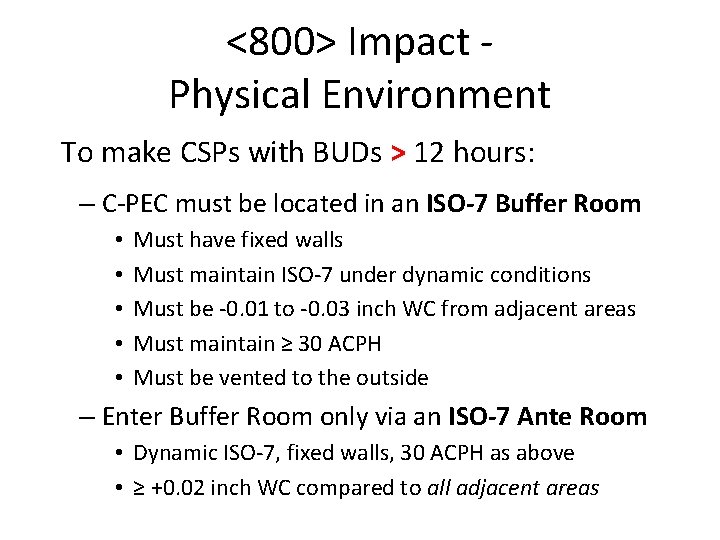
<800> Impact Physical Environment To make CSPs with BUDs > 12 hours: – C-PEC must be located in an ISO-7 Buffer Room • • • Must have fixed walls Must maintain ISO-7 under dynamic conditions Must be -0. 01 to -0. 03 inch WC from adjacent areas Must maintain ≥ 30 ACPH Must be vented to the outside – Enter Buffer Room only via an ISO-7 Ante Room • Dynamic ISO-7, fixed walls, 30 ACPH as above • ≥ +0. 02 inch WC compared to all adjacent areas
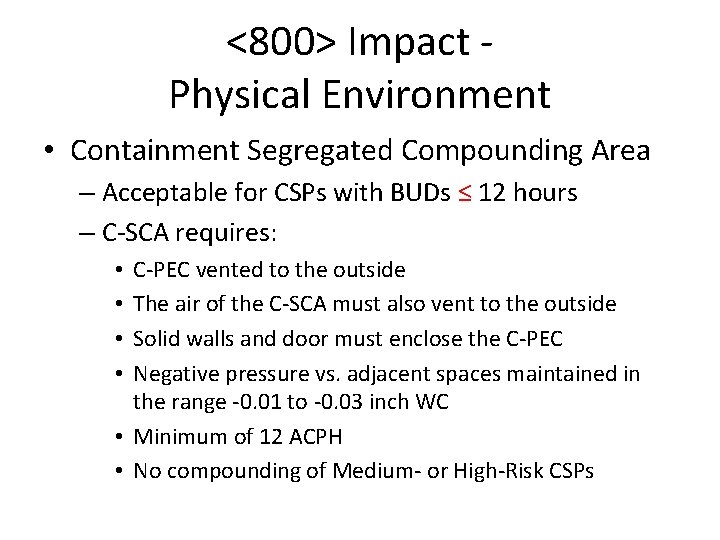
<800> Impact Physical Environment • Containment Segregated Compounding Area – Acceptable for CSPs with BUDs ≤ 12 hours – C-SCA requires: C-PEC vented to the outside The air of the C-SCA must also vent to the outside Solid walls and door must enclose the C-PEC Negative pressure vs. adjacent spaces maintained in the range -0. 01 to -0. 03 inch WC • Minimum of 12 ACPH • No compounding of Medium- or High-Risk CSPs • •
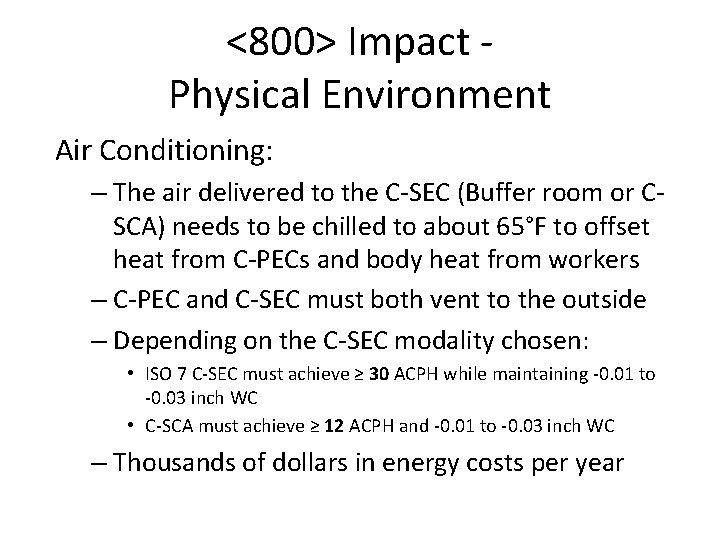
<800> Impact Physical Environment Air Conditioning: – The air delivered to the C-SEC (Buffer room or CSCA) needs to be chilled to about 65°F to offset heat from C-PECs and body heat from workers – C-PEC and C-SEC must both vent to the outside – Depending on the C-SEC modality chosen: • ISO 7 C-SEC must achieve ≥ 30 ACPH while maintaining -0. 01 to -0. 03 inch WC • C-SCA must achieve ≥ 12 ACPH and -0. 01 to -0. 03 inch WC – Thousands of dollars in energy costs per year
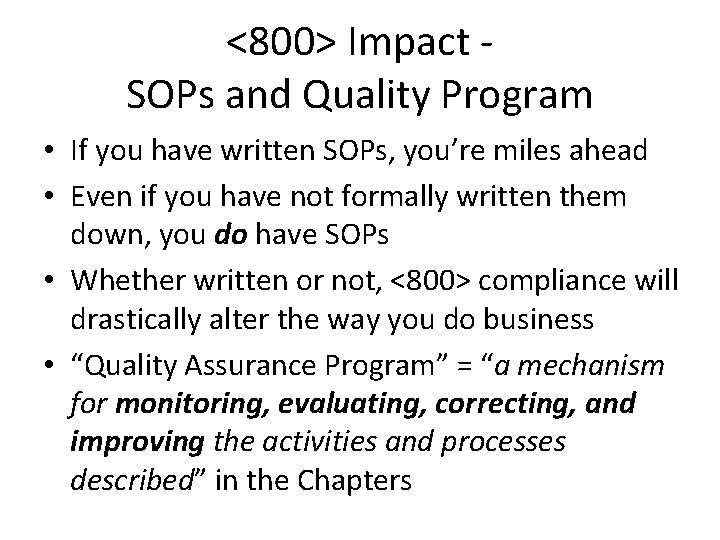
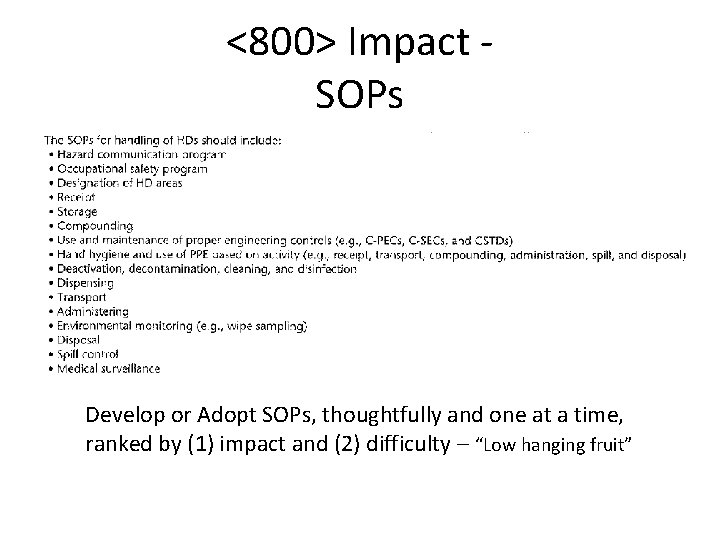
<800> Impact SOPs and Quality Program • If you have written SOPs, you’re miles ahead • Even if you have not formally written them down, you do have SOPs • Whether written or not, <800> compliance will drastically alter the way you do business • “Quality Assurance Program” = “a mechanism for monitoring, evaluating, correcting, and improving the activities and processes described” in the Chapters
<800> Impact SOPs Develop or Adopt SOPs, thoughtfully and one at a time, ranked by (1) impact and (2) difficulty – “Low hanging fruit”
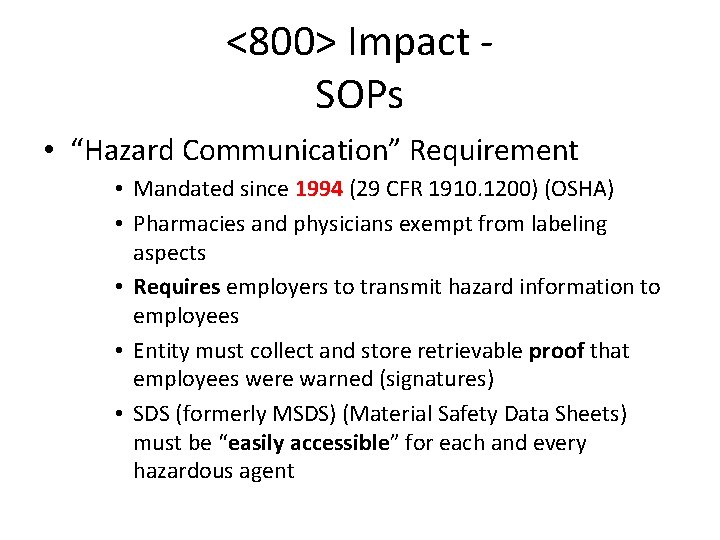
<800> Impact SOPs • “Hazard Communication” Requirement • Mandated since 1994 (29 CFR 1910. 1200) (OSHA) • Pharmacies and physicians exempt from labeling aspects • Requires employers to transmit hazard information to employees • Entity must collect and store retrievable proof that employees were warned (signatures) • SDS (formerly MSDS) (Material Safety Data Sheets) must be “easily accessible” for each and every hazardous agent
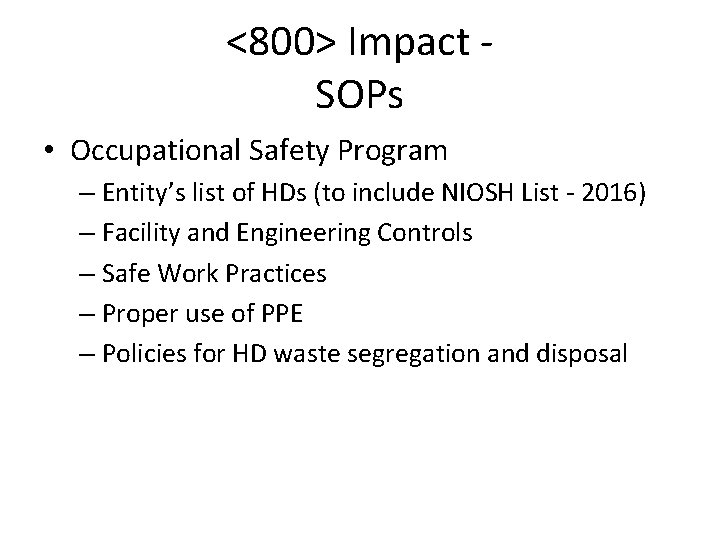
<800> Impact SOPs • Occupational Safety Program – Entity’s list of HDs (to include NIOSH List - 2016) – Facility and Engineering Controls – Safe Work Practices – Proper use of PPE – Policies for HD waste segregation and disposal
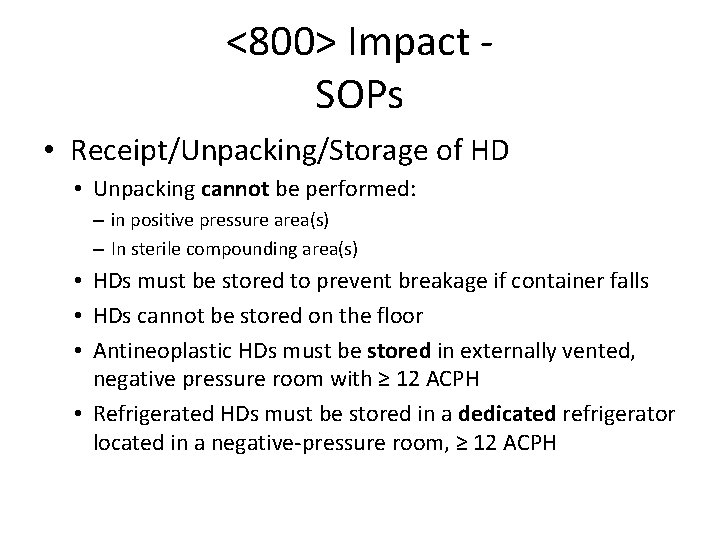
<800> Impact SOPs • Receipt/Unpacking/Storage of HD • Unpacking cannot be performed: – in positive pressure area(s) – In sterile compounding area(s) • HDs must be stored to prevent breakage if container falls • HDs cannot be stored on the floor • Antineoplastic HDs must be stored in externally vented, negative pressure room with ≥ 12 ACPH • Refrigerated HDs must be stored in a dedicated refrigerator located in a negative-pressure room, ≥ 12 ACPH
<800> Impact SOPs • Compounding • • • All requirements of <797> must also be followed C-PEC must operate continuously Loss of power = immediate suspension of all C-PEC activities Power returned – must decontaminate, clean, & disinfect Handwashing sink must be available Eyewash station must be readily available Water sources and drains must not degrade ISO qualification Water sources and drains located ≥ 1 meter from C-PEC Neither LAFW nor CAI are acceptable for HD compounding
<800> Impact SOPs • Hand hygiene and PPE • Disposable PPE must not be reused • Gowns, head, hair, shoe covers and two pairs of chemotherapy gloves to compound HDs • Two pairs of chemotherapy gloves required to administer antineoplastic HDs • Gowns must have demonstrated permeability resistance • Chemotherapy Gloves – Must meet ASTM Standard D 6978 (or successor) [read the box] – Must be powder-free
<800> Impact SOPs • Hand hygiene and PPE – Gloves must be physically inspected for defects – Gloves must have no pin holes or weak spots – If sterile compounding, gloves must be sterile – Gloves must be changed ≤ 30 minutes – Gowns must close at back and not be cloth – Gowns must not have HD-permeable seams – Potentially contaminated clothing is never taken home
<800> Impact SOPs • Hand hygiene and PPE – Gowns worn in areas of HD handling must never be worn into other areas – Head/hair/beard/moustache covers required – Second pair of shoe covers required when entering C-SEC and removed upon exiting – Eye and face covers required when risk of HD spills/splashes (e. g. , administration in O. R. , hanging HD CSPs above eye level, spill cleaning)
<800> Impact SOPs • Hand hygiene and PPE – Full-facepiece respirator protects eyes/face – Goggles required when eye protection needed – Face shields alone do not protect eyes from splash – Face shields + goggles = full eye/face protection – Unpacking HD requires elastomeric half-mask with a multi-gas cartridge and P 100 filter until ascertained that there was no leakage/spill – Surgical masks = inadequate respiratory protection
<800> Impact SOPs • Hand hygiene and PPE – Surgical N 95 respirator provides N 95 respiratory protection + barrier to splashes or sprays – Fit-tested N 95 respirators protect against airborne particles, but no protection for gasses/vapors and little protection against liquid splashes – Full facepiece or PAPR when at risk, including: • Attending to an HD spill • Deactivating, decontaminating and cleaning below C-PEC • Known or suspected airborne powders or vapors
<800> Impact SOPs • Deactivation/Decontamination/Cleaning – All areas where HD are handled any reusable equipment they touch must be deactivated, decontaminated, and cleaned – Sterile compounding areas and devices must also be disinfected – The procedures and the agents used, dilutions, frequency and documentation requirements – Procedures include eye, face and respiratory protection as required
<800> Impact SOPs • Drug Administration – HDs must be administered using protective devices and techniques (needle-less, closed systems) – Appropriate PPE must be worn when administering HDs – Used PPE must be disposed of in a waste container approved for trace-contaminated HD – Equipment and packaging materials disposed likewise – CSTDs must be used to administer antineoplastic HDs whenever the dosage form allows
<800> Impact SOPs • Personnel Training – Personnel who handle HD must be trained based on their job functions – Training must occur before employee independently handles HDs – Effectiveness of training must be demonstrated for each employee – Competency reassessed every 12 months – Each employee trained for all new HD and every new or altered SOP
<800> Impact Personnel Training/Competency • Not enough to train your staff, you must demonstrate that you did • Must demonstrate that training was effective • Not enough to train initially, • You must demonstrate that you’ve reiterated training regularly and that staff know what they need to know to protect themselves and others from HD exposure
<800> Impact – Disposable supplies • PPE (as noted) (gloves, gowns, booties, etc. ) • Cleanroom supplies and ancillaries – Tacky mats – Sterile, non-shedding wipes – Sterile alcohol (liquid and waterless foamers) – Steel or plastic shelving and carts – Deactivating/Decontaminating/Disinfection liquids – Dedicated disposable mops/buckets/scrubbers
<800> Impact Surveillance - Environment • Surface wipe sampling should include: – Interior of the C-PEC and equipment contained in it – Pass-through chambers – Surfaces in staging or work areas near the C-PEC – Areas adjacent to C-PECs (e. g. , floors directly under CPEC, staging, and dispensing area) – Areas immediately outside the HD buffer room or the C-SCA – Patient administration areas
<800> Impact Surveillance - Environment • Surface wipe sampling: – Example = cyclophosphamide – Not many vendors – Expensive – Paying for the test is step 1. – Cost to try to eliminate HD is step 2. – Paying to demonstrate elimination was effective is step 3.
<800> Impact Surveillance - Medical • Healthcare workers who handle HDs as a regular part of their job assignment should be enrolled in a medical surveillance program. • Medical surveillance programs involve assessment and documentation of symptom complaints, physical findings, and laboratory values (such as a blood count) to determine whethere is deviation from the expected norms. • Tracking personnel through medical surveillance allows the comparison of health variables over time in individual workers, which may facilitate early detection of a change in a laboratory value or health condition.
<800> Impact Surveillance - Medical • Medical surveillance programs also look for trends in populations of workers. • Examining grouped data compared with data from unexposed workers may reveal a small alteration or increase in the frequency of a health effect that would be obscured if individual workers' results alone were considered. • Medical surveillance evaluates the protection afforded by engineering controls, other administrative controls, safe work processes, PPE, and worker education about the hazards of the materials they work with in the course of their duties.
<800> Impact Surveillance - Medical • Why did USP prescribe such a costly, ineffective, inefficient, and disastrous process as “Medical Surveillance? ” • Because we had the data at our fingertips, but we never did the study… – We knew who handled and who were exposed to these drugs – The simplest case-control epidemiological study ever – Contrast rates of malignancy and specific “candidate” diseases between cohorts of orthopedic surgical workers vs. E. D. workers vs. El-Ed teachers vs. us + our staff and determine Relative Risk – No increase in risk obviates any need for “Medical Surveillance”
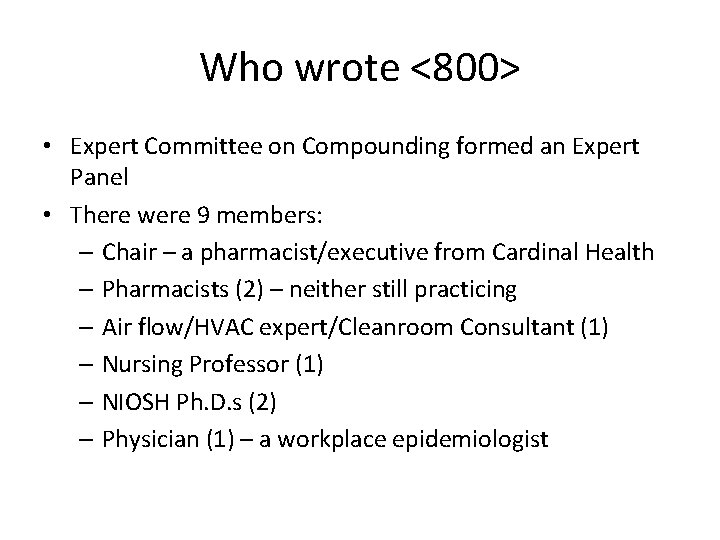
Who wrote <800> • Expert Committee on Compounding formed an Expert Panel • There were 9 members: – Chair – a pharmacist/executive from Cardinal Health – Pharmacists (2) – neither still practicing – Air flow/HVAC expert/Cleanroom Consultant (1) – Nursing Professor (1) – NIOSH Ph. D. s (2) – Physician (1) – a workplace epidemiologist
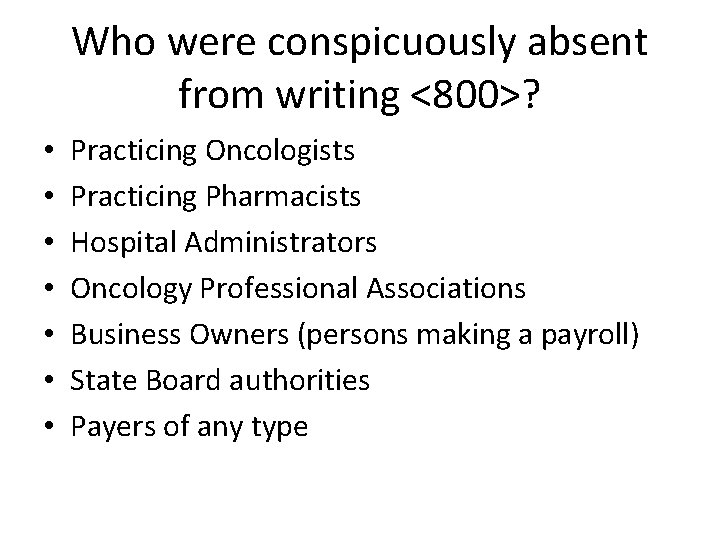
Who were conspicuously absent from writing <800>? • • Practicing Oncologists Practicing Pharmacists Hospital Administrators Oncology Professional Associations Business Owners (persons making a payroll) State Board authorities Payers of any type
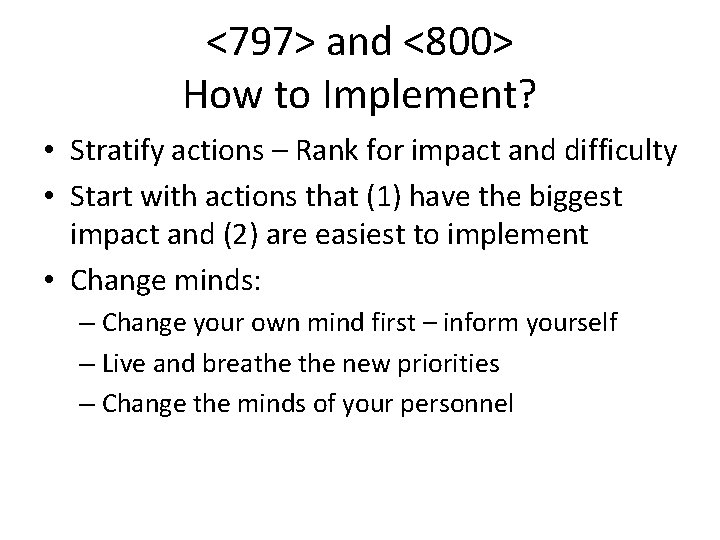
<797> and <800> How to Implement? • Stratify actions – Rank for impact and difficulty • Start with actions that (1) have the biggest impact and (2) are easiest to implement • Change minds: – Change your own mind first – inform yourself – Live and breathe new priorities – Change the minds of your personnel
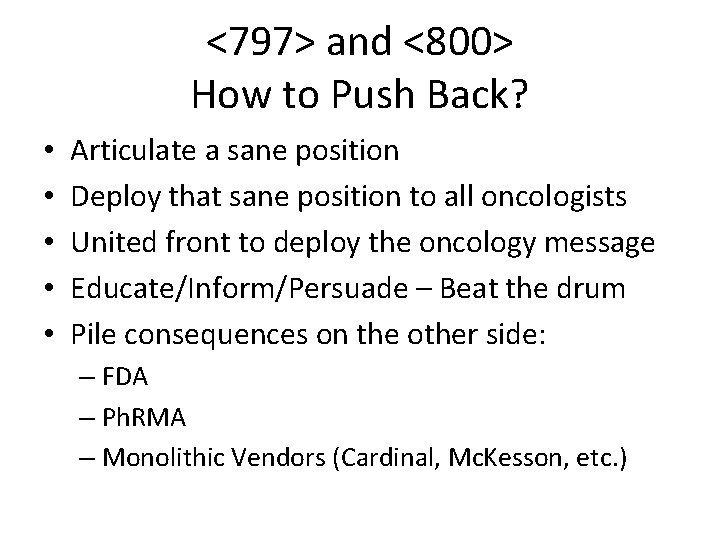
<797> and <800> How to Push Back? • • • Articulate a sane position Deploy that sane position to all oncologists United front to deploy the oncology message Educate/Inform/Persuade – Beat the drum Pile consequences on the other side: – FDA – Ph. RMA – Monolithic Vendors (Cardinal, Mc. Kesson, etc. )
Dialogue • Questions? • Comments?
Willis C Triplett, Pharm. D. • Best e-mail: willis. triplett@comply 797. com • Cellular telephone: 317 -626 -6973 • Please do not hesitate to reach out!
Background Reading • • • Purchase USP Compounding Compendium USP FAQs on <800> NIOSH List - 2016 Controlling Occupational Exposure to Hazardous Drugs-OSHA ASCO/ONS Safety Standards-2013 ASCO/ONS Safety Standards – Menu of 2003+2011+2013 versions ASHP Guidelines on Handling Hazardous Drugs New Jersey Assembly Bill No. 837 – 2016 Session New Jersey Senate 468 “Hazardous Drug Safe Handling Act” FDA Guidance on Process Validation Sterile Drug Process Inspections-FDA
Off-Label Use Disclosure(s) I do not intend to discuss any off-label use of any drug product during this activity
Financial Disclosure(s) I currently have or have had the following relevant financial relationships to disclose: – I do not have financial, consulting, and advisory relationships with any pharmaceutical companies other than “former consultant. ” – I do have business relationships with several companies that provide products or services in the sterile product compounding arena, including clean room builders, consulting companies, accreditation bodies, software providers, professional organizations, c. GMP validation firms, certification companies, and commercial laboratories. I do not intend to mention any of those by name during this presentation.