Safe handling of hazardous drugs USP 800 and












- Slides: 38
Safe handling of hazardous drugs: USP <800> and beyond Ann. Marie Walton, Ph. D, MPH, RN, OCN, CHES Assistant Professor Duke University School of Nursing GLAONS 3 rd Annual Oncology Care Summit September 2019
Objectives 1. Describe how hazardous drug exposure impacts healthcare workers 2. Describe the changes that will be required/recommended by USP <800> 3. Describe some recent research in this area
What are hazardous drugs? Drugs are hazardous “if studies in animals or humans indicate that exposures to them have a potential for causing cancer, developmental or reproductive toxicity, or harm to organs” Examples: chemotherapy, antiviral drugs, hormones
How do you know if a drug is hazardous? • NIOSH Alert Appendix A Sample list of hazardous drugs https: //www. cdc. gov/niosh/docs/2004165/pdfs/2004 -165. pdf • NIOSH bi-annual update www. cdc. gov/niosh/topics/hazdrug/ • Facility specific list
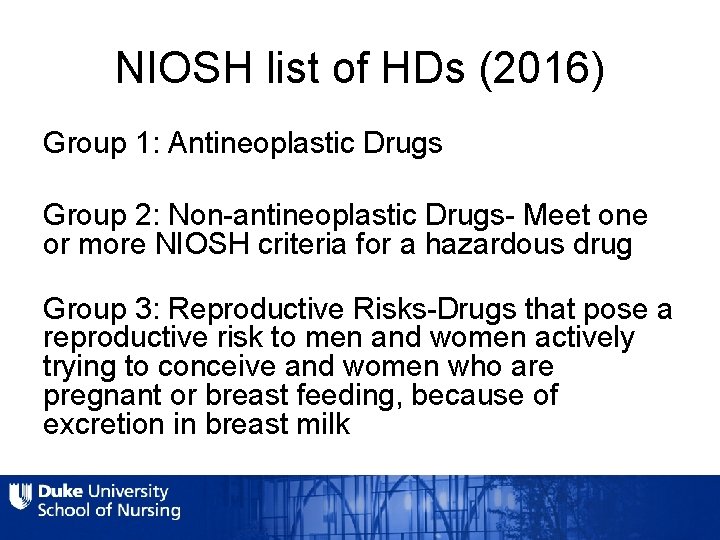
NIOSH list of HDs (2016) Group 1: Antineoplastic Drugs Group 2: Non-antineoplastic Drugs- Meet one or more NIOSH criteria for a hazardous drug Group 3: Reproductive Risks-Drugs that pose a reproductive risk to men and women actively trying to conceive and women who are pregnant or breast feeding, because of excretion in breast milk
Hazardous drug exposure: How it happens • • Dermal route of exposure is most common Inhalation Ingestion Accidental injection
Hazardous drug exposure: Who is affected? Over 8 million healthcare employees including (not limited to): –Pharmacy staff –Nurses, nursing assistants –Physicians, physician assistants –Dietitians, health educators –Occupational therapists, physical therapists, and OT/PT assistants –Environmental staff –Shipping/receiving staff Also- veterinarians/veterinarian technicians, research/laboratory staff
Hazardous drug exposure: Why do we care? • Have a potential for causing cancer, developmental or reproductive toxicity, or harm to organs • The impact of hazardous drug exposure is far and wide
This is not a new problem • Inquiry began in the 1970 s • Several hundred papers document exposure, adverse health effects, efficacy of PPE, guidelines for safe handling
Nor are the recommendations new • 1990, 2006 ASHP Guidelines on Handling Hazardous Drugs (HDs) • 2004 NIOSH “Alert” • NIOSH LIST of Antineoplastic and Other Hazardous Drugs in Healthcare Settings –most recent update 2016 (updated every 2 years) • USP <795>, <797> • USP <800> published 2/1/16, 6/1/19 –enforceable 12/1/19
U. S. Pharmacopeia (USP) General Chapter <800> Information about “standards for safe handling of hazardous drugs to minimize the risk of exposure to healthcare personnel, patients and the environment” –Population Standards are for “all healthcare personnel who receive, prepare, administer, transport or otherwise come in contact with hazardous drugs …. ”
Lifecycle of the Drug Ready for <800> website suggests thinking about preparation in this way: –Personnel and practices –Receiving/storage –Compounding environment –Compounding processes/procedures –Spills/cleaning/disposal –Medication administration and protective equipment
Training (Personnel and Practices) • Before employee handles HDs independently • Assessed annually • Must include: list of HDs, SOPs, proper use of PPE, spill management, response to exposure, proper disposal (in compliance with federal, state, local laws)
Delivery/Receiving -HDs unpacked in neutral/negative pressure areas; NOT unpacked in sterile compounding areas or positive pressure areas -Chemotherapy gloves donned for unpacking -Spill kit available in receiving area
Storage –Separate storage of HDs from non-hazardous inventory –Separate special refrigeration areas for nonhazardous inventory –“Negative-pressure room with at least 12 air changes per hour (ACPH)”(USP p 3) with external ventilation -Also consider where breakage is least likelyno storage on the floor
Transporting -Labeling -Containers least likely to break or leak -No pneumatic tubes
Compounding Engineering controls for containment are divided into 3 categories: Primary: (C-PEC) ventilated device when directly handling HDs Secondary: (C-SEC) the room in which the C-PEC is used Supplemental: Adjunct controls like CSTDs
Compounding continued… Sterile and nonsterile HDs must be compounded in a C-PEC within a C-SEC. The C-SEC must: have external ventilation, be a separate room, adhere to proper air exchange guidelines, be a negative pressure room according to specific guidelines for negative pressure measurements
PPE in pharmacy- and beyond • Chemotherapy rated gloves (ASTM) – Powder-free (and sterile outer glove if used for sterile compounding) – Replace every 30 minutes – Replace “when torn, punctured, or contaminated”(USP p 6) – Wash hands well with soap and water after taking gloves off • Gowns – Disposable, non-permeable, chemotherapy rated gowns, gowns with back closure and elastic or knit cuffs, replace at least every 2 -3 hours, replace if medication contacts gown. – Remember, do not wear the gown outside of the HD handling area! • Head/hair covers, shoe covers, and optional sleeve covers – An additional pair of shoe covers need to be applied before crossing into the C-SEC. – Remove additional pair of shoe covers when leaving the C-SEC. *Everything else is institution-specific standard operating procedure.
Respiratory prevention measures “Surgical masks do not provide respiratory protection from drug exposure and must not be used when respiratory protection from HD exposure is required. ”(USP p 7) “A surgical N 95 respirator provides … a barrier to splashes, droplets, and sprays around the nose and mouth…For most activities requiring respiratory protection, a fit -tested NIOSH-certified N 95 or more protective respirator is sufficient to protect against airborne particles. However, N 95 respirators offer no protection against gases and vapors and little protection against direct liquid splashes …. ”(p 7) “An appropriate full-facepiece, chemical cartridge-type respirator or powered airpurifying respirator (PAPR) should be worn when there is a risk of respiratory exposure to HDs, including when: ” • “Attending to HD spills larger than what can be contained with a spill kit” • “Deactivating, decontaminating, and cleaning underneath the work surface of a C-PEC” • “There is a known or suspected airborne exposure to powders or vapors”(p 7)
Administration • Avoid manipulation of HD dosage forms • CSTDs must be used at the point of administration for antineoplastic HDs • No priming or spiking at the bedside – Two pairs of chemo gloves for antineoplastic HDs – Disposable and impermeable gowns if injectable antineoplastic HDs – Everything else is institutional standard operating procedure • PPE in patient care areas • Education about proper donning and doffing
Spills • Train personnel in spill kit use • SOPs for spill prevention and clean-up including PPE and respirators (PAPR if HD spill larger than spill kit can handle) • Documentation • Immediate medical evaluation to potentially exposed personnel
Cleaning • Deactivation- inactivation • Decontamination-removal • Cleaning-remove organic/inorganic material • Disinfection- destroy microorganisms
More recommendations • Baseline and routine surface wipe sampling as a measure of containment* • Preparing for costs, anticipating resources • Medical surveillance • Alternative duty • Hazardous drug working group/ HD compliance officer
So, we will be safer right? Not all groups support USP<800> as written. ASCO published Standards in Feb 2019 challenging: 1. 2. 3. 4. Medical surveillance CSTDs External ventilation Alternative duty
Enforcement may be limited • State Boards of Pharmacy may choose whether or not to enforce USP <800> • In June 2019, USP said the legislation giving standards the force of law extends only to compounding
On the bright side • Joint Commission writes about compliance not only with USP <800> requirements but also with recognized national standards and leading best practices; CMS may hold organizations accountable • Facilities have been preparing for USP <800> for years and many have already made and will continue to make changes to improve safe handling • Except for CSTDs, USP does not say anything that NIOSH, OSHA, ASHP, and ONS don’t already recommend
Who and what is missing? • Nothing about post-administration care which NIOSH and ONS have written extensively about • A position statement from ONS/HOPA and resources are forthcoming
Let’s talk a little about excreta Per NIOSH Alert: • Wear two pairs of protective gloves and a disposable gown if you must handle linens, feces, or urine from patients who have received hazardous drugs within the last 48 hours — or in some cases, within the last seven days. • Dispose of the gown after each use or whenever it becomes contaminated. • Wear face shields if splashing is possible. • Remove the outer gloves and the gown by turning them inside out and placing them into the yellow chemotherapy waste container. Repeat the procedure for the inner gloves. • Wash hands with soap and water after removing the gloves. *ONS and some hospital policies include use of plastic backed pads when flushing
My own program of research: Study 1 (in press) • Are NAs exposed to HDs as a result of their routine work tasks? • 27 NAs in an inpatient oncology unit • Observation, verbally administered questionnaires, interviews • Double gloving, chemotherapy gown and face shield use was low; use of plastic backed pads when flushing was high • NAs have suggestions to improve training, communication about who is receiving ADs, and use of PPE, workplace safety climate matters Funded by NC OSHERC Pilot Grant, NIOSH
My own program of research Study 2 (under review) • Interested in measuring surface contamination, understanding PPE use • 27 nursing staff in two inpatient oncology units completed in a survey • 140 surface wipe samples- shared and administration areas Funded by DUSON CNR Pilot Grant
Results: Study 2 • Contamination with cyclophosphamide was detectable and quantifiable in 86/140 (61%) surfaces tested. • Of these, levels greater than 0. 05 ng/cm 2 (a level commonly reported in commercial wipe testing) were measured in 26% (22/86) for cyclophosphamide. • The surfaces most contaminated with cyclophosphamide were toilet seats, a remote control, a doorknob to the restroom, and an IV pole (in room), a floor near the common desk, a floor near the entry to the staff locker room, and a floor in front of the pharmaceutical waste bin (shared areas)
Interesting findings: Study 2 • PPE use was suboptimal; less PPE use with handling contaminated bodily fluids • No CSTD in use; some respondents reported use during administration • Workplace safety climate matters • In 1/3 of the patient administration surfaces tested in which the patient received only one drug of interest, the other drug was found (17/51); implications for cleaning.
Future directions in my program of research • What impact does extent of implementation of USP <800> have on surface contamination? NIOSH R 21 resubmission under review • Is there a novel method for HC worker exposure surveillance? NCI R 03 to be prepared after ALSF pilot study complete • How effective are recommendations for handling AD contaminated excreta? AND How effective is current cleaning in AD decontamination? DCI pilot in revision for Spring 2020 submission • Is there a more effective/safer solvent? Walton discretionary funds
Practical resources: What can you do to protect yourself? • • Polovich, M. , Olsen, M. (Eds). (2018). Safe Handling of Hazardous Drugs (3 rd Ed. ) Pittsburgh, PA: Oncology Nursing Society. Toolkit for Safe Handling of Hazardous Drugs for Nurses in Oncology: https: //www. ons. org/toolkitsafe-handling-hazardous-drugs-nurses-oncology? utm_source=HL&utm_medium=Email ONS/ASCO standards 2016: https: //www. ons. org/ascoons-chemotherapy-administration-safetystandards? utm_source=HL&utm_medium=Email ONS/HOPA/ASCO position statement 2016: https: //www. ons. org/sites/default/files/201706/Safe%20 Handling. pdf ONS/HOPA position statement 2019 ONS Safe Handling Basics Course: https: //www. ons. org/courses/safe-handlingbasics? utm_source=HL&utm_medium=Email NIOSH 2004 Alert – • USP <800>: live webcasts, webinars, e-learning modules – • www. usp. org/frequently-asked-questions/hazardous-drugs-handling-healthcare-settings Ready for <800> B. Braun Medical website – • www. usp. org/events-training FAQs re: USP <800> – • https: //www. cdc. gov/niosh/docs/2004 -165/pdfs/2004 -165. pdf https: //www. readyfor 800. com/ Your institutional policy
Consider your shared work environment • To reduce surface contamination • Don PPE appropriately; doff it properly • Make all staff aware of who is receiving hazardous drugs • Educate all workers in these settings • Educate families
References • • • • • Administering HDs and the Necessary PPE. Ready for <800>. B. Braun Medical Inc. Web site. https: //www. readyfor 800. com/administering-hds-necessary-ppe/ Accessed October 9, 2017. Celano, P. , Fausel, C. A. , Kennedy, E. B. , et al. (2019). Safe Handling of Hazardous Drugs: ASCO Standards. Journal of Clinical Oncology. Compounding HD and the necessary PPE. Ready for <800>. B. Braun Medical Inc. Web site. https: //www. readyfor 800. com/compounding-hd-necessary-ppe/ Accessed October 4, 2017. Connor TH. Safe handling of hazardous drugs. NIOSH Science Blog CDC website. http: //blogs. cdc. gov/niosh-science-blog/2014/05/21/hazardous-drugs/ Posted May 21, 2014. Updated December 7, 2016. Accessed October 4, 2017. Connor TH, De. Bord DG, Pretty JR, et al. Evaluation of antineoplastic drug exposure of health care workers at three university-based US cancer centers. J Occup Environ Med. 2010; 52(10): 1019 -1027. doi: 10. 1097/JOM. 0 b 013 e 3181 f 72 b 63. Department of Health and Human Services. NIOSH ALERT: preventing occupational exposures to antineoplastic and other hazardous drugs in health care settings. http: //www. cdc. gov/niosh/docs/2004 -165/pdfs/2004 -165. pdf. CDC Web site. Accessed October 4, 2017. Events & training. USP Web site. http: //www. usp. org/events-training Accessed October 4, 2017. Fausel, C. A. , Celano, P. Safe Handling of Hazardous Drugs: 2019 ASCO Standards. Feb 15, 2019. www. asco. org/safe-handling-standards FAQs: <800> hazardous drugs – handling in healthcare settings. USP Web site. http: //www. usp. org/frequently-asked-questions/hazardous-drugs-handling-healthcaresettings Accessed October 4, 2017. Hazardous drug exposures in healthcare. CDC Web site. https: //www. cdc. gov/niosh/topics/hazdrug/ Updated August 25, 2017. Accessed October 4, 2017. Hazardous drug exposures in healthcare: antineoplastic agents. CDC web site. https: //www. cdc. gov/niosh/topics/hazdrug/antineoplastic. html. Updated September 13, 2017. October 4, 2017. Hon CY, Teschke K, Shen H, Demers PA, Venners S. Antineoplastic drug contamination in the urine of Canadian healthcare workers. Int Arch Occup Environ Health. 2015; 88(7): 933 -941. doi: 10. 1007/s 00420 -015 -1026 -1. Infrastructure for compounding. Ready for <800>. B. Braun Medical Inc. Web site. https: //www. readyfor 800. com/infrastructure-for-compounding/. Published 2017. Accessed October 4, 2017. Polovich, M. , Olsen, M. (Eds). (2018). Safe Handling of Hazardous Drugs (3 rd Ed. ) Pittsburgh, PA: Oncology Nursing Society. Ready for <800>. B. Braun Medical Inc. Web site. https: //www. readyfor 800. com. Published 2017. Accessed October 4, 2017. Spills, cleaning and disposal. Ready for <800>. B. Braun Medical Inc. Web site. https: //www. readyfor 800. com/spills-cleaning-disposal/. Published 2017. Accessed October 4, 2017. The United States Pharmacopeial Convention (USP). USP General Chapter <800> Hazardous Drugs – Handling in Healthcare Settings: Reprinted from USP 40—NF 35, Second Supplement (2017). 2017. Available from www. usp. org with registration. USP general chapter <800> hazardous drugs — handling in healthcare settings. USP Web site. http: //www. usp. org/compounding/general-chapter-hazardous-drugshandling-healthcare. Accessed October 4, 2017. Yuki M, Sekine S, Takase K, Ishida T, Sessink PJ. Exposure of family members to antineoplastic drugs via excreta of treated cancer patients. J Oncol Pharm Pract. 2013; 19(3): 208 -217. doi: 10. 1177/1078155212459667.
Questions annmarie. walton@duke. edu