
Mandatory Access Control Lesson Introduction Understand need for
- Slides: 55
Mandatory Access Control Lesson Introduction ● Understand need for mandatory access control (MAC) and multilevel security ● Explore several MAC models ● Understand assurance techniques for a trusted computing base (TCB)
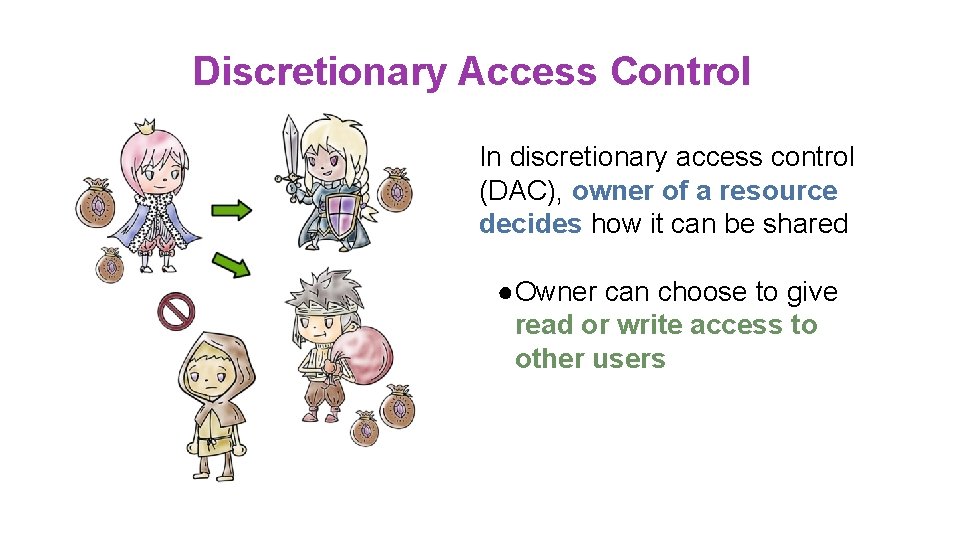
Discretionary Access Control In discretionary access control (DAC), owner of a resource decides how it can be shared ●Owner can choose to give read or write access to other users
Discretionary Access Control Two problems with DAC: ●You cannot control if someone you share a file with will not further share the data contained in it ●Cannot control “information flow” ●In many organizations, a user does not get to decide how certain type of data can be shared ●Typically the employer may mandate how to share various types of sensitive data ●Mandatory Access Control (MAC) helps address these problems
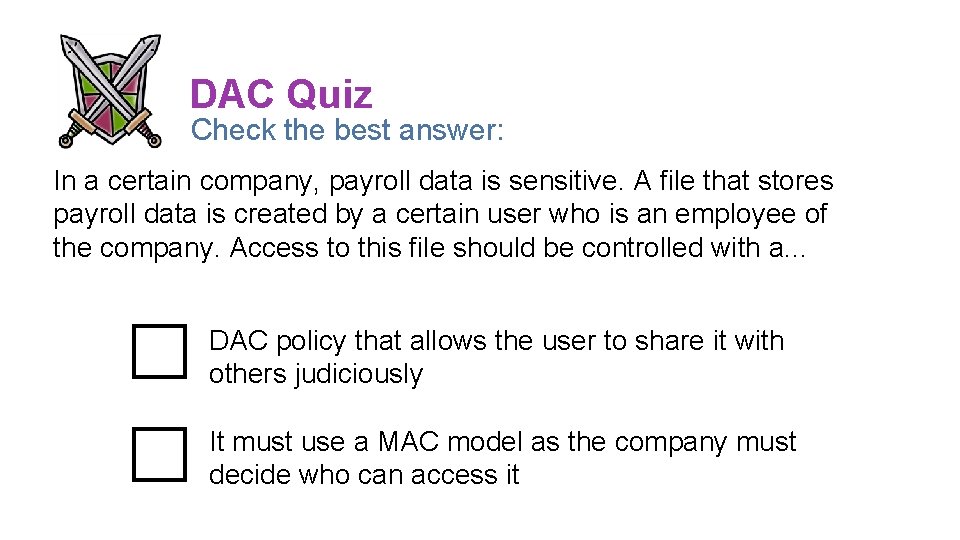
DAC Quiz Check the best answer: In a certain company, payroll data is sensitive. A file that stores payroll data is created by a certain user who is an employee of the company. Access to this file should be controlled with a. . . DAC policy that allows the user to share it with others judiciously It must use a MAC model as the company must decide who can access it
Mandatory Access Control (MAC) Models User works in a company and the company decides how data should be shared ●Hospital owns patient records and limits their sharing ●Regulatory requirements may limit sharing ●HIPAA for health information
Mandatory Access Control (MAC) Models Military and intelligence agencies: Data has associated classification level and users are cleared at various levels ● Top secret, confidential etc. ● Limits on who can access data at a certain level ● User cleared only at secret level should not be able to access top secret data ● Also called multilevel security (MLS)
Implementing MAC Labels: A Key Requirement for Implementing MAC ● indicate sensitivity/category of data or clearance/need-to-know requirements of users ● TCB associates labels with each user and object and checks them when access requests are made ● Need to relate labels to be able to compare them ● Exact nature of labels depends on what kind of model/policy is implemented ● Do. D models include classification/clearance level and a compartment in the label ● Commercial policies are different but use labels to deal with conflict -of-interest, separation-of-duty etc.
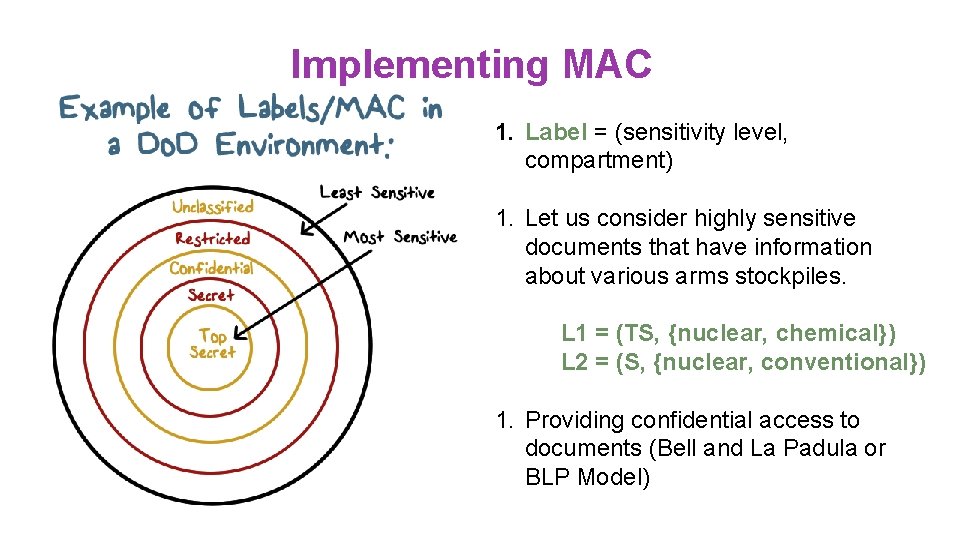
Implementing MAC 1. Label = (sensitivity level, compartment) 1. Let us consider highly sensitive documents that have information about various arms stockpiles. L 1 = (TS, {nuclear, chemical}) L 2 = (S, {nuclear, conventional}) 1. Providing confidential access to documents (Bell and La Padula or BLP Model)
Health Data Quiz Check the best answer: A hospital is found to be lax in securing access to patient records after it suffers a major breach. It may have violated the following policy: HIPAA BLP
Security Clearance Quiz Check the best answer: Highly sensitive defense or intelligence information should only be accessed by cleared personnel. Approximately, how many people in the United States have various types of clearances? 10, 000 1, 000 100, 000 5, 000
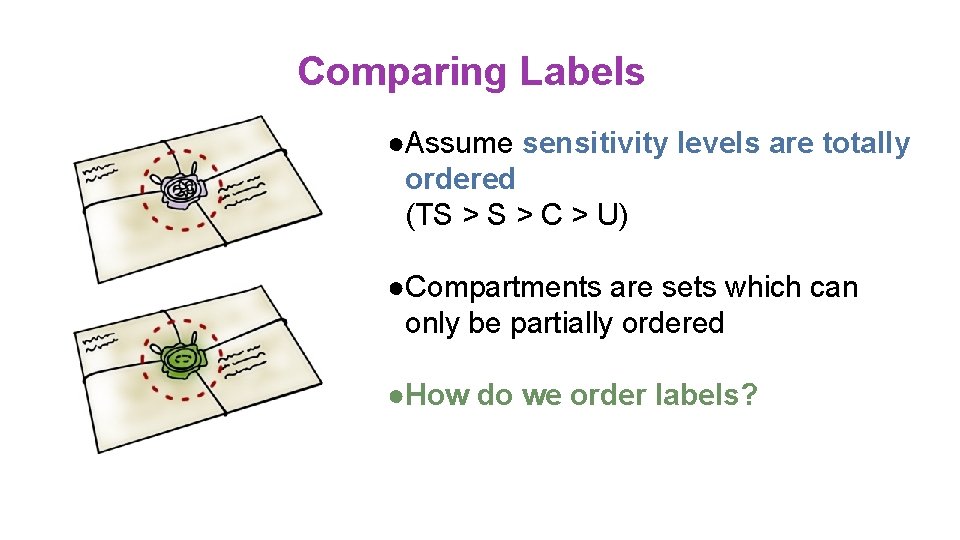
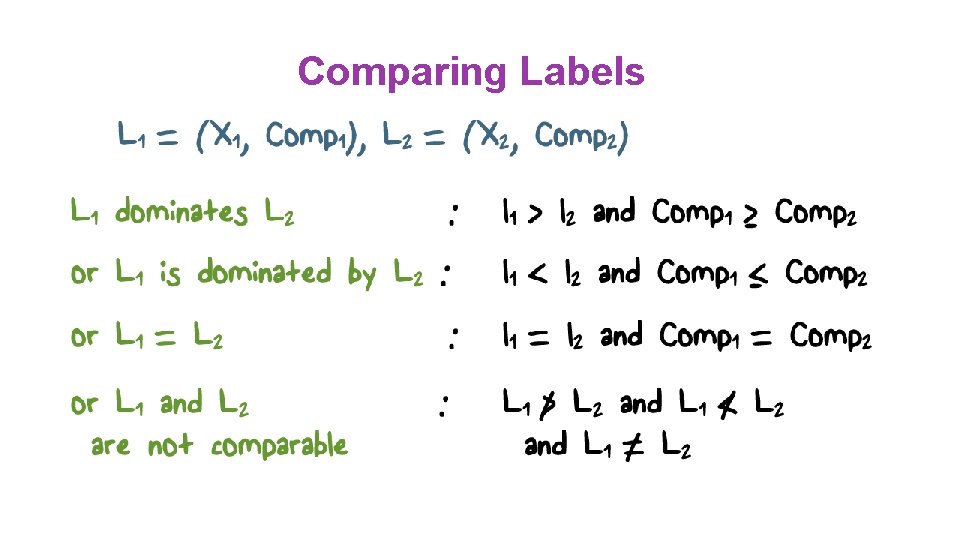
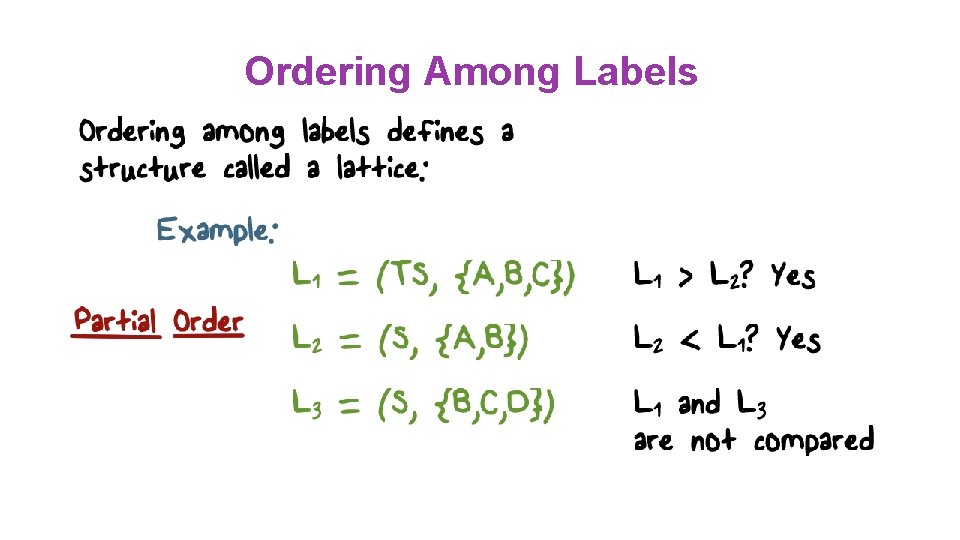
Comparing Labels ●Assume sensitivity levels are totally ordered (TS > C > U) ●Compartments are sets which can only be partially ordered ●How do we order labels?
Comparing Labels
Ordering Among Labels
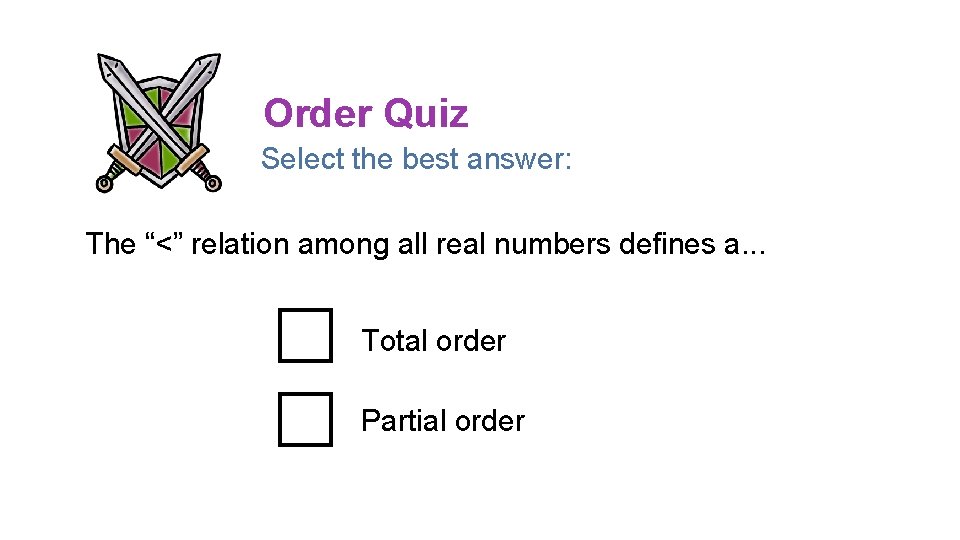
Order Quiz Select the best answer: The “<” relation among all real numbers defines a. . . Total order Partial order
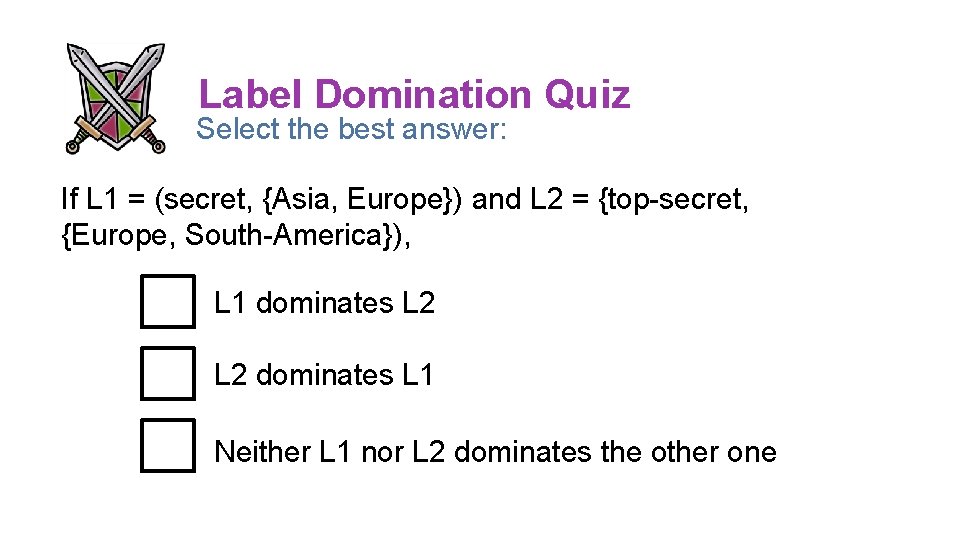
Label Domination Quiz Select the best answer: If L 1 = (secret, {Asia, Europe}) and L 2 = {top-secret, {Europe, South-America}), L 1 dominates L 2 dominates L 1 Neither L 1 nor L 2 dominates the other one
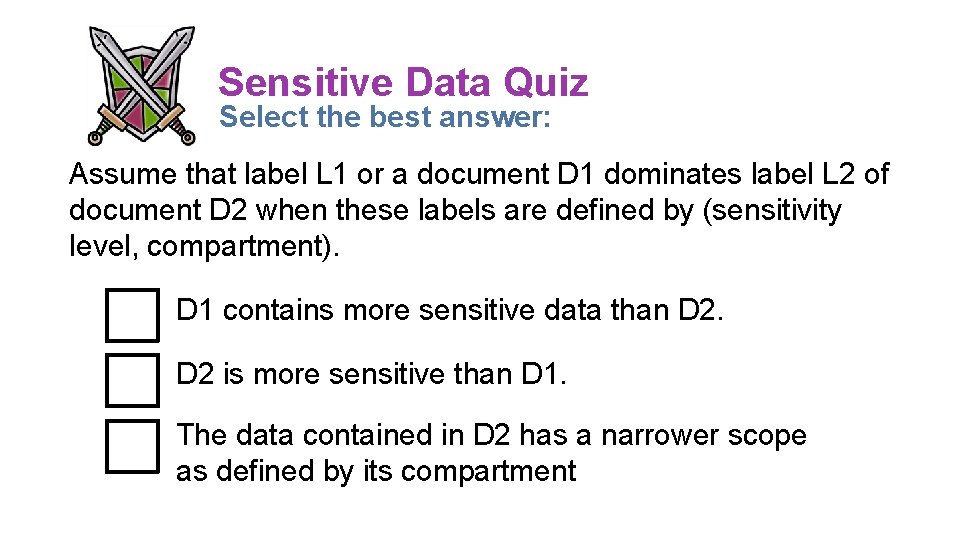
Sensitive Data Quiz Select the best answer: Assume that label L 1 or a document D 1 dominates label L 2 of document D 2 when these labels are defined by (sensitivity level, compartment). D 1 contains more sensitive data than D 2 is more sensitive than D 1. The data contained in D 2 has a narrower scope as defined by its compartment
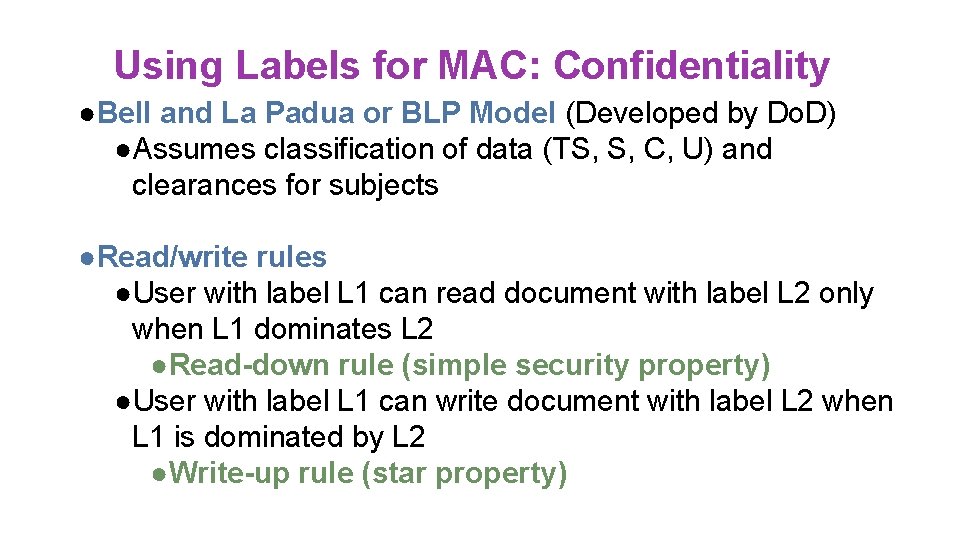
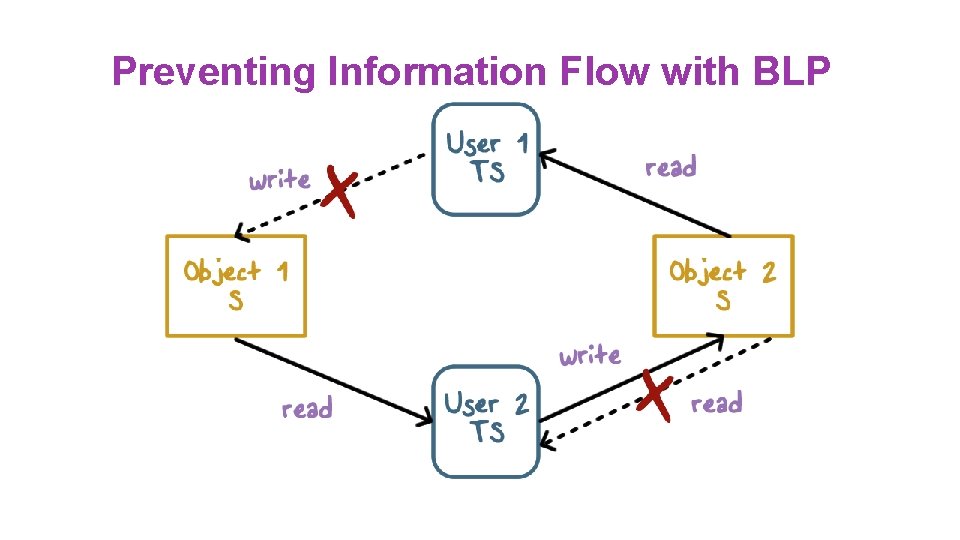
Using Labels for MAC: Confidentiality ●Bell and La Padua or BLP Model (Developed by Do. D) ●Assumes classification of data (TS, S, C, U) and clearances for subjects ●Read/write rules ●User with label L 1 can read document with label L 2 only when L 1 dominates L 2 ●Read-down rule (simple security property) ●User with label L 1 can write document with label L 2 when L 1 is dominated by L 2 ●Write-up rule (star property)
Preventing Information Flow with BLP
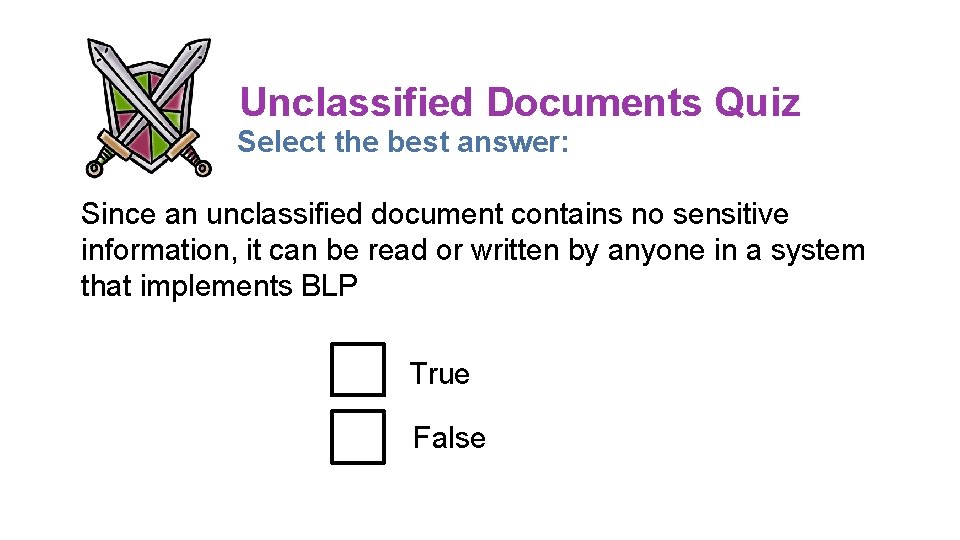
Unclassified Documents Quiz Select the best answer: Since an unclassified document contains no sensitive information, it can be read or written by anyone in a system that implements BLP True False
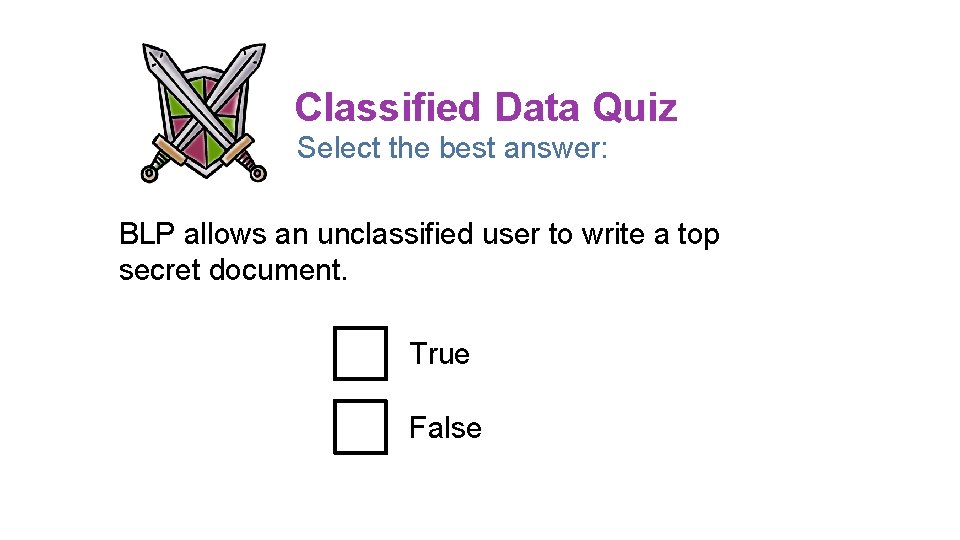
Classified Data Quiz Select the best answer: BLP allows an unclassified user to write a top secret document. True False
BLP Model Quiz Select the best answer: Tranquility principle in the BLP model states that classification of a subject or object does not change during a session. This principle is needed to avoid. . . Information flow that may violate confidentiality requirements defined by BLP To reduce overhead associated with change of classification level
Other MAC Models ●Biba is dual of BLP ●Focuses on integrity rather than confidentiality ●Read-up and write-down rules Example: ●Integrity level could be high, medium or low ●Compartment could be similar to BLP and captures topic(s) of document ●Low integrity information should never flow up into high integrity documents
Policies for Commercial Environments ●User clearance is not common ●Other requirements exist ●Data only be accessed by certain application (e. g. , payroll) ●Separation-of-duty and conflict-ofinterest requirements
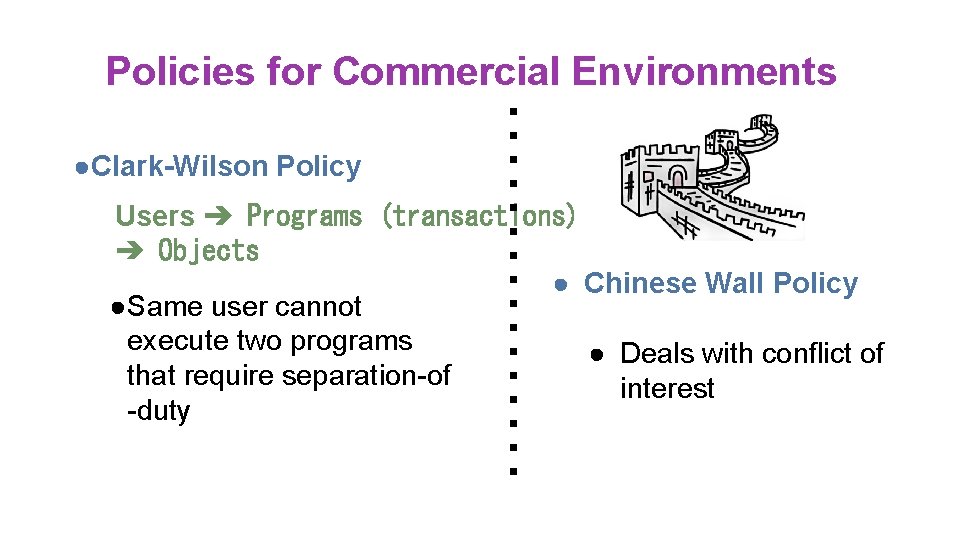
Policies for Commercial Environments ●Clark-Wilson Policy Users ➔ Programs (transactions) ➔ Objects ● Chinese Wall Policy ●Same user cannot execute two programs ● Deals with conflict of that require separation-of interest -duty
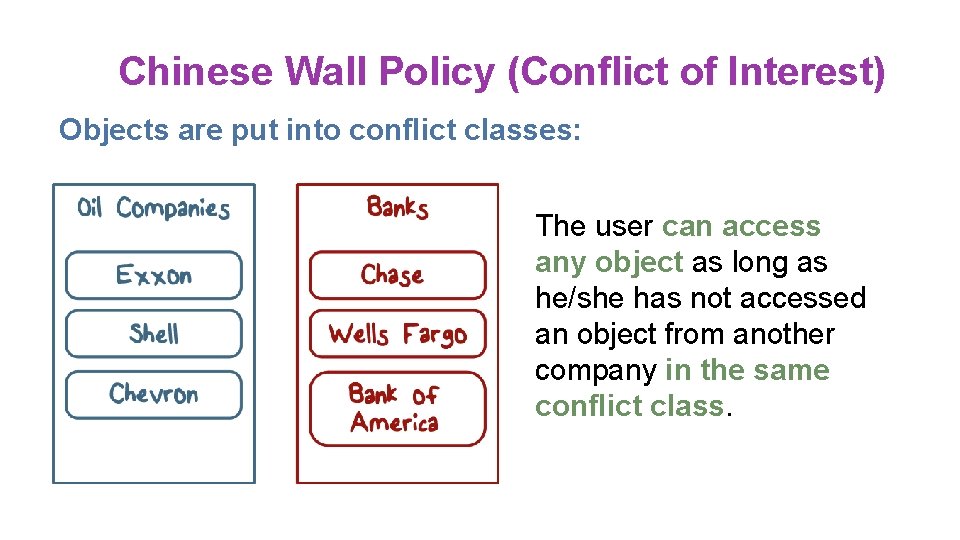
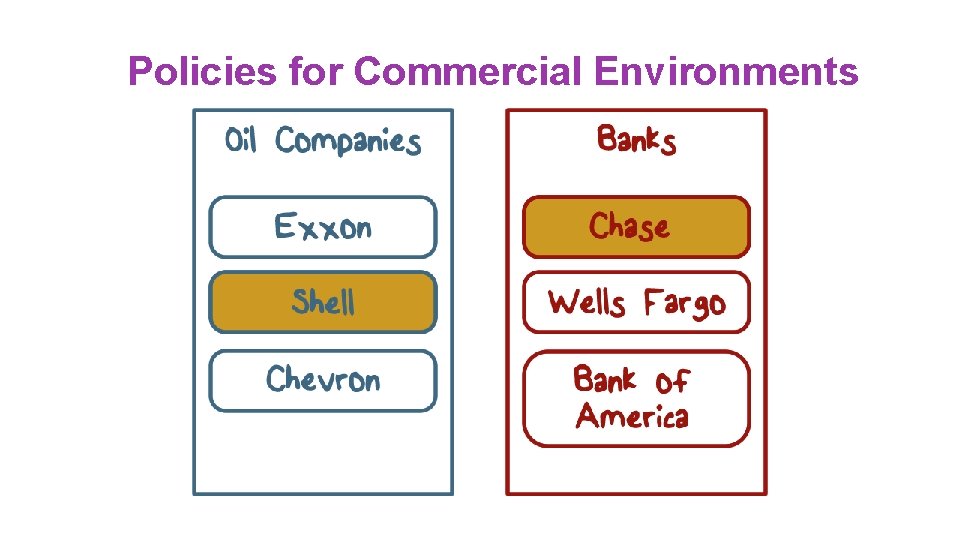
Chinese Wall Policy (Conflict of Interest) Objects are put into conflict classes: The user can access any object as long as he/she has not accessed an object from another company in the same conflict class.
Policies for Commercial Environments
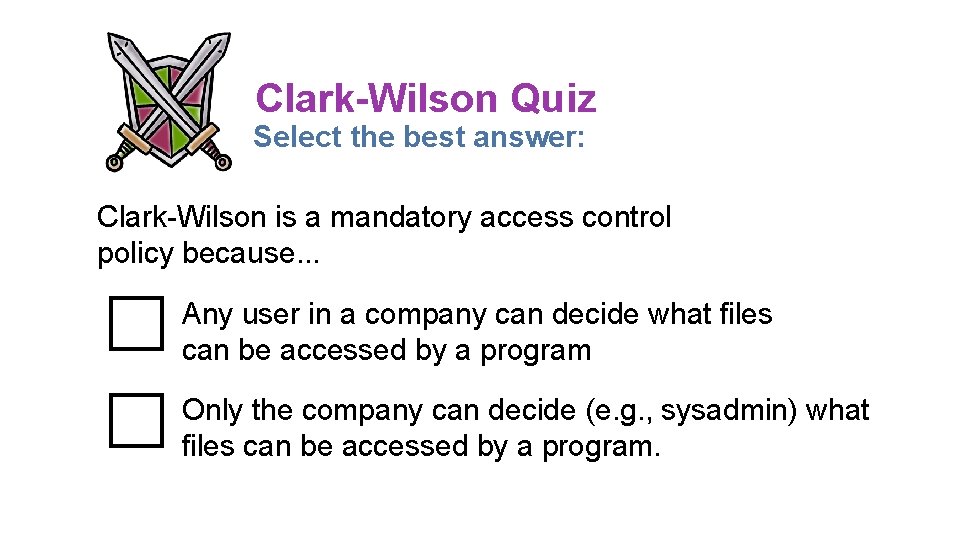
Clark-Wilson Quiz Select the best answer: Clark-Wilson is a mandatory access control policy because. . . Any user in a company can decide what files can be accessed by a program Only the company can decide (e. g. , sysadmin) what files can be accessed by a program.
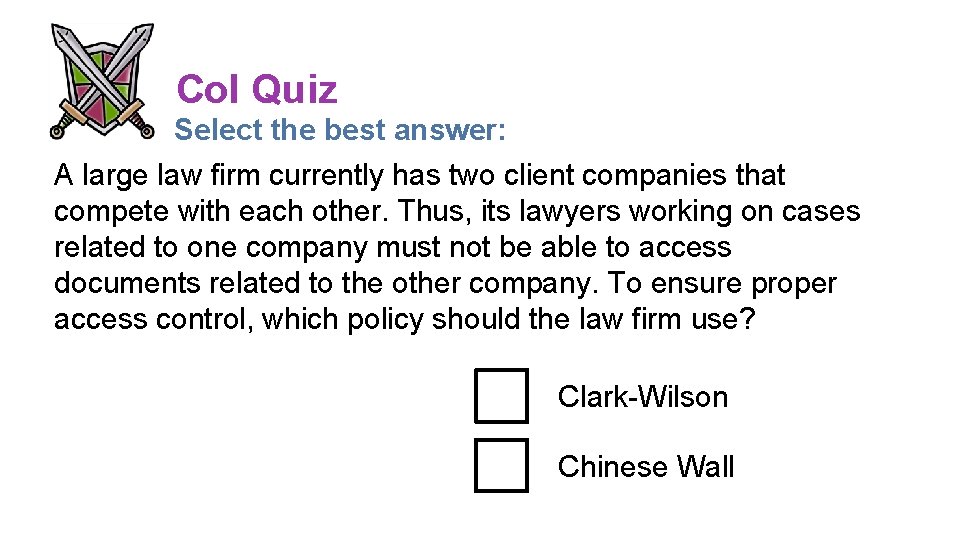
Co. I Quiz Select the best answer: A large law firm currently has two client companies that compete with each other. Thus, its lawyers working on cases related to one company must not be able to access documents related to the other company. To ensure proper access control, which policy should the law firm use? Clark-Wilson Chinese Wall
RBAC Quiz Select the best answer: Role-based access control (RBAC) is often used in a commercial setting. RBAC is an example of MAC because. . . File permissions are associated only with roles and not users Only the company can decide roles of its employees
MAC Support Quiz Select the best answer(s): Which of the following operating systems supports a BLPlike model? SELinux Mac. OS Windows SCOMP
Trusted Computing Bases (TCB) Revisiting Trusted Computing Base (TCB) ● How do we know TCB can be trusted? ● Secure vs. trusted. vs high assurance ● Set of all hardware and software trusted to operate securely ● Required for all other trust in the system security policy
Trusted Computing Bases (TCB) Trusting Software: ● Functional correctness ● Does what it was designed to do ● Maintains data integrity ● Even for bad input ● Protects disclosure of sensitive data ● Does not pass to untrusted software ● Confidence ● Experts analyze program & assure trust ● Statement giving security we expect system to enforce ● Do this formally when and where possible
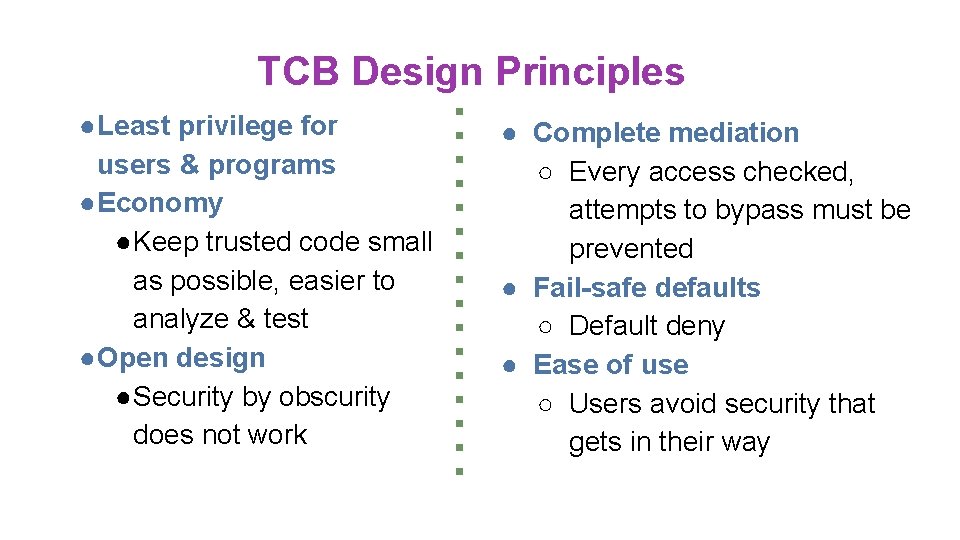
TCB Design Principles ●Least privilege for users & programs ●Economy ●Keep trusted code small as possible, easier to analyze & test ●Open design ●Security by obscurity does not work ● Complete mediation ○ Every access checked, attempts to bypass must be prevented ● Fail-safe defaults ○ Default deny ● Ease of use ○ Users avoid security that gets in their way
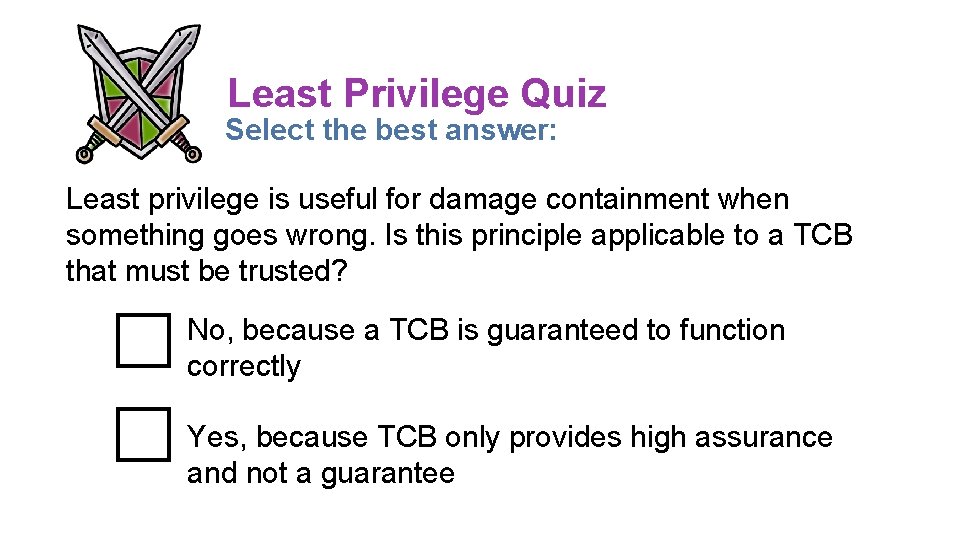
Least Privilege Quiz Select the best answer: Least privilege is useful for damage containment when something goes wrong. Is this principle applicable to a TCB that must be trusted? No, because a TCB is guaranteed to function correctly Yes, because TCB only provides high assurance and not a guarantee
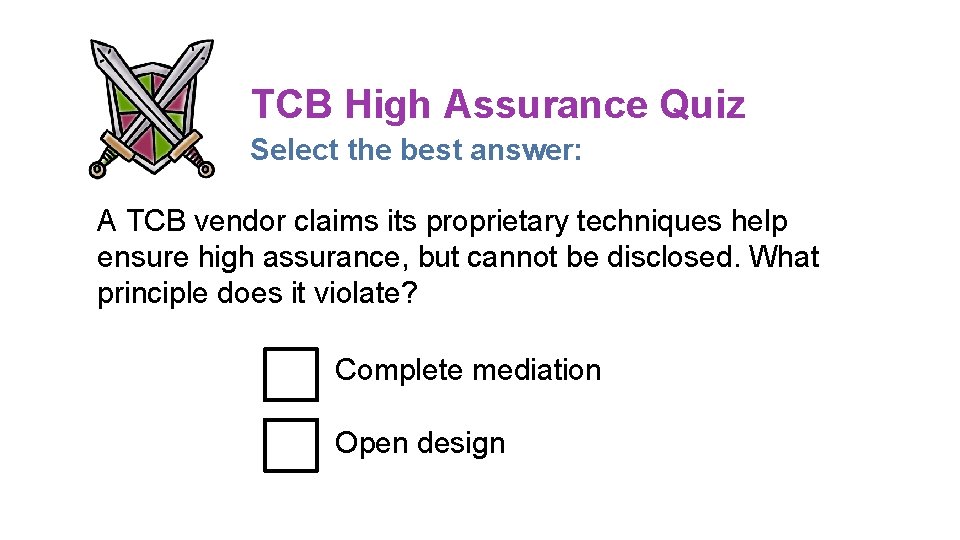
TCB High Assurance Quiz Select the best answer: A TCB vendor claims its proprietary techniques help ensure high assurance, but cannot be disclosed. What principle does it violate? Complete mediation Open design
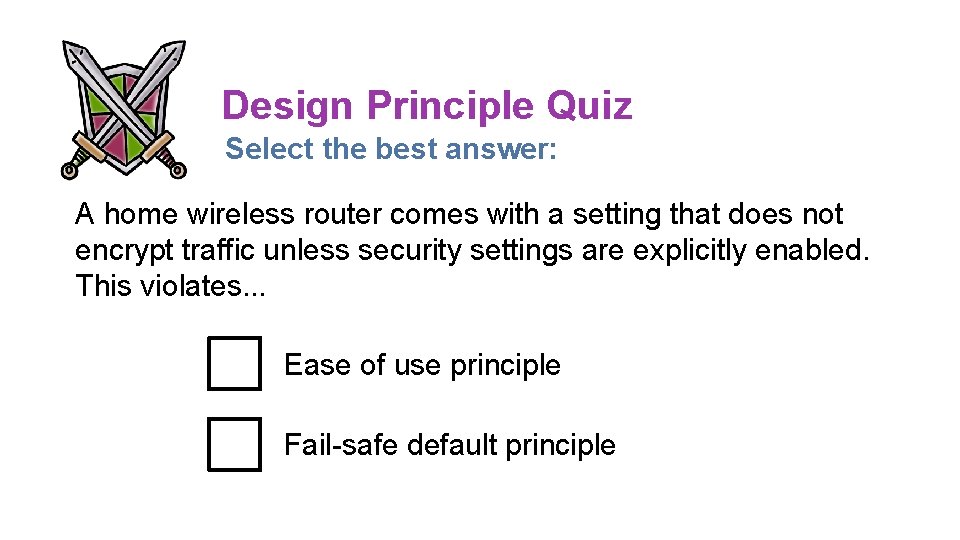
Design Principle Quiz Select the best answer: A home wireless router comes with a setting that does not encrypt traffic unless security settings are explicitly enabled. This violates. . . Ease of use principle Fail-safe default principle
How Do We Build a TCB: Support Key Security Features ●Must implement certain security relevant functions ●Authentication ●Access control to files & general objects ●Mandatory access control (SELinux) ●Discretionary access control (standard file permissions)
How Do We Build a TCB: Support Key Security Features ● Protection of data used by OS (OS must protect itself) ● Security features of trusted OSes ● Object reuse protection ● Disk blocks, memory frames reused ● Process can allocate disk or memory, then look to see what's left behind ● Trusted OS should zero out objects before reuse ● Secure file deletion: overwrite with varying patterns of zeros & ones ● Secure disk destruction: degaussing, physical destruction
How Do We Build a TCB: Support Key Security Features ●Complete mediation of accesses ●Trusted path from user to secure system ●Prevents programs from spoofing interface of secure components ●Prevents programs from tapping path (e. g. keyloggers) ●Audit log showing object accesses – only useful if you /look/ at the log ●Detect unusual use of the system
Kernel Design ●Security kernel enforces all security mechanisms ●Good isolation, small size for verifiability, keeps security code together ●Reference monitor controls access to objects (monitors all references to objects) ●Tamperproof [impossible to break or disable] ●Un-Bypassable [always invoked, complete mediation] ●Analyzable [small enough to analyze & understand]
Kernel Design What is included in the trusted computing base (TCB)? ● All parts of OS needed for correct enforcement of security policy ● Handles primitive I/O, clocks, interrupt handling, hardware capabilities, label checking ● Virtualization ● Virtual machine provides hardware isolation, logical OS separation
Revisiting Assurance: Ways of convincing ourselves that a model, design, & implementation are correct Methods of assurance validation: ●Testing /Penetration testing ●Formal verification Validation ●Checking that developers have implemented all requirements ●Requirements checking, design & code reviews, system testing
Revisiting Assurance Testing: ●Demonstrate existence of problem ●Cannot demonstrate absence of problem ●Regression testing: ensure that alterations do not break existing functionality / performance (regression: “going backwards”)
Revisiting Assurance ● ● Challenges: Test case generation Code coverage Exponential number of different executions Different execution environments Penetration testing: ●Ethical hackers attempt to defeat security measures ●Cannot demonstrate absence of problem
Revisiting Assurance Formal verification: Checking a mathematical specification of program to ensure that security assertions hold. ●Model checking, automated theorem proving ●State variables w/ initial assignment, program specification describing how state changes, boolean predicates over state variables ●Difficulty: exponential time & space worst case complexity ●Model checking pioneers won the 2007 Turing Award
Reducing TCB Size Quiz Check all applicable answers: We discussed the need for reducing the size of the TCB. This helps with. . . Testing of the TCB Verification of the TCB Isolation of the TCB
Testing TCB Quiz Check the correct answer: Testing is challenging for a complex system like a TCB because of. . . It is hard to cover all executions It can show both existence and absence of problems
Model Checking Quiz A key problem with model checking is. . . It cannot show absence of a problem It does not scale to practical large size systems
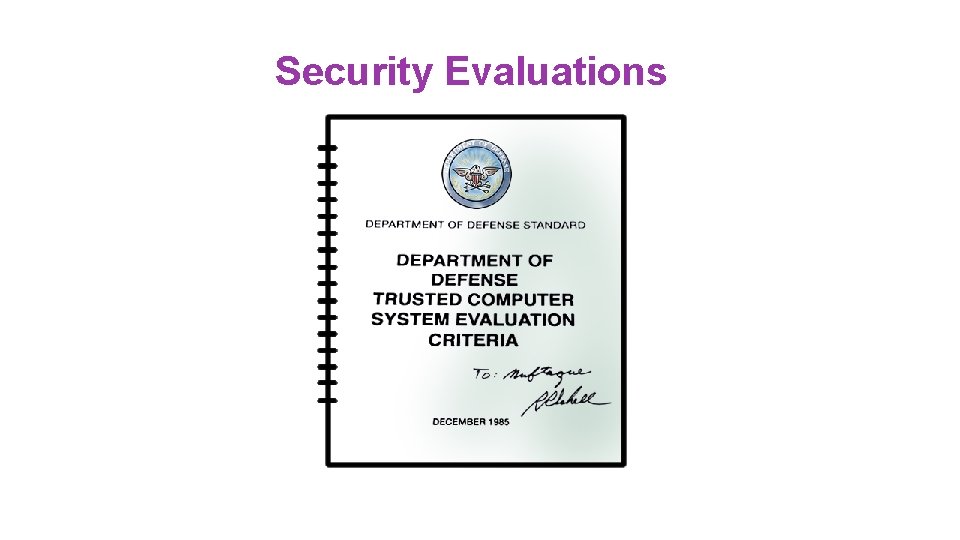
Security Evaluations
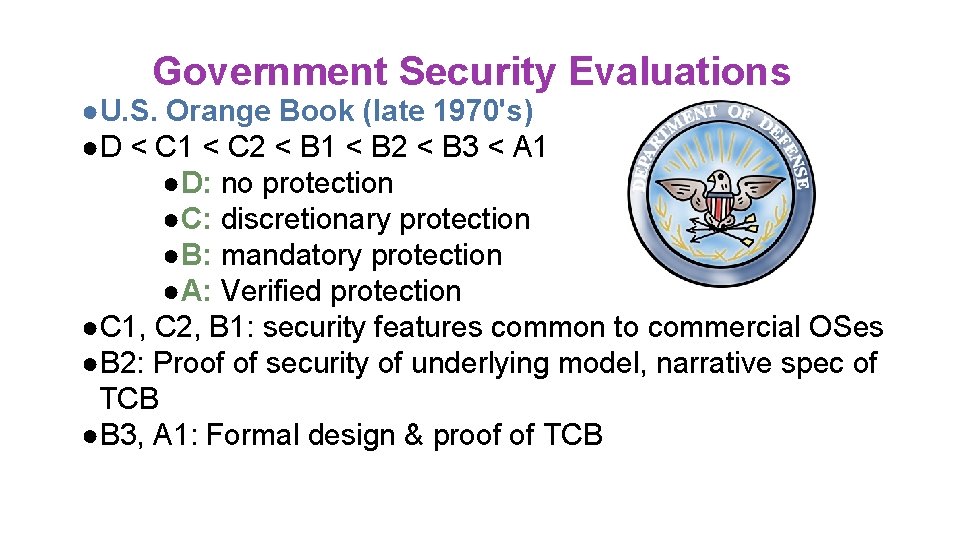
Government Security Evaluations ●U. S. Orange Book (late 1970's) ●D < C 1 < C 2 < B 1 < B 2 < B 3 < A 1 ●D: no protection ●C: discretionary protection ●B: mandatory protection ●A: Verified protection ●C 1, C 2, B 1: security features common to commercial OSes ●B 2: Proof of security of underlying model, narrative spec of TCB ●B 3, A 1: Formal design & proof of TCB
Government Security Evaluations Common Criteria (2005) international standard replaced orange book ●Originated out of European, Canadian, and US standards ●Idea: users specify system needs, vendors implement solution and make claims about security properties, evaluators determine whether vendors actually met claims ●Evaluation assurance level (EAL) rates systems ● EAL 1 most basic, EAL 7 most rigorous
TCSEC Divisions Quiz Many widely used operating systems do not support MAC and hence cannot be in a TCSEC division higher than. . . D C
Earning an EAL 4 Certification Quiz How did VMware v. Cloud Networking and Security v 5. 5 system receive an EAL 4+ certification? The system developers used formal techniques in its design and testing A systematic review and testing process was used by the system developers
Cost-Benefit Certification Tradeoffs Quiz Many OS vendors do not aim for the highest certifications because. . . There is no market demand for such certifications Cost/benefit tradeoffs dictate the highest certification
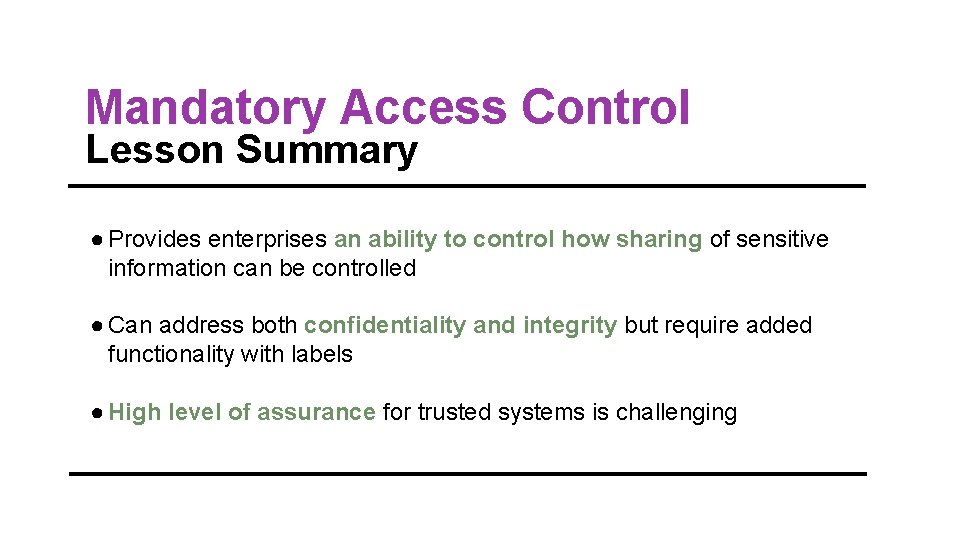
Mandatory Access Control Lesson Summary ● Provides enterprises an ability to control how sharing of sensitive information can be controlled ● Can address both confidentiality and integrity but require added functionality with labels ● High level of assurance for trusted systems is challenging