UNIT5 Cryptographic Hash Functions Prof R K Karangiya

- Slides: 36
UNIT-5 Cryptographic Hash Functions Prof. R. K. Karangiya rekha. karangiya@darshan. ac. in Information & Network Security (2170709) Darshan Institute of Engineering & Technology
Outline § Cryptographic Hash Functions § Applications § Simple hash functions § Requirements and security § Hash functions based on Cipher Block Chaining § Secure Hash Algorithm (SHA) Unit-5 Cryptographic Hash Functions Darshan Institute of Engineering & Technology 2
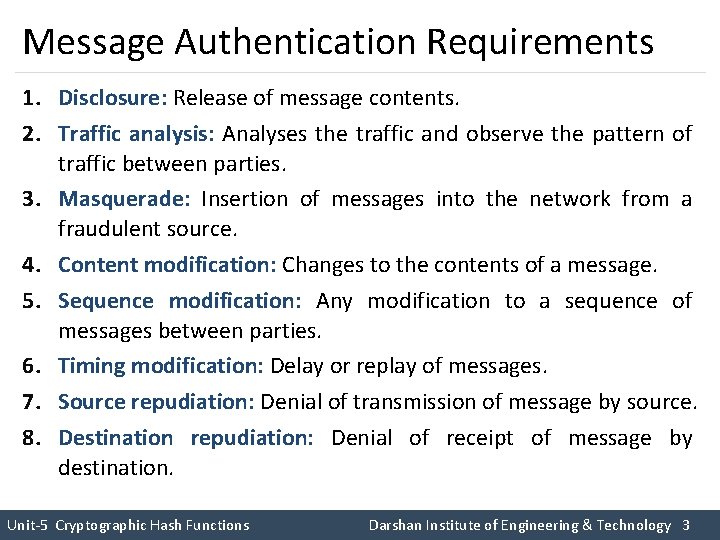
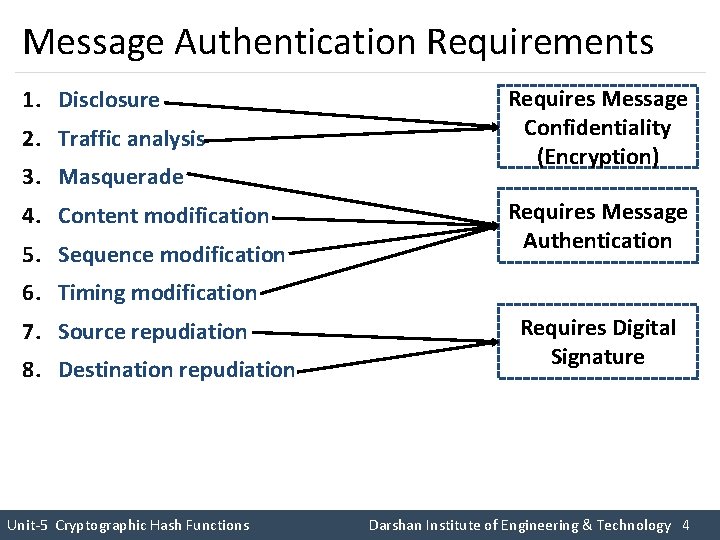
Message Authentication Requirements 1. Disclosure: Release of message contents. 2. Traffic analysis: Analyses the traffic and observe the pattern of traffic between parties. 3. Masquerade: Insertion of messages into the network from a fraudulent source. 4. Content modification: Changes to the contents of a message. 5. Sequence modification: Any modification to a sequence of messages between parties. 6. Timing modification: Delay or replay of messages. 7. Source repudiation: Denial of transmission of message by source. 8. Destination repudiation: Denial of receipt of message by destination. Unit-5 Cryptographic Hash Functions Darshan Institute of Engineering & Technology 3
Message Authentication Requirements 1. Disclosure 2. Traffic analysis 3. Masquerade 4. Content modification 5. Sequence modification Requires Message Confidentiality (Encryption) Requires Message Authentication 6. Timing modification 7. Source repudiation 8. Destination repudiation Unit-5 Cryptographic Hash Functions Requires Digital Signature Darshan Institute of Engineering & Technology 4
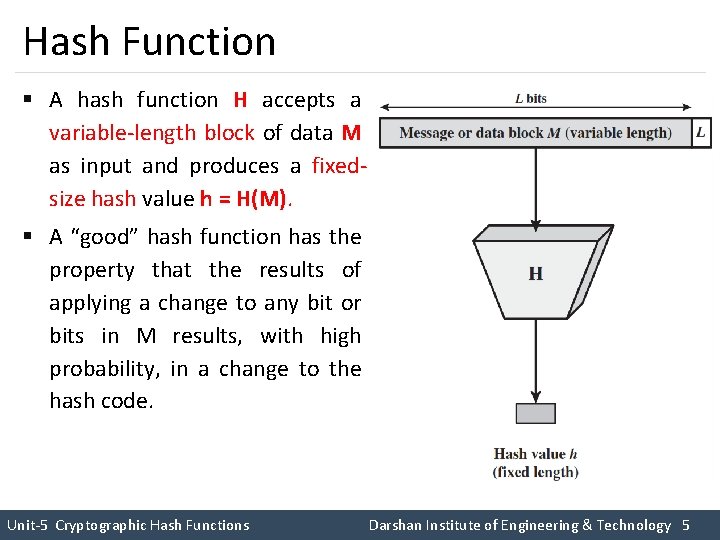
Hash Function § A hash function H accepts a variable-length block of data M as input and produces a fixedsize hash value h = H(M). § A “good” hash function has the property that the results of applying a change to any bit or bits in M results, with high probability, in a change to the hash code. Unit-5 Cryptographic Hash Functions Darshan Institute of Engineering & Technology 5
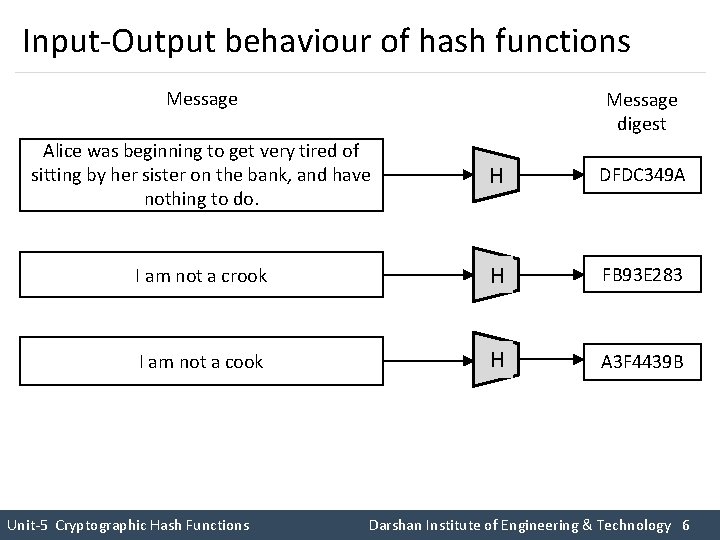
Input-Output behaviour of hash functions Message digest Alice was beginning to get very tired of sitting by her sister on the bank, and have nothing to do. H DFDC 349 A I am not a crook H FB 93 E 283 I am not a cook H A 3 F 4439 B Unit-5 Cryptographic Hash Functions Darshan Institute of Engineering & Technology 6
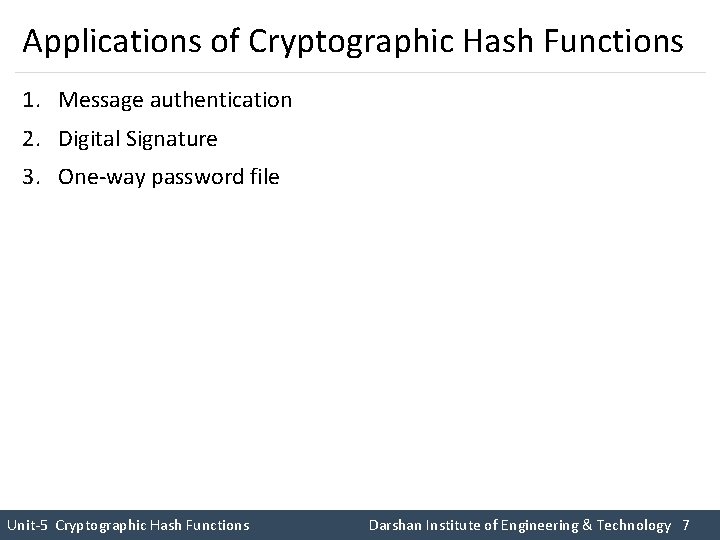
Applications of Cryptographic Hash Functions 1. Message authentication 2. Digital Signature 3. One-way password file Unit-5 Cryptographic Hash Functions Darshan Institute of Engineering & Technology 7
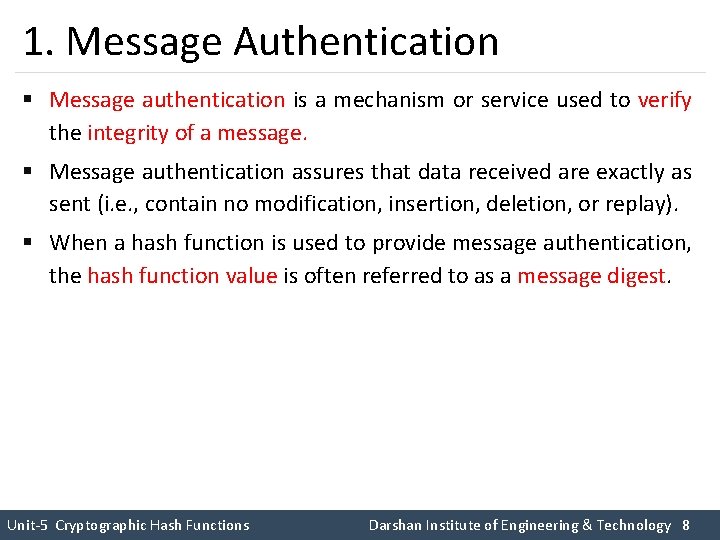
1. Message Authentication § Message authentication is a mechanism or service used to verify the integrity of a message. § Message authentication assures that data received are exactly as sent (i. e. , contain no modification, insertion, deletion, or replay). § When a hash function is used to provide message authentication, the hash function value is often referred to as a message digest. Unit-5 Cryptographic Hash Functions Darshan Institute of Engineering & Technology 8
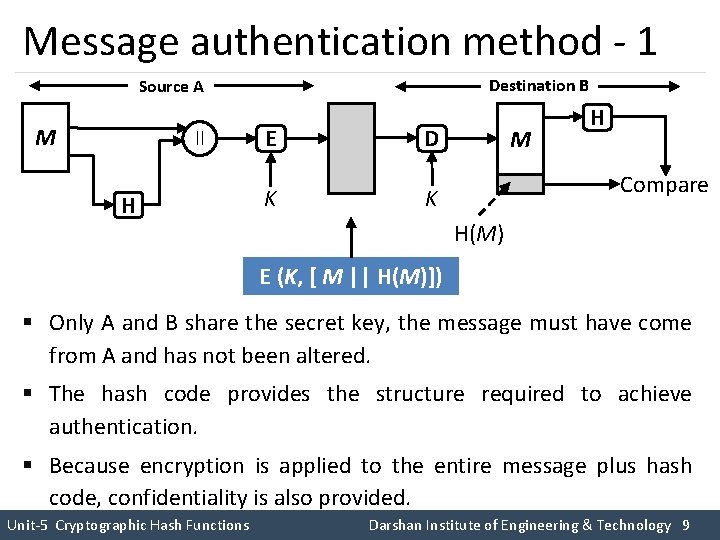
Message authentication method - 1 Destination B Source A M ll H E K D M H Compare K H(M) E (K, [ M || H(M)]) § Only A and B share the secret key, the message must have come from A and has not been altered. § The hash code provides the structure required to achieve authentication. § Because encryption is applied to the entire message plus hash code, confidentiality is also provided. Unit-5 Cryptographic Hash Functions Darshan Institute of Engineering & Technology 9
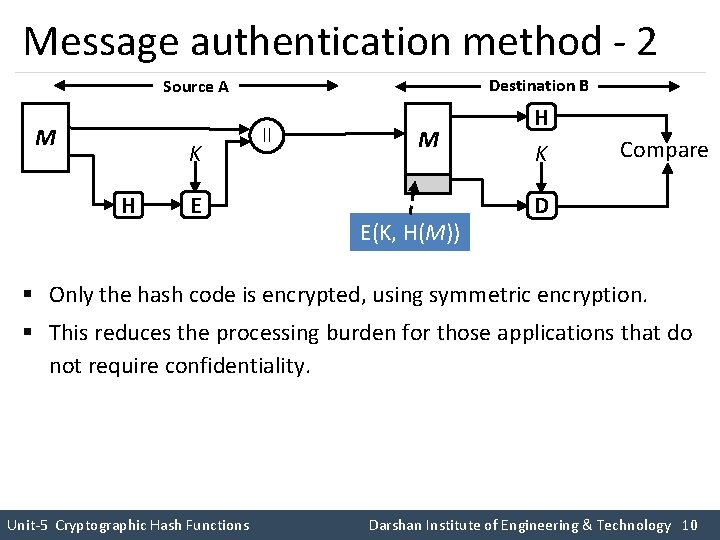
Message authentication method - 2 Destination B Source A M K H E ll M E(K, H(M)) H K Compare D § Only the hash code is encrypted, using symmetric encryption. § This reduces the processing burden for those applications that do not require confidentiality. Unit-5 Cryptographic Hash Functions Darshan Institute of Engineering & Technology 10
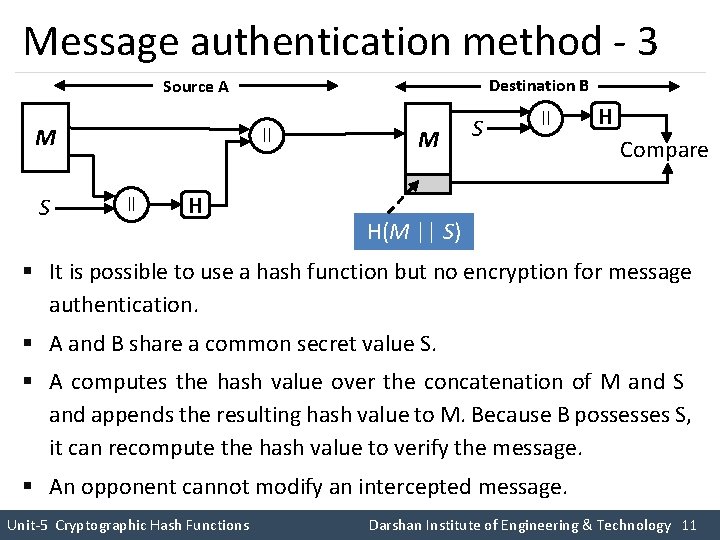
Message authentication method - 3 Destination B Source A M S ll ll H M S ll H Compare H(M || S) § It is possible to use a hash function but no encryption for message authentication. § A and B share a common secret value S. § A computes the hash value over the concatenation of M and S and appends the resulting hash value to M. Because B possesses S, it can recompute the hash value to verify the message. § An opponent cannot modify an intercepted message. Unit-5 Cryptographic Hash Functions Darshan Institute of Engineering & Technology 11
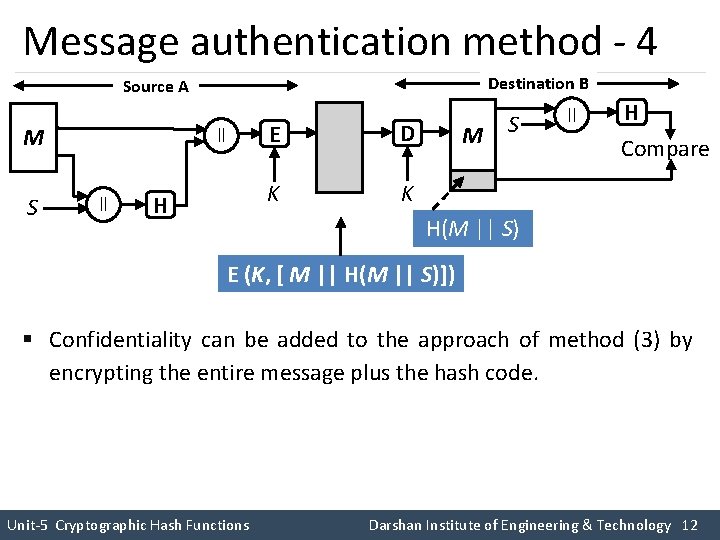
Message authentication method - 4 Destination B Source A M S ll ll H E D K K M S ll H Compare H(M || S) E (K, [ M || H(M || S)]) § Confidentiality can be added to the approach of method (3) by encrypting the entire message plus the hash code. Unit-5 Cryptographic Hash Functions Darshan Institute of Engineering & Technology 12
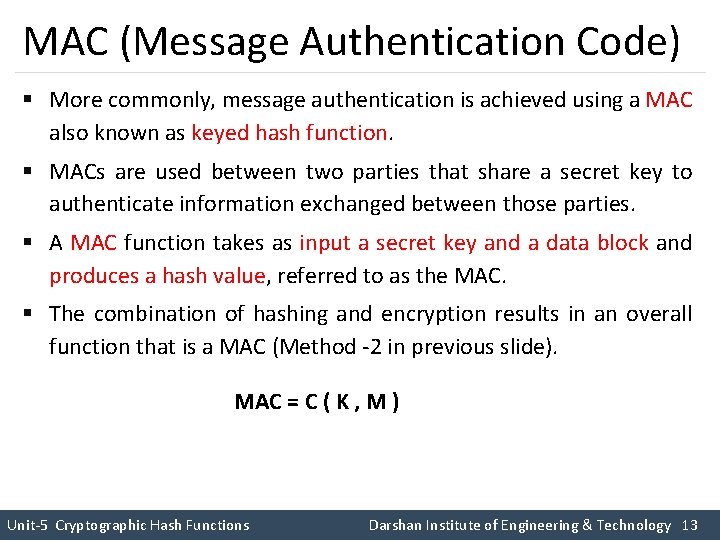
MAC (Message Authentication Code) § More commonly, message authentication is achieved using a MAC also known as keyed hash function. § MACs are used between two parties that share a secret key to authenticate information exchanged between those parties. § A MAC function takes as input a secret key and a data block and produces a hash value, referred to as the MAC. § The combination of hashing and encryption results in an overall function that is a MAC (Method -2 in previous slide). MAC = C ( K , M ) Unit-5 Cryptographic Hash Functions Darshan Institute of Engineering & Technology 13
Digital Signature § A digital signature is a mathematical technique used to validate the authenticity and integrity of a message, software or digital document. § The operation of the digital signature is similar to that of the MAC. § In the case of the digital signature, the hash value of a message is encrypted with a user’s private key. § Anyone who knows the user’s public key can verify the integrity of the message that is associated with the digital signature. Unit-5 Cryptographic Hash Functions Darshan Institute of Engineering & Technology 14
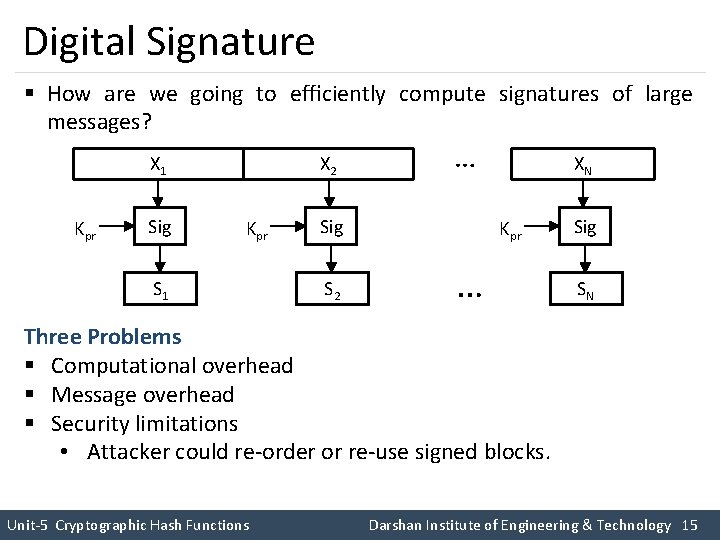
Digital Signature § How are we going to efficiently compute signatures of large messages? X 1 Kpr Sig X 2 Kpr S 1 … Sig S 2 XN Kpr … Sig SN Three Problems § Computational overhead § Message overhead § Security limitations • Attacker could re-order or re-use signed blocks. Unit-5 Cryptographic Hash Functions Darshan Institute of Engineering & Technology 15
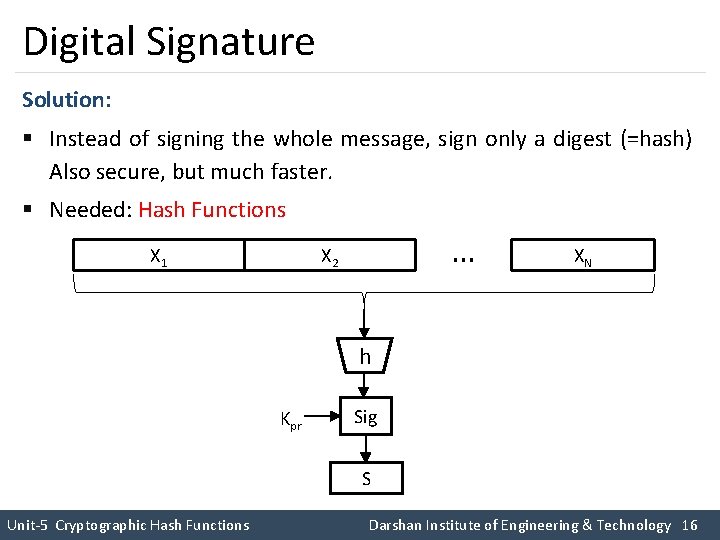
Digital Signature Solution: § Instead of signing the whole message, sign only a digest (=hash) Also secure, but much faster. § Needed: Hash Functions X 1 … X 2 XN h Kpr Sig S Unit-5 Cryptographic Hash Functions Darshan Institute of Engineering & Technology 16
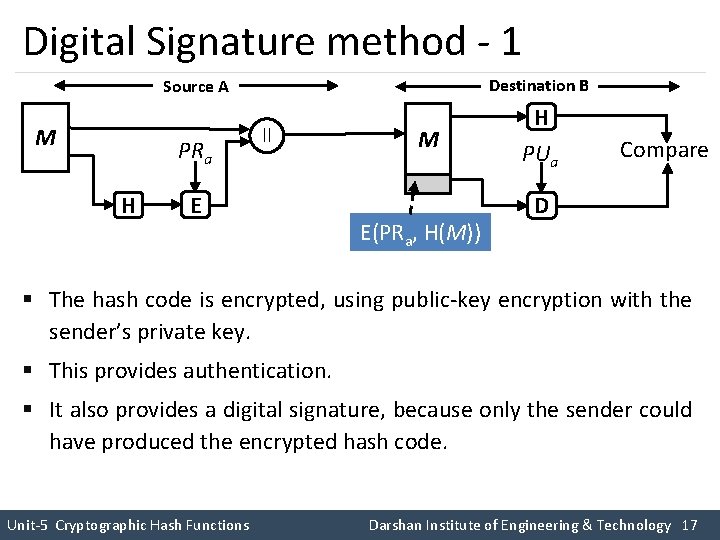
Digital Signature method - 1 M H Source A Destination B PRa H PUa ll E M E(PRa, H(M)) Compare D § The hash code is encrypted, using public-key encryption with the sender’s private key. § This provides authentication. § It also provides a digital signature, because only the sender could have produced the encrypted hash code. Unit-5 Cryptographic Hash Functions Darshan Institute of Engineering & Technology 17
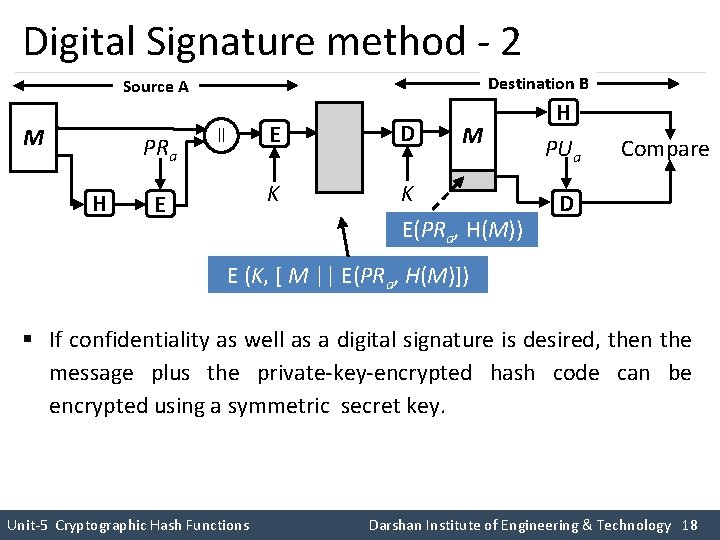
Digital Signature method - 2 Destination B Source A M PRa H ll E E D K K M E(PRa, H(M)) H PUa Compare D E (K, [ M || E(PRa, H(M)]) § If confidentiality as well as a digital signature is desired, then the message plus the private-key-encrypted hash code can be encrypted using a symmetric secret key. Unit-5 Cryptographic Hash Functions Darshan Institute of Engineering & Technology 18
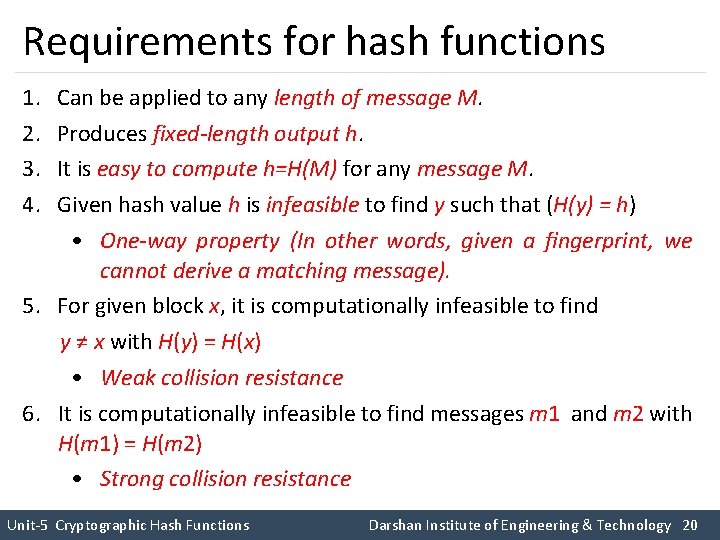
Requirements for hash functions 1. 2. 3. 4. Can be applied to any length of message M. Produces fixed-length output h. It is easy to compute h=H(M) for any message M. Given hash value h is infeasible to find y such that (H(y) = h) • One-way property (In other words, given a fingerprint, we cannot derive a matching message). 5. For given block x, it is computationally infeasible to find y ≠ x with H(y) = H(x) • Weak collision resistance 6. It is computationally infeasible to find messages m 1 and m 2 with H(m 1) = H(m 2) • Strong collision resistance Unit-5 Cryptographic Hash Functions Darshan Institute of Engineering & Technology 20
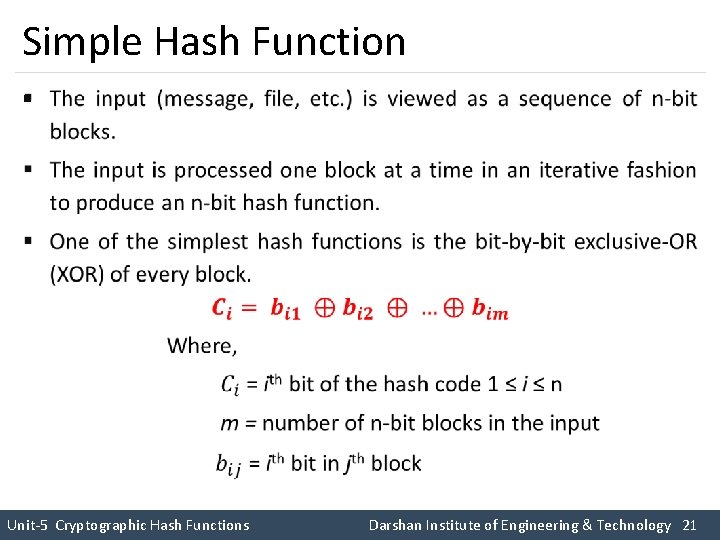
Simple Hash Function § Unit-5 Cryptographic Hash Functions Darshan Institute of Engineering & Technology 21
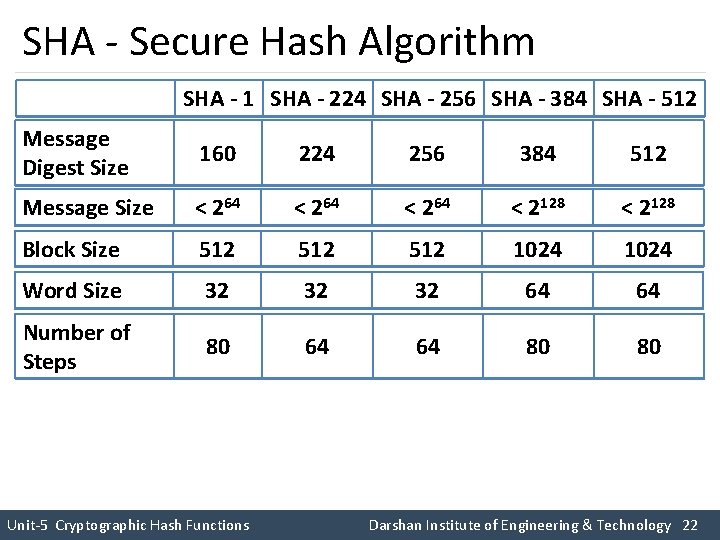
SHA - Secure Hash Algorithm SHA - 1 SHA - 224 SHA - 256 SHA - 384 SHA - 512 Message Digest Size 160 224 256 384 512 Message Size < 264 < 2128 Block Size 512 512 1024 Word Size 32 32 32 64 64 Number of Steps 80 64 64 80 80 Unit-5 Cryptographic Hash Functions Darshan Institute of Engineering & Technology 22
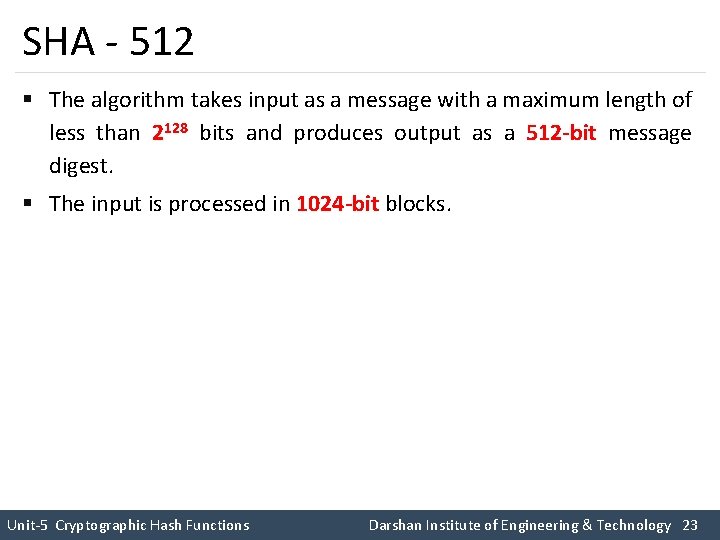
SHA - 512 § The algorithm takes input as a message with a maximum length of less than 2128 bits and produces output as a 512 -bit message digest. § The input is processed in 1024 -bit blocks. Unit-5 Cryptographic Hash Functions Darshan Institute of Engineering & Technology 23
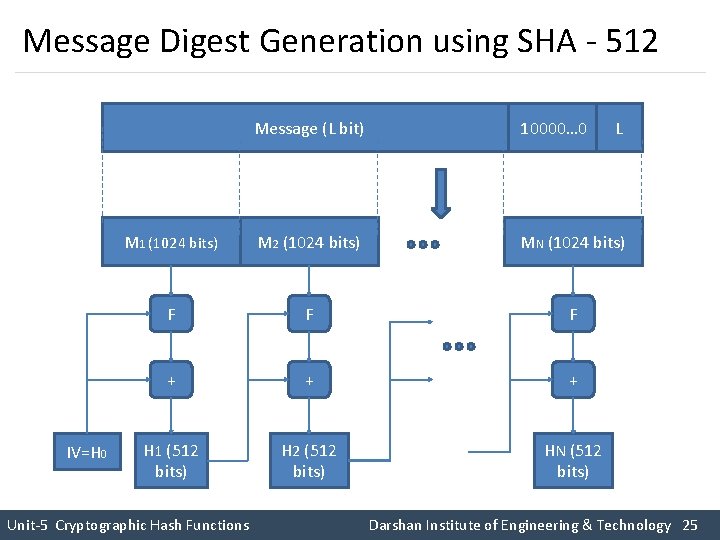
Message Digest Generation using SHA - 512 IV=H 0 Message (L bit) 10000… 0 M 1 (1024 bits) M 2 (1024 bits) MN (1024 bits) F F F + + + H 1 (512 bits) H 2 (512 bits) HN (512 bits) Unit-5 Cryptographic Hash Functions L Darshan Institute of Engineering & Technology 25
Step - 1 Append Padding Bits § The message is padded so that its length is congruent to 896 modulo 1024 [length ≡ 896(mod 1024)]. § Padding is always added, even if the message is already of the desired length. § Thus, the number of padding bits is in the range of 1 to 1024. § The padding consists of a single 1 bit followed by the necessary number of 0 bits. Unit-5 Cryptographic Hash Functions Darshan Institute of Engineering & Technology 26
Step - 2 Append Length § A block of 128 bits is appended to the message. § This block is treated as an unsigned 128 -bit integer (most significant byte first) and contains the length of the original message (before the padding). Unit-5 Cryptographic Hash Functions Darshan Institute of Engineering & Technology 27
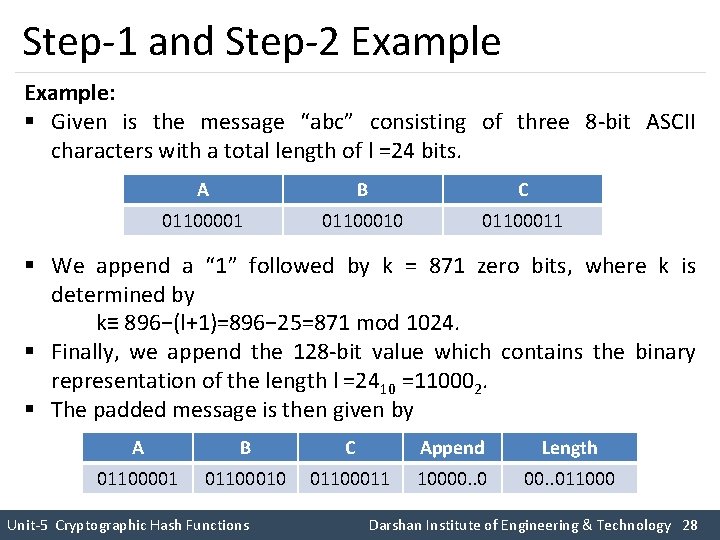
Step-1 and Step-2 Example: § Given is the message “abc” consisting of three 8 -bit ASCII characters with a total length of l =24 bits. A B C 01100001 01100010 01100011 § We append a “ 1” followed by k = 871 zero bits, where k is determined by k≡ 896−(l+1)=896− 25=871 mod 1024. § Finally, we append the 128 -bit value which contains the binary representation of the length l =2410 =110002. § The padded message is then given by A B C Append Length 01100001 01100010 01100011 10000. . 011000 Unit-5 Cryptographic Hash Functions Darshan Institute of Engineering & Technology 28
Step - 3 Initialize hash buffer § The outcome of the first two steps produces a message that is an integer multiple of 1024 bits in length. § The expanded message is represented as the sequence of 1024 -bit blocks M 1 , M 2, … , MN, so that the total length of expanded message is N X 1024 bits. § A 512 -bit buffer is used to hold intermediate and final results of the hash function. The buffer can be represented as eight 64 -bit registers (a, b, c, d, e, f, g, h). Unit-5 Cryptographic Hash Functions Darshan Institute of Engineering & Technology 29
Step - 4 Process message in 1024 -bit (128 -word) blocks § The heart of the algorithm is a module that consists of 80 rounds and this module is labelled as F function. Unit-5 Cryptographic Hash Functions Darshan Institute of Engineering & Technology 30
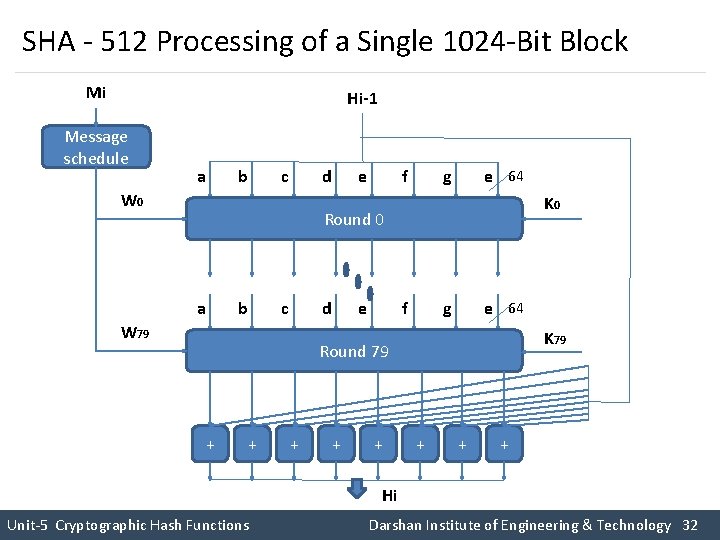
SHA - 512 Processing of a Single 1024 -Bit Block Mi Hi-1 Message schedule a b c d W 0 e f g e 64 K 0 Round 0 a b c d W 79 e f g e 64 K 79 Round 79 + + + + Hi Unit-5 Cryptographic Hash Functions Darshan Institute of Engineering & Technology 32
SHA - 512 Processing of a Single 1024 -Bit Block § Each round takes as input the 512 -bit buffer value, abcdefgh, and updates the contents of the buffer. § At input to the first round, the buffer has the value of the intermediate hash value, Hi-1. § Each round t makes use of a 64 -bit value Wt, derived from the current 1024 -bit block being processed. § The output of the eightieth round is added to the input to the first round (Hi-1) to produce Hi. Unit-5 Cryptographic Hash Functions Darshan Institute of Engineering & Technology 33
Step – 5 Output § After all Nth block of 1024 -bit have been processed, the output from the Nth stage is the 512 -bit message digest. Unit-5 Cryptographic Hash Functions Darshan Institute of Engineering & Technology 34
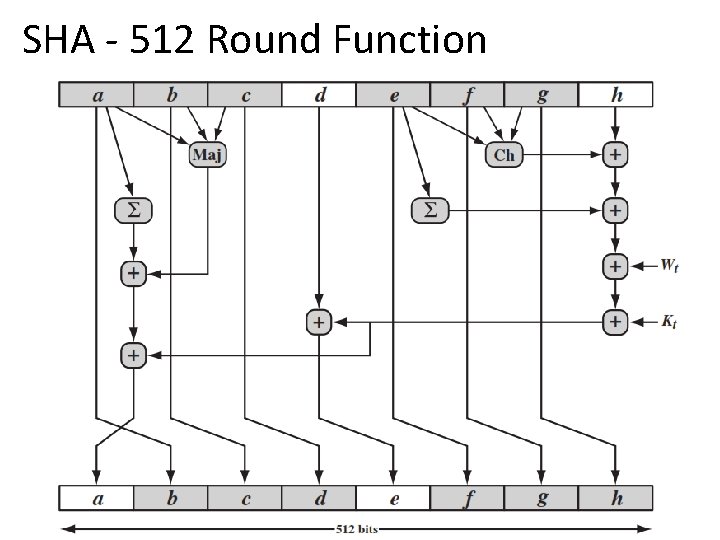
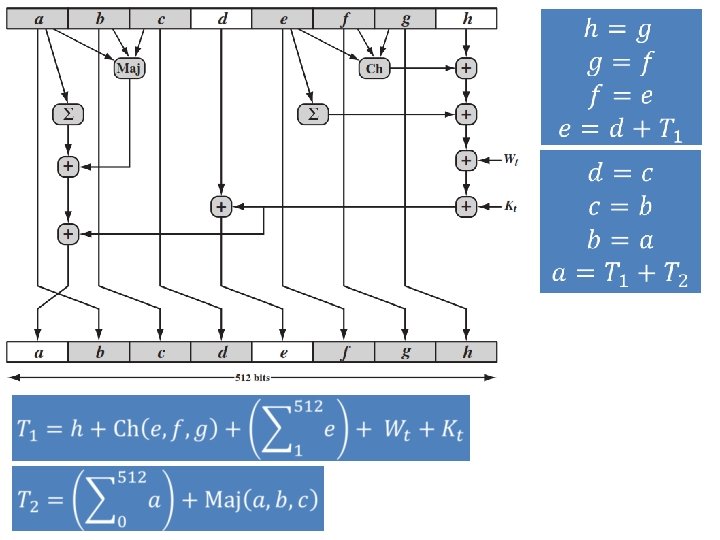
SHA - 512 Round Function
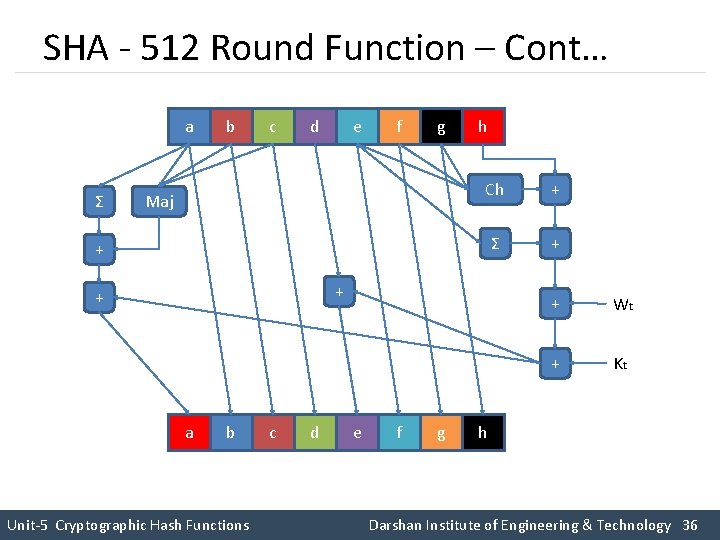
SHA - 512 Round Function – Cont… a Ʃ b c d e f g Maj h Ch + Ʃ + + a b Unit-5 Cryptographic Hash Functions c d e f g + Wt + Kt h Darshan Institute of Engineering & Technology 36
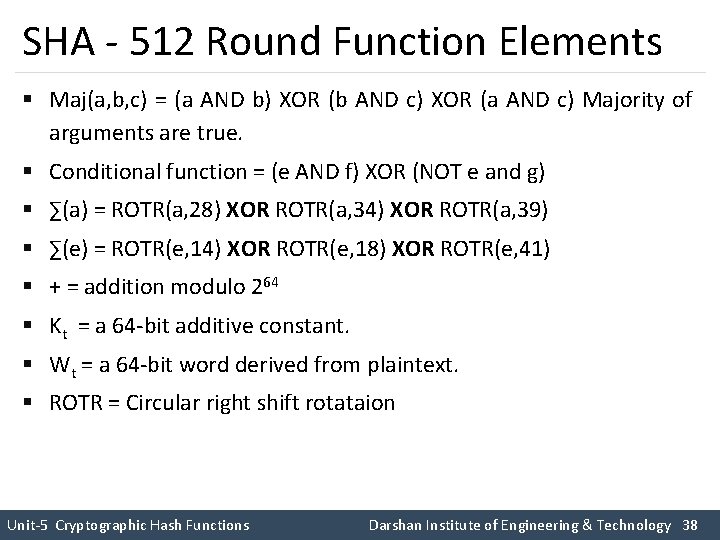
SHA - 512 Round Function Elements § Maj(a, b, c) = (a AND b) XOR (b AND c) XOR (a AND c) Majority of arguments are true. § Conditional function = (e AND f) XOR (NOT e and g) § ∑(a) = ROTR(a, 28) XOR ROTR(a, 34) XOR ROTR(a, 39) § ∑(e) = ROTR(e, 14) XOR ROTR(e, 18) XOR ROTR(e, 41) § + = addition modulo 264 § Kt = a 64 -bit additive constant. § Wt = a 64 -bit word derived from plaintext. § ROTR = Circular right shift rotataion Unit-5 Cryptographic Hash Functions Darshan Institute of Engineering & Technology 38