
Introduction 1 Cryptography Cryptography can reformat and transform

- Slides: 34
Introduction 1
Cryptography • Cryptography can reformat and transform our data, making it safer on its trip between computers. • The technology is based on the essentials of secret codes, augmented by modern mathematics that protects our data in powerful ways. – Computer Security - generic name for the collection of tools designed to protect data and to thwart hackers – Network Security - measures to protect data during their transmission – Internet Security - measures to protect data during their transmission over a collection of interconnected networks
Three aspects of information security: • Security attack – Any action that compromises the security of information owned by an organization. • Security mechanism – A mechanism that is designed to detect, prevent or recover from a security attack. • Security service – A service that enhances the security of the data processing systems and the information transfers of an organization.
Basic Terms • Plaintext The original intelligible message • Cipher text The transformed message • Cipher An algorithm for transforming an intelligible message into one that is unintelligible by transposition and/or substitution methods • Key Some critical information used by the cipher, known only to the sender& receiver • Encipher (encode) The process of converting plaintext to cipher text using a cipher and a key • Decipher (decode) the process of converting cipher text back into plaintext using a cipher and a key • Cryptanalysis The study of principles and methods of transforming an unintelligible message back into an intelligible message without knowledge of the key. Also called code breaking
Classifications • Type of operations – Substitution, in which each element in the plaintext is mapped into another element – Transposition, in which elements in the plaintext are rearranged. • The number of keys used – If the sender and receiver uses same key then it is said to be symmetric key (or) single key (or) conventional encryption. – If the sender and receiver use different keys then it is said to be public key encryption. • The way in which the plain text is processed – A block cipher processes the input and block of elements at a time, producing output block for each input block. – A stream cipher processes the input elements continuously, producing output element one at a time, as it goes along.
SECURITY SERVICES • Confidentiality: Ensures that the information in a computer system and transmitted information are accessible only for reading by authorized parties. • Authentication: Ensures that the origin of a message or electronic document is correctly identified, with an assurance that the identity is not false. • Integrity: Ensures that only authorized parties are able to modify computer system assets and transmitted information. Modification includes writing, changing status, deleting, creating and delaying or replaying of transmitted messages. • Non repudiation: Requires that neither the sender nor the receiver of a message be able to deny the transmission. • Access control: Requires that access to information resources may be controlled by or the target system. • Availability: Requires that computer system assets be available to authorized parties when needed.
SECURITY MECHANISMS • Encipherment • Digital Signature • Access Control
SECURITY ATTACKS • Interruption An asset of the system is destroyed or becomes unavailable or unusable. This is an attack on availability e. g. , destruction of piece of hardware, cutting of a communication line or Disabling of file management system. • Interception An unauthorized party gains access to an asset. This is an attack on confidentiality. Unauthorized party could be a person, a program or a computer. e. g. , wire tapping to capture data in the network, illicit copying of files • Modification An unauthorized party not only gains access to but tampers with an asset. This is an attack on integrity. e. g. , changing values in data file, altering a program, modifying the contents of messages being transmitted in a network. • Fabrication An unauthorized party inserts counterfeit objects into the system. This is an attack on authenticity. e. g. , insertion of spurious message in a network or addition of records to a file.
Cryptographic Attacks • Passive Attacks- The goal of the opponent is to obtain information that is being transmitted. – Passive attacks are of two types: • Release of message contents: A telephone conversation, an e-mail message and a transferred file may contain sensitive or confidential information. We would like to prevent the opponent from learning the contents of these transmissions. • Traffic analysis: If we had encryption protection in place, an opponent might still be able to observe the pattern of the message. The opponent could determine the location and identity of communication hosts and could observe the frequency and length of messages being exchanged. This information might be useful in guessing the nature of communication that was taking place. Passive attacks are very difficult to detect because they do not involve any alteration of data. However, it is feasible to prevent the success of these attacks
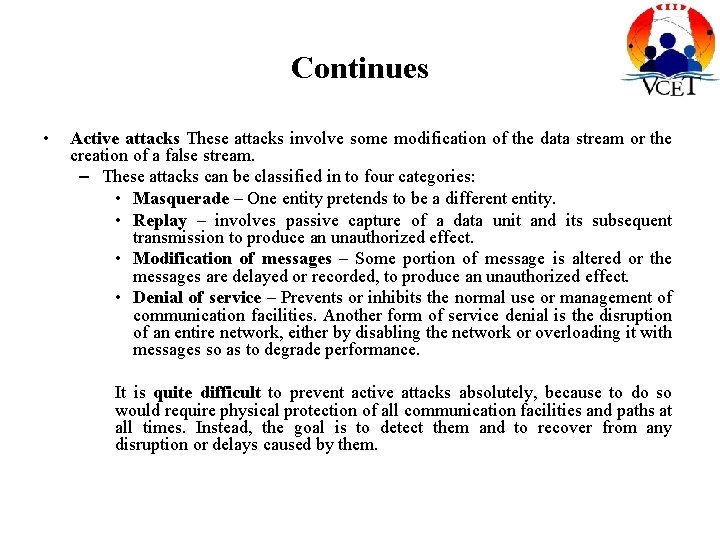
Continues • Active attacks These attacks involve some modification of the data stream or the creation of a false stream. – These attacks can be classified in to four categories: • Masquerade – One entity pretends to be a different entity. • Replay – involves passive capture of a data unit and its subsequent transmission to produce an unauthorized effect. • Modification of messages – Some portion of message is altered or the messages are delayed or recorded, to produce an unauthorized effect. • Denial of service – Prevents or inhibits the normal use or management of communication facilities. Another form of service denial is the disruption of an entire network, either by disabling the network or overloading it with messages so as to degrade performance. It is quite difficult to prevent active attacks absolutely, because to do so would require physical protection of all communication facilities and paths at all times. Instead, the goal is to detect them and to recover from any disruption or delays caused by them.
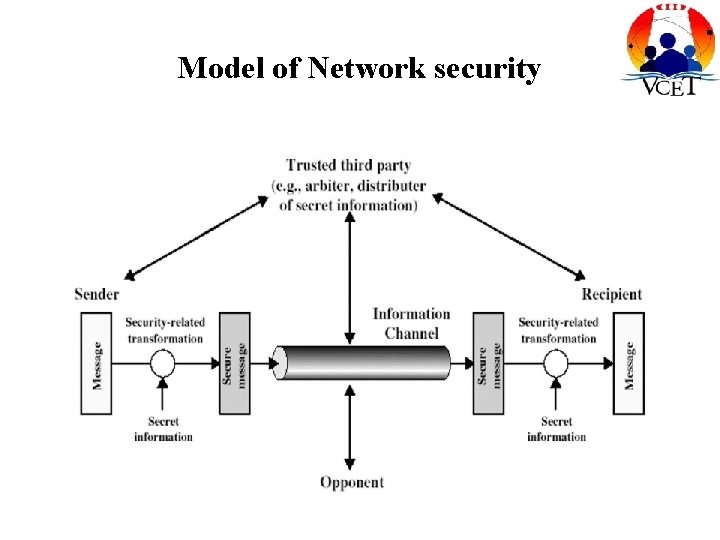
Model of Network security
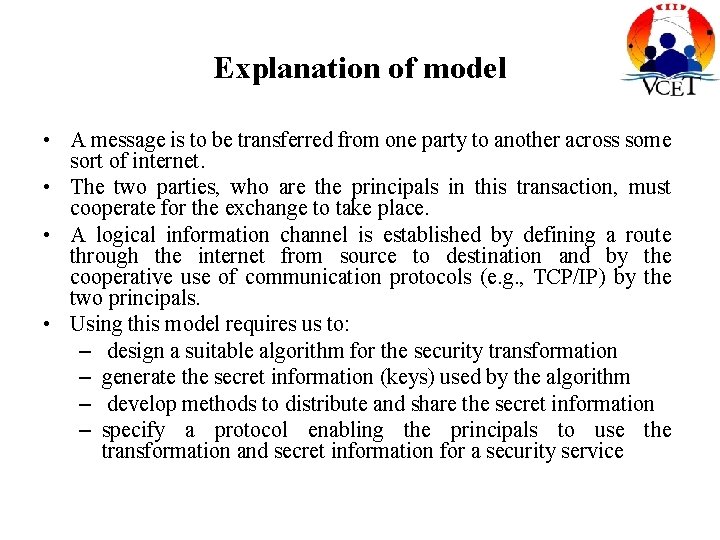
Explanation of model • A message is to be transferred from one party to another across some sort of internet. • The two parties, who are the principals in this transaction, must cooperate for the exchange to take place. • A logical information channel is established by defining a route through the internet from source to destination and by the cooperative use of communication protocols (e. g. , TCP/IP) by the two principals. • Using this model requires us to: – design a suitable algorithm for the security transformation – generate the secret information (keys) used by the algorithm – develop methods to distribute and share the secret information – specify a protocol enabling the principals to use the transformation and secret information for a security service
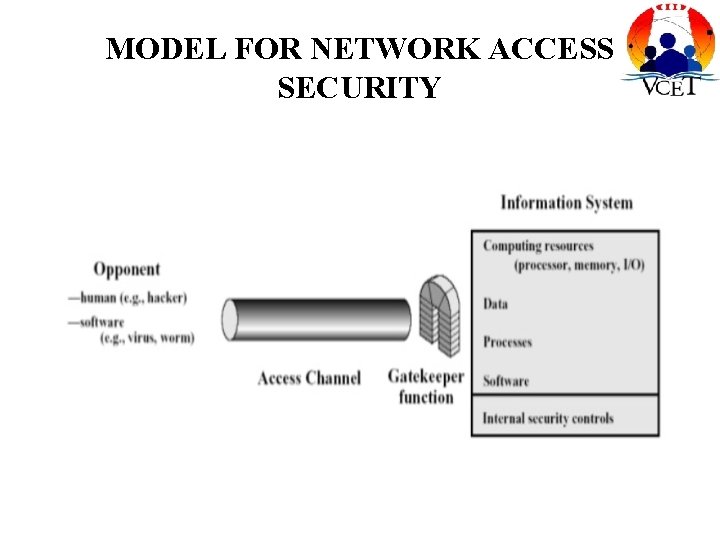
MODEL FOR NETWORK ACCESS SECURITY
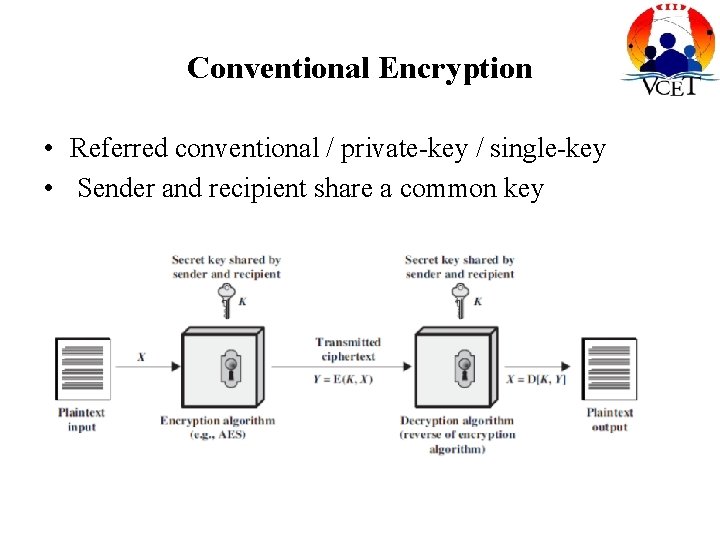
Conventional Encryption • Referred conventional / private-key / single-key • Sender and recipient share a common key
Continues • Two requirements for secure use of symmetric encryption: – A strong encryption algorithm – A secret key known only to sender / receiver – Classical encryption techniques classification • Substitution techniques-Replace one letter by other letter • Transposition techniques-Rearrange the letters of plain text • Steganography-Hide the message in the plain text
Substitution techniques – Caesar Cipher – Monoalphabetic – Polyalphabetic • Vigenere • Autokey • Vernam – Playfair – Hill – One timepad
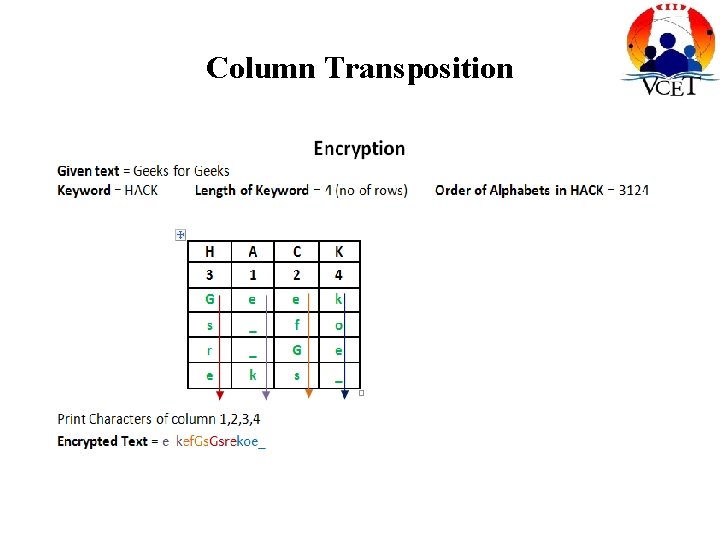
Transposition techniques – Railed Fence – Row Transposition – Column Transposition – Keyed Transposition
Column Transposition
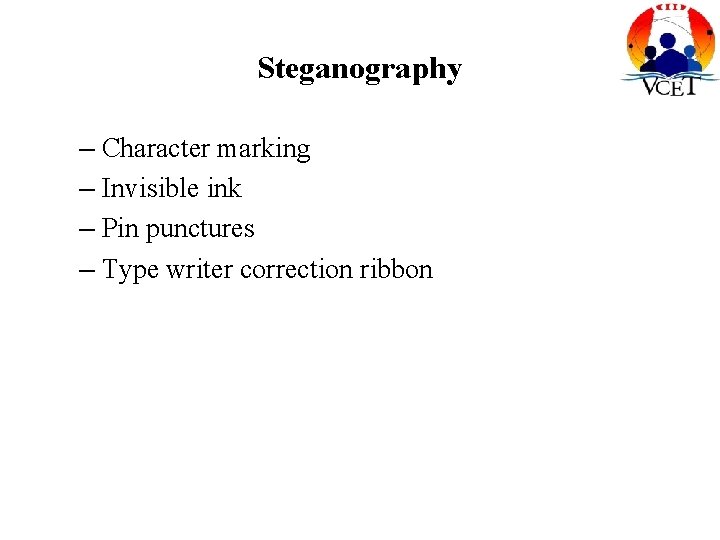
Steganography – Character marking – Invisible ink – Pin punctures – Type writer correction ribbon
Modern Cryptography • Modern cryptography is the cornerstone of computer and communications security. Classical cryptography was restricted to military. Modern cryptography is influences almost everyone. E. g. digital signatures, digital cash, secure voting • Its foundation is based on various concepts of mathematics such as – Number theory, – Computational-complexity theory, – Probability theory.
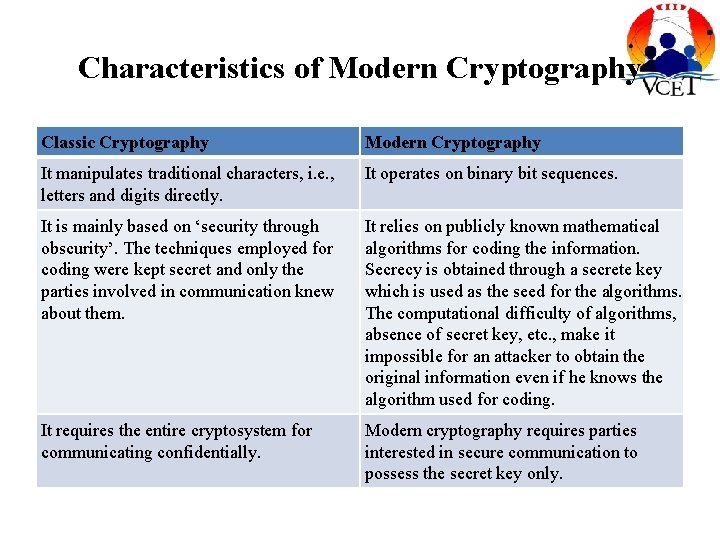
Characteristics of Modern Cryptography Classic Cryptography Modern Cryptography It manipulates traditional characters, i. e. , letters and digits directly. It operates on binary bit sequences. It is mainly based on ‘security through obscurity’. The techniques employed for coding were kept secret and only the parties involved in communication knew about them. It relies on publicly known mathematical algorithms for coding the information. Secrecy is obtained through a secrete key which is used as the seed for the algorithms. The computational difficulty of algorithms, absence of secret key, etc. , make it impossible for an attacker to obtain the original information even if he knows the algorithm used for coding. It requires the entire cryptosystem for communicating confidentially. Modern cryptography requires parties interested in secure communication to possess the secret key only.
Foundations of Modern Cryptography • Perfect Security or provable security � For any Cryptographic task, define security goals. � Formulate a strong security property (master property). � Argue that if certain standard cryptographic assumptions hold, then your protocol is secure with respect to the master property. � In other words, if there is an attack on your protocol, then that means that the standard cryptographic assumption does not hold (which is unlikely). � Some standard cryptographic assumptions: �AESis a pseudorandom permutation. �RSAis a one-way function. �Diffie-Hellman and discrete logarithm.
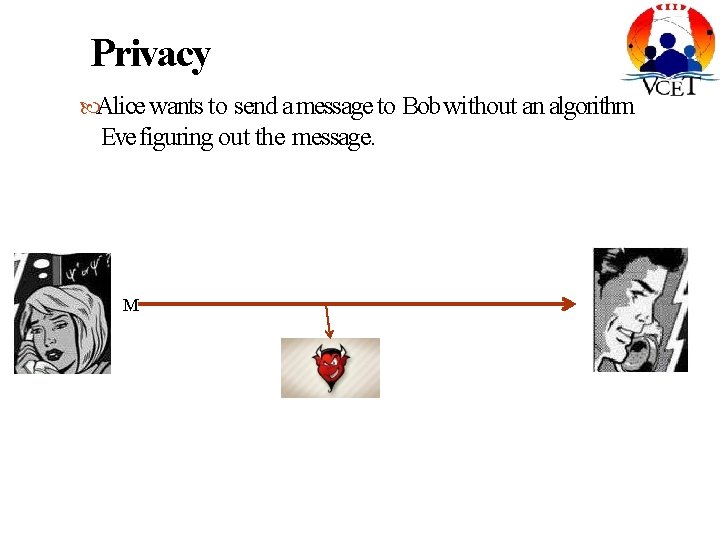
Privacy Alice wants to send a message to Bob without an algorithm Eve figuring out the message. M
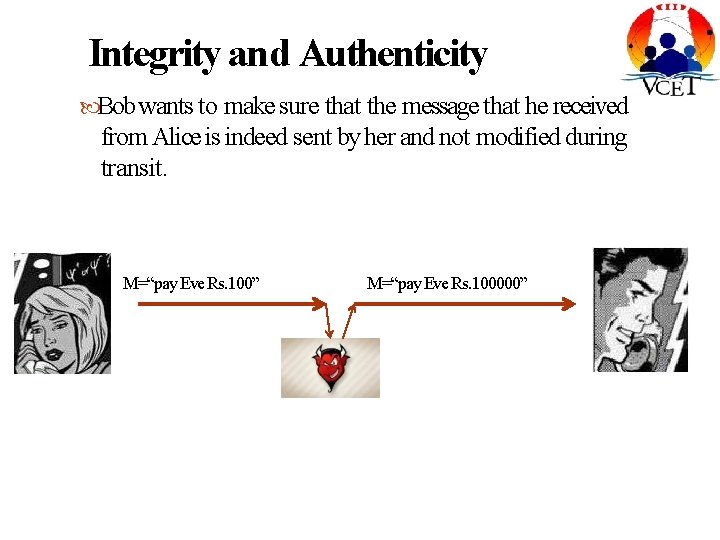
Integrity and Authenticity Bob wants to make sure that the message that he received from Alice is indeed sent by her and not modified during transit. M=“pay Eve Rs. 100” M=“pay Eve Rs. 100000”
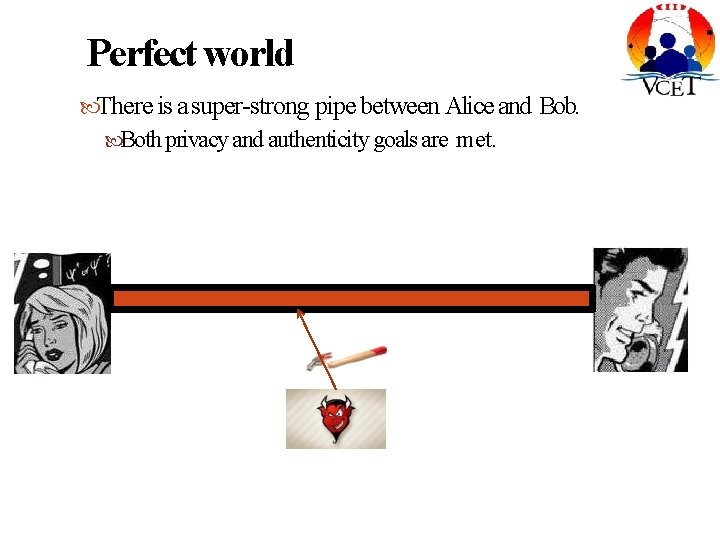
Perfect world There is a super-strong pipe between Alice and Bob. Both privacy and authenticity goals are met.
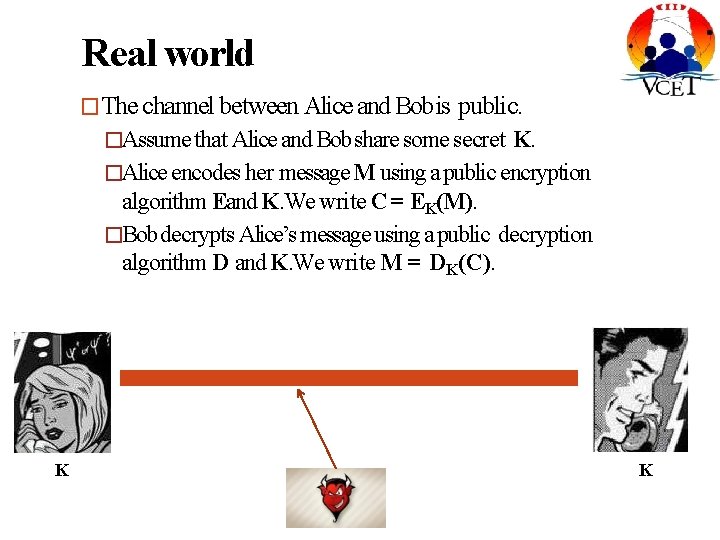
Real world �The channel between Alice and Bob is public. �Assume that Alice and Bob share some secret K. �Alice encodes her message M using a public encryption algorithm Eand K. We write C = EK(M). �Bob decrypts Alice’s message using a public decryption algorithm D and K. We write M = DK(C). K K
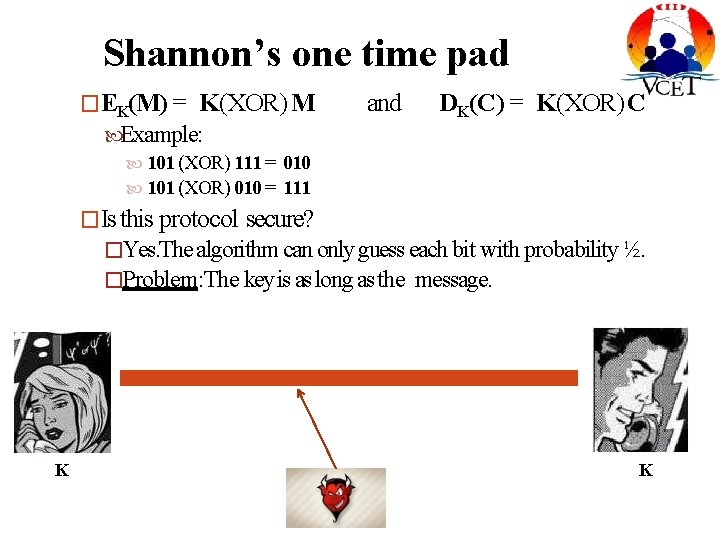
Shannon’s one time pad �EK(M) = K(XOR) M and DK(C) = K(XOR) C Example: 101 (XOR) 111 = 010 101 (XOR) 010 = 111 �Is this protocol secure? �Yes. The algorithm can only guess each bit with probability ½. �Problem: The key is as long as the message. K K
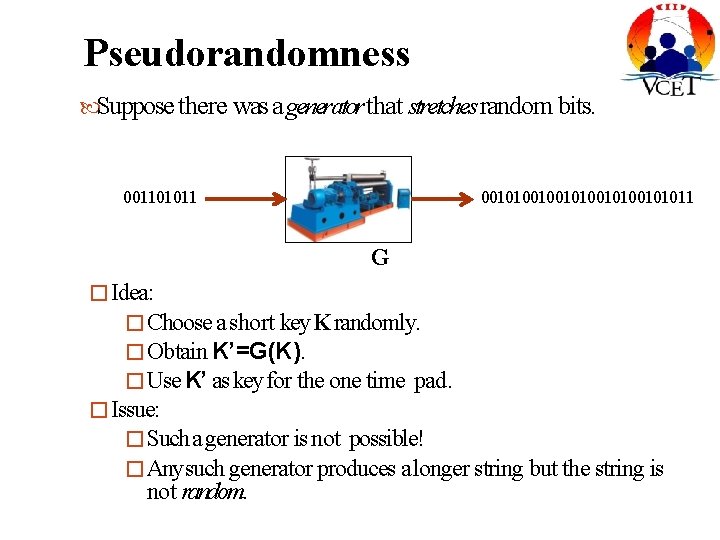
Pseudorandomness Suppose there was a generator that stretches random bits. 001101011 001010010100101011 G �Idea: �Choose a short key K randomly. �Obtain K’=G(K). �Use K’ as key for the one time pad. �Issue: �Such a generator is not possible! �Any such generator produces a longer string but the string is not random.
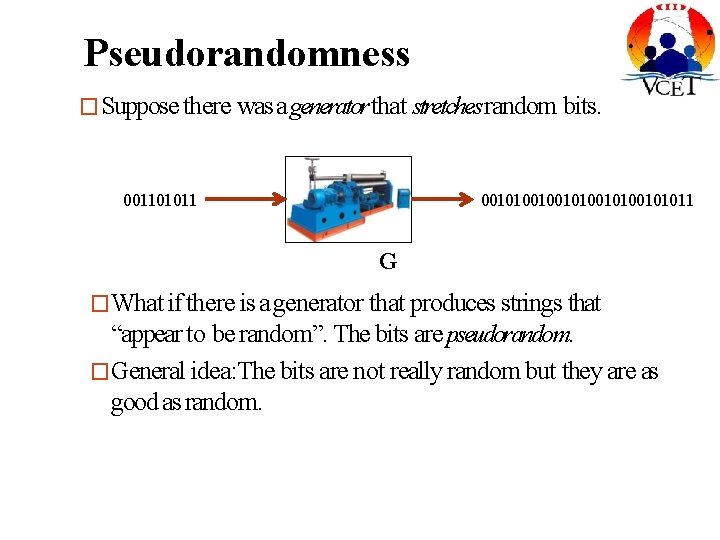
Pseudorandomness �Suppose there was a generator that stretches random bits. 001101011 001010010100101011 G �What if there is a generator that produces strings that “appear to be random”. The bits are pseudorandom. �General idea: The bits are not really random but they are as good as random.
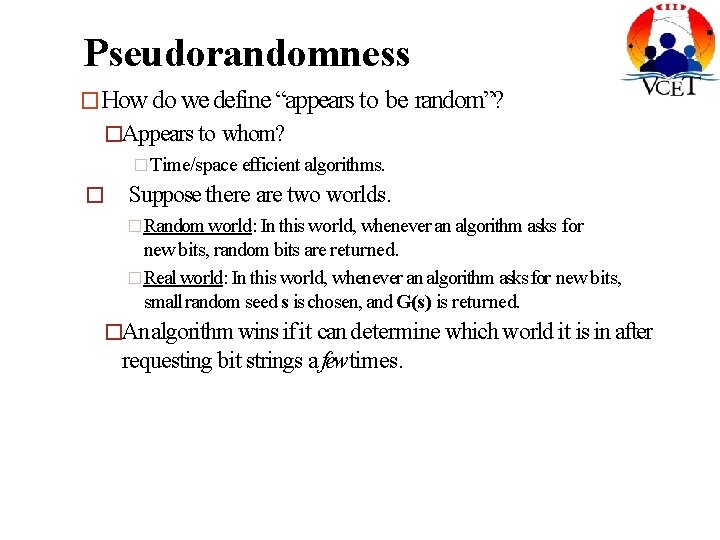
Pseudorandomness �How do we define “appears to be random”? �Appears to whom? �Time/space efficient algorithms. � Suppose there are two worlds. � Random world: In this world, whenever an algorithm asks for new bits, random bits are returned. �Real world: In this world, whenever an algorithm asks for new bits, small random seed s is chosen, and G(s) is returned. �An algorithm wins if it can determine which world it is in after requesting bit strings a few times.
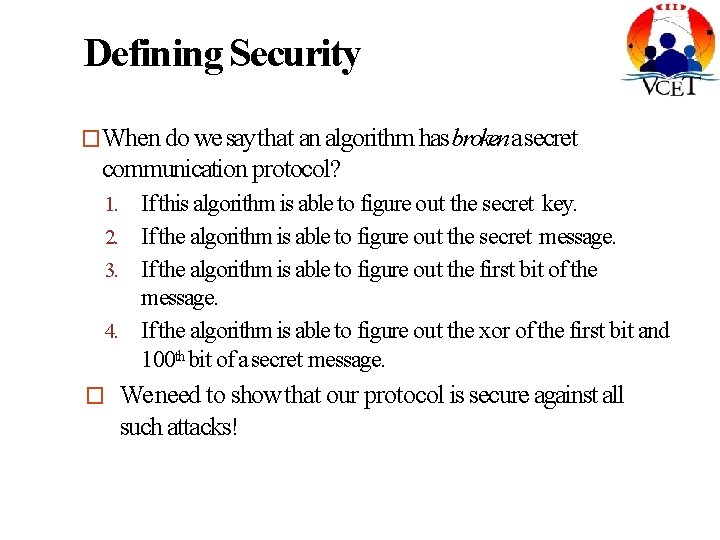
Defining Security �When do we say that an algorithm has brokena secret communication protocol? If this algorithm is able to figure out the secret key. 2. If the algorithm is able to figure out the secret message. 3. If the algorithm is able to figure out the first bit of the message. 4. If the algorithm is able to figure out the xor of the first bit and 100 th bit of a secret message. 1. � We need to show that our protocol is secure against all such attacks!
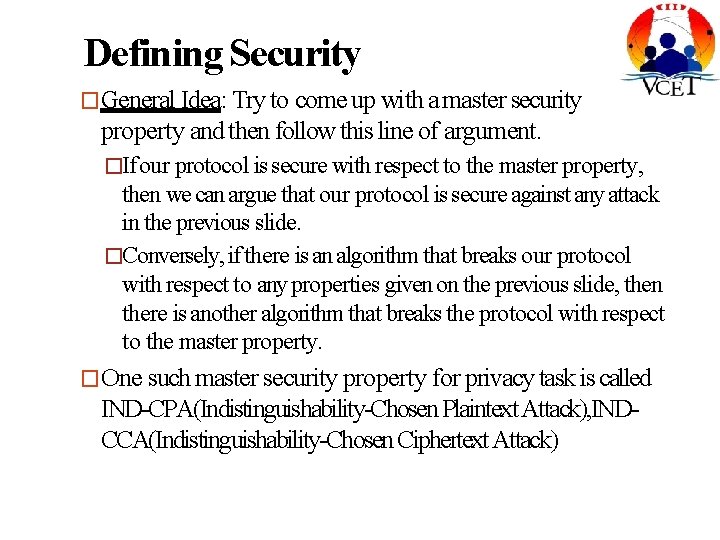
Defining Security �General Idea: Try to come up with a master security property and then follow this line of argument. �If our protocol is secure with respect to the master property, then we can argue that our protocol is secure against any attack in the previous slide. �Conversely, if there is an algorithm that breaks our protocol with respect to any properties given on the previous slide, then there is another algorithm that breaks the protocol with respect to the master property. �One such master security property for privacy task is called IND-CPA(Indistinguishability-Chosen Plaintext Attack), INDCCA(Indistinguishability-Chosen Ciphertext Attack)
Cryptanalysis • Cryptanalysis is the study of analyzing information systems in order to study the hidden aspects of the systems • Cryptanalysis is used to break cryptographic security systems and gain access to the contents of encrypted messages, even if the cryptographic key is unknown.
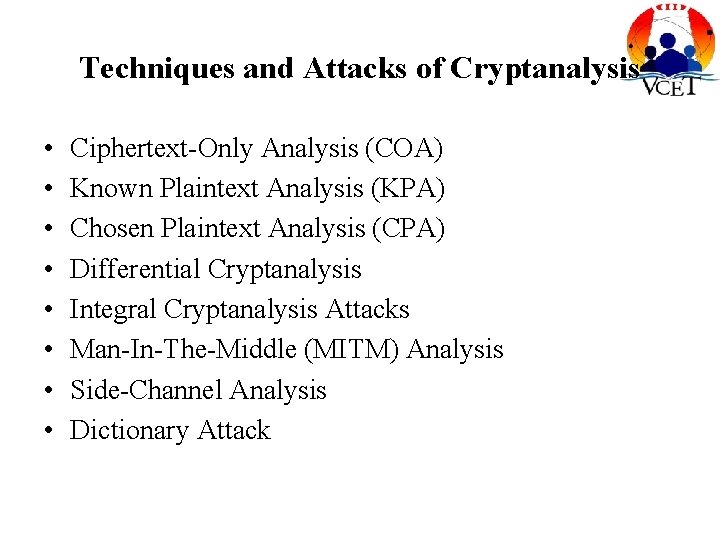
Techniques and Attacks of Cryptanalysis • • Ciphertext-Only Analysis (COA) Known Plaintext Analysis (KPA) Chosen Plaintext Analysis (CPA) Differential Cryptanalysis Integral Cryptanalysis Attacks Man-In-The-Middle (MITM) Analysis Side-Channel Analysis Dictionary Attack