
Authenticated Encryption and Cryptographic Network Protocols David Brumley
Authenticated Encryption and Cryptographic Network Protocols David Brumley dbrumley@cmu. edu Carnegie Mellon University
Some Straw Men 2
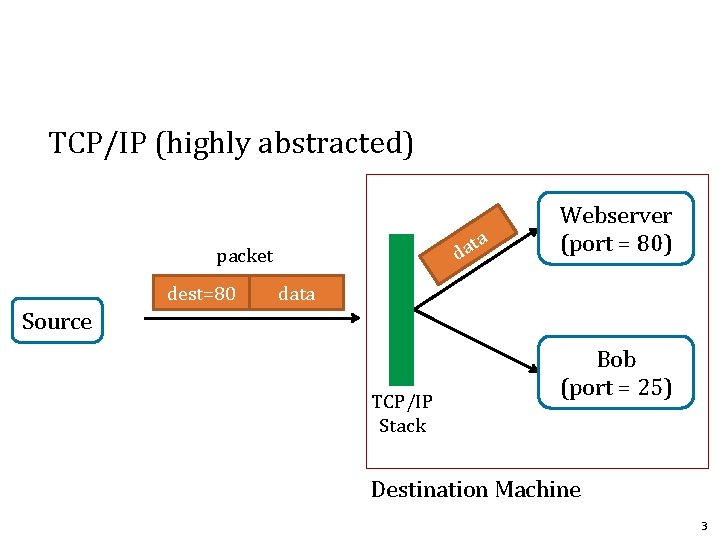
TCP/IP (highly abstracted) ta a d packet dest=80 Webserver (port = 80) data Source TCP/IP Stack Bob (port = 25) Destination Machine 3
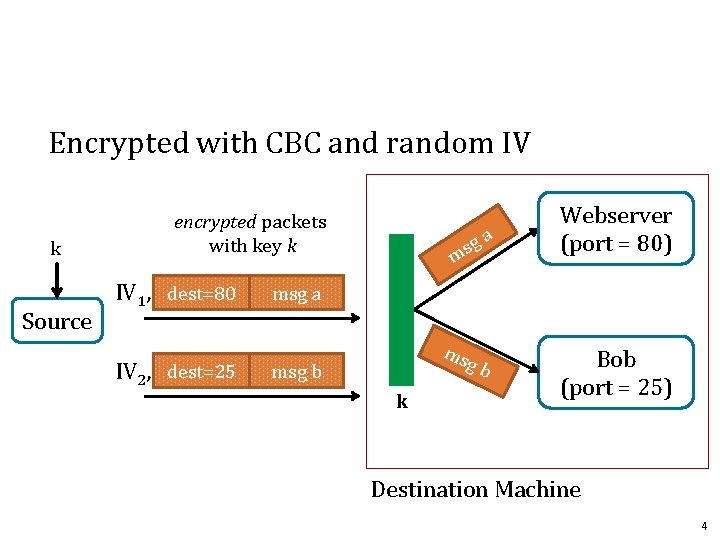
Encrypted with CBC and random IV k Source encrypted packets with key k IV 1, dest=80 IV 2, dest=25 ga s m Webserver (port = 80) msg a ms gb msg b k Bob (port = 25) Destination Machine 4
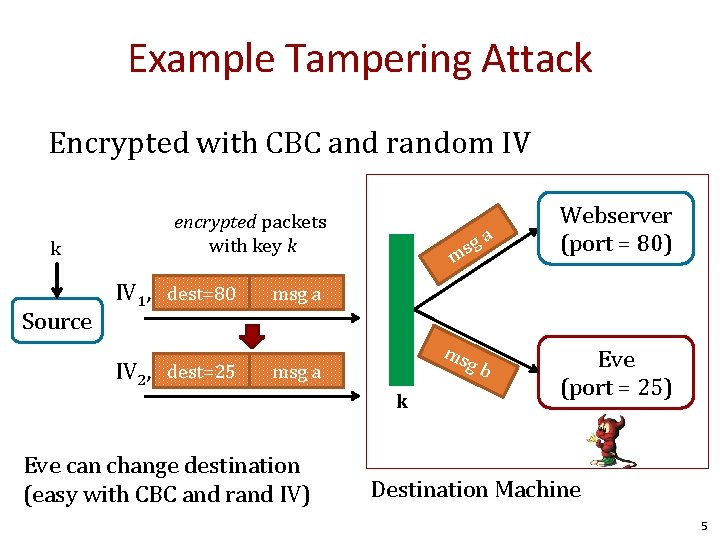
Example Tampering Attack Encrypted with CBC and random IV k Source encrypted packets with key k IV 1, dest=80 IV 2, dest=25 ga s m Webserver (port = 80) msg a ms gb msg a k Eve can change destination (easy with CBC and rand IV) Eve (port = 25) Destination Machine 5
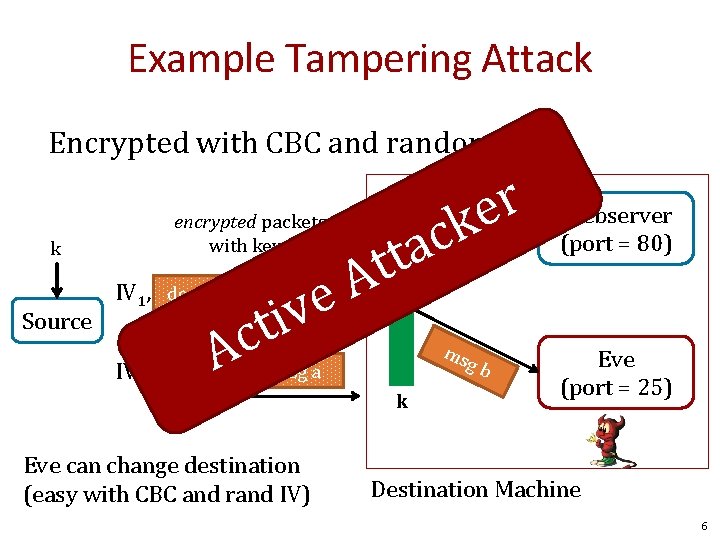
Example Tampering Attack Encrypted with CBC and random IV k Source encrypted packets with key k IV 1, dest=80 IV 2, dest=1026 ga s m A e v i ct A r e k c a t t msg a ms gb msg a k Eve can change destination (easy with CBC and rand IV) Webserver (port = 80) Eve (port = 25) Destination Machine 6
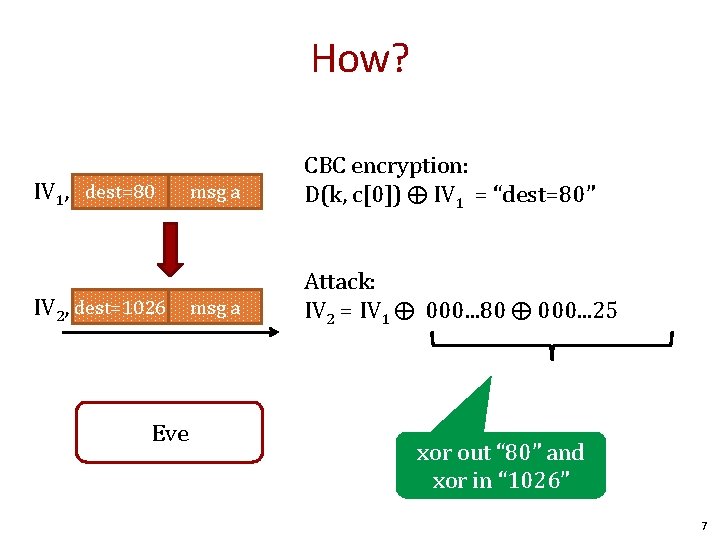
How? IV 1, dest=80 IV 2, dest=1026 Eve msg a CBC encryption: D(k, c[0]) ⨁ IV 1 = “dest=80” msg a Attack: IV 2 = IV 1 ⨁ 000. . . 80 ⨁ 000. . . 25 xor out “ 80” and xor in “ 1026” 7
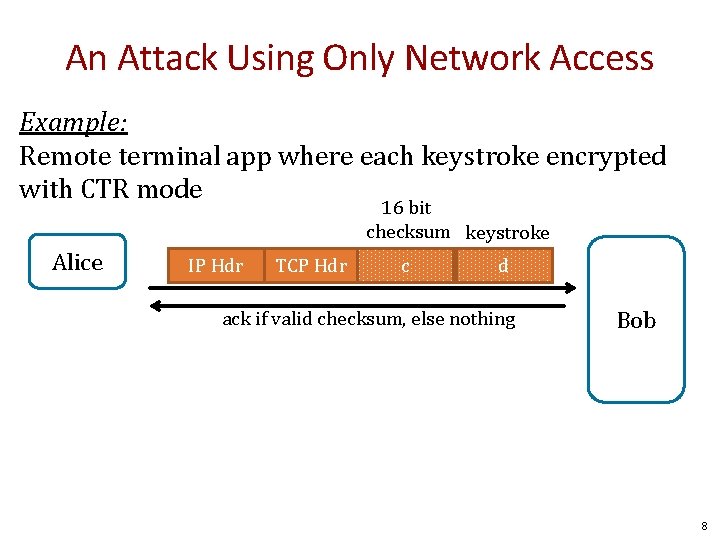
An Attack Using Only Network Access Example: Remote terminal app where each keystroke encrypted with CTR mode 16 bit checksum keystroke Alice IP Hdr TCP Hdr c d ack if valid checksum, else nothing Bob 8
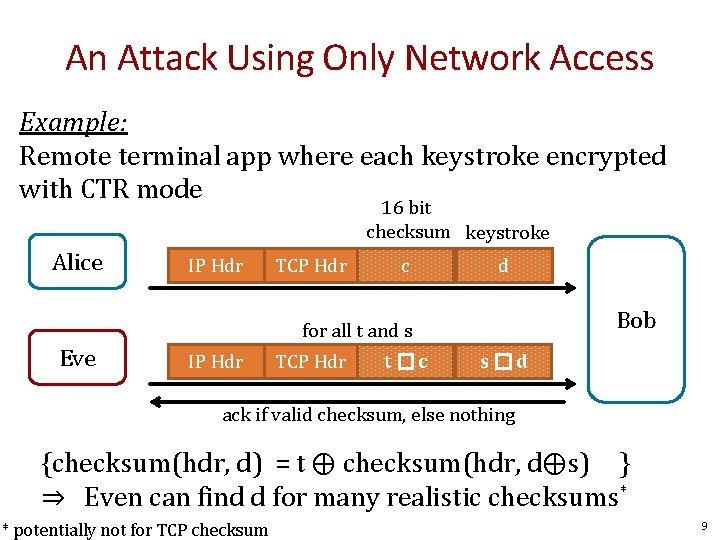
An Attack Using Only Network Access Example: Remote terminal app where each keystroke encrypted with CTR mode 16 bit checksum keystroke Alice IP Hdr TCP Hdr c d Bob for all t and s Eve IP Hdr TCP Hdr t �c s �d ack if valid checksum, else nothing {checksum(hdr, d) = t ⨁ checksum(hdr, d⨁s) } ⇒ Even can find d for many realistic checksums* * potentially not for TCP checksum 9
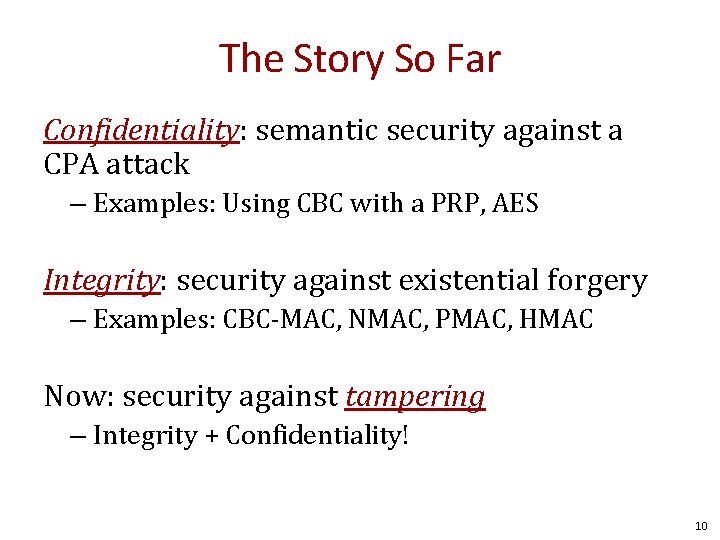
The Story So Far Confidentiality: semantic security against a CPA attack – Examples: Using CBC with a PRP, AES Integrity: security against existential forgery – Examples: CBC-MAC, NMAC, PMAC, HMAC Now: security against tampering – Integrity + Confidentiality! 10
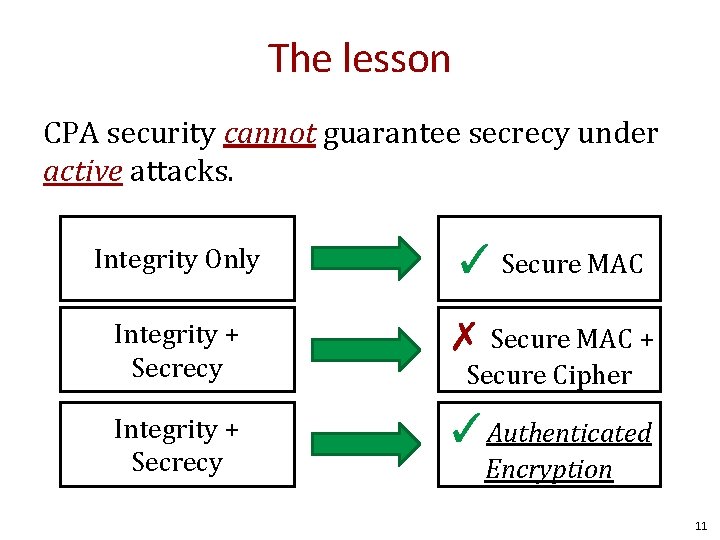
The lesson CPA security cannot guarantee secrecy under active attacks. Integrity Only ✓ Secure MAC Integrity + Secrecy ✗ Secure MAC + Integrity + Secrecy ✓Authenticated Secure Cipher Encryption 11
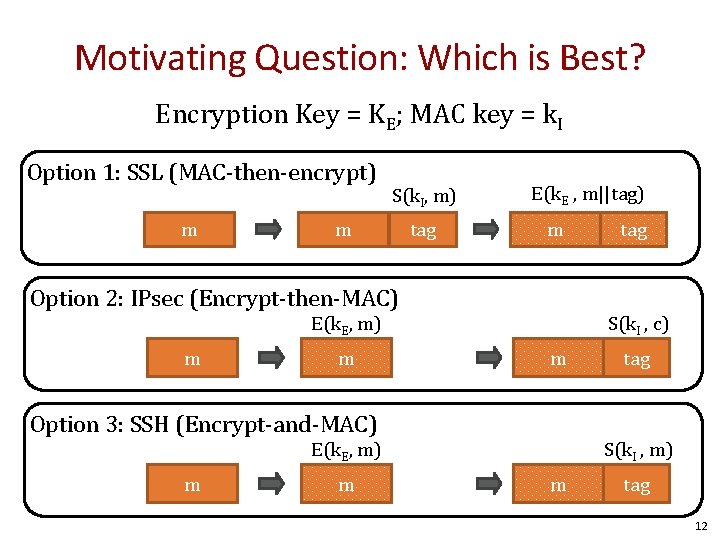
Motivating Question: Which is Best? Encryption Key = KE; MAC key = k. I Option 1: SSL (MAC-then-encrypt) m S(k. I, m) m tag E(k. E , m||tag) m Option 2: IPsec (Encrypt-then-MAC) S(k. I , c) E(k. E, m) m m m Option 3: SSH (Encrypt-and-MAC) m tag S(k. I , m) E(k. E, m) m tag 12
Authenticated Encryption 13
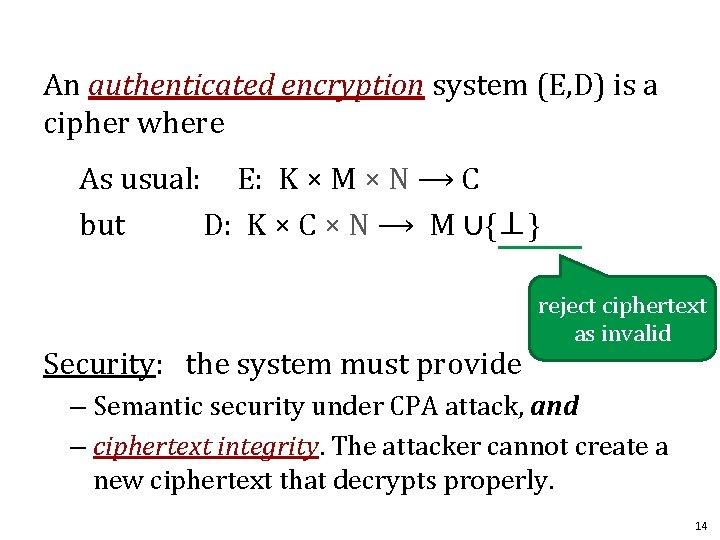
An authenticated encryption system (E, D) is a cipher where As usual: E: K × M × N ⟶ C but D: K × C × N ⟶ M ∪{⊥} Security: the system must provide reject ciphertext as invalid – Semantic security under CPA attack, and – ciphertext integrity. The attacker cannot create a new ciphertext that decrypts properly. 14
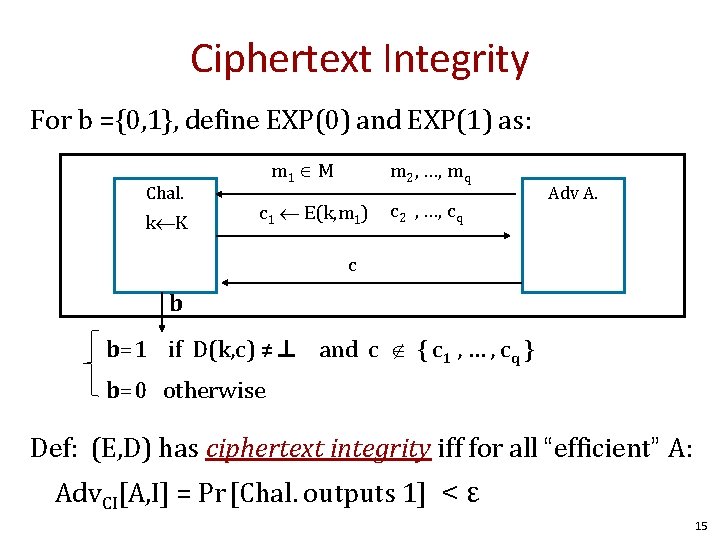
Ciphertext Integrity For b ={0, 1}, define EXP(0) and EXP(1) as: Chal. k K m 1 M m 2 , …, mq c 1 E(k, m 1) c 2 , …, cq Adv A. c b b=1 if D(k, c) ≠⊥ and c { c 1 , … , cq } b=0 otherwise Def: (E, D) has ciphertext integrity iff for all “efficient” A: Adv. CI[A, I] = Pr [Chal. outputs 1] < ε 15
Authenticated Encryption Def: cipher (E, D) provides authenticated encryption (AE) if it is (1) semantically secure under CPA, and (2) has ciphertext integrity Counter-example: CBC with rand. IV does not provide AE – D(k, ⋅) never outputs ⊥, hence adv. always wins ciphertext integrity game 16
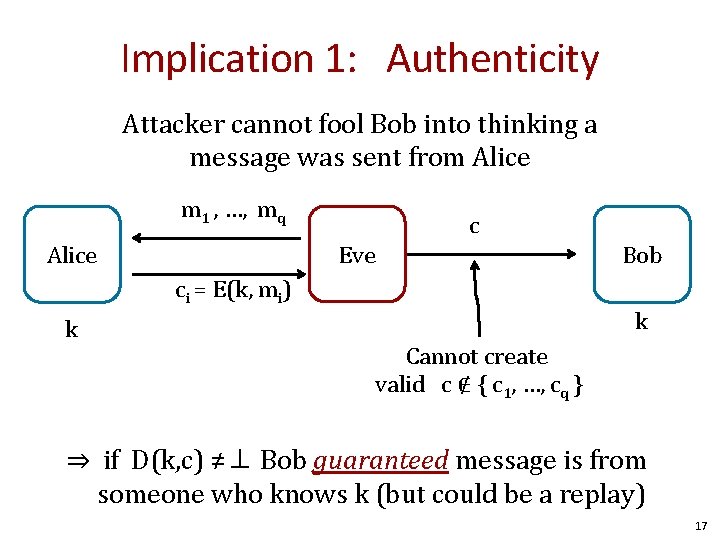
Implication 1: Authenticity Attacker cannot fool Bob into thinking a message was sent from Alice m 1 , …, mq c Eve Alice ci = E(k, mi) k Bob k Cannot create valid c ∉ { c 1, …, cq } ⇒ if D(k, c) ≠⊥ Bob guaranteed message is from someone who knows k (but could be a replay) 17
Implication 2 Authenticated encryption ⇒ Security against chosen ciphertext attack 18
Chosen Ciphertext Attacks 19
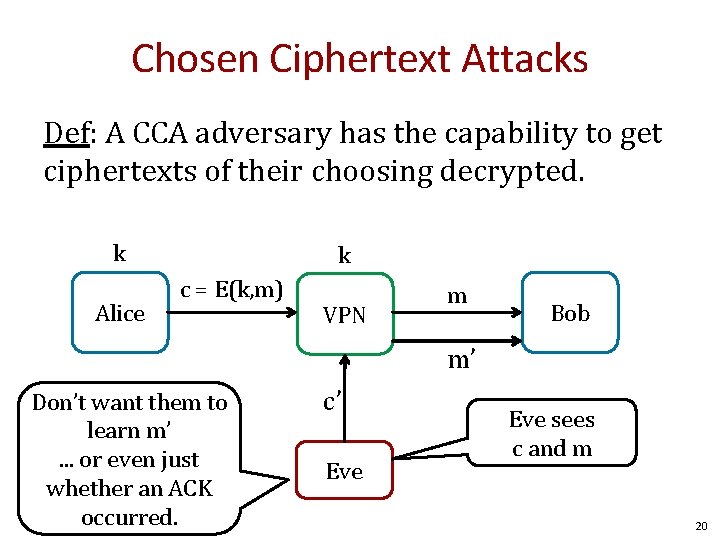
Chosen Ciphertext Attacks Def: A CCA adversary has the capability to get ciphertexts of their choosing decrypted. k Alice k c = E(k, m) VPN m Bob m’ Don’t want them to learn m’. . . or even just whether an ACK occurred. c’ Eve sees c and m 20
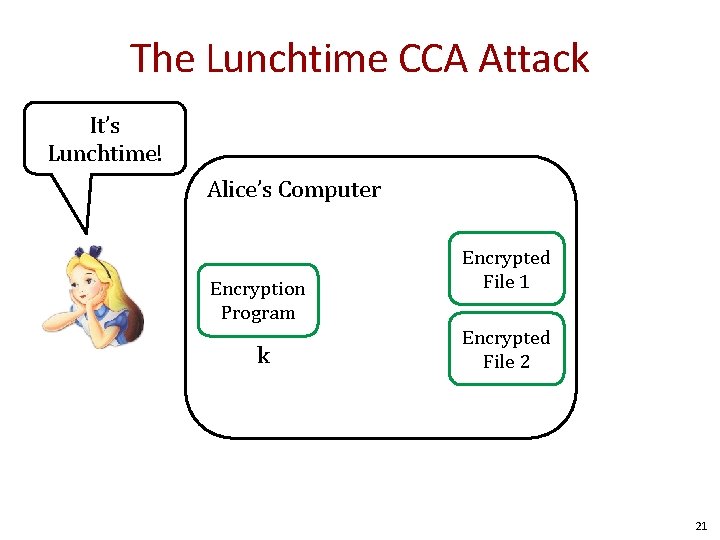
The Lunchtime CCA Attack It’s Lunchtime! Alice’s Computer Encryption Program k Encrypted File 1 Encrypted File 2 21
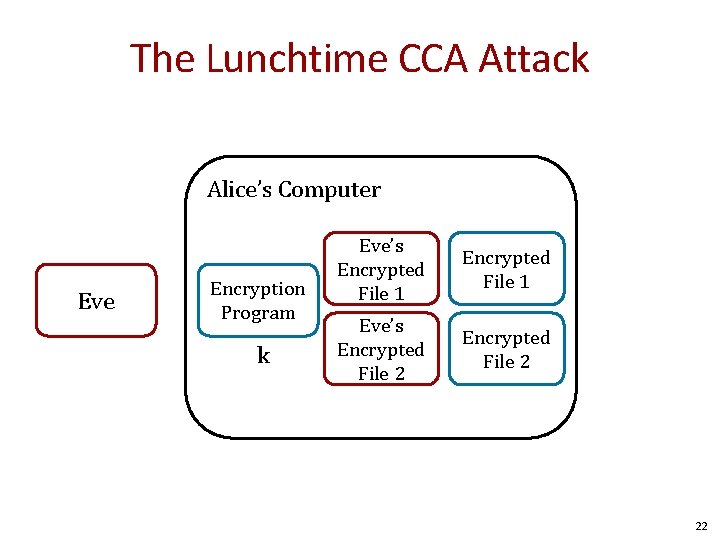
The Lunchtime CCA Attack Alice’s Computer Eve Encryption Program k Eve’s Encrypted File 1 Eve’s Encrypted File 2 22
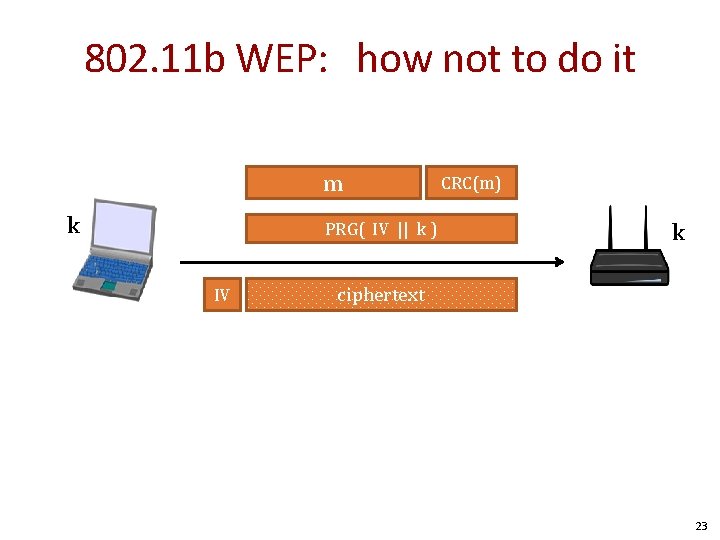
802. 11 b WEP: how not to do it m k PRG( IV || k ) IV CRC(m) k ciphertext 23
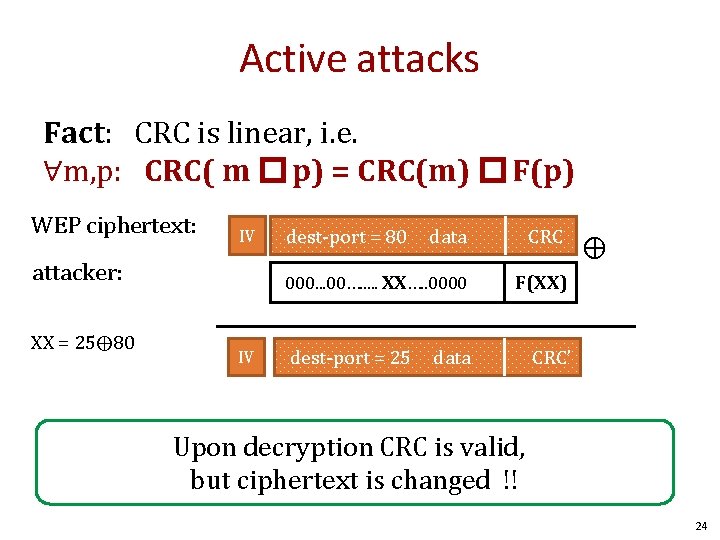
Active attacks Fact: CRC is linear, i. e. ∀m, p: CRC( m � p) = CRC(m) � F(p) WEP ciphertext: IV attacker: XX = 25⨁80 IV dest-port = 80 data CRC 000. . . 00…. . . XX…. . 0000 F(XX) dest-port = 25 data ⨁ CRC’ Upon decryption CRC is valid, but ciphertext is changed !! 24
Chosen Ciphertext Security Adversaries Power: both CPA and CCA – Can obtain the encryption of arbitrary messages – Can decrypt ciphertexts of his choice Adversaries Goal: break semantic security 25
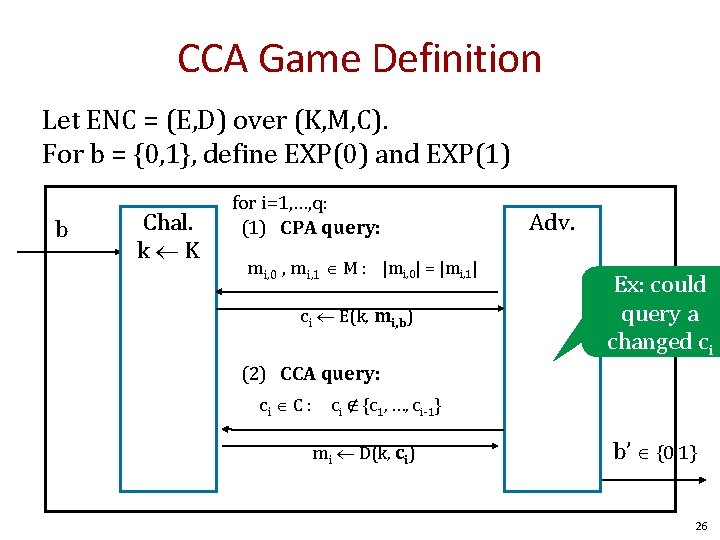
CCA Game Definition Let ENC = (E, D) over (K, M, C). For b = {0, 1}, define EXP(0) and EXP(1) b Chal. k K for i=1, …, q: (1) CPA query: mi, 0 , mi, 1 M : |mi, 0| = |mi, 1| ci E(k, mi, b) Adv. Ex: could query a changed ci (2) CCA query: ci C : ci ∉ {c 1, …, ci-1} mi D(k, ci) b’ {0, 1} 26
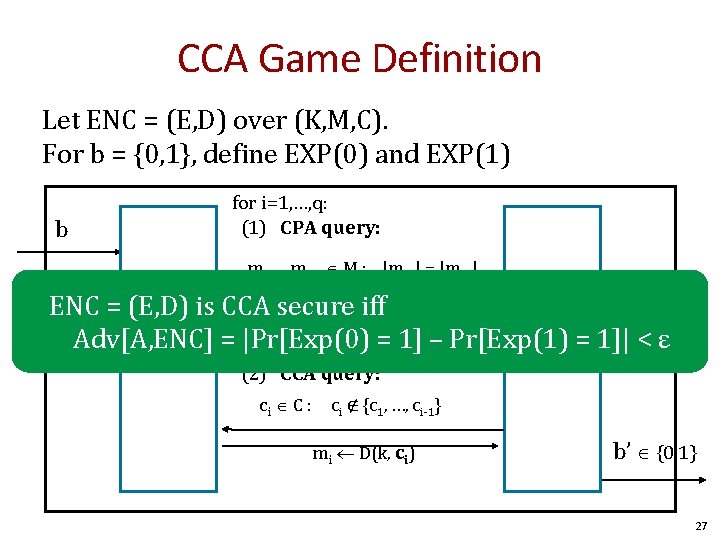
CCA Game Definition Let ENC = (E, D) over (K, M, C). For b = {0, 1}, define EXP(0) and EXP(1) for i=1, …, q: (1) CPA query: b mi, 0 , mi, 1 M : |mi, 0| = |mi, 1| ENC = (E, D) is CCA secure ci E(k, iff mi, b) Chal. = |Pr[Exp(0) = 1] – Pr[Exp(1) = 1]| < ε Adv[A, ENC] Adv. k K (2) CCA query: ci C : ci ∉ {c 1, …, ci-1} mi D(k, ci) b’ {0, 1} 27
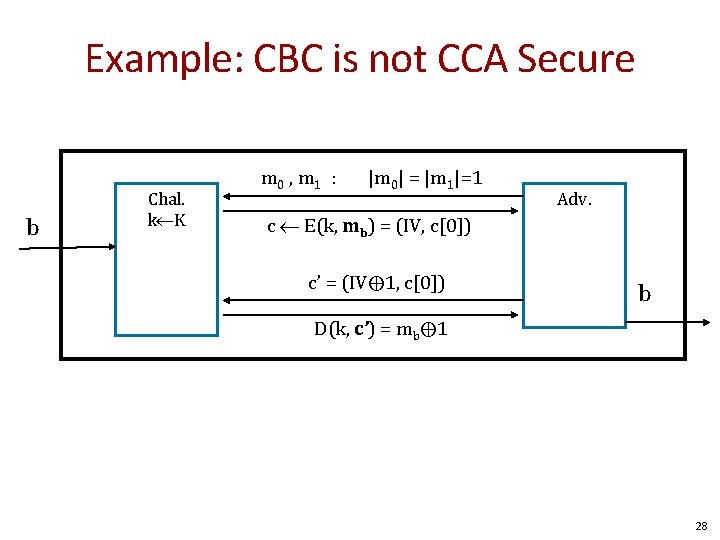
Example: CBC is not CCA Secure b Chal. k K m 0 , m 1 : |m 0| = |m 1|=1 Adv. c E(k, mb) = (IV, c[0]) c’ = (IV⨁1, c[0]) learns b b D(k, c’) = mb⨁1 28
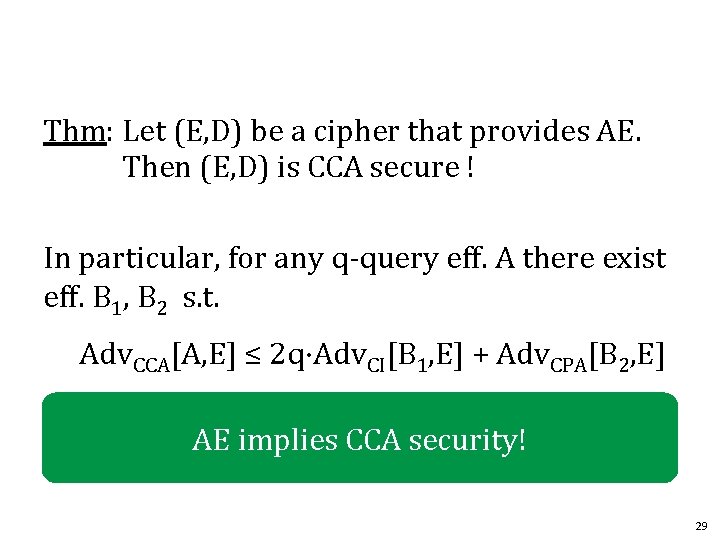
Thm: Let (E, D) be a cipher that provides AE. Then (E, D) is CCA secure ! In particular, for any q-query eff. A there exist eff. B 1, B 2 s. t. Adv. CCA[A, E] ≤ 2 q⋅Adv. CI[B 1, E] + Adv. CPA[B 2, E] AE implies CCA security! 29
So What? Authenticated encryption assures security against: – A passive adversary (CPA security) – An active adversary that can even decrypt some ciphertexts (CCA security) Limitations: – Does not protect against replay – Assumes no other information other than message/ciphertext pairs can be learned. • Timing attacks out of scope • Power attacks out of scope • . . . 30
AE Constructions Cipher + MAC = security 31
History Pre 2000: Crypto API’s provide separate MAC and encrypt primitives – Example: Microsoft Cryptographic Application Programming Interface (MS-CAPI) provided HMAC and CBC + IV – Every project had to combine primitives in their own way 2000: Authenticated Encryption – Bellare and Nampre in Crypto, 2000 – Katz and Yung in FSE, 2000 32
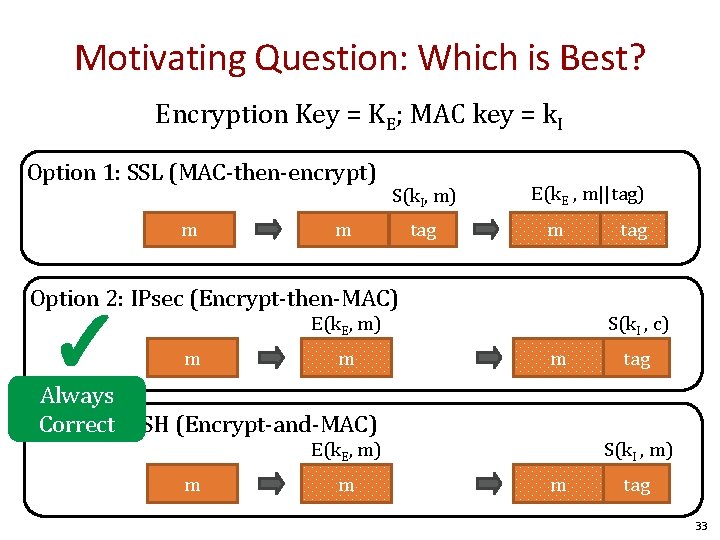
Motivating Question: Which is Best? Encryption Key = KE; MAC key = k. I Option 1: SSL (MAC-then-encrypt) m S(k. I, m) m tag E(k. E , m||tag) m Option 2: IPsec (Encrypt-then-MAC) ✓ S(k. I , c) E(k. E, m) m m m Always Option Correct 3: SSH (Encrypt-and-MAC) m tag S(k. I , m) E(k. E, m) m tag 33
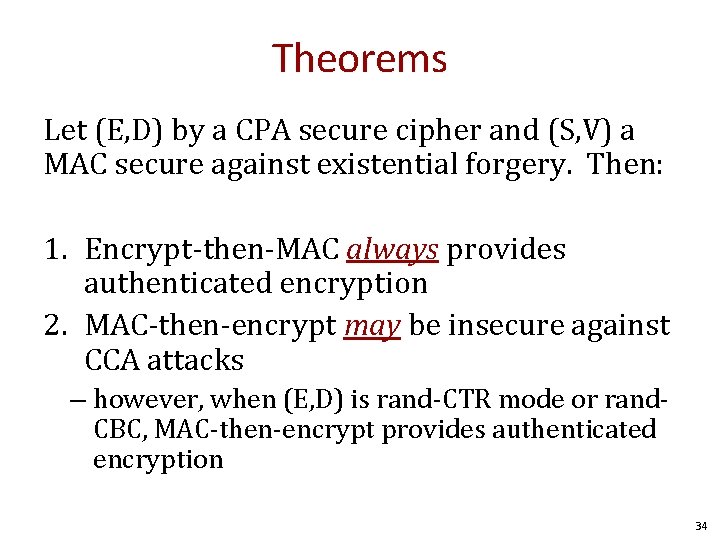
Theorems Let (E, D) by a CPA secure cipher and (S, V) a MAC secure against existential forgery. Then: 1. Encrypt-then-MAC always provides authenticated encryption 2. MAC-then-encrypt may be insecure against CCA attacks – however, when (E, D) is rand-CTR mode or rand. CBC, MAC-then-encrypt provides authenticated encryption 34
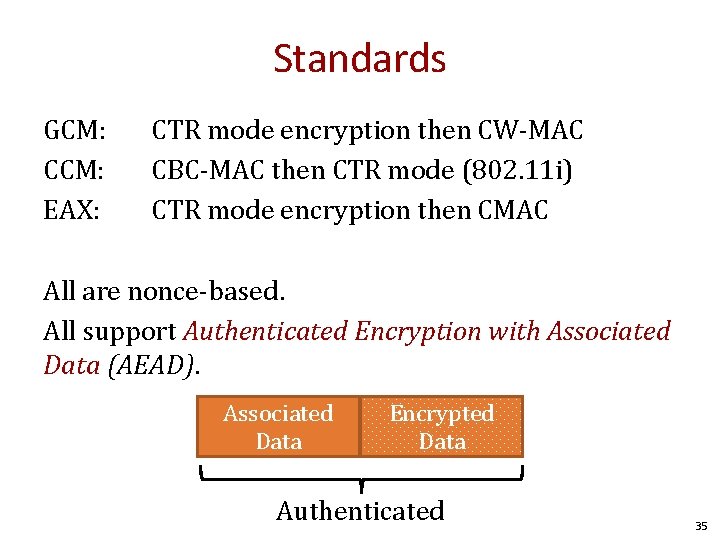
Standards GCM: CCM: EAX: CTR mode encryption then CW-MAC CBC-MAC then CTR mode (802. 11 i) CTR mode encryption then CMAC All are nonce-based. All support Authenticated Encryption with Associated Data (AEAD). Associated Data Encrypted Data Authenticated 35
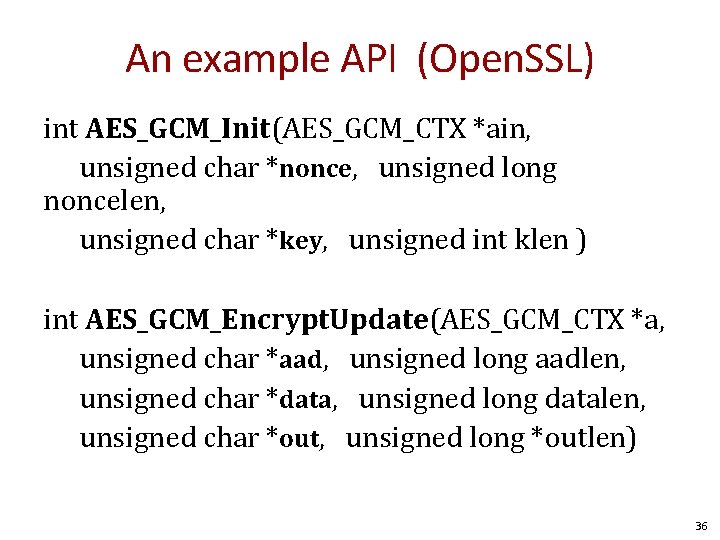
An example API (Open. SSL) int AES_GCM_Init(AES_GCM_CTX *ain, unsigned char *nonce, unsigned long noncelen, unsigned char *key, unsigned int klen ) int AES_GCM_Encrypt. Update(AES_GCM_CTX *a, unsigned char *aad, unsigned long aadlen, unsigned char *data, unsigned long datalen, unsigned char *out, unsigned long *outlen) 36
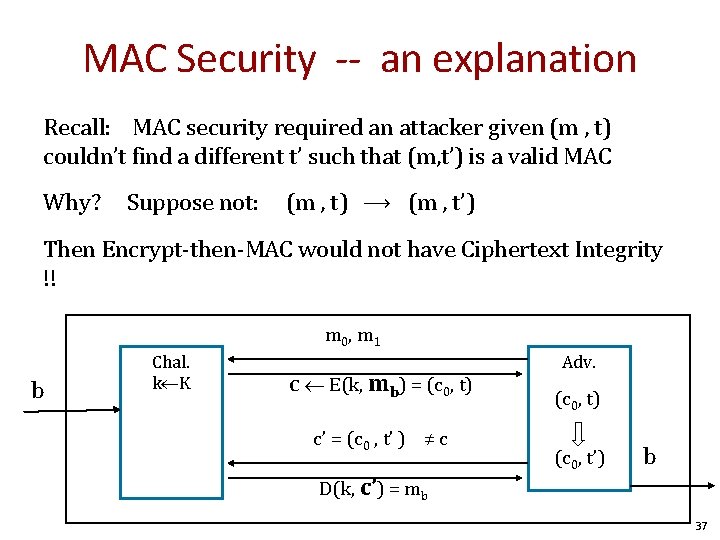
MAC Security -- an explanation Recall: MAC security required an attacker given (m , t) couldn’t find a different t’ such that (m, t’) is a valid MAC Why? Suppose not: (m , t) ⟶ (m , t’) Then Encrypt-then-MAC would not have Ciphertext Integrity !! m 0, m 1 b Chal. k K c E(k, mb) = (c 0, t) c’ = (c 0 , t’ ) ≠ c Adv. (c 0, t) (c 0, t’) b D(k, c’) = mb 37
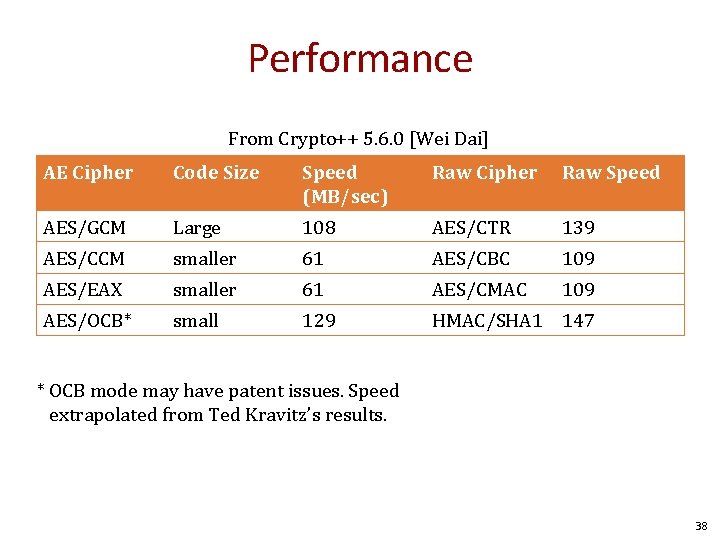
Performance From Crypto++ 5. 6. 0 [Wei Dai] AE Cipher Code Size Speed (MB/sec) Raw Cipher Raw Speed AES/GCM Large 108 AES/CTR 139 AES/CCM smaller 61 AES/CBC 109 AES/EAX smaller 61 AES/CMAC 109 AES/OCB* small 129 HMAC/SHA 1 147 * OCB mode may have patent issues. Speed extrapolated from Ted Kravitz’s results. 38
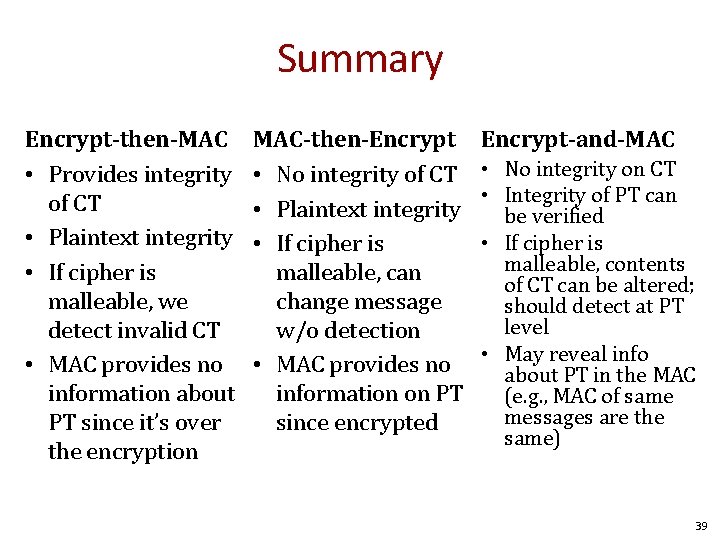
Summary Encrypt-then-MAC • Provides integrity of CT • Plaintext integrity • If cipher is malleable, we detect invalid CT • MAC provides no information about PT since it’s over the encryption MAC-then-Encrypt • No integrity of CT • Plaintext integrity • If cipher is malleable, can change message w/o detection • MAC provides no information on PT since encrypted Encrypt-and-MAC • No integrity on CT • Integrity of PT can be verified • If cipher is malleable, contents of CT can be altered; should detect at PT level • May reveal info about PT in the MAC (e. g. , MAC of same messages are the same) 39
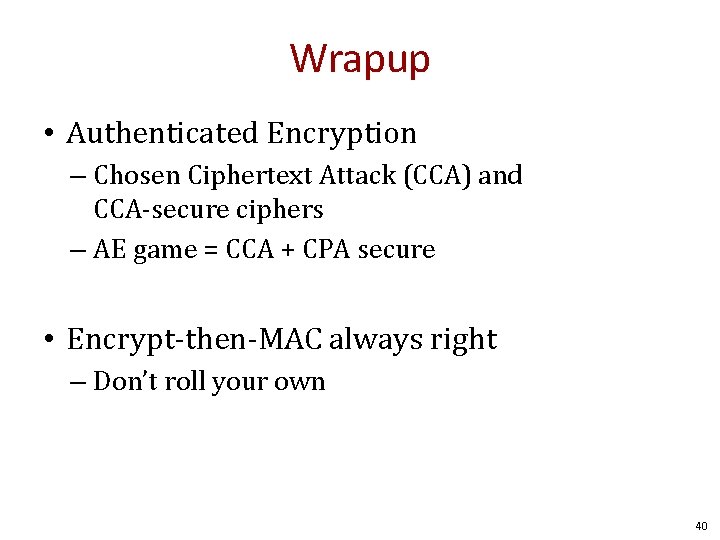
Wrapup • Authenticated Encryption – Chosen Ciphertext Attack (CCA) and CCA-secure ciphers – AE game = CCA + CPA secure • Encrypt-then-MAC always right – Don’t roll your own 40

Questions? 41

END
Case Study: TLS 43
Alice Public key Expiration Date Certificates bind a public key to a user 44
Certificate Authority (CA) binds certificate to person CA Signature Alice Public key Expiration Date Certificate parameters 45
Alice Sends: User ID || public key || … 46
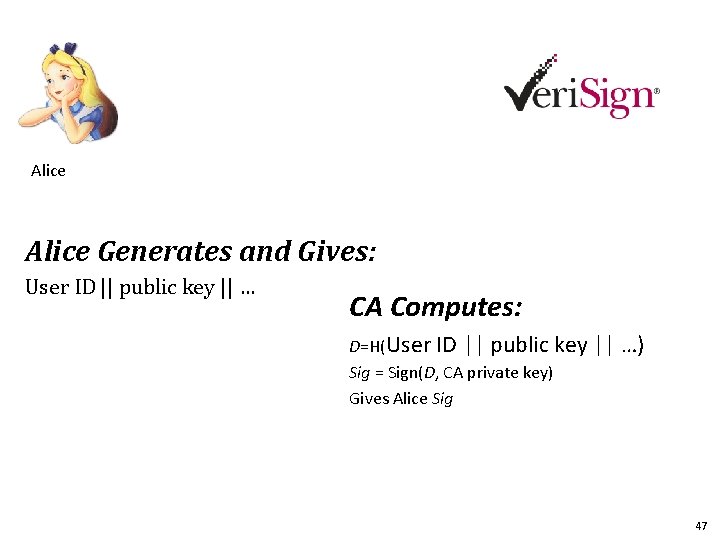
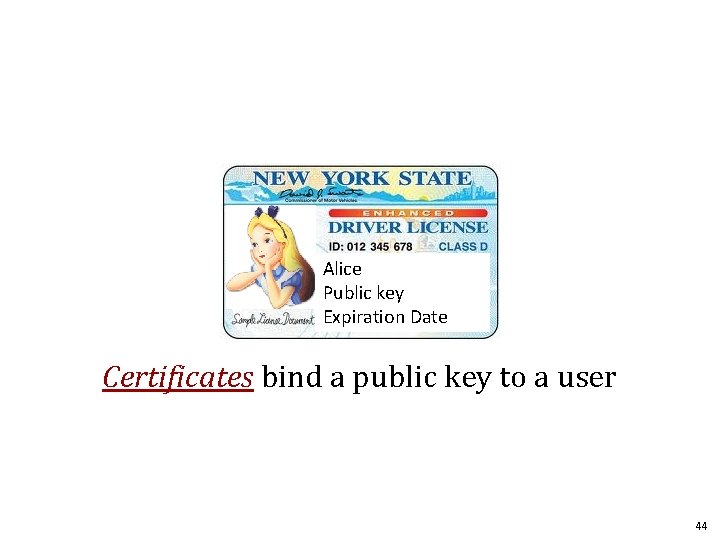
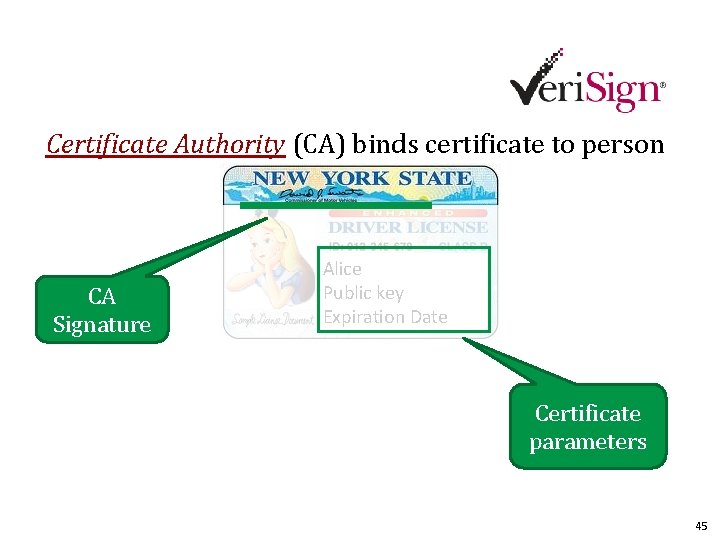
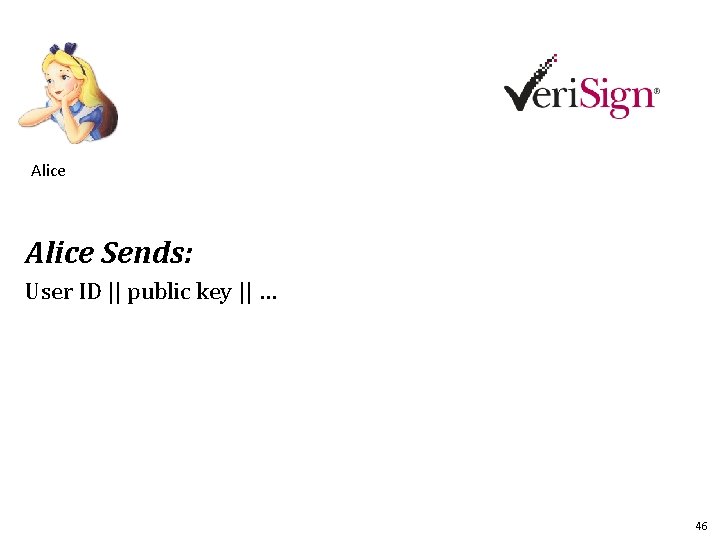
Alice Generates and Gives: User ID || public key || … CA Computes: D=H(User ID || public key Sig = Sign(D, CA private key) Gives Alice Sig || …) 47
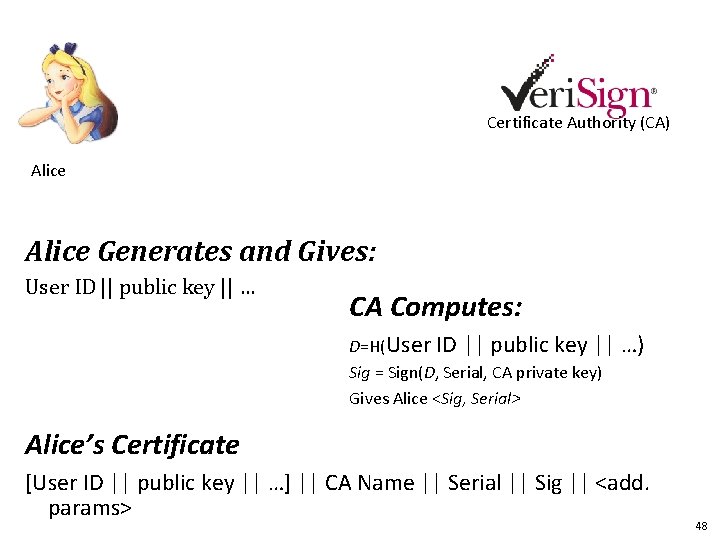
Certificate Authority (CA) Alice Generates and Gives: User ID || public key || … CA Computes: D=H(User ID || public key || Sig = Sign(D, Serial, CA private key) Gives Alice <Sig, Serial> …) Alice’s Certificate [User ID || public key || …] || CA Name || Serial || Sig || <add. params> 48
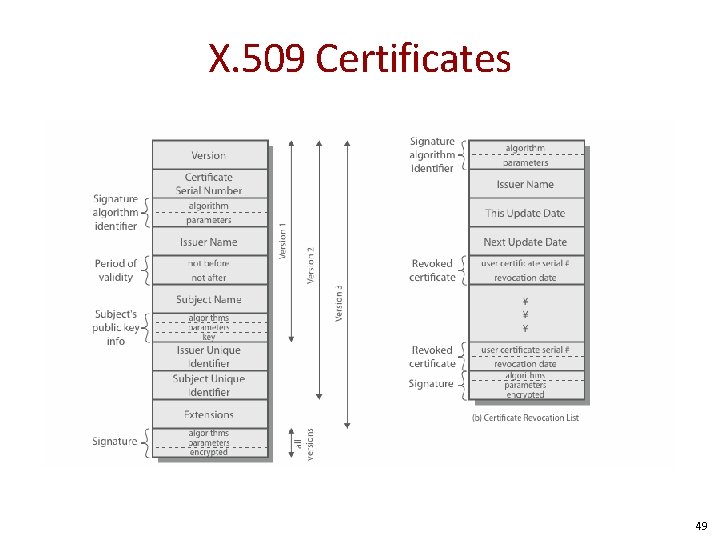
X. 509 Certificates 49
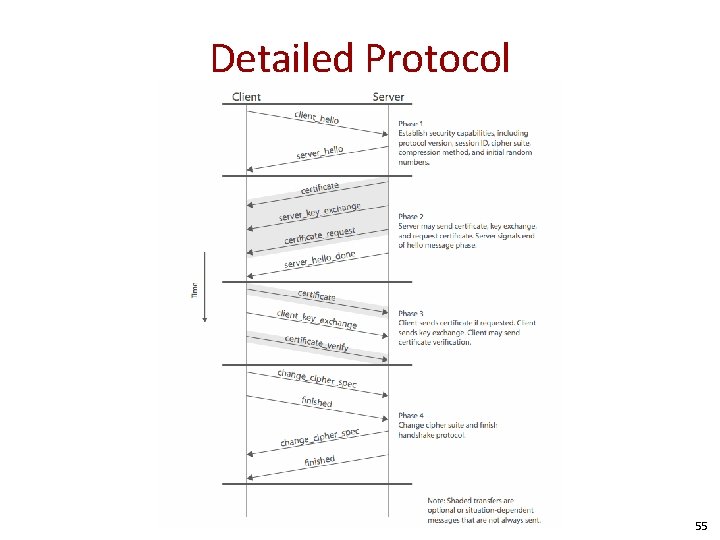
TLS and SSL • Transport Layer Security (TLS) – – Secure socket layer (SSL) predecessor originally developed by Netscape version 3 designed with public input RFC 2246 • Uses TCP to provide a reliable end-to-end service 50
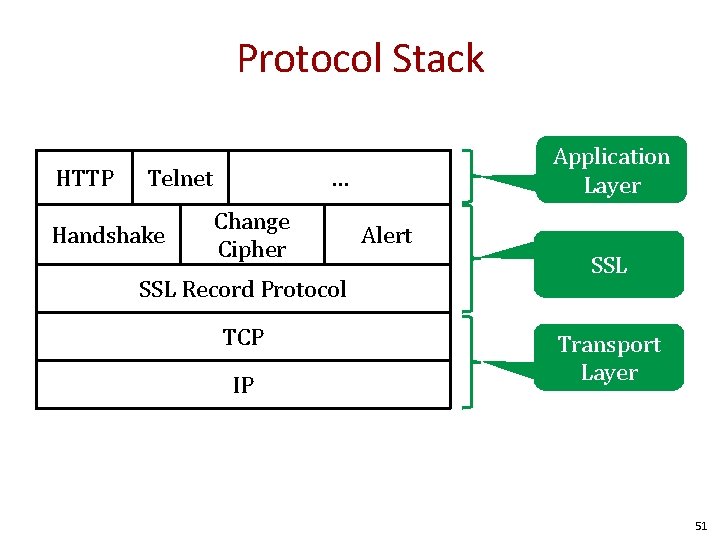
Protocol Stack HTTP Telnet Handshake Application Layer … Change Cipher SSL Record Protocol TCP IP Alert SSL Transport Layer 51
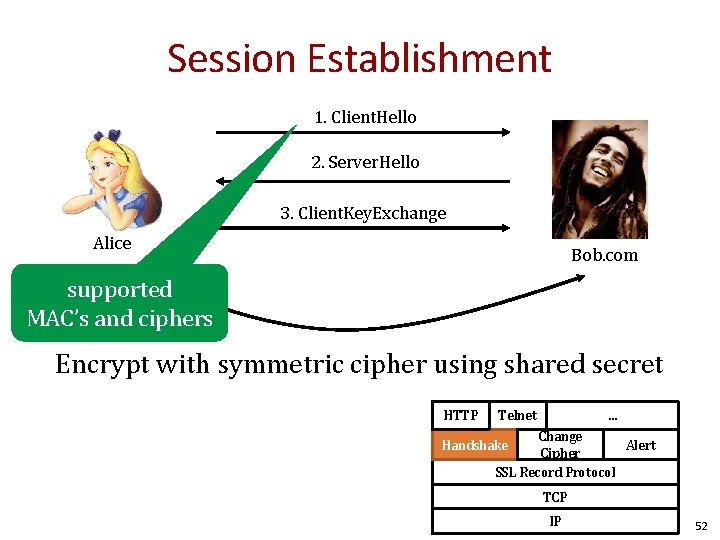
Session Establishment 1. Client. Hello 2. Server. Hello 3. Client. Key. Exchange Alice Bob. com supported MAC’s and ciphers Encrypt with symmetric cipher using shared secret HTTP Telnet … Change Alert Cipher SSL Record Protocol Handshake TCP IP 52
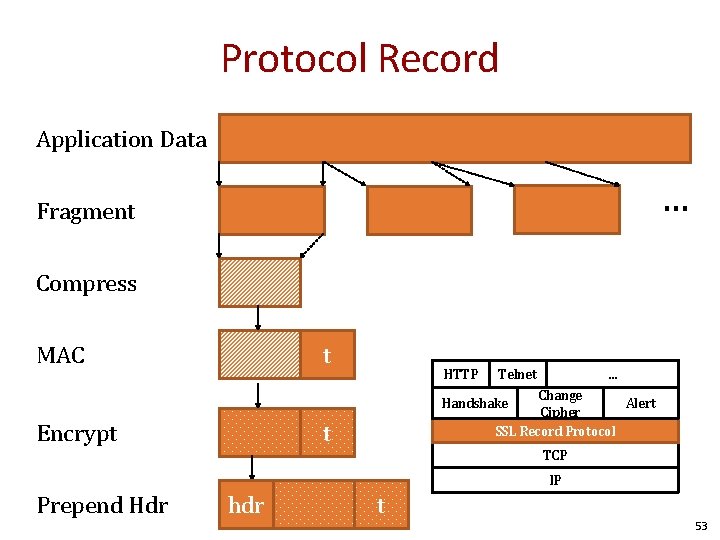
Protocol Record Application Data . . . Fragment Compress MAC t HTTP Telnet … Change Alert Cipher SSL Record Protocol Handshake Encrypt t TCP IP Prepend Hdr hdr t 53
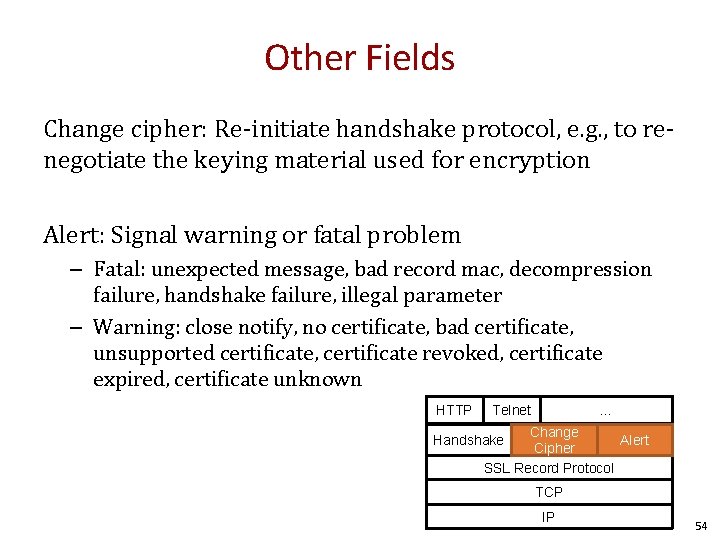
Other Fields Change cipher: Re-initiate handshake protocol, e. g. , to renegotiate the keying material used for encryption Alert: Signal warning or fatal problem – Fatal: unexpected message, bad record mac, decompression failure, handshake failure, illegal parameter – Warning: close notify, no certificate, bad certificate, unsupported certificate, certificate revoked, certificate expired, certificate unknown HTTP Telnet … Change Alert Cipher SSL Record Protocol Handshake TCP IP 54
Detailed Protocol 55
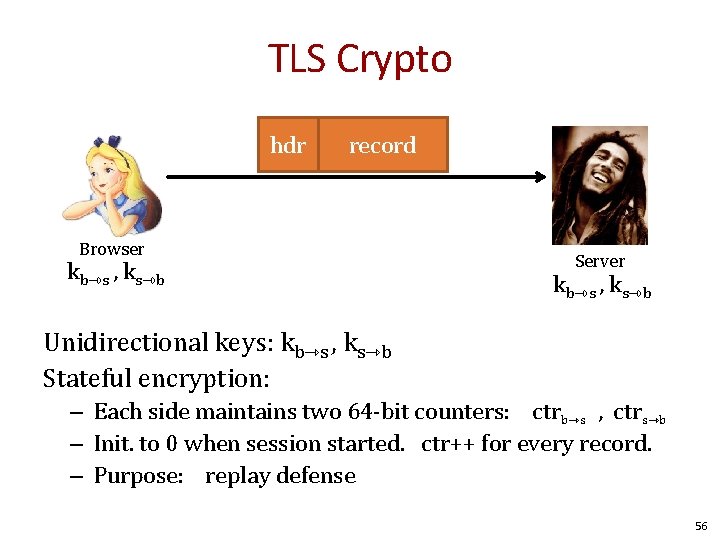
TLS Crypto hdr record Browser kb⇾s , ks⇾b Server kb⇾s , ks⇾b Unidirectional keys: kb⇾s , ks⇾b Stateful encryption: – Each side maintains two 64 -bit counters: ctrb⇾s , ctrs⇾b – Init. to 0 when session started. ctr++ for every record. – Purpose: replay defense 56
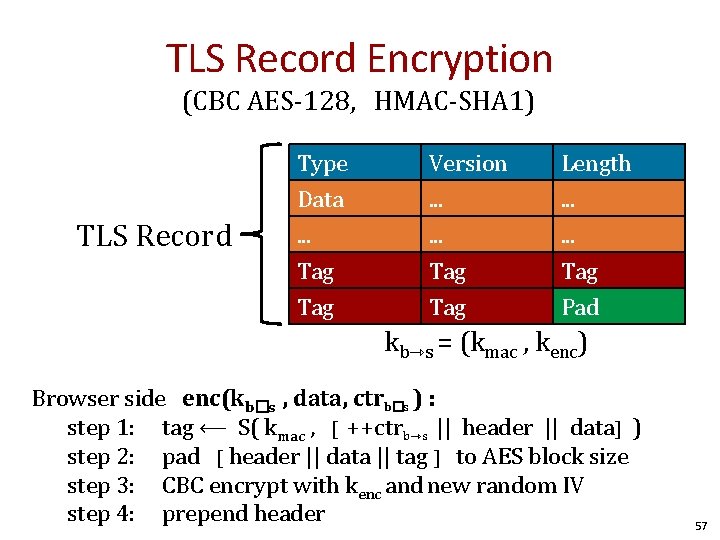
TLS Record Encryption (CBC AES-128, HMAC-SHA 1) TLS Record Type Data. . . Tag Version. . . Tag Length. . . Tag Tag Pad kb⇾s = (kmac , kenc) Browser side enc(kb�s , data, ctrb�s ) : step 1: tag ⟵ S( kmac , [ ++ctrb⇾s || header || data] ) step 2: pad [ header || data || tag ] to AES block size step 3: CBC encrypt with kenc and new random IV step 4: prepend header 57
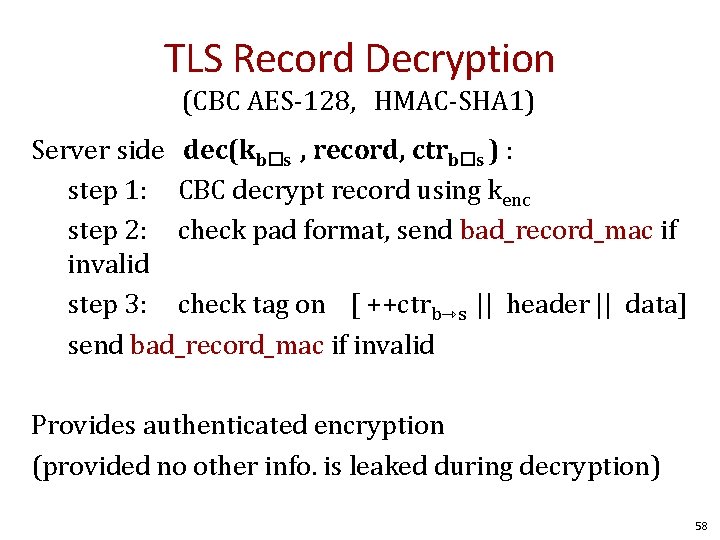
TLS Record Decryption (CBC AES-128, HMAC-SHA 1) Server side dec(kb�s , record, ctrb�s ) : step 1: CBC decrypt record using kenc step 2: check pad format, send bad_record_mac if invalid step 3: check tag on [ ++ctrb⇾s || header || data] send bad_record_mac if invalid Provides authenticated encryption (provided no other info. is leaked during decryption) 58
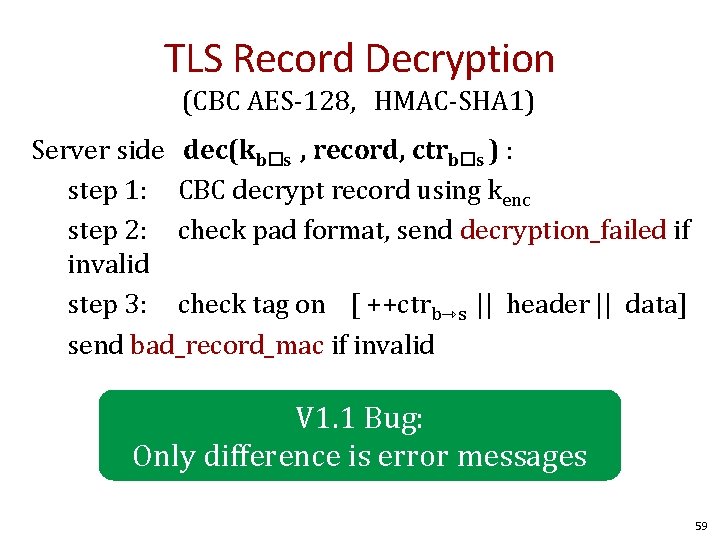
TLS Record Decryption (CBC AES-128, HMAC-SHA 1) Server side dec(kb�s , record, ctrb�s ) : step 1: CBC decrypt record using kenc step 2: check pad format, send decryption_failed if invalid step 3: check tag on [ ++ctrb⇾s || header || data] send bad_record_mac if invalid V 1. 1 Bug: Only difference is error messages 59
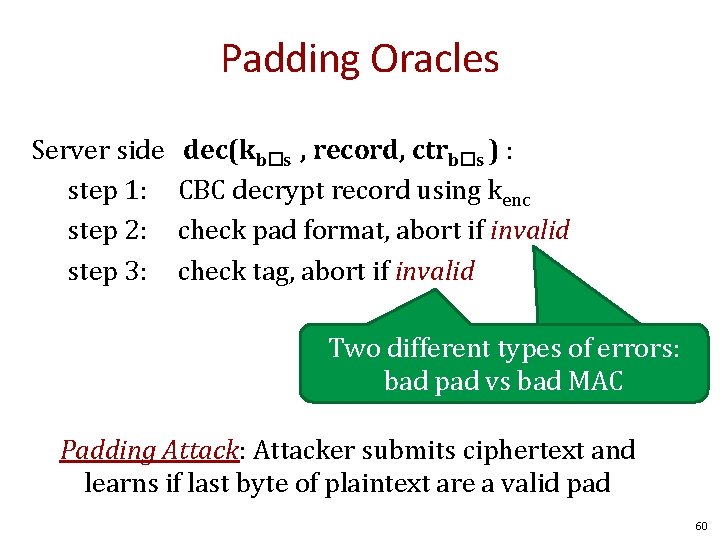
Padding Oracles Server side step 1: step 2: step 3: dec(kb�s , record, ctrb�s ) : CBC decrypt record using kenc check pad format, abort if invalid check tag, abort if invalid Two different types of errors: bad pad vs bad MAC Padding Attack: Attacker submits ciphertext and learns if last byte of plaintext are a valid pad 60
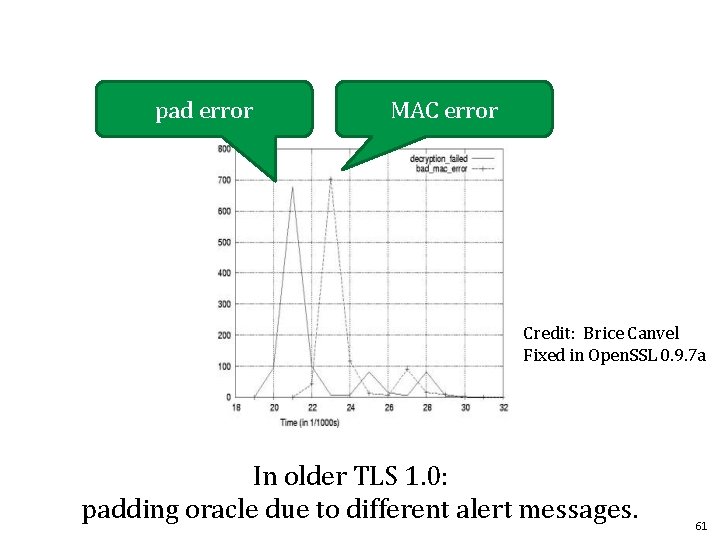
pad error MAC error Credit: Brice Canvel Fixed in Open. SSL 0. 9. 7 a In older TLS 1. 0: padding oracle due to different alert messages. 61
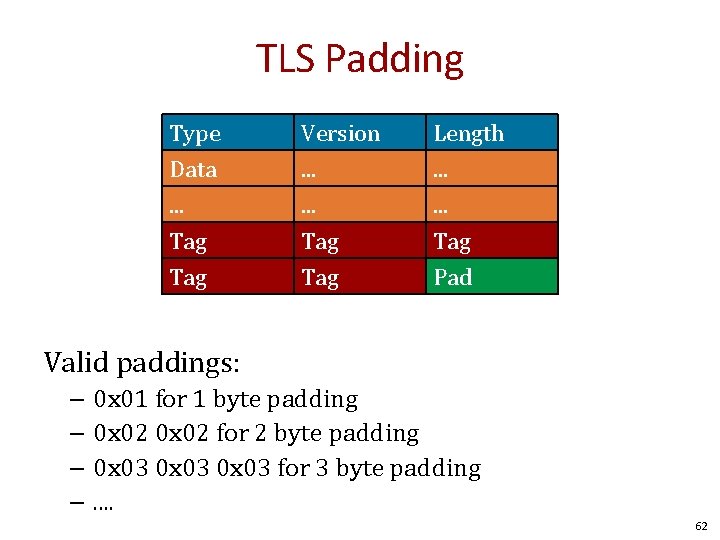
TLS Padding Type Data. . . Tag Version. . . Tag Length. . . Tag Tag Pad Valid paddings: – – 0 x 01 for 1 byte padding 0 x 02 for 2 byte padding 0 x 03 for 3 byte padding. . 62
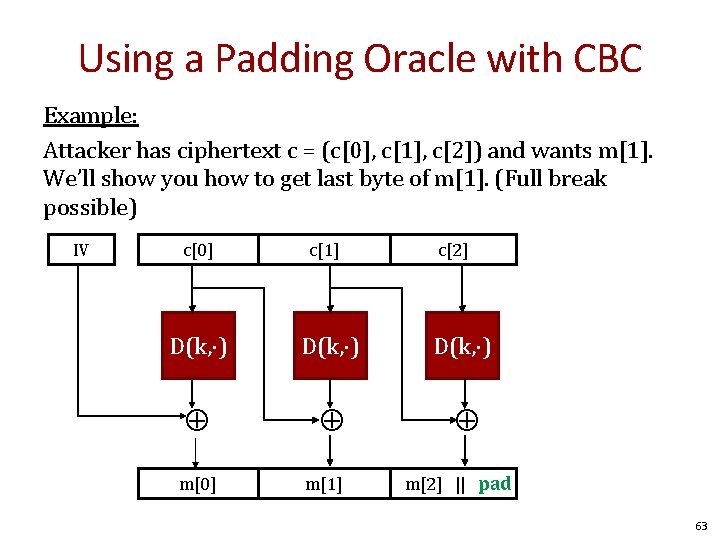
Using a Padding Oracle with CBC Example: Attacker has ciphertext c = (c[0], c[1], c[2]) and wants m[1]. We’ll show you how to get last byte of m[1]. (Full break possible) D(k, ) m[0] c[1] D(k, ) c[0] m[1] c[2] D(k, ) IV m[2] || pad 63
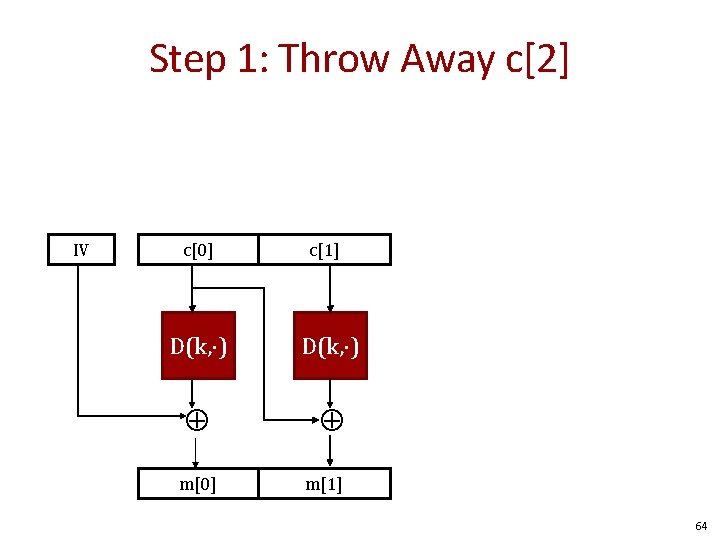
Step 1: Throw Away c[2] c[0] D(k, ) m[0] c[1] D(k, ) IV m[1] 64
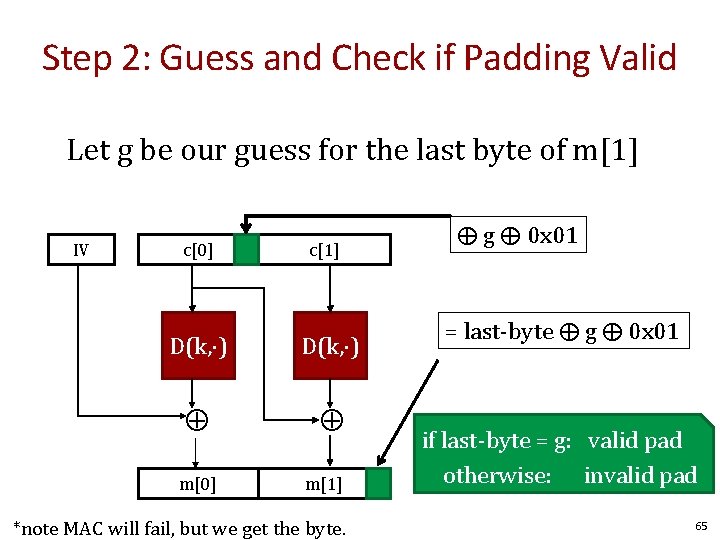
Step 2: Guess and Check if Padding Valid Let g be our guess for the last byte of m[1] c[0] c[1] D(k, ) IV m[0] m[1] *note MAC will fail, but we get the byte. ⨁ g ⨁ 0 x 01 = last-byte ⨁ g ⨁ 0 x 01 if last-byte = g: valid pad otherwise: invalid pad 65
Using a Padding Oracle Attack: submit ( IV, c’[0], c[1] ) to padding oracle ⇒ attacker learns if last byte = g Repeat with g = 0, 1, …, 255 to learn last byte of m[1] Then use a (0 x 02, 0 x 02) pad to learn the next byte and so on … 66
Another TLS Bug Prior to 1. 1 IV for CBC is predictable using chained IV – IV for next record is last ciphertext block of current record. – Not CPA secure (see block cipher lecture). BEAST attack is a practical implementation 67
Other Problems The TLS header leaks the length of TLS records • Lengths can also be inferred by observing network traffic For many web applications, leaking lengths reveals sensitive info: • In tax preparation sites, lengths indicate the type of return being filed which leaks information about the user’s income • In healthcare sites, lengths leaks what page the user is viewing • In Google maps, lengths leaks the location being requested No easy solution 68
Lesson 1. Encrypt-then-MAC would completely avoid many problem. – MAC is checked first and ciphertext discarded if invalid 2. MAC-then-CBC provides Authenticated Encryption, but padding oracle destroys it 69
Certificate Revocation What to do if your keys are compromised. 70
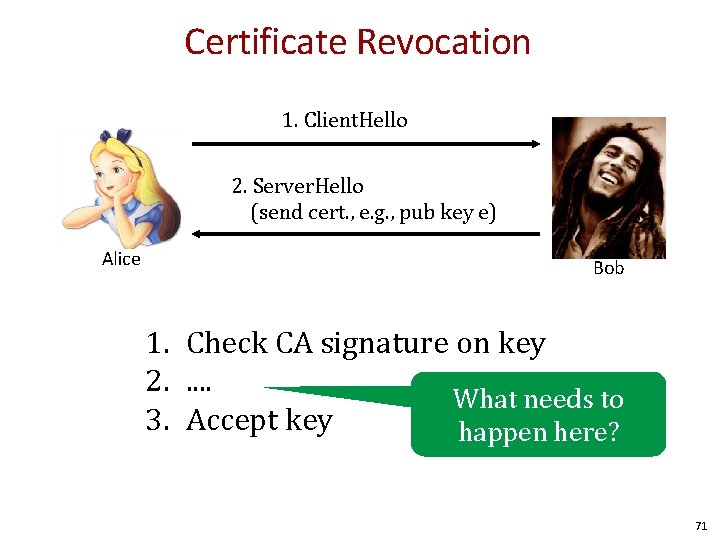
Certificate Revocation 1. Client. Hello 2. Server. Hello (send cert. , e. g. , pub key e) Alice Bob 1. Check CA signature on key 2. . . What needs to 3. Accept key happen here? 71
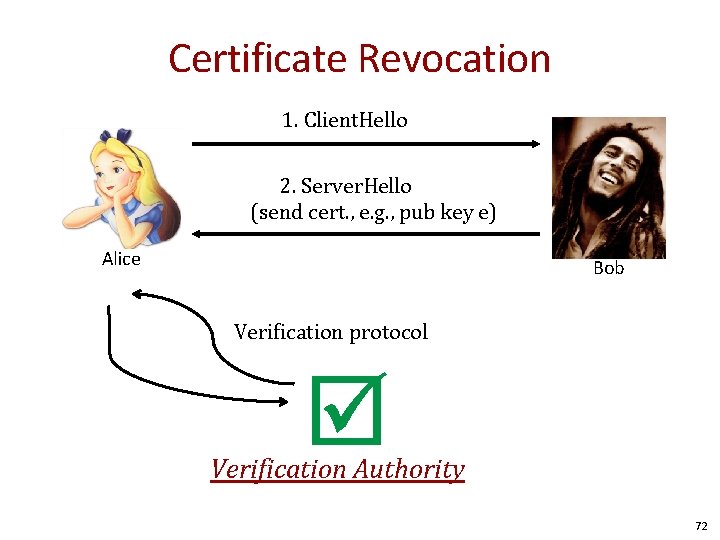
Certificate Revocation 1. Client. Hello 2. Server. Hello (send cert. , e. g. , pub key e) Alice Bob Verification protocol Verification Authority 72
Certificate Verification Protocols • Expiration Date • Certificate Revocation Lists (CRL) and Certificate Revocation Trees (CRT) • OCSP – Online Cert Status Protocol 73
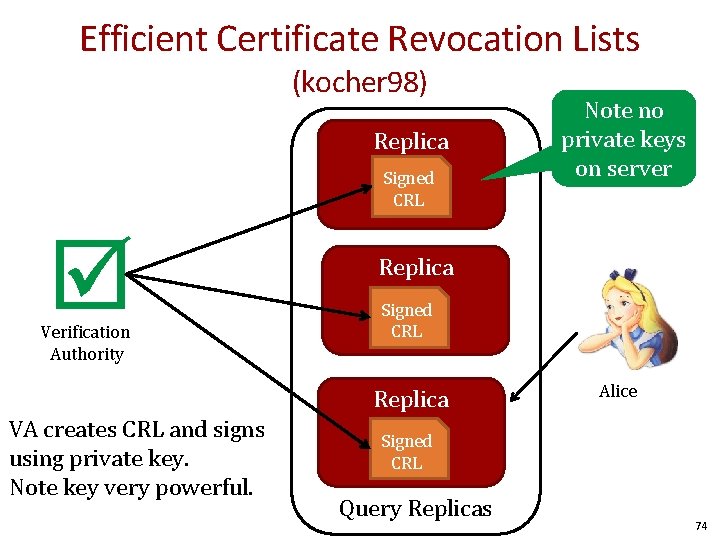
Efficient Certificate Revocation Lists (kocher 98) Replica Signed CRL Verification Authority Replica Signed CRL Replica VA creates CRL and signs using private key. Note key very powerful. Note no private keys on server Alice Signed CRL Query Replicas 74
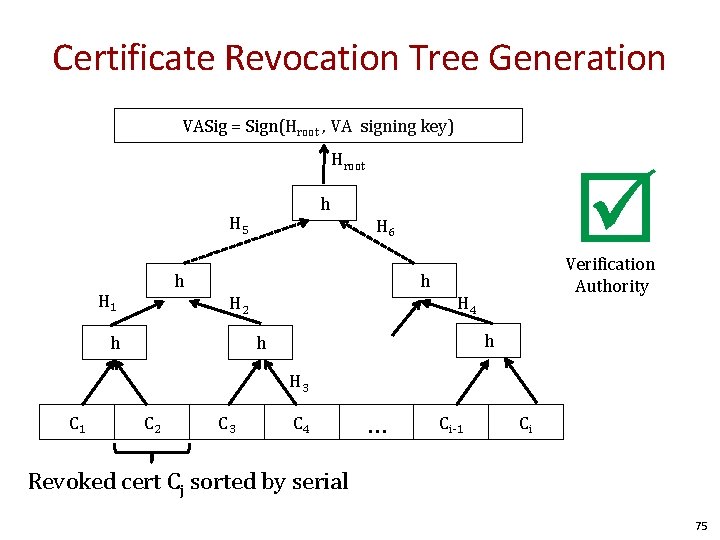
Certificate Revocation Tree Generation VASig = Sign(Hroot , VA signing key) Hroot H 5 H 6 h H 1 h Verification Authority h H 2 h H 4 h h H 3 C 1 C 2 C 3 C 4 … Ci-1 Ci Revoked cert Cj sorted by serial 75
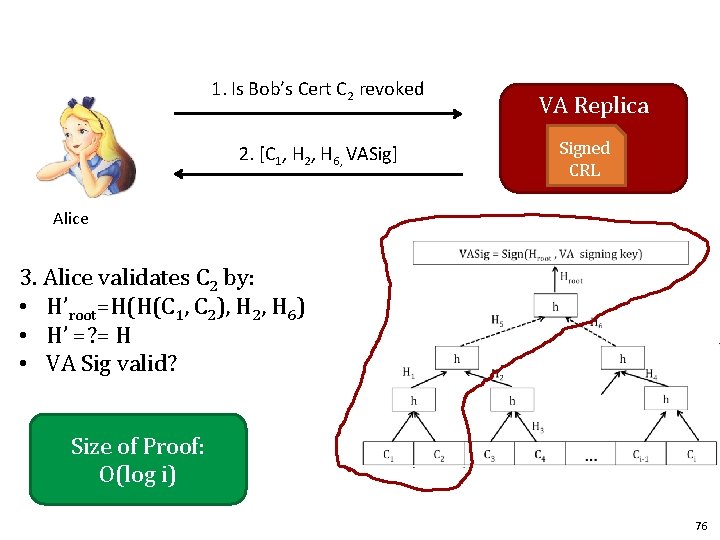
1. Is Bob’s Cert C 2 revoked 2. [C 1, H 2, H 6, VASig] VA Replica Signed CRL Alice 3. Alice validates C 2 by: • H’root=H(H(C 1, C 2), H 2, H 6) • H’ =? = H • VA Sig valid? Size of Proof: O(log i) 76
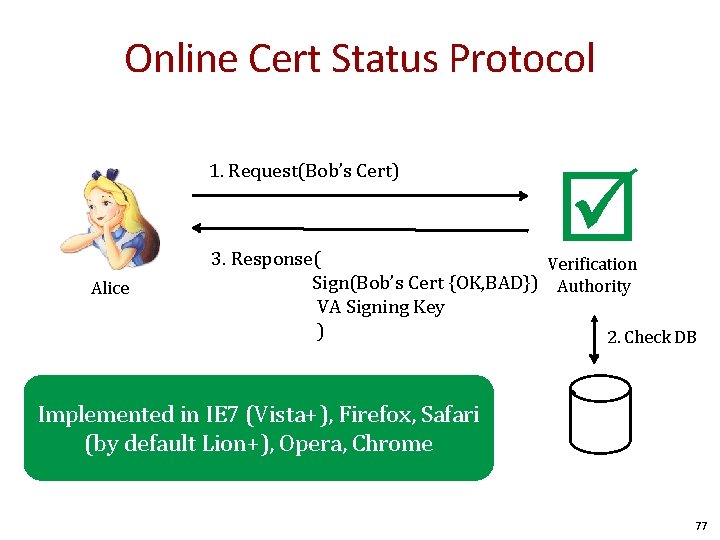
Online Cert Status Protocol 1. Request(Bob’s Cert) Alice 3. Response( Verification Sign(Bob’s Cert {OK, BAD}) Authority VA Signing Key ) 2. Check DB Implemented in IE 7 (Vista+), Firefox, Safari (by default Lion+), Opera, Chrome 77
- Slides: 77