
Hash Tables CSIT 402 Data Structures II Goal
Hash Tables CSIT 402 Data Structures II
Goal Hashing • Perform inserts, deletes, and finds in constant average time Topics • Hash table, hash function, collisions Collision handling • Separate chaining • Open addressing: linear probing, quadratic probing, double hashing Rehashing • Load factor
Goal • Develop a structure that will allow user to insert/delete/find records in constant average time – structure will be a table (relatively small) – table completely contained in memory – implemented by an array – capitalizes on ability to access any element of the array in constant time
Hash Table Applications • Symbol table in compilers • Accessing tree or graph nodes by name – E. g. , city names in Google maps • Maintaining a transposition table in games – Remember previous game situations and the move taken (avoid recomputation) • Dictionary lookups – Spelling checkers – Natural language understanding (word sense) • Heavily used in text processing languages – E. g. , Perl, Python, etc.
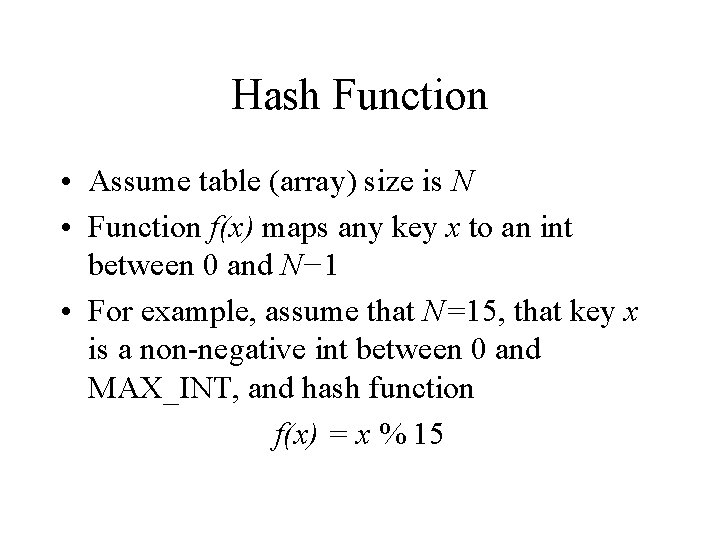
Hash Function • Assume table (array) size is N • Function f(x) maps any key x to an int between 0 and N− 1 • For example, assume that N=15, that key x is a non-negative int between 0 and MAX_INT, and hash function f(x) = x % 15
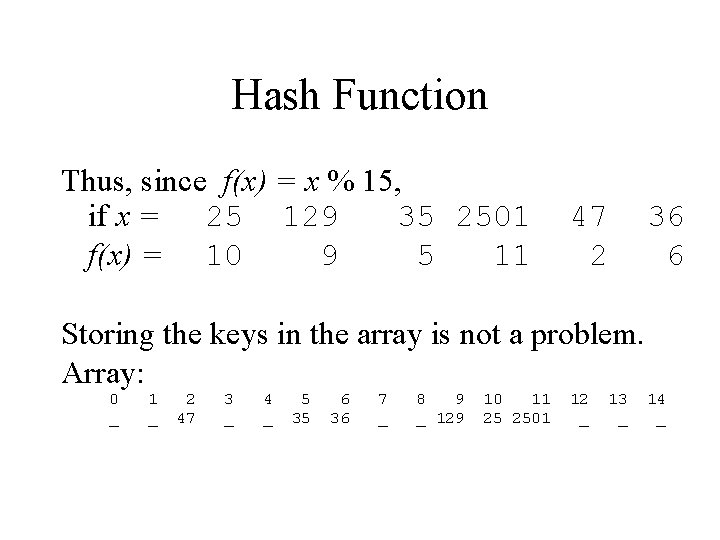
Hash Function Thus, since f(x) = x % 15, if x = 25 129 35 2501 f(x) = 10 9 5 11 47 2 36 6 Storing the keys in the array is not a problem. Array: 0 _ 1 _ 2 47 3 _ 4 _ 5 35 6 36 7 _ 8 9 _ 129 10 11 25 2501 12 _ 13 _ 14 _
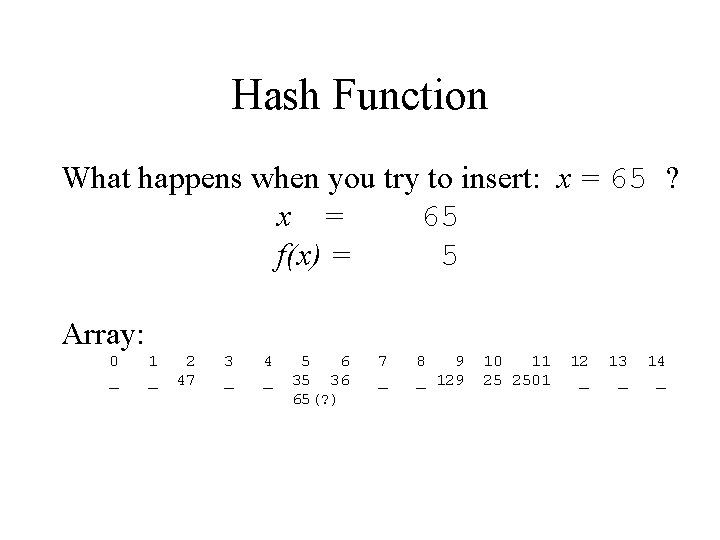
Hash Function What happens when you try to insert: x = 65 ? x = 65 f(x) = 5 Array: 0 _ 1 _ 2 47 3 _ 4 _ 5 6 35 36 65(? ) 7 _ 8 9 _ 129 10 11 25 2501 12 _ 13 _ 14 _
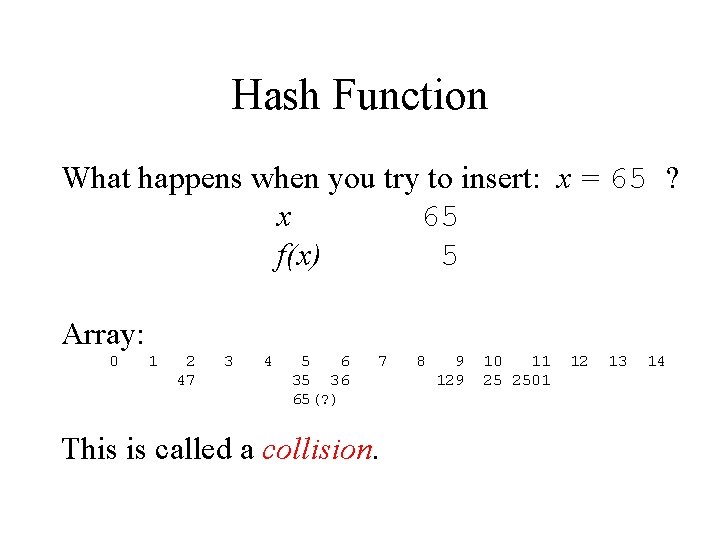
Hash Function What happens when you try to insert: x = 65 ? x 65 f(x) 5 Array: 0 1 2 47 3 4 5 6 35 36 65(? ) 7 This is called a collision. 8 9 129 10 11 25 2501 12 13 14
Handling Collisions • Separate Chaining • Open Addressing – Linear Probing – Quadratic Probing – Double Hashing

Handling Collisions Separate Chaining
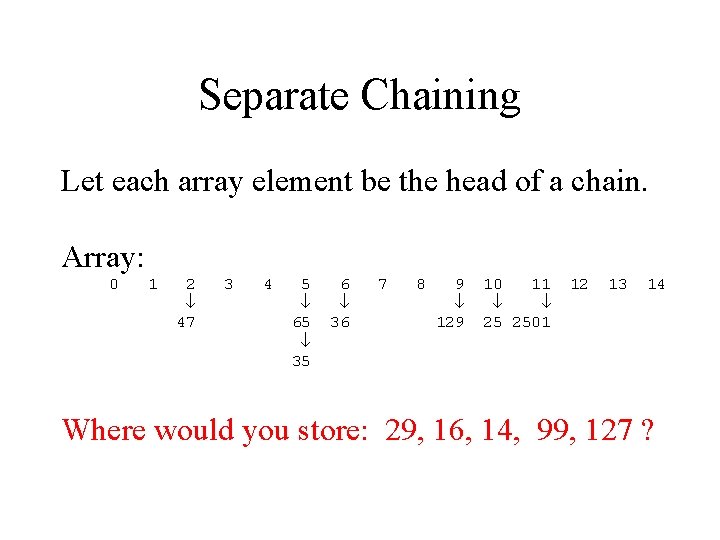
Separate Chaining Let each array element be the head of a chain. Array: 0 1 2 47 3 4 5 65 35 6 36 7 8 9 129 10 11 25 2501 12 13 14 Where would you store: 29, 16, 14, 99, 127 ?
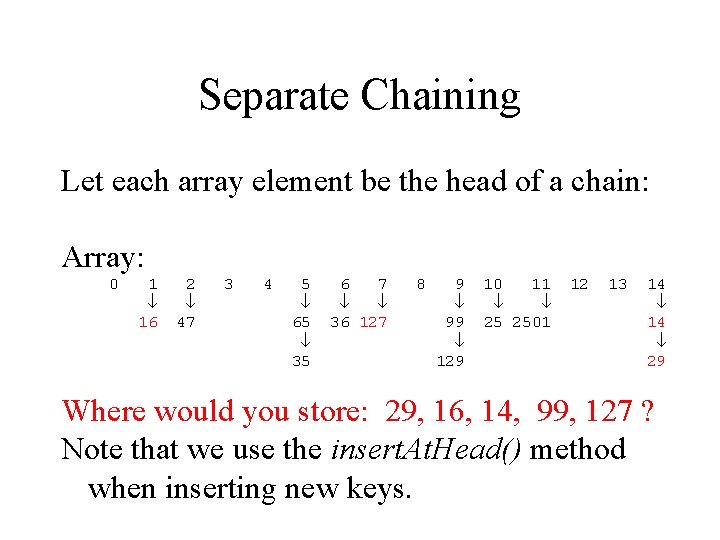
Separate Chaining Let each array element be the head of a chain: Array: 0 1 16 2 47 3 4 5 65 35 6 7 36 127 8 9 99 129 10 11 25 2501 12 13 14 29 Where would you store: 29, 16, 14, 99, 127 ? Note that we use the insert. At. Head() method when inserting new keys.
Handling Collisions Linear Probing
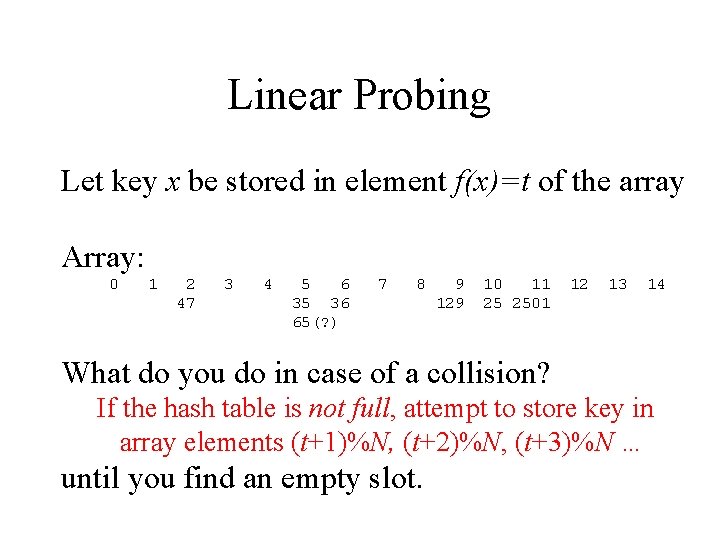
Linear Probing Let key x be stored in element f(x)=t of the array Array: 0 1 2 47 3 4 5 6 35 36 65(? ) 7 8 9 129 10 11 25 2501 12 13 14 What do you do in case of a collision? If the hash table is not full, attempt to store key in array elements (t+1)%N, (t+2)%N, (t+3)%N … until you find an empty slot.
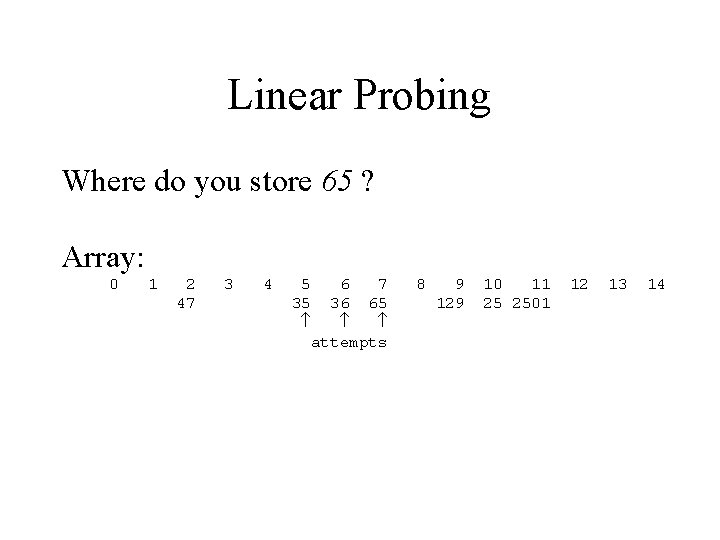
Linear Probing Where do you store 65 ? Array: 0 1 2 47 3 4 5 6 7 35 36 65 attempts 8 9 129 10 11 25 2501 12 13 14

Linear Probing If the hash table is not full, attempt to store key in array elements (t+1)%N, (t+2)%N, … Array: 0 1 2 47 3 4 5 35 6 36 7 65 8 9 129 10 11 25 2501 12 13 14 29 Where would you store: 29, 16, 14, 99, 127 ?

Linear Probing If the hash table is not full, attempt to store key in array elements (t+1)%N, (t+2)%N, … Array: 0 1 16 2 47 3 4 5 35 6 36 7 65 8 9 129 10 11 25 2501 12 Where would you store: 16, 14, 99, 127 ? 13 14 29
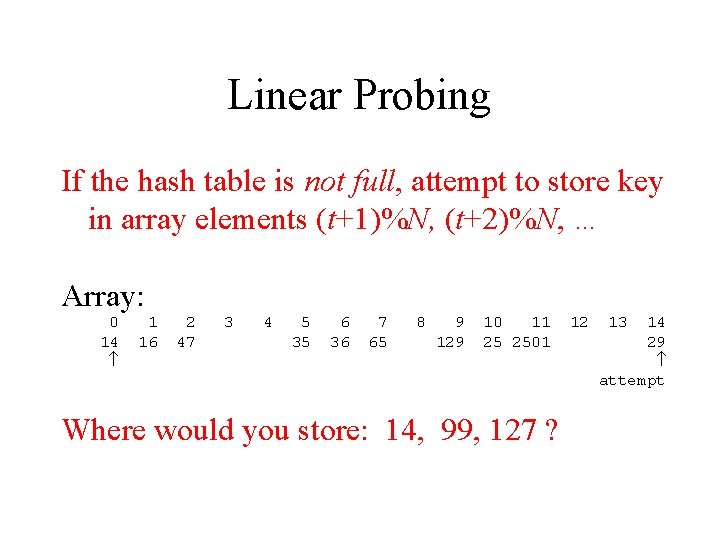
Linear Probing If the hash table is not full, attempt to store key in array elements (t+1)%N, (t+2)%N, … Array: 0 14 1 16 2 47 3 4 5 35 6 36 7 65 8 9 129 10 11 25 2501 Where would you store: 14, 99, 127 ? 12 13 14 29 attempt
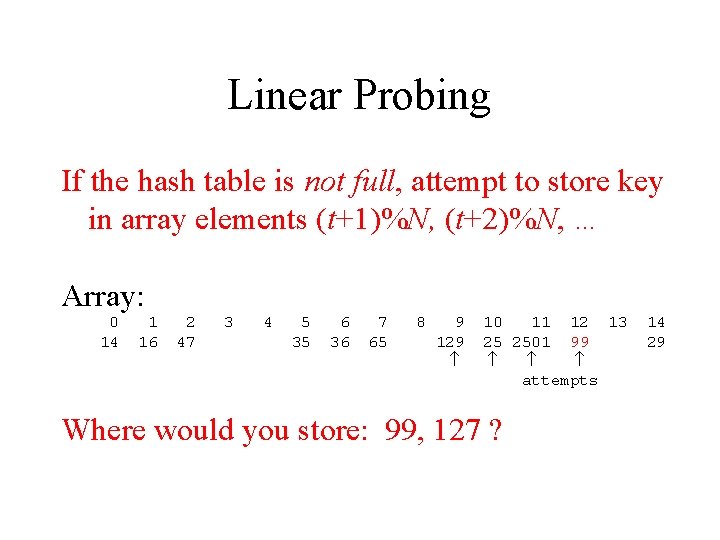
Linear Probing If the hash table is not full, attempt to store key in array elements (t+1)%N, (t+2)%N, … Array: 0 14 1 16 2 47 3 4 5 35 6 36 7 65 8 9 129 10 11 12 13 25 2501 99 attempts Where would you store: 99, 127 ? 14 29

Linear Probing If the hash table is not full, attempt to store key in array elements (t+1)%N, (t+2)%N, … Array: 0 14 1 16 2 47 3 4 5 35 6 36 7 8 9 65 127 129 attempts Where would you store: 127 ? 10 11 25 2501 12 99 13 14 29
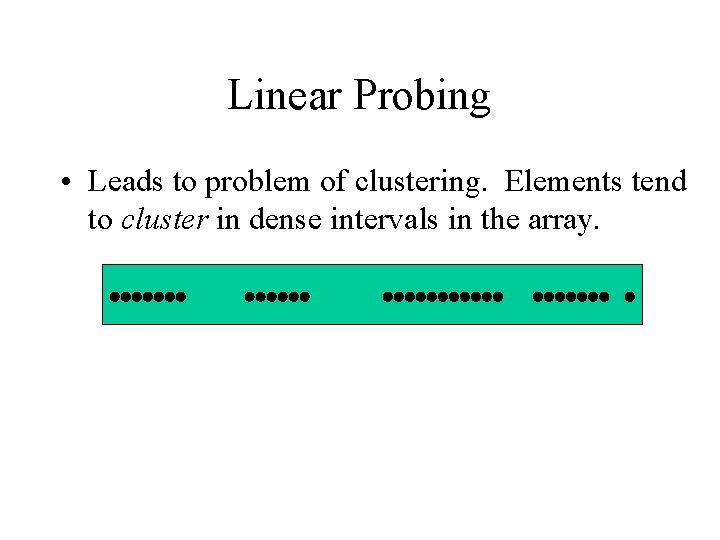
Linear Probing • Leads to problem of clustering. Elements tend to cluster in dense intervals in the array.
Drawbacks of Linear Probing • Works until array is full, but as number of items N approaches Table. Size, access time approaches O(N) • Very prone to cluster formation (as in our example) – If a key hashes anywhere into a cluster, finding a free cell involves going through the entire cluster – and making it grow! – Primary clustering – clusters grow when keys hash to values close to each other • Can have cases where table is empty except for a few clusters – Does not satisfy good hash function criterion of distributing keys uniformly

Handling Collisions Quadratic Probing
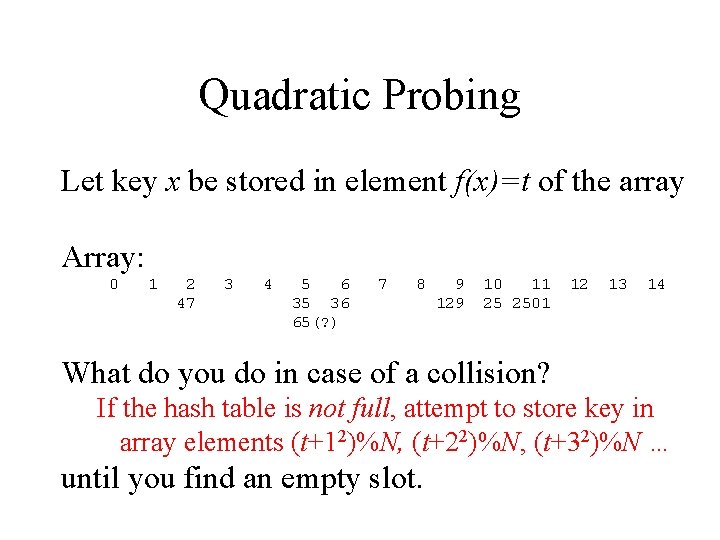
Quadratic Probing Let key x be stored in element f(x)=t of the array Array: 0 1 2 47 3 4 5 6 35 36 65(? ) 7 8 9 129 10 11 25 2501 12 13 14 What do you do in case of a collision? If the hash table is not full, attempt to store key in array elements (t+12)%N, (t+22)%N, (t+32)%N … until you find an empty slot.
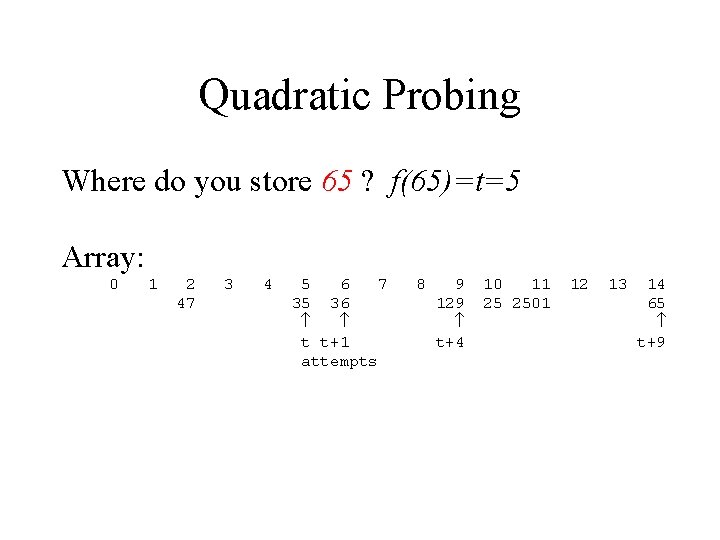
Quadratic Probing Where do you store 65 ? f(65)=t=5 Array: 0 1 2 47 3 4 5 6 7 35 36 t t+1 attempts 8 9 129 t+4 10 11 25 2501 12 13 14 65 t+9
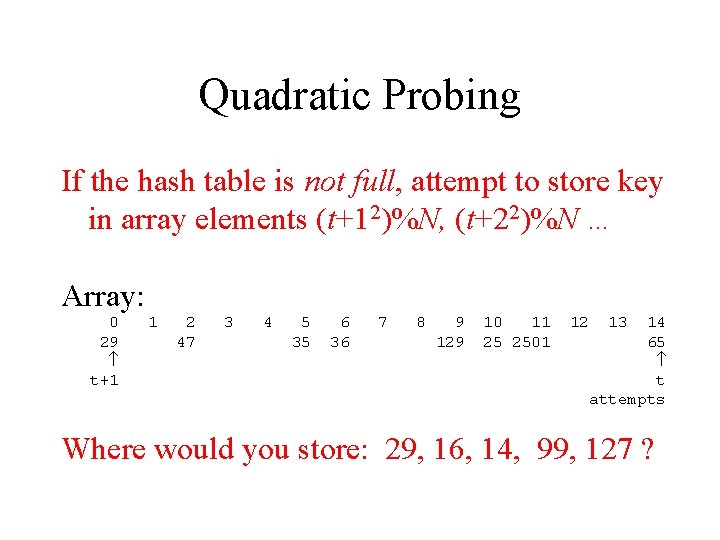
Quadratic Probing If the hash table is not full, attempt to store key in array elements (t+12)%N, (t+22)%N … Array: 0 29 t+1 1 2 47 3 4 5 35 6 36 7 8 9 129 10 11 25 2501 12 13 14 65 t attempts Where would you store: 29, 16, 14, 99, 127 ?
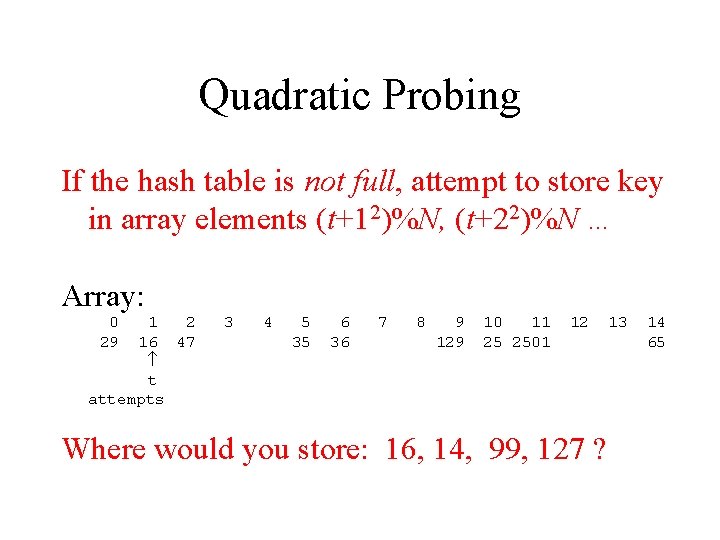
Quadratic Probing If the hash table is not full, attempt to store key in array elements (t+12)%N, (t+22)%N … Array: 0 29 1 2 16 47 t attempts 3 4 5 35 6 36 7 8 9 129 10 11 25 2501 12 Where would you store: 16, 14, 99, 127 ? 13 14 65
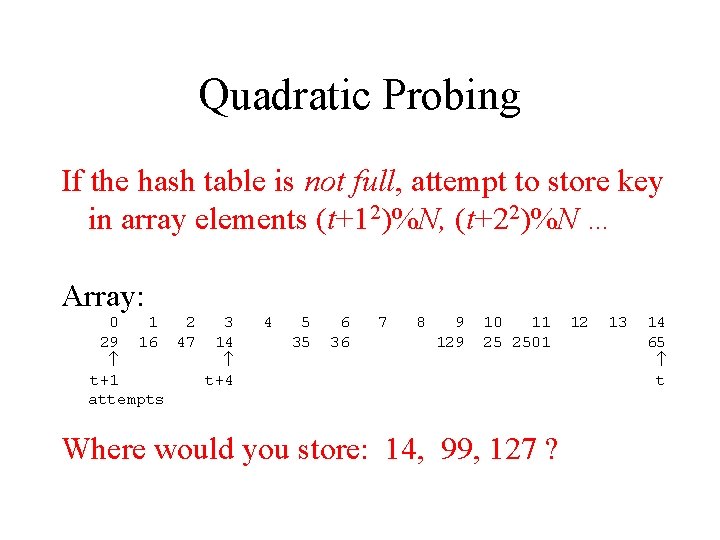
Quadratic Probing If the hash table is not full, attempt to store key in array elements (t+12)%N, (t+22)%N … Array: 0 1 2 3 29 16 47 14 t+1 t+4 attempts 4 5 35 6 36 7 8 9 129 10 11 25 2501 Where would you store: 14, 99, 127 ? 12 13 14 65 t
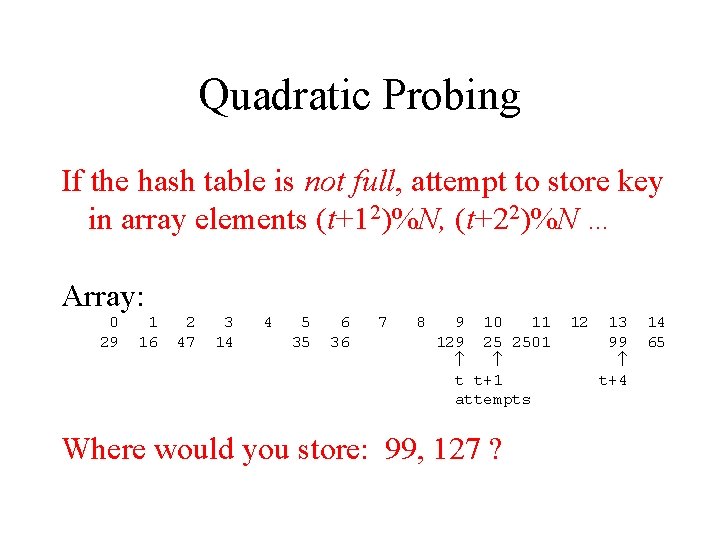
Quadratic Probing If the hash table is not full, attempt to store key in array elements (t+12)%N, (t+22)%N … Array: 0 29 1 16 2 47 3 14 4 5 35 6 36 7 8 9 10 11 129 25 2501 t t+1 attempts Where would you store: 99, 127 ? 12 13 99 t+4 14 65
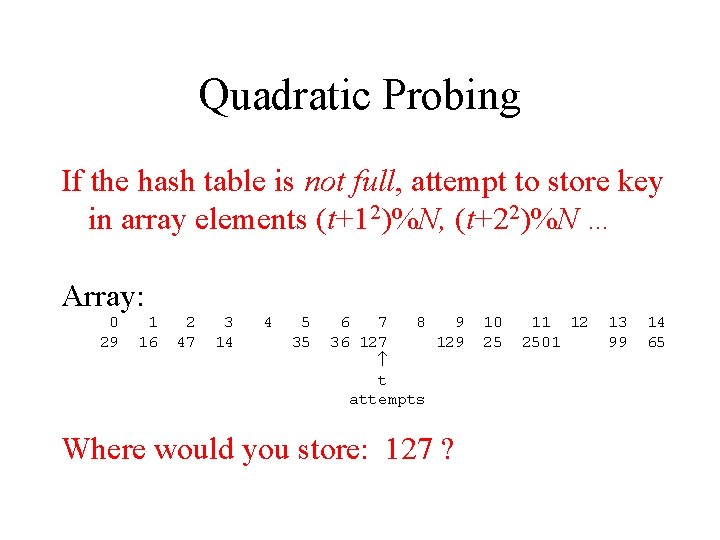
Quadratic Probing If the hash table is not full, attempt to store key in array elements (t+12)%N, (t+22)%N … Array: 0 29 1 16 2 47 3 14 4 5 35 6 7 8 9 36 127 129 t attempts Where would you store: 127 ? 10 25 11 12 2501 13 99 14 65

Quadratic Probing • Tends to distribute keys better • Alleviates problem of clustering
Handling Collisions Double Hashing
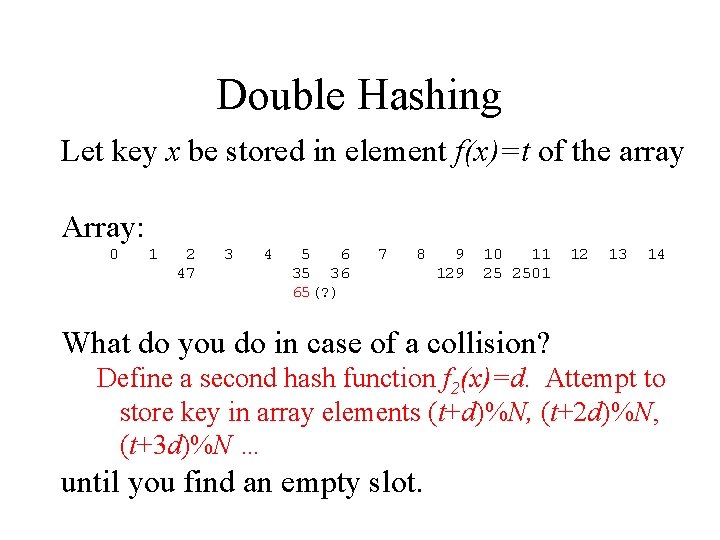
Double Hashing Let key x be stored in element f(x)=t of the array Array: 0 1 2 47 3 4 5 6 35 36 65(? ) 7 8 9 129 10 11 25 2501 12 13 14 What do you do in case of a collision? Define a second hash function f 2(x)=d. Attempt to store key in array elements (t+d)%N, (t+2 d)%N, (t+3 d)%N … until you find an empty slot.
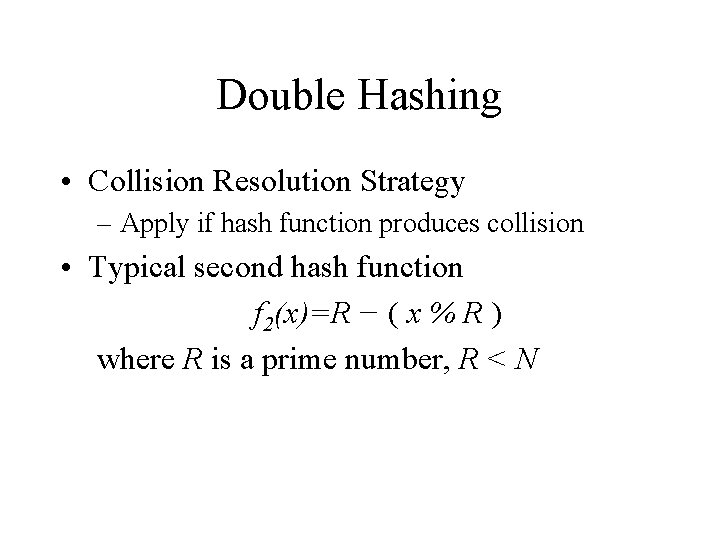
Double Hashing • Collision Resolution Strategy – Apply if hash function produces collision • Typical second hash function f 2(x)=R − ( x % R ) where R is a prime number, R < N
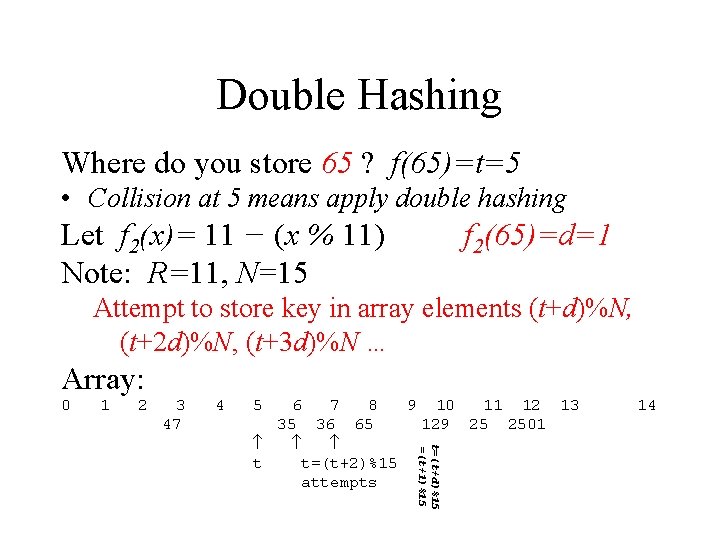
Double Hashing Where do you store 65 ? f(65)=t=5 • Collision at 5 means apply double hashing Let f 2(x)= 11 − (x % 11) Note: R=11, N=15 f 2(65)=d=1 Attempt to store key in array elements (t+d)%N, (t+2 d)%N, (t+3 d)%N … Array: 0 1 2 3 47 4 5 t=(t+d)%15 =(t+1)%15 6 7 8 9 10 11 12 13 35 36 65 129 25 2501 t t=(t+2)%15 attempts 14
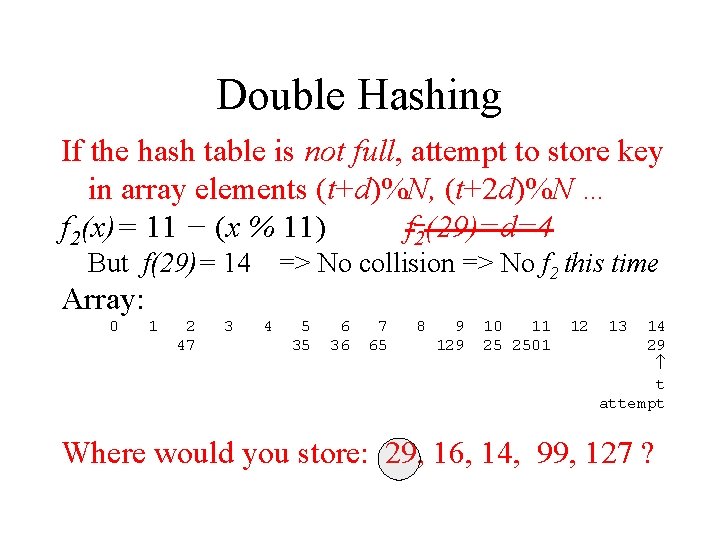
Double Hashing If the hash table is not full, attempt to store key in array elements (t+d)%N, (t+2 d)%N … f 2(x)= 11 − (x % 11) f 2(29)=d=4 But f(29)= 14 => No collision => No f 2 this time Array: 0 1 2 47 3 4 5 35 6 36 7 65 8 9 129 10 11 25 2501 12 13 14 29 t attempt Where would you store: 29, 16, 14, 99, 127 ?
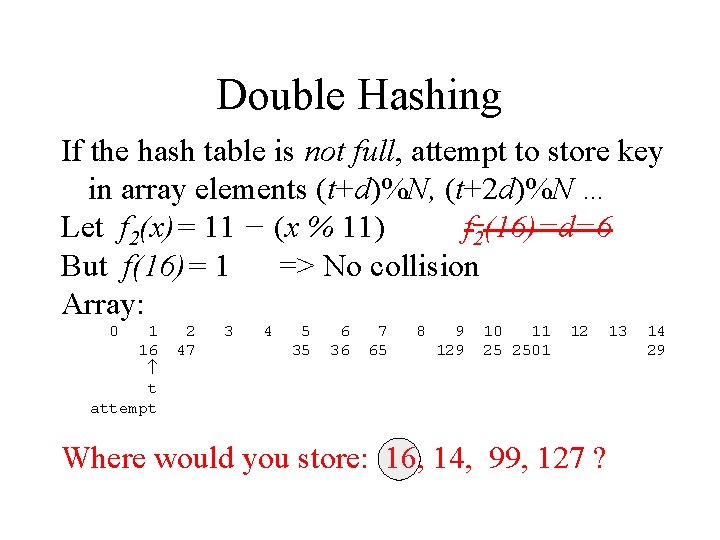
Double Hashing If the hash table is not full, attempt to store key in array elements (t+d)%N, (t+2 d)%N … Let f 2(x)= 11 − (x % 11) f 2(16)=d=6 But f(16)= 1 => No collision Array: 0 1 16 t attempt 2 47 3 4 5 35 6 36 7 65 8 9 129 10 11 25 2501 12 Where would you store: 16, 14, 99, 127 ? 13 14 29
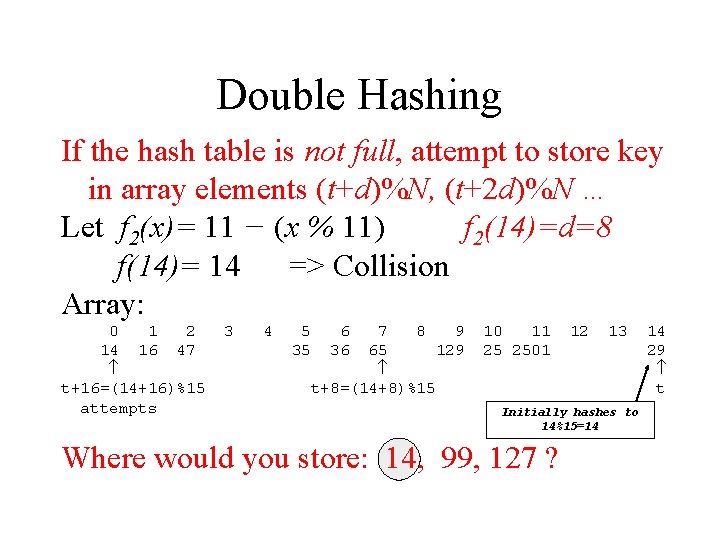
Double Hashing If the hash table is not full, attempt to store key in array elements (t+d)%N, (t+2 d)%N … Let f 2(x)= 11 − (x % 11) f 2(14)=d=8 f(14)= 14 => Collision Array: 0 1 2 14 16 47 t+16=(14+16)%15 attempts 3 4 5 35 6 36 7 8 9 65 129 t+8=(14+8)%15 10 11 25 2501 12 13 Initially hashes to 14%15=14 Where would you store: 14, 99, 127 ? 14 29 t
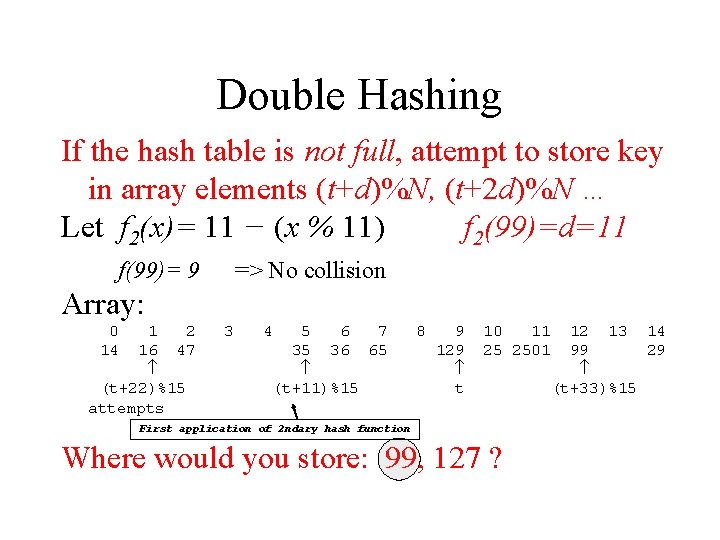
Double Hashing If the hash table is not full, attempt to store key in array elements (t+d)%N, (t+2 d)%N … Let f 2(x)= 11 − (x % 11) f 2(99)=d=11 f(99)= 9 => No collision Array: 0 14 1 2 16 47 (t+22)%15 attempts 3 4 5 6 7 35 36 65 (t+11)%15 8 9 129 t 10 11 25 2501 First application of 2 ndary hash function Where would you store: 99, 127 ? 12 13 14 99 29 (t+33)%15
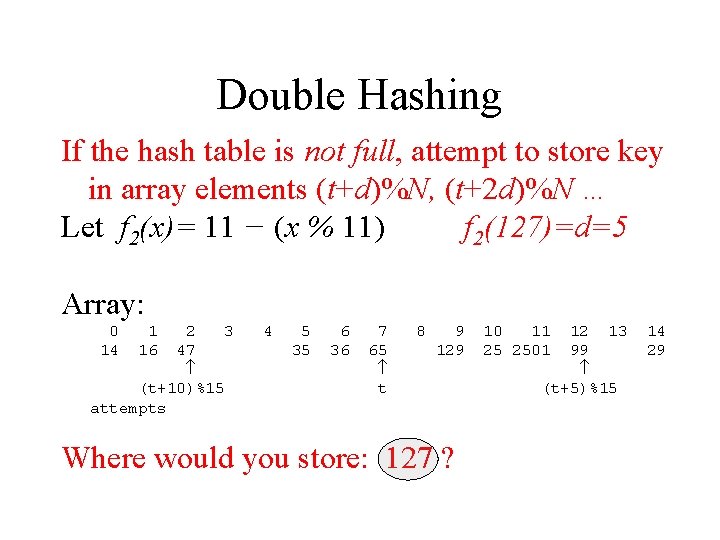
Double Hashing If the hash table is not full, attempt to store key in array elements (t+d)%N, (t+2 d)%N … Let f 2(x)= 11 − (x % 11) f 2(127)=d=5 Array: 0 14 1 16 2 3 47 (t+10)%15 attempts 4 5 35 6 36 7 65 t 8 9 129 Where would you store: 127 ? 10 11 25 2501 12 13 99 (t+5)%15 14 29
Delete Element Collision Ramifications • • Chaining Linear Probing Quadratic Probing Double Hashing
Deletion Issues Chaining/Buckets • Deletion from Linked List • No Issues Linear Probing • Issue: • Removal of element within cluster
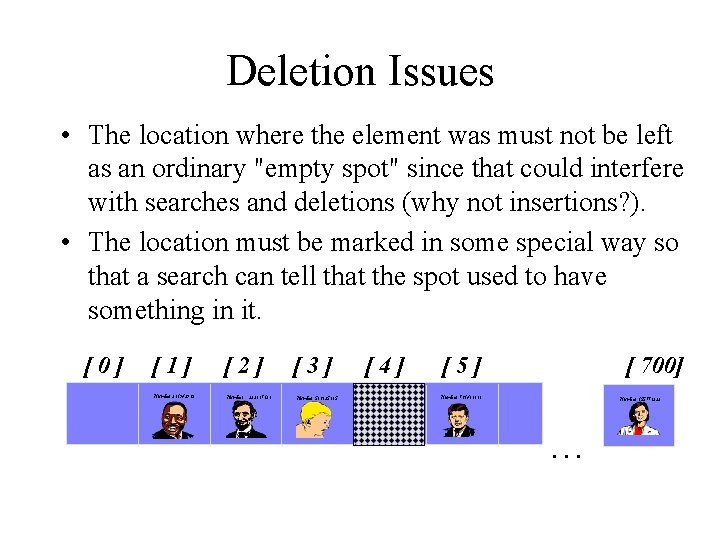
Deletion Issues • The location where the element was must not be left as an ordinary "empty spot" since that could interfere with searches and deletions (why not insertions? ). • The location must be marked in some special way so that a search can tell that the spot used to have something in it. [0] [1] Number 281942902 [2] Number 233667136 [3] Number 580625685 [4] [5] [ 700] Number 701466868 Number 155778322 . . .
Deletion Issues General Solutions • Each slot can be marked as empty, deleted, or occupied • Cascade following elements one slot back, according to the collision handling scheme • Remove all successor elements and reinsert • Second table of deleted items. • Commonly used in search engines. • Rebuild hash table • Move element at end of cluster to fill slot • Some of these are not foolproof!
Searching For a Key Elephant in the room • If there’s a collision, how do you know when you found your item, since all mapped to the same slot? • • The key is assumed to be a unique value Keep in mind: • • The hash function maps sparse data into an array or similar It is applied to the key
Hash Tables in C++ STL • STL hash table containers – hash_set – hash_map • These use Functors
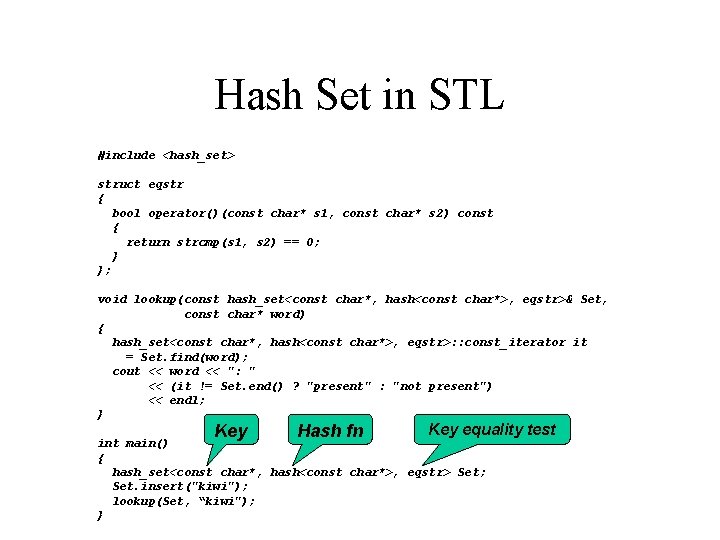
Hash Set in STL #include <hash_set> struct eqstr { bool operator()(const char* s 1, const char* s 2) const { return strcmp(s 1, s 2) == 0; } }; void lookup(const hash_set<const char*, hash<const char*>, eqstr>& Set, const char* word) { hash_set<const char*, hash<const char*>, eqstr>: : const_iterator it = Set. find(word); cout << word << ": " << (it != Set. end() ? "present" : "not present") << endl; } Key Hash fn Key equality test int main() { hash_set<const char*, hash<const char*>, eqstr> Set; Set. insert("kiwi"); lookup(Set, “kiwi"); }
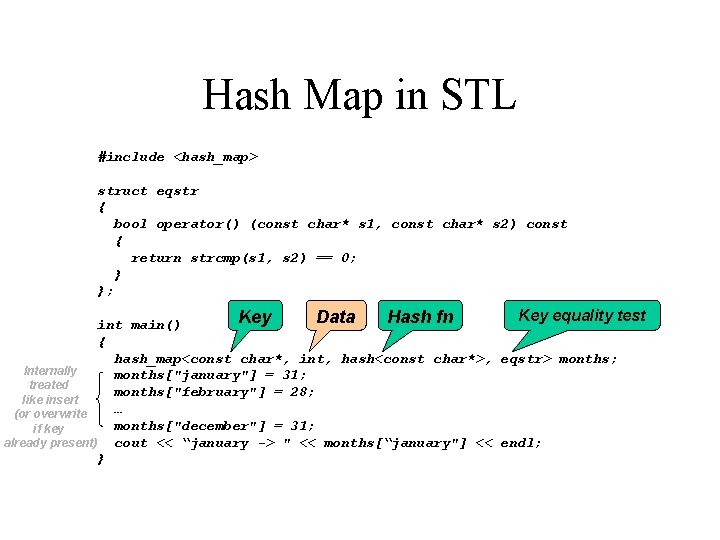
Hash Map in STL #include <hash_map> struct eqstr { bool operator() (const char* s 1, const char* s 2) const { return strcmp(s 1, s 2) == 0; } }; Key equality test Key Data Hash fn int main() { hash_map<const char*, int, hash<const char*>, eqstr> months; Internally months["january"] = 31; treated months["february"] = 28; like insert … (or overwrite months["december"] = 31; if key already present) cout << “january -> " << months[“january"] << endl; }
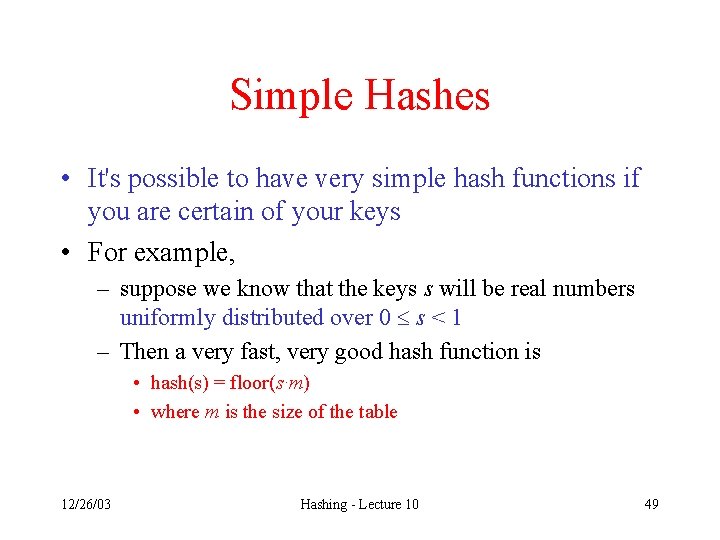
Simple Hashes • It's possible to have very simple hash functions if you are certain of your keys • For example, – suppose we know that the keys s will be real numbers uniformly distributed over 0 s < 1 – Then a very fast, very good hash function is • hash(s) = floor(s·m) • where m is the size of the table 12/26/03 Hashing - Lecture 10 49
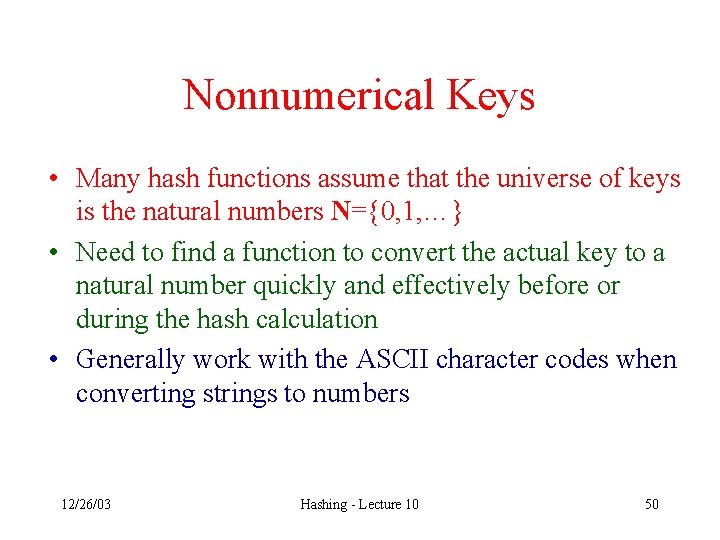
Nonnumerical Keys • Many hash functions assume that the universe of keys is the natural numbers N={0, 1, …} • Need to find a function to convert the actual key to a natural number quickly and effectively before or during the hash calculation • Generally work with the ASCII character codes when converting strings to numbers 12/26/03 Hashing - Lecture 10 50
Load Factor of a Hash Table • Let N = number of items to be stored • Load factor = N/Table. Size – Table. Size = 101 and N =505, then = 5 – Table. Size = 101 and N = 10, then = 0. 1 • Average length of chained list = and so average time for accessing an item = O(1) + O( ) – Want to be smaller than 1 but close to 1 if good hashing function (i. e. Table. Size N) – With chaining hashing continues to work for > 1 12/26/03 Hashing - Lecture 10 51
Conclusions • Best to choose N=prime number • Issue of Load Factor = fraction of hash table occupied – should rehash when load factor between 0. 5 and 0. 7 • Rehashing – approximately double the size of hash table (select N=nearest prime) – redefine hash function(s) – rehash keys into new table
- Slides: 52