Unit 3 Final Exam Forces Interactions Read each
- Slides: 36
Unit 3 Final Exam Forces & Interactions Read each question and all answers carefully. Eliminate obvious wrong answers, then choose the best remaining answer. Do not waste time as you will have 45 -60 seconds to answer each question. No going back!
MS: Waves & Information Transfer MS-PS 4 -1 1. A transverse wave is transporting energy from east to west. The particles of the medium will move_____. a. east to west only b. both eastward and westward c. north to south only d. both northward and southward
2. A wave is transporting energy from left to right. The particles of the medium are moving back and forth in a leftward and rightward direction. This type of wave is known as a ____. a. Mechanical b. Electromagnetic c. Transverse d. Longitudinal
3. The amount of energy carried by a wave is determined by the formula E = A 2. If E is the energy, what is A called? a. Crest b. Trough c. Wavelength d. Amplitude
4. How does the energy in a TRANSVERSE wave move? a. Parallel to the wave vibrations. b. Perpendicular to the wave direction. c. Opposite to the wave vibrations. d. Independent of wave direction.
5. How does the energy in LONGITUDINAL waves move? a. Parallel to the wave vibrations. b. Perpendicular to the wave direction. c. Apart from the wave vibrations. d. Independent of wave direction.
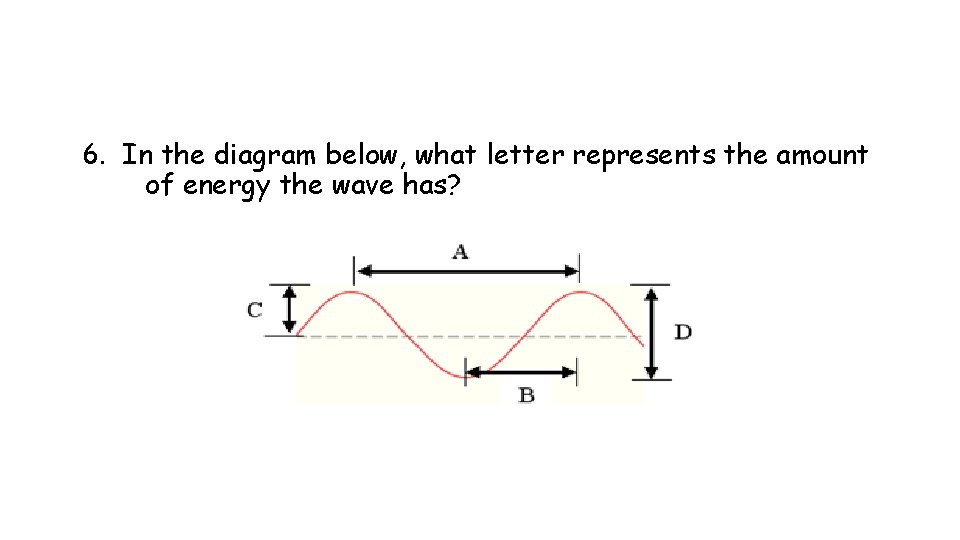
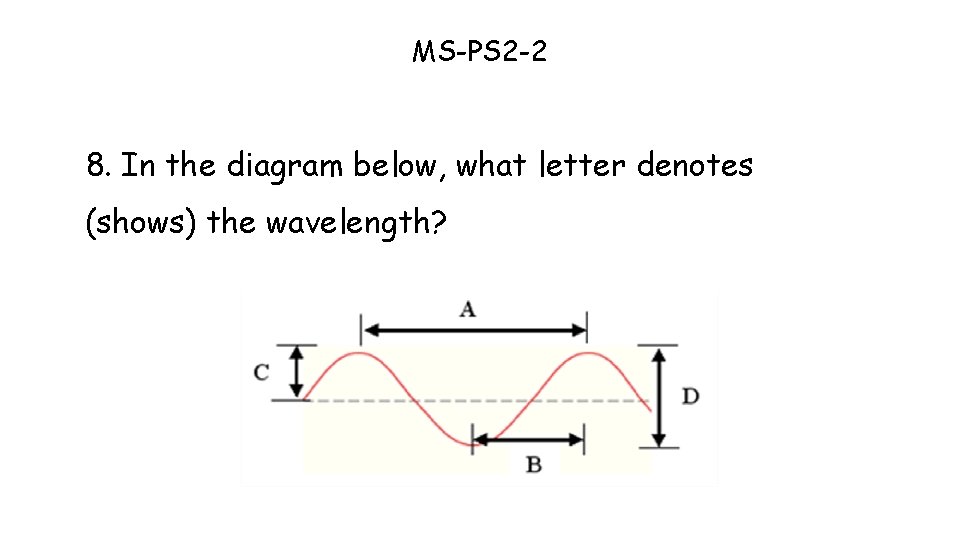
6. In the diagram below, what letter represents the amount of energy the wave has?
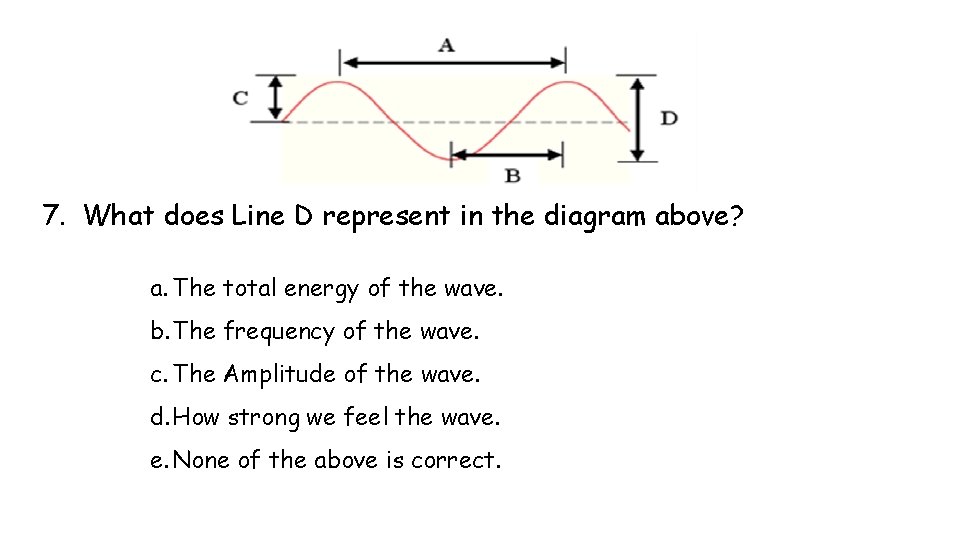
7. What does Line D represent in the diagram above? a. The total energy of the wave. b. The frequency of the wave. c. The Amplitude of the wave. d. How strong we feel the wave. e. None of the above is correct.
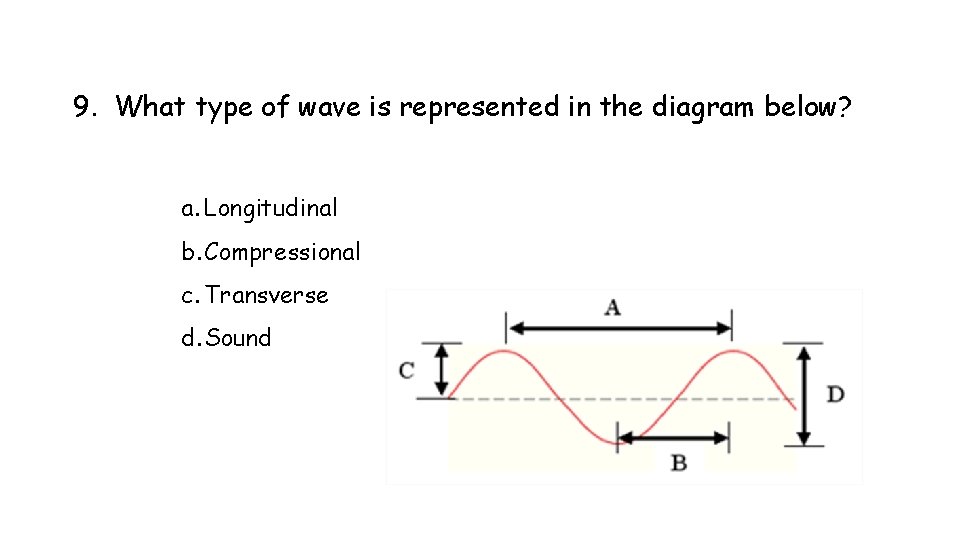
MS-PS 2 -2 8. In the diagram below, what letter denotes (shows) the wavelength?
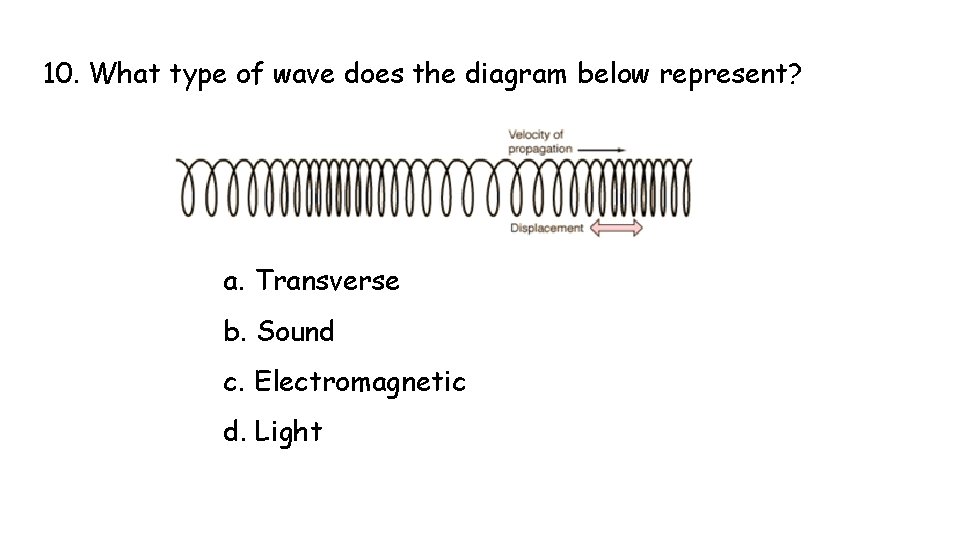
9. What type of wave is represented in the diagram below? a. Longitudinal b. Compressional c. Transverse d. Sound
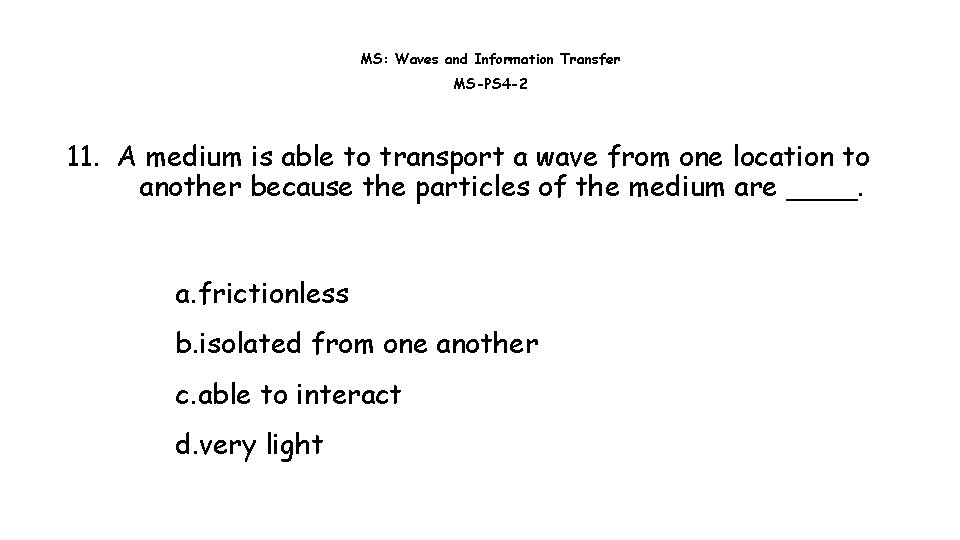
10. What type of wave does the diagram below represent? a. Transverse b. Sound c. Electromagnetic d. Light
MS: Waves and Information Transfer MS-PS 4 -2 11. A medium is able to transport a wave from one location to another because the particles of the medium are ____. a. frictionless b. isolated from one another c. able to interact d. very light
12. In order for John to hear Jill, air molecules must move from the lips of Jill to the ears of John. a. True b. False
13. In which of the following do transverse waves move fastest? a. space b. solids c. water d. air
14. In which medium do Sound waves move fastest? a. Air b. Water c. Space d. Solids
15. Which type of object transmits light easily? a. opaque b. translucent c. transparent d. colored
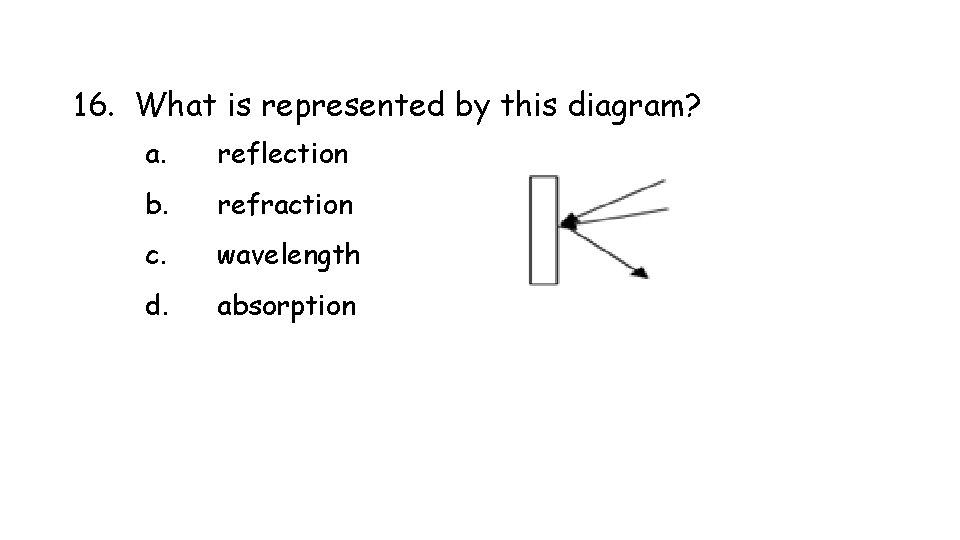
16. What is represented by this diagram? a. reflection b. refraction c. wavelength d. absorption
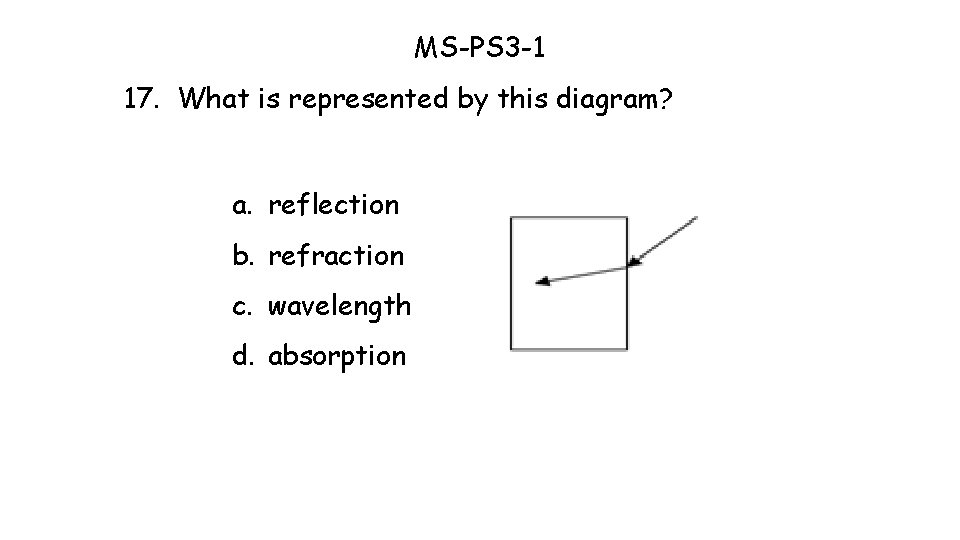
MS-PS 3 -1 17. What is represented by this diagram? a. reflection b. refraction c. wavelength d. absorption
18. What do Electromagnetic waves transmit? a. charges b. fields c. matter d. energy
19. An object is seen when light reflected from an object enters the eye. a. True b. False
20. What do waves transfer? a. matter b. energy c. particles d. water
21. What do we call reflected sound waves? a. Echoes b. Noise c. Rebounds d. Reverberations
22. All sounds are created by vibrations or particle to particle transfer of energy. a. True b. False
23. What is changed when you change the frequency of a sound wave? a. pitch b. amplitude c. volume d. color
24. What is a popular use for Microwaves? a. cooking b. scattering c. diffraction d. refraction
25. Which type of object transmits light easily? a. opaque b. translucent c. transparent d. colored
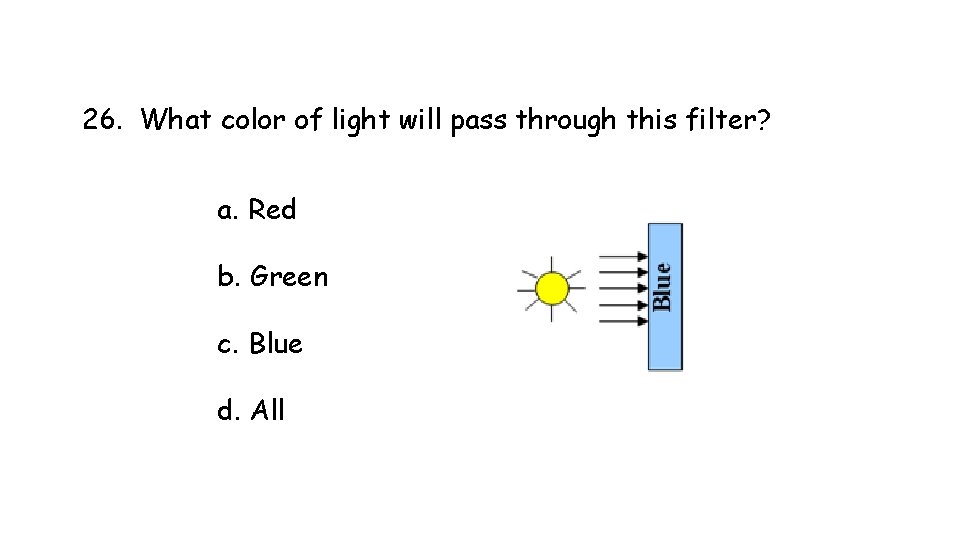
26. What color of light will pass through this filter? a. Red b. Green c. Blue d. All
27. What part of the electromagnetic spectrum is visible to humans? a. All parts b. Infrared c. Visible d. Ultraviolet
28. Light is a type of what? a. electromagnetic wave b. electromagnetic spectrum c. electromagnetic energy d. horizontal wave
29. Which of these has the longest wavelength? a. Blue light b. Infrared radiation c. Radio wave d. X-ray
30. Which of these has the highest frequency? a. Blue light b. Infrared radiation c. Radio wave d. X-ray
MS: Waves and Information Transfer MS-PS 4 -3 31. What is NOT an example of a Digital Transmission? a. A cell phone. b. High Speed Internet c. Cable TV d. Sirius XM Radio e. All of the above are examples
32. Which option below lists the type of signal denoted by binary 1 s and 0 s? a. Analog b. Digital c. Static d. Linear
33. Which of the following is NOT true for an Analog Wave? a. An Analog signal has a continuous change in amplitude and frequency. b. An Analog wave can carry much more information than a Digital wave. c. A person’s voice or a dog barking are examples of Analog waves. d. Analog wave transmission is more reliable than Digital. e. Both b and d are not true about Analog Waves
34. Analog signal are created when information is translated into electrical pulses of varying amplitude. a. True b. False
35. Which of the following is NOT true for a Digital Wave? a. An Analog wave can carry much more information than a Digital wave. b. Digital signals are used to make CD’s and MP 3’s. c. Digital signals are defined and consistent. d. Digital signals are created from 0’s and 1’s.