The Reitman Centre A program for CARERS and



- Slides: 24
The Reitman Centre A program for CARERS and A model for Change The Cyril & Dorothy, Joel & Jill Reitman Centre for Alzheimer Support and Training IFA Prague May 31 2012
Theresa is 43 years old and unmarried. In keeping with her strong commitment to her Chinese heritage and culture, When her 80 year old father became demented she became his primary family caregiver , dealing daily with behavioural changes caused by the dementia- incontinence, agitation, unreasonable resistance to care and unpredictable wandering away. Theresa was referred to the Reitman Centre’s CARERS program because of the enormous stress, including the embarrassment she has in providing intimate personal care to her father and social isolation as she devotes herself to her father’s care. She wanted to get help to address her frustration and bouts of anger when being confronted by her father’s resistive behaviours and endless pacing within the house. Despite the personal care support arranged through CCAC and the adult day program that have been put in place for her father by a seniors’ service agency, Theresa still felt overwhelmed, helpless, exhausted and had worries that she may cause harm to herself or her father by overreacting to the caregiving challenges. She has been getting some education in caring for demented patients through community workshops, but often found it hard to apply this knowledge to her specific caregiving situations.
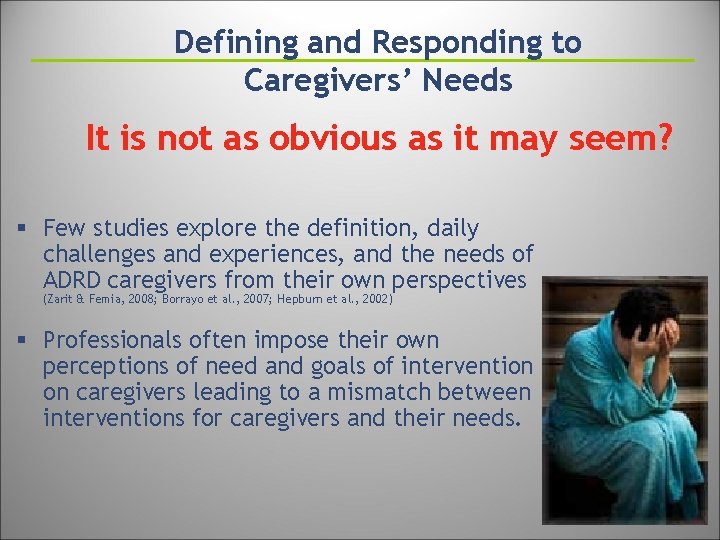
Defining and Responding to Caregivers’ Needs It is not as obvious as it may seem? § Few studies explore the definition, daily challenges and experiences, and the needs of ADRD caregivers from their own perspectives (Zarit & Femia, 2008; Borrayo et al. , 2007; Hepburn et al. , 2002) § Professionals often impose their own perceptions of need and goals of intervention on caregivers leading to a mismatch between interventions for caregivers and their needs.
Cultural differences • • • Psychological responses to stress (Patterson et al 1998) Individual coping styles (Haley et al 1996) Service utilization (Janevic 2001) View of the disease and approach the task of providing care for dementia (Gallagher –Thompson et al 2003) Chinese culture stigmatization of dementia (Elliott 1996) Lack of knowledge about dementia (Zhan 2004) Lack of culturally and linguistically appropriate services in the community (Hinton 2004) Familial obligation (“filial piety”) (Pang 2002) Negative interactions with health care providers(Zhan Joel Sadavo. Z MD. 2010 2004, Pang 2002)
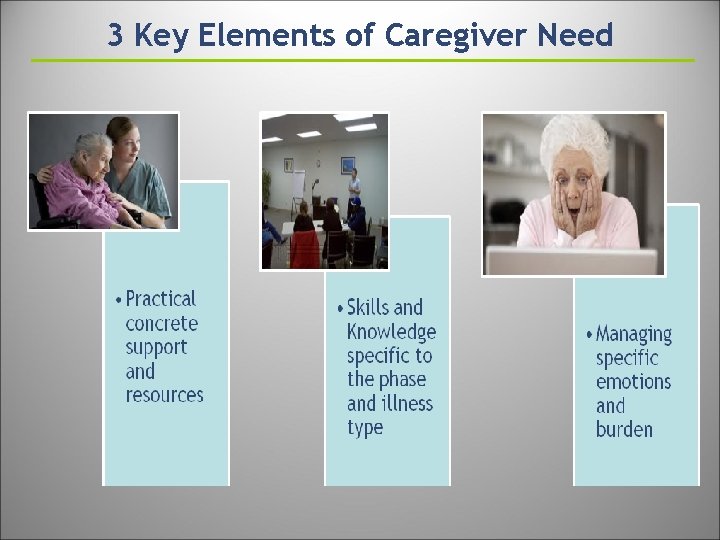
3 Key Elements of Caregiver Need
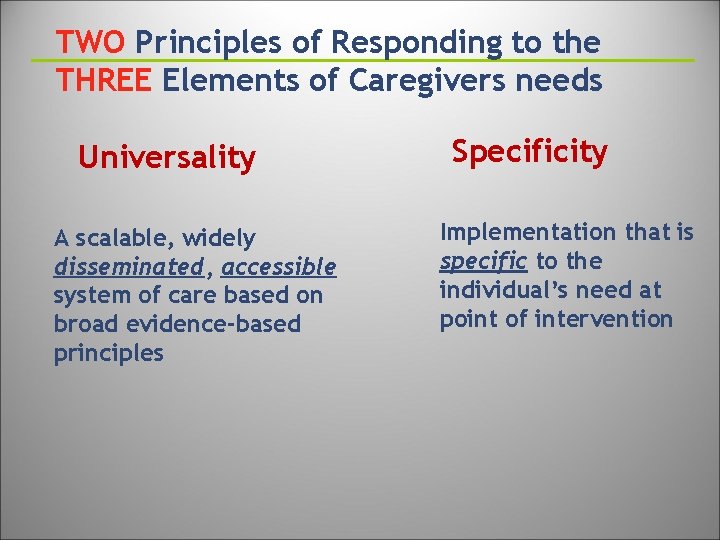
TWO Principles of Responding to the THREE Elements of Caregivers needs Universality A scalable, widely disseminated, accessible system of care based on broad evidence-based principles Specificity Implementation that is specific to the individual’s need at point of intervention
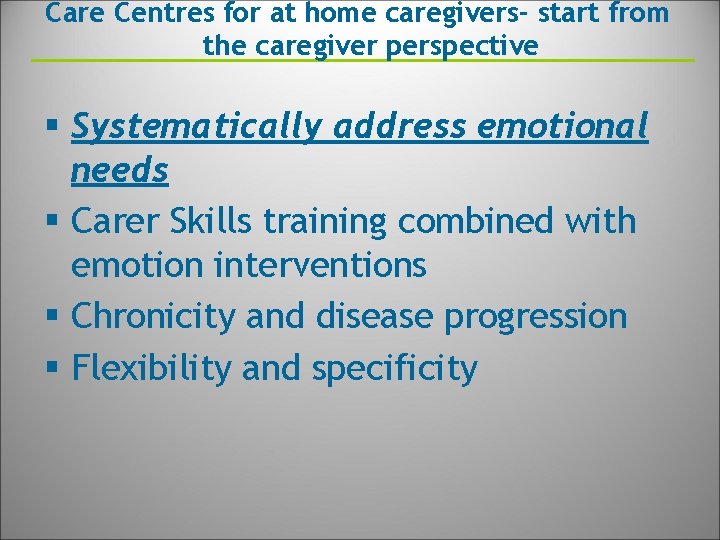
Care Centres for at home caregivers- start from the caregiver perspective § Systematically address emotional needs § Carer Skills training combined with emotion interventions § Chronicity and disease progression § Flexibility and specificity
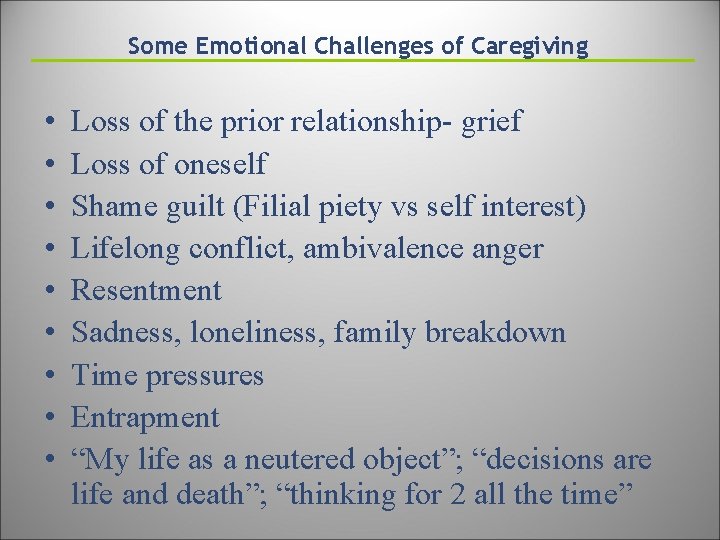
Some Emotional Challenges of Caregiving • • • Loss of the prior relationship- grief Loss of oneself Shame guilt (Filial piety vs self interest) Lifelong conflict, ambivalence anger Resentment Sadness, loneliness, family breakdown Time pressures Entrapment “My life as a neutered object”; “decisions are life and death”; “thinking for 2 all the time”
Can programs be designed for Universality, Scalability and Specificity?
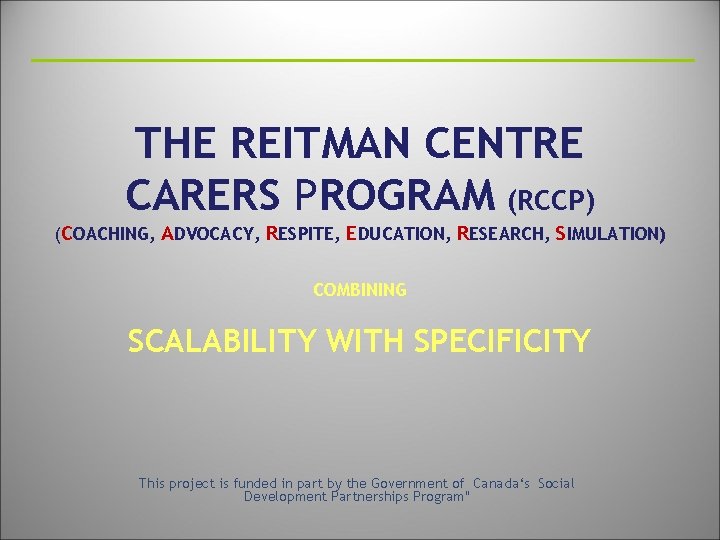
THE REITMAN CENTRE CARERS PROGRAM (RCCP) (COACHING, ADVOCACY, RESPITE, EDUCATION, RESEARCH, SIMULATION) COMBINING SCALABILITY WITH SPECIFICITY This project is funded in part by the Government of Canada‘s Social Development Partnerships Program"
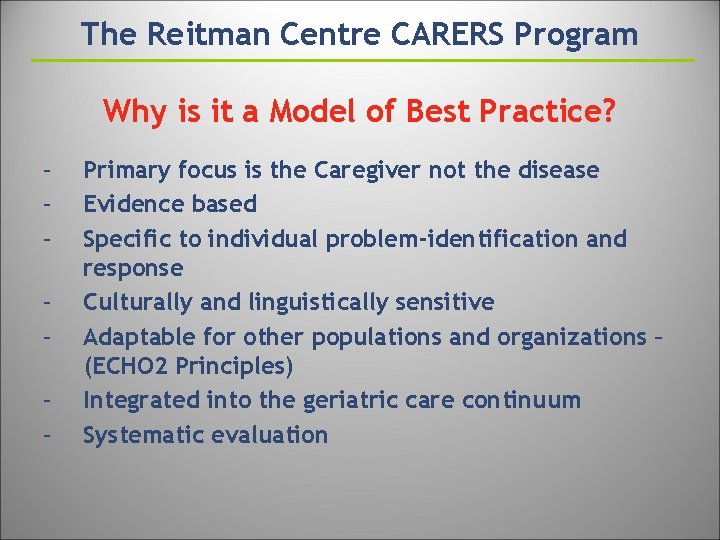
The Reitman Centre CARERS Program Why is it a Model of Best Practice? – – – – Primary focus is the Caregiver not the disease Evidence based Specific to individual problem-identification and response Culturally and linguistically sensitive Adaptable for other populations and organizations – (ECHO 2 Principles) Integrated into the geriatric care continuum Systematic evaluation
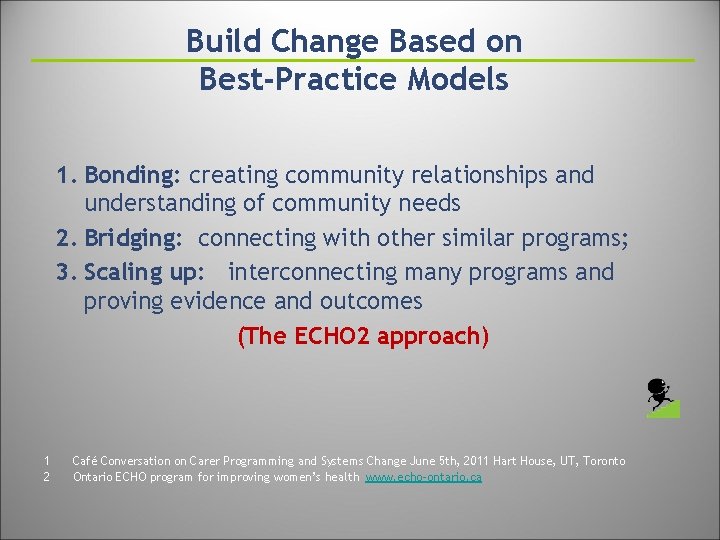
Build Change Based on Best-Practice Models 1. Bonding: creating community relationships and understanding of community needs 2. Bridging: connecting with other similar programs; 3. Scaling up: interconnecting many programs and proving evidence and outcomes (The ECHO 2 approach) 1 2 Café Conversation on Carer Programming and Systems Change June 5 th, 2011 Hart House, UT, Toronto Ontario ECHO program for improving women’s health www. echo-ontario. ca
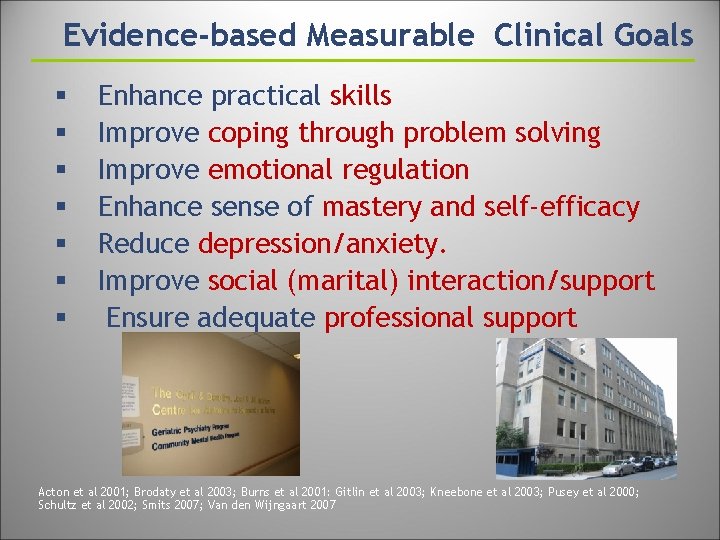
Evidence-based Measurable Clinical Goals § § § § Enhance practical skills Improve coping through problem solving Improve emotional regulation Enhance sense of mastery and self-efficacy Reduce depression/anxiety. Improve social (marital) interaction/support Ensure adequate professional support Acton et al 2001; Brodaty et al 2003; Burns et al 2001: Gitlin et al 2003; Kneebone et al 2003; Pusey et al 2000; Schultz et al 2002; Smits 2007; Van den Wijngaart 2007
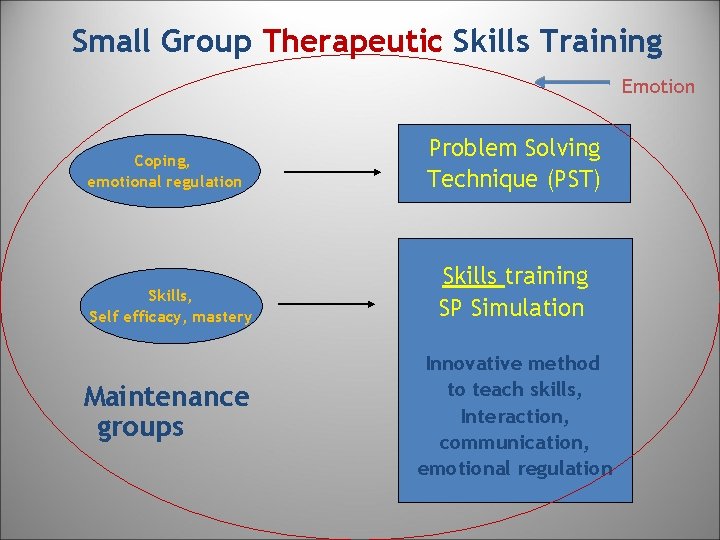
Small Group Therapeutic Skills Training Emotion Coping, emotional regulation Skills, Self efficacy, mastery Maintenance groups Problem Solving Technique (PST) Skills training SP Simulation Innovative method to teach skills, Interaction, communication, emotional regulation
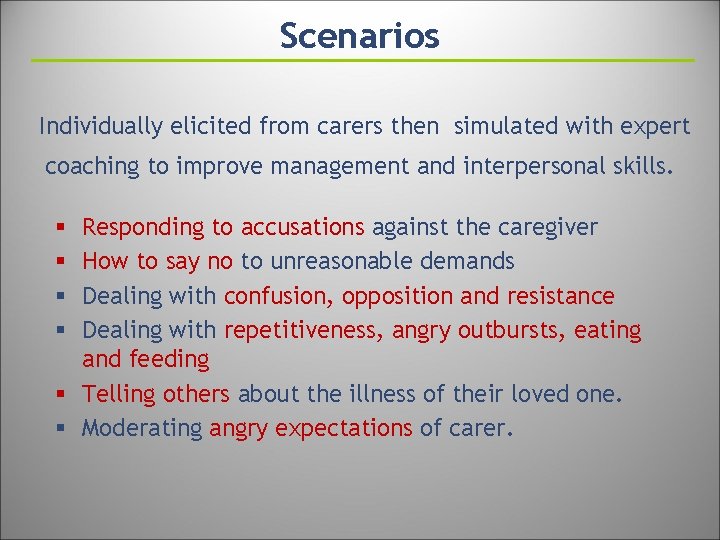
Scenarios Individually elicited from carers then simulated with expert coaching to improve management and interpersonal skills. Responding to accusations against the caregiver How to say no to unreasonable demands Dealing with confusion, opposition and resistance Dealing with repetitiveness, angry outbursts, eating and feeding § Telling others about the illness of their loved one. § Moderating angry expectations of carer. § §
EVALUATION OF CLINICAL EFFICACY AND SATISFACTION
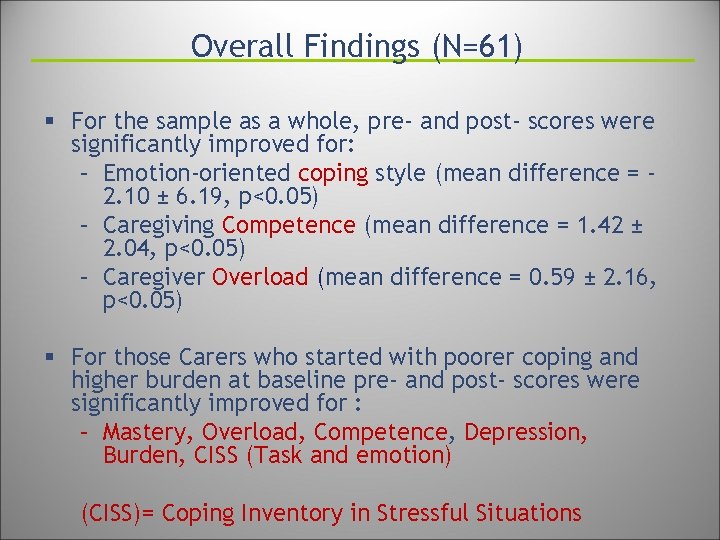
Overall Findings (N=61) § For the sample as a whole, pre- and post- scores were significantly improved for: – Emotion-oriented coping style (mean difference = 2. 10 ± 6. 19, p<0. 05) – Caregiving Competence (mean difference = 1. 42 ± 2. 04, p<0. 05) – Caregiver Overload (mean difference = 0. 59 ± 2. 16, p<0. 05) § For those Carers who started with poorer coping and higher burden at baseline pre- and post- scores were significantly improved for : – Mastery, Overload, Competence, Depression, Burden, CISS (Task and emotion) (CISS)= Coping Inventory in Stressful Situations
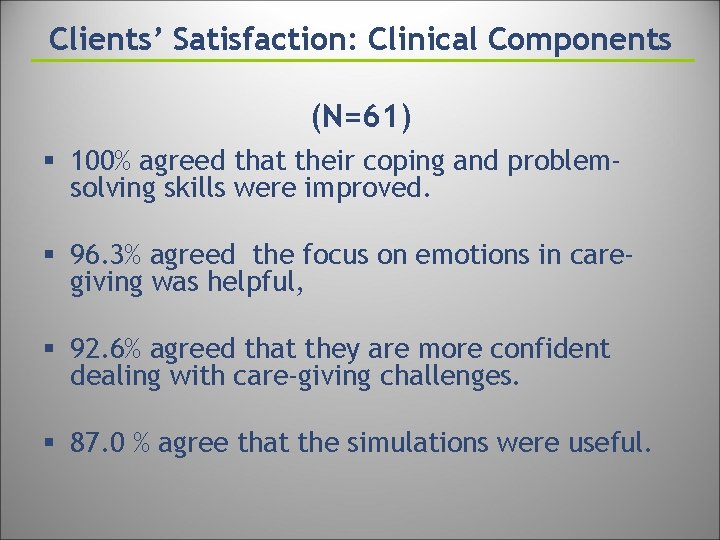
Clients’ Satisfaction: Clinical Components (N=61) § 100% agreed that their coping and problemsolving skills were improved. § 96. 3% agreed the focus on emotions in caregiving was helpful, § 92. 6% agreed that they are more confident dealing with care-giving challenges. § 87. 0 % agree that the simulations were useful.
KNOWLEDGE EXCHANGE MILESTONES BUILDING SYSTEM CAPACITY Manualization of intervention and educational Tools Web- based platform/e-manual 3 levels of Course curricula Testing/modification/implementation
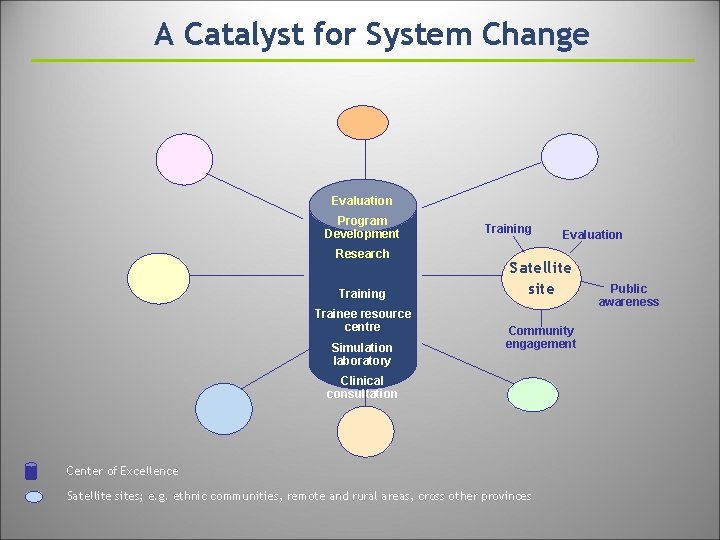
A Catalyst for System Change Evaluation Program Development Research Training Trainee resource centre Simulation laboratory Training Evaluation Satellite site Community engagement Clinical consultation Center of Excellence Satellite sites; e. g. ethnic communities, remote and rural areas, cross other provinces Public awareness
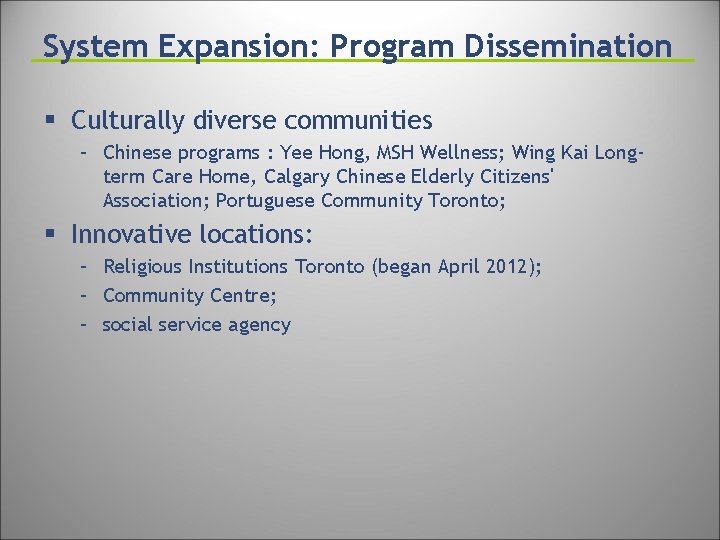
System Expansion: Program Dissemination § Culturally diverse communities – Chinese programs : Yee Hong, MSH Wellness; Wing Kai Longterm Care Home, Calgary Chinese Elderly Citizens' Association; Portuguese Community Toronto; § Innovative locations: – Religious Institutions Toronto (began April 2012); – Community Centre; – social service agency
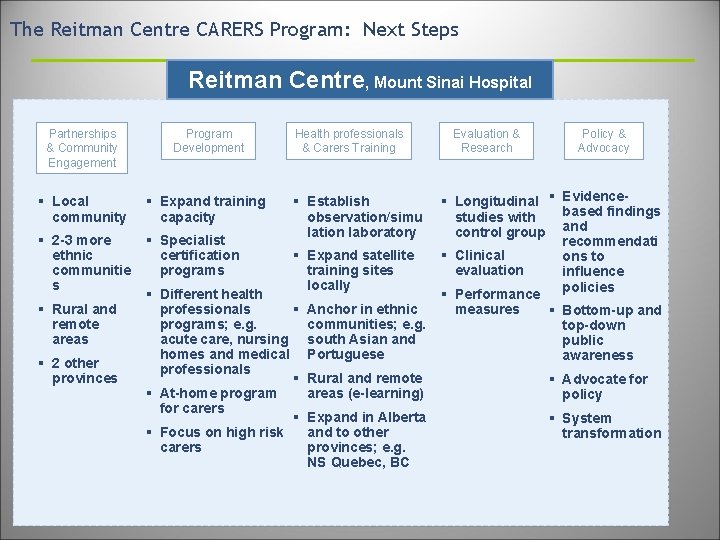
The Reitman Centre CARERS Program: Next Steps Reitman Centre, Mount Sinai Hospital Partnerships & Community Engagement Program Development § Local community § Expand training capacity § 2 -3 more ethnic communitie s § Specialist certification programs § Rural and remote areas § 2 other provinces Health professionals & Carers Training § Establish observation/simu lation laboratory § Expand satellite training sites locally § Different health professionals § programs; e. g. acute care, nursing homes and medical professionals § § At-home program for carers § § Focus on high risk carers Anchor in ethnic communities; e. g. south Asian and Portuguese Evaluation & Research Policy & Advocacy § Longitudinal § Evidencebased findings studies with control group and recommendati § Clinical ons to evaluation influence policies § Performance measures § Bottom-up and top-down public awareness Rural and remote areas (e-learning) § Advocate for policy Expand in Alberta and to other provinces; e. g. NS Quebec, BC § System transformation
DĚKUJI
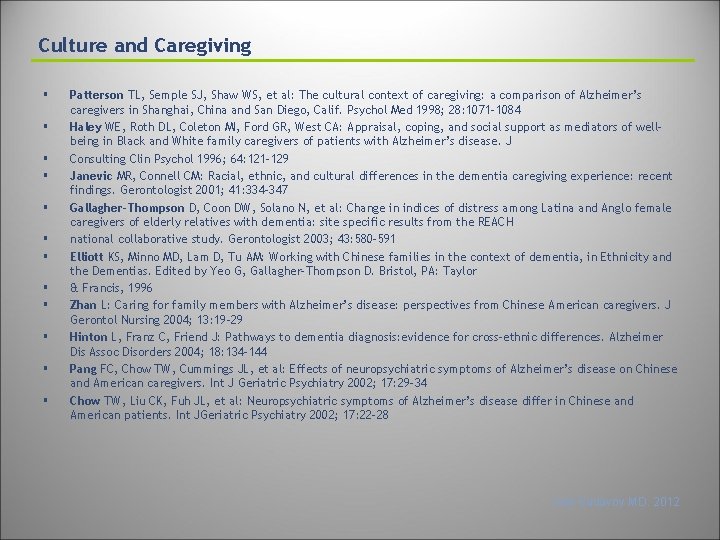
Culture and Caregiving § § § Patterson TL, Semple SJ, Shaw WS, et al: The cultural context of caregiving: a comparison of Alzheimer’s caregivers in Shanghai, China and San Diego, Calif. Psychol Med 1998; 28: 1071– 1084 Haley WE, Roth DL, Coleton MI, Ford GR, West CA: Appraisal, coping, and social support as mediators of wellbeing in Black and White family caregivers of patients with Alzheimer’s disease. J Consulting Clin Psychol 1996; 64: 121– 129 Janevic MR, Connell CM: Racial, ethnic, and cultural differences in the dementia caregiving experience: recent findings. Gerontologist 2001; 41: 334– 347 Gallagher-Thompson D, Coon DW, Solano N, et al: Change in indices of distress among Latina and Anglo female caregivers of elderly relatives with dementia: site specific results from the REACH national collaborative study. Gerontologist 2003; 43: 580– 591 Elliott KS, Minno MD, Lam D, Tu AM: Working with Chinese families in the context of dementia, in Ethnicity and the Dementias. Edited by Yeo G, Gallagher-Thompson D. Bristol, PA: Taylor & Francis, 1996 Zhan L: Caring for family members with Alzheimer’s disease: perspectives from Chinese American caregivers. J Gerontol Nursing 2004; 13: 19– 29 Hinton L, Franz C, Friend J: Pathways to dementia diagnosis: evidence for cross-ethnic differences. Alzheimer Dis Assoc Disorders 2004; 18: 134– 144 Pang FC, Chow TW, Cummings JL, et al: Effects of neuropsychiatric symptoms of Alzheimer’s disease on Chinese and American caregivers. Int J Geriatric Psychiatry 2002; 17: 29– 34 Chow TW, Liu CK, Fuh JL, et al: Neuropsychiatric symptoms of Alzheimer’s disease differ in Chinese and American patients. Int JGeriatric Psychiatry 2002; 17: 22– 28 Joel Sadavoy MD. 2012