The Quest for Civil Rights Landmark Reform Derailed
- Slides: 64
The Quest for Civil Rights: Landmark Reform Derailed
Our Focus: Groups Who Opposed the Civil Rights Reform in the Nineteenth Century-Racists, State Legislatures and Federal Courts The Objective of These Groups: Find Ways to Block, Limit and Roll Back the Reforms Produced in the Years 1865 -1875
The Strategy of the Opponents of Reform: Legislation, Judicial Interpretation and Terror
The Intention of the Republicans who enacted the 13 th, 14 th and 15 th Amendments as well as the Civil Rights Acts was to bring about revolutionary change. They wanted to give all Americans citizenship and provide them with civil rights. They envisioned a society in which people were not treated unfairly because of the color of their skin. They wanted to shift the protection of civil rights from the states to the national government. The hope and promise of these amendments would not be achieved.
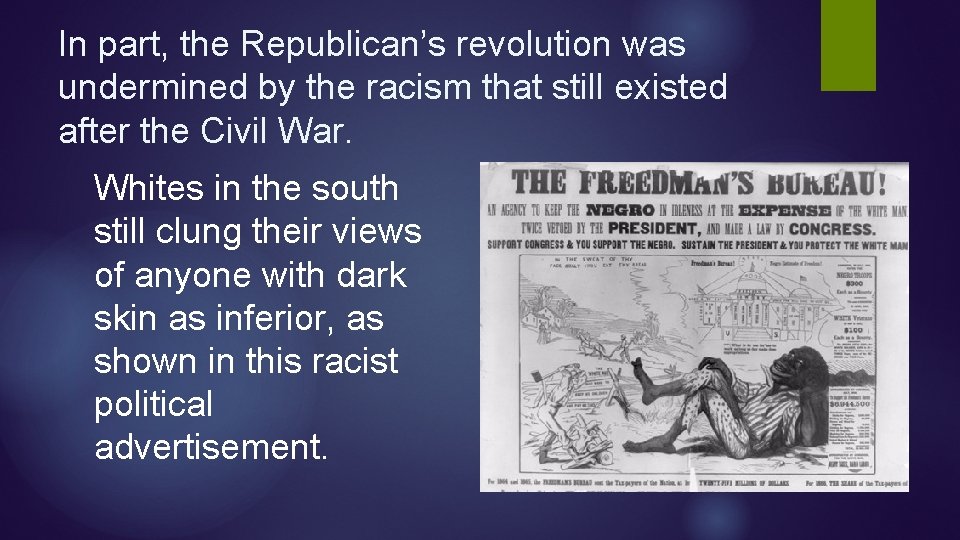
In part, the Republican’s revolution was undermined by the racism that still existed after the Civil War. Whites in the south still clung their views of anyone with dark skin as inferior, as shown in this racist political advertisement.
Even after the 13 th Amendment abolished slavery, southern states enacted Black Codes that treated freed men and women as secondclass citizens and prevented their successful integration into society.
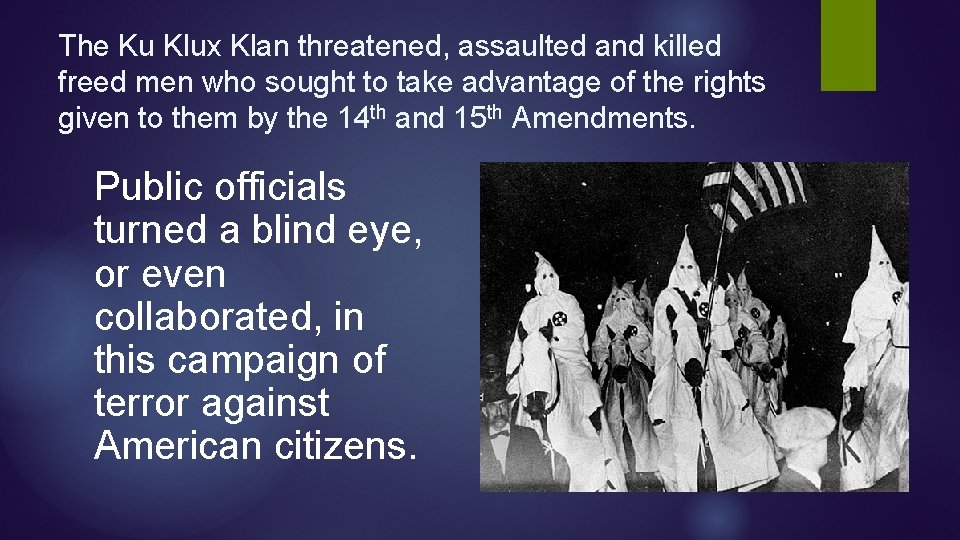
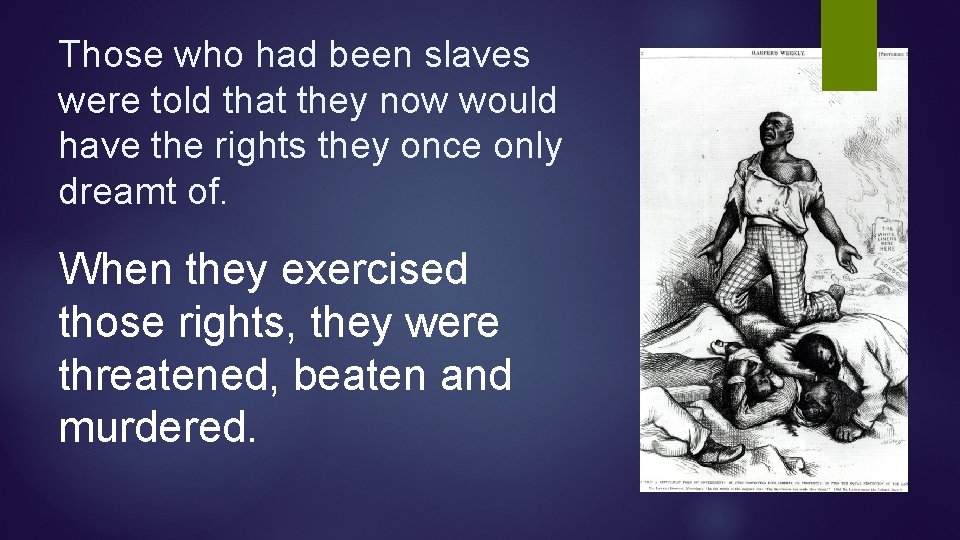
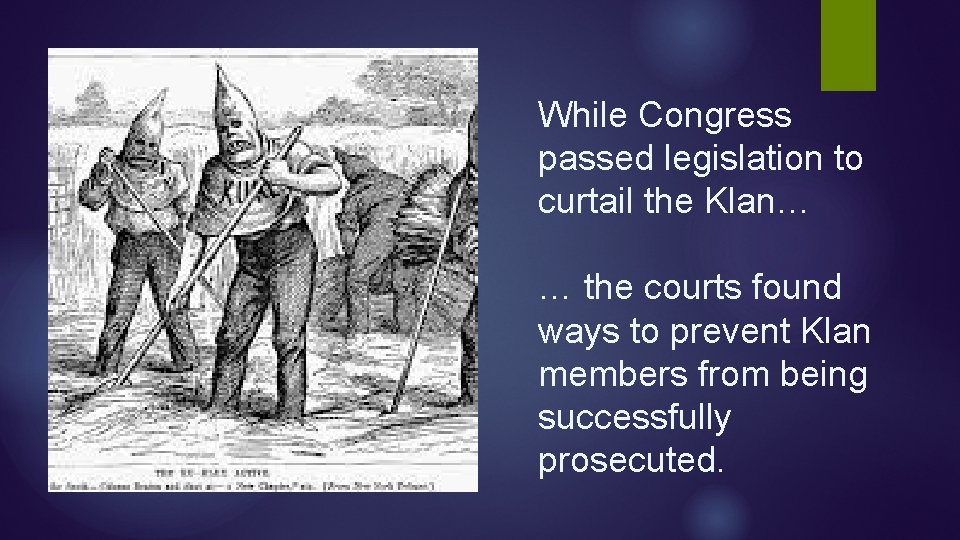
The Ku Klux Klan threatened, assaulted and killed freed men who sought to take advantage of the rights given to them by the 14 th and 15 th Amendments. Public officials turned a blind eye, or even collaborated, in this campaign of terror against American citizens.
Those who had been slaves were told that they now would have the rights they once only dreamt of. When they exercised those rights, they were threatened, beaten and murdered.
While Congress passed legislation to curtail the Klan… … the courts found ways to prevent Klan members from being successfully prosecuted.
The Supreme Court of the United States in this period found many ways to push back enforcement of civil rights. The 14 th Amendment was supposed to be a wellspring of rights for the newly-freed, its guarantee of “privileges and immunities” for citizens a shield against those who would deny those rights.
The Slaughterhouse Cases (1873) did devastating damage to the reach of the 14 th Amendment. When a Louisiana law created a monopoly for a few slaughterhouses, white butchers challenged the validity of the law. They cited the 14 th Amendment as their justification, arguing that as citizens of the United States and the state of Louisiana, the privileges and immunities they enjoyed included the ability to pursue an honest living without having the state unfairly interfering with that right.
In its decision in The Slaughterhouse Cases, the Supreme Court: Stated that the 14 th Amendment was to protect freed slaves, not white butchers, attempting to limit the applicability of the amendment Ruled that the rights of citizenship granted by the 14 th Amendment did not prevent states from imposing limits on the civil rights of its citizens
The Court’s decision rejected the very role the Republicans envisioned for the 14 th Amendment. To accept the argument of the butchers, the Court stated, “would constitute this court a perpetual censor upon all legislation of the States, on the civil rights of their own citizens, with authority to nullify such as it did not approve as consistent with those rights. ” The Court indicated it had no interest in playing such a role.
However, the very existence of the 14 th Amendment would suggest that this is indeed the role the Court should be playing. If state officials are violating the Constitution, then the Court should be censoring them.
This trend of limiting the impact of the Civil War Amendments would continue in The Civil Rights Cases (1883). The Civil Rights Act of 1875 prohibited discrimination in the operation of public transportation, hotels, inns and other public accommodations. The 1875 Act attempted to bring about equality in the way people were treated in those places where they spent so much of their time in public.
The Court ruled that with the passage of the Civil Rights Act of 1875, Congress exceeded its authority under the 14 th Amendment. The Equal Protection clause, which the law was based upon, was designed to ensure that states did not deny equal protection. For the 14 th Amendment to apply, there must be state action denying equal protection. Congress was illegitimately attempting to regulate individual action, the choices of private business owners regarding whom to serve. There was no state action here that would trigger the Equal Protection Clause.
The Court did not stop with limiting the reach of the 14 th Amendment. It also diminished the impact of the 13 th Amendment. The Court acknowledged that under the 13 th Amendment’s abolition of slavery, Congress could regulate private action that imposed “the badges of slavery” upon freed men and women.
The Court rejected the idea that forcing people of different races to sit in another area or make use of different accommodations imposed “the badges of slavery” on those segregated. By dismissing the impact of separating the races, the Court was signaling that this practice was acceptable. States would take this as a green light to engage in decades of discrimination.
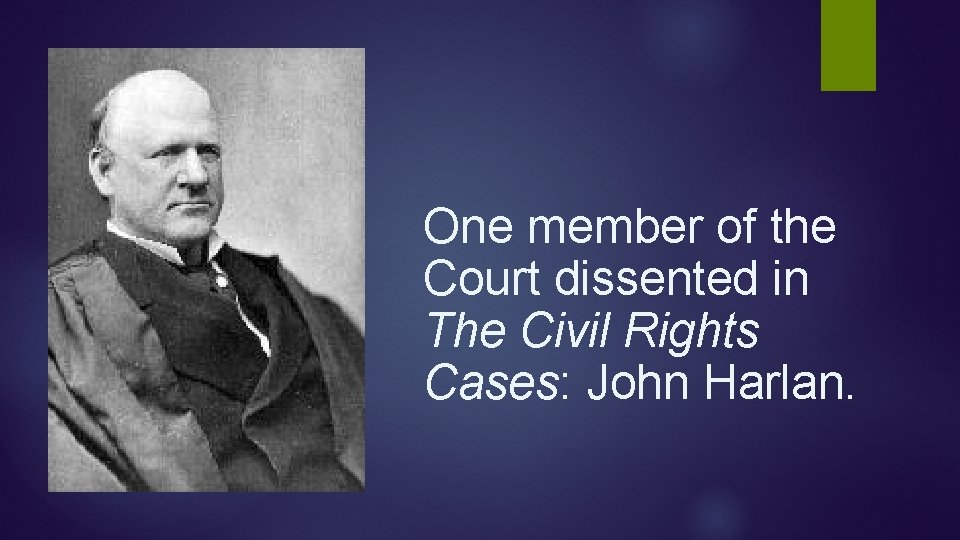
One member of the Court dissented in The Civil Rights Cases: John Harlan.
Harlan argued that “the badges of slavery” were present here and the 1875 Act was consistent with the 13 th Amendment. “Since slavery … rested wholly upon the inferiority, as a race, of those held in bondage, their freedom necessarily involved protection against all discrimination against them because of their race…Congress therefore may enact laws to protect that people against the deprivation because of their race of any civil rights granted…”
Harlan also argued that the requirement of state action was present and thus consistent with the 14 th Amendment. “In every material sense applicable to the practical enforcement of the 14 th Amendment, railroad corporations, keepers of inns and managers of places of public amusement are agents or instrumentalities of the State, because they are charged with duties to the public and are amenable in respect of their duties and functions to government regulation. ”
Put yourself on the Court at the time of The Civil Rights Cases. Would you have joined the opinion of the majority of the Court or the dissenting opinion written by Justice Harlan?
The Supreme Court also lessened the impact of the 15 th Amendment. In United States v. Reese (1876), the Court ruled unconstitutional a portion of the Civil Rights Act of 1870, because it did not explicitly reference depriving the vote based upon race, even though that was clearly the intent of Congress.
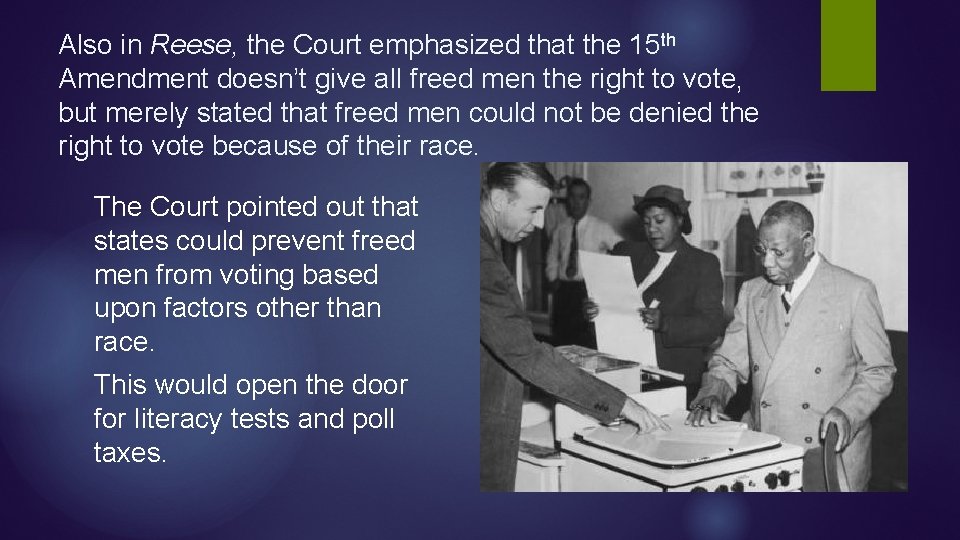
Also in Reese, the Court emphasized that the 15 th Amendment doesn’t give all freed men the right to vote, but merely stated that freed men could not be denied the right to vote because of their race. The Court pointed out that states could prevent freed men from voting based upon factors other than race. This would open the door for literacy tests and poll taxes.
How should we evaluate the decisions of the U. S. Supreme Court in the 1870’s and 1880’s? Some contend that these decisions are a betrayal of the intention of those who drafted the Civil War Amendments, giving too much power back to the states who had been defeated in the War. Others argue that these decisions show great wisdom, recognizing that as a practical matter, states had to be maintained and allowed to perform their essential roles, while still acknowledging the national interest in preservation of civil rights. How do you see them?
With the Supreme Court’s decision in The Civil Rights Cases, the door had been opened for another group that sought to limit the impact of the Civil War Amendments: state legislatures.
The Court had rejected the idea that segregation of the races imposed the badges of slavery upon those segregated. State legislatures could now require by law the very segregation that had been accepted by the Court.
However, there was still one legal hurdle for the state legislatures: The Equal Protection Clause of the 14 th Amendment was applicable to the states. State legislatures had an answer for that as well: Separate but Equal. The 14 th Amendment simply required equality of treatment, not the exact same treatment. If the separate facilities and opportunities for the different races were roughly equal, then states would be in compliance with the 14 th Amendment.
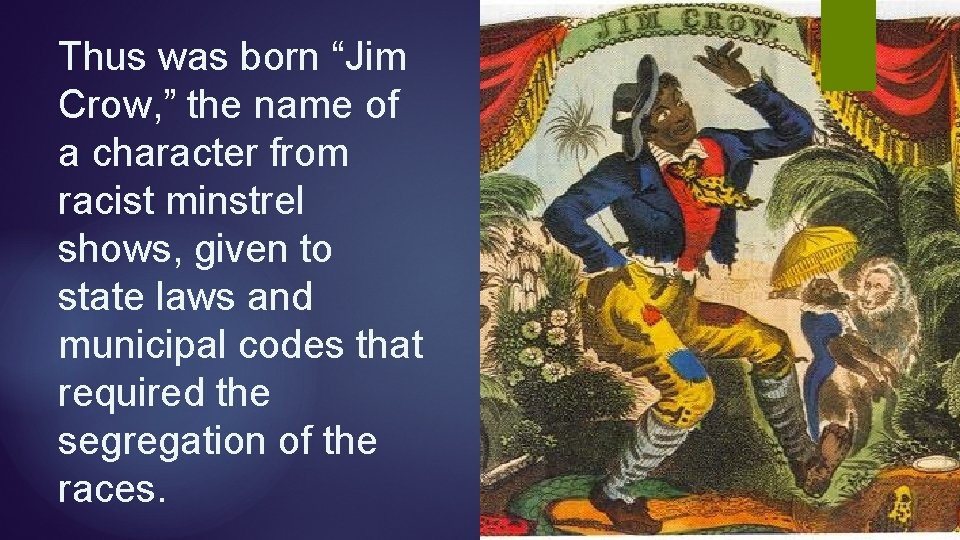
Thus was born “Jim Crow, ” the name of a character from racist minstrel shows, given to state laws and municipal codes that required the segregation of the races.
Under “Jim Crow” Laws: Public schools were segregated by race White nurses were prohibited from taking care of black patients and vice versa Whites and blacks could not play sports together or use the same recreational facilities Blacks and whites could not be buried in the same cemeteries Interracial marriage or cohabitation was criminalized Black and white witnesses in court to take their oaths using separate bibles
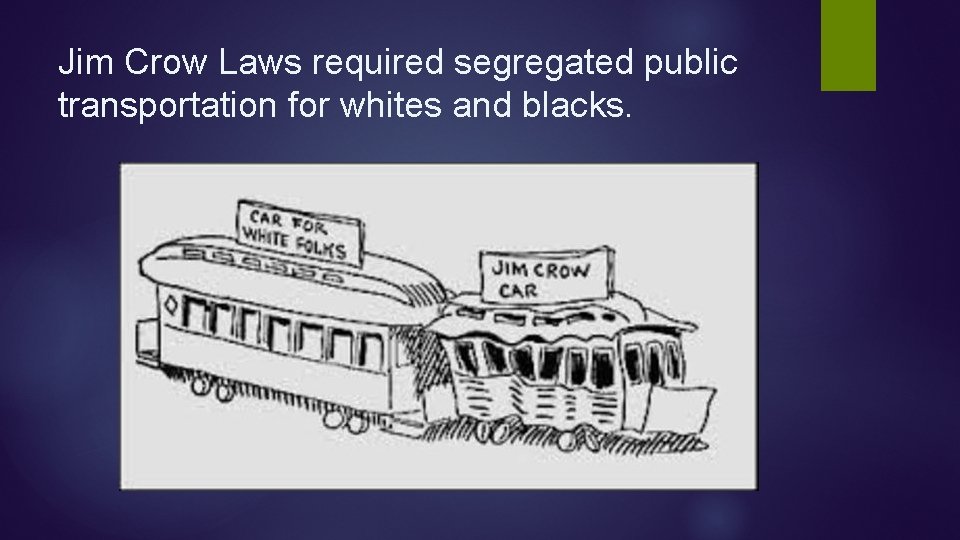
Jim Crow Laws required segregated public transportation for whites and blacks.
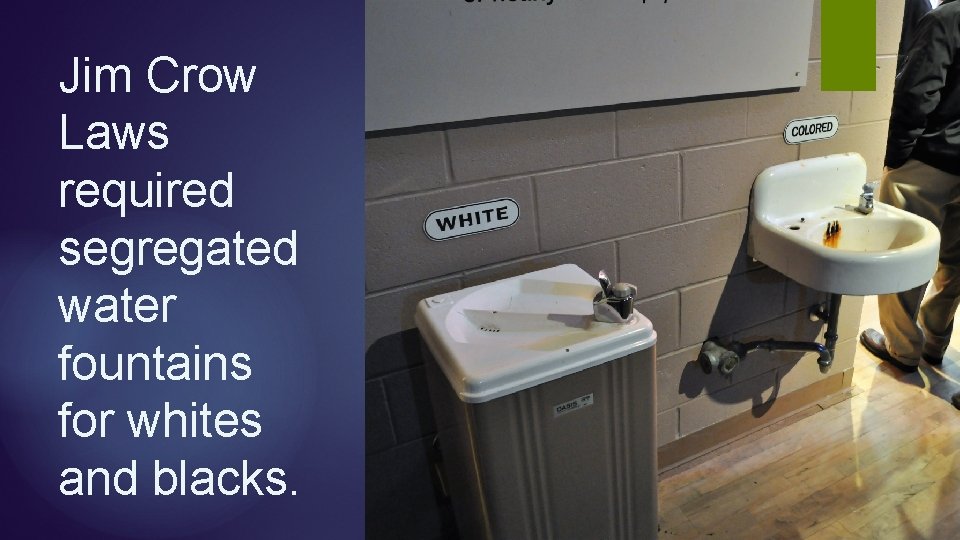
Jim Crow Laws required segregated water fountains for whites and blacks.
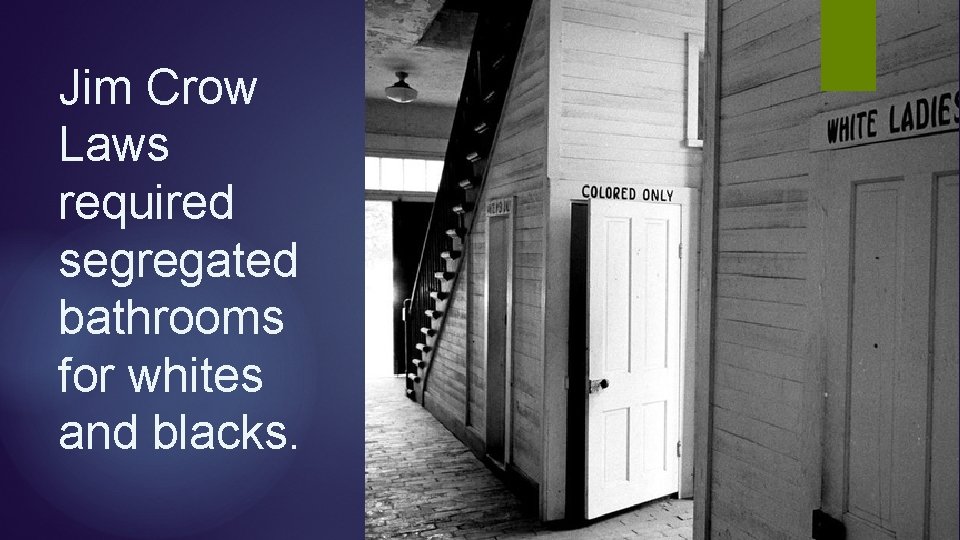
Jim Crow Laws required segregated bathrooms for whites and blacks.
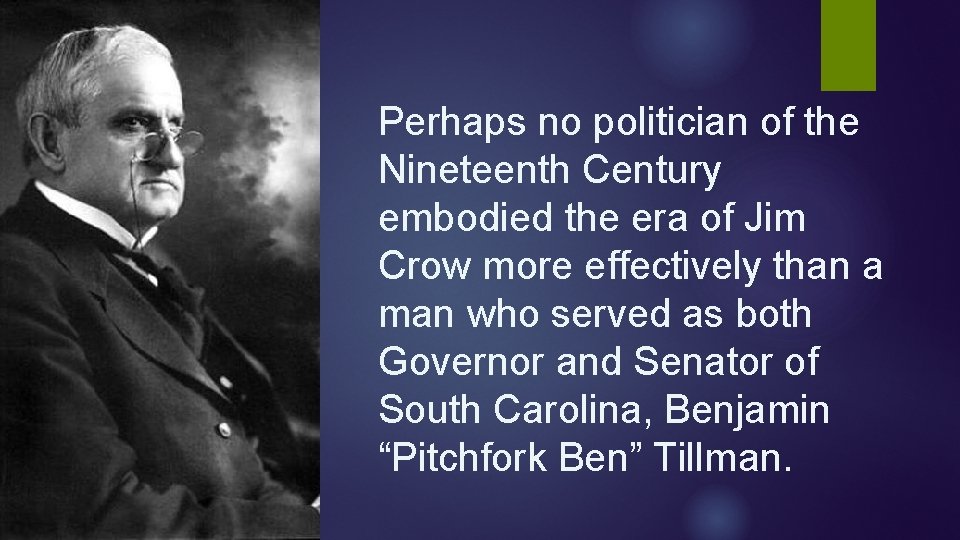
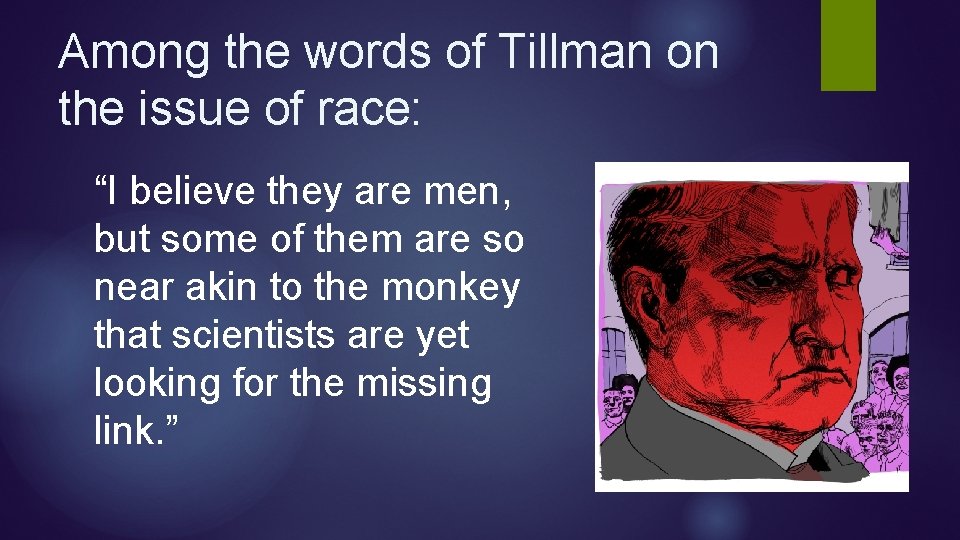
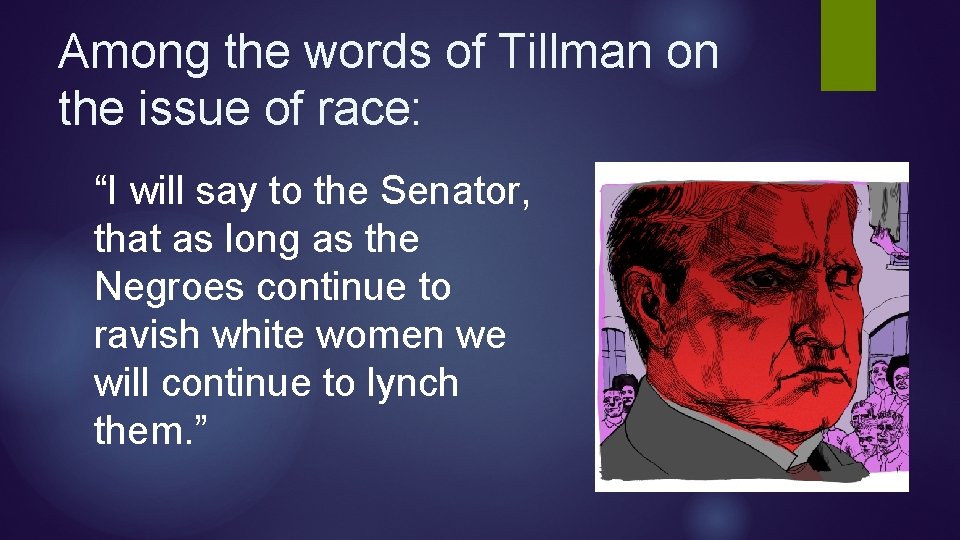
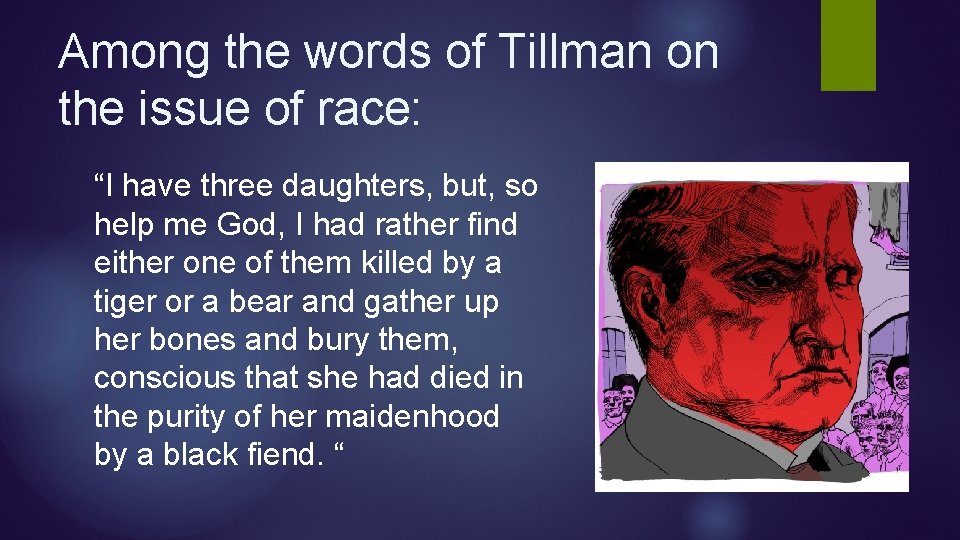
Perhaps no politician of the Nineteenth Century embodied the era of Jim Crow more effectively than a man who served as both Governor and Senator of South Carolina, Benjamin “Pitchfork Ben” Tillman.
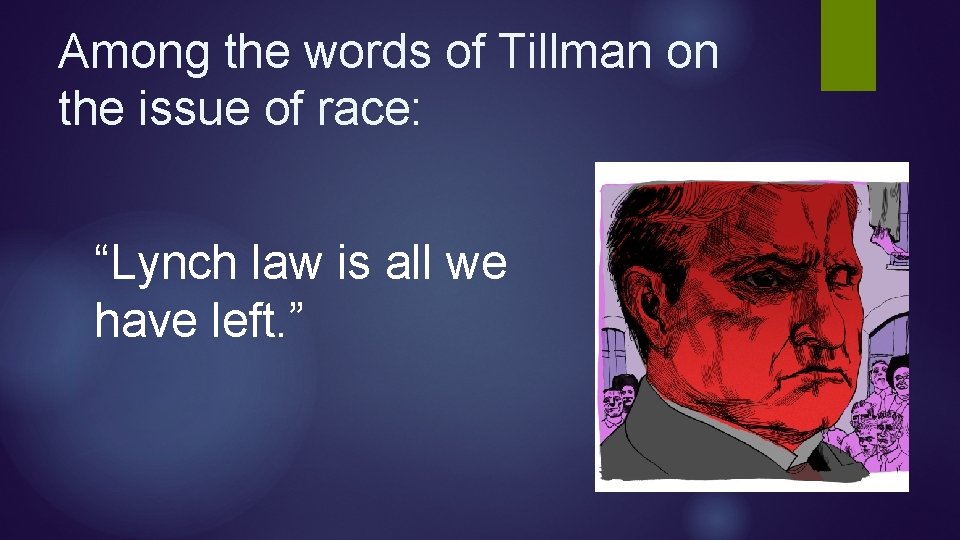
Among the words of Tillman on the issue of race: “Lynch law is all we have left. ”
Among the words of Tillman on the issue of race: “I believe they are men, but some of them are so near akin to the monkey that scientists are yet looking for the missing link. ”
Among the words of Tillman on the issue of race: “I will say to the Senator, that as long as the Negroes continue to ravish white women we will continue to lynch them. ”
Among the words of Tillman on the issue of race: “I have three daughters, but, so help me God, I had rather find either one of them killed by a tiger or a bear and gather up her bones and bury them, conscious that she had died in the purity of her maidenhood by a black fiend. “
Even though there was much support for the Ben Tillman’s of the world, there were some who believed that Jim Crow was fundamentally inconsistent with the Equal Protection Clause of the 14 th Amendment. Some of these individuals challenged the constitutionality of a Louisiana law requiring segregation of railroad cars in Plessy v. Ferguson (1896), arguing that the law violated both the 13 th and 14 th Amendments.
Justice Brown, writing for the Court in Plessy, upheld the constitutionality of the Louisiana law. Rejecting the 13 th Amendment argument, he wrote that laws requiring segregation “did not stamp the colored race with a badge of inferiority, ” and referred to the matter as “too clear for argument. ” Rejecting the 14 th Amendment argument, he wrote that “In the nature of things, it could not have been intended to abolish distinctions based upon color or to enforce social, as distinguished from political, equality, or a commingling of the two races upon terms unsatisfactory to either. ”
If The Civil Rights Cases had provided implicit approval for Jim Crow, Plessy v. Ferguson gave explicit constitutional protection for racial segregation required by law. The Court was not unanimous. Once again, Justice Harlan presented a rejection of his colleagues’ views on the Constitution and racial discrimination.
Harlan’s dissent in Plessy: “But in view of the Constitution, in the eye of the law, there is in this country no superior, dominant ruling class of citizens. There is no caste here. Our Constitution is color-blind, and neither knows nor tolerates classes among its citizens. ”
Harlan’s dissent in Plessy: “We boast of the freedom enjoyed by our people above all other peoples. But it is difficult to reconcile that boast with a state of the law which, practically, puts the brand of servitude and degradation upon a large class of our fellow citizens-our equals before the law. ”
Harlan’s dissent in Plessy: “In my opinion, the judgment this day rendered will, in time, prove to be quite as pernicious as the decision made in the Dred Scott case. ”
Although they occupied the same place in time, Ben Tillman and John Harlan represented vastly different views on the relations among the races and civil rights. Compare their views.
Having been excluded from the protection of the Civil War Amendments, things would not be any better for women in this period. A frustrated Susan B. Anthony would write on the Centennial Celebration of the United States, “The history of our country the past hundred years has been a series of assumptions and usurpations of power over woman, in direct opposition to the principles of just government. ”
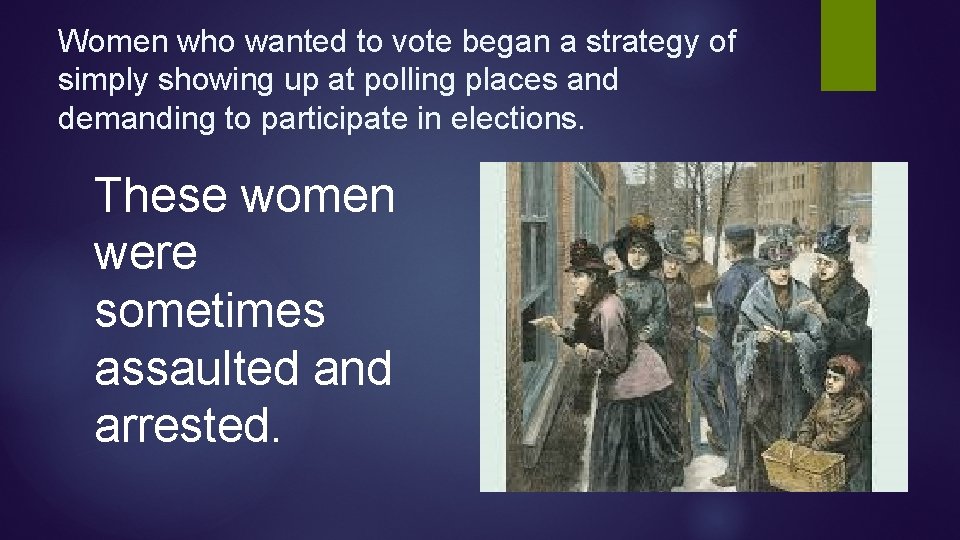
Women who wanted to vote began a strategy of simply showing up at polling places and demanding to participate in elections. These women were sometimes assaulted and arrested.
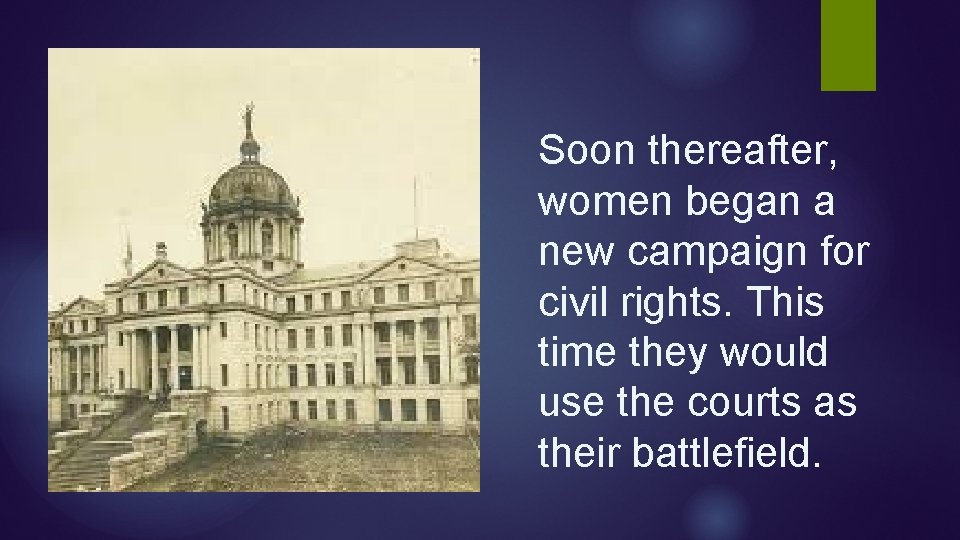
Soon thereafter, women began a new campaign for civil rights. This time they would use the courts as their battlefield.
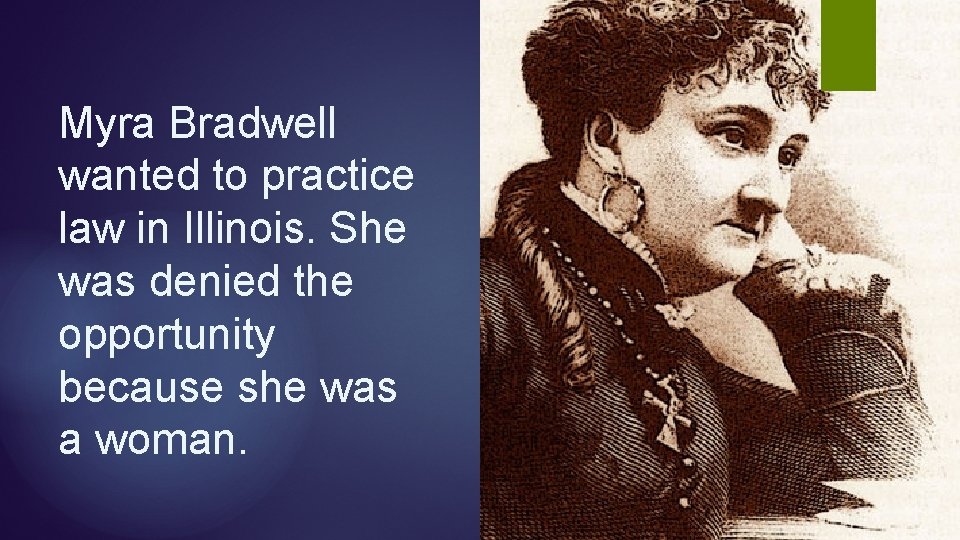
Myra Bradwell wanted to practice law in Illinois. She was denied the opportunity because she was a woman.
Myra Bradwell’s Legal Argument: Mrs. Bradwell, like the butchers in Slaughterhouse, grounded her constitutional claim in the Privileges and Immunities clause of the 14 th Amendment. She argued that there are certain privileges and immunities that belong to her as a citizen of the United States, which may not be abridged by Illinois. Mrs. Bradwell contended that admission to the bar of a State of a person who possesses the requisite learning and character is one of those privileges and immunities which a State cannot deny.
Unfortunately for Mrs. Bradwell, her argument received the same reaction as the butchers in The Slaughterhouse Cases. The Supreme Court rejected her argument, concluding: “The right to control and regulate the granting of a license to practice law in the courts of a State is one of those powers which are not transferred for its protection to the Federal government. ” Illinois’ decision about whom to allow to be admitted to the bar “is in no manner governed or controlled by citizenship of the United States in the party seeking such license. ”
Justice Bradley, while agreeing with the result reached by the Court, was unable to restrain himself from adding a few of his own thoughts on the matter: “Man is, or should be, woman’s protector and defender. The natural and proper timidity and delicacy which belongs to the female sex evidently unfits it for many of the occupations of civil life. The constitution of the family organization, which is founded in the divine ordinance, as well as in the nature of things, indicates the domestic sphere as that which properly belongs to the domain and functions of womanhood…”
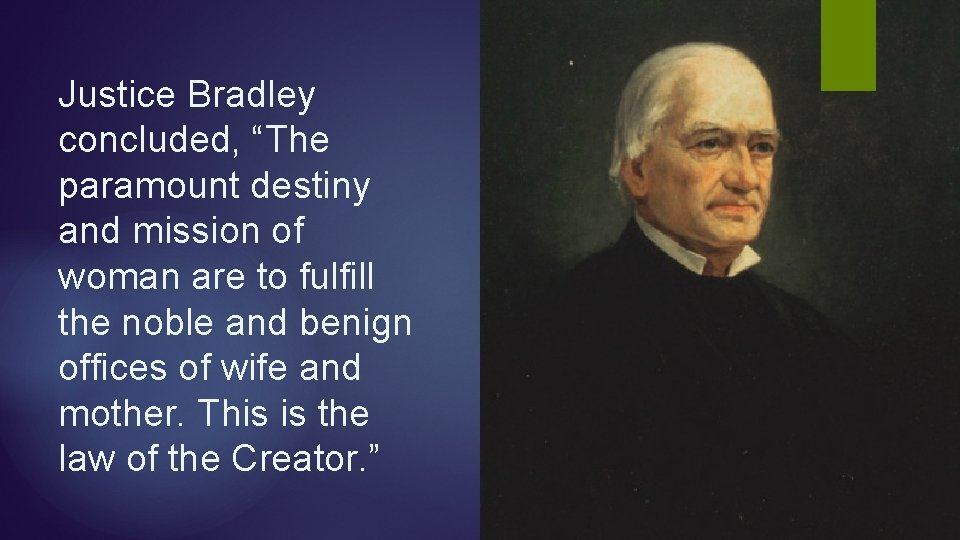
Justice Bradley concluded, “The paramount destiny and mission of woman are to fulfill the noble and benign offices of wife and mother. This is the law of the Creator. ”
Despite this setback, the issue of the rights of women was once again brought before the Supreme Court just a few years later.
Virginia Minor of Missouri sought to register to vote in 1872. She was denied permission, based upon the Missouri law that confined the right to vote to men.
Minor challenged the constitutionality of the Missouri law. Her argument: As a citizen of the United States and of the State in which she resides, the had the right to vote as one of the Privileges and Immunities of her citizenship, which the State cannot abridge. Like the butchers in New Orleans and Mrs. Myra Bradwell, Virginia Minor chose to rely upon a constitutional argument that the Supreme Court was not willing to accept.
In Minor v. Happersett (1875), the Supreme Court ruled against Virginia Minor. The Court ruled that the status of “citizen” does not necessarily confer the right to vote: “For nearly ninety years the people have acted upon the idea that the Constitution, when it conferred citizenship, did not necessarily confer the right of suffrage. ” The exclusion of women from the voting booth was not a matter for the Court to decide: “If the law is wrong, it ought to e changed; but the power for that is not with us. ”
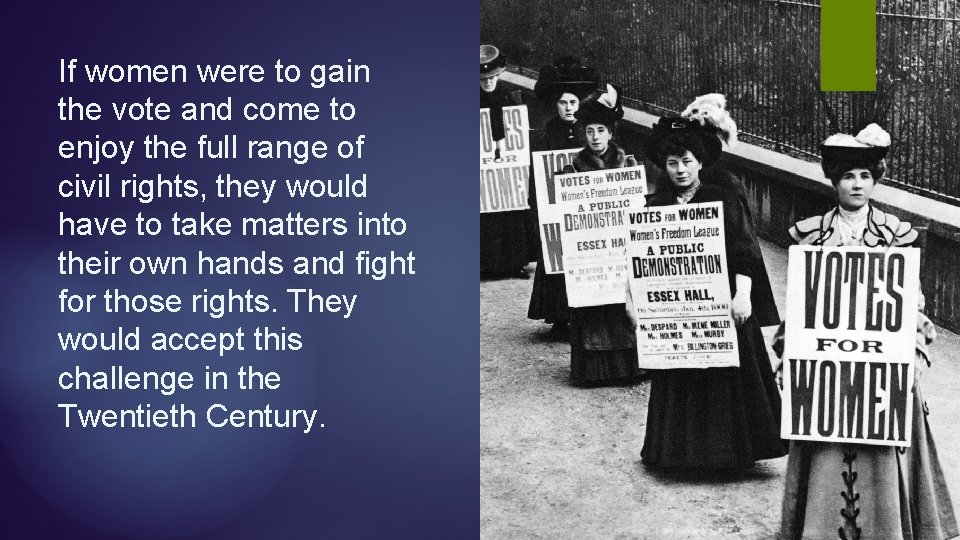
If women were to gain the vote and come to enjoy the full range of civil rights, they would have to take matters into their own hands and fight for those rights. They would accept this challenge in the Twentieth Century.
Were the forces united to stop civil rights reform in the Nineteenth Century successful?
The argument can be made that they were successful. The reform envisioned by the Republicans in Congress was not achieved. Slavery was abolished, but the descendants of slaves were not only treated as inferior, these efforts received the approval of the courts. Equal protection of the laws became just an empty promise, as individuals were free to discriminate and even states were ultimately allowed to dance around the 14 th Amendment with “separate but equal. ”
The argument can be made that they were successful. The reform envisioned by the Republicans in Congress was not achieved. The 15 th Amendment’s promise was shattered by private acts of violence against those who dared to exercise their right to vote and government created tests and taxes that kept most blacks away from the polls. Women were denied rights which had been given to people who only recently been property. When they sought the protection of the courts, they were given pious lectures about the proper role of women.
However, the argument can be made that while they enjoyed considerable success in the last quarter of the Nineteenth Century, the opponents of reform had only delayed the change that was inevitable. The Civil War Amendments were still a part of the Constitution and these ideas and principles were still a part of the most important document in America. The fire may have been doused, but the embers still glowed, awaiting the wind that would fan the flames and start a conflagration. Even at the darkest hour of civil rights, people continued to fight the fight. Whether it was Myra Bradwell or Homer Plessy, someone stepped forward to challenge the forces of opposition and to present a case to the courts that civil rights matter and freedom should be advanced.
However, the argument can be made that while they enjoyed considerable success in the last quarter of the Nineteenth Century, the opponents of reform had only delayed the change that was inevitable. Even in defeat, lessons were being learned and the tools of constitutional battle were being improved. If Privileges and Immunities would not work as a means of attack, then perhaps Due Process or Equal Protection could be employed. Justice Harlan had, as all brilliant dissents do, planted the seeds for the ultimate reversal of dubious precedents. While the Minor case was a loss for the women’s movement, the Supreme Court signaled that the fight could continue. The Court acknowledged that a change may be needed, but its statement that it is “not for us to do” implied that there would be other possibilities for reform.
The fight for Civil Rights in America was on the brink of its brightest chapter.