THE INTERNATIONAL REGULATION OF SHIP GHG EMISSIONS Aldo
- Slides: 23
THE INTERNATIONAL REGULATION OF SHIP GHG EMISSIONS Aldo Chircop Canada Research Chair in Maritime Law and Policy Marine & Environmental Law Institute Schulich School of Law, Dalhousie University, Canada 1
1. Introduction 2. Regulatory complexity 3. IMO Strategy for GHG emissions 4. Strategy delivery 5. Concluding observations OUTLINE (c) Chircop/HIELC 2019 2
1. INTRODUCTION • UNFCCC/Paris Agreement • Mitigation goal: keeping global temperatures well below 2° C, aiming for 1. 5°C • Nationally determined contributions (NDCs); shipping not addressed directly, but included in the goal • UNCLOS • Article 192: ‘positive obligation to take active measures’ • Article 194: duty to minimize pollution from ships • Article 212: • duty to prevent, reduce & control pollution through the atmosphere • to establish global & regional rules, standards & recommended practices & procedures to prevent, reduce & control such pollution through the IMO or diplomatic conference • Article 222: duty to enforce • Regulatory authority = IMO = ‘the competent international organization’ for international shipping (c) Chircop/HIELC 2019 3
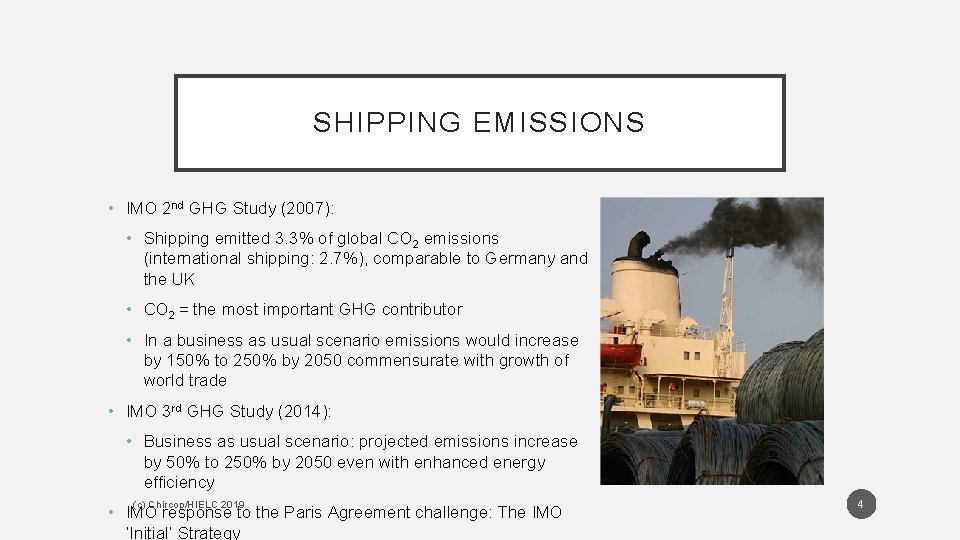
SHIPPING EMISSIONS • IMO 2 nd GHG Study (2007): • Shipping emitted 3. 3% of global CO 2 emissions (international shipping: 2. 7%), comparable to Germany and the UK • CO 2 = the most important GHG contributor • In a business as usual scenario emissions would increase by 150% to 250% by 2050 commensurate with growth of world trade • IMO 3 rd GHG Study (2014): • Business as usual scenario: projected emissions increase by 50% to 250% by 2050 even with enhanced energy efficiency (c) Chircop/HIELC 2019 • IMO response to the Paris Agreement challenge: The IMO ‘Initial’ Strategy 4
2. REGULATORY COMPLEXITY Mobility, globality, transnationality of international shipping Numerous and diverse actors (owners, charterers, managers, etc. ) Very diverse ships, fuel and energy use patterns Speed, just in time, port arrival, floating warehouse concerns Risk management, ship finance and amortization issues Ramifications for markets, trade and wealth distribution Unequal capabilities in national maritime administrations Shipping is already a heavily regulated industry … 5 (c) Chircop/HIELC 2019
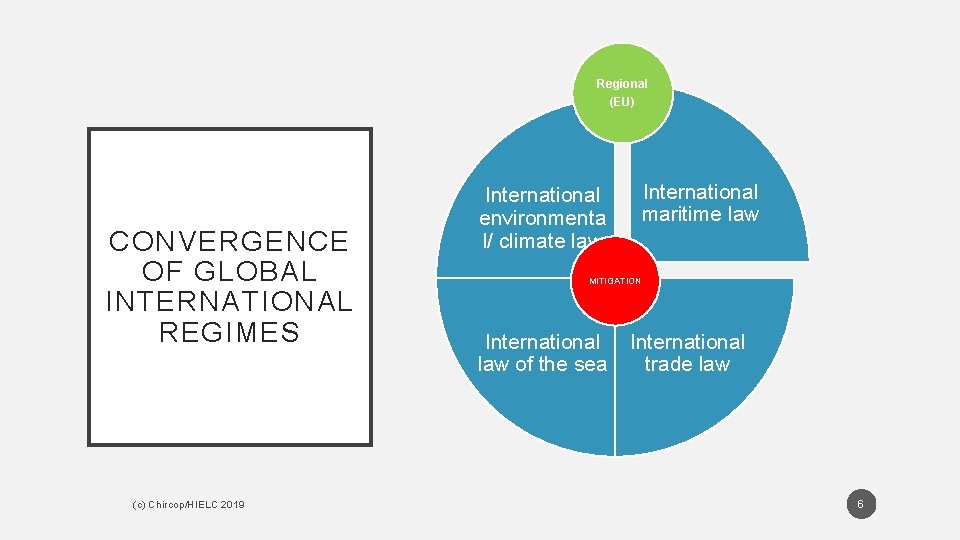
Regional (EU) CONVERGENCE OF GLOBAL INTERNATIONAL REGIMES (c) Chircop/HIELC 2019 International environmenta l/ climate law International maritime law MITIGATION International law of the sea International trade law 6
EFFORTS IN DEVELOPING SHIPPING’S APPROACH TO MITIGATION • Prevention of Air Pollution from Ships, Assembly Resolution A. 719(17), 1991 • MARPOL Protocol of 1997 and adoption of Annex VI • Kyoto Protocol, 1997: • Annex I States Parties to the UNFCCC agredd to pursue through the IMO the reduction of GHG emissions from marine bunker fuels not addressed by the Montreal Protocol • Cooperation between the Secretariats of IMO and UNFCCC/SBSTA since MEPC 42 in 1998 • MEPC has deliberated on GHG emissions in most sessions since MEPC 42 • New MARPOL Annex VI Chapter 4: Regulations on Energy Efficiency of Ships 2019 (c) Chircop/HIELC • Roadmap and initial draft strategy adopted in 2018 7
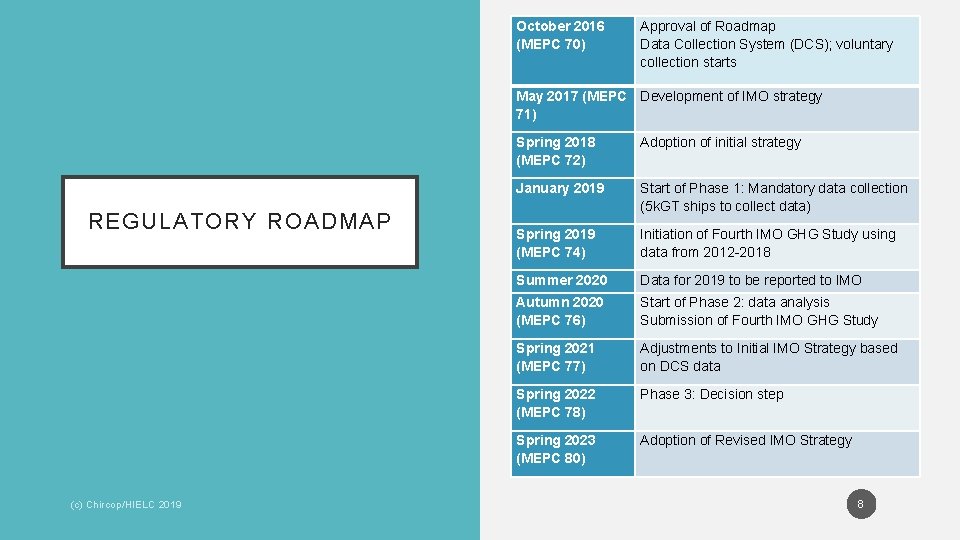
October 2016 (MEPC 70) Approval of Roadmap Data Collection System (DCS); voluntary collection starts May 2017 (MEPC Development of IMO strategy 71) REGULATORY ROADMAP (c) Chircop/HIELC 2019 Spring 2018 (MEPC 72) Adoption of initial strategy January 2019 Start of Phase 1: Mandatory data collection (5 k. GT ships to collect data) Spring 2019 (MEPC 74) Initiation of Fourth IMO GHG Study using data from 2012 -2018 Summer 2020 Data for 2019 to be reported to IMO Autumn 2020 (MEPC 76) Start of Phase 2: data analysis Submission of Fourth IMO GHG Study Spring 2021 (MEPC 77) Adjustments to Initial IMO Strategy based on DCS data Spring 2022 (MEPC 78) Phase 3: Decision step Spring 2023 (MEPC 80) Adoption of Revised IMO Strategy 8
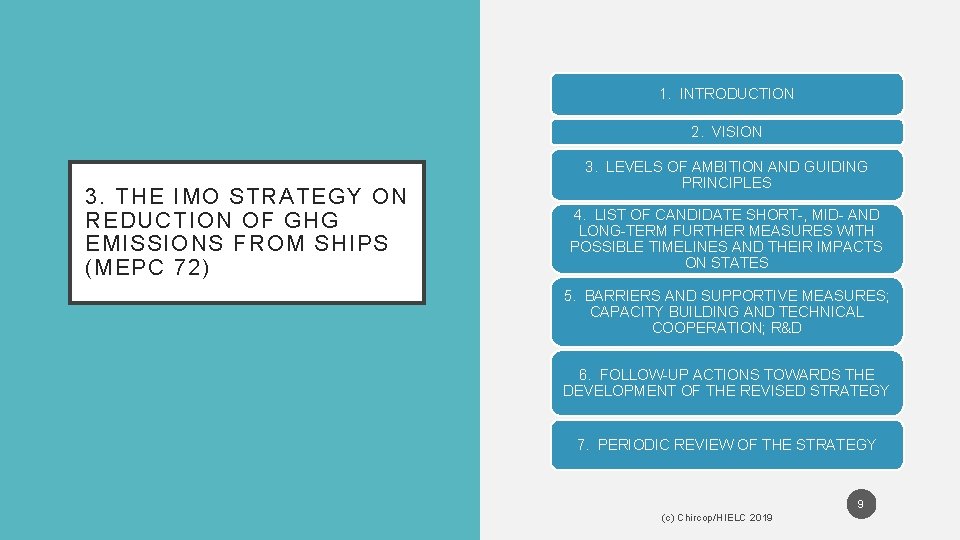
1. INTRODUCTION 2. VISION 3. THE IMO STRATEGY ON REDUCTION OF GHG EMISSIONS FROM SHIPS (MEPC 72) 3. LEVELS OF AMBITION AND GUIDING PRINCIPLES 4. LIST OF CANDIDATE SHORT-, MID- AND LONG-TERM FURTHER MEASURES WITH POSSIBLE TIMELINES AND THEIR IMPACTS ON STATES 5. BARRIERS AND SUPPORTIVE MEASURES; CAPACITY BUILDING AND TECHNICAL COOPERATION; R&D 6. FOLLOW-UP ACTIONS TOWARDS THE DEVELOPMENT OF THE REVISED STRATEGY 7. PERIODIC REVIEW OF THE STRATEGY 9 (c) Chircop/HIELC 2019
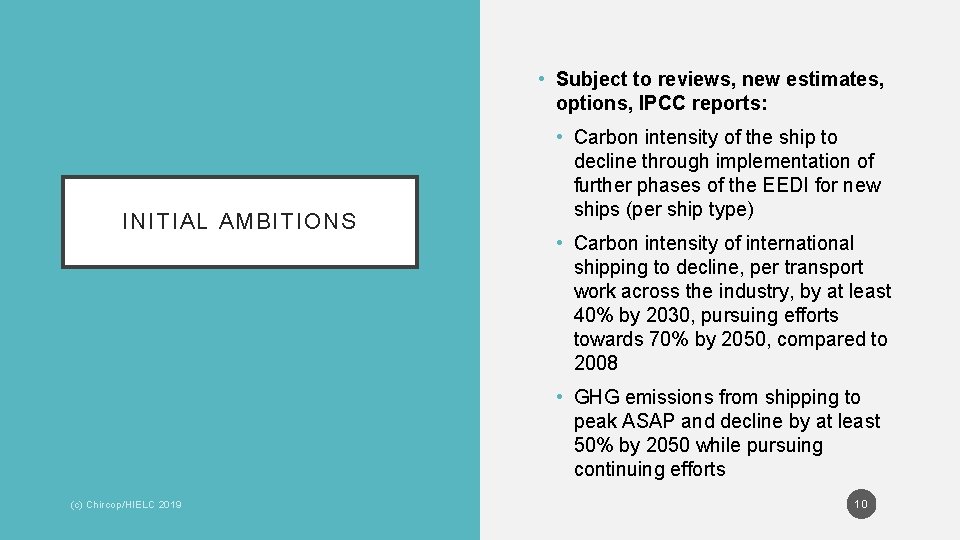
• Subject to reviews, new estimates, options, IPCC reports: INITIAL AMBITIONS • Carbon intensity of the ship to decline through implementation of further phases of the EEDI for new ships (per ship type) • Carbon intensity of international shipping to decline, per transport work across the industry, by at least 40% by 2030, pursuing efforts towards 70% by 2050, compared to 2008 • GHG emissions from shipping to peak ASAP and decline by at least 50% by 2050 while pursuing continuing efforts (c) Chircop/HIELC 2019 10
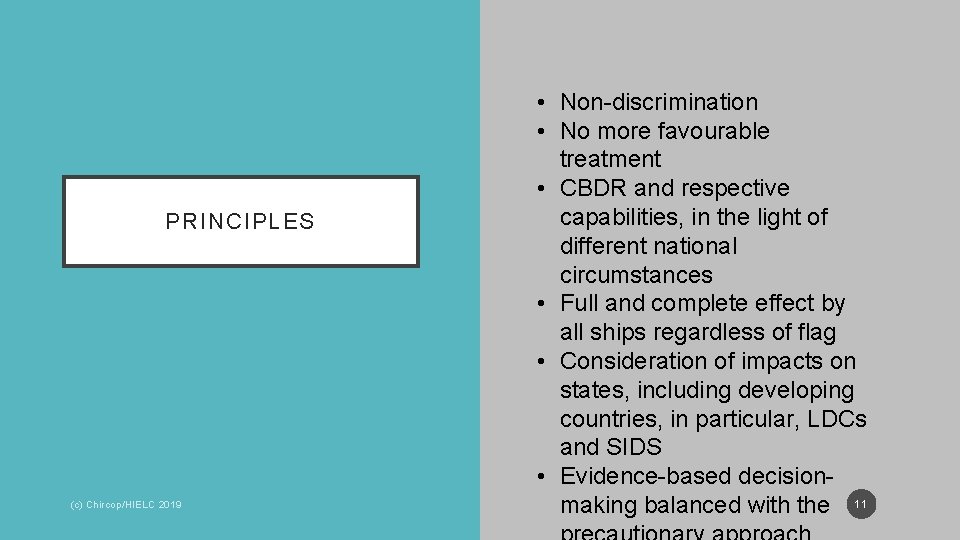
PRINCIPLES (c) Chircop/HIELC 2019 • Non-discrimination • No more favourable treatment • CBDR and respective capabilities, in the light of different national circumstances • Full and complete effect by all ships regardless of flag • Consideration of impacts on states, including developing countries, in particular, LDCs and SIDS • Evidence-based decisionmaking balanced with the 11
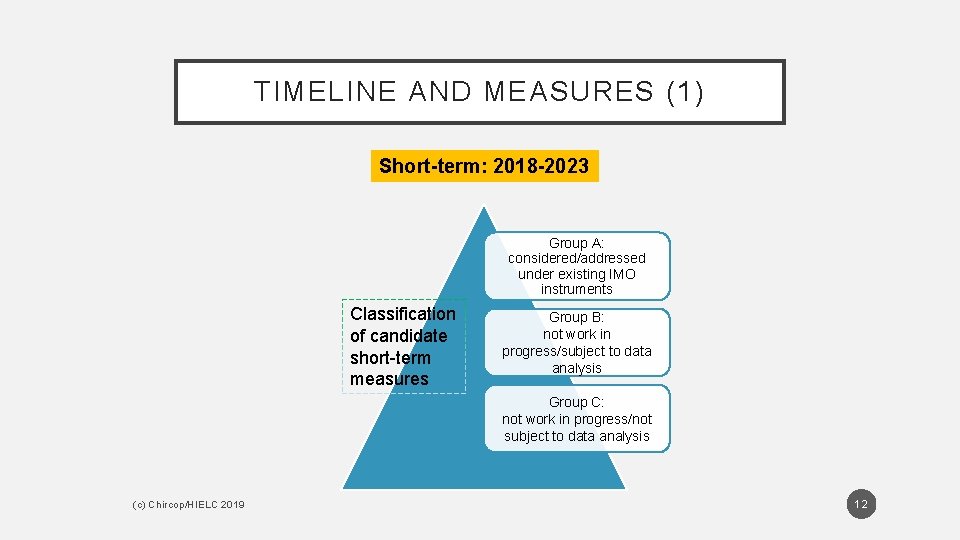
TIMELINE AND MEASURES (1) Short-term: 2018 -2023 Group A: considered/addressed under existing IMO instruments Classification of candidate short-term measures Group B: not work in progress/subject to data analysis Group C: not work in progress/not subject to data analysis (c) Chircop/HIELC 2019 12
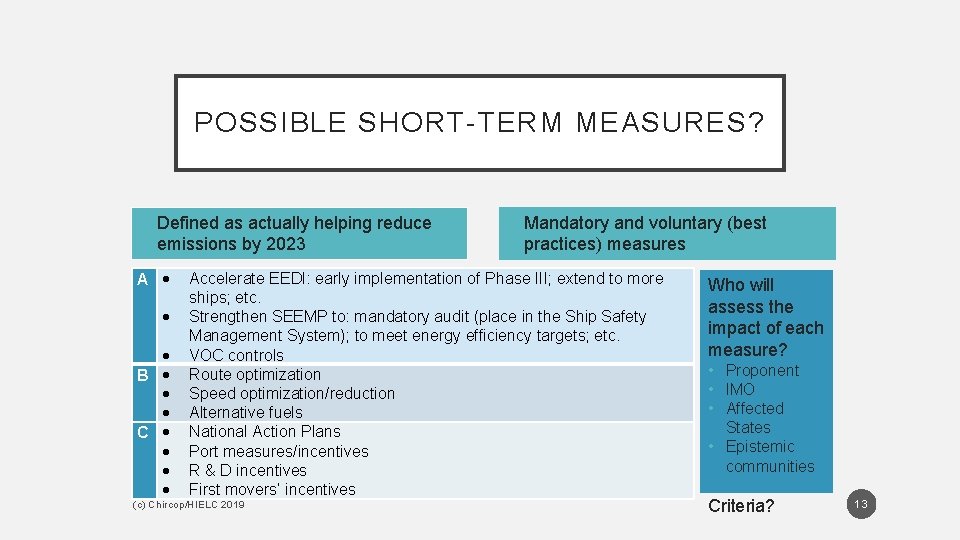
POSSIBLE SHORT-TERM MEASURES? • Defined as actually helping reduce emissions by 2023 A B C • Mandatory and voluntary (best practices) measures Accelerate EEDI: early implementation of Phase III; extend to more ships; etc. Strengthen SEEMP to: mandatory audit (place in the Ship Safety Management System); to meet energy efficiency targets; etc. VOC controls Route optimization Speed optimization/reduction Alternative fuels National Action Plans Port measures/incentives R & D incentives First movers’ incentives (c) Chircop/HIELC 2019 Who will assess the impact of each measure? • Proponent • IMO • Affected States • Epistemic communities Criteria? 13
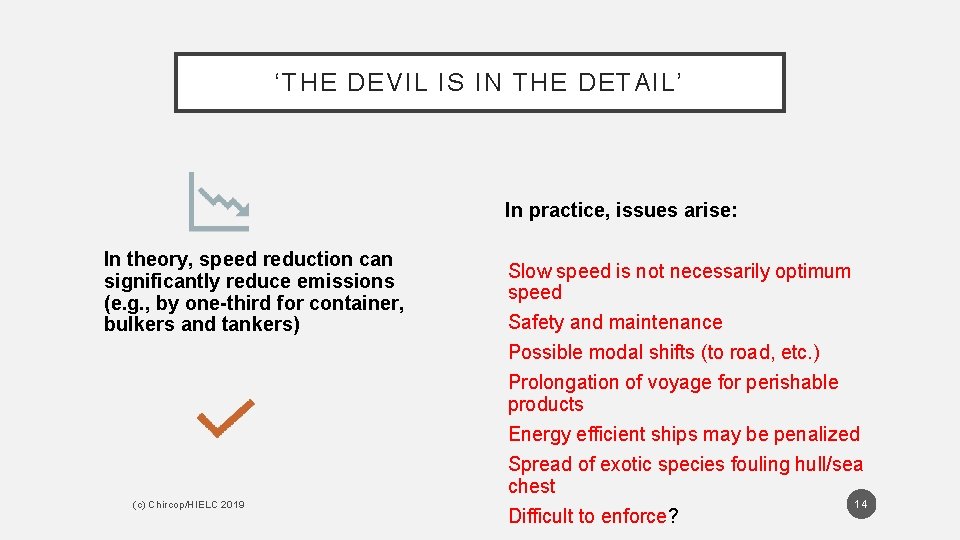
‘THE DEVIL IS IN THE DETAIL’ In practice, issues arise: In theory, speed reduction can significantly reduce emissions (e. g. , by one-third for container, bulkers and tankers) (c) Chircop/HIELC 2019 Slow speed is not necessarily optimum speed Safety and maintenance Possible modal shifts (to road, etc. ) Prolongation of voyage for perishable products Energy efficient ships may be penalized Spread of exotic species fouling hull/sea chest 14 Difficult to enforce?
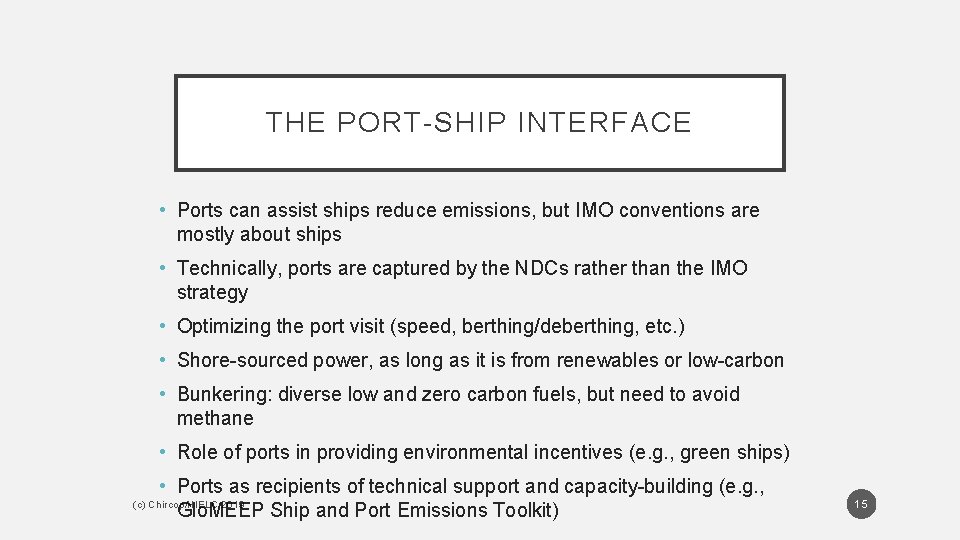
THE PORT-SHIP INTERFACE • Ports can assist ships reduce emissions, but IMO conventions are mostly about ships • Technically, ports are captured by the NDCs rather than the IMO strategy • Optimizing the port visit (speed, berthing/deberthing, etc. ) • Shore-sourced power, as long as it is from renewables or low-carbon • Bunkering: diverse low and zero carbon fuels, but need to avoid methane • Role of ports in providing environmental incentives (e. g. , green ships) • Ports as recipients of technical support and capacity-building (e. g. , Glo. MEEP Ship and Port Emissions Toolkit) (c) Chircop/HIELC 2019 15
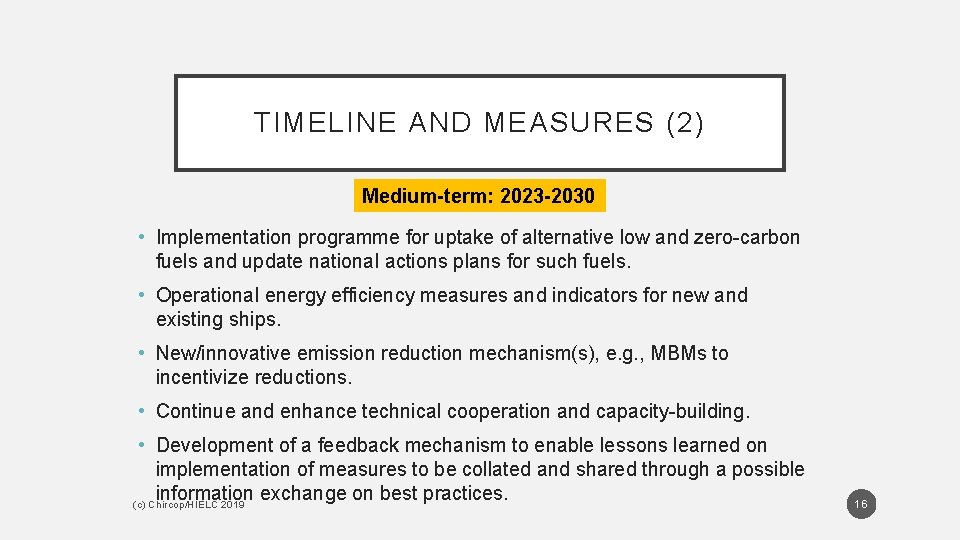
TIMELINE AND MEASURES (2) Medium-term: 2023 -2030 • Implementation programme for uptake of alternative low and zero-carbon fuels and update national actions plans for such fuels. • Operational energy efficiency measures and indicators for new and existing ships. • New/innovative emission reduction mechanism(s), e. g. , MBMs to incentivize reductions. • Continue and enhance technical cooperation and capacity-building. • Development of a feedback mechanism to enable lessons learned on implementation of measures to be collated and shared through a possible information exchange on best practices. (c) Chircop/HIELC 2019 16
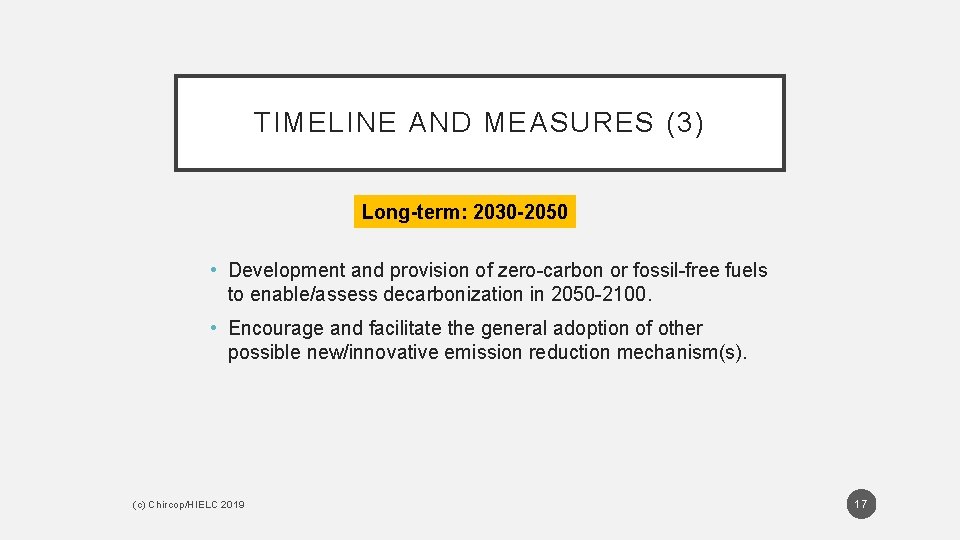
TIMELINE AND MEASURES (3) Long-term: 2030 -2050 • Development and provision of zero-carbon or fossil-free fuels to enable/assess decarbonization in 2050 -2100. • Encourage and facilitate the general adoption of other possible new/innovative emission reduction mechanism(s). (c) Chircop/HIELC 2019 17
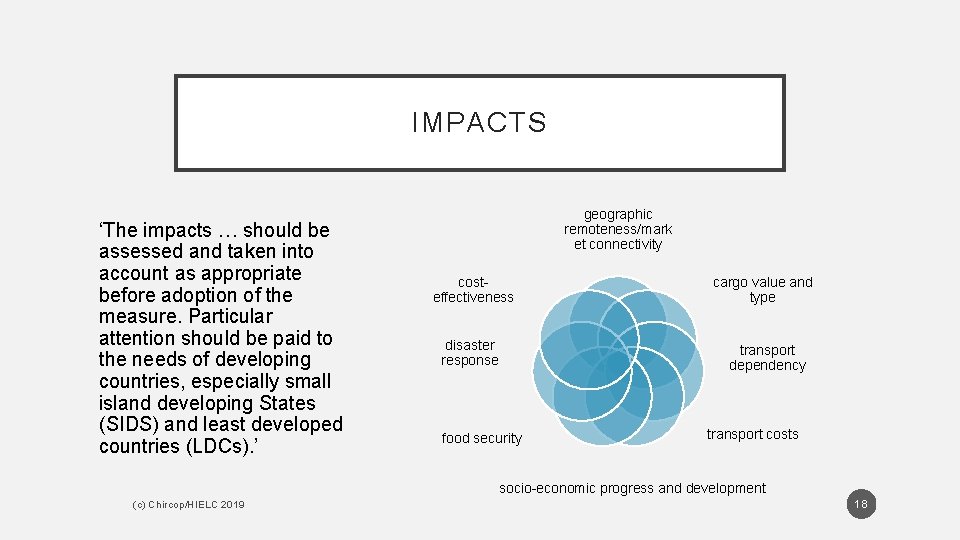
IMPACTS ‘The impacts … should be assessed and taken into account as appropriate before adoption of the measure. Particular attention should be paid to the needs of developing countries, especially small island developing States (SIDS) and least developed countries (LDCs). ’ geographic remoteness/mark et connectivity costeffectiveness disaster response cargo value and type transport dependency food security transport costs socio-economic progress and development (c) Chircop/HIELC 2019 18
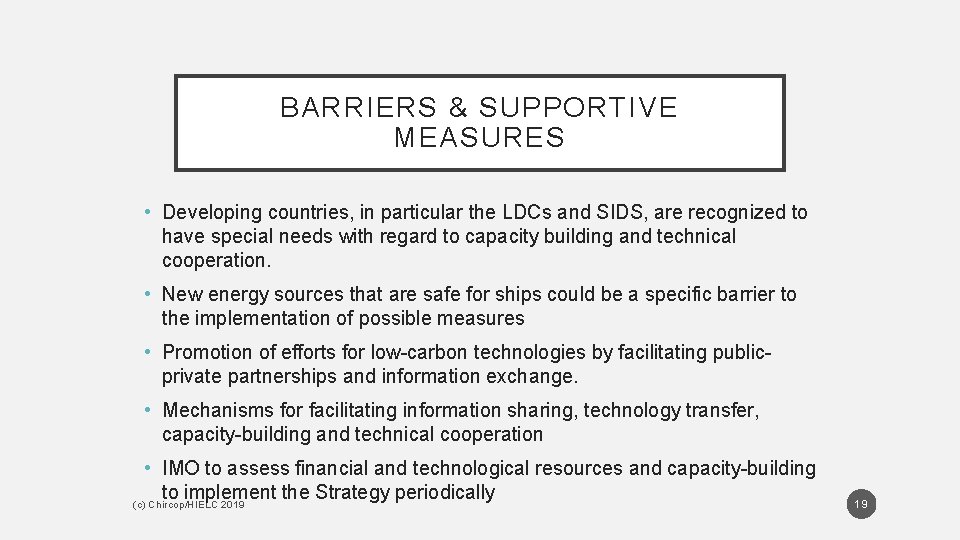
BARRIERS & SUPPORTIVE MEASURES • Developing countries, in particular the LDCs and SIDS, are recognized to have special needs with regard to capacity building and technical cooperation. • New energy sources that are safe for ships could be a specific barrier to the implementation of possible measures • Promotion of efforts for low-carbon technologies by facilitating publicprivate partnerships and information exchange. • Mechanisms for facilitating information sharing, technology transfer, capacity-building and technical cooperation • IMO to assess financial and technological resources and capacity-building to implement the Strategy periodically (c) Chircop/HIELC 2019 19
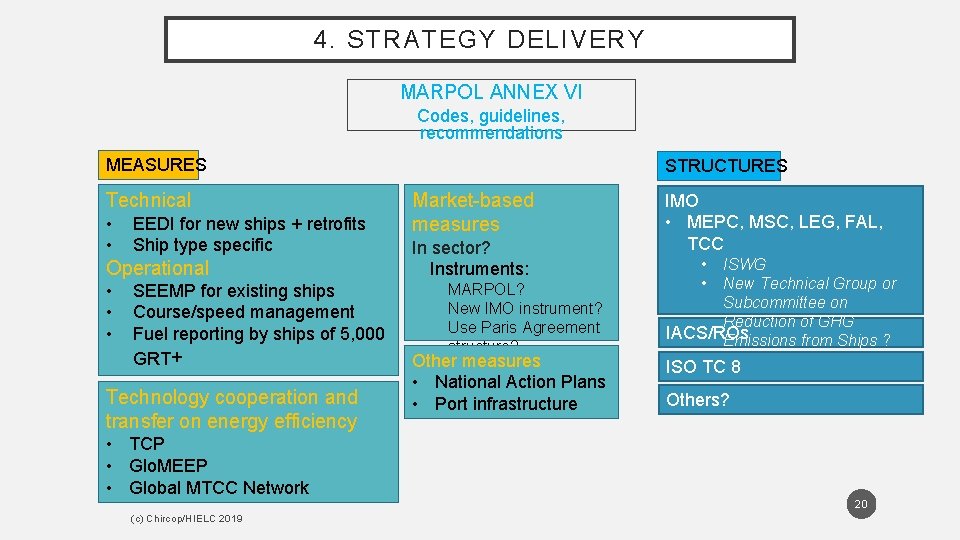
4. STRATEGY DELIVERY MARPOL ANNEX VI Codes, guidelines, recommendations MEASURES Technical • • EEDI for new ships + retrofits Ship type specific Operational • • • SEEMP for existing ships Course/speed management Fuel reporting by ships of 5, 000 GRT+ Technology cooperation and transfer on energy efficiency STRUCTURES Market-based measures In sector? Instruments: • MARPOL? • New IMO instrument? • Use Paris Agreement structure? Other measures • National Action Plans • Port infrastructure IMO • MEPC, MSC, LEG, FAL, TCC • • ISWG New Technical Group or Subcommittee on Reduction of GHG IACS/ROs Emissions from Ships ? ISO TC 8 Others? • TCP • Glo. MEEP • Global MTCC Network 20 (c) Chircop/HIELC 2019
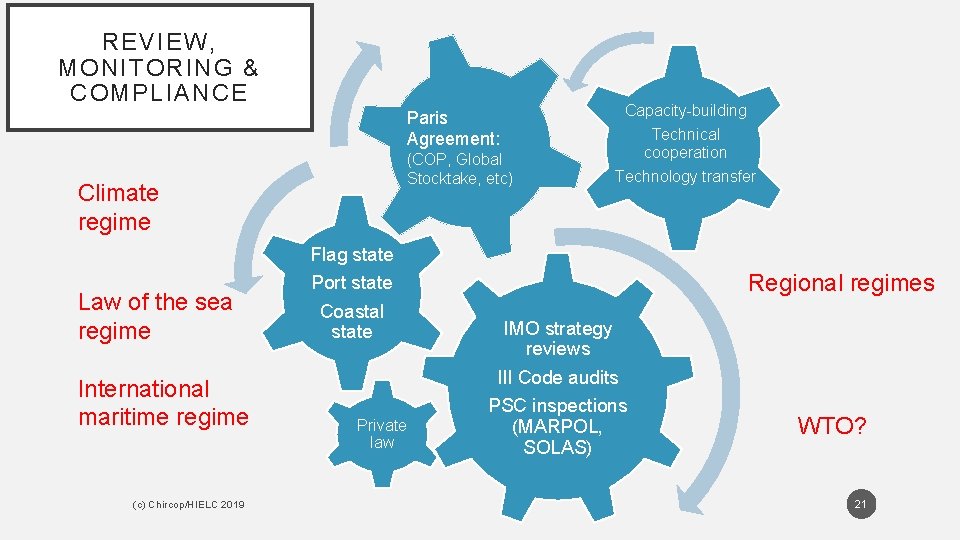
REVIEW, MONITORING & COMPLIANCE Capacity-building Paris Agreement: (COP, Global Stocktake, etc) Climate regime Technical cooperation Technology transfer Flag state Law of the sea regime International maritime regime (c) Chircop/HIELC 2019 Port state Coastal state Private law Regional regimes IMO strategy reviews III Code audits PSC inspections (MARPOL, SOLAS) WTO? 21
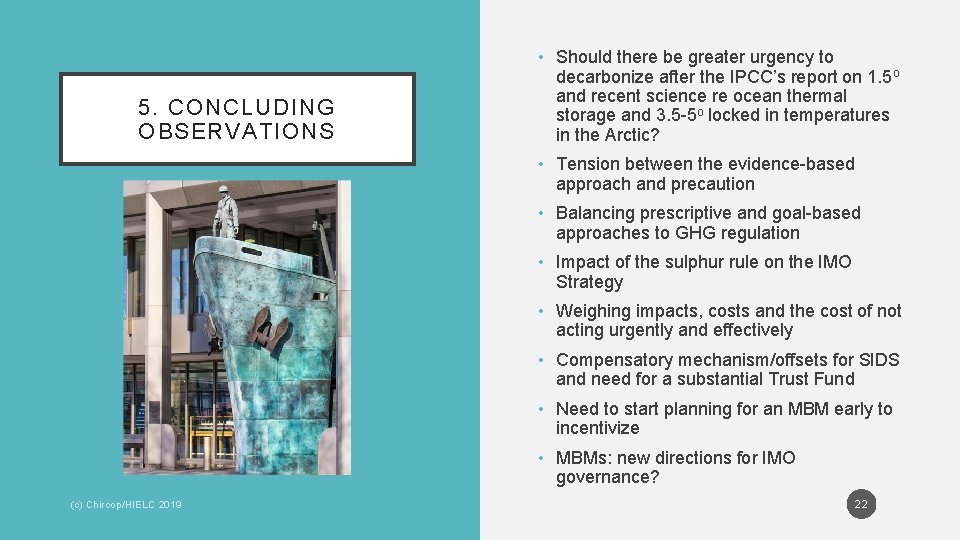
5. CONCLUDING OBSERVATIONS • Should there be greater urgency to decarbonize after the IPCC’s report on 1. 5 o and recent science re ocean thermal storage and 3. 5 -5 o locked in temperatures in the Arctic? • Tension between the evidence-based approach and precaution • Balancing prescriptive and goal-based approaches to GHG regulation • Impact of the sulphur rule on the IMO Strategy • Weighing impacts, costs and the cost of not acting urgently and effectively • Compensatory mechanism/offsets for SIDS and need for a substantial Trust Fund • Need to start planning for an MBM early to incentivize • MBMs: new directions for IMO governance? (c) Chircop/HIELC 2019 22
VIELEN DANK! THANK YOU Acknowledgement Parts of this presentation are based on A Chircop, M Doelle & R Gauvin, Shipping and Climate Change: International Law and Policy Considerations (Centre for International Governance Innovation, 2018) (c) Chircop/HIELC 2019 23