
Charge transport in molecular devices Aldo Di Carlo
- Slides: 35
Charge transport in molecular devices Aldo Di Carlo, A. Pecchia, L. Latessa, M. Ghorghe* Dept. Electronic Eng. University of Rome “Tor Vergata”, (ITALY) P. Lugli TU-Munich (GERMANY) Collaborations T. Niehaus, T. Frauenheim University of Paderborn (GERMANY) G. Seifert TU-Dresden (GERMANY) R. Gutierrez, G. Cuniberti *University of Regensburg (GERMANY) European Commission Project U Tor Vergata
What about realistic nanostructured devices ? Inorganics 1 D (quantum wells): 100 -1000 atoms in the unit cell 2 D (quantum wires): 1000 -10’ 000 atoms in the unit cell 3 D (quantum dots): 100’ 000 -1’ 000 atoms in the unit cell Organics Molecules, Nanotubes, DNA: 100 -1000 atoms (or more) Traditionally, nanostructures are studied via k · p approaches in the context of the envelope function approximation (EFA). In this case, only the envelope of the nanostructure wavefunction is considered, regardless of atomic details. Modern technology, however, pushes nanostructures to dimensions, geometries and systems where the EFA does not hold any more. Atomistic approaches are required for the modeling structural, electronic and optical properties of modern nanostructured devices. U Tor Vergata
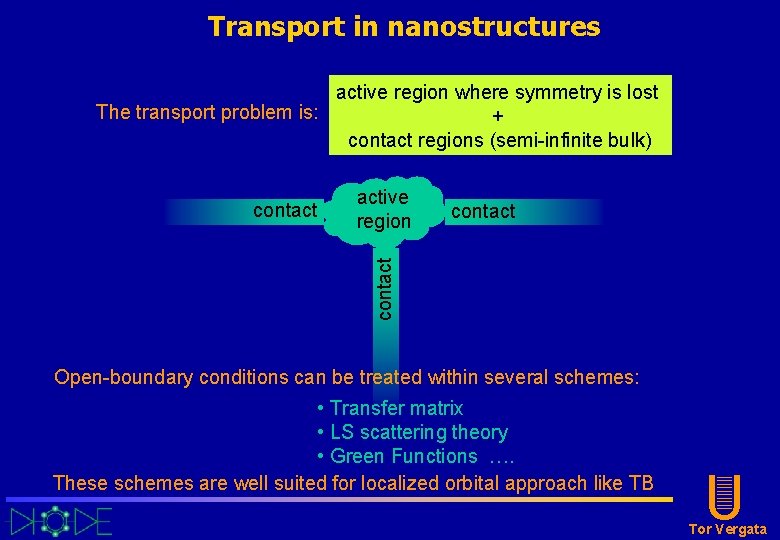
Transport in nanostructures active region where symmetry is lost The transport problem is: + contact regions (semi-infinite bulk) contact active region Open-boundary conditions can be treated within several schemes: • Transfer matrix • LS scattering theory • Green Functions …. These schemes are well suited for localized orbital approach like TB U Tor Vergata
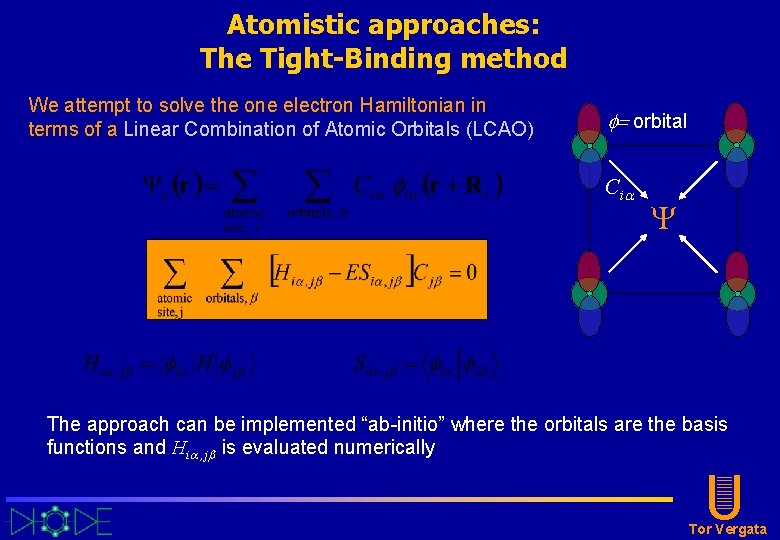
Atomistic approaches: The Tight-Binding method We attempt to solve the one electron Hamiltonian in terms of a Linear Combination of Atomic Orbitals (LCAO) f= orbital C ia Y The approach can be implemented “ab-initio” where the orbitals are the basis functions and Hia , jb is evaluated numerically U Tor Vergata
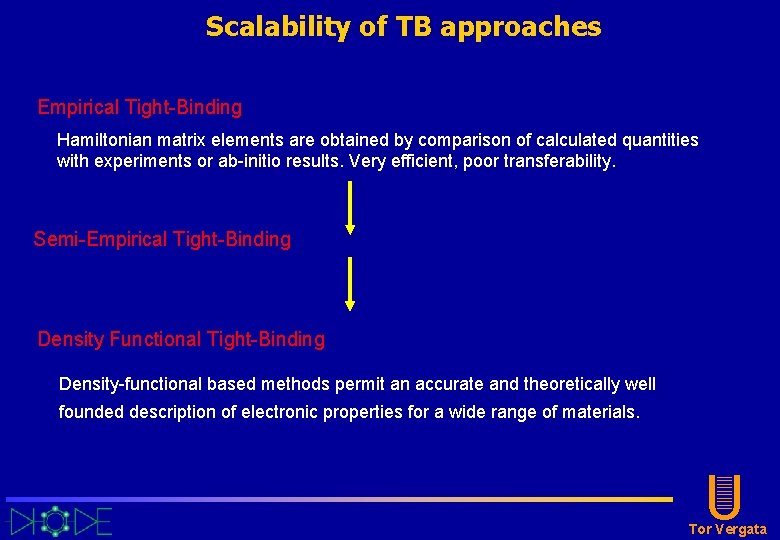
Scalability of TB approaches Empirical Tight-Binding Hamiltonian matrix elements are obtained by comparison of calculated quantities with experiments or ab-initio results. Very efficient, poor transferability. Semi-Empirical Tight-Binding Density Functional Tight-Binding Density-functional based methods permit an accurate and theoretically well founded description of electronic properties for a wide range of materials. U Tor Vergata
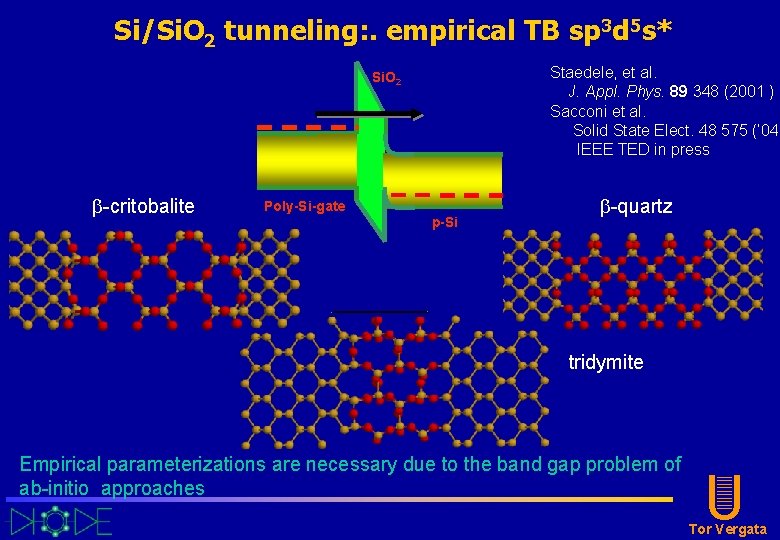
Si/Si. O 2 tunneling: . empirical TB sp 3 d 5 s* Staedele, et al. J. Appl. Phys. 89 348 (2001 ) Sacconi et al. Solid State Elect. 48 575 (‘ 04) IEEE TED in press Si. O 2 b-critobalite Poly-Si-gate p-Si b-quartz tridymite Empirical parameterizations are necessary due to the band gap problem of ab-initio approaches U Tor Vergata
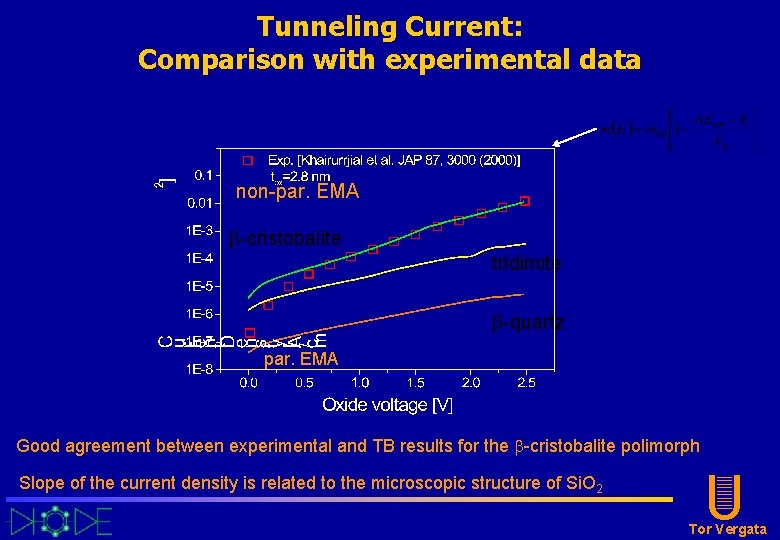
Tunneling Current: Comparison with experimental data non-par. EMA b-cristobalite tridimite b-quartz par. EMA Good agreement between experimental and TB results for the b-cristobalite polimorph Slope of the current density is related to the microscopic structure of Si. O 2 U Tor Vergata
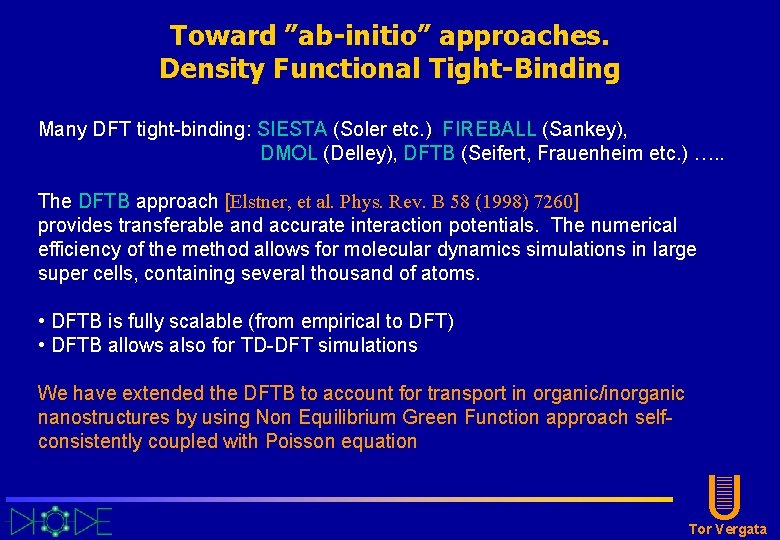
Toward ”ab-initio” approaches. Density Functional Tight-Binding Many DFT tight-binding: SIESTA (Soler etc. ), FIREBALL (Sankey), DMOL (Delley), DFTB (Seifert, Frauenheim etc. ) …. . The DFTB approach [Elstner, et al. Phys. Rev. B 58 (1998) 7260] provides transferable and accurate interaction potentials. The numerical efficiency of the method allows for molecular dynamics simulations in large super cells, containing several thousand of atoms. • DFTB is fully scalable (from empirical to DFT) • DFTB allows also for TD-DFT simulations We have extended the DFTB to account for transport in organic/inorganic nanostructures by using Non Equilibrium Green Function approach selfconsistently coupled with Poisson equation U Tor Vergata
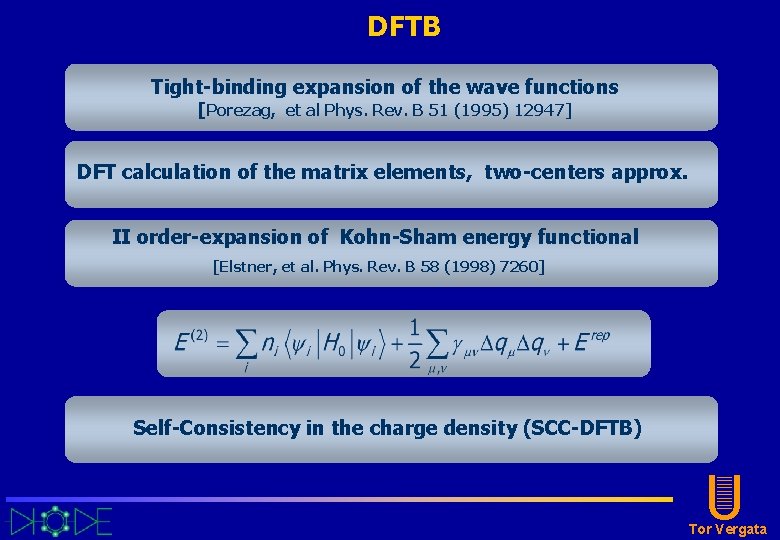
DFTB Tight-binding expansion of the wave functions [Porezag, et al Phys. Rev. B 51 (1995) 12947] DFT calculation of the matrix elements, two-centers approx. II order-expansion of Kohn-Sham energy functional [Elstner, et al. Phys. Rev. B 58 (1998) 7260] Self-Consistency in the charge density (SCC-DFTB) U Tor Vergata
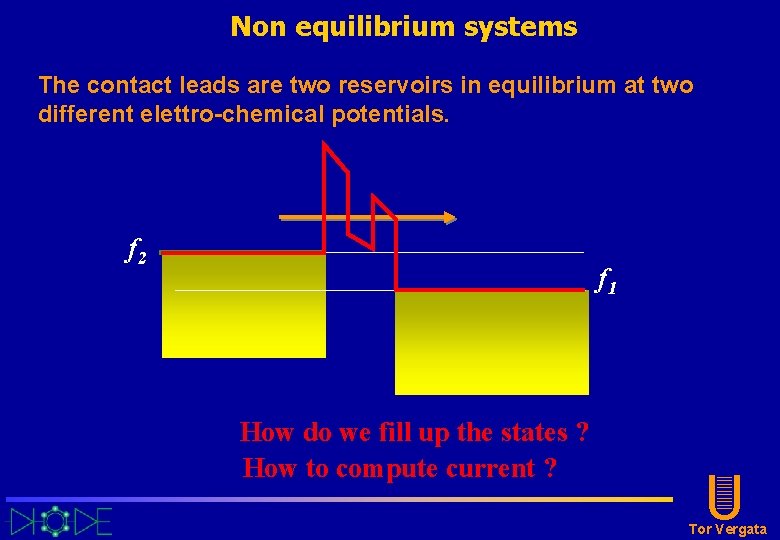
Non equilibrium systems The contact leads are two reservoirs in equilibrium at two different elettro-chemical potentials. f 2 f 1 How do we fill up the states ? How to compute current ? U Tor Vergata
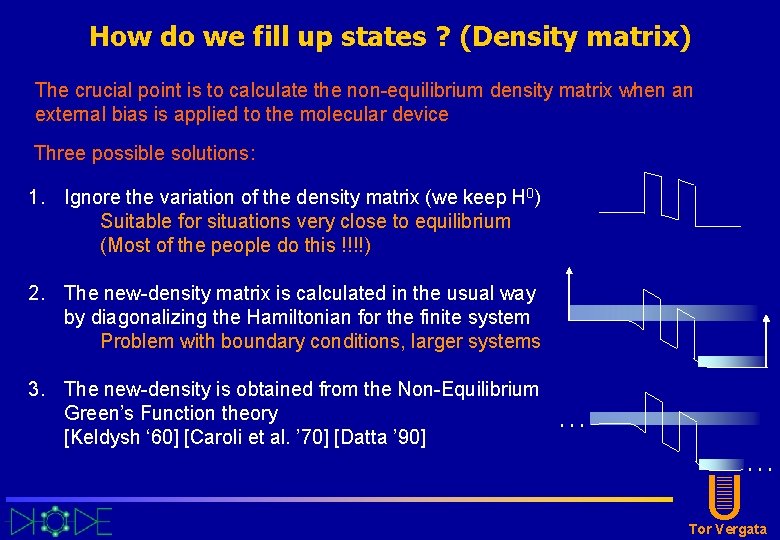
How do we fill up states ? (Density matrix) The crucial point is to calculate the non-equilibrium density matrix when an external bias is applied to the molecular device Three possible solutions: 1. Ignore the variation of the density matrix (we keep H 0) Suitable for situations very close to equilibrium (Most of the people do this !!!!) 2. The new-density matrix is calculated in the usual way by diagonalizing the Hamiltonian for the finite system Problem with boundary conditions, larger systems 3. The new-density is obtained from the Non-Equilibrium Green’s Function theory [Keldysh ‘ 60] [Caroli et al. ’ 70] [Datta ’ 90] . . . U . . . Tor Vergata
DFTB + Green Functions Systems close to the equilibrium • Molecular vibrations and current (details: Poster 16) U Tor Vergata
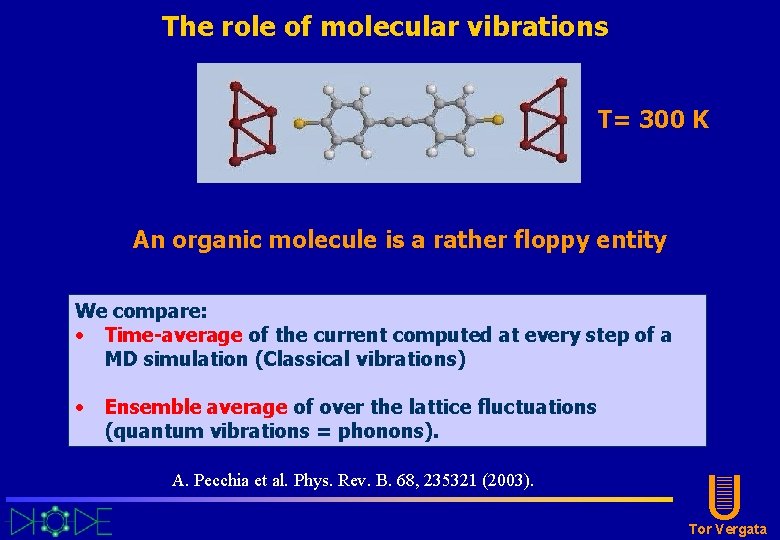
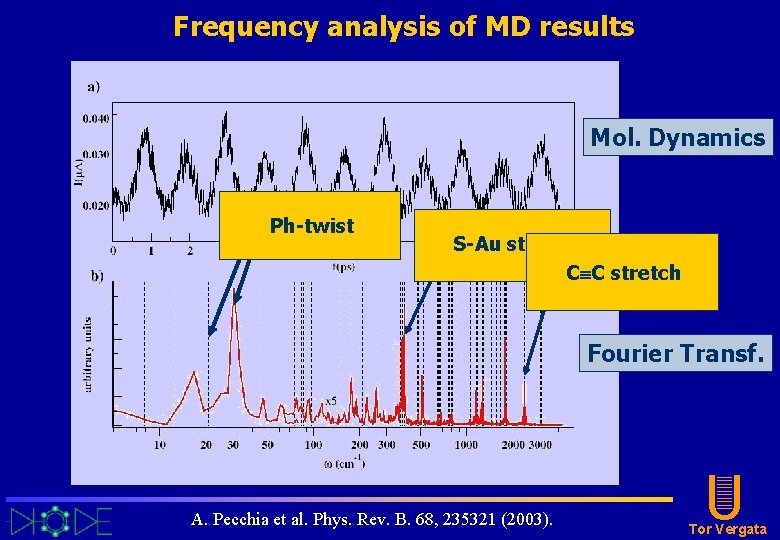
The role of molecular vibrations T= 300 K An organic molecule is a rather floppy entity We compare: • Time-average of the current computed at every step of a MD simulation (Classical vibrations) • Ensemble average of over the lattice fluctuations (quantum vibrations = phonons). A. Pecchia et al. Phys. Rev. B. 68, 235321 (2003). U Tor Vergata
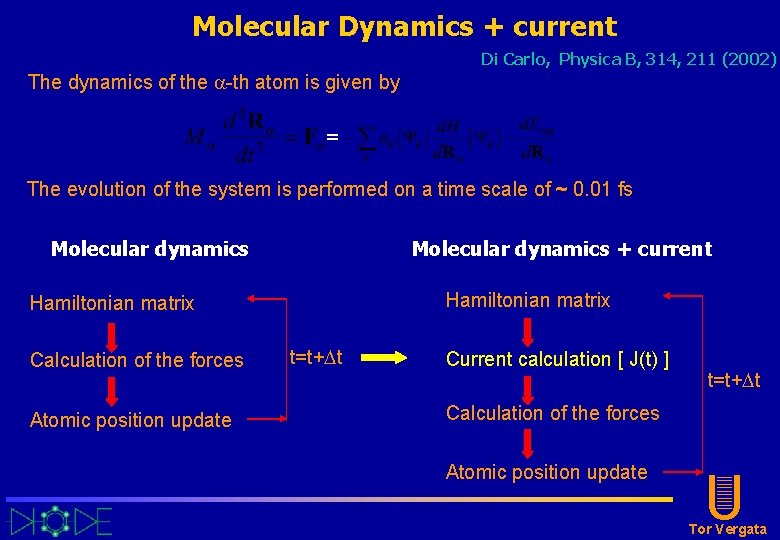
Molecular Dynamics + current Di Carlo, Physica B, 314, 211 (2002) The dynamics of the a-th atom is given by = The evolution of the system is performed on a time scale of ~ 0. 01 fs Molecular dynamics + current Hamiltonian matrix Calculation of the forces Atomic position update t=t+Dt Current calculation [ J(t) ] t=t+Dt Calculation of the forces Atomic position update U Tor Vergata
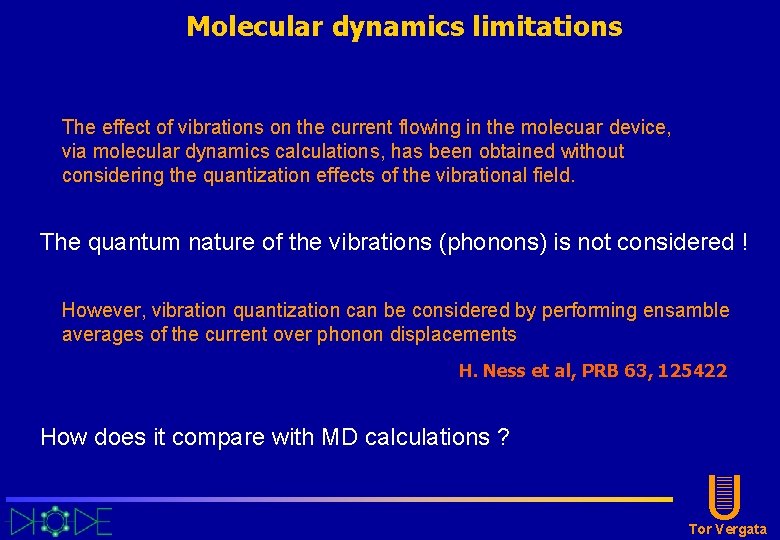
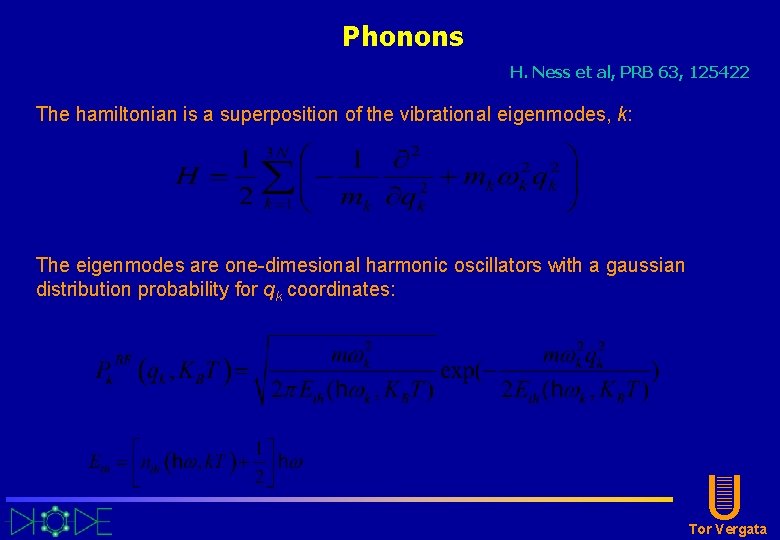
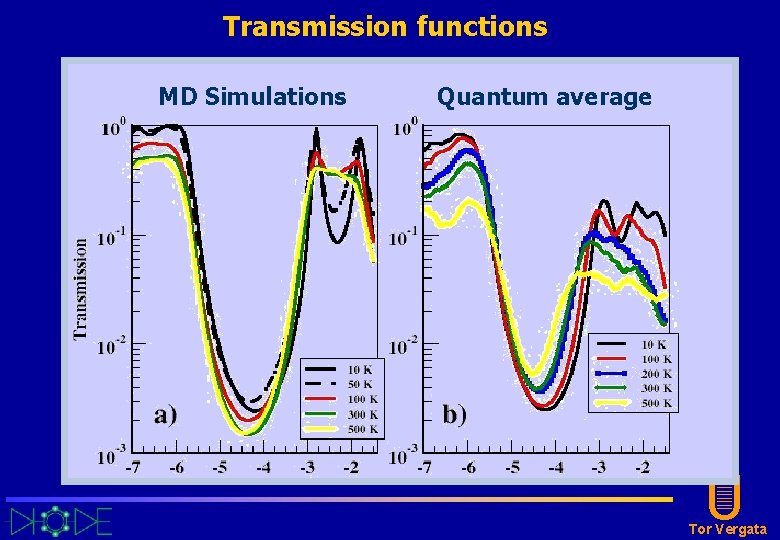
Molecular dynamics limitations The effect of vibrations on the current flowing in the molecuar device, via molecular dynamics calculations, has been obtained without considering the quantization effects of the vibrational field. The quantum nature of the vibrations (phonons) is not considered ! However, vibration quantization can be considered by performing ensamble averages of the current over phonon displacements H. Ness et al, PRB 63, 125422 How does it compare with MD calculations ? U Tor Vergata
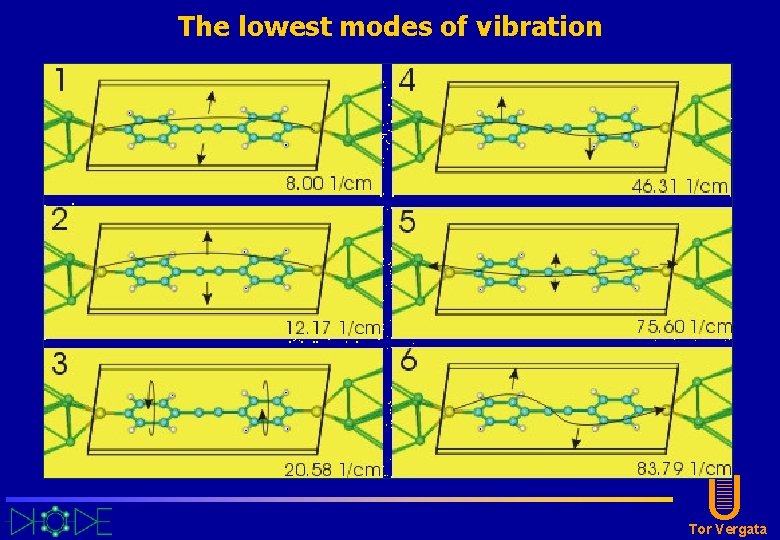
The lowest modes of vibration U Tor Vergata
Phonons H. Ness et al, PRB 63, 125422 The hamiltonian is a superposition of the vibrational eigenmodes, k: The eigenmodes are one-dimesional harmonic oscillators with a gaussian distribution probability for qk coordinates: U Tor Vergata
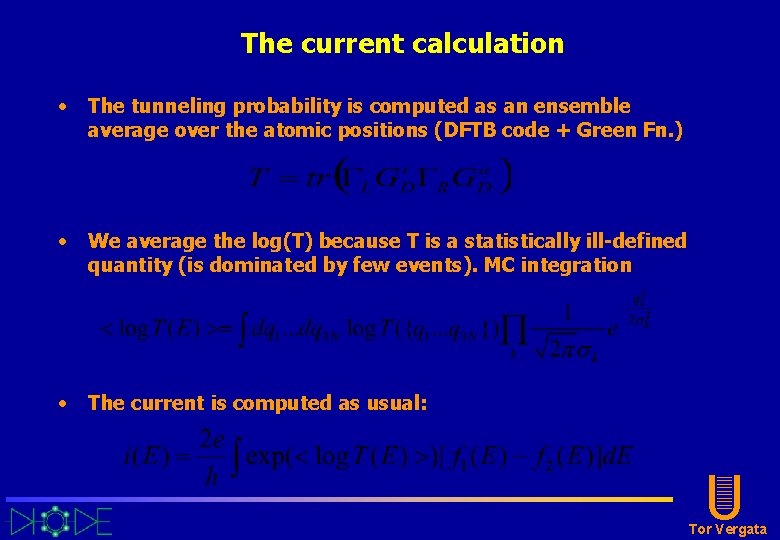
The current calculation • The tunneling probability is computed as an ensemble average over the atomic positions (DFTB code + Green Fn. ) • We average the log(T) because T is a statistically ill-defined quantity (is dominated by few events). MC integration • The current is computed as usual: U Tor Vergata
Transmission functions MD Simulations Quantum average U Tor Vergata
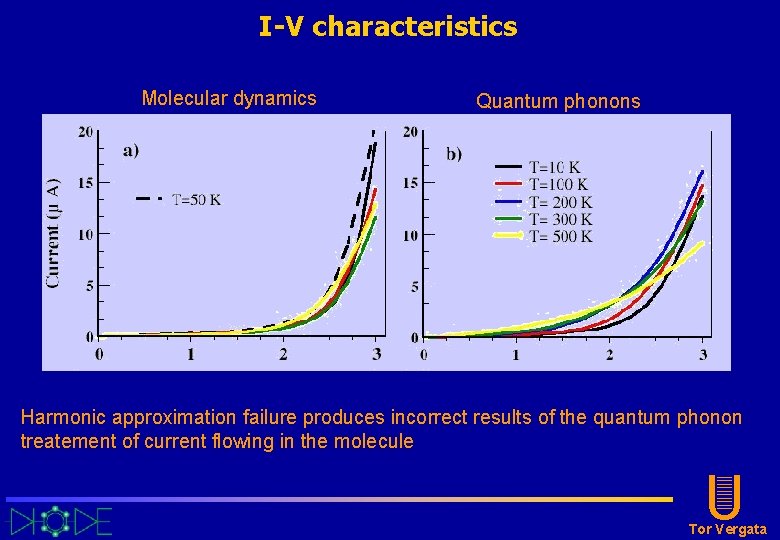
Comparison: MD, Quantum PH, Classical PH QPH = phonon treatement CPH = phonons treatement without zero point energy U Tor Vergata
Frequency analysis of MD results Mol. Dynamics Ph-twist S-Au stretch C C stretch Fourier Transf. A. Pecchia et al. Phys. Rev. B. 68, 235321 (2003). U Tor Vergata
I-V characteristics Molecular dynamics Quantum phonons Harmonic approximation failure produces incorrect results of the quantum phonon treatement of current flowing in the molecule U Tor Vergata
DFTB + Non-Equilibrium Green Functions • Full Self-Consistent results • Electron-Phonon scattering (details: Posters 34 and 37) U Tor Vergata
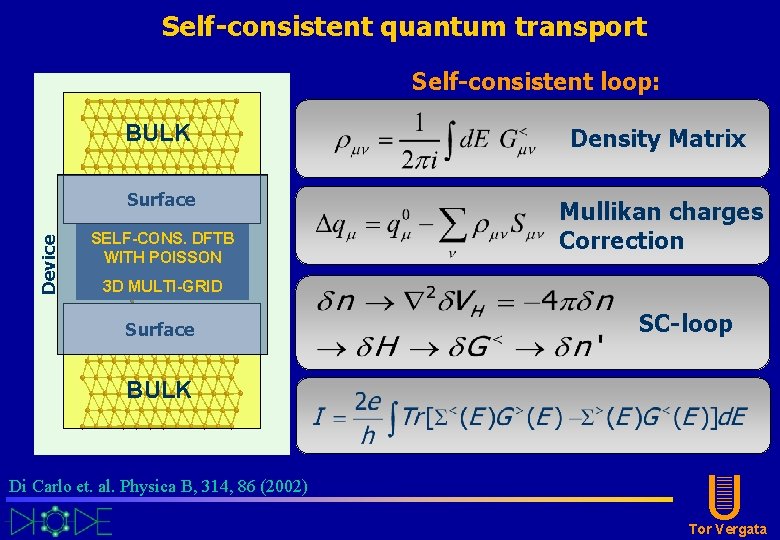
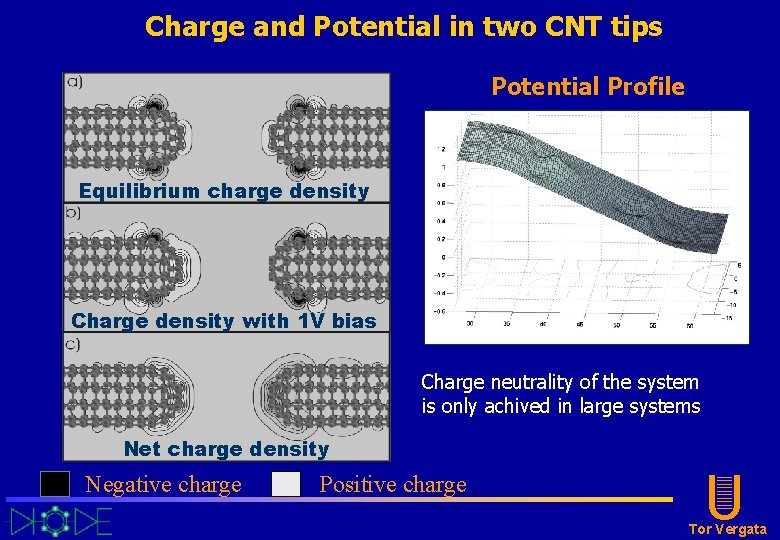
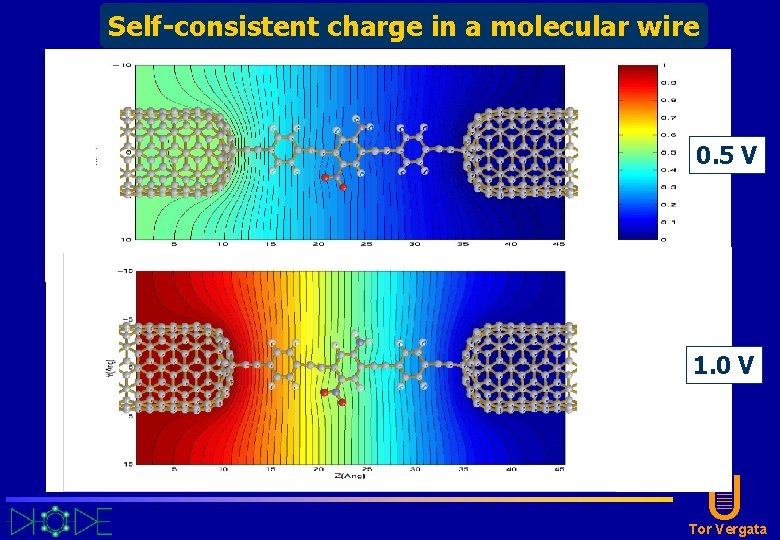
Self-consistent quantum transport Device Self-consistent loop: BULK Density Matrix Surface Mullikan charges Correction SELF-CONS. DFTB WITH POISSON 3 D MULTI-GRID Surface SC-loop BULK Di Carlo et. al. Physica B, 314, 86 (2002) U Tor Vergata
Charge and Potential in two CNT tips Potential Profile Equilibrium charge density Charge density with 1 V bias Charge neutrality of the system is only achived in large systems Net charge density Negative charge Positive charge U Tor Vergata
Self-consistent charge in a molecular wire 0. 5 V 1. 0 V U Tor Vergata
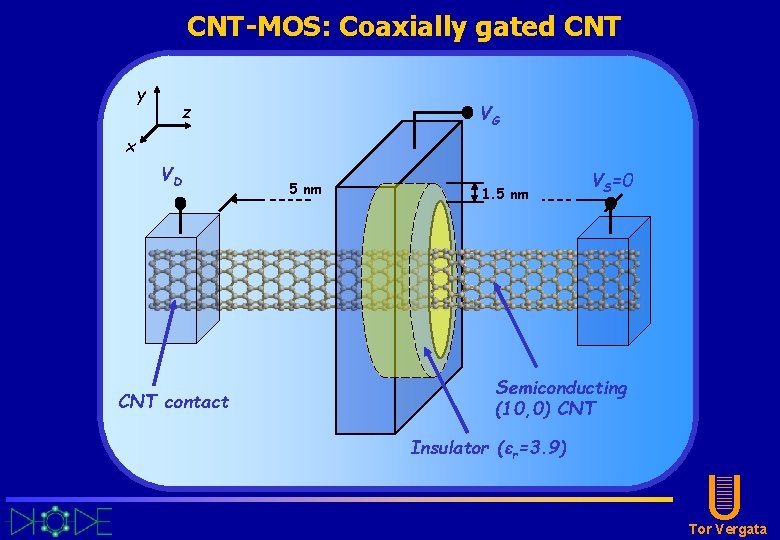
CNT-MOS: Coaxially gated CNT y z VG x VD CNT contact 5 nm 1. 5 nm VS=0 Semiconducting (10, 0) CNT Insulator (εr=3. 9) U Tor Vergata
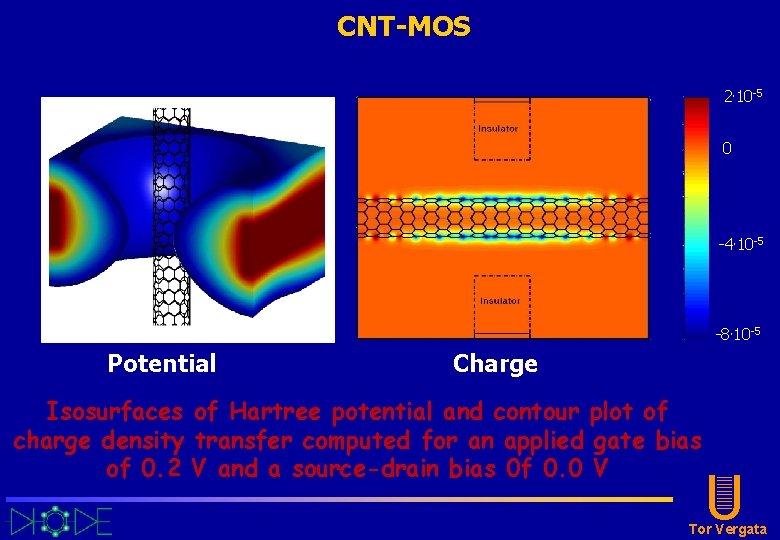
CNT-MOS 2. 10 -5 0 -4. 10 -5 -8. 10 -5 Potential Charge Isosurfaces of Hartree potential and contour plot of charge density transfer computed for an applied gate bias of 0. 2 V and a source-drain bias 0 f 0. 0 V U Tor Vergata
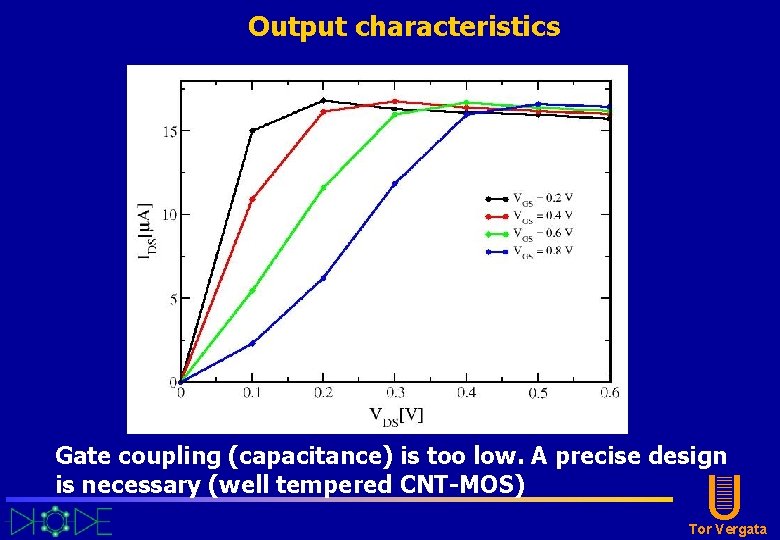
Output characteristics Gate coupling (capacitance) is too low. A precise design is necessary (well tempered CNT-MOS) U Tor Vergata
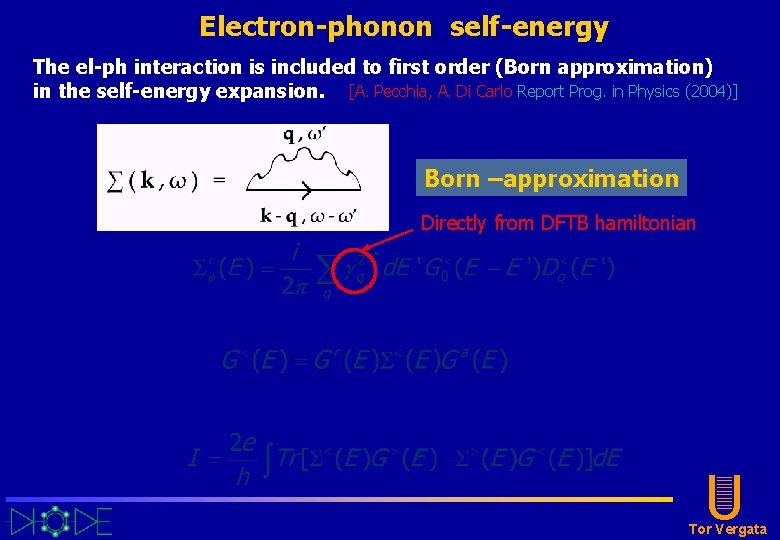
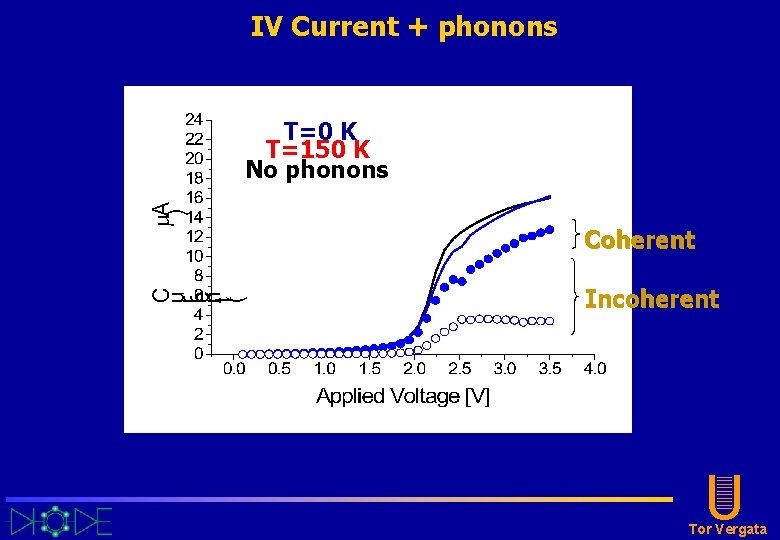
Electron-phonon self-energy The el-ph interaction is included to first order (Born approximation) in the self-energy expansion. [A. Pecchia, A. Di Carlo Report Prog. in Physics (2004)] Born –approximation Directly from DFTB hamiltonian U Tor Vergata
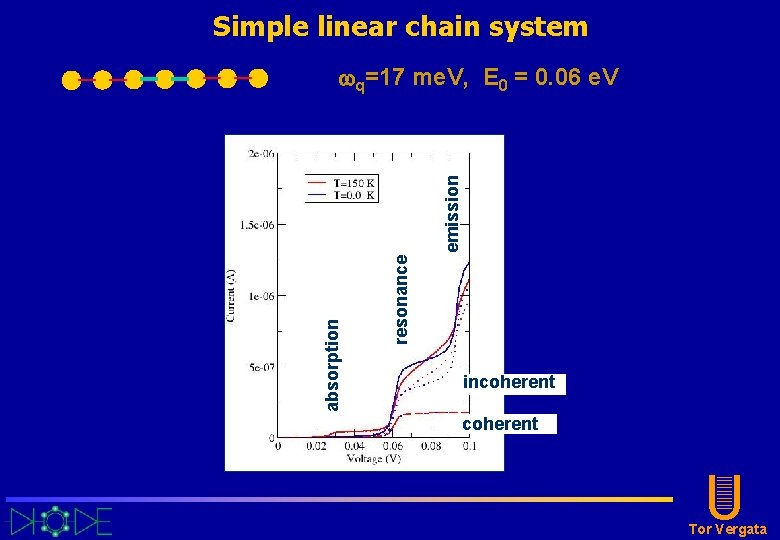
Simple linear chain system resonance absorption emission q=17 me. V, E 0 = 0. 06 e. V incoherent U Tor Vergata
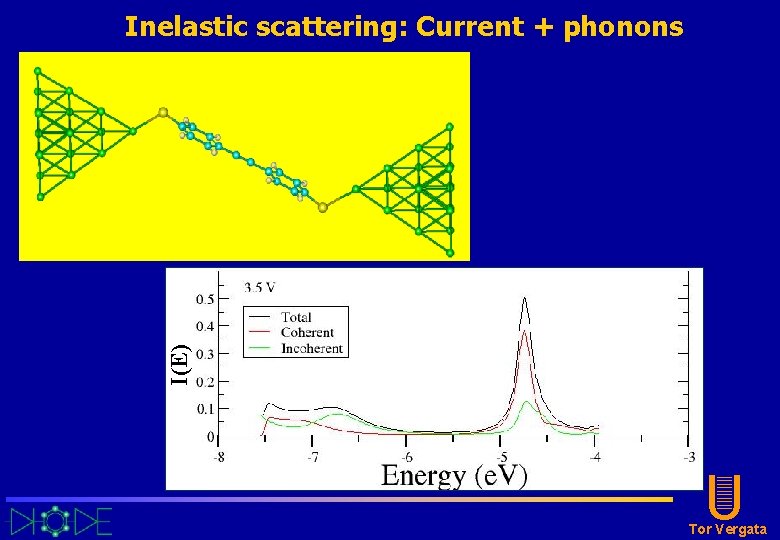
I(E) Inelastic scattering: Current + phonons U Tor Vergata
IV Current + phonons T=0 K T=150 K No phonons Coherent Incoherent U Tor Vergata
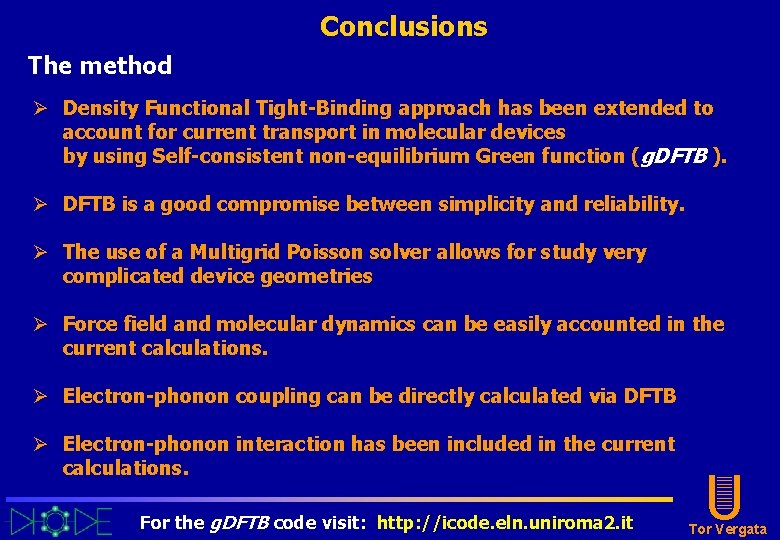
Conclusions The method Ø Density Functional Tight-Binding approach has been extended to account for current transport in molecular devices by using Self-consistent non-equilibrium Green function (g. DFTB ). Ø DFTB is a good compromise between simplicity and reliability. Ø The use of a Multigrid Poisson solver allows for study very complicated device geometries Ø Force field and molecular dynamics can be easily accounted in the current calculations. Ø Electron-phonon coupling can be directly calculated via DFTB Ø Electron-phonon interaction has been included in the current calculations. For the g. DFTB code visit: http: //icode. eln. uniroma 2. it U Tor Vergata
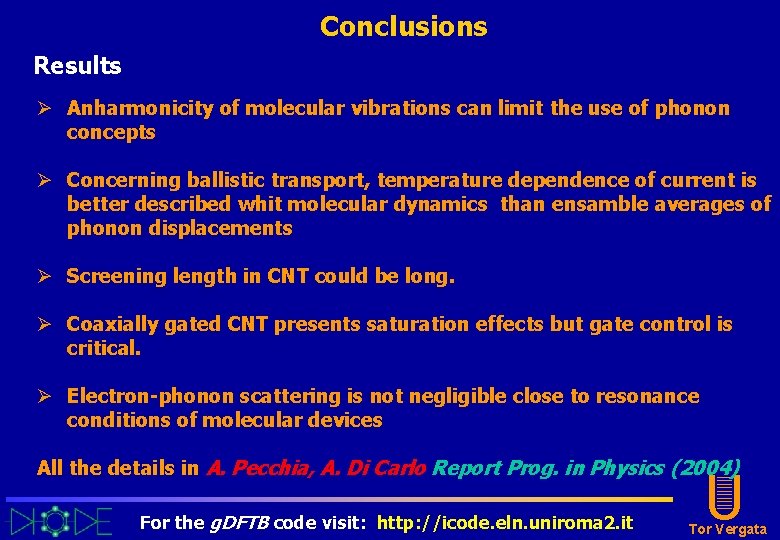
Conclusions Results Ø Anharmonicity of molecular vibrations can limit the use of phonon concepts Ø Concerning ballistic transport, temperature dependence of current is better described whit molecular dynamics than ensamble averages of phonon displacements Ø Screening length in CNT could be long. Ø Coaxially gated CNT presents saturation effects but gate control is critical. Ø Electron-phonon scattering is not negligible close to resonance conditions of molecular devices All the details in A. Pecchia, A. Di Carlo Report Prog. in Physics (2004) For the g. DFTB code visit: http: //icode. eln. uniroma 2. it U Tor Vergata