
Borexino and status of the project Aldo Ianni
Borexino and status of the project Aldo Ianni INFN, Gran Sasso Laboratory on behalf of the Borexino collaboration Moscow, 15/10/2005 Aldo Ianni, INFN LNGS 1
Outline q. Borexino: Italian-Russian cooperation q. Borexino: The Physics Case q. Borexino: Status and Schedule Moscow, 15/10/2005 Aldo Ianni, INFN LNGS 2
Borexino Collaboration – Italy (INFN & Universiy of Milano and Genova, Perugia Univ. , LNGS) – USA (Princeton Univ. , Virginia Tech. ) – Russia (RRC KI, JINR, INP MSU, INP St. Petersburg) – Germany (Hiedelberg MPI, Munich Technical University) – France (College de France) – Hungary (Research Institute for Particle & Nuclear Physics) – Poland (Institute of Physics, Jaegollian University, Cracow) Moscow, 15/10/2005 Aldo Ianni, INFN LNGS 3
Italian-Russian Cooperation on Borexino § From Russia: ~ 20 collaborators ü 60% from RRC KI (M. Skorokhvatov is responsible on the Russian side) ü JINR (O. Zaimidoroga) ü INP of Moscow State University (A. Chepurnov) ü INP of St. Petersburg (A. Derbin) § Research Activities carried out by Russian colleagues: üsimulations (RRC KI + Dubna + INP St. Petersburg) üon-line software development (A. Sabelnikov, RRC KI) üdevelopment of electronics (INP of MSU + RRC KI) üPMT tests and parameters data-base (O. Smirnov, Dubna) üAnalysis (at present of CTF data – RRC KI + Dubna + St. Petersburg) üContribution on installations, commissioning and filling of detector (shifts – all groups) Moscow, 15/10/2005 Aldo Ianni, INFN LNGS 4
The Physics Case § Solar Neurinos § Geo-Neutrinos § Supernova Neutrinos § Non standard neutrino interactions, neutrino from reactors Moscow, 15/10/2005 Aldo Ianni, INFN LNGS 5
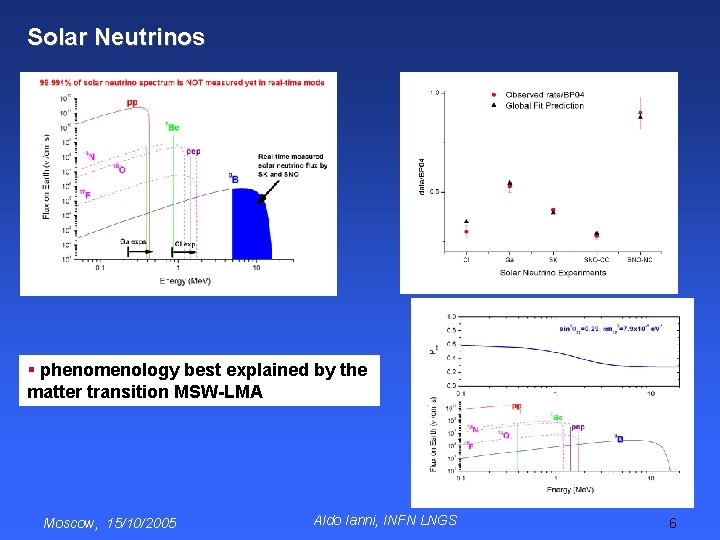
Solar Neutrinos § phenomenology best explained by the matter transition MSW-LMA Moscow, 15/10/2005 Aldo Ianni, INFN LNGS 6
Solar Neutrinos in Borexino q 7 Be solar neutrinos spectroscopy by resolving the Compton-like edge (neutrino-electron elastic scattering) q 1/R 2 effect gives 3 s integral evidence of neutrinos in 2 yr of data taking (7 Be + CNO) q pep neutrinos by three-fold coincidence tagging Moscow, 15/10/2005 Aldo Ianni, INFN LNGS 7
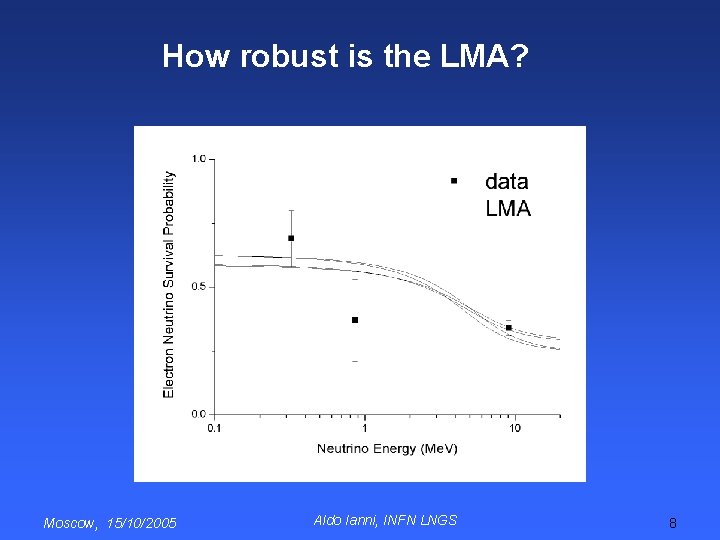
How robust is the LMA? Moscow, 15/10/2005 Aldo Ianni, INFN LNGS 8
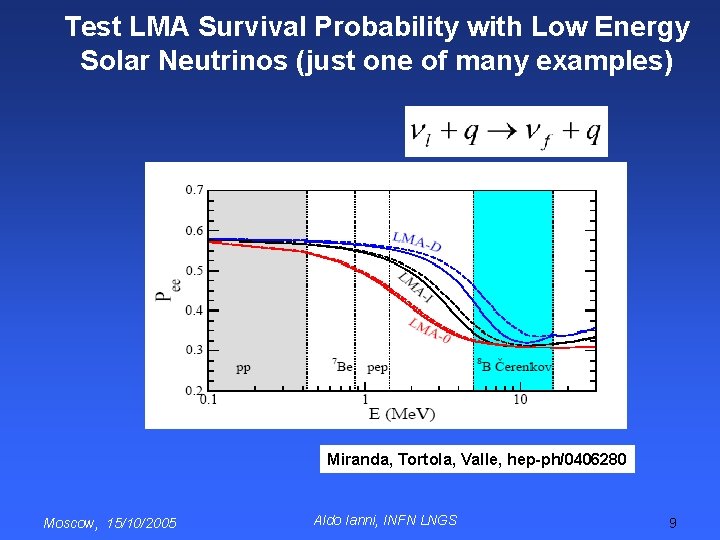
Test LMA Survival Probability with Low Energy Solar Neutrinos (just one of many examples) Miranda, Tortola, Valle, hep-ph/0406280 Moscow, 15/10/2005 Aldo Ianni, INFN LNGS 9
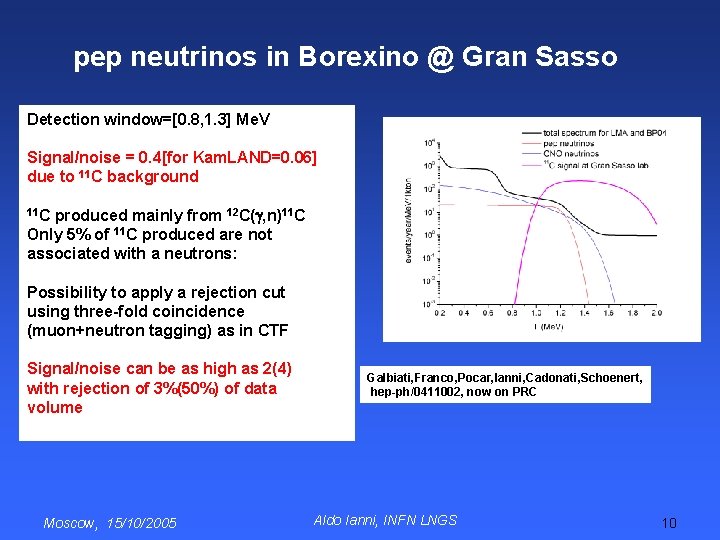
pep neutrinos in Borexino @ Gran Sasso Detection window=[0. 8, 1. 3] Me. V Signal/noise = 0. 4[for Kam. LAND=0. 06] due to 11 C background 11 C produced mainly from 12 C(g, n)11 C Only 5% of 11 C produced are not associated with a neutrons: Possibility to apply a rejection cut using three-fold coincidence (muon+neutron tagging) as in CTF Signal/noise can be as high as 2(4) with rejection of 3%(50%) of data volume Moscow, 15/10/2005 Galbiati, Franco, Pocar, Ianni, Cadonati, Schoenert, hep-ph/0411002, now on PRC Aldo Ianni, INFN LNGS 10
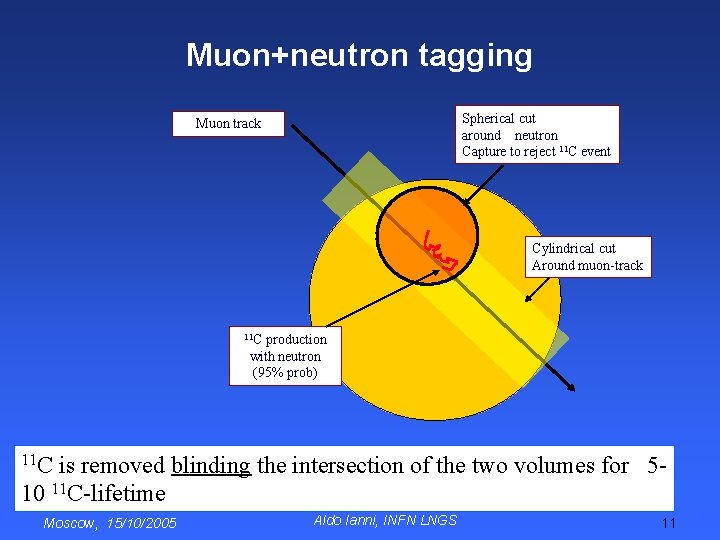
Muon+neutron tagging Spherical cut around neutron Capture to reject 11 C event Muon track Cylindrical cut Around muon-track 11 C production with neutron (95% prob) 11 C is removed blinding the intersection of the two volumes for 510 11 C-lifetime Moscow, 15/10/2005 Aldo Ianni, INFN LNGS 11
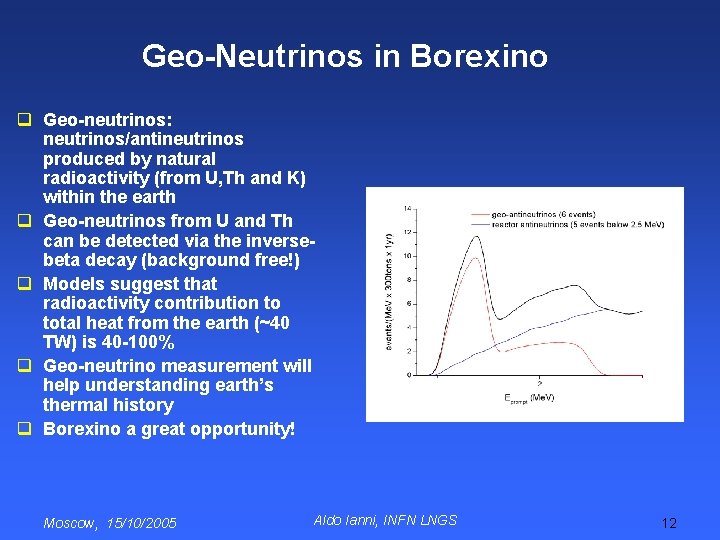
Geo-Neutrinos in Borexino q Geo-neutrinos: neutrinos/antineutrinos produced by natural radioactivity (from U, Th and K) within the earth q Geo-neutrinos from U and Th can be detected via the inversebeta decay (background free!) q Models suggest that radioactivity contribution to total heat from the earth (~40 TW) is 40 -100% q Geo-neutrino measurement will help understanding earth’s thermal history q Borexino a great opportunity! Moscow, 15/10/2005 Aldo Ianni, INFN LNGS 12
SN Neutrinos in Borexino § Neutrinos from Supernovae § § We use 300 tons target mass and a SN at 10 kpc, 2. 5 x 1053 ergs ~17 ev from ( )12 C NC: + 12 C -> + 12 C*(15. 1 Me. V g) ~81 from inverse- decay Inverse-beta decay gives information on spectrum at low energy (≥ 2 Me. V) Moscow, 15/10/2005 Aldo Ianni, INFN LNGS 13
Status of the project q Following August 2002 accident, Borexino activity has suffered from severe restrictions especially for what concerns fluid handling operations; q In spite of this, the detector installation has continued and was completed in july 2004; q INFN and NSF approved fundings for 2005 -2006; q In march 2005: authorization to handle water and scintillator; Moscow, 15/10/2005 Aldo Ianni, INFN LNGS 14
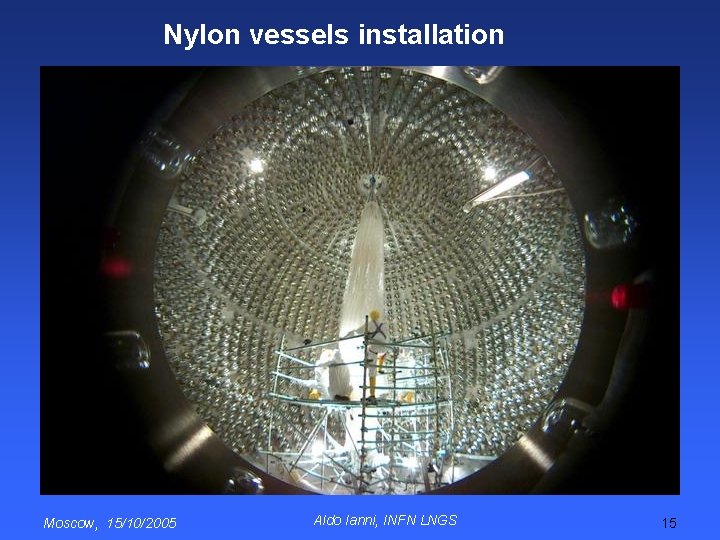
Nylon vessels installation Moscow, 15/10/2005 Aldo Ianni, INFN LNGS 15
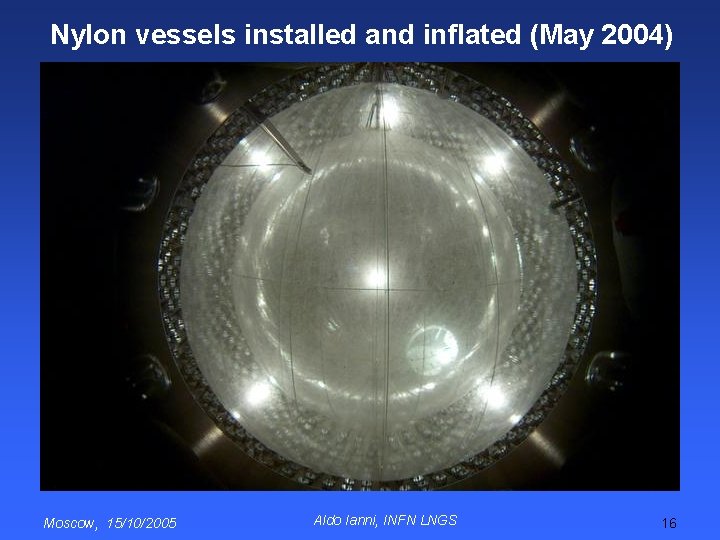
Nylon vessels installed and inflated (May 2004) Moscow, 15/10/2005 Aldo Ianni, INFN LNGS 16
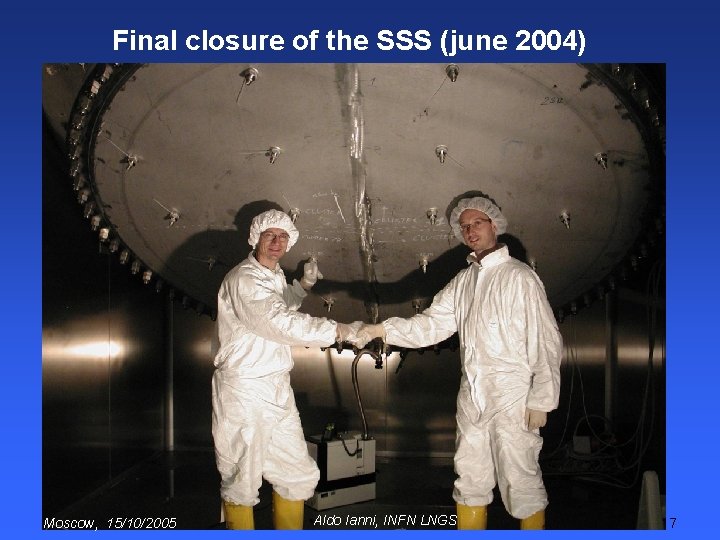
Final closure of the SSS (june 2004) Moscow, 15/10/2005 Aldo Ianni, INFN LNGS 17
Operations group & contribution from collaborators q At present: Strong group based at Gran Sasso to push ahead the commissioning q 3 external technicians with experience on petrochemical plants q 3 collaborators from Princeton q 2 collaborators from Russia (1 full time based) q 6 collaborators from INFN Expected STRONG support from the WHOLE collaborators in 2006 for detector filling (shifts) Moscow, 15/10/2005 Aldo Ianni, INFN LNGS 18
Status of the project (cont. ) q re-commissioning of all ancillary plants in progress – Cleaning of systems – Tuning for distillation of PC and of Master Solution (PC+PPO@200 g/l) – Preparing CTF for distillation test (210 Pb – 210 Po contamination issue) q Software for data analysis – Monte Carlo chain, on-line code, tests, physics codes – Tests of software chain by so-called “air runs” Moscow, 15/10/2005 Aldo Ianni, INFN LNGS 19
Satus of the project (cont. ) q After CTF distillation test (beginning of 2006) – Filling of the detector, expected before spring 2006 – Data taking, expected beginnig of 2007 Moscow, 15/10/2005 Aldo Ianni, INFN LNGS 20
Conclusions § Detecting low-energy solar neutrinos in real-time is crucial § Years of R&D studies by the Borexino collaboration has addressed all the relevant radio purity issues which are needed to lower the detection threshold down to ~200 ke. V for a tonscale detector; § Borexino detector is built, tested with several ”air-runs” and ready to be filled; § Strategy of filling from CTF distillation test (soon) § 2006 crucial year for Borexino: strong effort by the collaboration expected § Data-taking is expected beginning of 2007; Moscow, 15/10/2005 Aldo Ianni, INFN LNGS 21

Moscow, 15/10/2005 Aldo Ianni, INFN LNGS 22
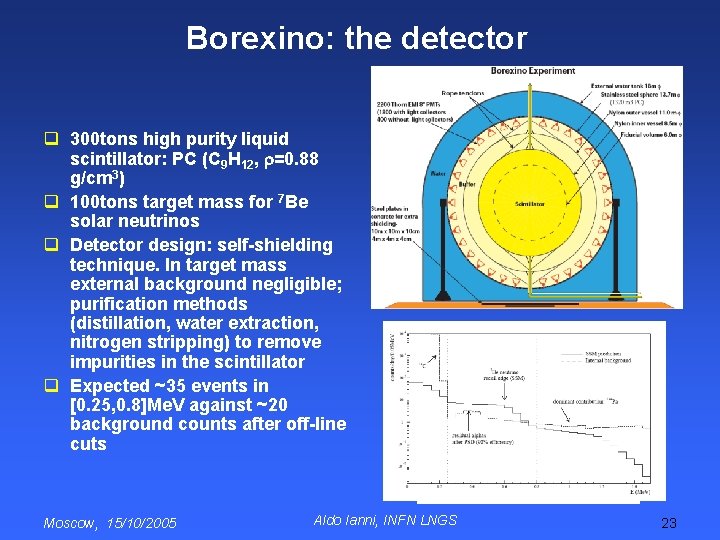
Borexino: the detector q 300 tons high purity liquid scintillator: PC (C 9 H 12, r=0. 88 g/cm 3) q 100 tons target mass for 7 Be solar neutrinos q Detector design: self-shielding technique. In target mass external background negligible; purification methods (distillation, water extraction, nitrogen stripping) to remove impurities in the scintillator q Expected ~35 events in [0. 25, 0. 8]Me. V against ~20 background counts after off-line cuts Moscow, 15/10/2005 Aldo Ianni, INFN LNGS 23
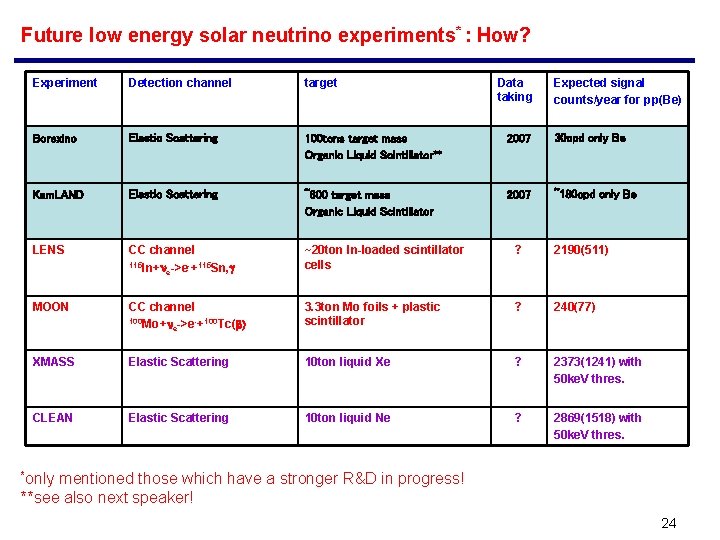
Future low energy solar neutrino experiments* : How? Experiment Detection channel target Data taking Expected signal counts/year for pp(Be) Borexino Elastic Scattering 100 tons target mass Organic Liquid Scintillator** 2007 30 cpd only Be Kam. LAND Elastic Scattering ~600 target mass Organic Liquid Scintillator 2007 ~180 cpd only Be LENS CC channel 115 In+ ->e-+115 Sn, g e ~20 ton In-loaded scintillator cells ? 2190(511) MOON CC channel 100 Mo+ ->e-+100 Tc( ) e 3. 3 ton Mo foils + plastic scintillator ? 240(77) XMASS Elastic Scattering 10 ton liquid Xe ? 2373(1241) with 50 ke. V thres. CLEAN Elastic Scattering 10 ton liquid Ne ? 2869(1518) with 50 ke. V thres. *only mentioned those which have a stronger R&D in progress! **see also next speaker! Moscow, 15/10/2005 Aldo Ianni, INFN LNGS 24
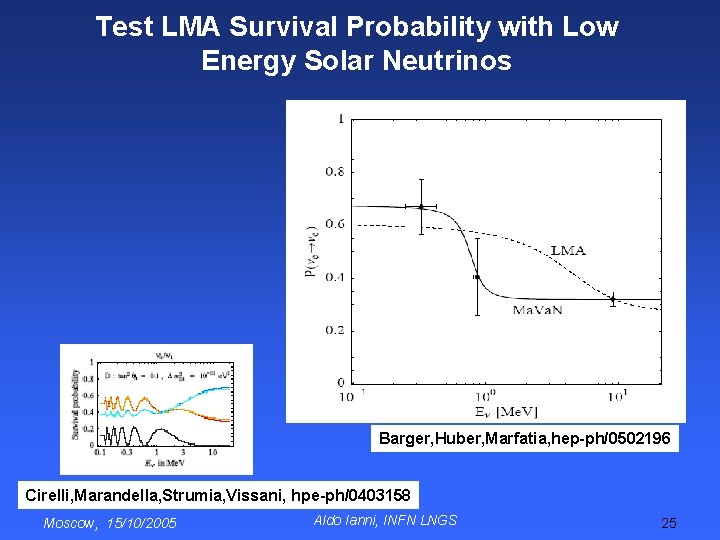
Test LMA Survival Probability with Low Energy Solar Neutrinos Miranda, Tortola, Valle, hep-ph/0406280 Friedland, Lunardini, Pena-Garay, hep-ph/0402266 Barger, Huber, Marfatia, hep-ph/0502196 Cirelli, Marandella, Strumia, Vissani, hpe-ph/0403158 Moscow, 15/10/2005 Aldo Ianni, INFN LNGS 25
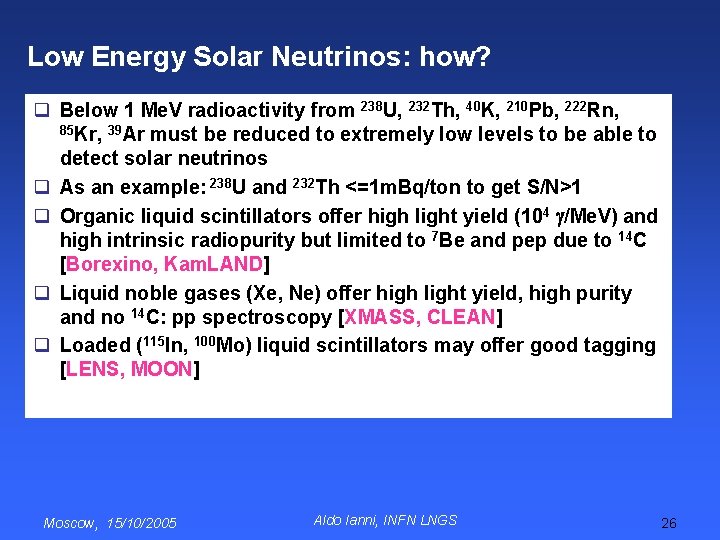
Low Energy Solar Neutrinos: how? q Below 1 Me. V radioactivity from 238 U, 232 Th, 40 K, 210 Pb, 222 Rn, 85 Kr, 39 Ar must be reduced to extremely low levels to be able to detect solar neutrinos q As an example: 238 U and 232 Th <=1 m. Bq/ton to get S/N>1 q Organic liquid scintillators offer high light yield (104 g/Me. V) and high intrinsic radiopurity but limited to 7 Be and pep due to 14 C [Borexino, Kam. LAND] q Liquid noble gases (Xe, Ne) offer high light yield, high purity and no 14 C: pp spectroscopy [XMASS, CLEAN] q Loaded (115 In, 100 Mo) liquid scintillators may offer good tagging [LENS, MOON] Moscow, 15/10/2005 Aldo Ianni, INFN LNGS 26
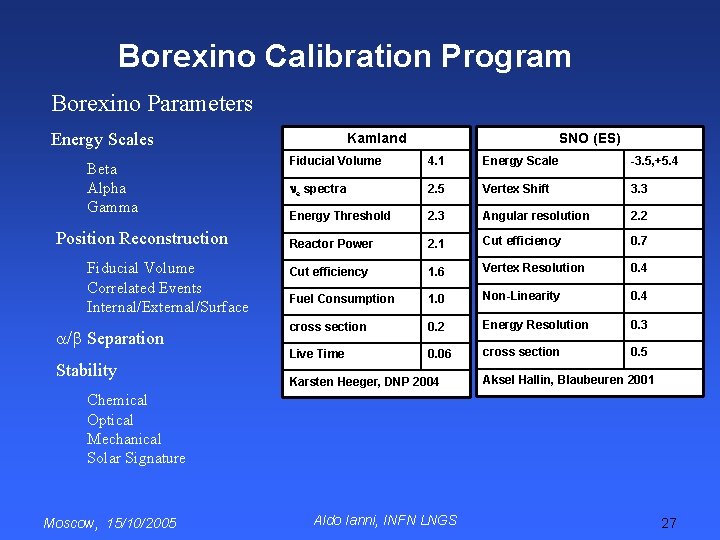
Borexino Calibration Program Borexino Parameters Energy Scales Beta Alpha Gamma Position Reconstruction Fiducial Volume Correlated Events Internal/External/Surface / Separation Stability Kamland SNO (ES) Fiducial Volume 4. 1 Energy Scale -3. 5, +5. 4 e spectra 2. 5 Vertex Shift 3. 3 Energy Threshold 2. 3 Angular resolution 2. 2 Reactor Power 2. 1 Cut efficiency 0. 7 Cut efficiency 1. 6 Vertex Resolution 0. 4 Fuel Consumption 1. 0 Non-Linearity 0. 4 cross section 0. 2 Energy Resolution 0. 3 Live Time 0. 06 cross section 0. 5 Karsten Heeger, DNP 2004 Aksel Hallin, Blaubeuren 2001 Chemical Optical Mechanical Solar Signature Moscow, 15/10/2005 Aldo Ianni, INFN LNGS 27
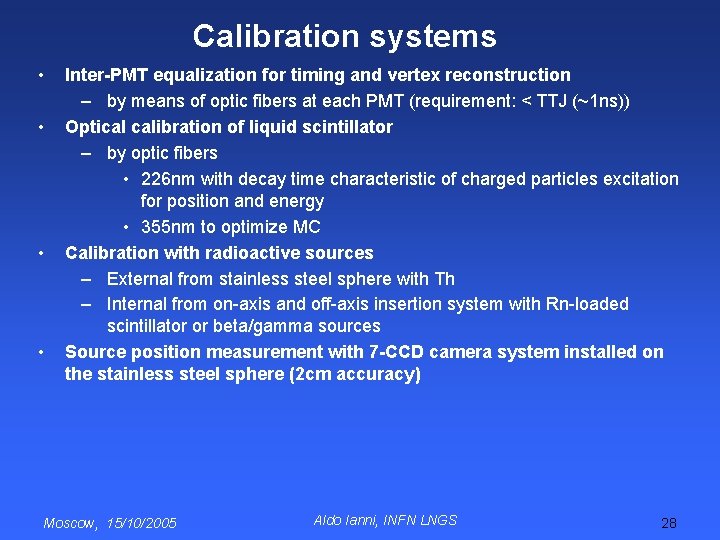
Calibration systems • • Inter-PMT equalization for timing and vertex reconstruction – by means of optic fibers at each PMT (requirement: < TTJ (~1 ns)) Optical calibration of liquid scintillator – by optic fibers • 226 nm with decay time characteristic of charged particles excitation for position and energy • 355 nm to optimize MC Calibration with radioactive sources – External from stainless steel sphere with Th – Internal from on-axis and off-axis insertion system with Rn-loaded scintillator or beta/gamma sources Source position measurement with 7 -CCD camera system installed on the stainless steel sphere (2 cm accuracy) Moscow, 15/10/2005 Aldo Ianni, INFN LNGS 28
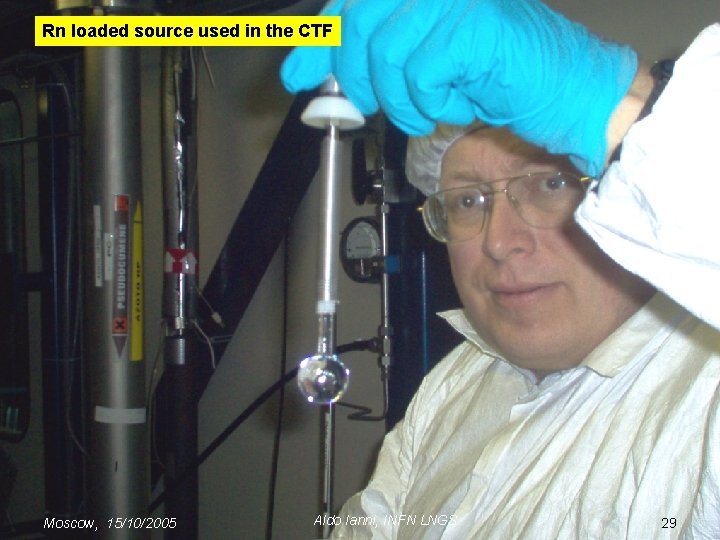
Rn loaded source used in the CTF Moscow, 15/10/2005 Aldo Ianni, INFN LNGS 29
- Slides: 29