The Enlightenment and the Industrial Revolution SCSTS 3760



- Slides: 44
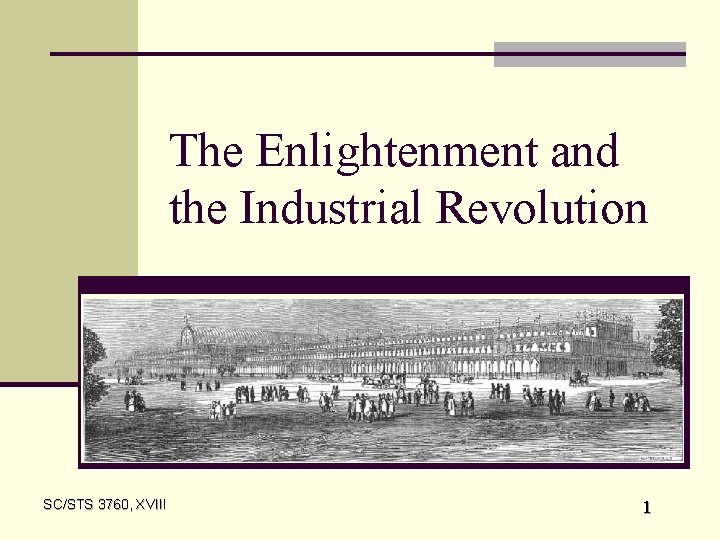
The Enlightenment and the Industrial Revolution SC/STS 3760, XVIII 1
Newtonianism n Newtonianism was the outcome of the Scientific Revolution of the 16 th and 17 th centuries. Mechanism triumphed. n Newtonian problems were swept away. n n SC/STS 3760, XVIII E. g. , universal gravitation implied action at a distance, a notion foreign to mechanism. 2
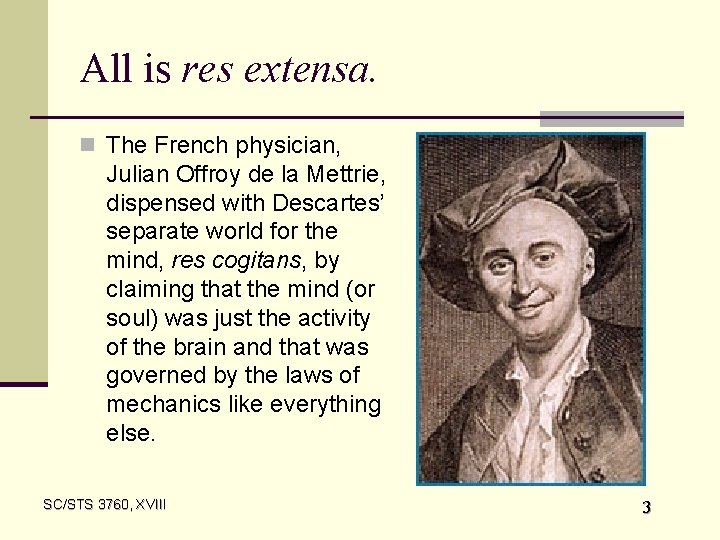
All is res extensa. n The French physician, Julian Offroy de la Mettrie, dispensed with Descartes’ separate world for the mind, res cogitans, by claiming that the mind (or soul) was just the activity of the brain and that was governed by the laws of mechanics like everything else. SC/STS 3760, XVIII 3
Man a Machine n His book, L’homme machine caused a sensation in France. n He was accused of atheism and had to flee France. n But he was just taking Newtonianism to its logical conclusion. SC/STS 3760, XVIII 4
Loose ends in Newton’s physics n Newton had found that he could not account for all the heavenly motions with his laws of physics. n Jupiter and Saturn did not move in precisely the orbits and at the speeds that Newton calculated. n Newton saw no reason that the planets should all move around the Sun in the same direction and in approximately the same plane. SC/STS 3760, XVIII 5
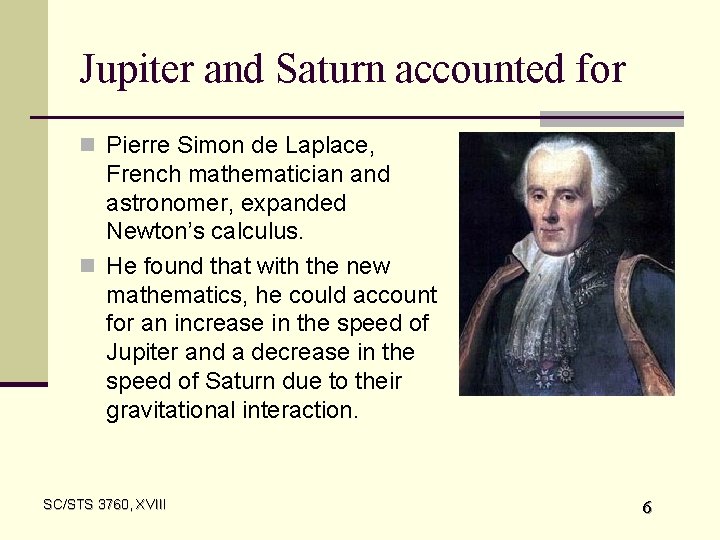
Jupiter and Saturn accounted for n Pierre Simon de Laplace, French mathematician and astronomer, expanded Newton’s calculus. n He found that with the new mathematics, he could account for an increase in the speed of Jupiter and a decrease in the speed of Saturn due to their gravitational interaction. SC/STS 3760, XVIII 6
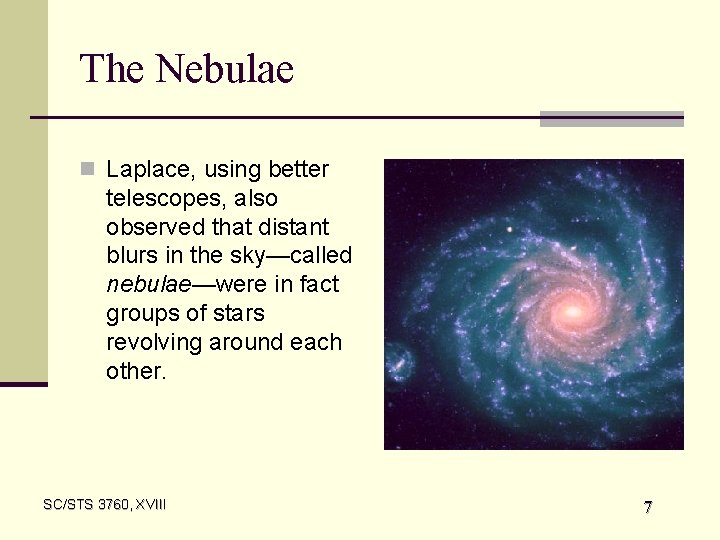
The Nebulae n Laplace, using better telescopes, also observed that distant blurs in the sky—called nebulae—were in fact groups of stars revolving around each other. SC/STS 3760, XVIII 7
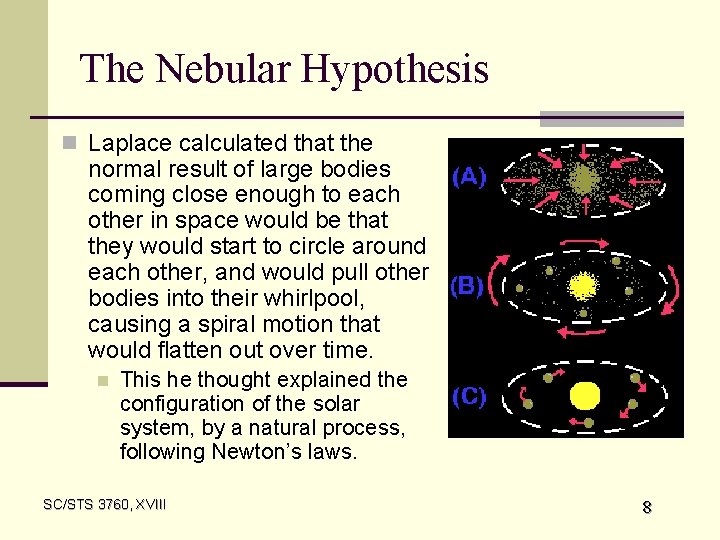
The Nebular Hypothesis n Laplace calculated that the normal result of large bodies coming close enough to each other in space would be that they would start to circle around each other, and would pull other bodies into their whirlpool, causing a spiral motion that would flatten out over time. n This he thought explained the configuration of the solar system, by a natural process, following Newton’s laws. SC/STS 3760, XVIII 8
No need for God n For Newton, wherever he saw regularity in the universe that he could not account for with his physical laws was where the hand of God was apparent, tinkering with the system. n When asked how God fit into Laplace’s understanding of the world, he announced that he had “no further need of that hypothesis. ” SC/STS 3760, XVIII 9
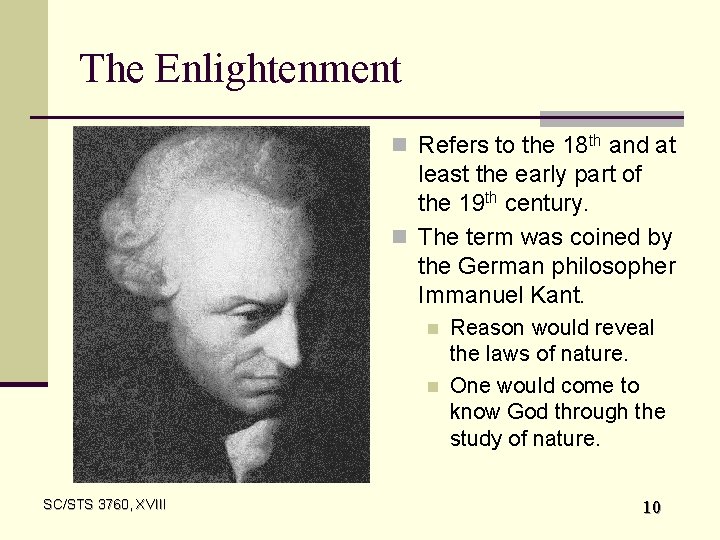
The Enlightenment n Refers to the 18 th and at least the early part of the 19 th century. n The term was coined by the German philosopher Immanuel Kant. n n SC/STS 3760, XVIII Reason would reveal the laws of nature. One would come to know God through the study of nature. 10
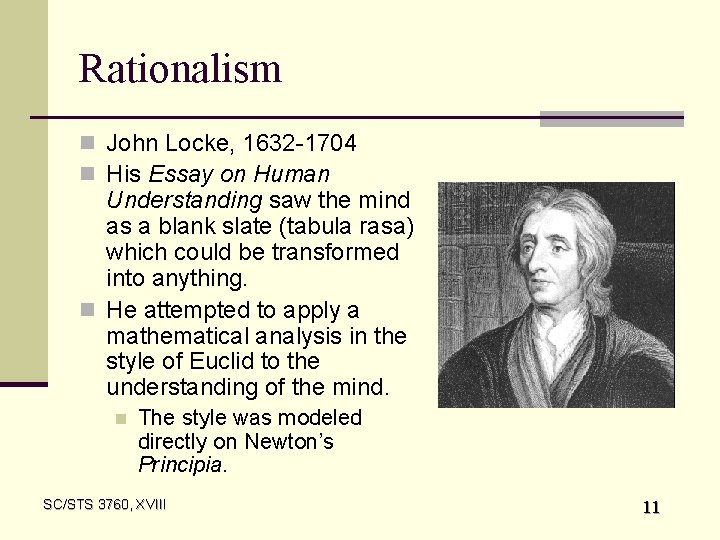
Rationalism n John Locke, 1632 -1704 n His Essay on Human Understanding saw the mind as a blank slate (tabula rasa) which could be transformed into anything. n He attempted to apply a mathematical analysis in the style of Euclid to the understanding of the mind. n The style was modeled directly on Newton’s Principia. SC/STS 3760, XVIII 11
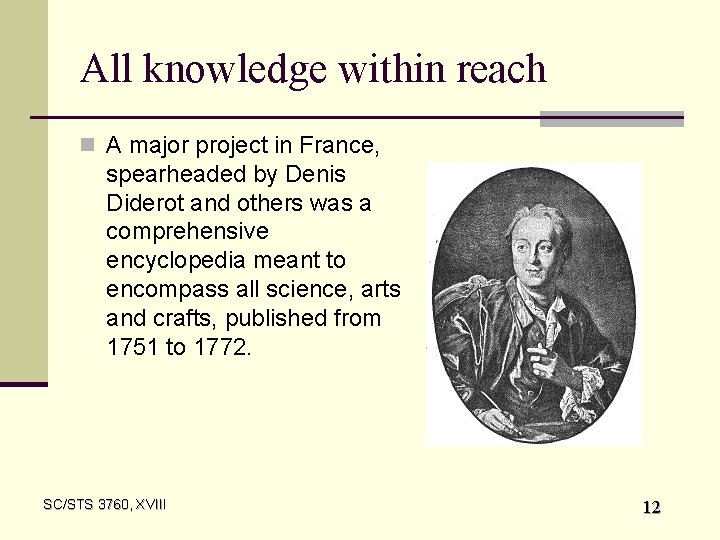
All knowledge within reach n A major project in France, spearheaded by Denis Diderot and others was a comprehensive encyclopedia meant to encompass all science, arts and crafts, published from 1751 to 1772. SC/STS 3760, XVIII 12
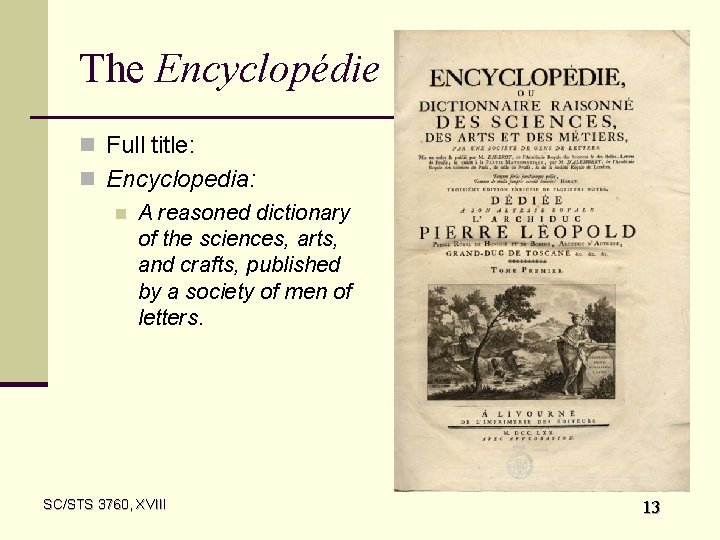
The Encyclopédie n Full title: n Encyclopedia: n A reasoned dictionary of the sciences, arts, and crafts, published by a society of men of letters. SC/STS 3760, XVIII 13
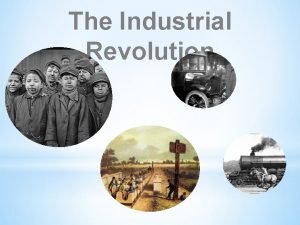
The Industrial Revolution n Not only did the Enlightenment take on the task of understanding all of nature, at the same time, Europeans began to try to control nature and make it work for them. SC/STS 3760, XVIII 14
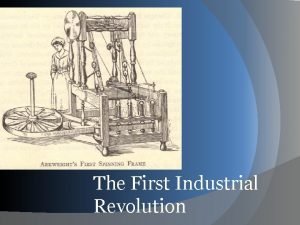
The Industrial Revolution n After the Agricultural Revolution, the Industrial Revolution has marked the biggest change in the way human beings lived their lives. n The Industrial Revolution began about the middle of the 18 th century and lasted through most of the 19 th century. n Its most significant feature is the harnessing of powers of nature far in excess of anything done before, and turning those powers to industrial tasks. SC/STS 3760, XVIII 15
The Steam Engine n The key invention of the Industrial Revolution is the steam engine. n The principles involved in the steam engine are: The expansion of steam. n The pressure of the atmosphere. n The conversion of power into other forms. n n Each will be described below. SC/STS 3760, XVIII 16
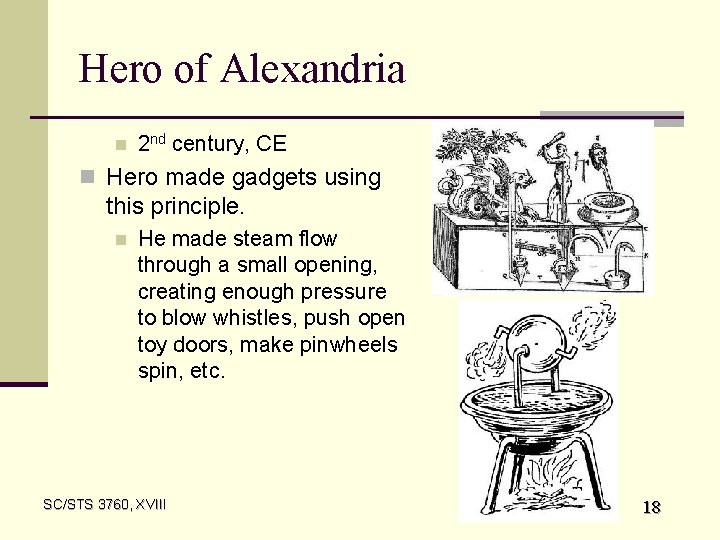
The Expansion of Steam n Water expands on boiling and exerts pressure on the walls of whatever is containing it. n Boiling water in a closed container with small opening creates a flow of pressure that can be used to cause motion. SC/STS 3760, XVIII 17
Hero of Alexandria n 2 nd century, CE n Hero made gadgets using this principle. n He made steam flow through a small opening, creating enough pressure to blow whistles, push open toy doors, make pinwheels spin, etc. SC/STS 3760, XVIII 18
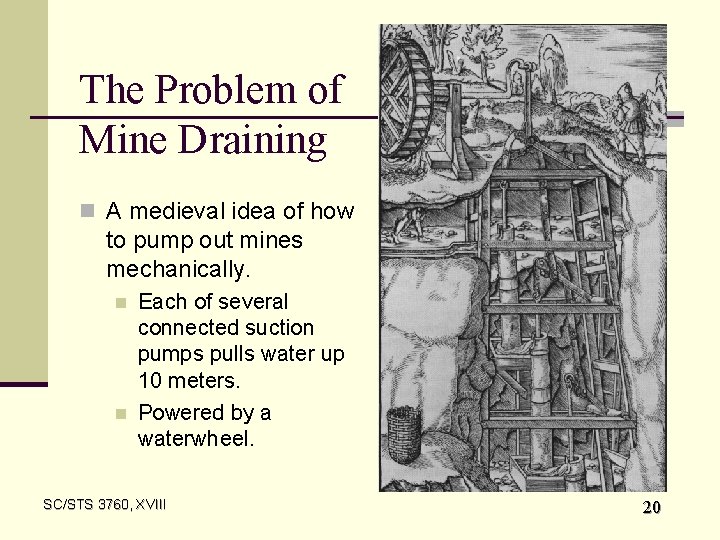
Pumping out mines n One of the bottlenecks to the advance of industry was a limitation on mining. n It is difficult to mine a deposit deep in the ground without having an adequate means to pump out the ground water that will quickly fill the mine shaft. n The easiest way to pump water is with a suction pump. n But a suction pump cannot pull more than about 10 meters. SC/STS 3760, XVIII 19
The Problem of Mine Draining n A medieval idea of how to pump out mines mechanically. n n Each of several connected suction pumps pulls water up 10 meters. Powered by a waterwheel. SC/STS 3760, XVIII 20
Atmospheric Pressure n Galileo thought that the limit of a suction pump to about 10 metres was the limit of some sort of tension in the water, like tension in a rope. n The true mechanist explanation: n Torricelli reasoned that we live at bottom of ocean of air. The air pressing on the surface of the water being pumped drives it up the suction because there is no corresponding air pushing it down there. SC/STS 3760, XVIII 21
Atmospheric Pressure, 2 n The test of the sea of air explanation: The mercury barometer. Mercury is 13 times heavier than water. A vacuum over a column of mercury should allow it to rise by about 1/13 the height that water rises. n Moreover, the mercury column should be shorter at higher elevations, e. g. on a mountain top. n n SC/STS 3760, XVIII Pascal’s experiment on Puy de Dôme mountain near Paris. 22
The power of the vacuum n Vacuum pumps: n Devices were made to evacuate air from containers. n The atmospheric pressure around an evacuated container presses very firmly against the sides of the container. n This pressure can be used to do work. SC/STS 3760, XVIII 23
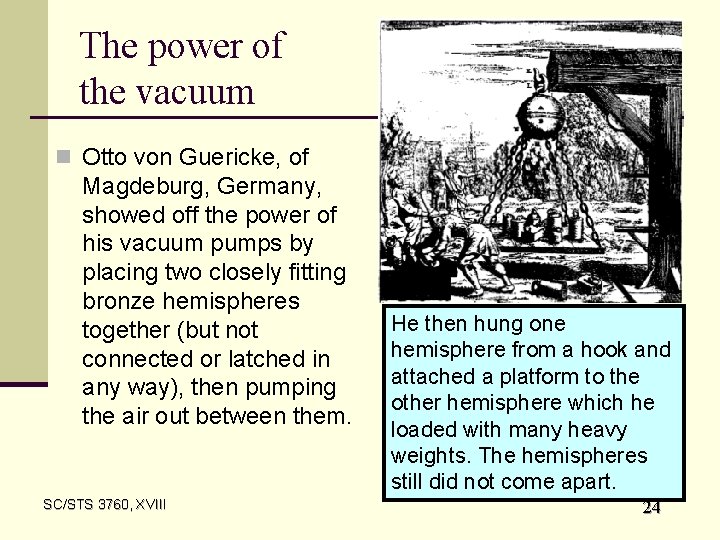
The power of the vacuum n Otto von Guericke, of Magdeburg, Germany, showed off the power of his vacuum pumps by placing two closely fitting bronze hemispheres together (but not connected or latched in any way), then pumping the air out between them. SC/STS 3760, XVIII He then hung one hemisphere from a hook and attached a platform to the other hemisphere which he loaded with many heavy weights. The hemispheres still did not come apart. 24
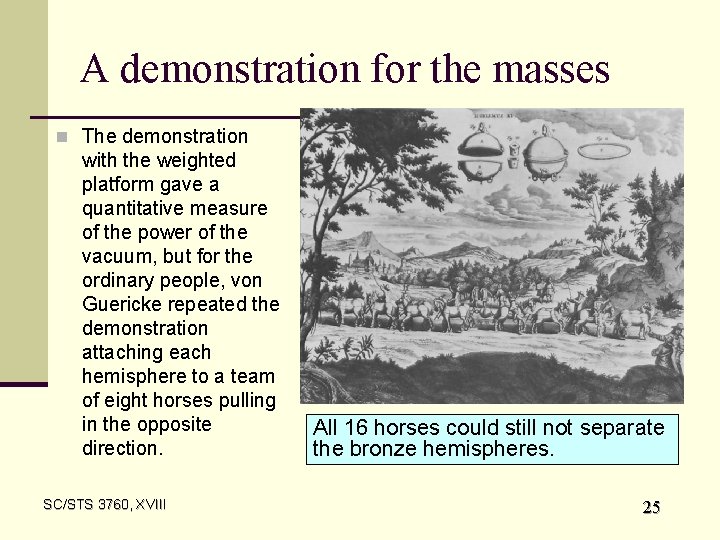
A demonstration for the masses n The demonstration with the weighted platform gave a quantitative measure of the power of the vacuum, but for the ordinary people, von Guericke repeated the demonstration attaching each hemisphere to a team of eight horses pulling in the opposite direction. SC/STS 3760, XVIII All 16 horses could still not separate the bronze hemispheres. 25
Using steam to make a vacuum n The discovery of the power of atmospheric pressure that could be applied against a vacuum led inventive minds to try to find a way to harness it. n The chief problem was to find a practical way to create a vacuum. n Air evacuation pumps were too slow and cumbersome. n Solution: Use steam to fill a space. Then condense it. SC/STS 3760, XVIII 26
Condensing steam, leaving a vacuum n A small amount of water, when boiled, makes a very large amount of steam. n Steam can be let into a container to fill it, driving out the air. n The container, which is then sealed, contains nothing but steam. n Let the steam cool and it will condense back into the small amount of water, leaving a vacuum in the rest of the container. SC/STS 3760, XVIII 27
Letting atmospheric pressure do the work n The container, then empty of everything except a very small amount of water, has all of the weight of the atmosphere pressing on it on all sides. n If the container is fitted with a moving valve, the atmospheric pressure will push the valve with quite a force. SC/STS 3760, XVIII 28
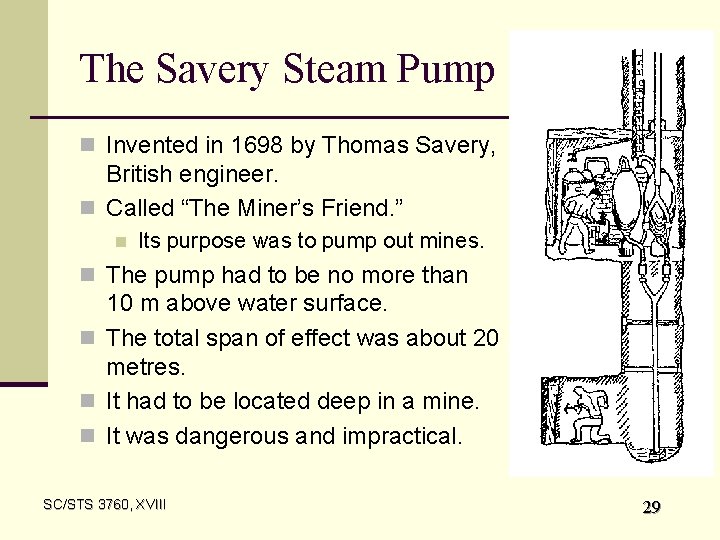
The Savery Steam Pump n Invented in 1698 by Thomas Savery, British engineer. n Called “The Miner’s Friend. ” n Its purpose was to pump out mines. n The pump had to be no more than 10 m above water surface. n The total span of effect was about 20 metres. n It had to be located deep in a mine. n It was dangerous and impractical. SC/STS 3760, XVIII 29
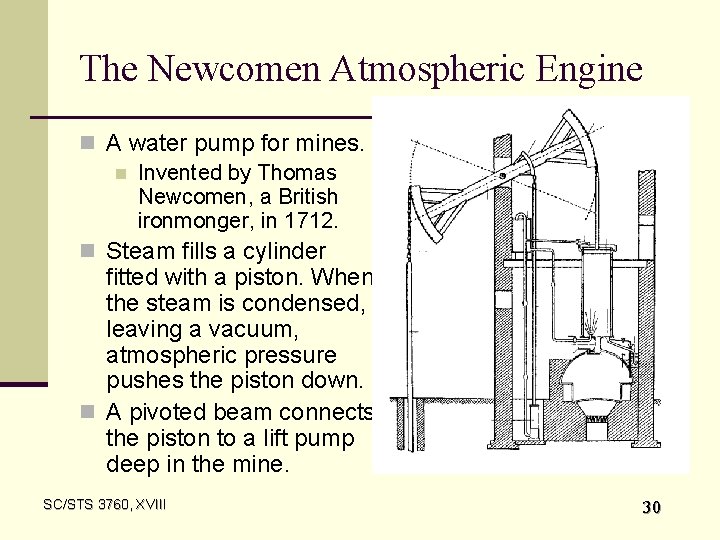
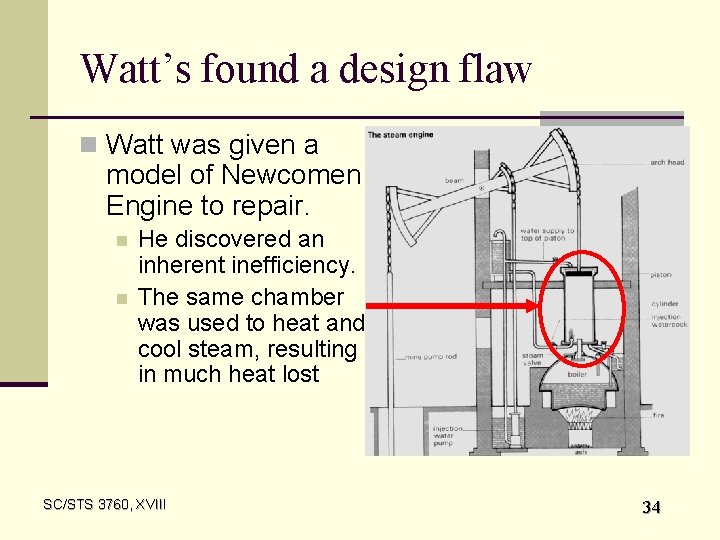
The Newcomen Atmospheric Engine n A water pump for mines. n Invented by Thomas Newcomen, a British ironmonger, in 1712. n Steam fills a cylinder fitted with a piston. When the steam is condensed, leaving a vacuum, atmospheric pressure pushes the piston down. n A pivoted beam connects the piston to a lift pump deep in the mine. SC/STS 3760, XVIII 30
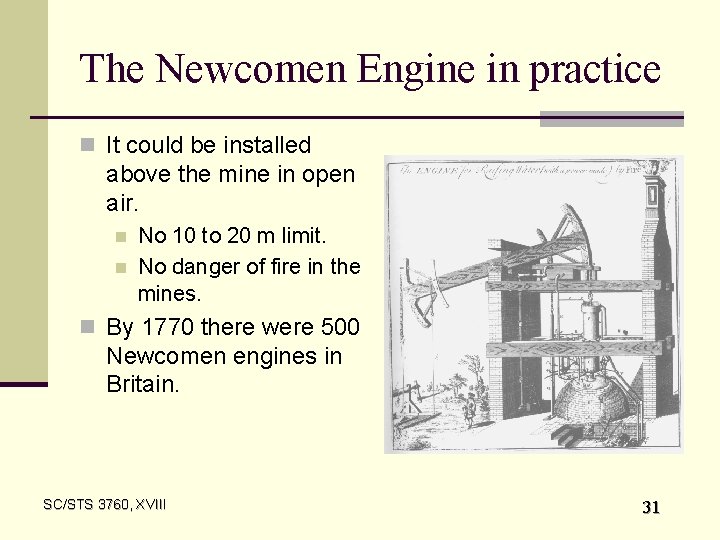
The Newcomen Engine in practice n It could be installed above the mine in open air. n n No 10 to 20 m limit. No danger of fire in the mines. n By 1770 there were 500 Newcomen engines in Britain. SC/STS 3760, XVIII 31
The drawbacks of the Newcomen Engine. n Its mechanical efficiency was less than 1%. n The action remained jerky and suitable only as a pump. n It was practical only as a very large machine where fuel was cheap. SC/STS 3760, XVIII 32
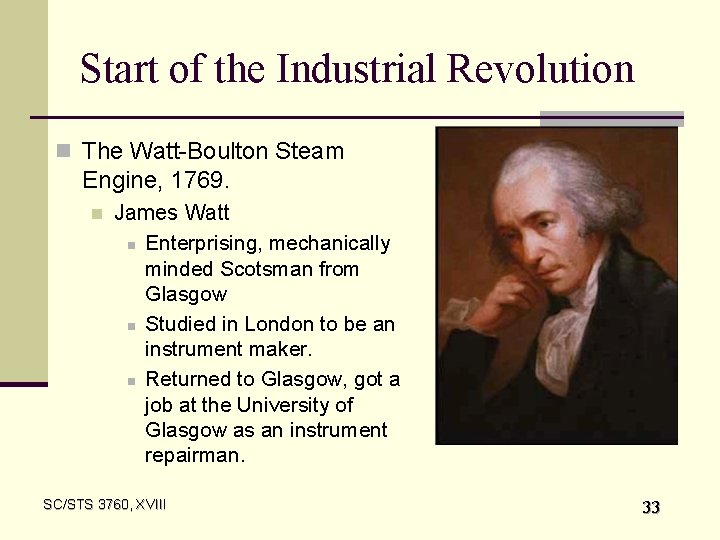
Start of the Industrial Revolution n The Watt-Boulton Steam Engine, 1769. n James Watt n Enterprising, mechanically minded Scotsman from Glasgow n Studied in London to be an instrument maker. n Returned to Glasgow, got a job at the University of Glasgow as an instrument repairman. SC/STS 3760, XVIII 33
Watt’s found a design flaw n Watt was given a model of Newcomen Engine to repair. n n He discovered an inherent inefficiency. The same chamber was used to heat and cool steam, resulting in much heat lost SC/STS 3760, XVIII 34
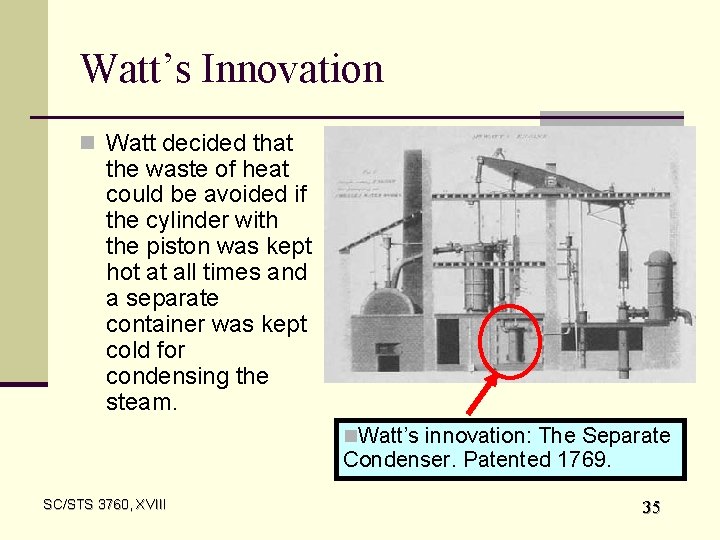
Watt’s Innovation n Watt decided that the waste of heat could be avoided if the cylinder with the piston was kept hot at all times and a separate container was kept cold for condensing the steam. n. Watt’s innovation: The Separate Condenser. Patented 1769. SC/STS 3760, XVIII 35
Watt meets Boulton n Matthew Boulton, Entrepreneur and James Watt, Inventor Together they set up a factory in Birmingham to manufacture steam engines “for the whole world. ” n The Watt-Boulton Engine was 4 times more efficient than the Newcomen Engine. n It was leased to miners for 1/3 of their fuel savings over their Newcomen Engine. n SC/STS 3760, XVIII 36
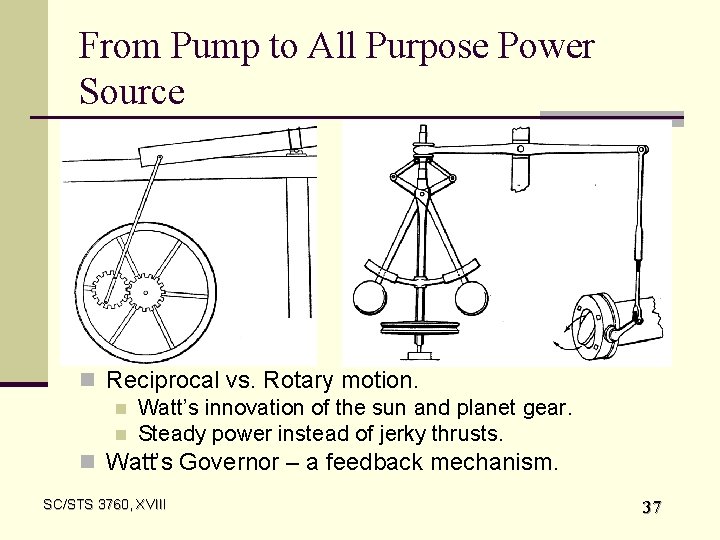
From Pump to All Purpose Power Source n Reciprocal vs. Rotary motion. n Watt’s innovation of the sun and planet gear. n Steady power instead of jerky thrusts. n Watt’s Governor – a feedback mechanism. SC/STS 3760, XVIII 37
The Engine of the Industrial Revolution n Other improvements made it run more smoothly and reliably. n n Fuel feedback mechanism. Parallelogram motion. Automatic on/off valves. Fly wheel. n Result: n A machine that had more power than anything imaginable and could be used for any task requiring continuous motion. n Large scale: implied large factories, 24 hour operation. SC/STS 3760, XVIII 38
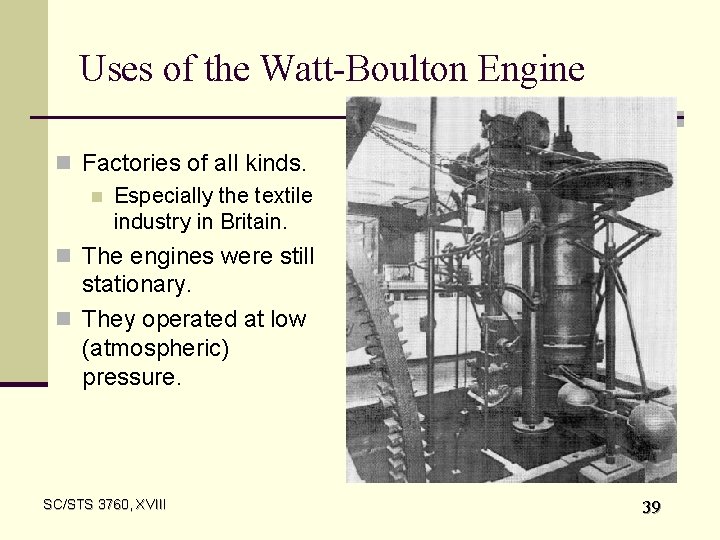
Uses of the Watt-Boulton Engine n Factories of all kinds. n Especially the textile industry in Britain. n The engines were still stationary. n They operated at low (atmospheric) pressure. SC/STS 3760, XVIII 39
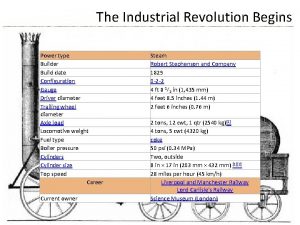
High Pressure Steam n Watt-Boulton patent expired 1800. n High Pressure engines were quick to appear on the market. n n These used the principle of the push of the steam on the piston instead of the weight of the atmosphere. They were smaller and more efficient. n The steam engine expanded its use from running factories and other stationary power needs to providing mobile power for transportation. SC/STS 3760, XVIII 40
The Railroad n High pressure steam engines were portable. This very quickly suggested their use in transportation. n The railroad was a solution to the land transportation problem given the lack of roads and heavy vehicles that would sink in a road anyway: SC/STS 3760, XVIII 41
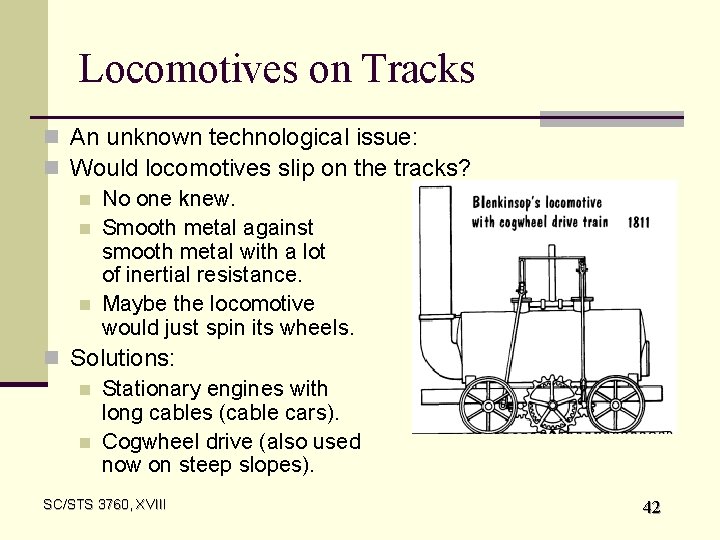
Locomotives on Tracks n An unknown technological issue: n Would locomotives slip on the tracks? n No one knew. n Smooth metal against smooth metal with a lot of inertial resistance. n Maybe the locomotive would just spin its wheels. n Solutions: n Stationary engines with long cables (cable cars). n Cogwheel drive (also used now on steep slopes). SC/STS 3760, XVIII 42
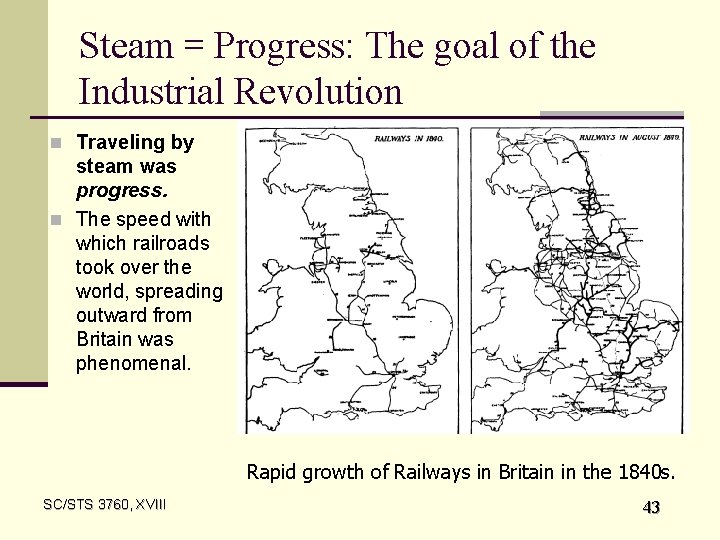
Steam = Progress: The goal of the Industrial Revolution n Traveling by steam was progress. n The speed with which railroads took over the world, spreading outward from Britain was phenomenal. Rapid growth of Railways in Britain in the 1840 s. SC/STS 3760, XVIII 43
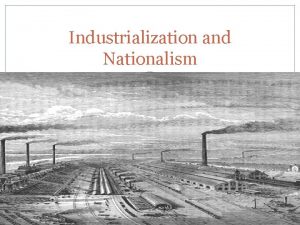
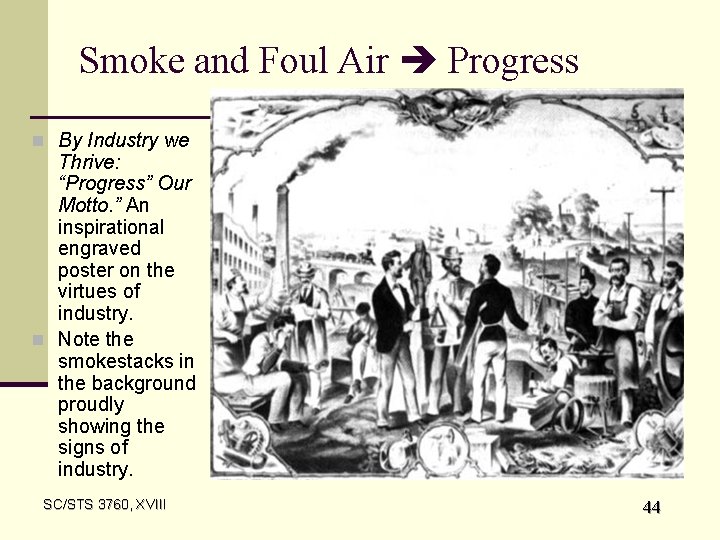
Smoke and Foul Air Progress n By Industry we Thrive: “Progress” Our Motto. ” An inspirational engraved poster on the virtues of industry. n Note the smokestacks in the background proudly showing the signs of industry. SC/STS 3760, XVIII 44