The Dual Receiver Cryptosystem and its Applications Presented











- Slides: 25
The Dual Receiver Cryptosystem and its Applications Presented by Brijesh Shetty
Overview o o Dual Receiver Cryptosystem – Concept Interesting Applications Ø Ø Combined Cryptosystem Useful Puzzle Solving
Dual Receiver Cryptosystem o o o Encryption Scheme Ciphertext can be decrypted by two independent receivers! Bilinear Diffie Hellman Assumption (based on elliptic curves)
Elliptic Curve based Discrete Log problem o q q Given Y = k. P and Y, P (i. e P added to itself k times) Find k ? ? (P, P)--- g (Y, P)--- h By definition of Bilinear Curve, we get k=gk (Y, P)=(k. P, P)=(P, P) h = gk [since (a. P, b. Q)=(P, Q)ab]
“ Key Escrow ” o o (in the context of Dual receiver) An arrangement where keys needed to decrypt encrypted data must be held in escrow by a third party. Eg. Govt. agencies can use it to decrypt messages which they suspect to be relevant to national security.
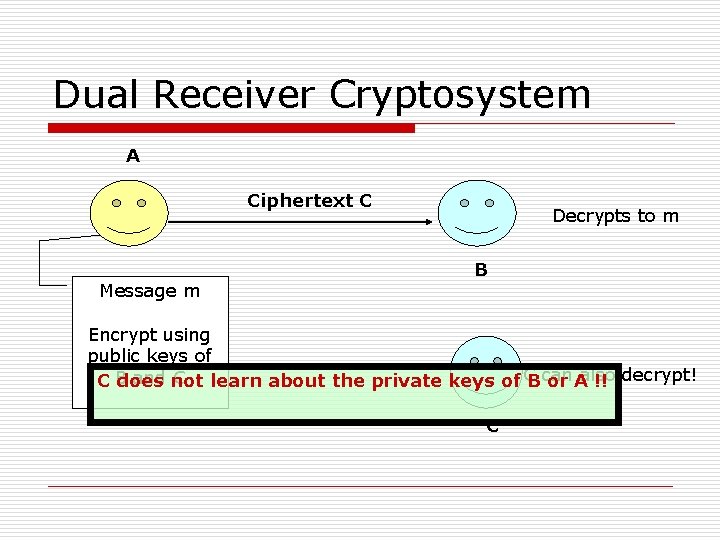
Dual Receiver Cryptosystem A Ciphertext C Message m Decrypts to m B Encrypt using public keys of and not C learn about the private keys of CB can CB does or Aalso !! decrypt! C
Dual Receiver Cryptosystem - The Scheme o o Some Definitions (Semantically secure) Dual Receiver Cryptosystem scheme
Definitions o o (Randomised algorithms) Key Generation algorithm K(k) = (e, d) & (f, g) Encryption algorithm E e, f (m) = c
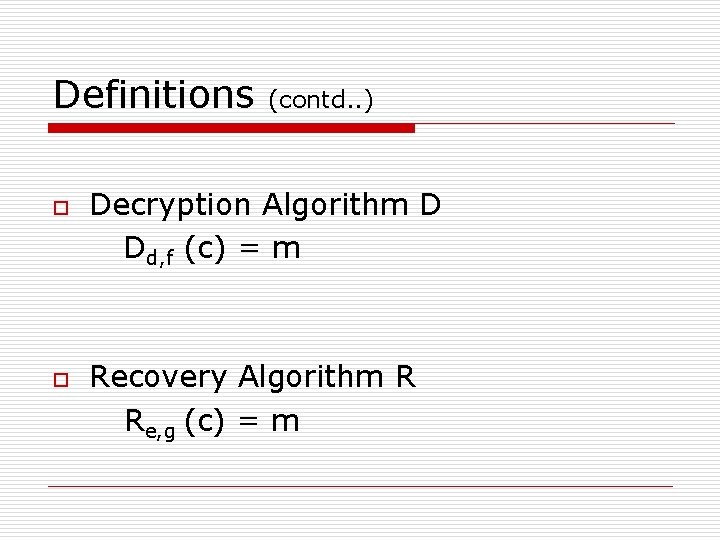
Definitions o o (contd. . ) Decryption Algorithm D Dd, f (c) = m Recovery Algorithm R Re, g (c) = m
Dual Receiver Cryptosystem - The Scheme þ o Some Definitions (Semantically secure) Dual Receiver Cryptosystem scheme
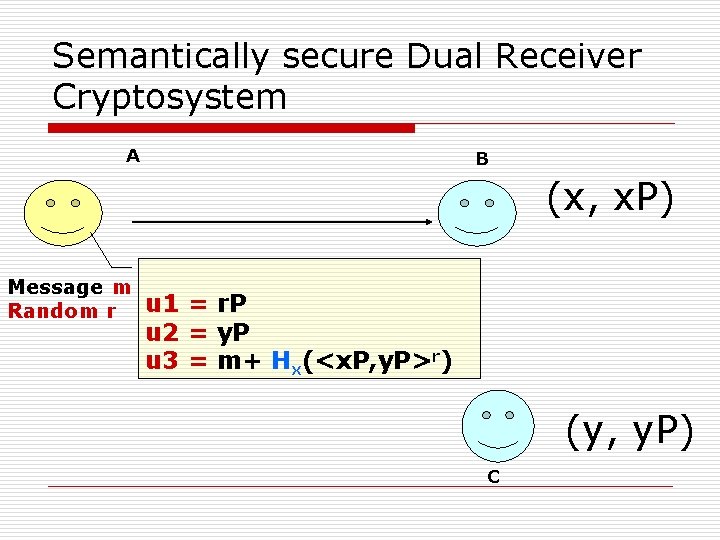
Semantically secure Dual Receiver Cryptosystem A (x, x. P) Message m Random r (u 1, u 2, u 3) B private (y, y. P) C Hx is a hash fn associated with public key x. P
Semantically secure Dual Receiver Cryptosystem A B (x, x. P) Message m Random r u 1 = r. P u 2 = y. P u 3 = m+ Hx(<x. P, y. P>r) (y, y. P) C
Decryption <u 1, u 2>x = <r. P, y. P>x = <x. P, y. P>r = <P, P>xyr U 3 + Hx(<x. P, y. P>r) = B m
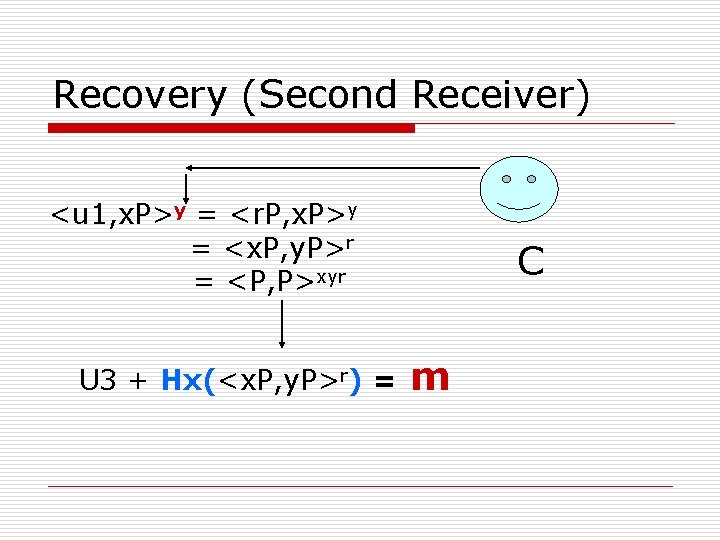
Recovery (Second Receiver) <u 1, x. P>y = <r. P, x. P>y = <x. P, y. P>r = <P, P>xyr U 3 + Hx(<x. P, y. P>r) = C m
Dual Receiver Cryptosystem - The Scheme þ þ Some Definitions (Semantically secure) Dual Receiver Cryptosystem scheme
Overview þ o Dual Receiver Cryptosystem – Concept Interesting Applications Ø Ø Combined Cryptosystem Useful Puzzle Solving
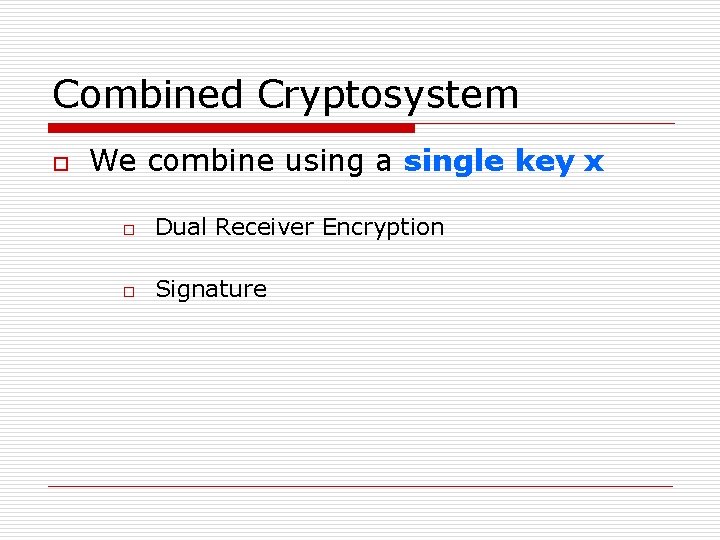
Combined Cryptosystem o We combine using a single key x o Dual Receiver Encryption o Signature
Signature (in Combined scheme) o Same key x. Hash I: {0, 1}n -> G 1 Sign the hash A Message m σ = x. I(m) B
Verification. . B has m, σ <P, σ B Verify > = <x. P, I(m)> If they are same both must be equal <P, I(m)>x
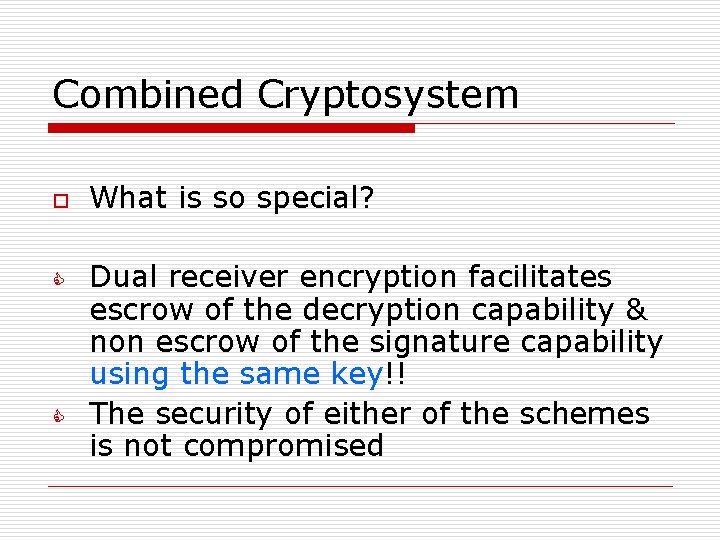
Combined Cryptosystem o C C What is so special? Dual receiver encryption facilitates escrow of the decryption capability & non escrow of the signature capability using the same key!! The security of either of the schemes is not compromised
Overview þ o Dual Receiver Cryptosystem – Concept Interesting Applications ü Ø Combined Cryptosystem Useful Security Puzzles
Useful Security Puzzles o Application Areas n n o When Server wants to rate-limit the clients (against DOS attacks) Lighten the server’s computational burden Example : File Server
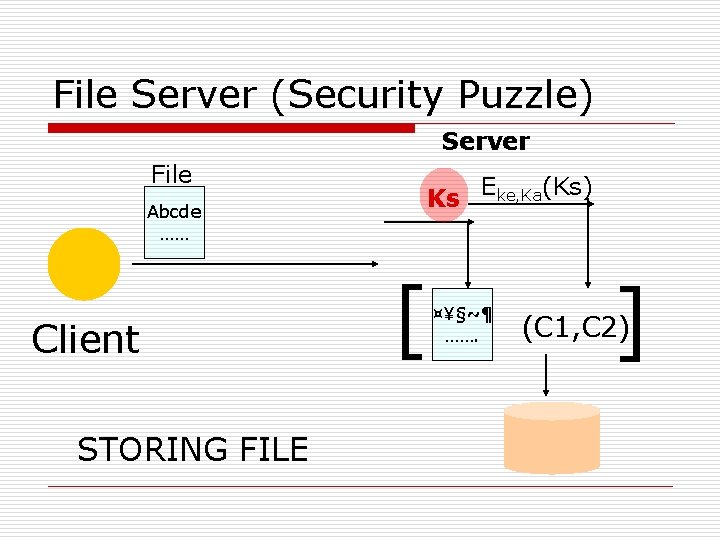
File Server (Security Puzzle) Server File Abcde …… Client STORING FILE Ks Eke, Ka(Ks) [ ¤¥§~¶ ……. ] (C 1, C 2)
File Server … (Request File) [ ] ¤¥§~¶ Decryption. . (C 1, C 2) ……. Computation intensive Dual Receiver Encrytpion G, F are hashes XOR and hash Client Compute DPa, Ke(C 1) C 1, Pa TD 1 Random p C 1 = Eke, Ka(p) u 1 = Ks+ G(p) u 2 = F(p, Ks, C 1, u 1) C 2 = [u 1, u 2] G(TD 1)+u 1 = m Check u 2=F(p, m, c, u 1)
Thank you