IV 054 CHAPTER 4 Classical secretkey cryptosystems In
- Slides: 47
IV 054 CHAPTER 4: Classical (secret-key) cryptosystems • In this chapter we deal with some of the very old or quite old cryptosystems that were primarily used in the pre-computer era. • These cryptosystems are too weak nowadays, too easy to break, especially with computers. • However, these simple cryptosystems give a good illustration of several of the important ideas of the cryptography and cryptanalysis’s. Classical (secret-key) cryptosystems 1
IV 054 Cryptology, Cryptosystems - secret-key cryptography Cryptology (= cryptography + cryptoanalysis) has more than two thousand years of history. Basic historical observation • People have always had fascination with keeping information away from others. • Some people – rulers, diplomats, militaries, businessmen – have always had needs to keep some information away from others. Importance of cryptography nowadays • Applications: cryptography is the key tool to make modern information transmission secure, and to create secure information society. • Foundations: cryptography gave rise to several new key concepts of the foundation of informatics: one-way functions, computationally perfect pseudorandom generators, zero-knowledge proofs, holographic proofs, program self-testing and self-correcting, … Classical (secret-key) cryptosystems 2
IV 054 Approaches and paradoxes of cryptography Sound approaches to cryptography • Shannon’s approach based on information theory • Current approach based on complexity theory • Very recent approach based on the laws and limitations of quantum physics Paradoxes of modern cryptography • Positive results of modern cryptography are based on negative results of complexity theory. • Computers that were designed originally for decryption seem to be now more useful for encryption. Classical (secret-key) cryptosystems 3
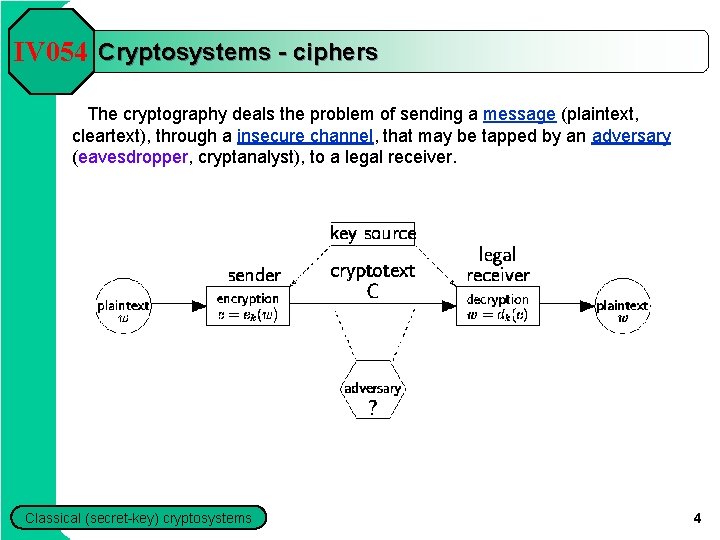
IV 054 Cryptosystems - ciphers The cryptography deals the problem of sending a message (plaintext, cleartext), through a insecure channel, that may be tapped by an adversary (eavesdropper, cryptanalyst), to a legal receiver. Classical (secret-key) cryptosystems 4
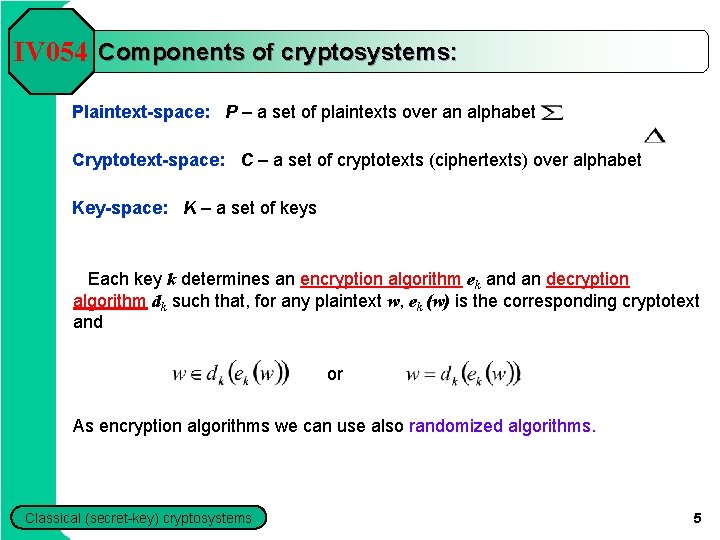
IV 054 Components of cryptosystems: Plaintext-space: P – a set of plaintexts over an alphabet Cryptotext-space: C – a set of cryptotexts (ciphertexts) over alphabet Key-space: K – a set of keys Each key k determines an encryption algorithm ek and an decryption algorithm dk such that, for any plaintext w, ek (w) is the corresponding cryptotext and or As encryption algorithms we can use also randomized algorithms. Classical (secret-key) cryptosystems 5
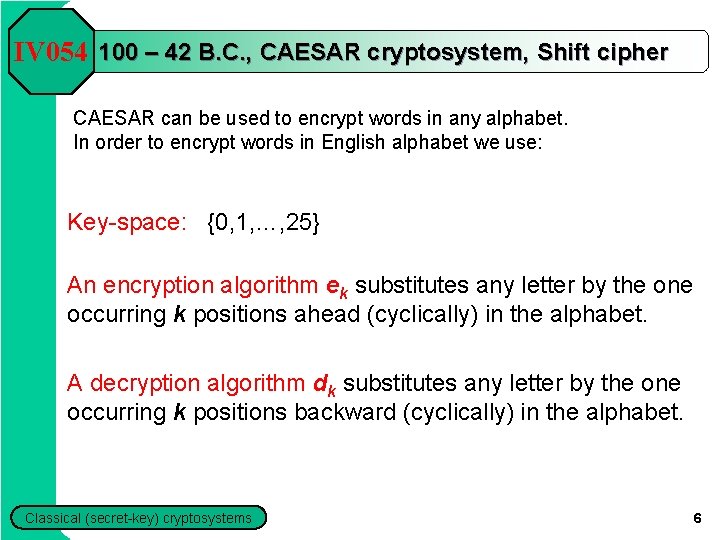
IV 054 100 – 42 B. C. , CAESAR cryptosystem, Shift cipher CAESAR can be used to encrypt words in any alphabet. In order to encrypt words in English alphabet we use: Key-space: {0, 1, …, 25} An encryption algorithm ek substitutes any letter by the one occurring k positions ahead (cyclically) in the alphabet. A decryption algorithm dk substitutes any letter by the one occurring k positions backward (cyclically) in the alphabet. Classical (secret-key) cryptosystems 6
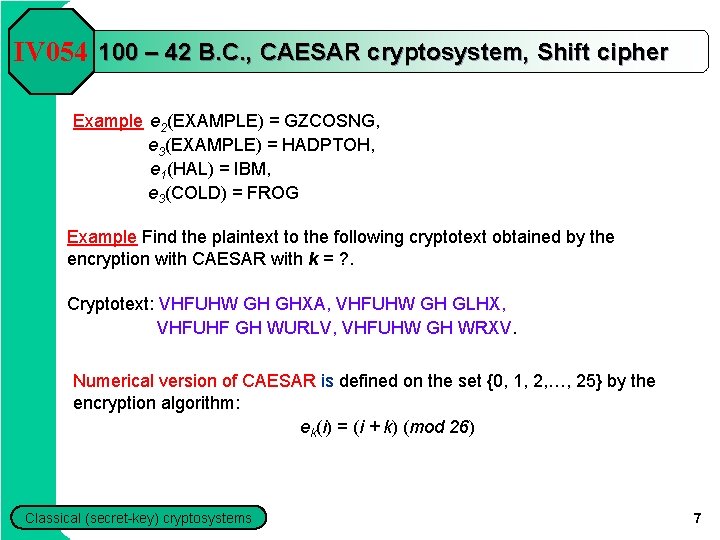
IV 054 100 – 42 B. C. , CAESAR cryptosystem, Shift cipher Example e 2(EXAMPLE) = GZCOSNG, e 3(EXAMPLE) = HADPTOH, e 1(HAL) = IBM, e 3(COLD) = FROG Example Find the plaintext to the following cryptotext obtained by the encryption with CAESAR with k = ? . Cryptotext: VHFUHW GH GHXA, VHFUHW GH GLHX, VHFUHF GH WURLV, VHFUHW GH WRXV. Numerical version of CAESAR is defined on the set {0, 1, 2, …, 25} by the encryption algorithm: ek(i) = (i + k) (mod 26) Classical (secret-key) cryptosystems 7
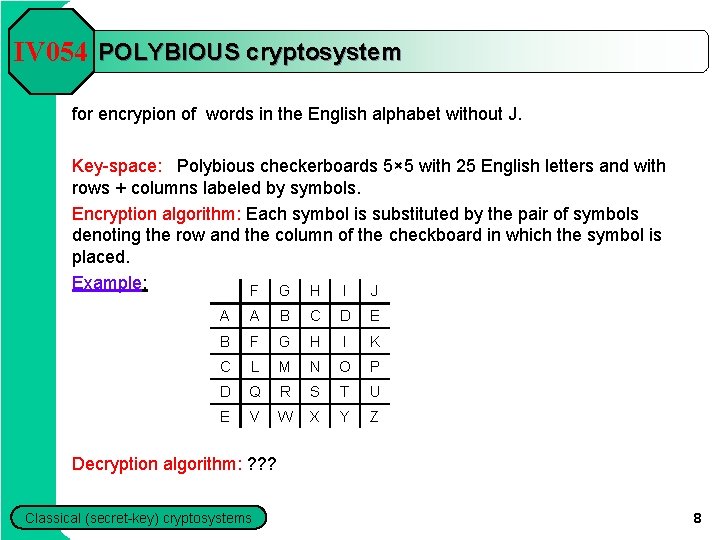
IV 054 POLYBIOUS cryptosystem for encrypion of words in the English alphabet without J. Key-space: Polybious checkerboards 5× 5 with 25 English letters and with rows + columns labeled by symbols. Encryption algorithm: Each symbol is substituted by the pair of symbols denoting the row and the column of the checkboard in which the symbol is placed. Example: F G H I J A A B C D E B F G H I K C L M N O P D Q R S T U E V W X Y Z Decryption algorithm: ? ? ? Classical (secret-key) cryptosystems 8
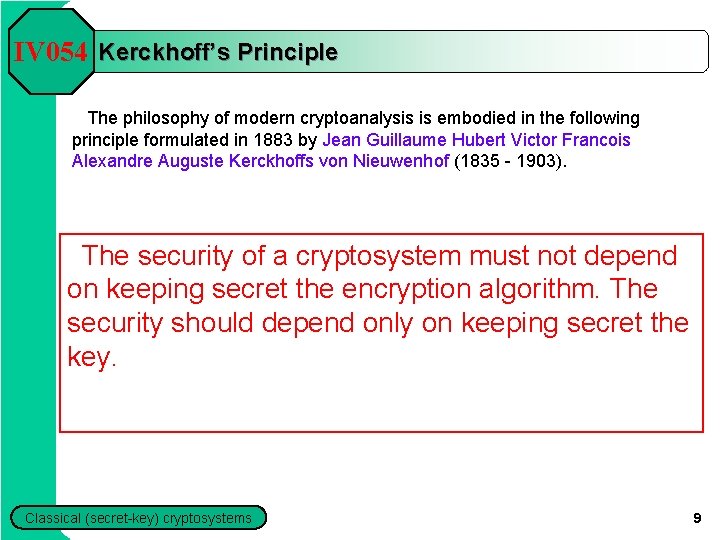
IV 054 Kerckhoff’s Principle The philosophy of modern cryptoanalysis is embodied in the following principle formulated in 1883 by Jean Guillaume Hubert Victor Francois Alexandre Auguste Kerckhoffs von Nieuwenhof (1835 - 1903). The security of a cryptosystem must not depend on keeping secret the encryption algorithm. The security should depend only on keeping secret the key. Classical (secret-key) cryptosystems 9
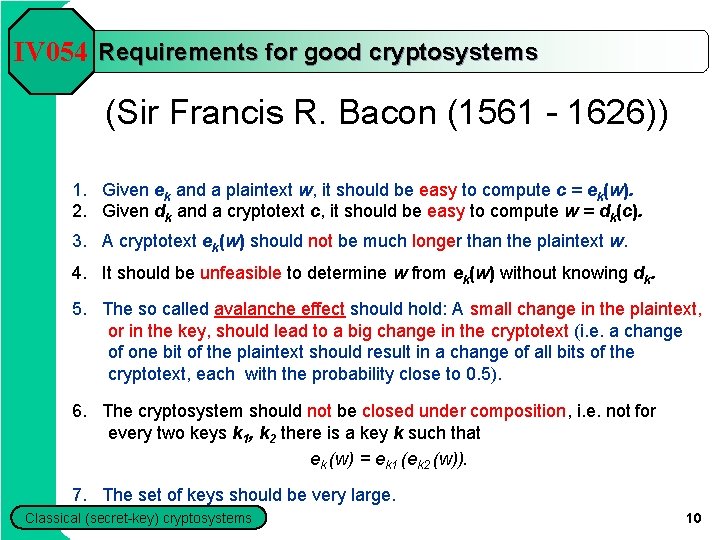
IV 054 Requirements for good cryptosystems (Sir Francis R. Bacon (1561 - 1626)) 1. Given ek and a plaintext w, it should be easy to compute c = ek(w). 2. Given dk and a cryptotext c, it should be easy to compute w = dk(c). 3. A cryptotext ek(w) should not be much longer than the plaintext w. 4. It should be unfeasible to determine w from ek(w) without knowing dk. 5. The so called avalanche effect should hold: A small change in the plaintext, or in the key, should lead to a big change in the cryptotext (i. e. a change of one bit of the plaintext should result in a change of all bits of the cryptotext, each with the probability close to 0. 5). 6. The cryptosystem should not be closed under composition, i. e. not for every two keys k 1, k 2 there is a key k such that ek (w) = ek 1 (ek 2 (w)). 7. The set of keys should be very large. Classical (secret-key) cryptosystems 10
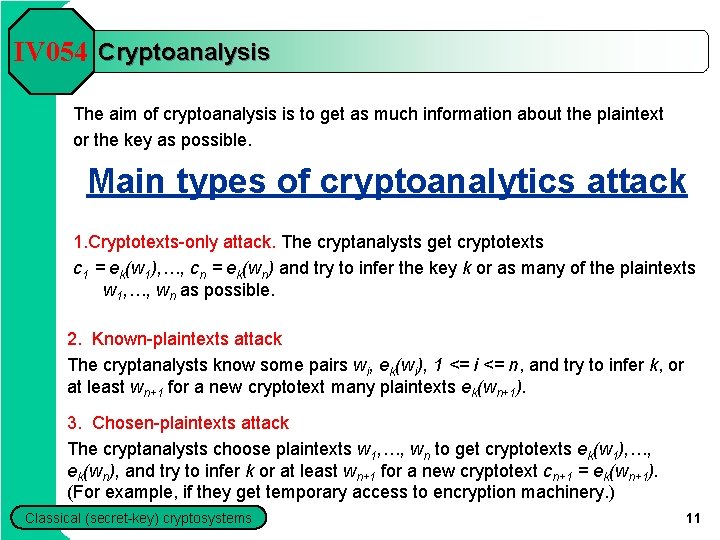
IV 054 Cryptoanalysis The aim of cryptoanalysis is to get as much information about the plaintext or the key as possible. Main types of cryptoanalytics attack 1. Cryptotexts-only attack. The cryptanalysts get cryptotexts c 1 = ek(w 1), …, cn = ek(wn) and try to infer the key k or as many of the plaintexts w 1, …, wn as possible. 2. Known-plaintexts attack The cryptanalysts know some pairs wi, ek(wi), 1 <= i <= n, and try to infer k, or at least wn+1 for a new cryptotext many plaintexts ek(wn+1). 3. Chosen-plaintexts attack The cryptanalysts choose plaintexts w 1, …, wn to get cryptotexts ek(w 1), …, ek(wn), and try to infer k or at least wn+1 for a new cryptotext cn+1 = ek(wn+1). (For example, if they get temporary access to encryption machinery. ) Classical (secret-key) cryptosystems 11
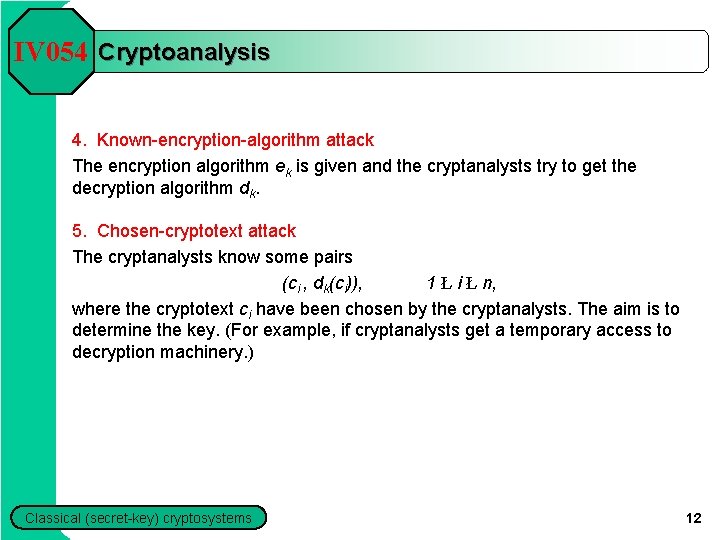
IV 054 Cryptoanalysis 4. Known-encryption-algorithm attack The encryption algorithm ek is given and the cryptanalysts try to get the decryption algorithm dk. 5. Chosen-cryptotext attack The cryptanalysts know some pairs (ci , dk(ci)), 1 Ł i Ł n, where the cryptotext ci have been chosen by the cryptanalysts. The aim is to determine the key. (For example, if cryptanalysts get a temporary access to decryption machinery. ) Classical (secret-key) cryptosystems 12
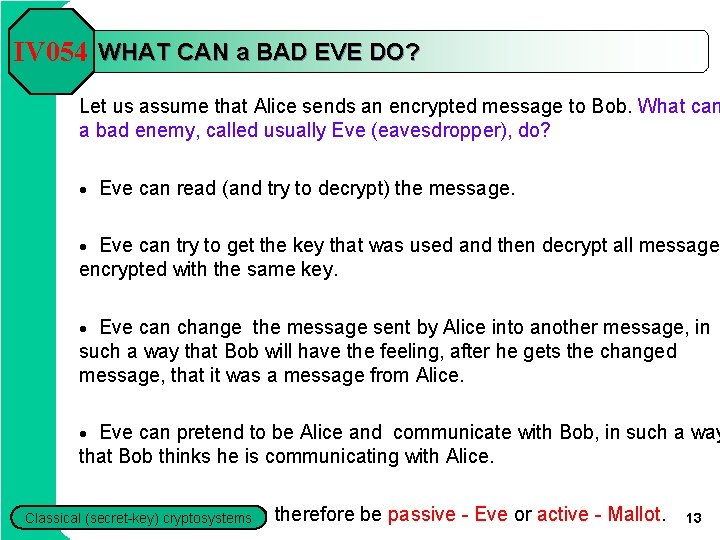
IV 054 WHAT CAN a BAD EVE DO? Let us assume that Alice sends an encrypted message to Bob. What can a bad enemy, called usually Eve (eavesdropper), do? · Eve can read (and try to decrypt) the message. · Eve can try to get the key that was used and then decrypt all messages encrypted with the same key. · Eve can change the message sent by Alice into another message, in such a way that Bob will have the feeling, after he gets the changed message, that it was a message from Alice. · Eve can pretend to be Alice and communicate with Bob, in such a way that Bob thinks he is communicating with Alice. eavesdropper can Classical. An (secret-key) cryptosystems therefore be passive - Eve or active - Mallot. 13
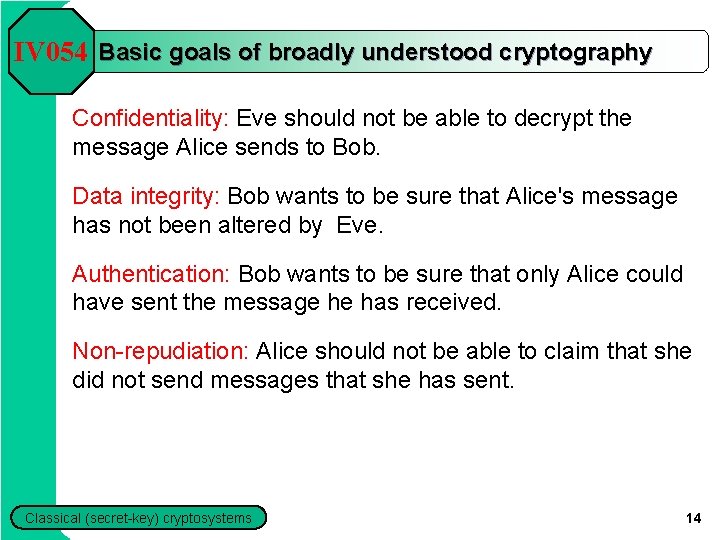
IV 054 Basic goals of broadly understood cryptography Confidentiality: Eve should not be able to decrypt the message Alice sends to Bob. Data integrity: Bob wants to be sure that Alice's message has not been altered by Eve. Authentication: Bob wants to be sure that only Alice could have sent the message he has received. Non-repudiation: Alice should not be able to claim that she did not send messages that she has sent. Classical (secret-key) cryptosystems 14
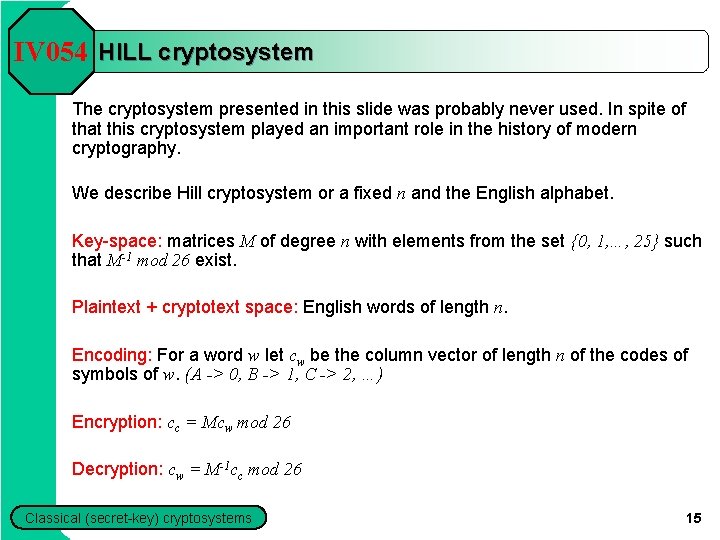
IV 054 HILL cryptosystem The cryptosystem presented in this slide was probably never used. In spite of that this cryptosystem played an important role in the history of modern cryptography. We describe Hill cryptosystem or a fixed n and the English alphabet. Key-space: matrices M of degree n with elements from the set {0, 1, …, 25} such that M-1 mod 26 exist. Plaintext + cryptotext space: English words of length n. Encoding: For a word w let cw be the column vector of length n of the codes of symbols of w. (A -> 0, B -> 1, C -> 2, …) Encryption: cc = Mcw mod 26 Decryption: cw = M-1 cc mod 26 Classical (secret-key) cryptosystems 15
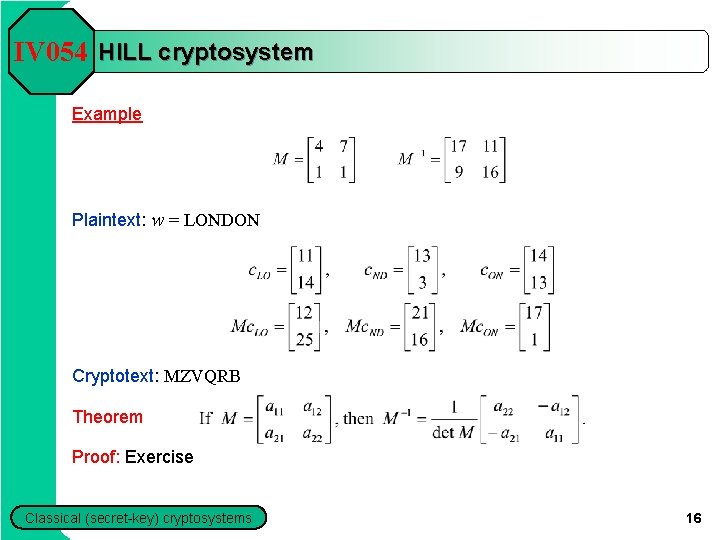
IV 054 HILL cryptosystem Example Plaintext: w = LONDON Cryptotext: MZVQRB Theorem Proof: Exercise Classical (secret-key) cryptosystems 16
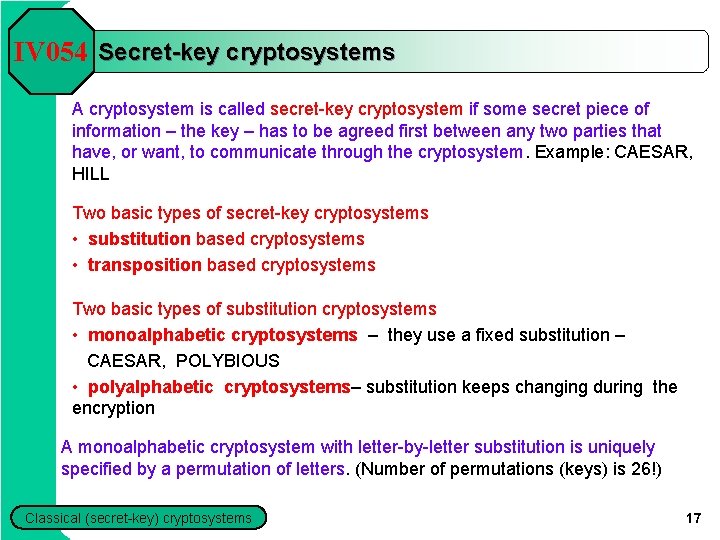
IV 054 Secret-key cryptosystems A cryptosystem is called secret-key cryptosystem if some secret piece of information – the key – has to be agreed first between any two parties that have, or want, to communicate through the cryptosystem. Example: CAESAR, HILL Two basic types of secret-key cryptosystems • substitution based cryptosystems • transposition based cryptosystems Two basic types of substitution cryptosystems • monoalphabetic cryptosystems – they use a fixed substitution – CAESAR, POLYBIOUS • polyalphabetic cryptosystems– substitution keeps changing during the encryption A monoalphabetic cryptosystem with letter-by-letter substitution is uniquely specified by a permutation of letters. (Number of permutations (keys) is 26!) Classical (secret-key) cryptosystems 17
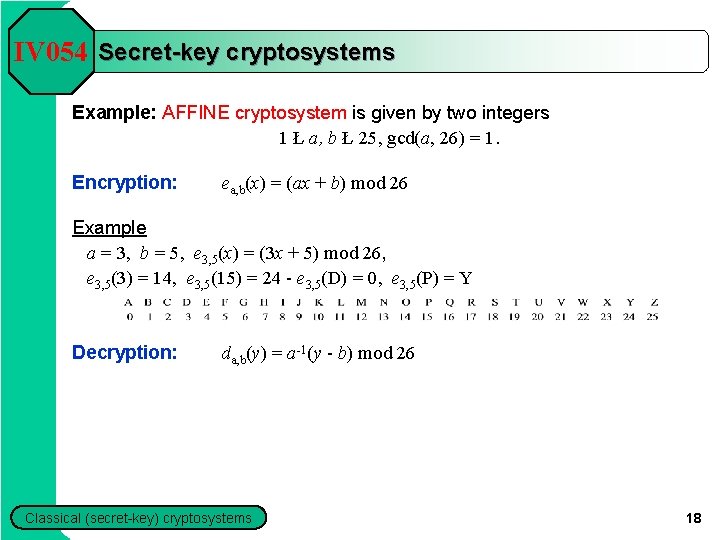
IV 054 Secret-key cryptosystems Example: AFFINE cryptosystem is given by two integers 1 Ł a, b Ł 25, gcd(a, 26) = 1. Encryption: ea, b(x) = (ax + b) mod 26 Example a = 3, b = 5, e 3, 5(x) = (3 x + 5) mod 26, e 3, 5(3) = 14, e 3, 5(15) = 24 - e 3, 5(D) = 0, e 3, 5(P) = Y Decryption: da, b(y) = a-1(y - b) mod 26 Classical (secret-key) cryptosystems 18
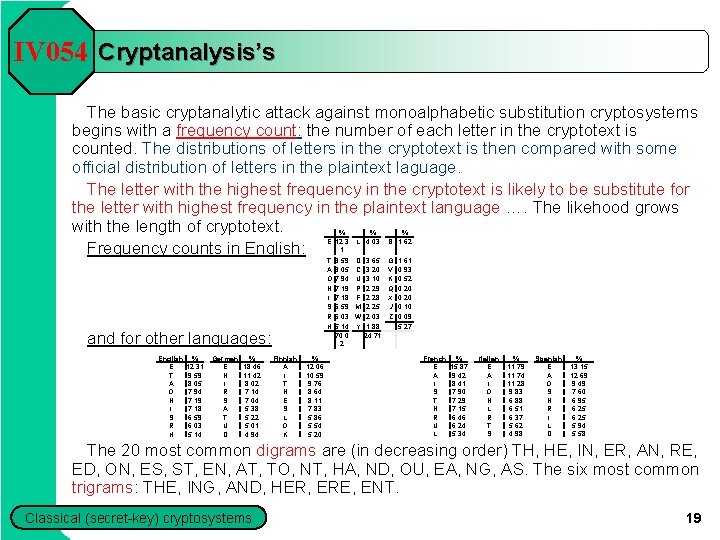
IV 054 Cryptanalysis’s The basic cryptanalytic attack against monoalphabetic substitution cryptosystems begins with a frequency count: the number of each letter in the cryptotext is counted. The distributions of letters in the cryptotext is then compared with some official distribution of letters in the plaintext laguage. The letter with the highest frequency in the cryptotext is likely to be substitute for the letter with highest frequency in the plaintext language …. The likehood grows with the length of cryptotext. % % % E 12. 3 L 4. 03 B 1. 62 1 Frequency counts in English: T 9. 59 D 3. 65 G 1. 61 A O N I S R H and for other languages: English E T A O N I S R H % 12. 31 9. 59 8. 05 7. 94 7. 19 7. 18 6. 59 6. 03 5. 14 German E N I R S A T U D % 18. 46 11. 42 8. 02 7. 14 7. 04 5. 38 5. 22 5. 01 4. 94 Finnish A I T N E S L O K % 12. 06 10. 59 9. 76 8. 64 8. 11 7. 83 5. 86 5. 54 5. 20 8. 05 7. 94 7. 19 7. 18 6. 59 6. 03 5. 14 70. 0 2 C U P F M W Y 3. 20 3. 10 2. 29 2. 28 2. 25 2. 03 1. 88 24. 71 V K Q X J Z 0. 93 0. 52 0. 20 0. 10 0. 09 5. 27 French E A I S T N R U L % 15. 87 9. 42 8. 41 7. 90 7. 29 7. 15 6. 46 6. 24 5. 34 Italian E A I O N L R T S % 11. 79 11. 74 11. 28 9. 83 6. 88 6. 51 6. 37 5. 62 4. 98 Spanish E A O S N R I L D % 13. 15 12. 69 9. 49 7. 60 6. 95 6. 25 5. 94 5. 58 The 20 most common digrams are (in decreasing order) TH, HE, IN, ER, AN, RE, ED, ON, ES, ST, EN, AT, TO, NT, HA, ND, OU, EA, NG, AS. The six most common trigrams: THE, ING, AND, HER, ERE, ENT. Classical (secret-key) cryptosystems 19
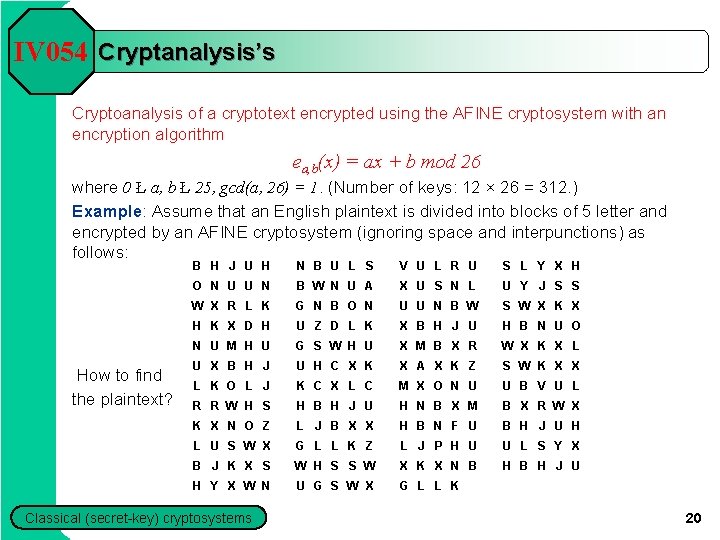
IV 054 Cryptanalysis’s Cryptoanalysis of a cryptotext encrypted using the AFINE cryptosystem with an encryption algorithm ea, b(x) = ax + b mod 26 where 0 Ł a, b Ł 25, gcd(a, 26) = 1. (Number of keys: 12 × 26 = 312. ) Example: Assume that an English plaintext is divided into blocks of 5 letter and encrypted by an AFINE cryptosystem (ignoring space and interpunctions) as follows: How to find the plaintext? B H J U H N B U L S V U L R U S L Y X H O N U U N B W N U A X U S N L U Y J S S W X R L K G N B O N U U N B W S W X K X H K X D H U Z D L K X B H J U H B N U O N U M H U G S W H U X M B X R W X K X L U X B H J U H C X K X A X K Z S W K X X L K O L J K C X L C M X O N U U B V U L R R W H S H B H J U H N B X M B X R W X K X N O Z L J B X X H B N F U B H J U H L U S W X G L L K Z L J P H U U L S Y X B J K X S W H S S W X K X N B H J U H Y X W N U G S W X G L L K Classical (secret-key) cryptosystems 20
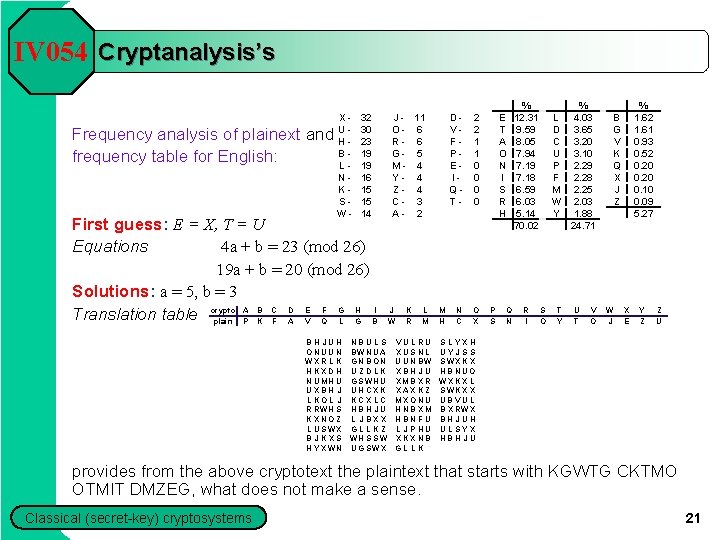
IV 054 Cryptanalysis’s Frequency analysis of plainext and frequency table for English: XUHBLNKSW- 32 30 23 19 19 16 15 15 14 First guess: E = X, T = U Equations 4 a + b = 23 (mod 26) 19 a + b = 20 (mod 26) Solutions: a = 5, b = 3 A B C D E F G H I Translation table crypto plain P K F A V Q L G B BH J UH ONUUN WX R L K HKXDH N UMH U UXBH J L KO L J R RWH S K X NO Z L U SWX BJKXS H Y XWN J - 11 O- 6 R- 6 G- 5 M- 4 Y- 4 Z- 4 C- 3 A- 2 J W K R L M M H DVFPEIQT- 2 2 1 1 0 0 N C O X E T A O N I S R H P S Q N % 12. 31 9. 59 8. 05 7. 94 7. 19 7. 18 6. 59 6. 03 5. 14 70. 02 R I L D C U P F M W Y S O T Y % 4. 03 3. 65 3. 20 3. 10 2. 29 2. 28 2. 25 2. 03 1. 88 24. 71 U T V O % 1. 62 1. 61 0. 93 0. 52 0. 20 0. 10 0. 09 5. 27 B G V K Q X J Z W J X E Y Z Z U NBUL S VULRU S L YXH BWN U A X U S N L U Y J S S G N B O N U U N BW S W X K X U Z D L K X BH J U HBNUO G S WH U X M B X R W X K X L U H C X K X A X K Z S WK X X KC X L C MXONU UB V U L H B H J U H N B X M B X RW X L J BXX HBN F U BH J UH GL LKZ L J PHU U L SYX WH S S W X K X N B H J U U G SWX G L L K provides from the above cryptotext the plaintext that starts with KGWTG CKTMO OTMIT DMZEG, what does not make a sense. Classical (secret-key) cryptosystems 21
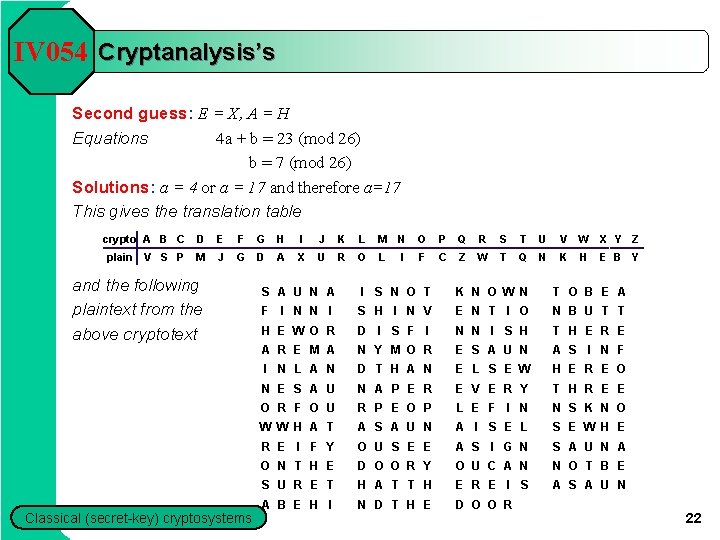
IV 054 Cryptanalysis’s Second guess: E = X, A = H Equations 4 a + b = 23 (mod 26) b = 7 (mod 26) Solutions: a = 4 or a = 17 and therefore a=17 This gives the translation table crypto A B C D E F G H I J K L M N O P Q R S T U V W X Y Z plain V S P M J G D A X U R O L I F C Z W T Q N K H E B Y and the following plaintext from the above cryptotext Classical (secret-key) cryptosystems S A U N A I S N O T K N O W N T O B E A F I N N I S H I N V E N T I O N B U T T H E W O R D I S F I N N I S H T H E R E A R E M A N Y M O R E S A U N A S I N F I N L A N D T H A N E L S E W H E R E O N E S A U N A P E R E V E R Y T H R E E O R F O U R P E O P L E F I N N S K N O W W H A T A S A U N A I S E L S E W H E R E I F Y O U S E E A S I G N S A U N A O N T H E D O O R Y O U C A N N O T B E S U R E T H A T T H E R E I S A U N A B E H I N D T H E D O O R 22
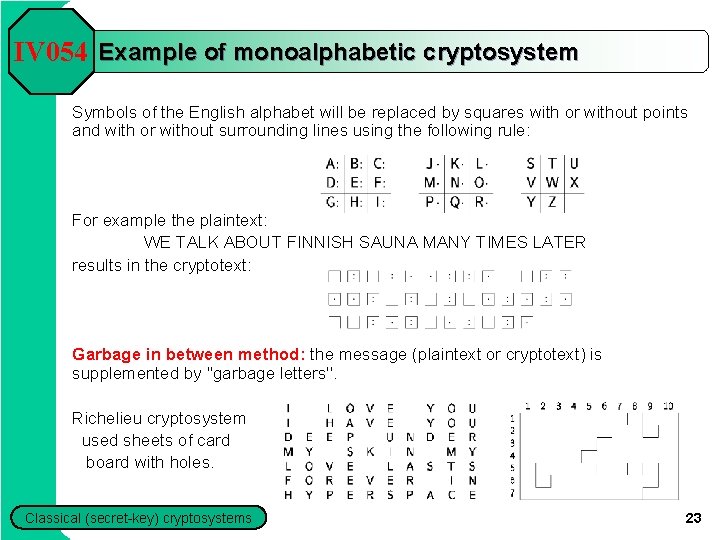
IV 054 Example of monoalphabetic cryptosystem Symbols of the English alphabet will be replaced by squares with or without points and with or without surrounding lines using the following rule: For example the plaintext: WE TALK ABOUT FINNISH SAUNA MANY TIMES LATER results in the cryptotext: Garbage in between method: the message (plaintext or cryptotext) is supplemented by ''garbage letters''. Richelieu cryptosystem used sheets of card board with holes. Classical (secret-key) cryptosystems 23
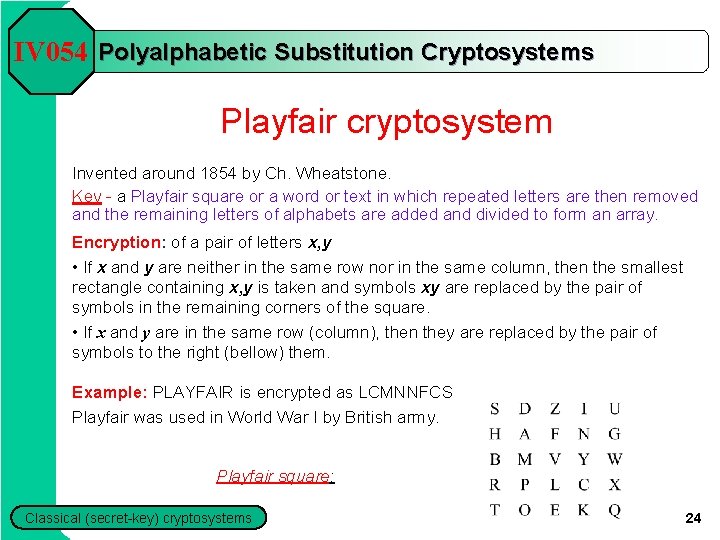
IV 054 Polyalphabetic Substitution Cryptosystems Playfair cryptosystem Invented around 1854 by Ch. Wheatstone. Key - a Playfair square or a word or text in which repeated letters are then removed and the remaining letters of alphabets are added and divided to form an array. Encryption: of a pair of letters x, y • If x and y are neither in the same row nor in the same column, then the smallest rectangle containing x, y is taken and symbols xy are replaced by the pair of symbols in the remaining corners of the square. • If x and y are in the same row (column), then they are replaced by the pair of symbols to the right (bellow) them. Example: PLAYFAIR is encrypted as LCMNNFCS Playfair was used in World War I by British army. Playfair square: Classical (secret-key) cryptosystems 24
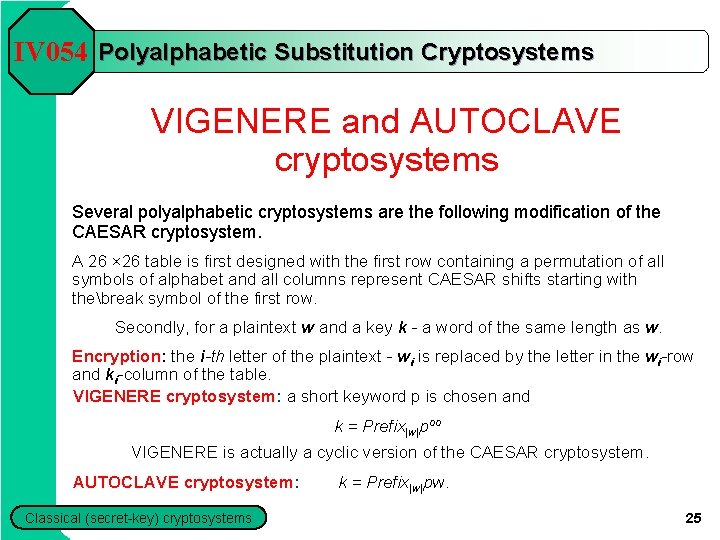
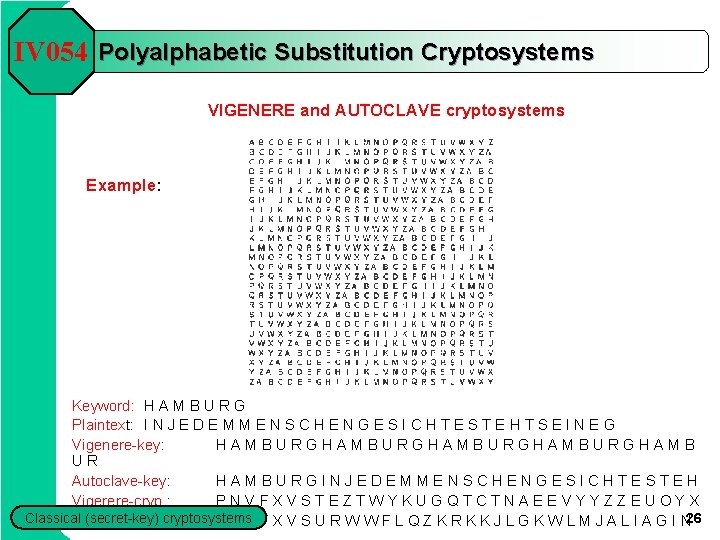
IV 054 Polyalphabetic Substitution Cryptosystems VIGENERE and AUTOCLAVE cryptosystems Several polyalphabetic cryptosystems are the following modification of the CAESAR cryptosystem. A 26 × 26 table is first designed with the first row containing a permutation of all symbols of alphabet and all columns represent CAESAR shifts starting with thebreak symbol of the first row. Secondly, for a plaintext w and a key k - a word of the same length as w. Encryption: the i-th letter of the plaintext - wi is replaced by the letter in the wi-row and ki-column of the table. VIGENERE cryptosystem: a short keyword p is chosen and k = Prefix|w|poo VIGENERE is actually a cyclic version of the CAESAR cryptosystem. AUTOCLAVE cryptosystem: Classical (secret-key) cryptosystems k = Prefix|w|pw. 25
IV 054 Polyalphabetic Substitution Cryptosystems VIGENERE and AUTOCLAVE cryptosystems Example: Keyword: H A M B U R G Plaintext: I N J E D E M M E N S C H E N G E S I C H T E S T E H T S E I N E G Vigenere-key: HAMBURGHAMBURGHAMB UR Autoclave-key: HAMBURGINJEDEMMENSCHENGESICHTESTEH Vigerere-cryp. : PNVFXVSTEZTWYKUGQTCTNAEEVYYZZEUOYX Classical (secret-key) cryptosystems Autoclave-cryp. : P N V F X V S U R W W F L Q Z K R K K J L G K W L M J A L I A G I N 26
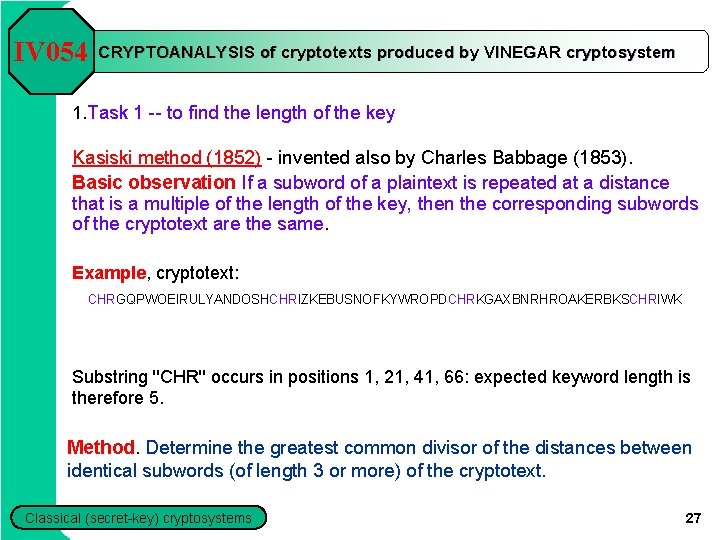
IV 054 CRYPTOANALYSIS of cryptotexts produced by VINEGAR cryptosystem 1. Task 1 -- to find the length of the key Kasiski method (1852) - invented also by Charles Babbage (1853). Basic observation If a subword of a plaintext is repeated at a distance that is a multiple of the length of the key, then the corresponding subwords of the cryptotext are the same. Example, cryptotext: CHRGQPWOEIRULYANDOSHCHRIZKEBUSNOFKYWROPDCHRKGAXBNRHROAKERBKSCHRIWK Substring ''CHR'' occurs in positions 1, 21, 41, 66: expected keyword length is therefore 5. Method. Determine the greatest common divisor of the distances between identical subwords (of length 3 or more) of the cryptotext. Classical (secret-key) cryptosystems 27
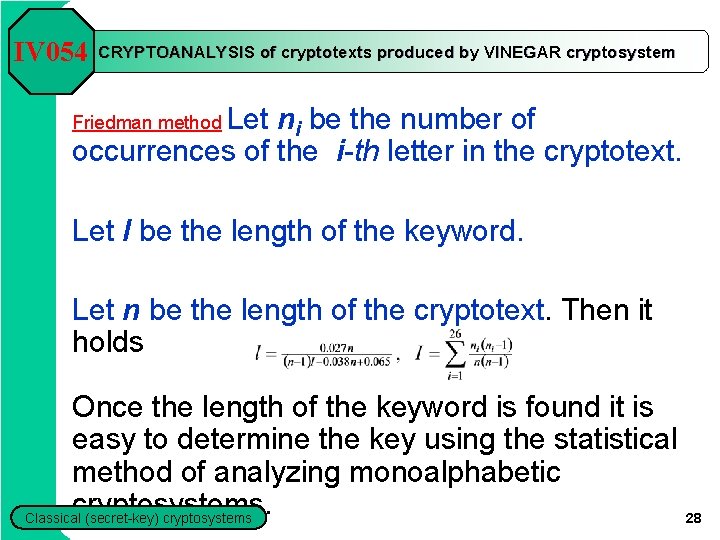
IV 054 CRYPTOANALYSIS of cryptotexts produced by VINEGAR cryptosystem Friedman method Let ni be the number of occurrences of the i-th letter in the cryptotext. Let l be the length of the keyword. Let n be the length of the cryptotext. Then it holds Once the length of the keyword is found it is easy to determine the key using the statistical method of analyzing monoalphabetic cryptosystems. 28 Classical (secret-key) cryptosystems
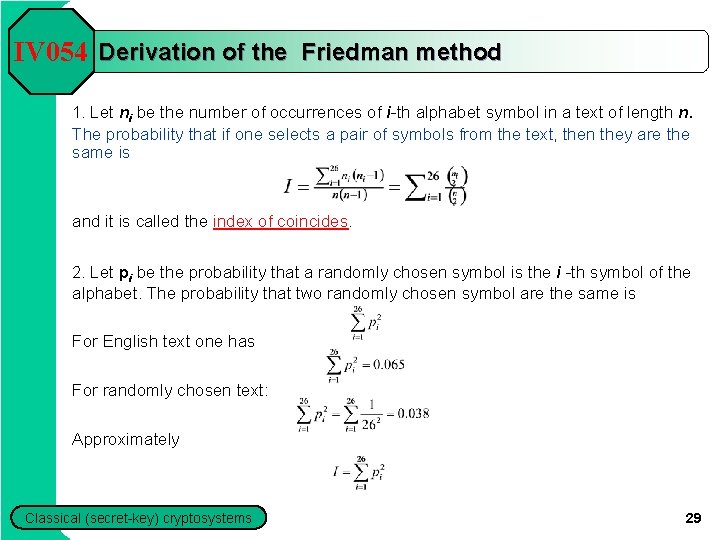
IV 054 Derivation of the Friedman method 1. Let ni be the number of occurrences of i-th alphabet symbol in a text of length n. The probability that if one selects a pair of symbols from the text, then they are the same is and it is called the index of coincides. 2. Let pi be the probability that a randomly chosen symbol is the i -th symbol of the alphabet. The probability that two randomly chosen symbol are the same is For English text one has For randomly chosen text: Approximately Classical (secret-key) cryptosystems 29
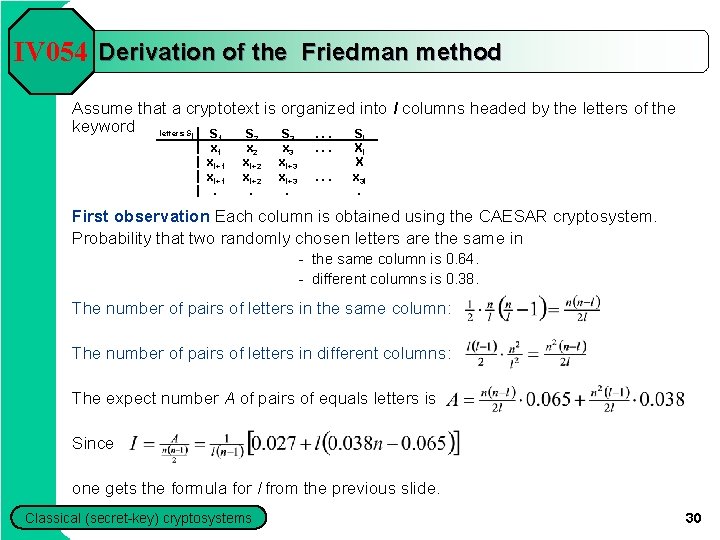
IV 054 Derivation of the Friedman method Assume that a cryptotext is organized into l columns headed by the letters of the keyword letters Sl S S S. . . S 1 xl+1. 2 xl+2. 3 xl+3. . . . l Xl X x 3 l. First observation Each column is obtained using the CAESAR cryptosystem. Probability that two randomly chosen letters are the same in - the same column is 0. 64. - different columns is 0. 38. The number of pairs of letters in the same column: The number of pairs of letters in different columns: The expect number A of pairs of equals letters is Since one gets the formula for l from the previous slide. Classical (secret-key) cryptosystems 30
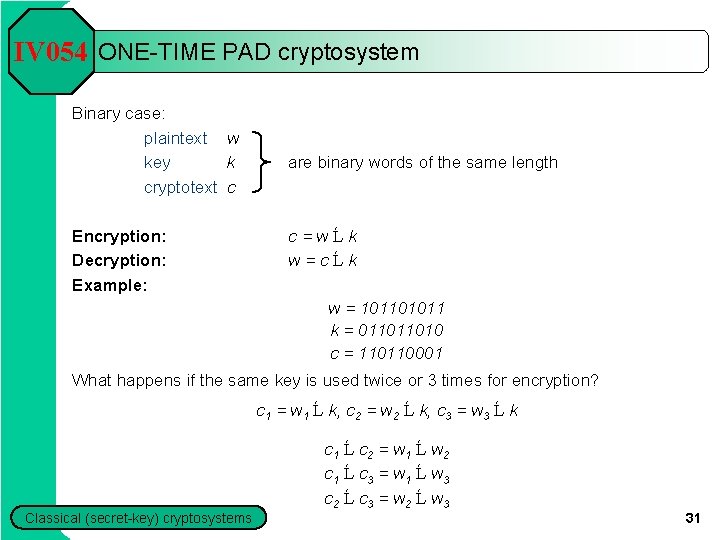
IV 054 ONE-TIME PAD cryptosystem Binary case: plaintext w key k cryptotext c Encryption: Decryption: Example: are binary words of the same length c=wĹk w=cĹk w = 101101011 k = 011011010 c = 110110001 What happens if the same key is used twice or 3 times for encryption? c 1 = w 1 Ĺ k, c 2 = w 2 Ĺ k, c 3 = w 3 Ĺ k Classical (secret-key) cryptosystems c 1 Ĺ c 2 = w 1 Ĺ w 2 c 1 Ĺ c 3 = w 1 Ĺ w 3 c 2 Ĺ c 3 = w 2 Ĺ w 3 31
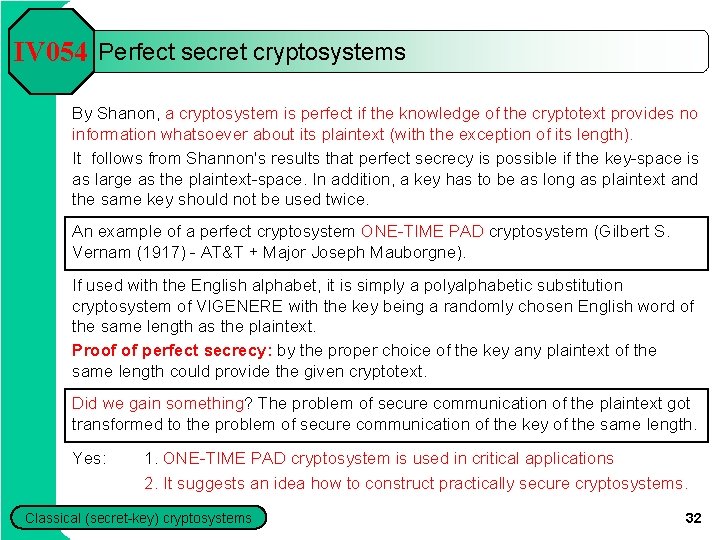
IV 054 Perfect secret cryptosystems By Shanon, a cryptosystem is perfect if the knowledge of the cryptotext provides no information whatsoever about its plaintext (with the exception of its length). It follows from Shannon's results that perfect secrecy is possible if the key-space is as large as the plaintext-space. In addition, a key has to be as long as plaintext and the same key should not be used twice. An example of a perfect cryptosystem ONE-TIME PAD cryptosystem (Gilbert S. Vernam (1917) - AT&T + Major Joseph Mauborgne). If used with the English alphabet, it is simply a polyalphabetic substitution cryptosystem of VIGENERE with the key being a randomly chosen English word of the same length as the plaintext. Proof of perfect secrecy: by the proper choice of the key any plaintext of the same length could provide the given cryptotext. Did we gain something? The problem of secure communication of the plaintext got transformed to the problem of secure communication of the key of the same length. Yes: 1. ONE-TIME PAD cryptosystem is used in critical applications 2. It suggests an idea how to construct practically secure cryptosystems. Classical (secret-key) cryptosystems 32
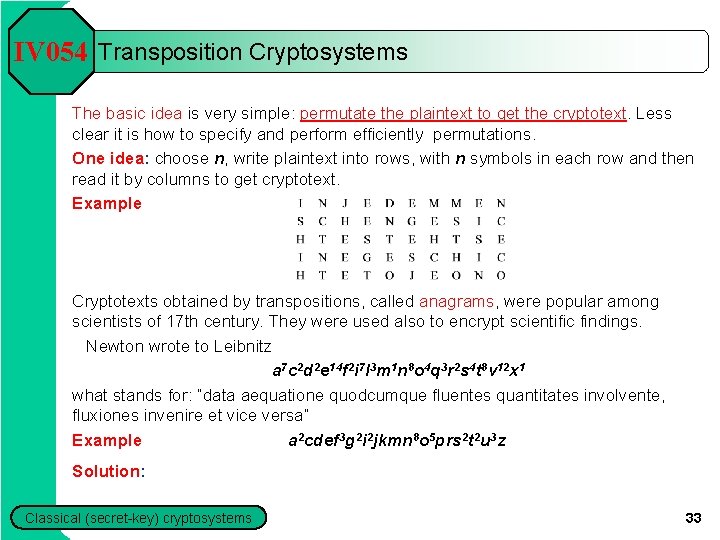
IV 054 Transposition Cryptosystems The basic idea is very simple: permutate the plaintext to get the cryptotext. Less clear it is how to specify and perform efficiently permutations. One idea: choose n, write plaintext into rows, with n symbols in each row and then read it by columns to get cryptotext. Example Cryptotexts obtained by transpositions, called anagrams, were popular among scientists of 17 th century. They were used also to encrypt scientific findings. Newton wrote to Leibnitz a 7 c 2 d 2 e 14 f 2 i 7 l 3 m 1 n 8 o 4 q 3 r 2 s 4 t 8 v 12 x 1 what stands for: ”data aequatione quodcumque fluentes quantitates involvente, fluxiones invenire et vice versa” Example a 2 cdef 3 g 2 i 2 jkmn 8 o 5 prs 2 t 2 u 3 z Solution: Classical (secret-key) cryptosystems 33
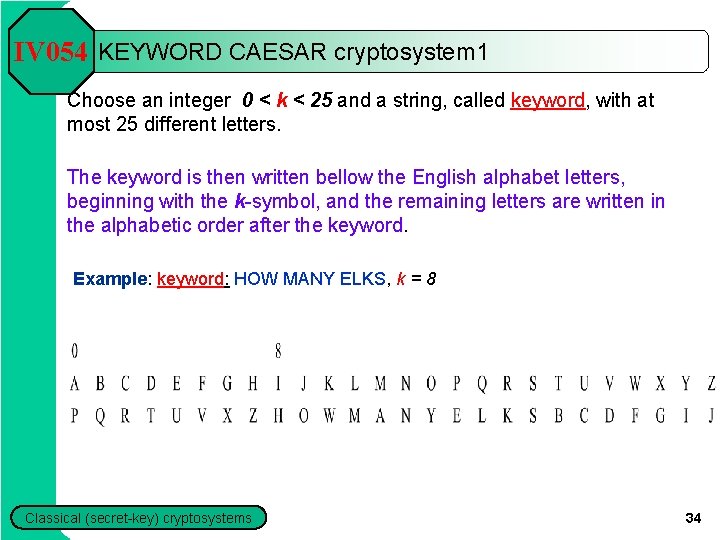
IV 054 KEYWORD CAESAR cryptosystem 1 Choose an integer 0 < k < 25 and a string, called keyword, with at most 25 different letters. The keyword is then written bellow the English alphabet letters, beginning with the k-symbol, and the remaining letters are written in the alphabetic order after the keyword. Example: keyword: HOW MANY ELKS, k = 8 Classical (secret-key) cryptosystems 34
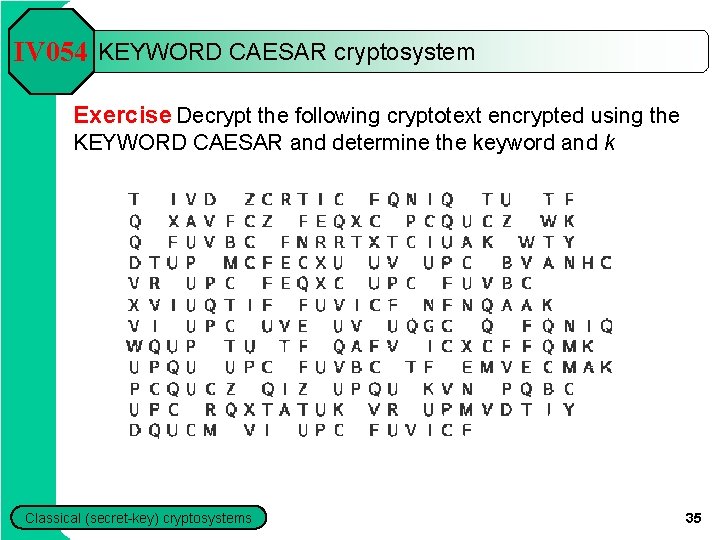
IV 054 KEYWORD CAESAR cryptosystem Exercise Decrypt the following cryptotext encrypted using the KEYWORD CAESAR and determine the keyword and k Classical (secret-key) cryptosystems 35
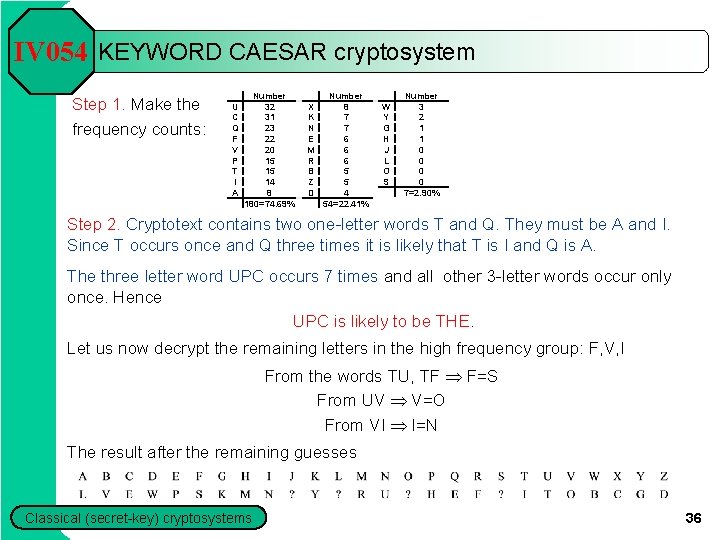
IV 054 KEYWORD CAESAR cryptosystem Step 1. Make the frequency counts: U C Q F V P T I A Number 32 31 23 22 20 15 15 14 8 180=74. 69% X K N E M R B Z D Number 8 7 7 6 6 6 5 5 4 54=22. 41% W Y G H J L O S Number 3 2 1 1 0 0 7=2. 90% Step 2. Cryptotext contains two one-letter words T and Q. They must be A and I. Since T occurs once and Q three times it is likely that T is I and Q is A. The three letter word UPC occurs 7 times and all other 3 -letter words occur only once. Hence UPC is likely to be THE. Let us now decrypt the remaining letters in the high frequency group: F, V, I From the words TU, TF Þ F=S From UV Þ V=O From VI Þ I=N The result after the remaining guesses Classical (secret-key) cryptosystems 36
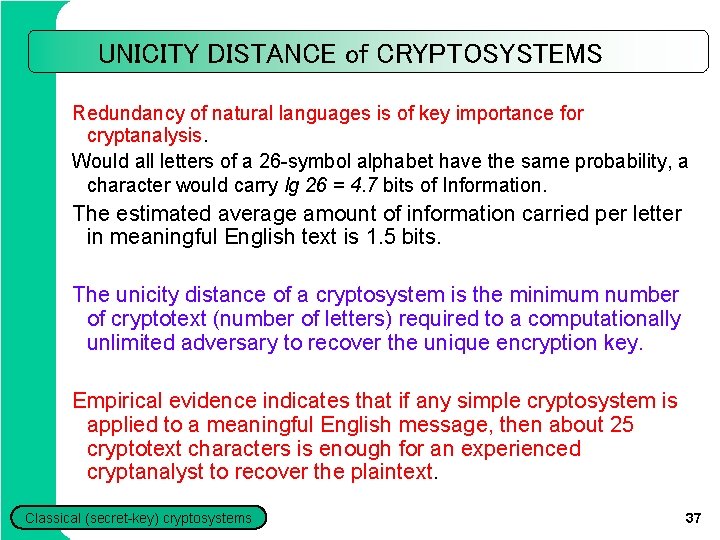
UNICITY DISTANCE of CRYPTOSYSTEMS Redundancy of natural languages is of key importance for cryptanalysis. Would all letters of a 26 -symbol alphabet have the same probability, a character would carry lg 26 = 4. 7 bits of Information. The estimated average amount of information carried per letter in meaningful English text is 1. 5 bits. The unicity distance of a cryptosystem is the minimum number of cryptotext (number of letters) required to a computationally unlimited adversary to recover the unique encryption key. Empirical evidence indicates that if any simple cryptosystem is applied to a meaningful English message, then about 25 cryptotext characters is enough for an experienced cryptanalyst to recover the plaintext. Classical (secret-key) cryptosystems 37
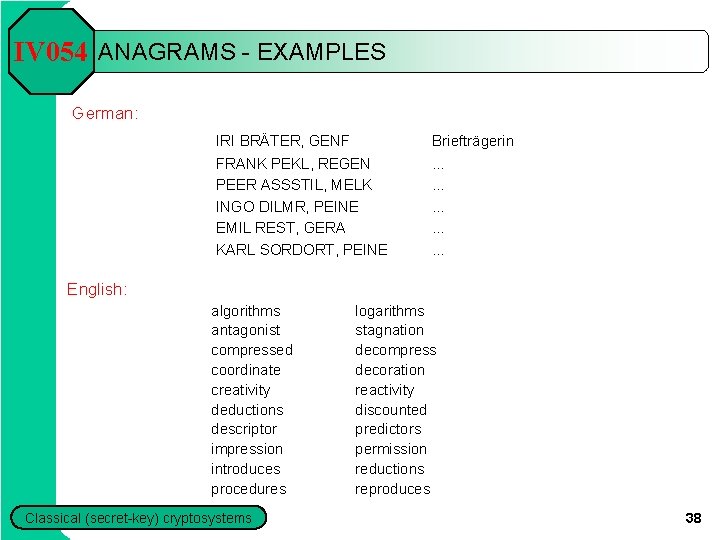
IV 054 ANAGRAMS - EXAMPLES German: IRI BRÄTER, GENF Briefträgerin FRANK PEKL, REGEN PEER ASSSTIL, MELK INGO DILMR, PEINE EMIL REST, GERA KARL SORDORT, PEINE … … … English: algorithms antagonist compressed coordinate creativity deductions descriptor impression introduces procedures Classical (secret-key) cryptosystems logarithms stagnation decompress decoration reactivity discounted predictors permission reductions reproduces 38
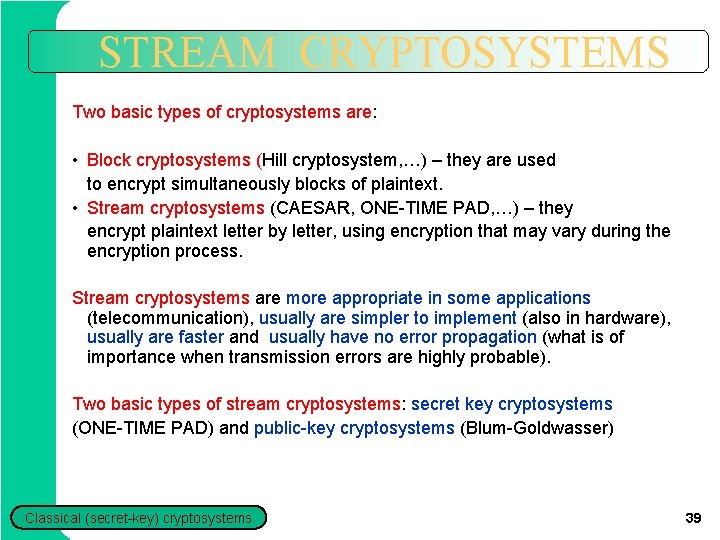
STREAM CRYPTOSYSTEMS Two basic types of cryptosystems are: • Block cryptosystems (Hill cryptosystem, …) – they are used to encrypt simultaneously blocks of plaintext. • Stream cryptosystems (CAESAR, ONE-TIME PAD, …) – they encrypt plaintext letter by letter, using encryption that may vary during the encryption process. Stream cryptosystems are more appropriate in some applications (telecommunication), usually are simpler to implement (also in hardware), usually are faster and usually have no error propagation (what is of importance when transmission errors are highly probable). Two basic types of stream cryptosystems: secret key cryptosystems (ONE-TIME PAD) and public-key cryptosystems (Blum-Goldwasser) Classical (secret-key) cryptosystems 39
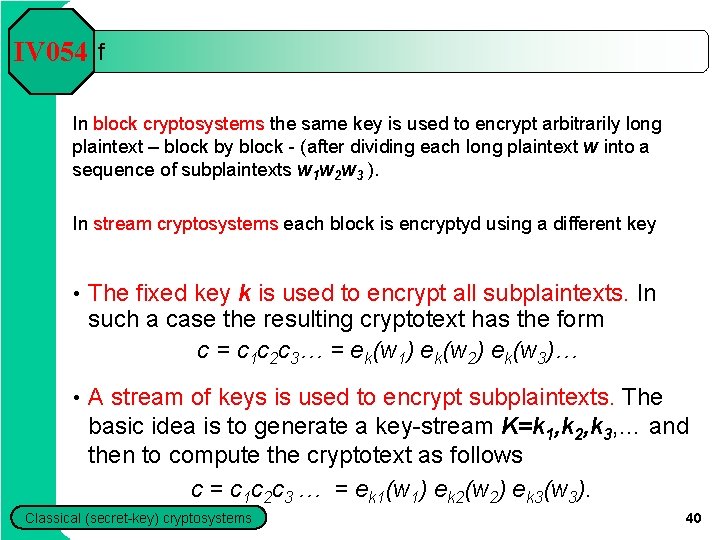
IV 054 f In block cryptosystems the same key is used to encrypt arbitrarily long plaintext – block by block - (after dividing each long plaintext w into a sequence of subplaintexts w 1 w 2 w 3 ). In stream cryptosystems each block is encryptyd using a different key • The fixed key k is used to encrypt all subplaintexts. In such a case the resulting cryptotext has the form c = c 1 c 2 c 3… = ek(w 1) ek(w 2) ek(w 3)… • A stream of keys is used to encrypt subplaintexts. The basic idea is to generate a key-stream K=k 1, k 2, k 3, … and then to compute the cryptotext as follows c = c 1 c 2 c 3 … = ek 1(w 1) ek 2(w 2) ek 3(w 3). Classical (secret-key) cryptosystems 40
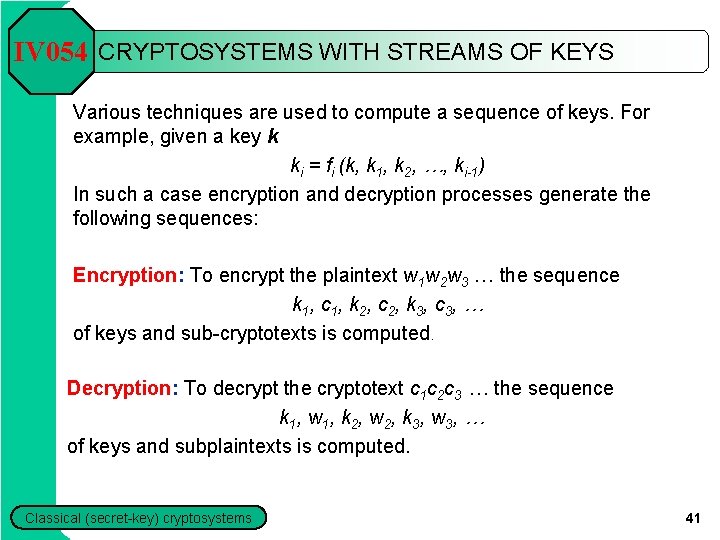
IV 054 CRYPTOSYSTEMS WITH STREAMS OF KEYS Various techniques are used to compute a sequence of keys. For example, given a key k ki = fi (k, k 1, k 2, …, ki-1) In such a case encryption and decryption processes generate the following sequences: Encryption: To encrypt the plaintext w 1 w 2 w 3 … the sequence k 1, c 1, k 2, c 2, k 3, c 3, … of keys and sub-cryptotexts is computed. Decryption: To decrypt the cryptotext c 1 c 2 c 3 … the sequence k 1, w 1, k 2, w 2, k 3, w 3, … of keys and subplaintexts is computed. Classical (secret-key) cryptosystems 41
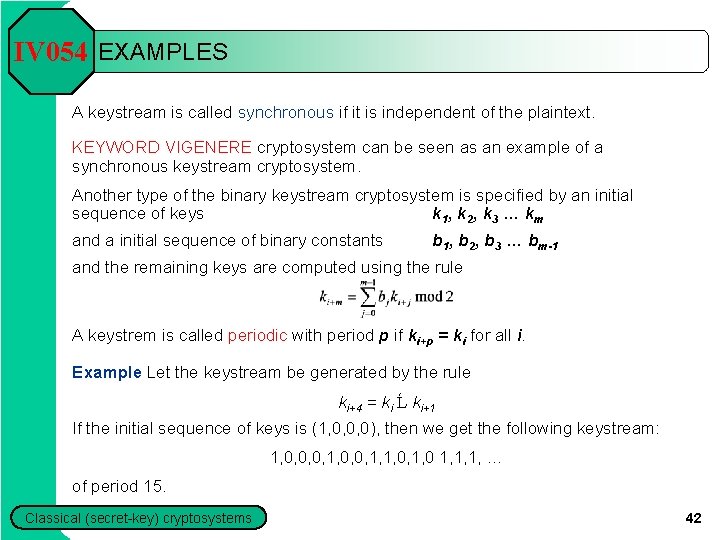
IV 054 EXAMPLES A keystream is called synchronous if it is independent of the plaintext. KEYWORD VIGENERE cryptosystem can be seen as an example of a synchronous keystream cryptosystem. Another type of the binary keystream cryptosystem is specified by an initial sequence of keys k 1 , k 2 , k 3 … k m and a initial sequence of binary constants b 1, b 2, b 3 … bm-1 and the remaining keys are computed using the rule A keystrem is called periodic with period p if ki+p = ki for all i. Example Let the keystream be generated by the rule ki+4 = ki Ĺ ki+1 If the initial sequence of keys is (1, 0, 0, 0), then we get the following keystream: 1, 0, 0, 0, 1, 1, 0 1, 1, 1, … of period 15. Classical (secret-key) cryptosystems 42
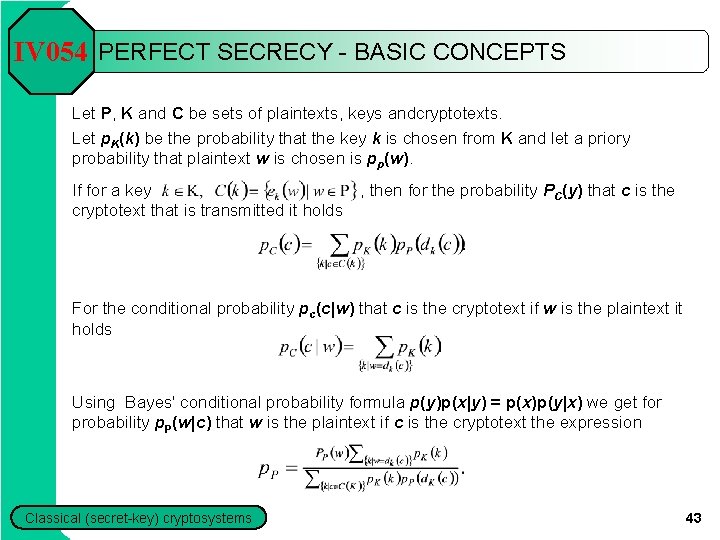
IV 054 PERFECT SECRECY - BASIC CONCEPTS Let P, K and C be sets of plaintexts, keys andcryptotexts. Let p. K(k) be the probability that the key k is chosen from K and let a priory probability that plaintext w is chosen is pp(w). If for a key cryptotext that is transmitted it holds , then for the probability PC(y) that c is the For the conditional probability pc(c|w) that c is the cryptotext if w is the plaintext it holds Using Bayes' conditional probability formula p(y)p(x|y) = p(x)p(y|x) we get for probability p. P(w|c) that w is the plaintext if c is the cryptotext the expression Classical (secret-key) cryptosystems 43
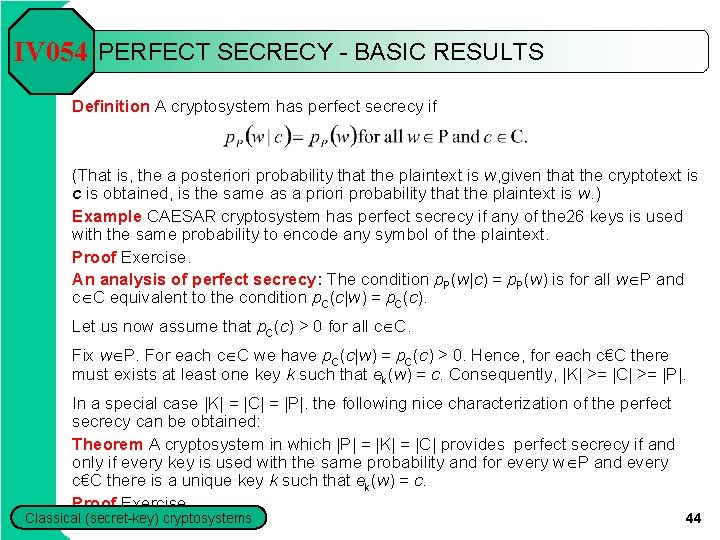
IV 054 PERFECT SECRECY - BASIC RESULTS Definition A cryptosystem has perfect secrecy if (That is, the a posteriori probability that the plaintext is w, given that the cryptotext is c is obtained, is the same as a priori probability that the plaintext is w. ) Example CAESAR cryptosystem has perfect secrecy if any of the 26 keys is used with the same probability to encode any symbol of the plaintext. Proof Exercise. An analysis of perfect secrecy: The condition p. P(w|c) = p. P(w) is for all wÎP and cÎC equivalent to the condition p. C(c|w) = p. C(c). Let us now assume that p. C(c) > 0 for all cÎC. Fix wÎP. For each cÎC we have p. C(c|w) = p. C(c) > 0. Hence, for each c€C there must exists at least one key k such that ek(w) = c. Consequently, |K| >= |C| >= |P|. In a special case |K| = |C| = |P|. the following nice characterization of the perfect secrecy can be obtained: Theorem A cryptosystem in which |P| = |K| = |C| provides perfect secrecy if and only if every key is used with the same probability and for every wÎP and every c€C there is a unique key k such that ek(w) = c. Proof Exercise. Classical (secret-key) cryptosystems 44
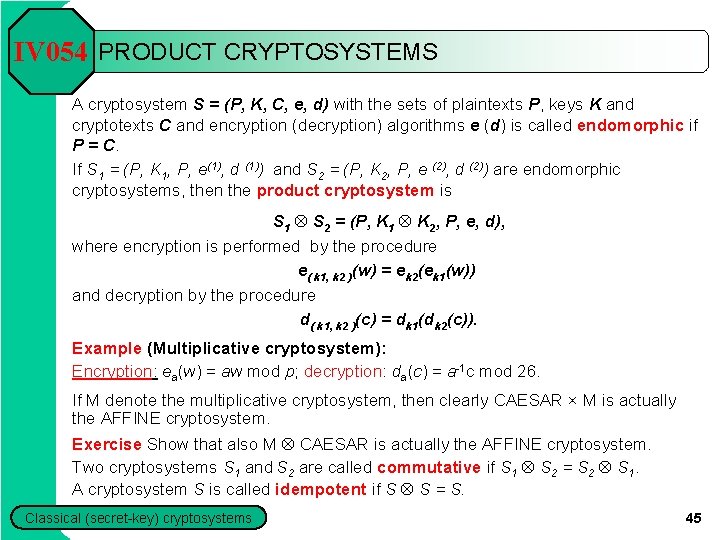
IV 054 PRODUCT CRYPTOSYSTEMS A cryptosystem S = (P, K, C, e, d) with the sets of plaintexts P, keys K and cryptotexts C and encryption (decryption) algorithms e (d) is called endomorphic if P = C. If S 1 = (P, K 1, P, e(1), d (1)) and S 2 = (P, K 2, P, e (2), d (2)) are endomorphic cryptosystems, then the product cryptosystem is S 1 Ä S 2 = (P, K 1 Ä K 2, P, e, d), where encryption is performed by the procedure e( k 1, k 2 )(w) = ek 2(ek 1(w)) and decryption by the procedure d( k 1, k 2 )(c) = dk 1(dk 2(c)). Example (Multiplicative cryptosystem): Encryption: ea(w) = aw mod p; decryption: da(c) = a-1 c mod 26. If M denote the multiplicative cryptosystem, then clearly CAESAR × M is actually the AFFINE cryptosystem. Exercise Show that also M Ä CAESAR is actually the AFFINE cryptosystem. Two cryptosystems S 1 and S 2 are called commutative if S 1 Ä S 2 = S 2 Ä S 1. A cryptosystem S is called idempotent if S Ä S = S. Classical (secret-key) cryptosystems 45
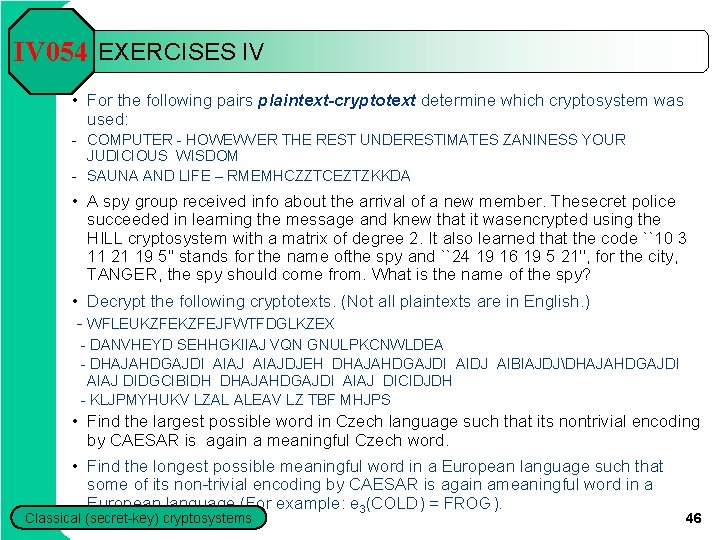
IV 054 EXERCISES IV • For the following pairs plaintext-cryptotext determine which cryptosystem was used: - COMPUTER - HOWEWVER THE REST UNDERESTIMATES ZANINESS YOUR JUDICIOUS WISDOM - SAUNA AND LIFE – RMEMHCZZTCEZTZKKDA • A spy group received info about the arrival of a new member. Thesecret police succeeded in learning the message and knew that it wasencrypted using the HILL cryptosystem with a matrix of degree 2. It also learned that the code ``10 3 11 21 19 5'' stands for the name ofthe spy and ``24 19 16 19 5 21'', for the city, TANGER, the spy should come from. What is the name of the spy? • Decrypt the following cryptotexts. (Not all plaintexts are in English. ) - WFLEUKZFEJFWTFDGLKZEX - DANVHEYD SEHHGKIIAJ VQN GNULPKCNWLDEA - DHAJAHDGAJDI AIAJDJEH DHAJAHDGAJDI AIDJ AIBIAJDJDHAJAHDGAJDI AIAJ DIDGCIBIDH DHAJAHDGAJDI AIAJ DICIDJDH - KLJPMYHUKV LZAL ALEAV LZ TBF MHJPS • Find the largest possible word in Czech language such that its nontrivial encoding by CAESAR is again a meaningful Czech word. • Find the longest possible meaningful word in a European language such that some of its non-trivial encoding by CAESAR is again ameaningful word in a European language (For example: e 3(COLD) = FROG). Classical (secret-key) cryptosystems 46
IV 054 EXERCISES IV • Decrypt the following cryptotext obtained by encryption with an AFFINE cryptosystem: KQEREJEBCPPCJCRKIEACUZBKRVPKRBCIBQCARBJCVFCUPKRIOFKPACUZQEPBKRX PEIIEABDKPBCPFCDCCAFIEABDKPBCPFEQPKAZBKRHAIBKAPCCIBURCCDKDCCJCI DFUIXPAFFERBICZDFKABICBBENEFCUPJCVKABPCYDCCDPKBCOCPERKIVKSCPICB RKIJPKAI • Suppose we are told that the plaintext “FRIDAY'' yields the cryptotext “PQCFKU'' with a HALL cryptosystem. Determine the encryption matrix. • Suppose we are told that the plaintext “BREATHTAKING”' yieldsthe cryptotext “RUPOTENTOSUP'' with a HILL cryptosystem. Determine the encryption matrix. • Decrypt the following cryptotext, obtained using the AUTOKLAVE cryptotext (using exhaustive search ? ) MALVVMAFBHBUQPTSOXALTGVWWRG • Design interesting cryptograms in (at least) one of the languages: Czech, French, Spanish, Chines? • Show that each permutation cryptosystem is a special case of the HILL cryptosystem. • How many 2 × 2 matrices are there that are invertible over Zp, where p is a prime. • Invent your own interesting and quite secure cryptosystem. Classical (secret-key) cryptosystems 47