
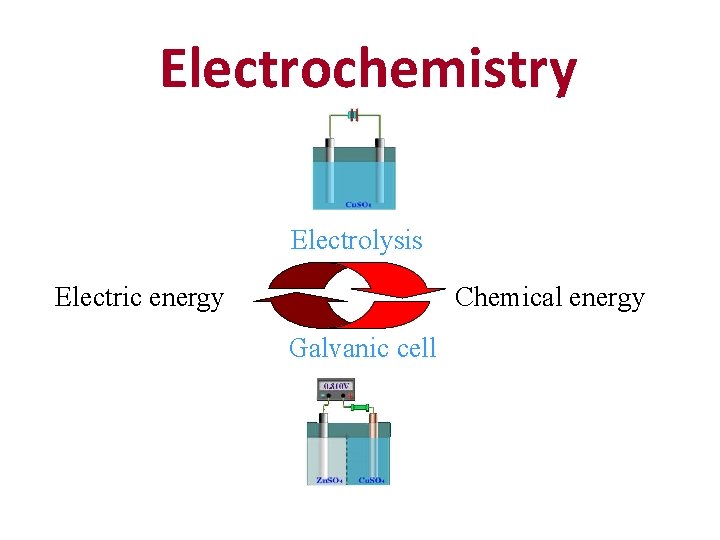
Electrochemistry Electrolysis Electric energy Chemical energy Galvanic cell


- Slides: 34
Electrochemistry Electrolysis Electric energy Chemical energy Galvanic cell
Definition of electrochemistry • I: A science studying the relationship between chemical energy and electrical energy and the rules of conversion of two energies. • II: Electrochemistry is the study of solutions of electrolytes and of phenomena occurring at electrodes immersed in these solutions.
Electrolytes Substances whose solution in water conducts electric current. Conduction takes place by the movement of ions. Examples are salts, acids and bases. Substances whose aqueous solution does not conduct electricity are called non electrolytes. Examples are solutions of cane sugar, glucose, urea etc.
Types of Electrolytes Strong electrolyte are highly ionized in the solution. Examples are HCl, H 2 SO 4, Na. OH, KOH etc Weak electrolytes are only feebly ionized in the solution. Examples are H 2 CO 3, CH 3 COOH, NH 4 OH etc
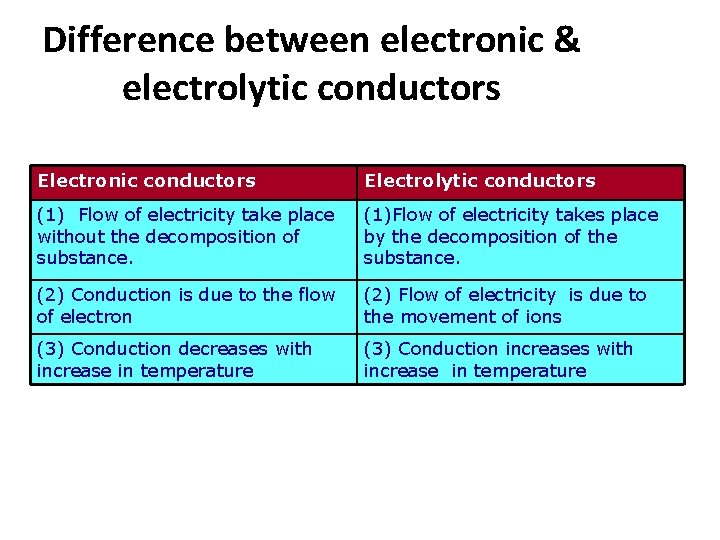
Difference between electronic & electrolytic conductors Electronic conductors Electrolytic conductors (1) Flow of electricity take place without the decomposition of substance. (1)Flow of electricity takes place by the decomposition of the substance. (2) Conduction is due to the flow of electron (2) Flow of electricity is due to the movement of ions (3) Conduction decreases with increase in temperature (3) Conduction increases with increase in temperature
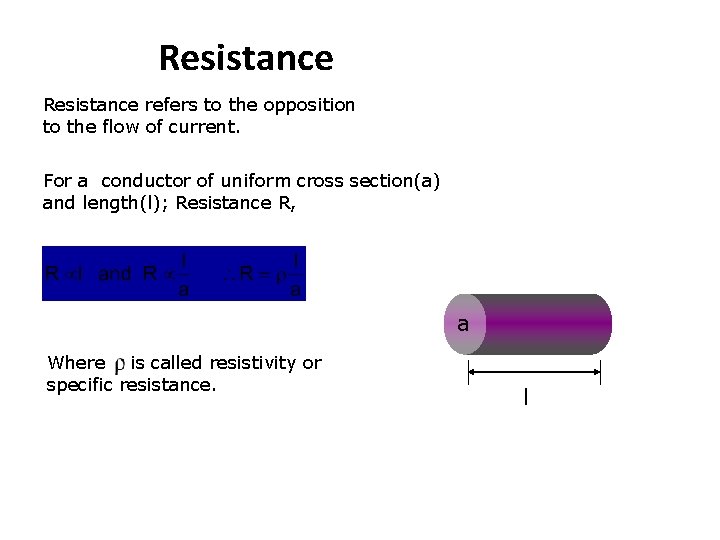
Resistance refers to the opposition to the flow of current. For a conductor of uniform cross section(a) and length(l); Resistance R, a Where is called resistivity or specific resistance. l
Conductance The reciprocal of the resistance is called conductance. It is denoted by C. C=1/R Conductors allows electric current to pass through them. Examples are metals, aqueous solution of acids, bases and salts etc. Unit of conductance is ohm-1 or mho or Siemen(S) Insulators do not allow the electric current to pass through them. Examples are pure water, urea, sugar etc.
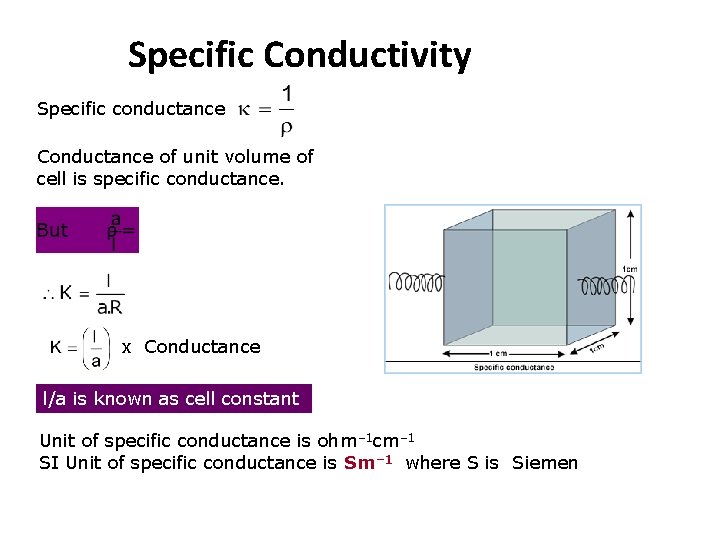
Specific Conductivity Specific conductance Conductance of unit volume of cell is specific conductance. x Conductance l/a is known as cell constant Unit of specific conductance is ohm– 1 cm– 1 SI Unit of specific conductance is Sm– 1 where S is Siemen
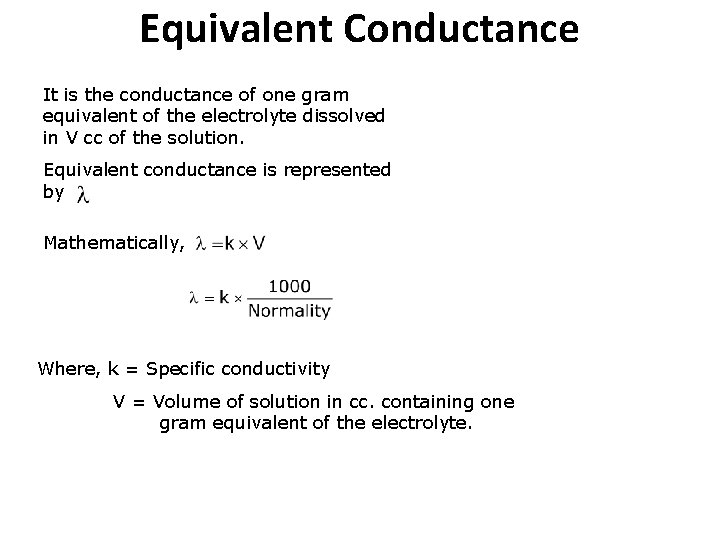
Equivalent Conductance It is the conductance of one gram equivalent of the electrolyte dissolved in V cc of the solution. Equivalent conductance is represented by Mathematically, Where, k = Specific conductivity V = Volume of solution in cc. containing one gram equivalent of the electrolyte.
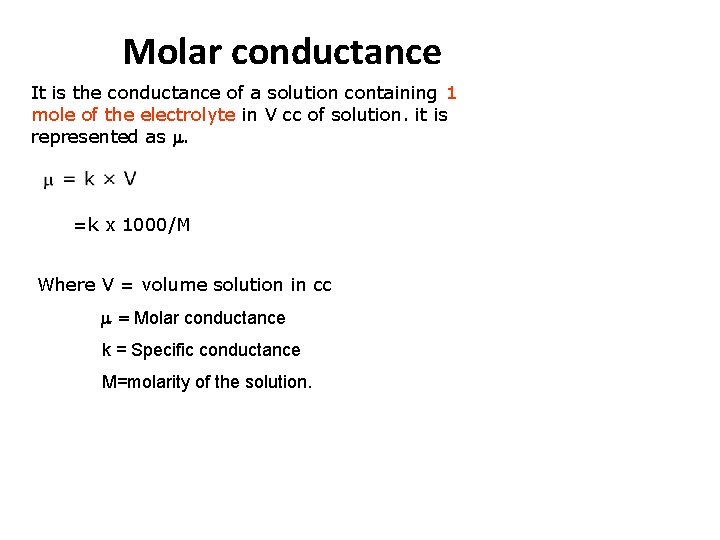
Molar conductance It is the conductance of a solution containing 1 mole of the electrolyte in V cc of solution. it is represented as m. =k x 1000/M Where V = volume solution in cc m = Molar conductance k = Specific conductance M=molarity of the solution.
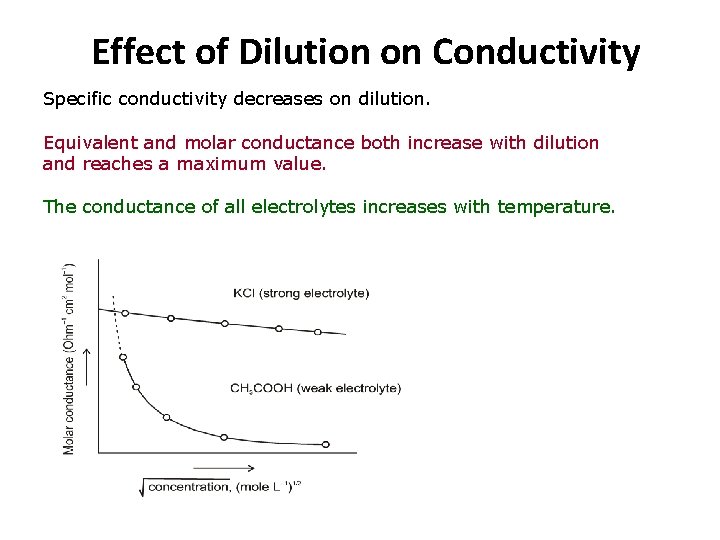
Effect of Dilution on Conductivity Specific conductivity decreases on dilution. Equivalent and molar conductance both increase with dilution and reaches a maximum value. The conductance of all electrolytes increases with temperature.
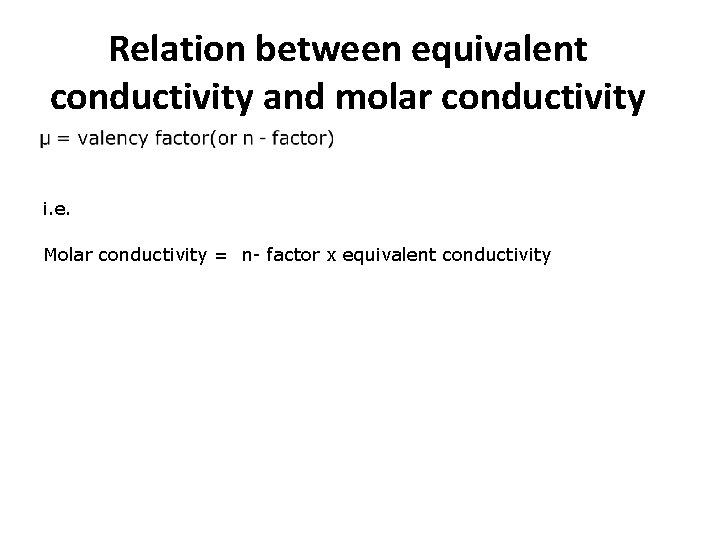
Relation between equivalent conductivity and molar conductivity i. e. Molar conductivity = n- factor x equivalent conductivity
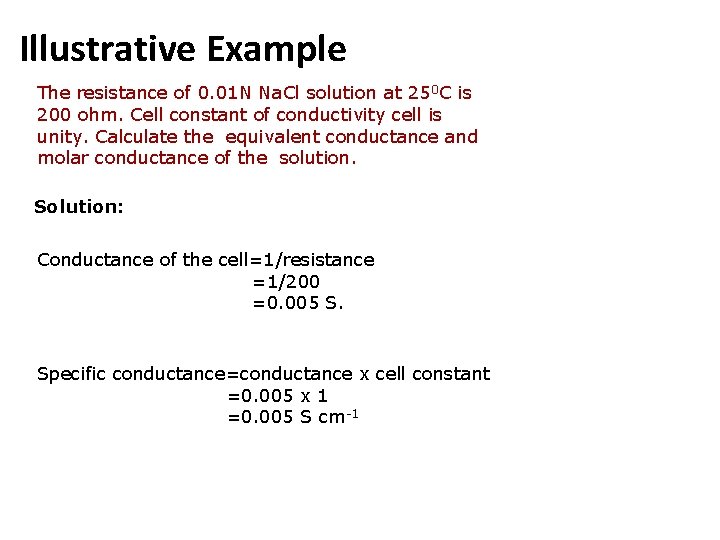
Illustrative Example The resistance of 0. 01 N Na. Cl solution at 250 C is 200 ohm. Cell constant of conductivity cell is unity. Calculate the equivalent conductance and molar conductance of the solution. Solution: Conductance of the cell=1/resistance =1/200 =0. 005 S. Specific conductance=conductance x cell constant =0. 005 x 1 =0. 005 S cm-1
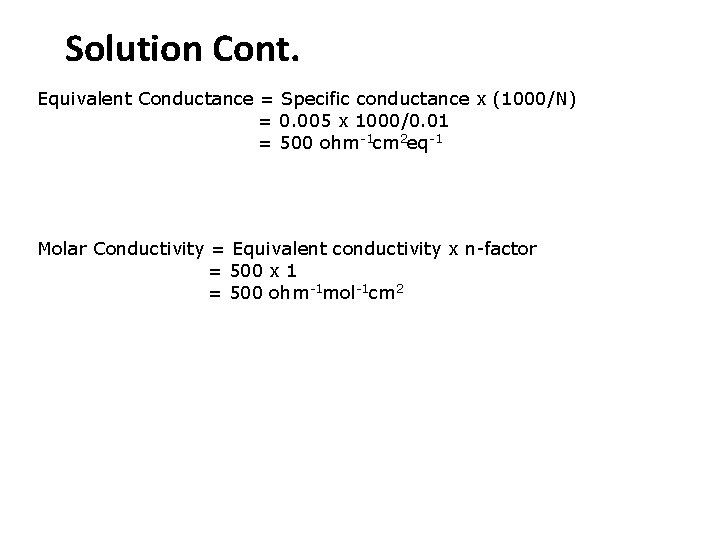
Solution Cont. Equivalent Conductance = Specific conductance x (1000/N) = 0. 005 x 1000/0. 01 = 500 ohm-1 cm 2 eq-1 Molar Conductivity = Equivalent conductivity x n-factor = 500 x 1 = 500 ohm-1 mol-1 cm 2
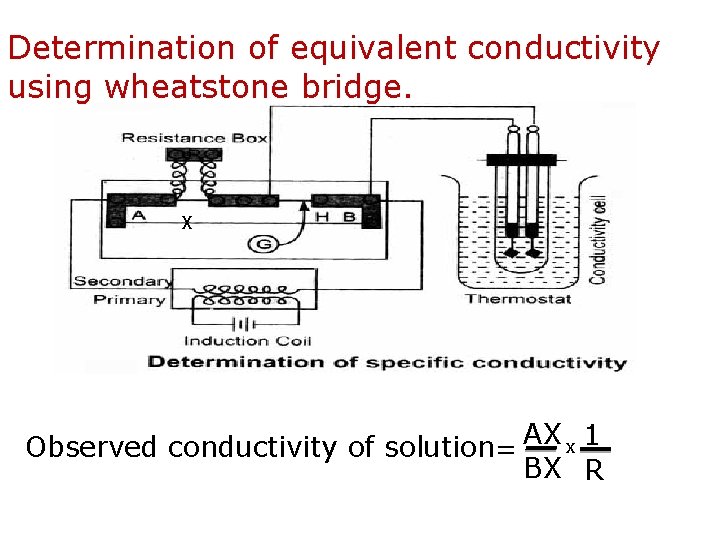
Determination of equivalent conductivity using wheatstone bridge. X AX x 1 Observed conductivity of solution= BX R
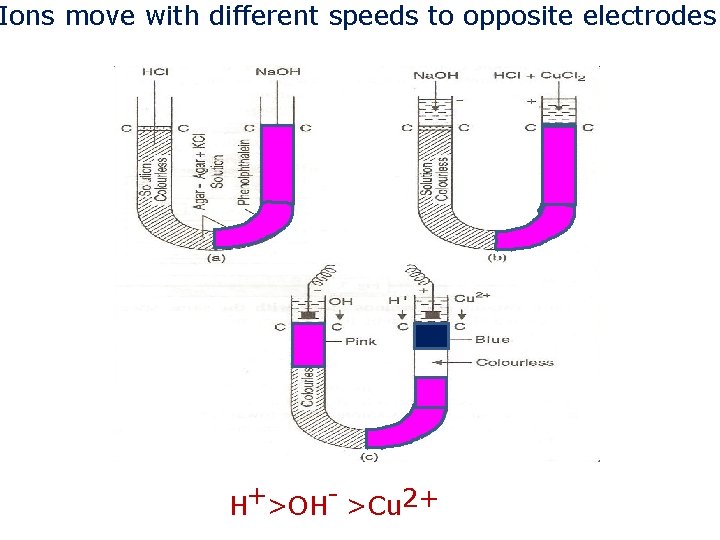
Ions move with different speeds to opposite electrodes H+>OH- >Cu 2+
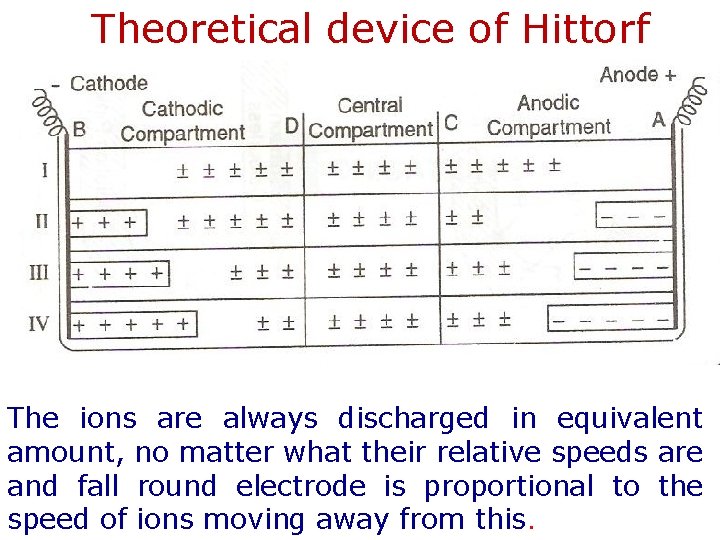
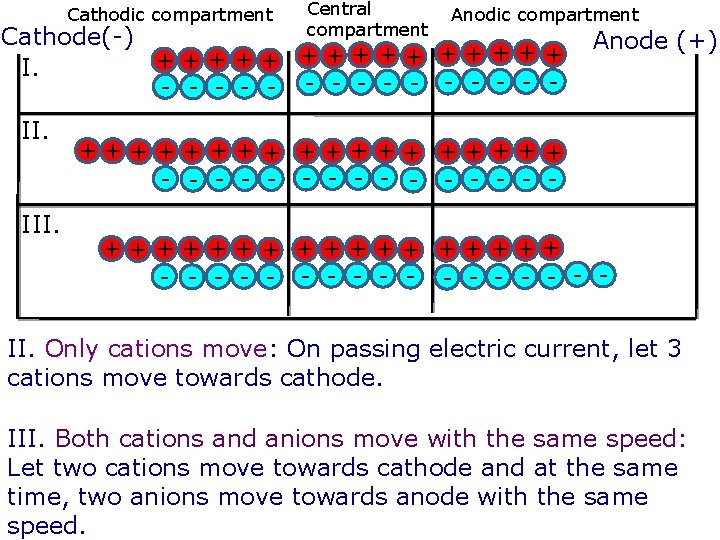
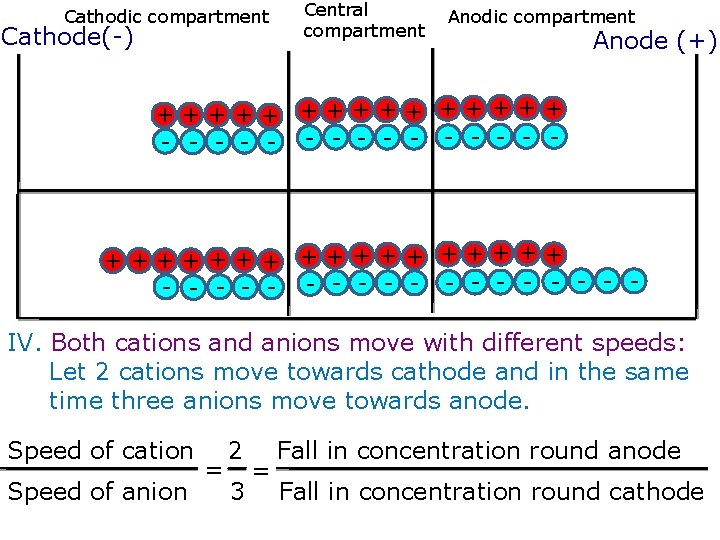
Theoretical device of Hittorf The ions are always discharged in equivalent amount, no matter what their relative speeds are and fall round electrode is proportional to the speed of ions moving away from this.
Cathodic compartment Central compartment Anodic compartment Cathode(-) +++++ + + + I. - - - - II. III. Anode (+) +++++ - - - - +++++++ - - - - - II. Only cations move: On passing electric current, let 3 cations move towards cathode. III. Both cations and anions move with the same speed: Let two cations move towards cathode and at the same time, two anions move towards anode with the same speed.
Cathodic compartment Cathode(-) Central compartment Anodic compartment Anode (+) +++++ - - - - +++++++ - - - - - IV. Both cations and anions move with different speeds: Let 2 cations move towards cathode and in the same time three anions move towards anode. Speed of cation Speed of anion = 2 3 = Fall in concentration round anode Fall in concentration round cathode
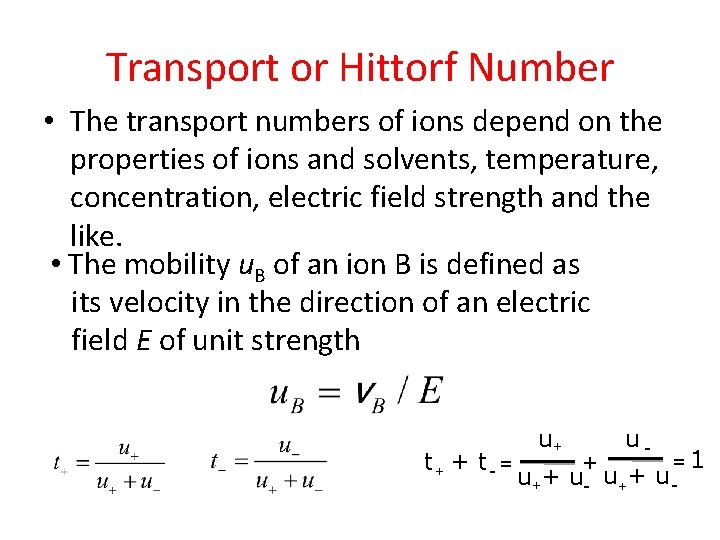
Transport or Hittorf Number • The transport numbers of ions depend on the properties of ions and solvents, temperature, concentration, electric field strength and the like. • The mobility u. B of an ion B is defined as its velocity in the direction of an electric field E of unit strength t+ + t-= u+ u+ + + u- uu++ =1 u-
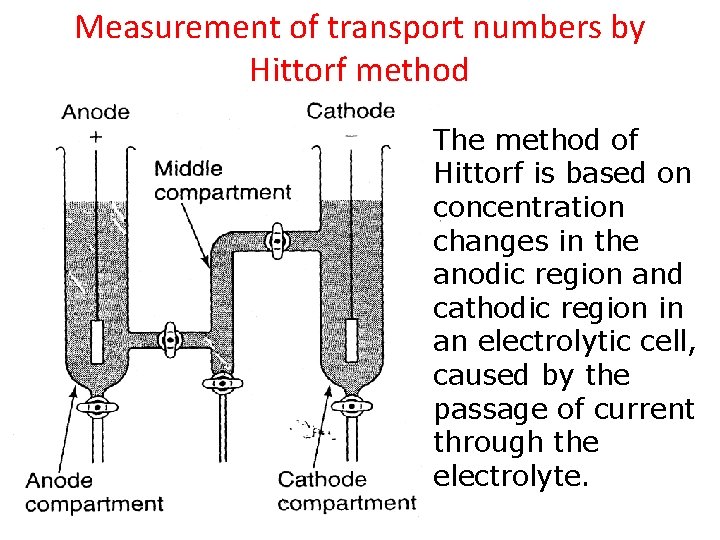
Measurement of transport numbers by Hittorf method The method of Hittorf is based on concentration changes in the anodic region and cathodic region in an electrolytic cell, caused by the passage of current through the electrolyte.
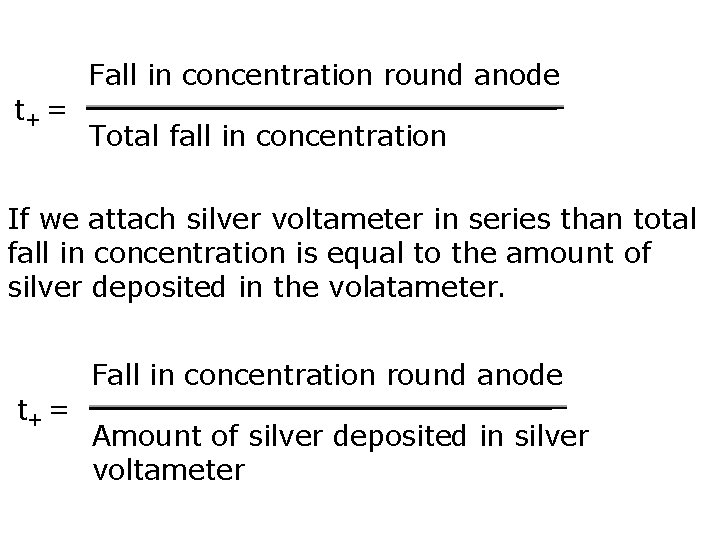
t+ = Fall in concentration round anode Total fall in concentration If we attach silver voltameter in series than total fall in concentration is equal to the amount of silver deposited in the volatameter. t+ = Fall in concentration round anode Amount of silver deposited in silver voltameter
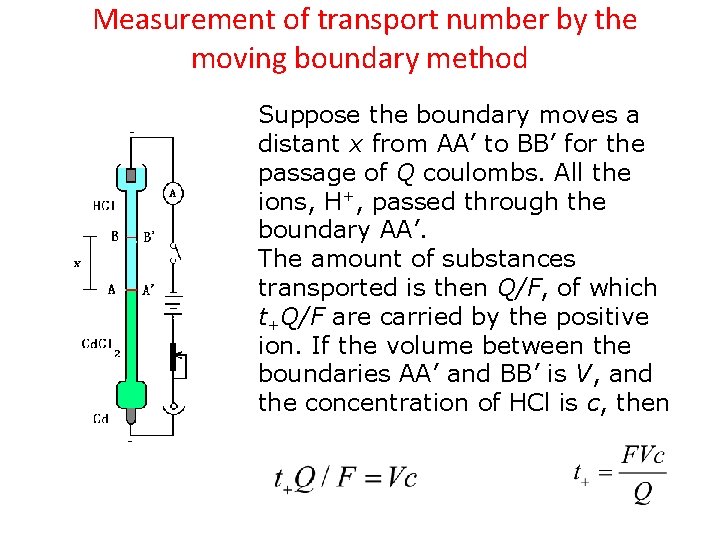
Measurement of transport number by the moving boundary method Suppose the boundary moves a distant x from AA’ to BB’ for the passage of Q coulombs. All the ions, H+, passed through the boundary AA’. The amount of substances transported is then Q/F, of which t+Q/F are carried by the positive ion. If the volume between the boundaries AA’ and BB’ is V, and the concentration of HCl is c, then
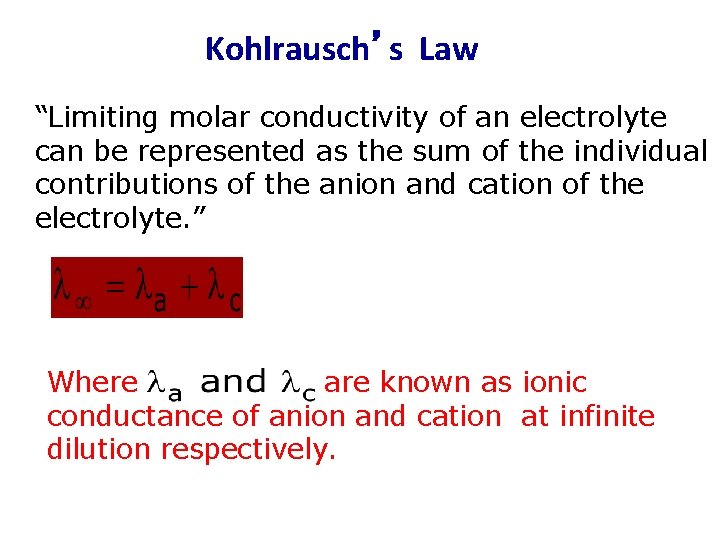
Kohlrausch’s Law “Limiting molar conductivity of an electrolyte can be represented as the sum of the individual contributions of the anion and cation of the electrolyte. ” Where are known as ionic conductance of anion and cation at infinite dilution respectively.
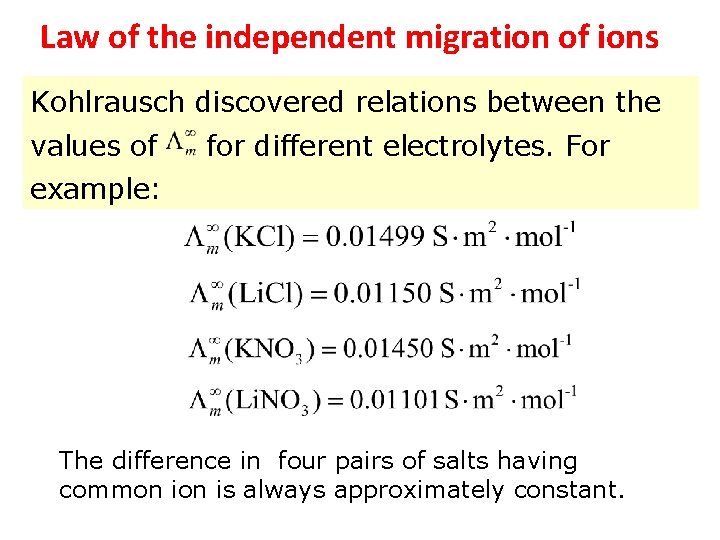
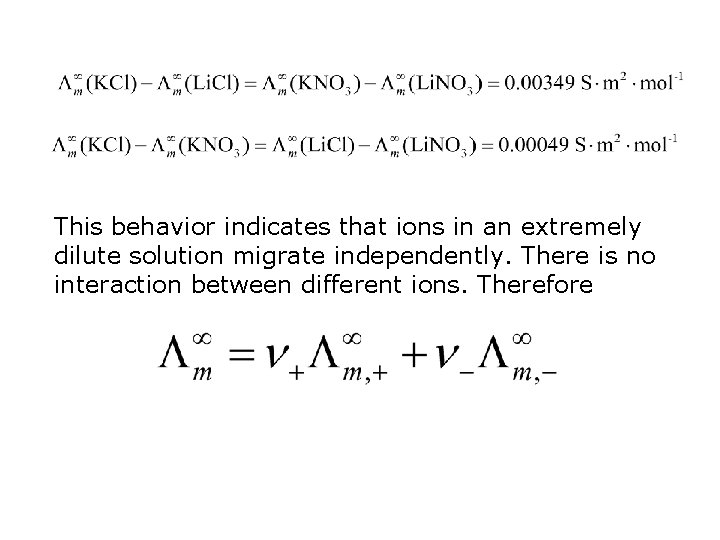
Law of the independent migration of ions Kohlrausch discovered relations between the values of for different electrolytes. For example: The difference in four pairs of salts having common is always approximately constant.
This behavior indicates that ions in an extremely dilute solution migrate independently. There is no interaction between different ions. Therefore
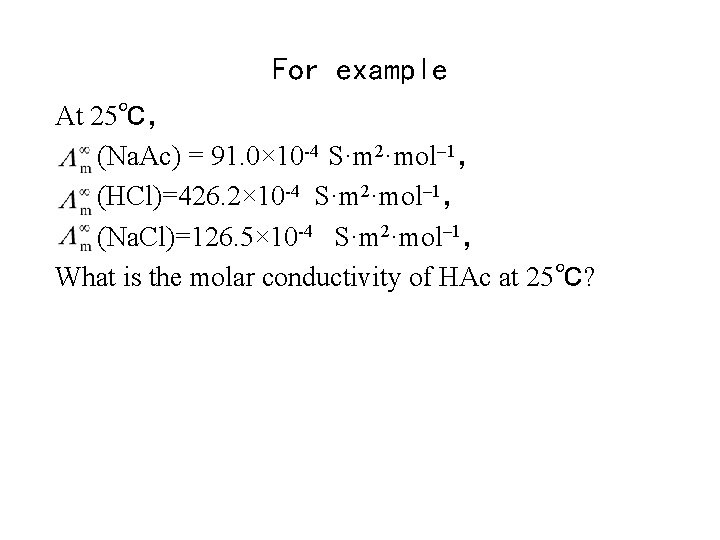
For example At 25℃, (Na. Ac) = 91. 0× 10 -4 S·m 2·mol– 1, (HCl)=426. 2× 10 -4 S·m 2·mol– 1, (Na. Cl)=126. 5× 10 -4 S·m 2·mol– 1, What is the molar conductivity of HAc at 25℃?
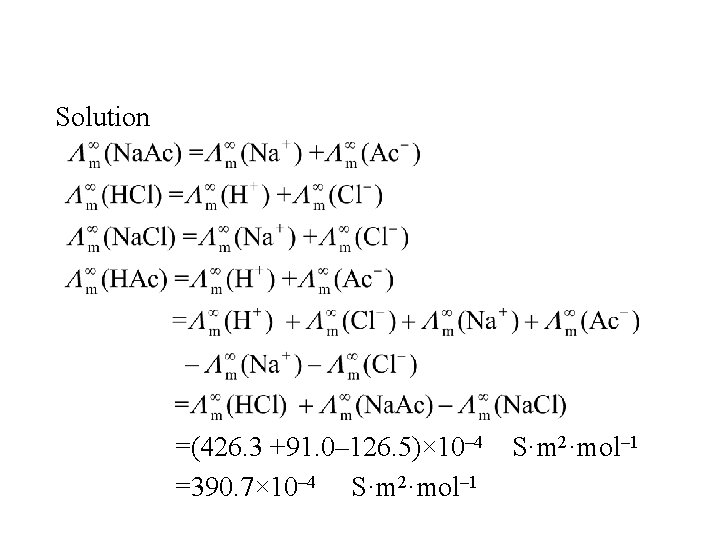
Solution =(426. 3 +91. 0– 126. 5)× 10– 4 S·m 2·mol– 1 =390. 7× 10– 4 S·m 2·mol– 1
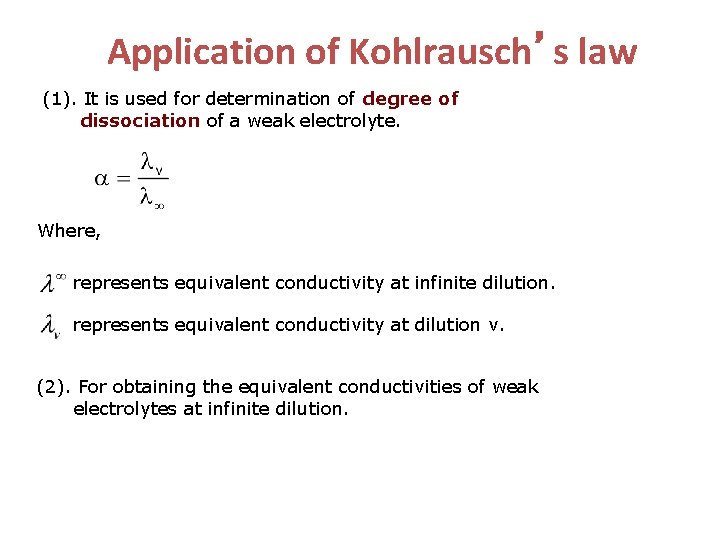
Application of Kohlrausch’s law (1). It is used for determination of degree of dissociation of a weak electrolyte. Where, represents equivalent conductivity at infinite dilution. represents equivalent conductivity at dilution v. (2). For obtaining the equivalent conductivities of weak electrolytes at infinite dilution.
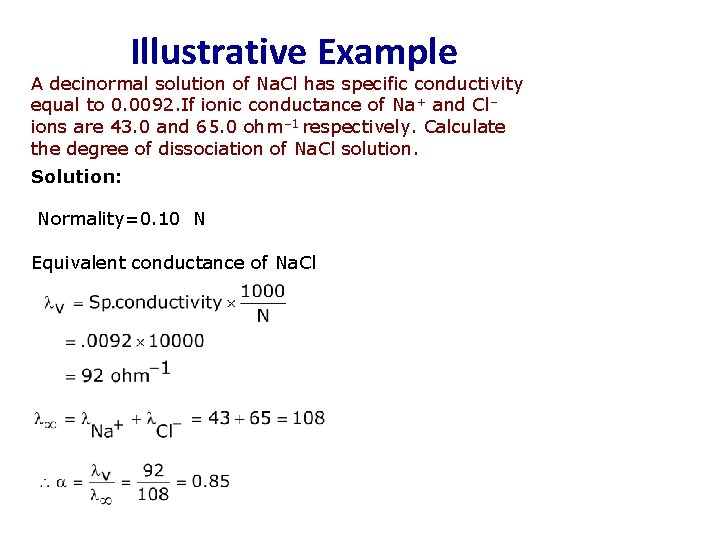
Illustrative Example A decinormal solution of Na. Cl has specific conductivity equal to 0. 0092. If ionic conductance of Na+ and Cl– ions are 43. 0 and 65. 0 ohm– 1 respectively. Calculate the degree of dissociation of Na. Cl solution. Solution: Normality=0. 10 N Equivalent conductance of Na. Cl
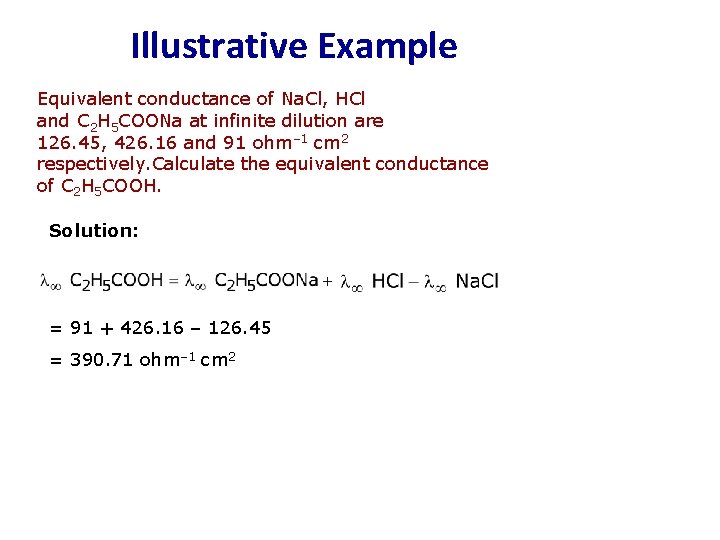
Illustrative Example Equivalent conductance of Na. Cl, HCl and C 2 H 5 COONa at infinite dilution are 126. 45, 426. 16 and 91 ohm– 1 cm 2 respectively. Calculate the equivalent conductance of C 2 H 5 COOH. Solution: = 91 + 426. 16 – 126. 45 = 390. 71 ohm– 1 cm 2
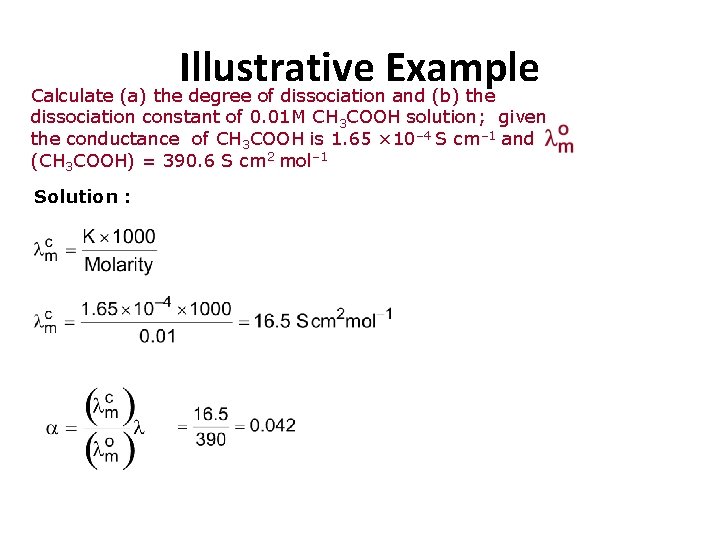
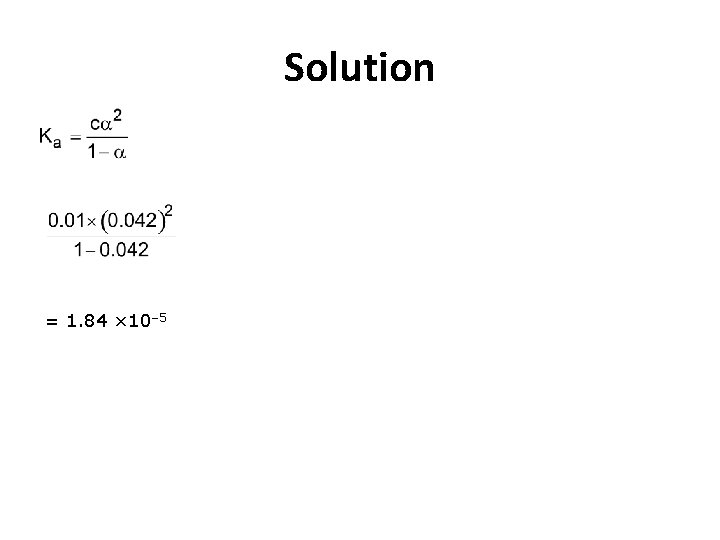
Illustrative Example Calculate (a) the degree of dissociation and (b) the dissociation constant of 0. 01 M CH 3 COOH solution; given the conductance of CH 3 COOH is 1. 65 × 10– 4 S cm– 1 and (CH 3 COOH) = 390. 6 S cm 2 mol– 1 Solution :
Solution = 1. 84 × 10– 5
Thank you