
Dimensional Analysis and Its Applications Dr J Badshah

Dimensional Analysis and Its Applications Dr. J. Badshah University Professor – cum - Chief Scientist Dairy Engineering Department Sanjay Gandhi Institute of Dairy Science & Technology, Jagdeopath, Patna (Bihar Animal Sciences University, Patna)
Dimensional Analysis q Dimensional Analysis is a process of arranging various factors in a manner that it forms dimensionless number. Its principal use is to deduce the expression of dependent variable in terms of independent variables in a study. q An equation will be dimensionally homogeneous if the dimensions of various terms on the two sides of the equation are identical. A dimensionally homogeneous equation is independent of the fundamental units of measurement and is applicable to all systems of units. q T = 2π √l/g, Dimension on LHS and RHS same as [T] shows homogeneity of equation. q Utilized in developing of models to predict the mechanisms and economize the resources (6 Ms) requirements. q Utilized for hydraulic similitude of Prototype and model of physical structure, equipments, Machines and products for safe and efficient design.
Application of Dimensional Analysis v Application of Dimensional Analysis q To determine the dimensional homogeneity of any equation which helps to determine the dimensions and thus the units of any quantity. q Units can be easily transformed from one system to another. q To establish relationship between number of variables. q To reduce equations by arranging variables in dimensionless forms. q The application of dimensional analysis to mathematically represent engineering problems consists of several steps. v Steps for Dimensional Analysis q Formulate a differential equations and/or algebraic expressions which adequately describe the problem, together with the required boundary conditions; q Select the appropriate dimensionless variables tor all independent and dependent variables involved, using arbitrary terms or boundary values for the denominator in each case;
Steps for Dimensional Analysis q Substitute the new dimensionless variables into each differential equation and boundary condition to normalize them; q Group into functional form all dimensionless variables and those parameters generated; q Reduce the functionality to the minimum possible number of independent groups; and q Drop any groups in which the arbitrary terms can not be divided out using other groups of the functionality.
Rayleigh’s Method for Dimensional Analysis • Independent variables are identified which will express the functional relationship most closely. A maximum of three to four variables must be selected. • If the dependent variable X is some function of the independent variables x 1, x 2, x 3…. , • The equation is written as: X = f (x 1, x 2, x 3 …) • Above equation may be written as: • X = C(x 1 a , x 2 b , x 3 c , …), where C is a dimensionless coefficient to be determined through experiments Values of a, b, c etc are determined by comparing the powers on both sides.
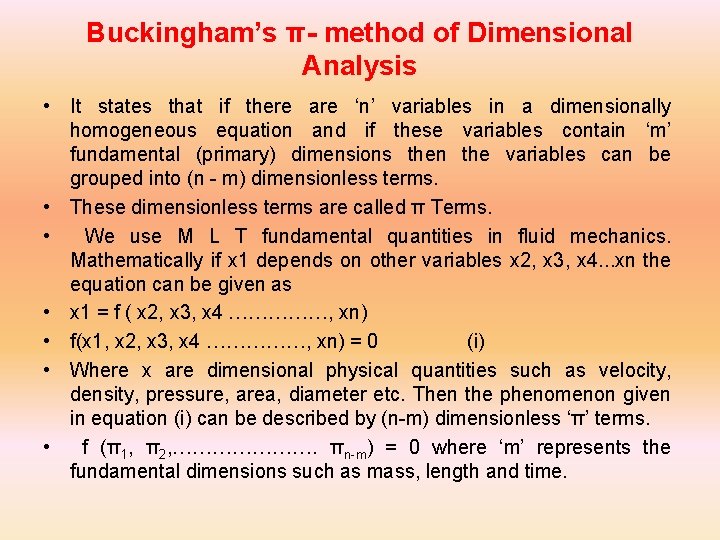
Buckingham’s π- method of Dimensional Analysis • It states that if there are ‘n’ variables in a dimensionally homogeneous equation and if these variables contain ‘m’ fundamental (primary) dimensions then the variables can be grouped into (n - m) dimensionless terms. • These dimensionless terms are called π Terms. • We use M L T fundamental quantities in fluid mechanics. Mathematically if x 1 depends on other variables x 2, x 3, x 4. . . xn the equation can be given as • x 1 = f ( x 2, x 3, x 4 ……………, xn) • f(x 1, x 2, x 3, x 4 ……………, xn) = 0 (i) • Where x are dimensional physical quantities such as velocity, density, pressure, area, diameter etc. Then the phenomenon given in equation (i) can be described by (n-m) dimensionless ‘π’ terms. • f (π1, π2, …………………. πn-m) = 0 where ‘m’ represents the fundamental dimensions such as mass, length and time.
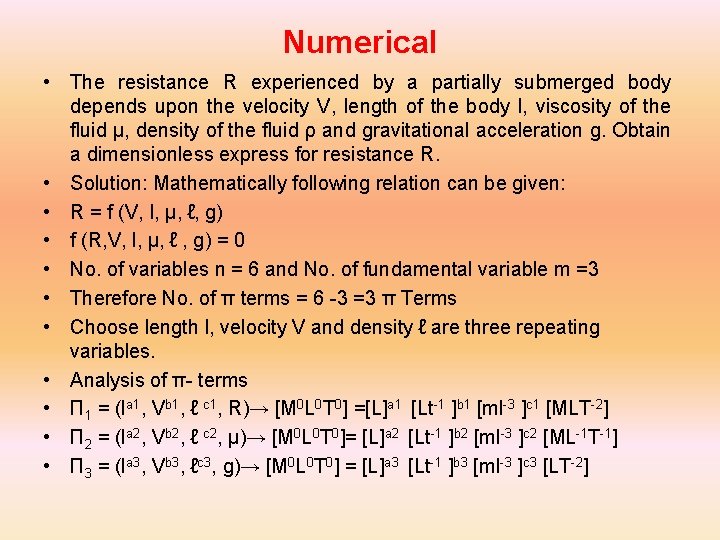
Numerical • The resistance R experienced by a partially submerged body depends upon the velocity V, length of the body l, viscosity of the fluid µ, density of the fluid ρ and gravitational acceleration g. Obtain a dimensionless express for resistance R. • Solution: Mathematically following relation can be given: • R = f (V, l, µ, ℓ, g) • f (R, V, l, µ, ℓ , g) = 0 • No. of variables n = 6 and No. of fundamental variable m =3 • Therefore No. of π terms = 6 -3 =3 π Terms • Choose length l, velocity V and density ℓ are three repeating variables. • Analysis of π- terms • Π 1 = (la 1, Vb 1, ℓ c 1, R)→ [M 0 L 0 T 0] =[L]a 1 [Lt-1 ]b 1 [ml-3 ]c 1 [MLT-2] • Π 2 = (la 2, Vb 2, ℓ c 2, µ)→ [M 0 L 0 T 0]= [L]a 2 [Lt-1 ]b 2 [ml-3 ]c 2 [ML-1 T-1] • Π 3 = (la 3, Vb 3, ℓc 3, g)→ [M 0 L 0 T 0] = [L]a 3 [Lt-1 ]b 3 [ml-3 ]c 3 [LT-2]
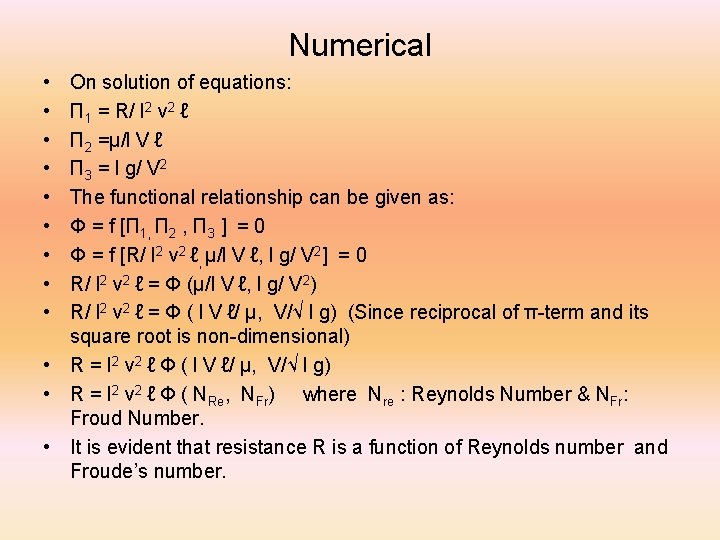
Numerical • • • On solution of equations: Π 1 = R/ l 2 v 2 ℓ Π 2 =µ/l V ℓ Π 3 = l g/ V 2 The functional relationship can be given as: Φ = f [Π 1, Π 2 , Π 3 ] = 0 Φ = f [R/ l 2 v 2 ℓ, µ/l V ℓ, l g/ V 2] = 0 R/ l 2 v 2 ℓ = Φ (µ/l V ℓ, l g/ V 2) R/ l 2 v 2 ℓ = Φ ( l V ℓ/ µ, V/√ l g) (Since reciprocal of π-term and its square root is non-dimensional) • R = l 2 v 2 ℓ Φ ( l V ℓ/ µ, V/√ l g) • R = l 2 v 2 ℓ Φ ( NRe, NFr) where Nre : Reynolds Number & NFr: Froud Number. • It is evident that resistance R is a function of Reynolds number and Froude’s number.
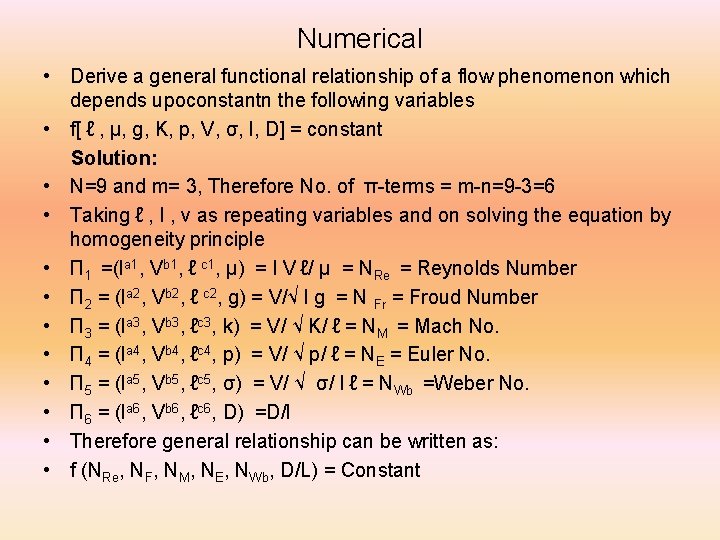
Numerical • Derive a general functional relationship of a flow phenomenon which depends upoconstantn the following variables • f[ ℓ , µ, g, K, p, V, σ, l, D] = constant Solution: • N=9 and m= 3, Therefore No. of π-terms = m-n=9 -3=6 • Taking ℓ , l , v as repeating variables and on solving the equation by homogeneity principle • Π 1 =(la 1, Vb 1, ℓ c 1, µ) = l V ℓ/ µ = NRe = Reynolds Number • Π 2 = (la 2, Vb 2, ℓ c 2, g) = V/√ l g = N Fr = Froud Number • Π 3 = (la 3, Vb 3, ℓc 3, k) = V/ √ K/ ℓ = NM = Mach No. • Π 4 = (la 4, Vb 4, ℓc 4, p) = V/ √ p/ ℓ = NE = Euler No. • Π 5 = (la 5, Vb 5, ℓc 5, σ) = V/ √ σ/ l ℓ = NWb =Weber No. • Π 6 = (la 6, Vb 6, ℓc 6, D) =D/l • Therefore general relationship can be written as: • f (NRe, NF, NM, NE, NWb, D/L) = Constant

- Slides: 10