TH 18 TH 20 CENTURY WORLD Intellectual and
- Slides: 86
TH 18 – TH 20 CENTURY WORLD Intellectual and Scientific Movements Industrial Revolution --Dr. Sujata Menon
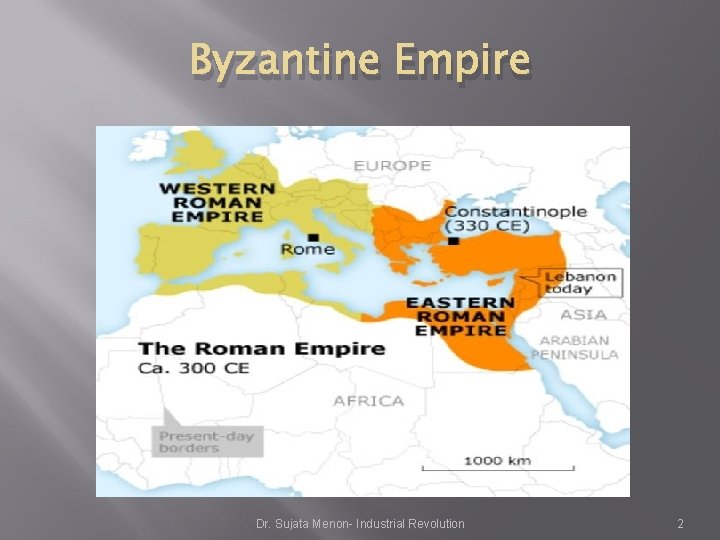
Byzantine Empire Dr. Sujata Menon- Industrial Revolution 2
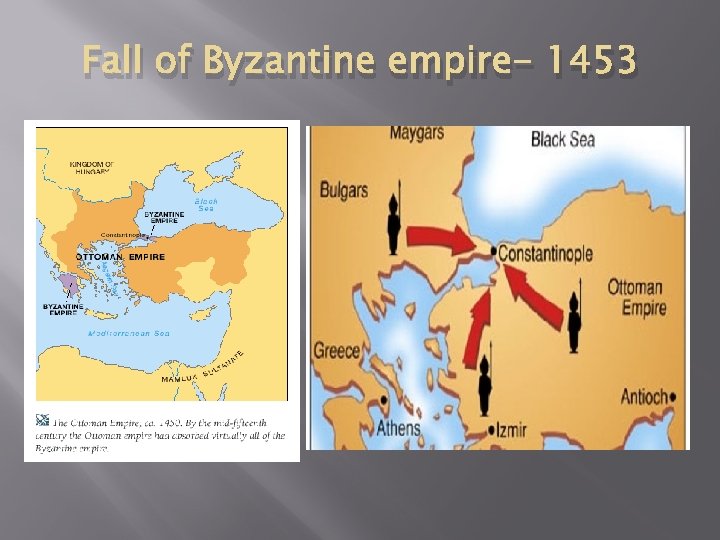
Fall of Byzantine empire- 1453
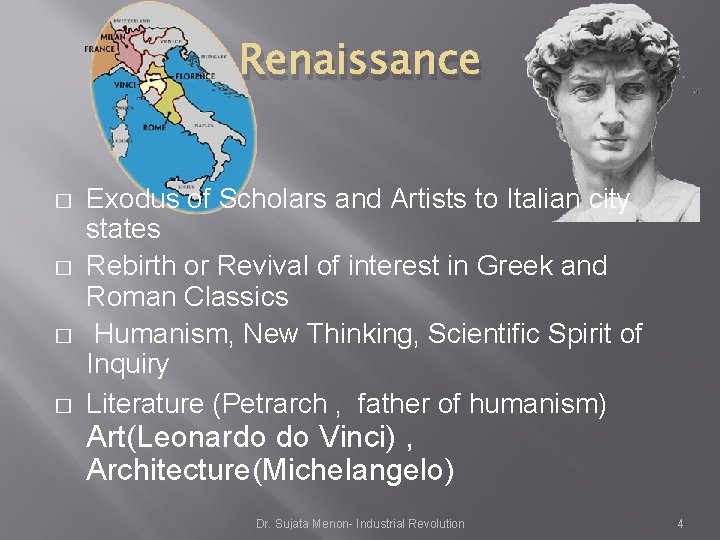
Renaissance � � Exodus of Scholars and Artists to Italian city states Rebirth or Revival of interest in Greek and Roman Classics Humanism, New Thinking, Scientific Spirit of Inquiry Literature (Petrarch , father of humanism) Art(Leonardo do Vinci) , Architecture(Michelangelo) Dr. Sujata Menon- Industrial Revolution 4
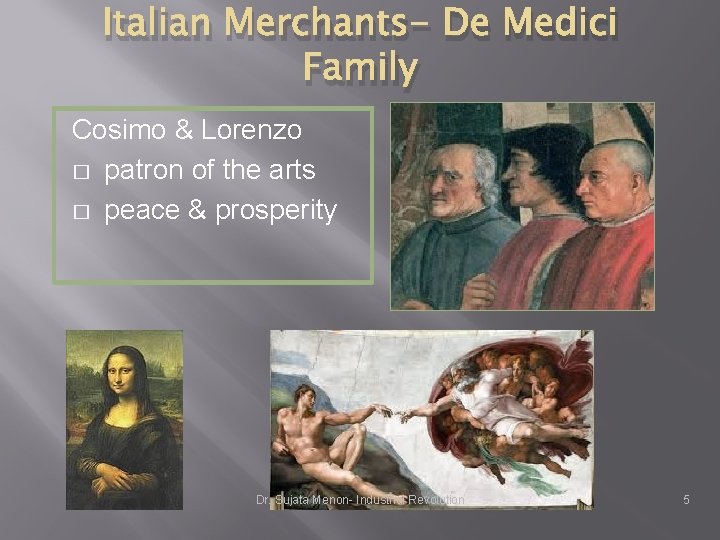
Italian Merchants- De Medici Family Cosimo & Lorenzo � patron of the arts � peace & prosperity Dr. Sujata Menon- Industrial Revolution 5
Invention of printing Press. Johannes Gutenberg(1398 - 1468) Gutenberg- Effects � - Mass knowledge possible � Page numbering and indexes invented and used � Standardization in form and spelling � � Reading moves from communal to private activity Authorship becomes more important and profitable. Early copyright and intellectual property laws established Decline of Latin and move towards vernacular language use Dr. Sujata Menon- Industrial Revolution 6
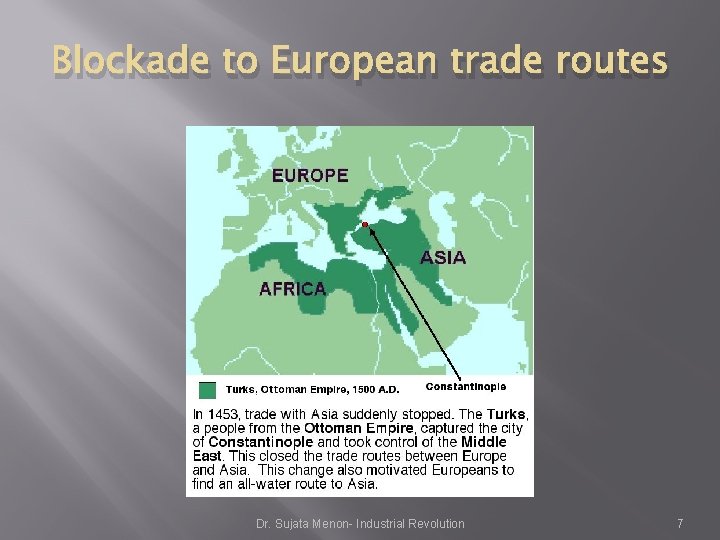
Blockade to European trade routes Dr. Sujata Menon- Industrial Revolution 7
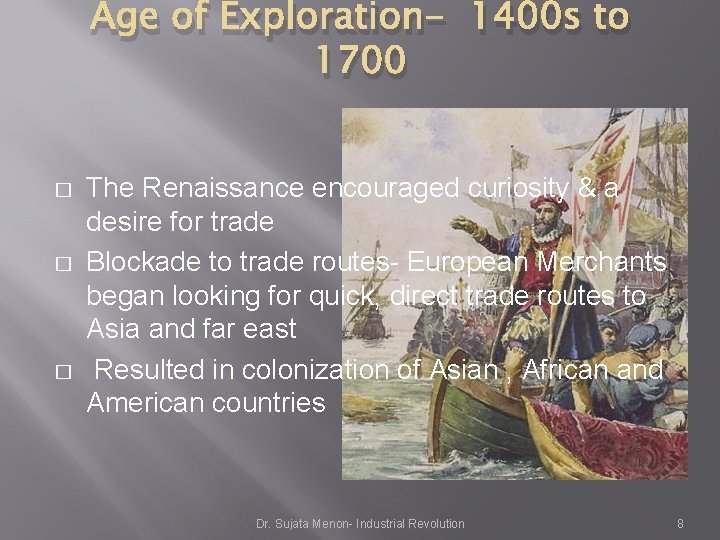
Age of Exploration- 1400 s to 1700 � � � The Renaissance encouraged curiosity & a desire for trade Blockade to trade routes- European Merchants began looking for quick, direct trade routes to Asia and far east Resulted in colonization of Asian , African and American countries Dr. Sujata Menon- Industrial Revolution 8
The Commercial Revolution-16 th 18 th c � � European economic expansion - outcome of the age of discovery It was a major factor contributing to Industrial Revolution in Britain. The Commercial Revolution is marked by an increase in general commerce, and in the growth of financial services such as banking, insurance, and investing. Commercial Revolution changed Europe from a local economy to a global one Dr. Sujata Menon- Industrial Revolution 9
British Agriculture Revolution 1750 -1880 � � � unprecedented increase in agricultural production and subsequent population increase New scientific farming techniques – crop rotation system, Seed drill Enclosure system- large landowners enclosed the common village land to increase the productivity and apply new emerging farming techniques Dr. Sujata Menon- Industrial Revolution 10
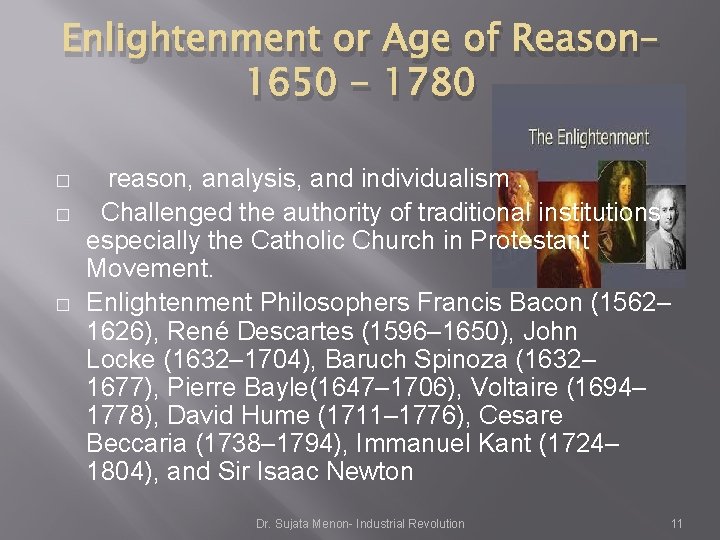
Enlightenment or Age of Reason– 1650 - 1780 � � � reason, analysis, and individualism. Challenged the authority of traditional institutions especially the Catholic Church in Protestant Movement. Enlightenment Philosophers Francis Bacon (1562– 1626), René Descartes (1596– 1650), John Locke (1632– 1704), Baruch Spinoza (1632– 1677), Pierre Bayle(1647– 1706), Voltaire (1694– 1778), David Hume (1711– 1776), Cesare Beccaria (1738– 1794), Immanuel Kant (1724– 1804), and Sir Isaac Newton Dr. Sujata Menon- Industrial Revolution 11
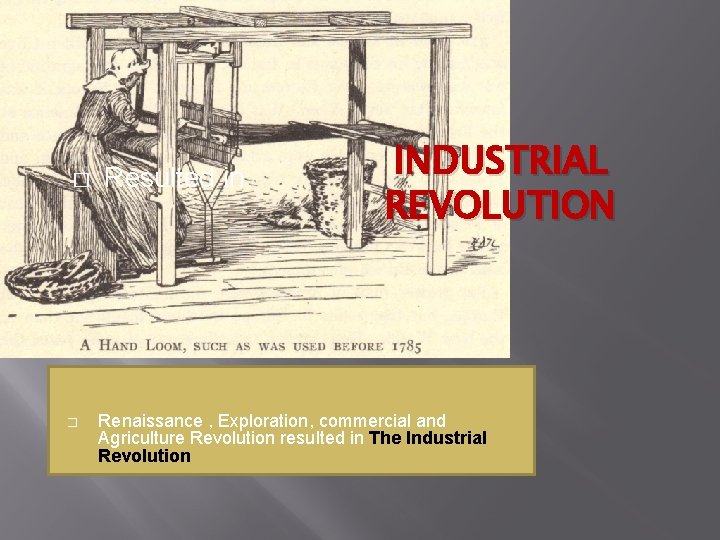
� � Resulted in INDUSTRIAL REVOLUTION Renaissance , Exploration, commercial and Agriculture Revolution resulted in The Industrial Revolution
Industrial Revolution- The Silent Revolution. . still going on… � � � The Industrial Revolution was a fundamental change in the way goods were produced, from human labor to machines Machines replaced human labor. The more efficient means of production and subsequent higher levels of production triggered far-reaching changes to industrialized societies Dr. Sujata Menon- Industrial Revolution 13
Industrial Revolution- Developments and Transformations ü ü ü Development of New energy sources– water, steam, electricity, oil Development and Improvement in Coal, Iron and Steel Transportation Revolution – Steamboats, Trains, Automobiles, avaiation Communication Revolution- Telegraph, Telephone, Radio Agriculture Revolution- Mechanized tools like Harvester, Driller and Agriculture Research Dr. Sujata Menon- Industrial Revolution 14
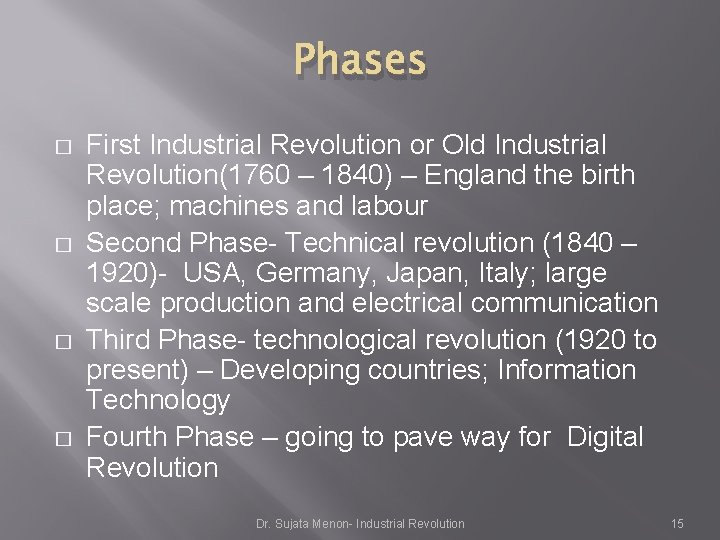
Phases � � First Industrial Revolution or Old Industrial Revolution(1760 – 1840) – England the birth place; machines and labour Second Phase- Technical revolution (1840 – 1920)- USA, Germany, Japan, Italy; large scale production and electrical communication Third Phase- technological revolution (1920 to present) – Developing countries; Information Technology Fourth Phase – going to pave way for Digital Revolution Dr. Sujata Menon- Industrial Revolution 15
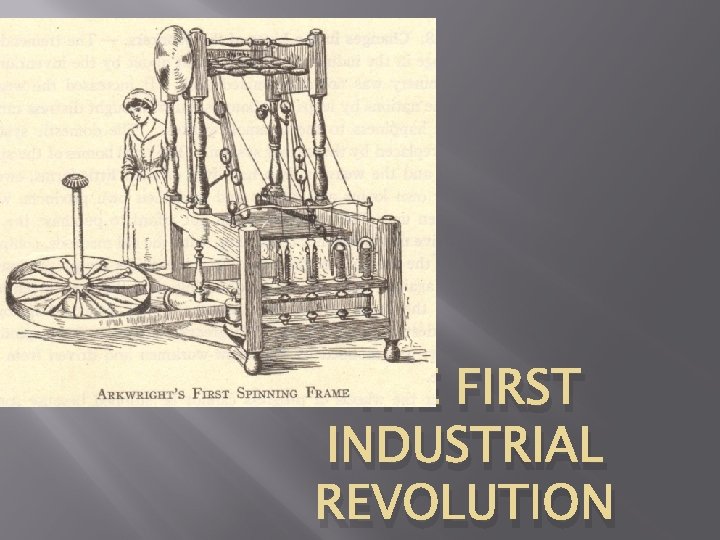
THE FIRST INDUSTRIAL REVOLUTION
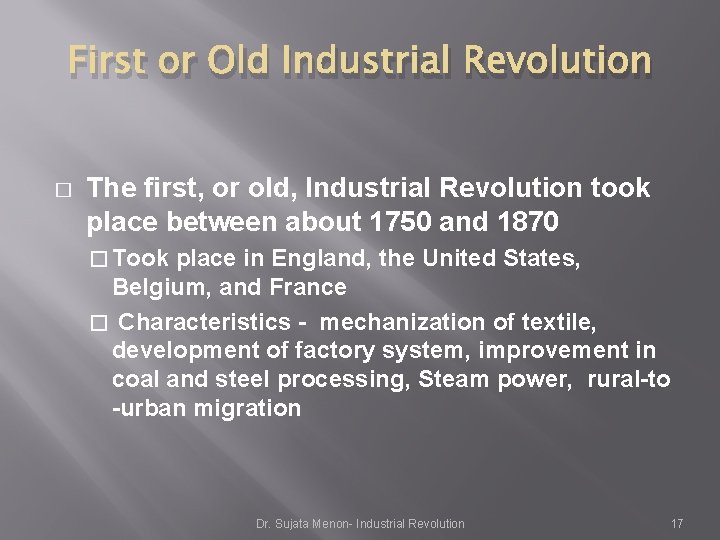
First or Old Industrial Revolution � The first, or old, Industrial Revolution took place between about 1750 and 1870 � Took place in England, the United States, Belgium, and France � Characteristics - mechanization of textile, development of factory system, improvement in coal and steel processing, Steam power, rural-to -urban migration Dr. Sujata Menon- Industrial Revolution 17
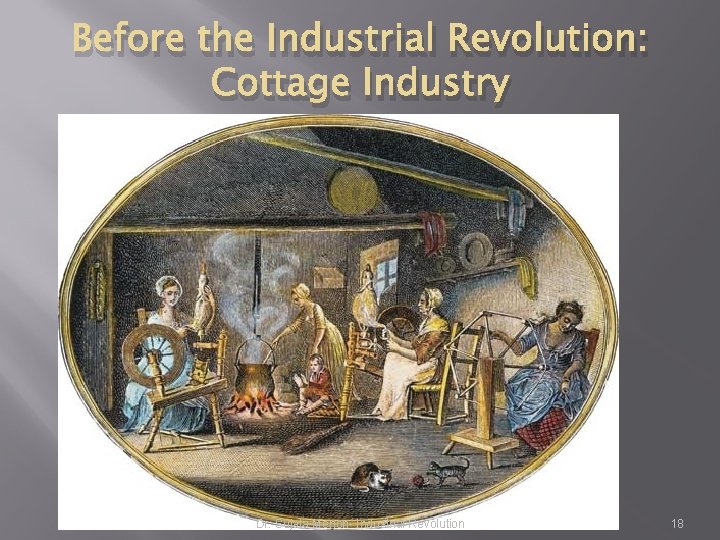
Before the Industrial Revolution: Cottage Industry Dr. Sujata Menon- Industrial Revolution 18
Factory System replaced Domestic System or Cottage Industry � Domestic system of production : Home based or Cottage business ü Labor based ü ü Small scale of production � ü ü ü Factory System of production: Factory Based Machine Large production of goods Dr. Sujata Menon- Industrial Revolution 19
That Nation of Shopkeepers! -- Napoleon Bonaparte
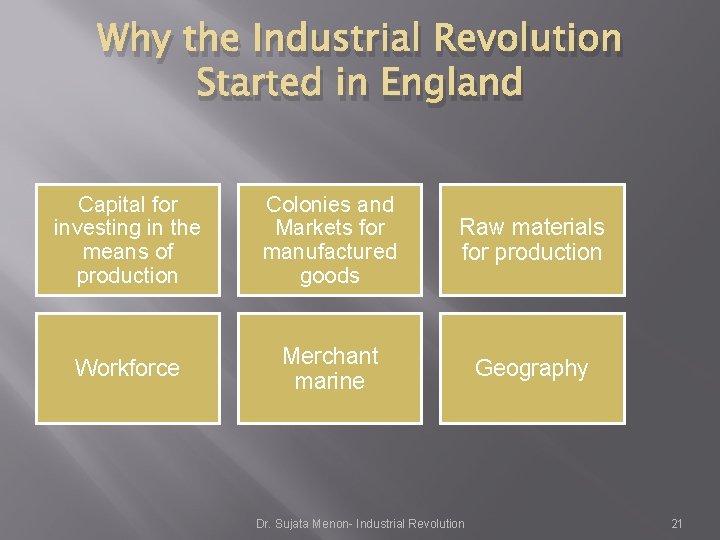
Why the Industrial Revolution Started in England Capital for investing in the means of production Colonies and Markets for manufactured goods Raw materials for production Workforce Merchant marine Geography Dr. Sujata Menon- Industrial Revolution 21
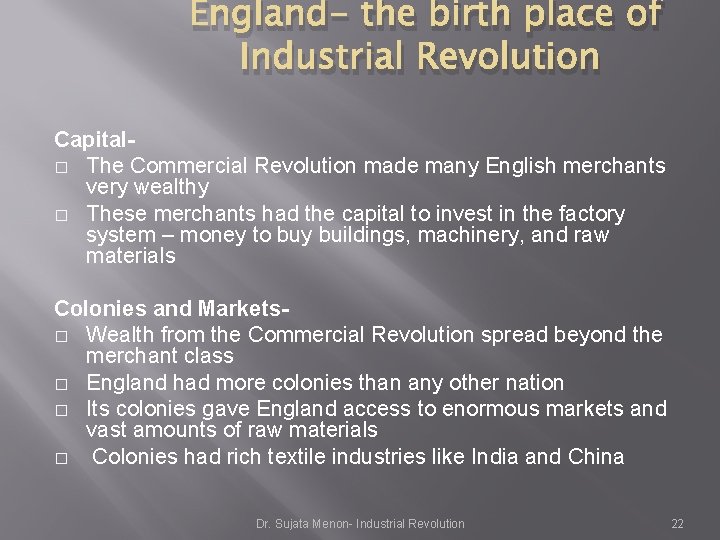
England- the birth place of Industrial Revolution Capital- � The Commercial Revolution made many English merchants very wealthy � These merchants had the capital to invest in the factory system – money to buy buildings, machinery, and raw materials Colonies and Markets- � Wealth from the Commercial Revolution spread beyond the merchant class � England had more colonies than any other nation � Its colonies gave England access to enormous markets and vast amounts of raw materials � Colonies had rich textile industries like India and China Dr. Sujata Menon- Industrial Revolution 22
Cont. . Raw Materials � England itself possessed the necessary raw materials to create the means of production � Coal – vast coal reserves powered steam engines � Iron – basic building block of large machines, railroad tracks, trains, and ships � � � Merchant Marine World’s largest merchant fleet Vast numbers of ships could bring raw materials and finished goods to and from England’s colonies and from other countries Dr. Sujata Menon- Industrial Revolution 23
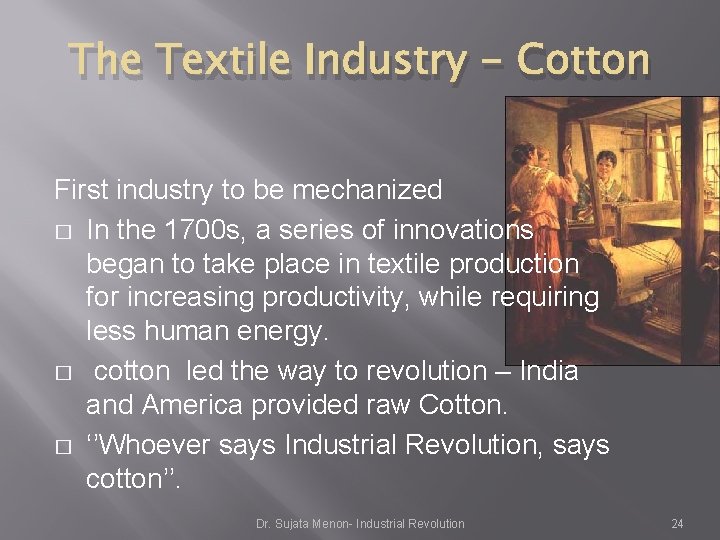
The Textile Industry - Cotton First industry to be mechanized � In the 1700 s, a series of innovations began to take place in textile production for increasing productivity, while requiring less human energy. � cotton led the way to revolution – India and America provided raw Cotton. � ‘’Whoever says Industrial Revolution, says cotton’’. Dr. Sujata Menon- Industrial Revolution 24
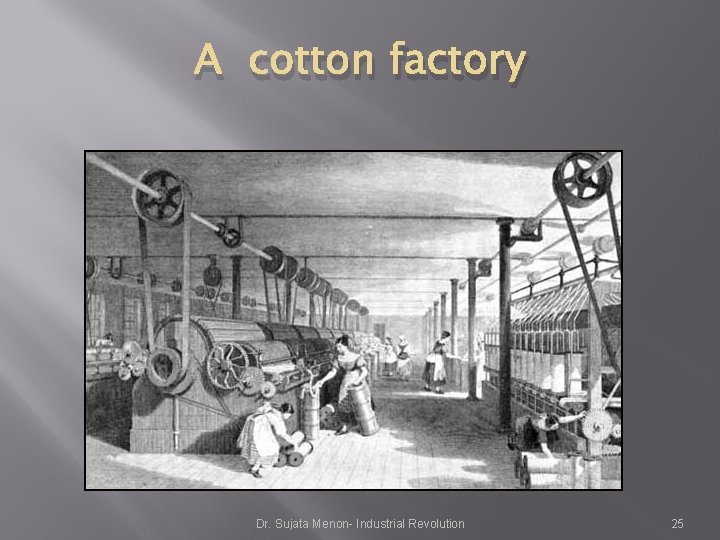
A cotton factory Dr. Sujata Menon- Industrial Revolution 25
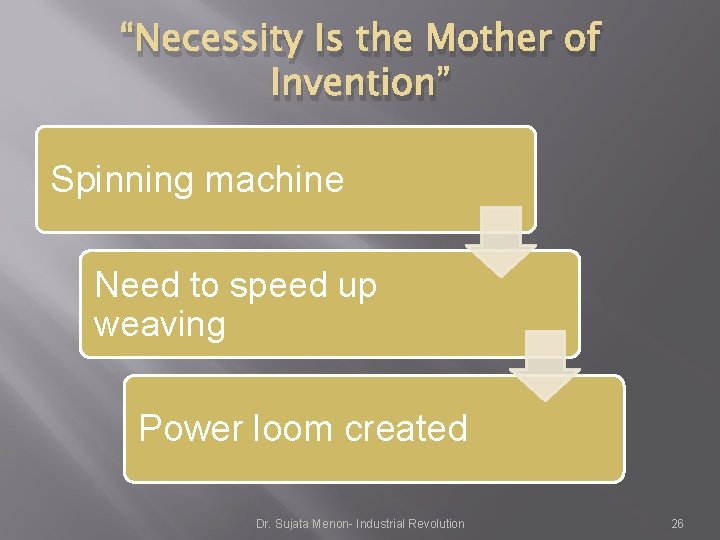
“Necessity Is the Mother of Invention” Spinning machine Need to speed up weaving Power loom created Dr. Sujata Menon- Industrial Revolution 26
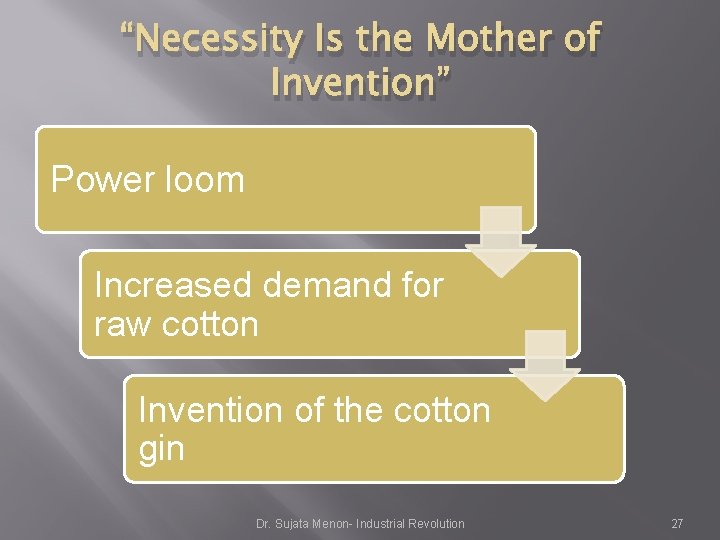
“Necessity Is the Mother of Invention” Power loom Increased demand for raw cotton Invention of the cotton gin Dr. Sujata Menon- Industrial Revolution 27
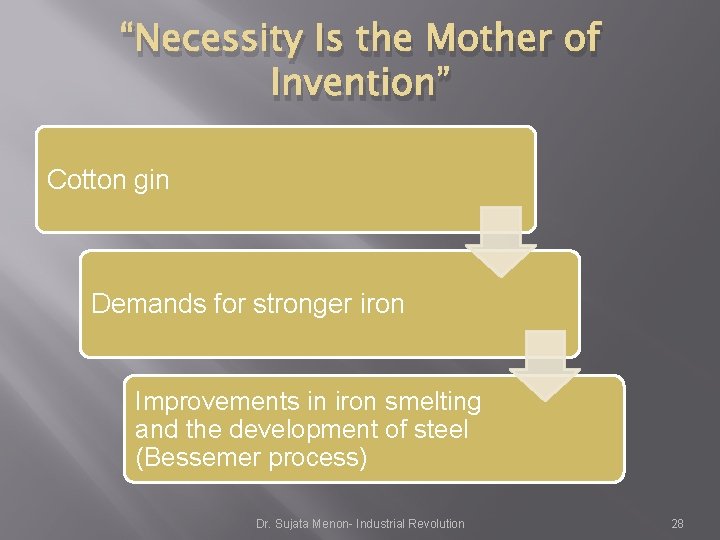
“Necessity Is the Mother of Invention” Cotton gin Demands for stronger iron Improvements in iron smelting and the development of steel (Bessemer process) Dr. Sujata Menon- Industrial Revolution 28
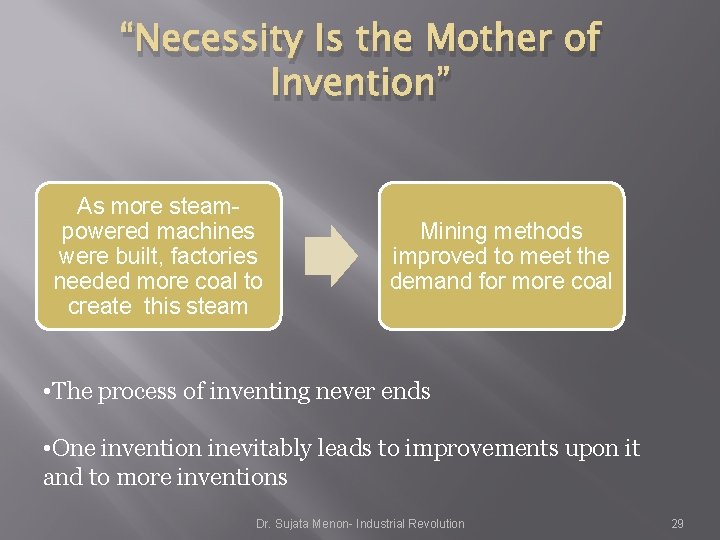
“Necessity Is the Mother of Invention” As more steampowered machines were built, factories needed more coal to create this steam Mining methods improved to meet the demand for more coal • The process of inventing never ends • One invention inevitably leads to improvements upon it and to more inventions Dr. Sujata Menon- Industrial Revolution 29
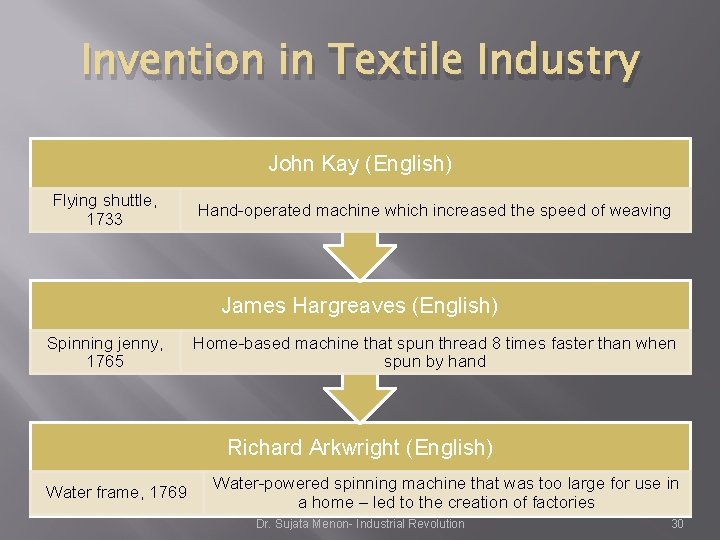
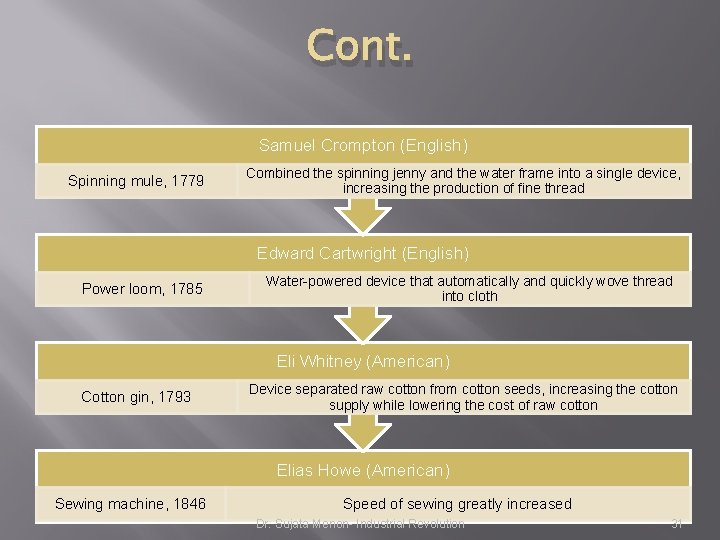
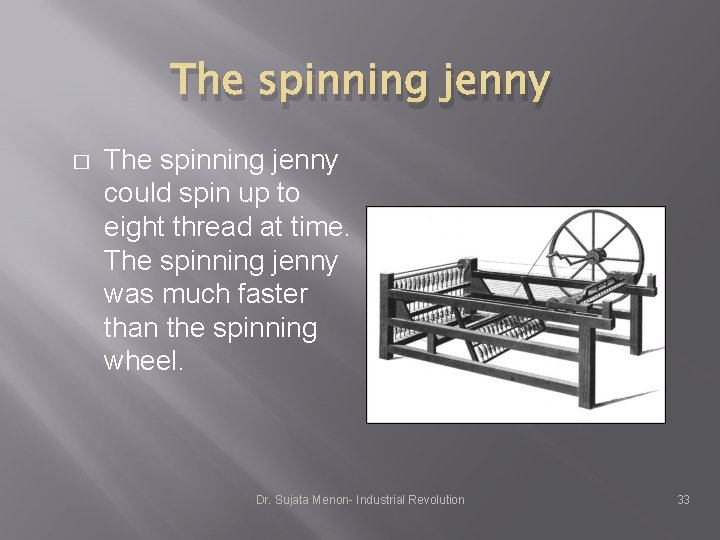
Invention in Textile Industry John Kay (English) Flying shuttle, 1733 Hand-operated machine which increased the speed of weaving James Hargreaves (English) Spinning jenny, 1765 Home-based machine that spun thread 8 times faster than when spun by hand Richard Arkwright (English) Water frame, 1769 Water-powered spinning machine that was too large for use in a home – led to the creation of factories Dr. Sujata Menon- Industrial Revolution 30
Cont. Samuel Crompton (English) Spinning mule, 1779 Combined the spinning jenny and the water frame into a single device, increasing the production of fine thread Edward Cartwright (English) Power loom, 1785 Water-powered device that automatically and quickly wove thread into cloth Eli Whitney (American) Cotton gin, 1793 Device separated raw cotton from cotton seeds, increasing the cotton supply while lowering the cost of raw cotton Elias Howe (American) Sewing machine, 1846 Speed of sewing greatly increased Dr. Sujata Menon- Industrial Revolution 31
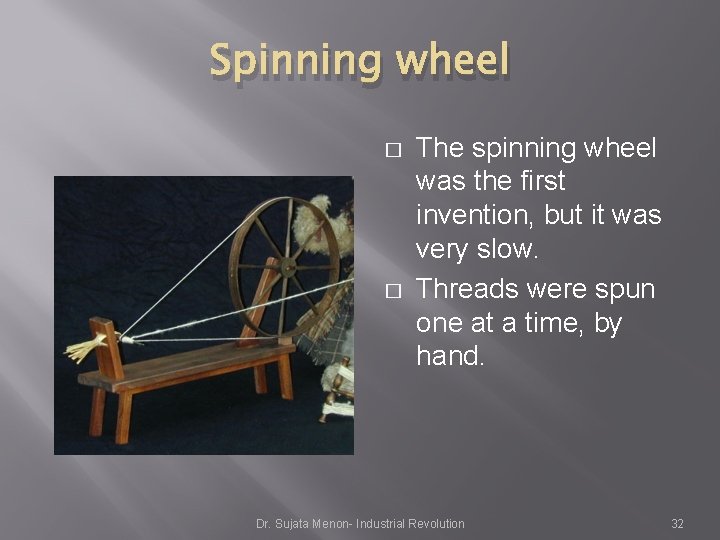
Spinning wheel � � The spinning wheel was the first invention, but it was very slow. Threads were spun one at a time, by hand. Dr. Sujata Menon- Industrial Revolution 32
The spinning jenny � The spinning jenny could spin up to eight thread at time. The spinning jenny was much faster than the spinning wheel. Dr. Sujata Menon- Industrial Revolution 33
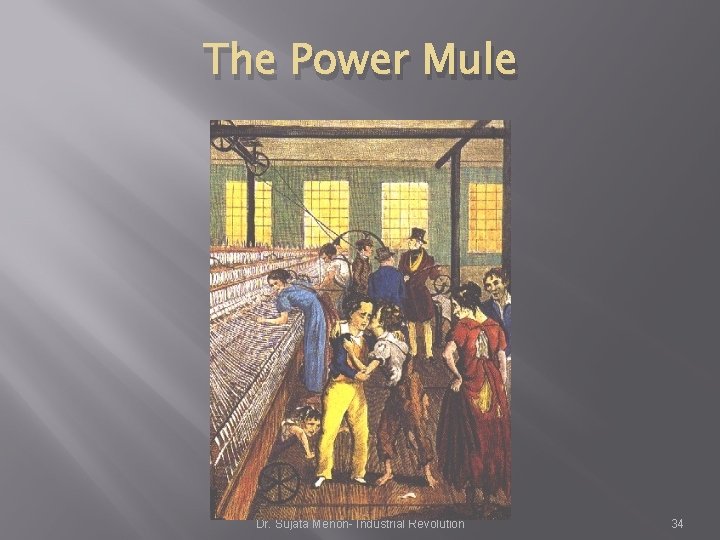
The Power Mule Dr. Sujata Menon- Industrial Revolution 34
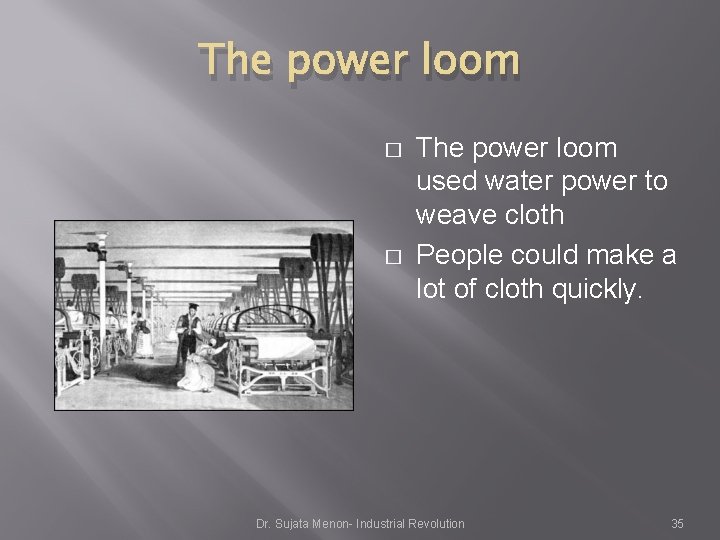
The power loom � � The power loom used water power to weave cloth People could make a lot of cloth quickly. Dr. Sujata Menon- Industrial Revolution 35
Inventions and Development in Iron Industry � � Vast amounts of fuel were required to smelt iron ore required for machine making John Smeaton (1760) � Smelted iron by using water-powered air pumps to create steam blasts � Henry Cort (1783) � Developed the paddling process which purified and strengthened molten iron � Dr. Sujata Menon- Industrial Revolution 36
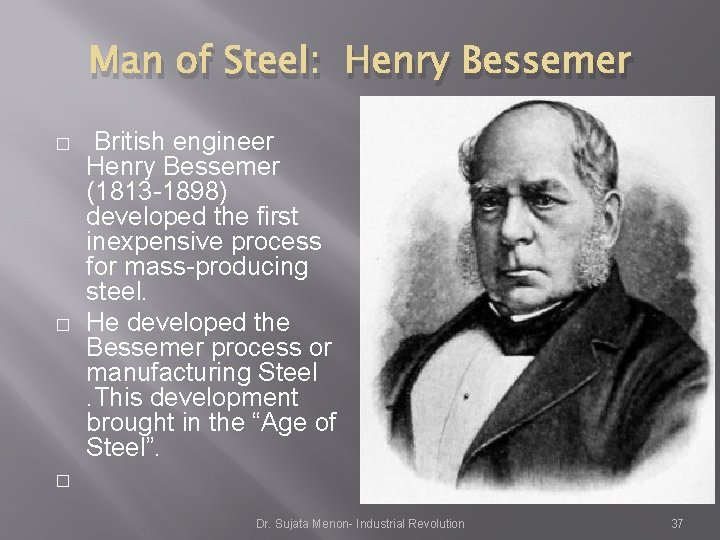
Man of Steel: Henry Bessemer � � � British engineer Henry Bessemer (1813 -1898) developed the first inexpensive process for mass-producing steel. He developed the Bessemer process or manufacturing Steel . This development brought in the “Age of Steel”. Dr. Sujata Menon- Industrial Revolution 37
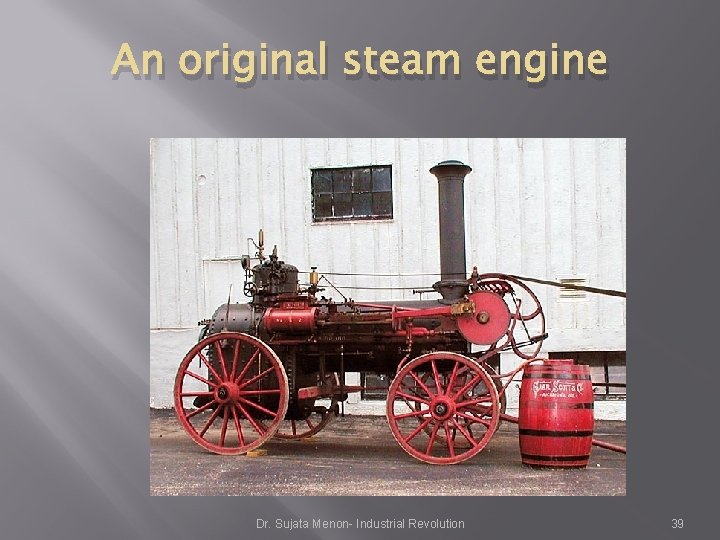
Steam Power - Invention and Improvement � Thomas Newcomen, England (1704) � Created a steam engine to pump water from mines � James Watt, Scotland (1769) � Improved Newcomen’s engine to power machinery � By 1800, steam engines were replacing water wheels as sources of power for factories Dr. Sujata Menon- Industrial Revolution 38
An original steam engine Dr. Sujata Menon- Industrial Revolution 39
Transport Revolution � Before the Industrial Revolution � Canal barges pulled by mules � Ships powered by sails � Horse-drawn wagons, carts, and carriages � After the Industrial Revolution � Railroads � Steamships � Trolleys � Automobiles Dr. Sujata Menon- Industrial Revolution 40
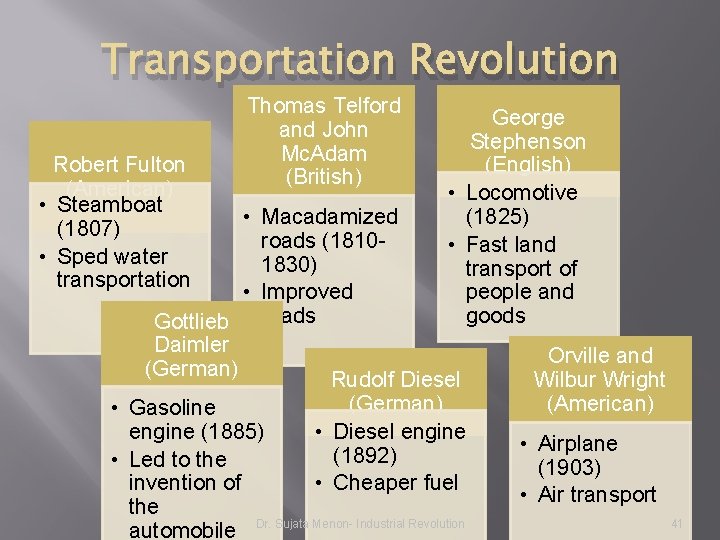
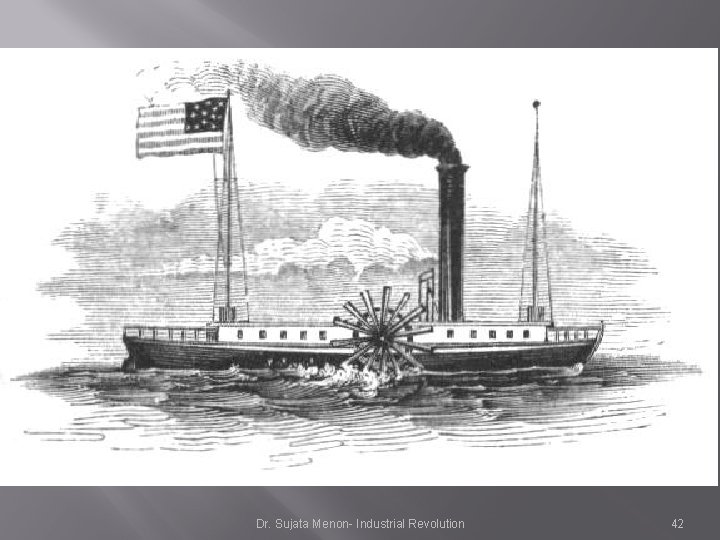
Transportation Revolution Robert Fulton (American) • Steamboat (1807) • Sped water transportation Thomas Telford and John Mc. Adam (British) George Stephenson (English) • Locomotive (1825) • Fast land transport of people and goods • Macadamized roads (18101830) • Improved Gottlieb roads Daimler (German) Rudolf Diesel (German) • Gasoline engine (1885) • Diesel engine (1892) • Led to the invention of • Cheaper fuel the automobile Dr. Sujata Menon- Industrial Revolution Orville and Wilbur Wright (American) • Airplane (1903) • Air transport 41
Dr. Sujata Menon- Industrial Revolution 42
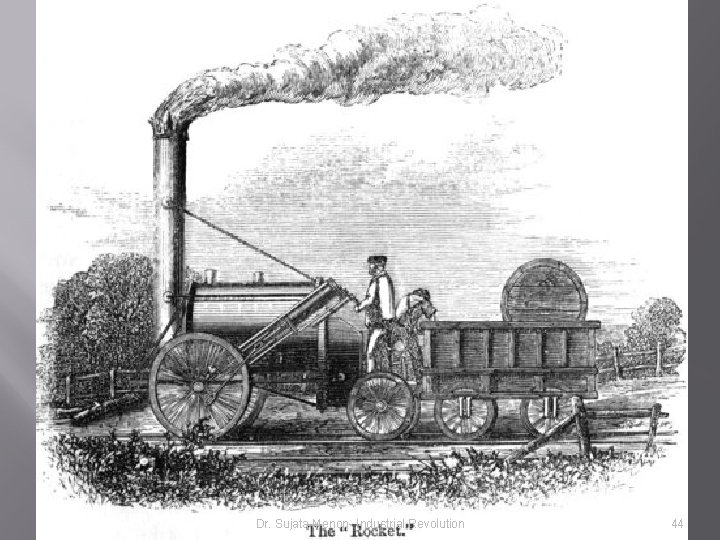
Railroads � � � 1830 – Stephenson’s “Rocket” train traveled the 40 miles between Liverpool and Manchester in 1 ½ hours 1830 -1870 – railroad tracks went from 49 miles to over 15, 000 miles Steel rails replaced iron rails 1869 – Westinghouse’s air brake made train travel safer train traveling comfort – heavier train cars, improved road beds, and sleeping cars Dr. Sujata Menon- Industrial Revolution 43
Dr. Sujata Menon- Industrial Revolution 44
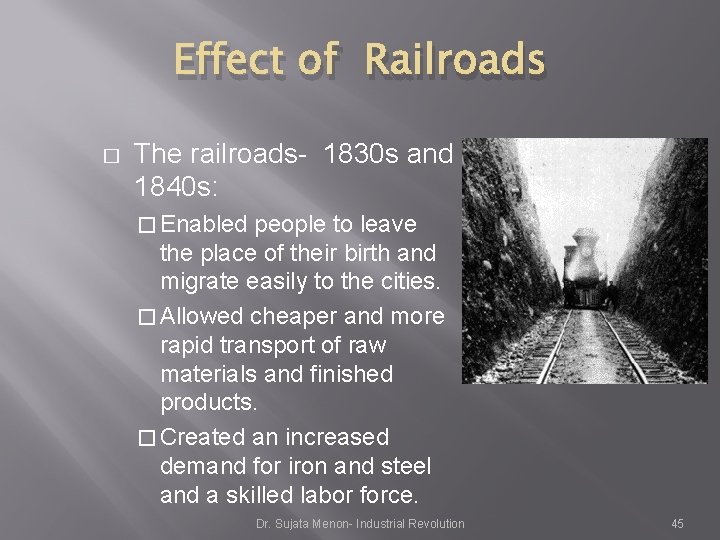
Effect of Railroads � The railroads- 1830 s and 1840 s: � Enabled people to leave the place of their birth and migrate easily to the cities. � Allowed cheaper and more rapid transport of raw materials and finished products. � Created an increased demand for iron and steel and a skilled labor force. Dr. Sujata Menon- Industrial Revolution 45
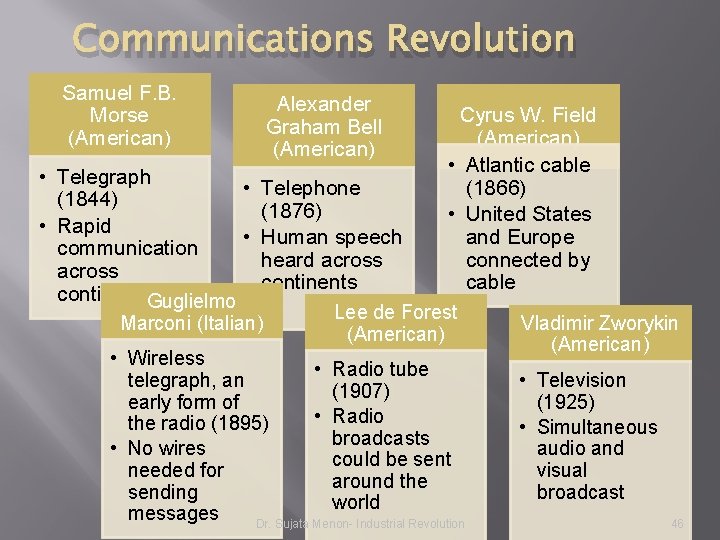
Communications Revolution Samuel F. B. Morse (American) Alexander Graham Bell (American) Cyrus W. Field (American) • Atlantic cable • Telegraph • Telephone (1866) (1844) (1876) • United States • Rapid • Human speech and Europe communication heard across connected by across cable continents. Guglielmo Lee de Forest Marconi (Italian) Vladimir Zworykin (American) • Wireless • Radio tube telegraph, an • Television (1907) early form of (1925) • Radio the radio (1895) • Simultaneous broadcasts • No wires audio and could be sent needed for visual around the sending broadcast world messages Dr. Sujata Menon- Industrial Revolution 46
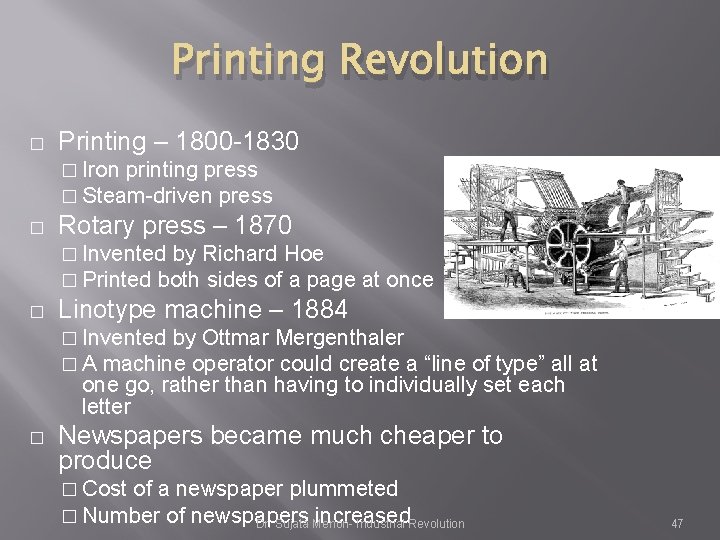
Printing Revolution � Printing – 1800 -1830 � Iron printing press � Steam-driven press � Rotary press – 1870 � Invented by Richard Hoe � Printed both sides of a page at once � Linotype machine – 1884 � Invented by Ottmar Mergenthaler � A machine operator could create a “line of type” all at one go, rather than having to individually set each letter � Newspapers became much cheaper to produce � Cost of a newspaper plummeted � Number of newspapers increased Dr. Sujata Menon- Industrial Revolution 47
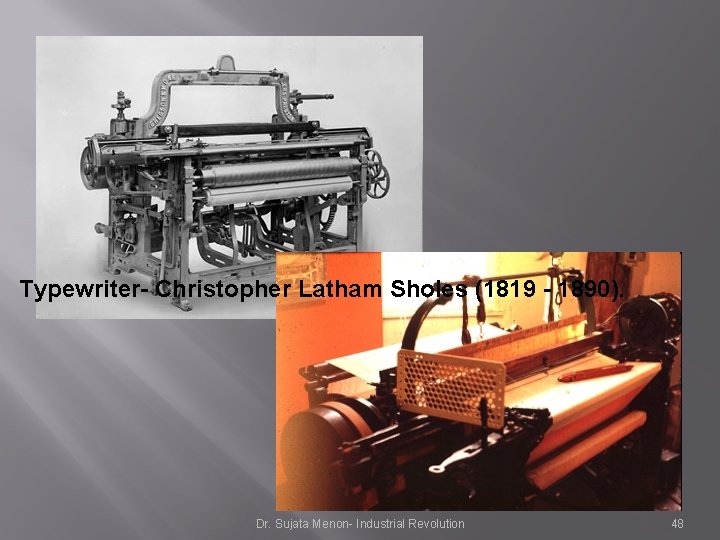
Typewriter- Christopher Latham Sholes (1819 - 1890). Dr. Sujata Menon- Industrial Revolution 48
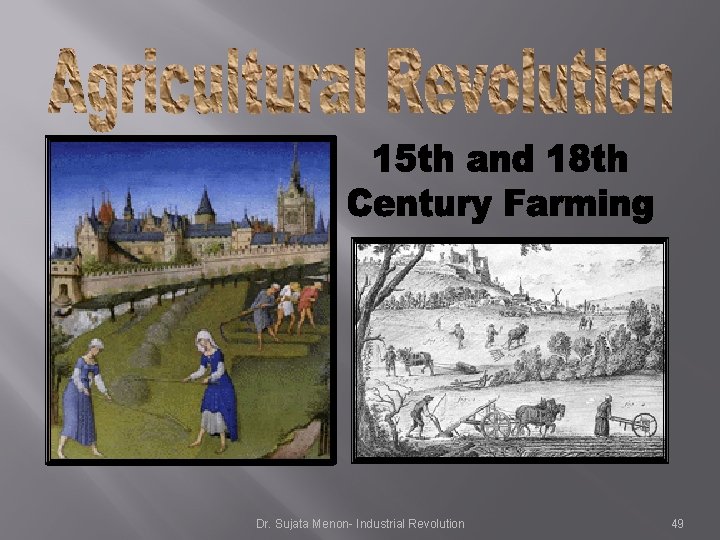
Dr. Sujata Menon- Industrial Revolution 49
The Agricultural Revolution � � � Traditional Agricultural methods and tools were replaced by farm machinery Farm machinery displaced farm workers Displaced farm workers moved to the cities to find work in factories � This is called rural-to-urban migration � Growing populations in urban cities created huge demand for food crop and commercial crops like raw cotton for textile factories Dr. Sujata Menon- Industrial Revolution 50
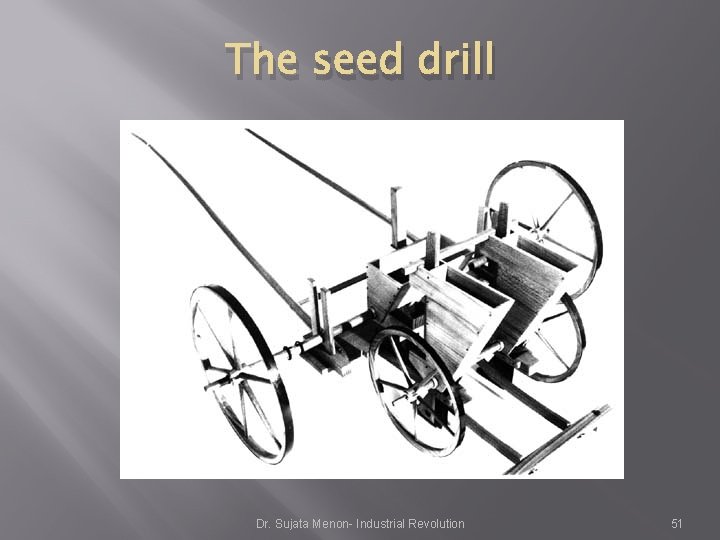
The seed drill Dr. Sujata Menon- Industrial Revolution 51
Agricultural Science � � Agriculture became a science during the Agricultural Revolution Farmers and governments invested in agricultural research � Established agricultural schools, societies, and experimental stations � Progress in agriculture � Pesticides, stock breeding, new foods, food preservation, new farming techniques and irrigation methods, frozen foods Dr. Sujata Menon- Industrial Revolution 52
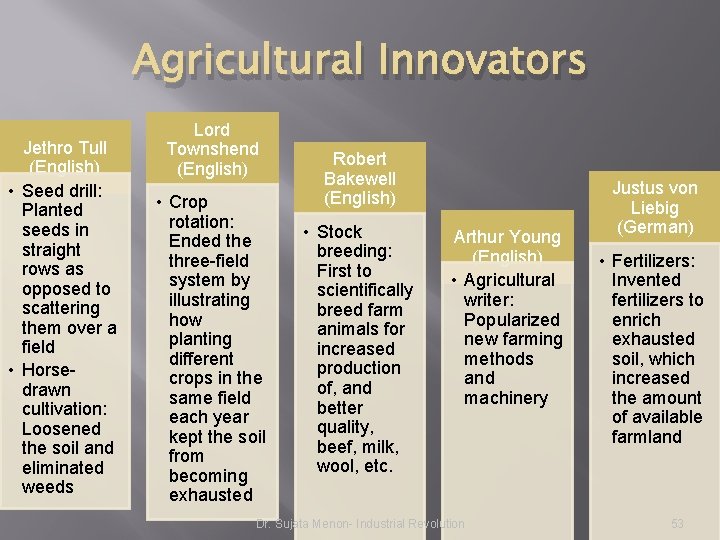
Agricultural Innovators Jethro Tull (English) • Seed drill: Planted seeds in straight rows as opposed to scattering them over a field • Horsedrawn cultivation: Loosened the soil and eliminated weeds Lord Townshend (English) • Crop rotation: Ended the three-field system by illustrating how planting different crops in the same field each year kept the soil from becoming exhausted Robert Bakewell (English) • Stock breeding: First to scientifically breed farm animals for increased production of, and better quality, beef, milk, wool, etc. Arthur Young (English) • Agricultural writer: Popularized new farming methods and machinery Dr. Sujata Menon- Industrial Revolution Justus von Liebig (German) • Fertilizers: Invented fertilizers to enrich exhausted soil, which increased the amount of available farmland 53
The Spread of the Industrial Revolution Industrialization of U. S. – 1815 - 1914 (It transformed from an Agricultural Country into an Industrial Giant. ) innovations in transportation, such as roads, steamboats, railroads and most notably electricity and telecommunication. � Industrialization of Germany after 1870 � Industrialization of Russia and Japan after 1890 � Dr. Sujata Menon- Industrial Revolution 54
Summary � � � Intellectual Revolution gave way to Industrial Revolution First Industrial Revolution or Old Industrial revolution took place in England Characteristics- Mechanization in Textile industry, Improvement in Iron and Steel Industry, Invention of steam power and transportation Dr. Sujata Menon- Industrial Revolution 55
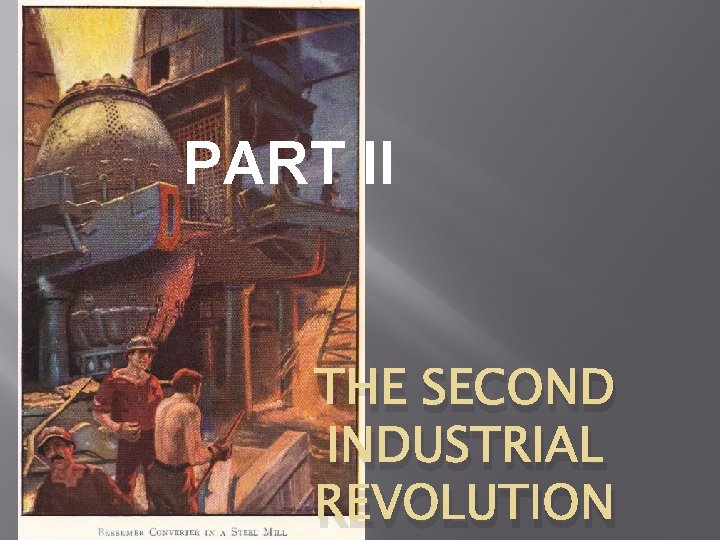
PART II THE SECOND INDUSTRIAL REVOLUTION
The Second Industrial Revolutions � The second Industrial Revolution took place between about 1870 and 1920 � Saw the spread of the Industrial Revolution to places such as Germany, Japan, and Russia � Electricity became the primary source of power for factories, farms, and homes � Mass production, particularly of consumer goods � Use of electrical power saw electronics consumer Items enter the marketplace (electric lights, radios, fans, television sets) Dr. Sujata Menon- Industrial Revolution 57
Cont. . Railroads – intensification and expansion � Russia – Trans-Siberian railroad (1891 -1905) � Germany – Berlin-to-Baghdad railroad across Europe to the Middle East � Great Britain – Cape-to-Cairo railroad vertically across Africa � USA- "Pacific Railroad". Dr. Sujata Menon- Industrial Revolution 58
Cont. � Canals � Suez Canal (1869) – provided access to the Indian Ocean from the Mediterranean Sea without the need to sail around Africa � Kiel Canal (1896) – North Sea connected to the Baltic Sea � Panama Canal (1914) – provided access from one side of the Americas to the other without the need to sail around the tip of South America Dr. Sujata Menon- Industrial Revolution 59
Advancement in transportation � Charles Goodyear – vulcanized rubber, 1839 � Gottlieb Daimler – gasoline engine, 1885 � Henry Ford – assembly line technique of mass production, 1908 -1915 � Aviation Industry � 20 th-century – growth of commercial aviation � Orville and Wilbur Wright – airplane, 1903 � Charles Lindbergh – first non-stop flight across the Atlantic, 1927 Dr. Sujata Menon- Industrial Revolution 60
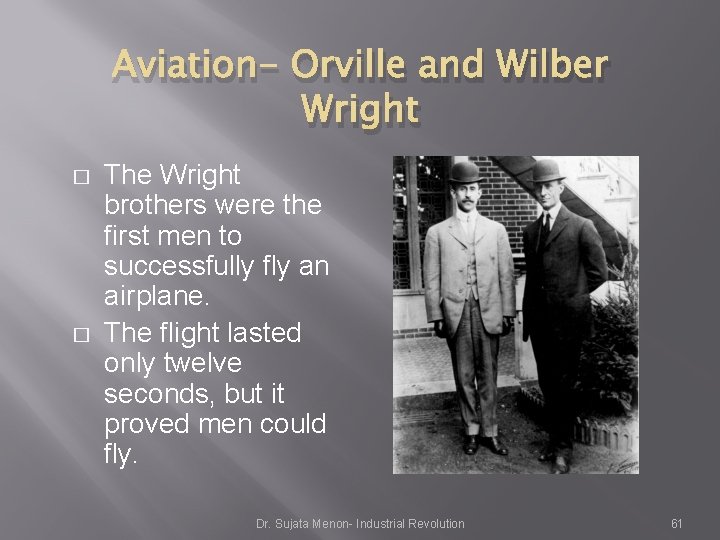
Aviation- Orville and Wilber Wright � � The Wright brothers were the first men to successfully fly an airplane. The flight lasted only twelve seconds, but it proved men could fly. Dr. Sujata Menon- Industrial Revolution 61
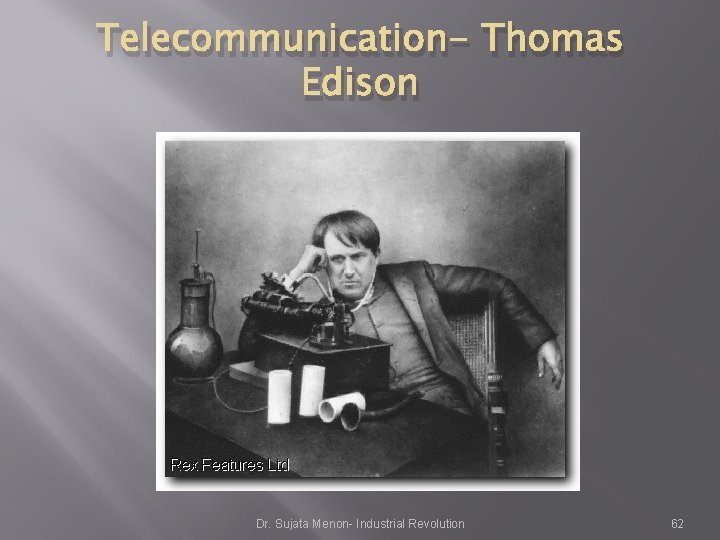
Telecommunication- Thomas Edison Dr. Sujata Menon- Industrial Revolution 62
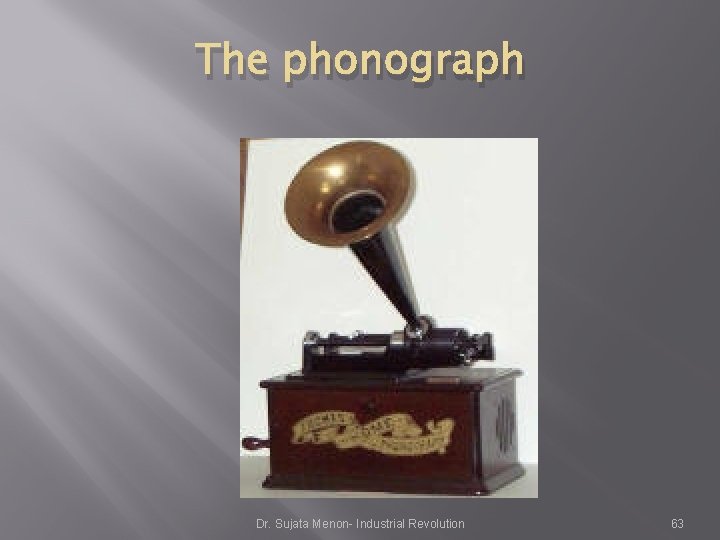
The phonograph Dr. Sujata Menon- Industrial Revolution 63
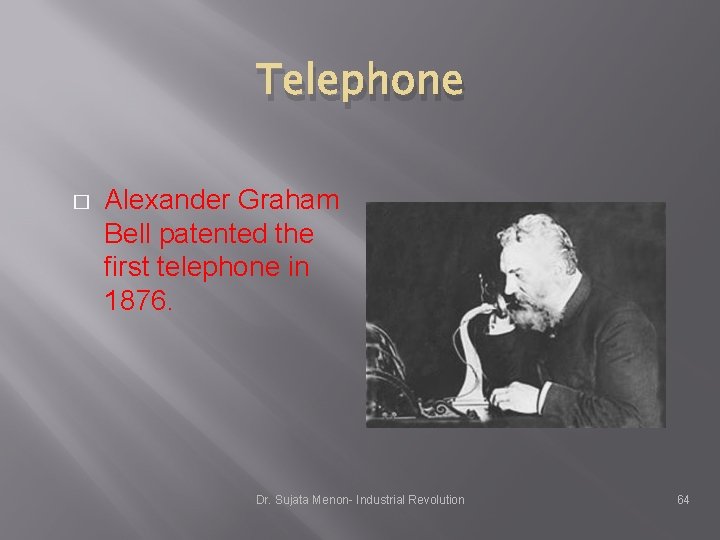
Telephone � Alexander Graham Bell patented the first telephone in 1876. Dr. Sujata Menon- Industrial Revolution 64
Rise of Large corporate companies � Andrew Carnegie and steel company � J. P. Morgan and Railroad business � John D. Rockefeller and oil industry � Henry Ford and Assembly Line concept Dr. Sujata Menon- Industrial Revolution 65
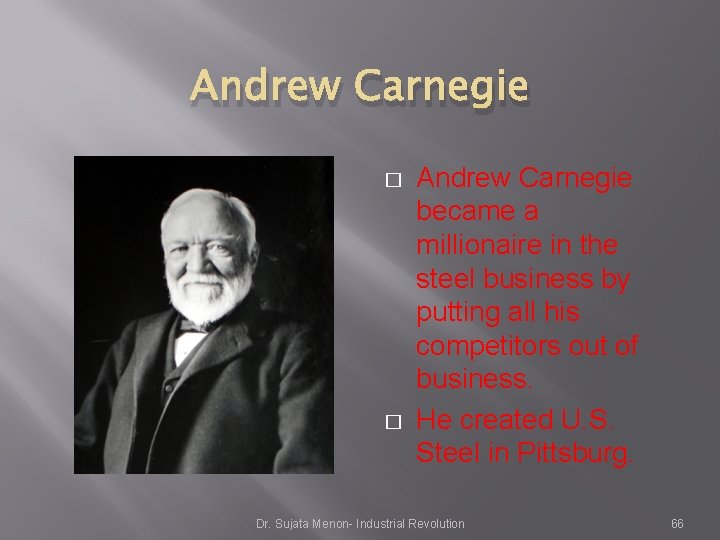
Andrew Carnegie � � Andrew Carnegie became a millionaire in the steel business by putting all his competitors out of business. He created U. S. Steel in Pittsburg. Dr. Sujata Menon- Industrial Revolution 66
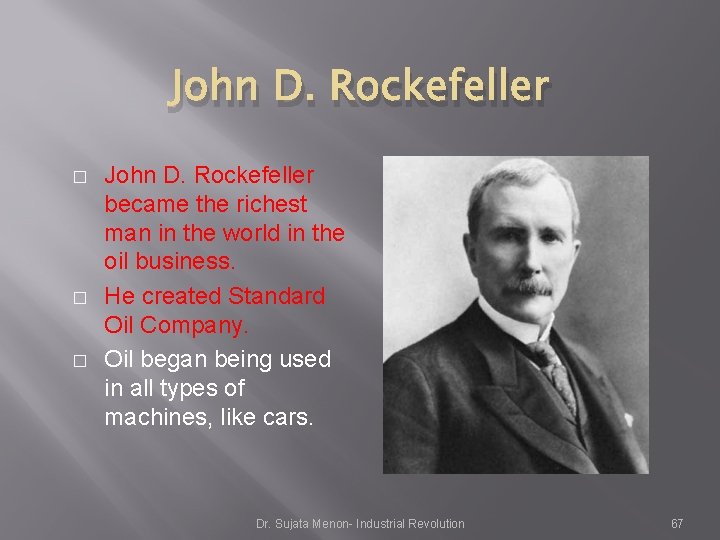
John D. Rockefeller � � � John D. Rockefeller became the richest man in the world in the oil business. He created Standard Oil Company. Oil began being used in all types of machines, like cars. Dr. Sujata Menon- Industrial Revolution 67
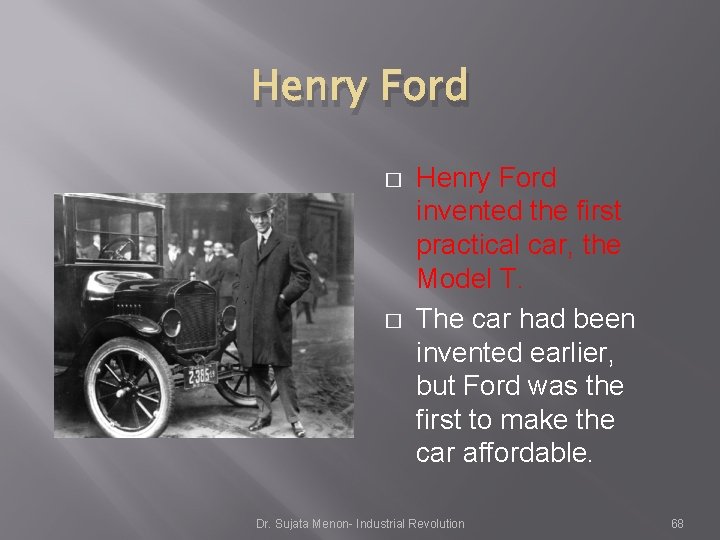
Henry Ford � � Henry Ford invented the first practical car, the Model T. The car had been invented earlier, but Ford was the first to make the car affordable. Dr. Sujata Menon- Industrial Revolution 68
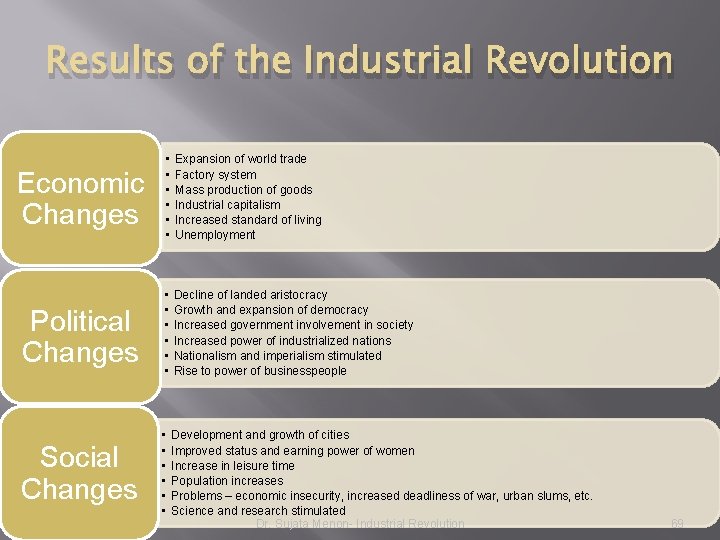
Results of the Industrial Revolution • • • Expansion of world trade Factory system Mass production of goods Industrial capitalism Increased standard of living Unemployment Political Changes • • • Decline of landed aristocracy Growth and expansion of democracy Increased government involvement in society Increased power of industrialized nations Nationalism and imperialism stimulated Rise to power of businesspeople Social Changes • • • Development and growth of cities Improved status and earning power of women Increase in leisure time Population increases Problems – economic insecurity, increased deadliness of war, urban slums, etc. Science and research stimulated Dr. Sujata Menon- Industrial Revolution Economic Changes 69
Economic Changes � ü ü Expansion of world trade- Free trade, protective tariffs, large scale international trade Mass production of goods Industrial capitalism- large Industrial corporation Recession , Depression as common phenomenon Unemployment- working class’s dependence on employers Dr. Sujata Menon- Industrial Revolution 70
Political Changes ü ü ü Decline of landed aristocracy Increased government involvement in society Increased power of industrialized nations Nationalism , imperialism, socialism , labor Movements stimulated Rise of powerful business class Dr. Sujata Menon- Industrial Revolution 71
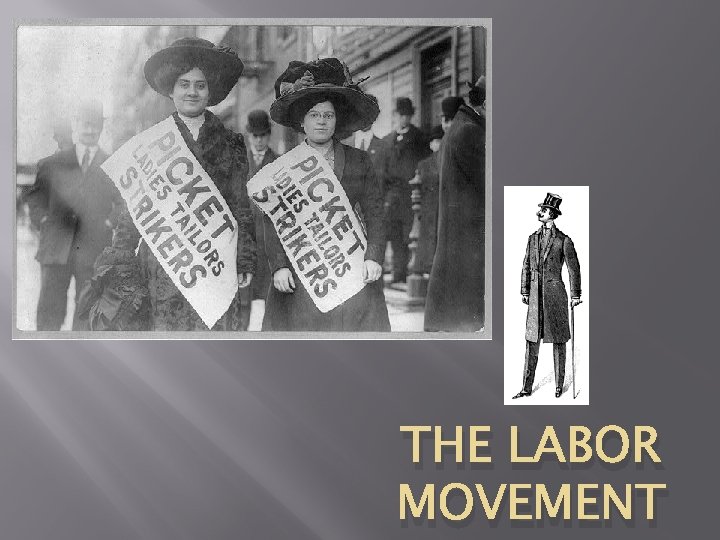
Cont…Growth and Expansion of Democracy � The middle class grew during the Industrial Revolution � Gained more rights � Rise of working class � The working class fought for rights in the workplace � The working class demanded and earned a voice in government � Labor Movement Dr. Sujata Menon- Industrial Revolution 72
THE LABOR MOVEMENT
Cont. . � ü ü ü Social Development and growth of cities Improved status and earning power of women Population increases Science and research stimulated Problems – economic insecurity, wars became more devastating, urban slums Dr. Sujata Menon- Industrial Revolution 74
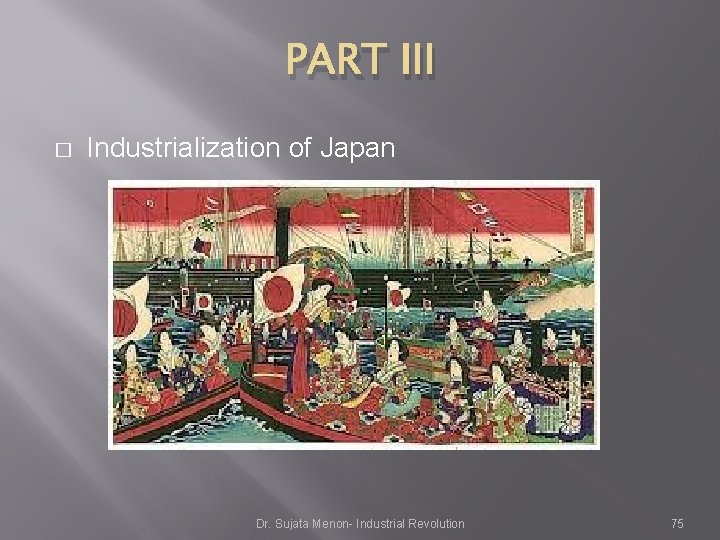
PART III � Industrialization of Japan Dr. Sujata Menon- Industrial Revolution 75
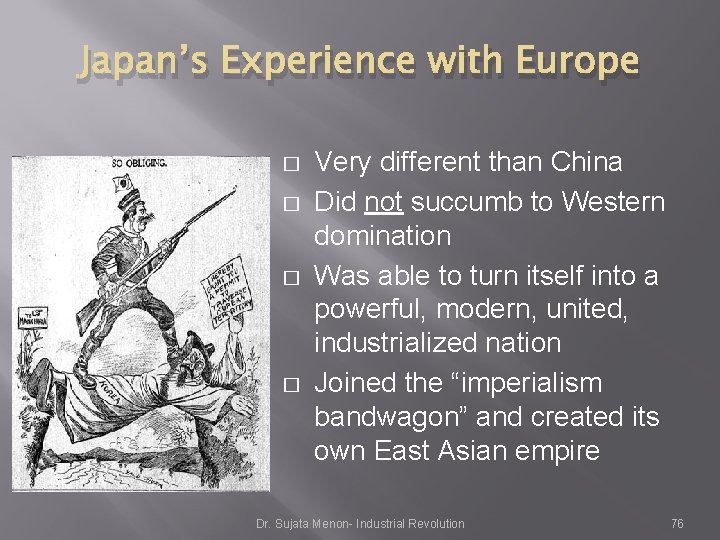
Japan’s Experience with Europe � � Very different than China Did not succumb to Western domination Was able to turn itself into a powerful, modern, united, industrialized nation Joined the “imperialism bandwagon” and created its own East Asian empire Dr. Sujata Menon- Industrial Revolution 76
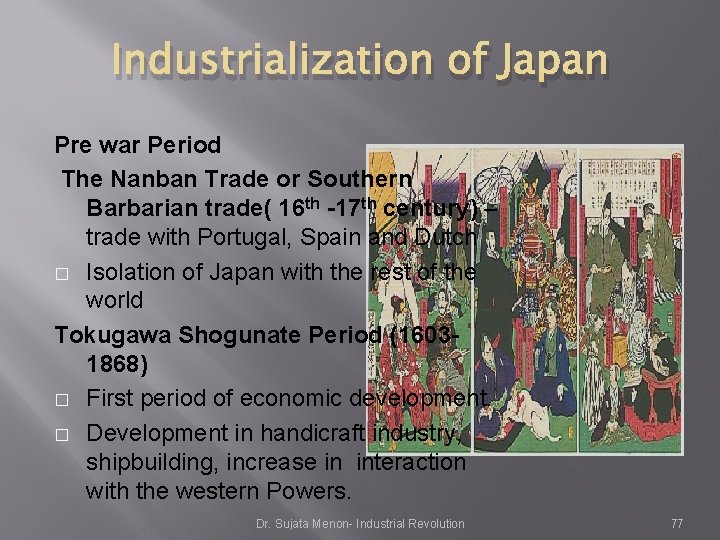
Industrialization of Japan Pre war Period The Nanban Trade or Southern Barbarian trade( 16 th -17 th century) – trade with Portugal, Spain and Dutch � Isolation of Japan with the rest of the world Tokugawa Shogunate Period (16031868) � First period of economic development. � Development in handicraft industry, shipbuilding, increase in interaction with the western Powers. Dr. Sujata Menon- Industrial Revolution 77
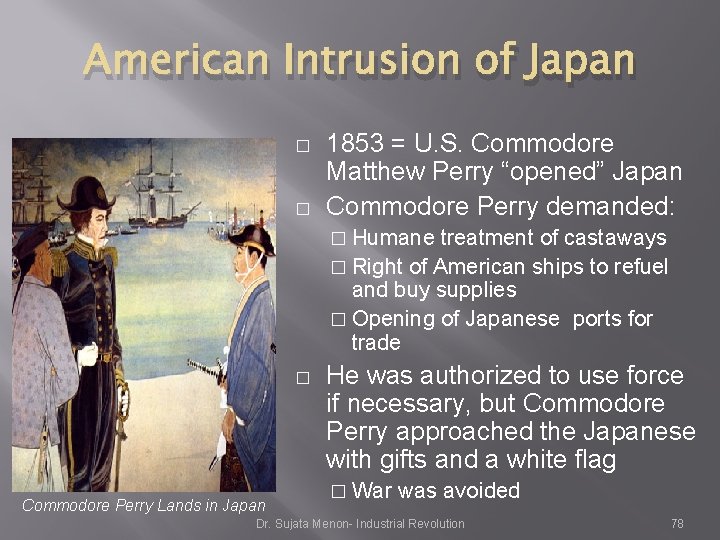
American Intrusion of Japan � � 1853 = U. S. Commodore Matthew Perry “opened” Japan Commodore Perry demanded: � Humane treatment of castaways � Right of American ships to refuel and buy supplies � Opening of Japanese ports for trade � Commodore Perry Lands in Japan He was authorized to use force if necessary, but Commodore Perry approached the Japanese with gifts and a white flag � War was avoided Dr. Sujata Menon- Industrial Revolution 78
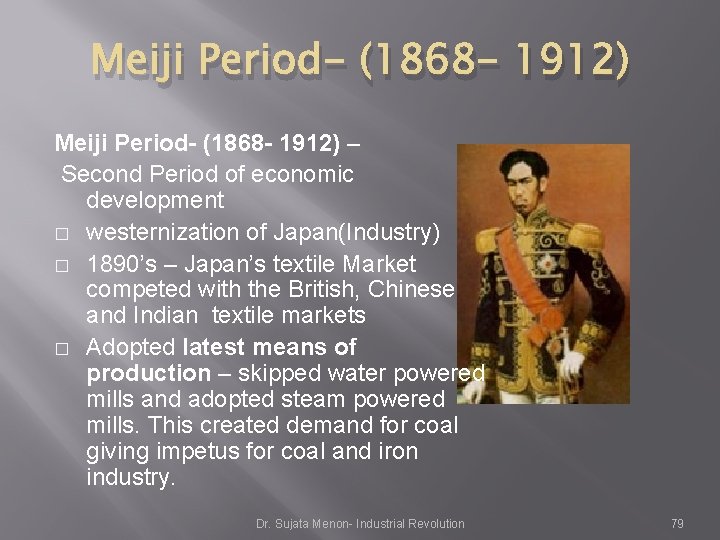
Meiji Period- (1868 - 1912) – Second Period of economic development � westernization of Japan(Industry) � 1890’s – Japan’s textile Market competed with the British, Chinese and Indian textile markets � Adopted latest means of production – skipped water powered mills and adopted steam powered mills. This created demand for coal giving impetus for coal and iron industry. Dr. Sujata Menon- Industrial Revolution 79
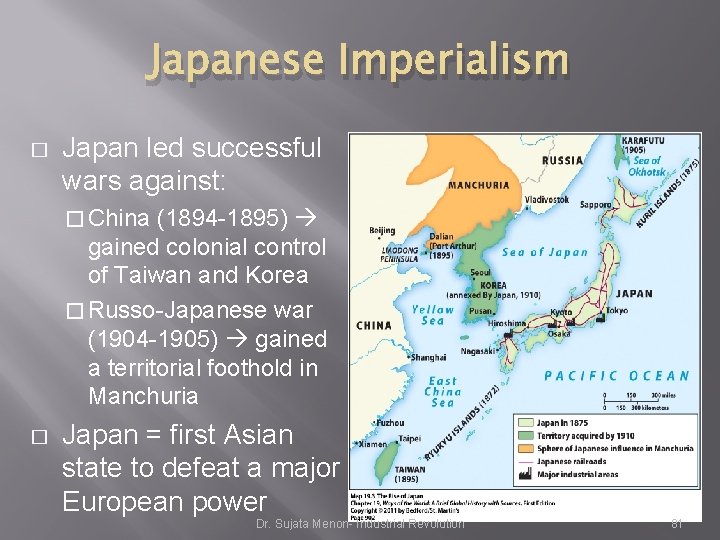
Meiji Period- (1868 - 1912) � � � End of Feudal System – encouraging invention and entrepreneurship activities Propagation of western education – technical education Government's Investment in transportation – Railroads , waterways Japanese sphere of influence or Japanese Empire- Taiwan, Korea, Manchuria, Northern parts of China , Militarization - foreign countries were blocked to access raw materials , crucial sea routed were blocked Out put of modern industries increased by the beginning of the 20 th century Dr. Sujata Menon- Industrial Revolution 80
Japanese Imperialism � Japan led successful wars against: � China (1894 -1895) gained colonial control of Taiwan and Korea � Russo-Japanese war (1904 -1905) gained a territorial foothold in Manchuria � Japan = first Asian state to defeat a major European power Dr. Sujata Menon- Industrial Revolution 81
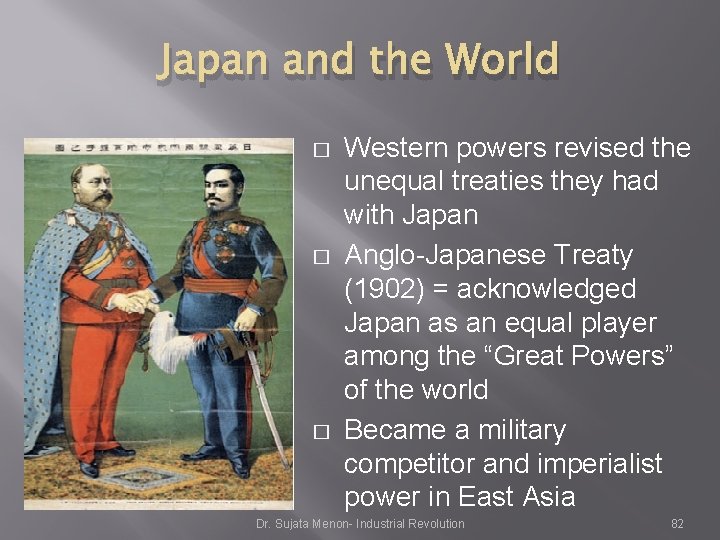
Japan and the World � � � Western powers revised the unequal treaties they had with Japan Anglo-Japanese Treaty (1902) = acknowledged Japan as an equal player among the “Great Powers” of the world Became a military competitor and imperialist power in East Asia Dr. Sujata Menon- Industrial Revolution 82
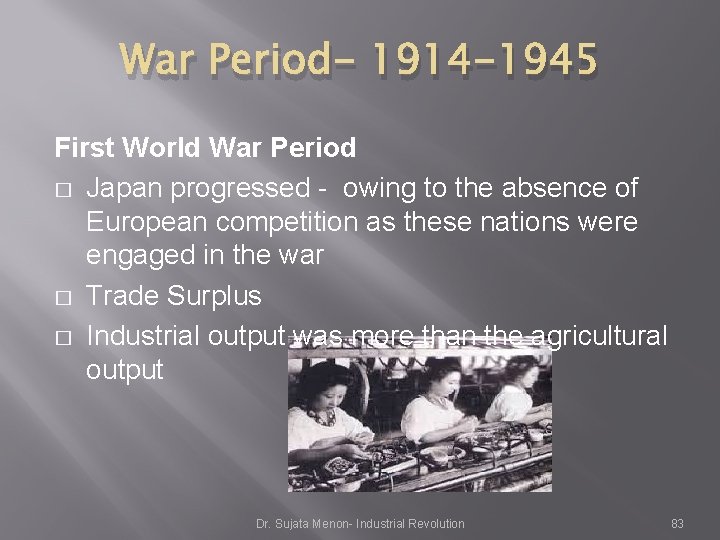
War Period- 1914 -1945 First World War Period � Japan progressed - owing to the absence of European competition as these nations were engaged in the war � Trade Surplus � Industrial output was more than the agricultural output Dr. Sujata Menon- Industrial Revolution 83
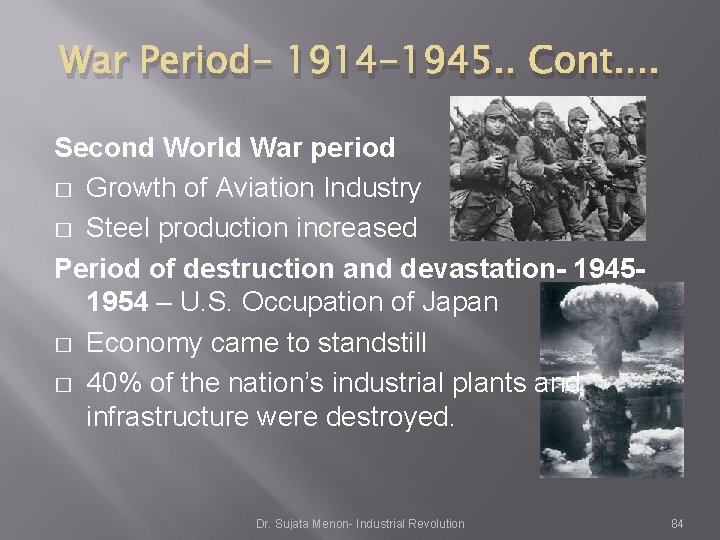
War Period- 1914 -1945. . Cont. . Second World War period � Growth of Aviation Industry � Steel production increased Period of destruction and devastation- 1945 - 1954 – U. S. Occupation of Japan � Economy came to standstill � 40% of the nation’s industrial plants and infrastructure were destroyed. Dr. Sujata Menon- Industrial Revolution 84
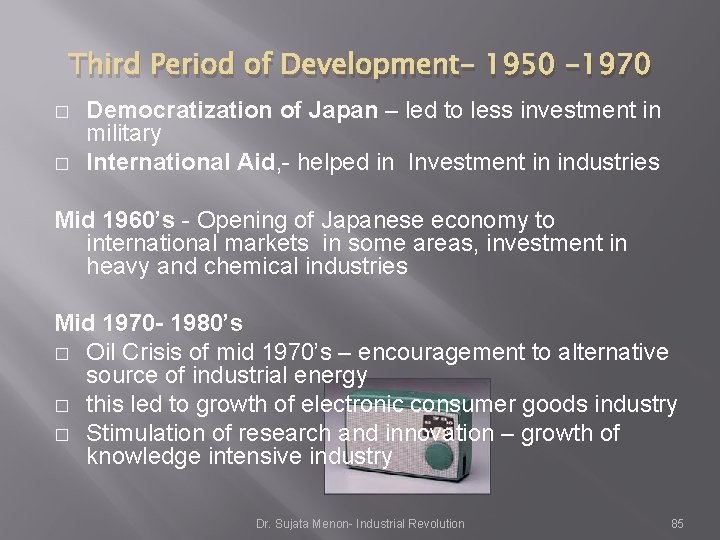
Third Period of Development- 1950 -1970 � � Democratization of Japan – led to less investment in military International Aid, - helped in Investment in industries Mid 1960’s - Opening of Japanese economy to international markets in some areas, investment in heavy and chemical industries Mid 1970 - 1980’s � Oil Crisis of mid 1970’s – encouragement to alternative source of industrial energy � this led to growth of electronic consumer goods industry � Stimulation of research and innovation – growth of knowledge intensive industry Dr. Sujata Menon- Industrial Revolution 85
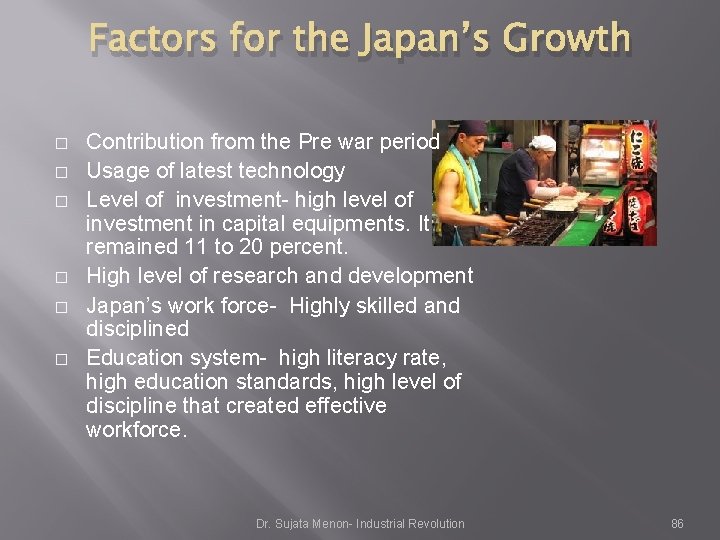
Factors for the Japan’s Growth � � � Contribution from the Pre war period Usage of latest technology Level of investment- high level of investment in capital equipments. It remained 11 to 20 percent. High level of research and development Japan’s work force- Highly skilled and disciplined Education system- high literacy rate, high education standards, high level of discipline that created effective workforce. Dr. Sujata Menon- Industrial Revolution 86