
BTEC Health Social Care TASK FIVE Intellectual Development
BTEC Health & Social Care TASK FIVE
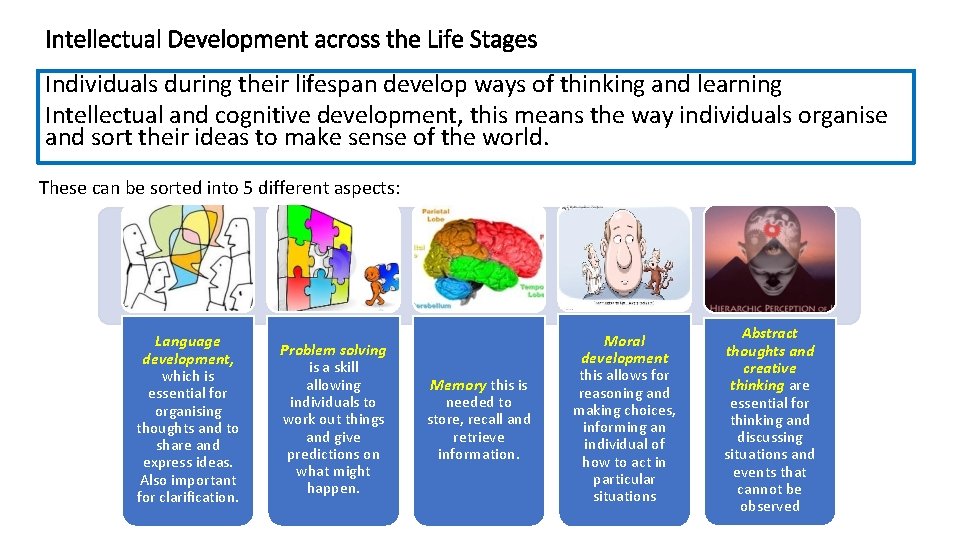
Intellectual Development across the Life Stages Individuals during their lifespan develop ways of thinking and learning Intellectual and cognitive development, this means the way individuals organise and sort their ideas to make sense of the world. These can be sorted into 5 different aspects: Language development, which is essential for organising thoughts and to share and express ideas. Also important for clarification. Problem solving is a skill allowing individuals to work out things and give predictions on what might happen. Memory this is needed to store, recall and retrieve information. Moral development this allows for reasoning and making choices, informing an individual of how to act in particular situations Abstract thoughts and creative thinking are essential for thinking and discussing situations and events that cannot be observed
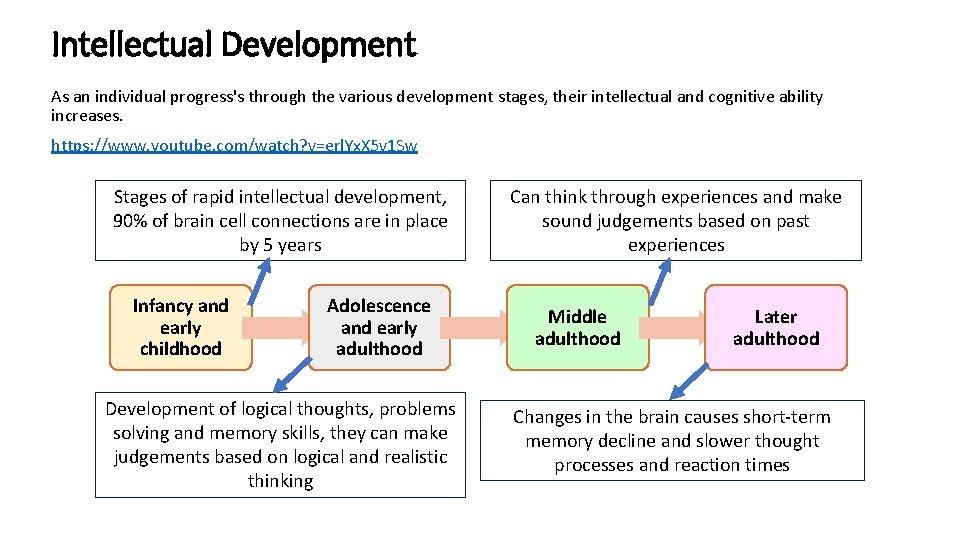
Intellectual Development As an individual progress's through the various development stages, their intellectual and cognitive ability increases. https: //www. youtube. com/watch? v=erl. Yx. X 5 v 1 Sw Stages of rapid intellectual development, 90% of brain cell connections are in place by 5 years Infancy and early childhood Adolescence and early adulthood Development of logical thoughts, problems solving and memory skills, they can make judgements based on logical and realistic thinking Can think through experiences and make sound judgements based on past experiences Middle adulthood Later adulthood Changes in the brain causes short-term memory decline and slower thought processes and reaction times
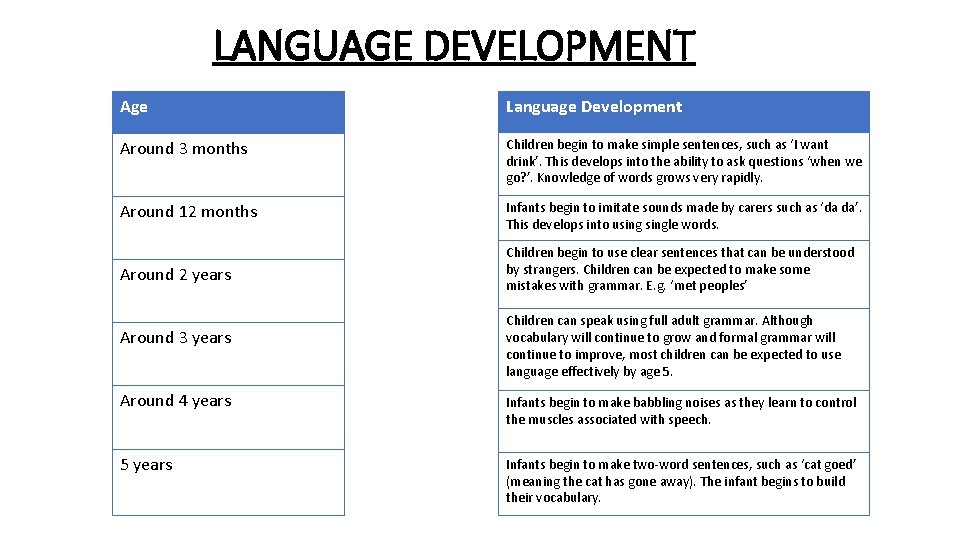
LANGUAGE DEVELOPMENT Age Language Development Around 3 months Children begin to make simple sentences, such as ‘I want drink’. This develops into the ability to ask questions ‘when we go? ’. Knowledge of words grows very rapidly. Around 12 months Infants begin to imitate sounds made by carers such as ‘da da’. This develops into usingle words. Around 2 years Children begin to use clear sentences that can be understood by strangers. Children can be expected to make some mistakes with grammar. E. g. ‘met peoples’ Around 3 years Children can speak using full adult grammar. Although vocabulary will continue to grow and formal grammar will continue to improve, most children can be expected to use language effectively by age 5. Around 4 years Infants begin to make babbling noises as they learn to control the muscles associated with speech. 5 years Infants begin to make two-word sentences, such as ‘cat goed’ (meaning the cat has gone away). The infant begins to build their vocabulary.
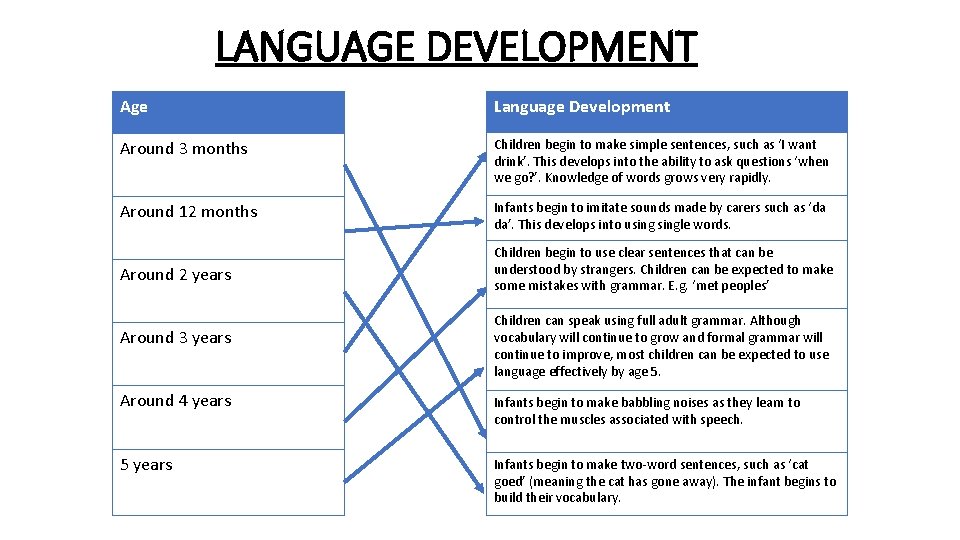
LANGUAGE DEVELOPMENT Age Language Development Around 3 months Children begin to make simple sentences, such as ‘I want drink’. This develops into the ability to ask questions ‘when we go? ’. Knowledge of words grows very rapidly. Around 12 months Infants begin to imitate sounds made by carers such as ‘da da’. This develops into usingle words. Around 2 years Children begin to use clear sentences that can be understood by strangers. Children can be expected to make some mistakes with grammar. E. g. ‘met peoples’ Around 3 years Children can speak using full adult grammar. Although vocabulary will continue to grow and formal grammar will continue to improve, most children can be expected to use language effectively by age 5. Around 4 years Infants begin to make babbling noises as they learn to control the muscles associated with speech. 5 years Infants begin to make two-word sentences, such as ‘cat goed’ (meaning the cat has gone away). The infant begins to build their vocabulary.
- Slides: 5