
WHAT DO WE MEAN BY GIFTEDNESS Lifang Zhang

WHAT DO WE MEAN BY “GIFTEDNESS”? Li-fang Zhang Faculty of Education The University of Hong Kong December 1, 2007
Objectives Ø Ø Why do we care about understanding our conceptions of giftedness? Is it possible to attain any degree of universality in people’s conceptions of giftedness? How could we apply our knowledge about conceptions of giftedness to educational practice? Is giftedness developmental?
What is going on? n n Why is it that a student who is viewed as gifted by one teacher could be considered as being dumb by another teacher? How could it be that a child previously enrolled in the gifted program in his old school found himself in a mainstream class in his new school?
Implicit theories of Giftedness Not public or formal n Reside in people’s minds n
Why bother studying conceptions of giftedness? n To establish common cultural views that dominate thinking within a society n “Society decides on the direction toward its (referring to “high potential”) fulfillment by rewarding some kinds of achievement while ignoring or even discouraging others” n n Tannenbaum (1986) More powerful than explicit theories
Our focus today n n n The Pentagonal Theory (Sternberg & Zhang, 1995) Giftedness as developing successful intelligence (Sternberg, 1996) Giftedness as a preference for the flexible use of intellectual styles (Zhang & Sternberg, 2006)
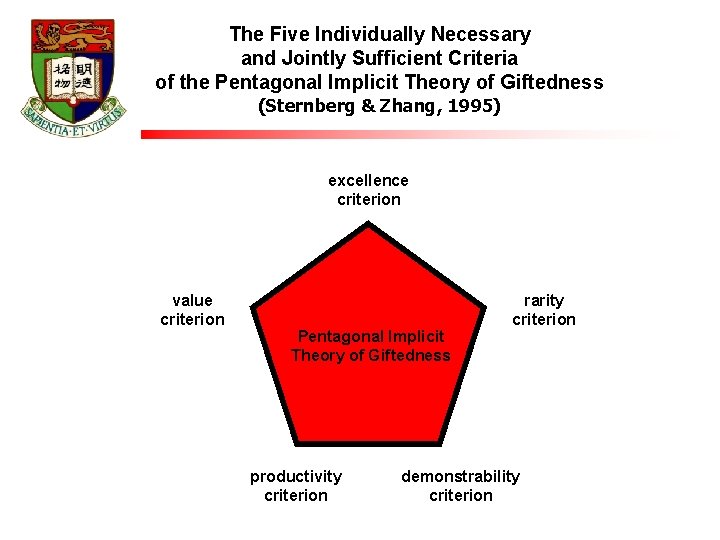
The Five Individually Necessary and Jointly Sufficient Criteria of the Pentagonal Implicit Theory of Giftedness (Sternberg & Zhang, 1995) excellence criterion value criterion Pentagonal Implicit Theory of Giftedness productivity criterion rarity criterion demonstrability criterion
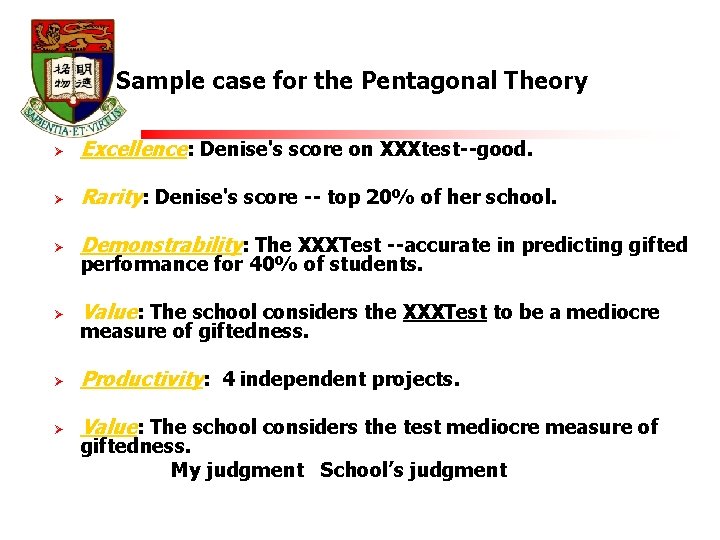
Sample case for the Pentagonal Theory Ø Excellence: Denise's score on XXXtest--good. Ø Rarity: Denise's score -- top 20% of her school. Ø Demonstrability: The XXXTest --accurate in predicting gifted Ø Value: The school considers the XXXTest to be a mediocre Ø Productivity: 4 independent projects. Ø Value: The school considers the test mediocre measure of performance for 40% of students. measure of giftedness. My judgment School’s judgment

Summary of Multiple Regression Analyses: Student Sample & Parent Sample (Sternberg & Zhang, 1995) β (Standardized regression coefficient) Rating (statement) Girls-School Girls-Self Boys-School Boys-Self Excellence (1) . 32*** . 73*** . 28*** . 55*** Rarity (2) . 45*** . 38*** . 25** . 23*** Productivity (5) . 37*** . 22*** . 44*** . 58*** Demonstrability (3) . 00 . 13** . 03 . 28*** Value (4) . 49*** . 26*** . 50*** . 19*** Value (6) . 26*** . 10* . 28*** . 07 R 2 . 78*** . 91*** . 68*** . 87*** Root-mean-square-error . 46 . 33 . 60 . 38 Student Sample (Student sample: N = 24 students evaluating 21 girls and 18 boys) Parent Sample Excellence (1) . 33*** . 53*** . 34*** . 49*** Rarity (2) . 29*** . 35*** . 24** . 37*** Productivity (5) . 34*** . 50*** . 44*** . 67*** Demonstrability (3) . 02 . 25*** . 00 . 11** Value (4) . 50*** . 28*** . 43*** . 18*** Value (6) . 44*** . 20*** . 35*** . 13** R 2 . 76*** . 90*** . 68*** . 91*** Root-mean-square-error . 49 . 24 . 66 . 26 (Parent sample: N = 39 parents evaluating 21 girls and 18 boys) * p <. 05, ** p <. 01, *** p<. 001.
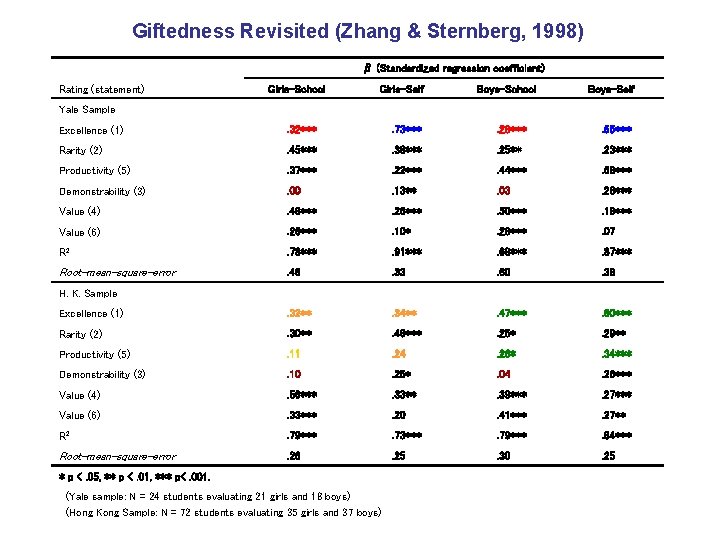
Giftedness Revisited (Zhang & Sternberg, 1998) β (Standardized regression coefficient) Rating (statement) Girls-School Girls-Self Boys-School Boys-Self Yale Sample Excellence (1) . 32*** . 73*** . 28*** . 55*** Rarity (2) . 45*** . 38*** . 25** . 23*** Productivity (5) . 37*** . 22*** . 44*** . 58*** Demonstrability (3) . 00 . 13** . 03 . 28*** Value (4) . 49*** . 26*** . 50*** . 19*** Value (6) . 26*** . 10* . 28*** . 07 R 2 . 78*** . 91*** . 68*** . 87*** Root-mean-square-error . 46 . 33 . 60 . 38 Excellence (1) . 32** . 34** . 47*** . 60*** Rarity (2) . 30** . 46*** . 25* . 29** Productivity (5) . 11 . 24 . 26* . 34*** Demonstrability (3) . 10 . 25* . 04 . 26*** Value (4) . 56*** . 33** . 39*** . 27*** Value (6) . 33*** . 20 . 41*** . 27** R 2 . 79*** . 73*** . 79*** . 84*** Root-mean-square-error . 26 . 25 . 30 . 25 H. K. Sample * p <. 05, ** p <. 01, *** p<. 001. (Yale sample: N = 24 students evaluating 21 girls and 18 boys) (Hong Kong Sample: N = 72 students evaluating 35 girls and 37 boys)
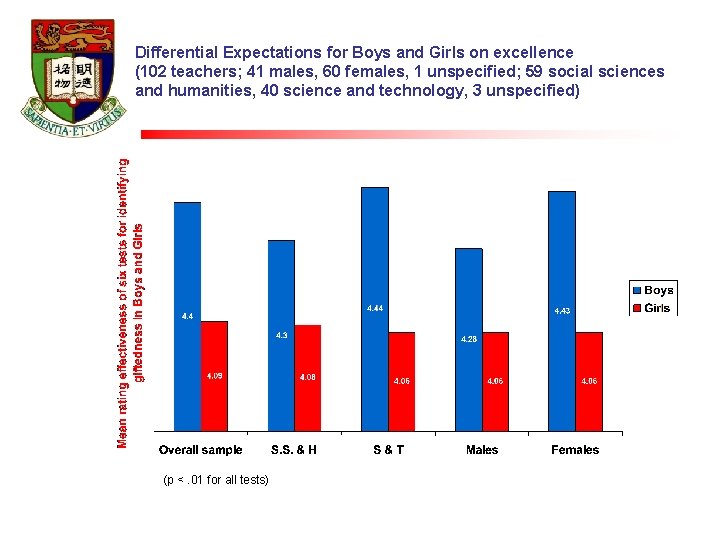
Differential Expectations for Boys and Girls on excellence (102 teachers; 41 males, 60 females, 1 unspecified; 59 social sciences and humanities, 40 science and technology, 3 unspecified) (p <. 01 for all tests)
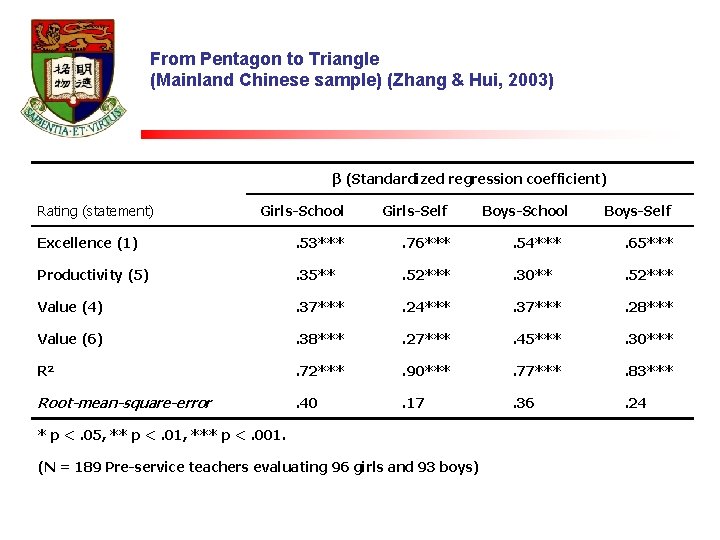
From Pentagon to Triangle (Mainland Chinese sample) (Zhang & Hui, 2003) β (Standardized regression coefficient) Rating (statement) Girls-School Girls-Self Excellence (1) . 53*** . 76*** . 54*** . 65*** Productivity (5) . 35** . 52*** . 30** . 52*** Value (4) . 37*** . 24*** . 37*** . 28*** Value (6) . 38*** . 27*** . 45*** . 30*** R 2 . 72*** . 90*** . 77*** . 83*** Root-mean-square-error . 40 . 17 . 36 . 24 * p <. 05, ** p <. 01, *** p <. 001. (N = 189 Pre-service teachers evaluating 96 girls and 93 boys) Boys-School Boys-Self
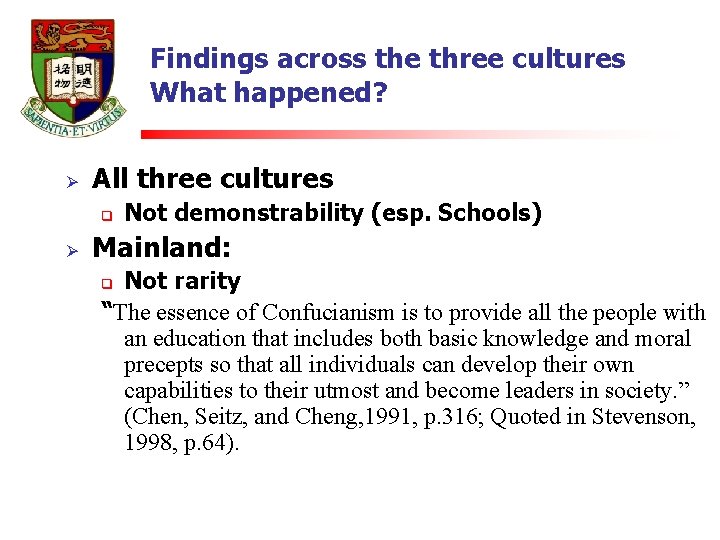
Findings across the three cultures What happened? Ø All three cultures q Ø Not demonstrability (esp. Schools) Mainland: Not rarity “The essence of Confucianism is to provide all the people with an education that includes both basic knowledge and moral precepts so that all individuals can develop their own capabilities to their utmost and become leaders in society. ” (Chen, Seitz, and Cheng, 1991, p. 316; Quoted in Stevenson, 1998, p. 64). q
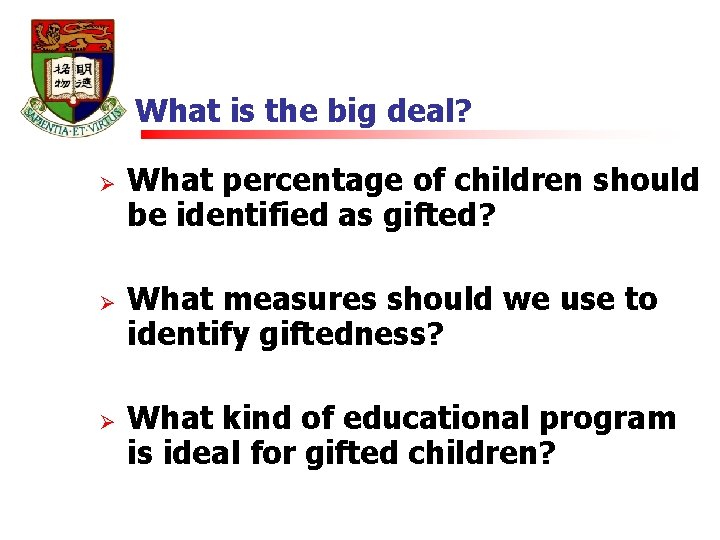
What is the big deal? Ø Ø Ø What percentage of children should be identified as gifted? What measures should we use to identify giftedness? What kind of educational program is ideal for gifted children?
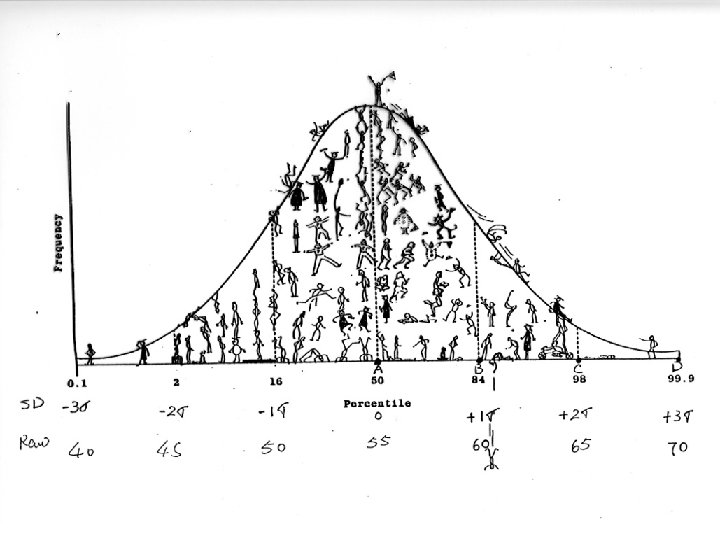
What percentage of children should be identified as gifted? Ø Ø Ø No one correct answer Problem with norm-referencing confusing rarity with excellence Solution: criterion-referencing followed by norm-referencing
What measures should we use to identify giftedness? Ø Again, no definite answer depends on what we value.
What kind of educational program is ideal for gifted children? Again, ask ourselves what we value: Ø Ø Ø If rapid learner acceleration program If depth enrichment OR, a combination Whatever we do, we should ensure that the values expressed in the instructional program are the same as those expressed in the identification program.
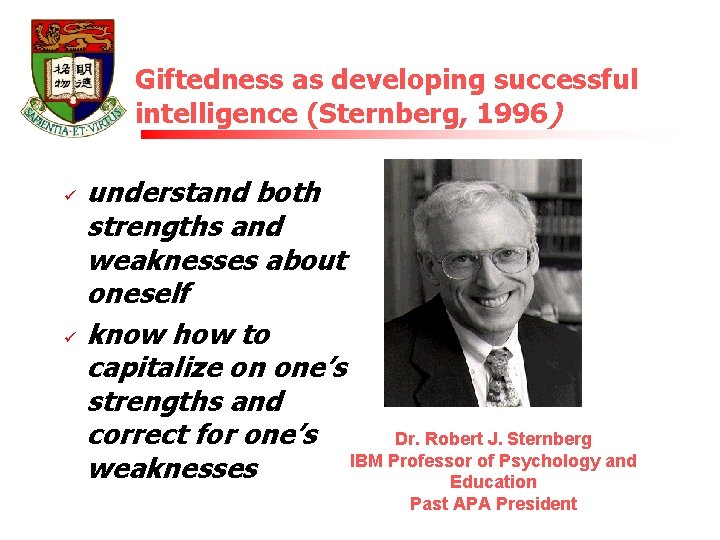
Giftedness as developing successful intelligence (Sternberg, 1996) ü ü understand both strengths and weaknesses about oneself know how to capitalize on one’s strengths and correct for one’s Dr. Robert J. Sternberg IBM Professor of Psychology and weaknesses Education Past APA President
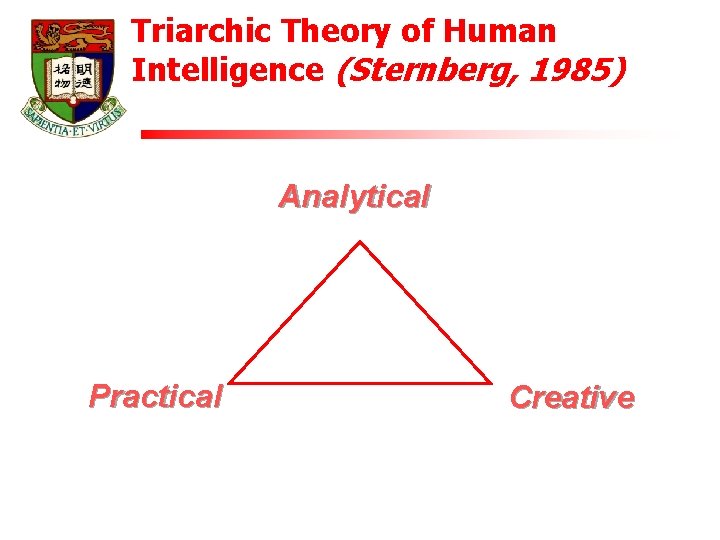
Triarchic Theory of Human Intelligence (Sternberg, 1985) Analytical Practical Creative
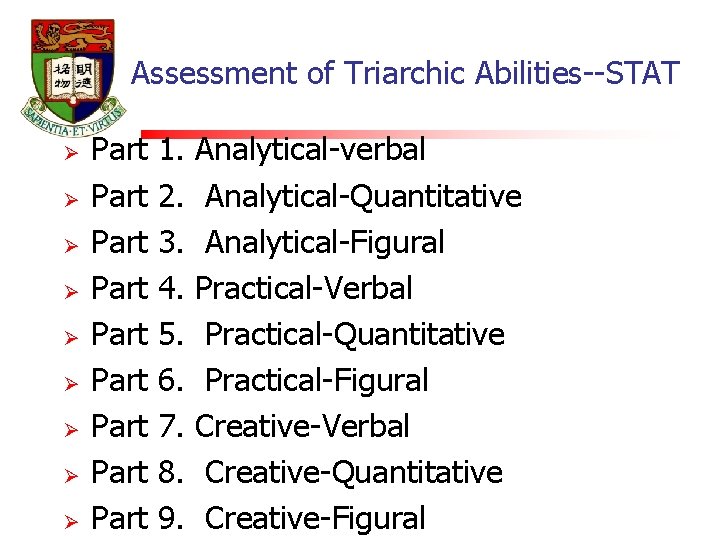
Assessment of Triarchic Abilities--STAT Ø Ø Ø Ø Ø Part Part Part 1. 2. 3. 4. 5. 6. 7. 8. 9. Analytical-verbal Analytical-Quantitative Analytical-Figural Practical-Verbal Practical-Quantitative Practical-Figural Creative-Verbal Creative-Quantitative Creative-Figural
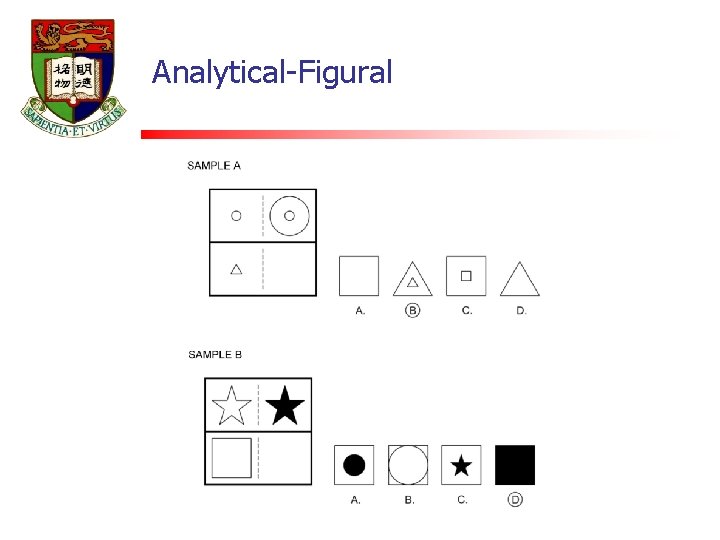
Analytical-Figural
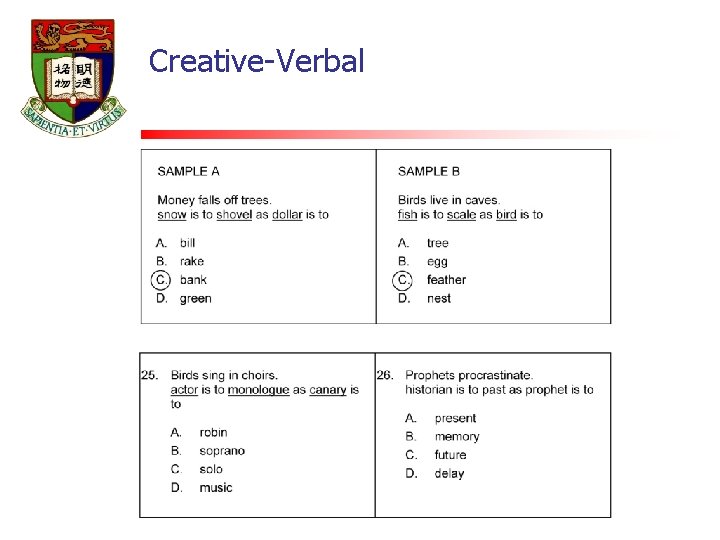
Creative-Verbal
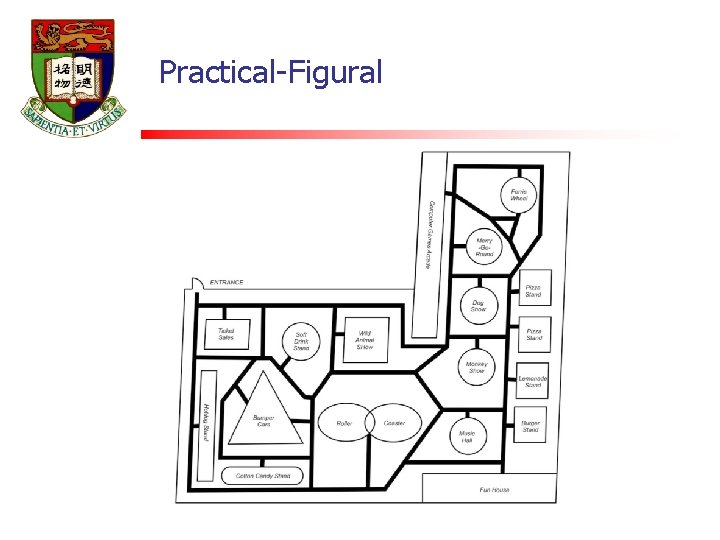
Practical-Figural
Giftedness as developing successful intelligence (Sternberg, 1996) Ø A gifted person understands both strengths and weaknesses about oneself and knows how to capitalize on his/her strengths and correct for his/her weaknesses.
Characteristics of Successful Intelligence (giftedness) n Traditional versus successful intelligence Ø Ø adaptation vs. shaping and selection as well criteria relevant for assessing predictive validity (academic achievement and IQ scores vs. achievement/IQ + other information) School performance vs. life-long performance largely culture-free vs. culture-specific
Giftedness is culture-specific n “In ‘The Country of the Blind’, the sighted person who wanders into that strange land finds he cannot dominate the inhabitants because they have found a coherent set of adaptations to their blindness. ” n n “Self-construction of the extraordinary” Howard Gruber H. G. Wells, 1911
Giftedness (as successful intelligence) can be cultivated research—experimental studies (e. g. , Sternberg et al. , 1992, 1993, 1999)
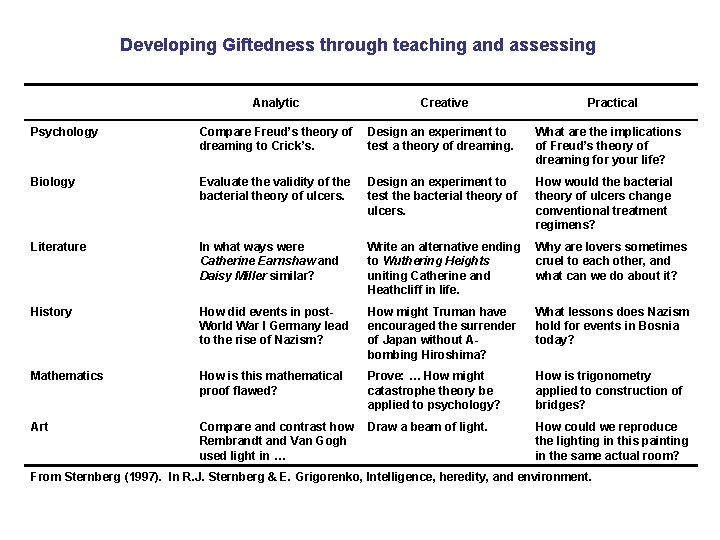
Developing Giftedness through teaching and assessing Analytic Creative Practical Psychology Compare Freud’s theory of dreaming to Crick’s. Design an experiment to test a theory of dreaming. What are the implications of Freud’s theory of dreaming for your life? Biology Evaluate the validity of the bacterial theory of ulcers. Design an experiment to test the bacterial theory of ulcers. How would the bacterial theory of ulcers change conventional treatment regimens? Literature In what ways were Catherine Earnshaw and Daisy Miller similar? Write an alternative ending to Wuthering Heights uniting Catherine and Heathcliff in life. Why are lovers sometimes cruel to each other, and what can we do about it? History How did events in post. World War I Germany lead to the rise of Nazism? How might Truman have encouraged the surrender of Japan without Abombing Hiroshima? What lessons does Nazism hold for events in Bosnia today? Mathematics How is this mathematical proof flawed? Prove: … How might catastrophe theory be applied to psychology? How is trigonometry applied to construction of bridges? Art Compare and contrast how Rembrandt and Van Gogh used light in … Draw a beam of light. How could we reproduce the lighting in this painting in the same actual room? From Sternberg (1997). In R. J. Sternberg & E. Grigorenko, Intelligence, heredity, and environment.
Giftedness as a preference for the flexible use of intellectual styles
What is an intellectual style? v Not ability, but preferred ways of processing information (Zhang & Sternberg, 2005, 2006) v E. g. , cognitive styles, learning styles, thinking styles, mind styles, decisionmaking styles…
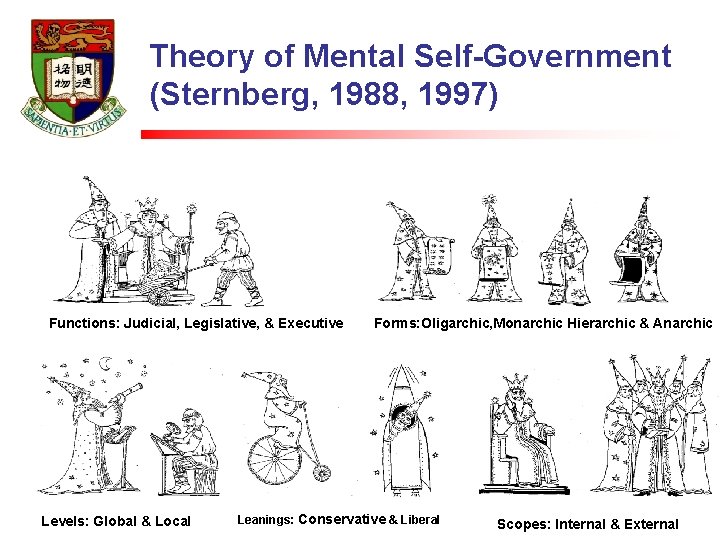
Theory of Mental Self-Government (Sternberg, 1988, 1997) Functions: Judicial, Legislative, & Executive Levels: Global & Local Forms: Oligarchic, Monarchic Hierarchic & Anarchic Leanings: Conservative & Liberal Scopes: Internal & External
Thinking Styles Re-conceptualized (Zhang, 2004) n n n Type I thinking styles--higher levels of cognitive complexity and creativity-generating (legislative, judicial, liberal, hierarchical, global) Type II thinking styles-- lower levels of cognitive complexity and norm-favoring ( executive, conservative, monarchic, local) Type III Thinking styles -- manifest characteristics of both Type I and II styles, depending on specific tasks (internal, external, oligarchic, anarchic)
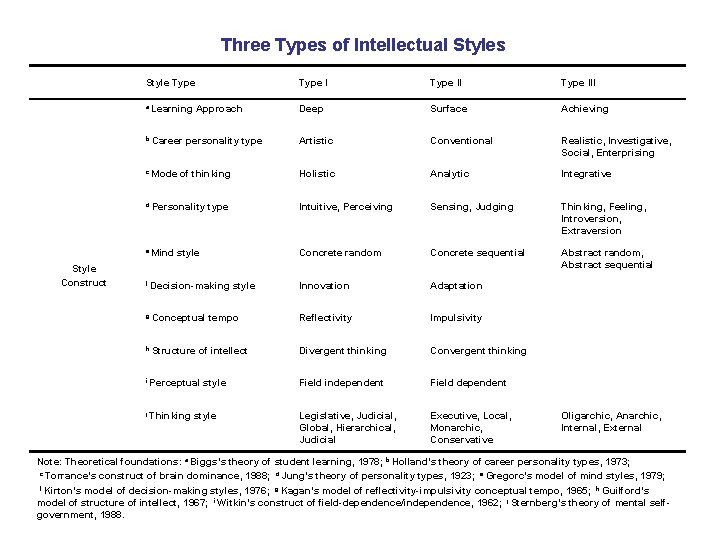
Three Types of Intellectual Styles Style Type a Learning b Career c Mode Approach personality type of thinking d Personality e Mind Style Construct type style f Decision-making g Conceptual h Structure tempo of intellect i Perceptual j Thinking style Type III Deep Surface Achieving Artistic Conventional Realistic, Investigative, Social, Enterprising Holistic Analytic Integrative Intuitive, Perceiving Sensing, Judging Thinking, Feeling, Introversion, Extraversion Concrete random Concrete sequential Abstract random, Abstract sequential Innovation Adaptation Reflectivity Impulsivity Divergent thinking Convergent thinking Field independent Field dependent Legislative, Judicial, Global, Hierarchical, Judicial Executive, Local, Monarchic, Conservative Oligarchic, Anarchic, Internal, External Note: Theoretical foundations: a Biggs’s theory of student learning, 1978; b Holland’s theory of career personality types, 1973; c Torrance’s construct of brain dominance, 1988; d Jung’s theory of personality types, 1923; e Gregorc’s model of mind styles, 1979; f Kirton’s model of decision-making styles, 1976; g Kagan’s model of reflectivity-impulsivity conceptual tempo, 1965; h Guilford’s model of structure of intellect, 1967; i Witkin’s construct of field-dependence/independence, 1962; j Sternberg’s theory of mental selfgovernment, 1988.
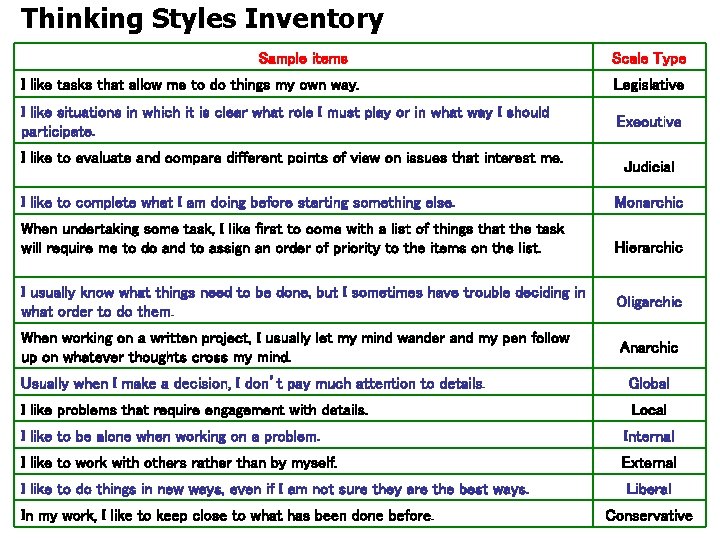
Thinking Styles Inventory Sample items Scale Type I like tasks that allow me to do things my own way. Legislative I like situations in which it is clear what role I must play or in what way I should participate. Executive I like to evaluate and compare different points of view on issues that interest me. Judicial I like to complete what I am doing before starting something else. Monarchic When undertaking some task, I like first to come with a list of things that the task will require me to do and to assign an order of priority to the items on the list. Hierarchic I usually know what things need to be done, but I sometimes have trouble deciding in what order to do them. Oligarchic When working on a written project, I usually let my mind wander and my pen follow up on whatever thoughts cross my mind. Anarchic Usually when I make a decision, I don’t pay much attention to details. Global I like problems that require engagement with details. Local I like to be alone when working on a problem. Internal I like to work with others rather than by myself. External I like to do things in new ways, even if I am not sure they are the best ways. In my work, I like to keep close to what has been done before. Liberal Conservative
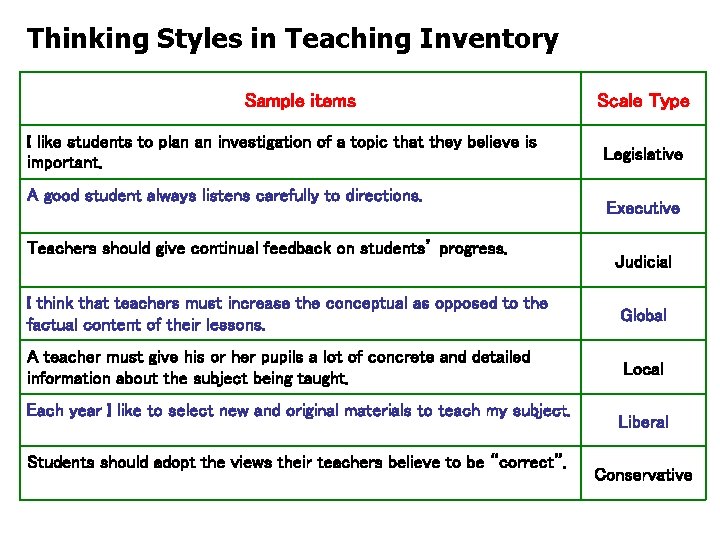
Thinking Styles in Teaching Inventory Sample items I like students to plan an investigation of a topic that they believe is important. A good student always listens carefully to directions. Teachers should give continual feedback on students’ progress. Scale Type Legislative Executive Judicial I think that teachers must increase the conceptual as opposed to the factual content of their lessons. Global A teacher must give his or her pupils a lot of concrete and detailed information about the subject being taught. Local Each year I like to select new and original materials to teach my subject. Students should adopt the views their teachers believe to be “correct”. Liberal Conservative
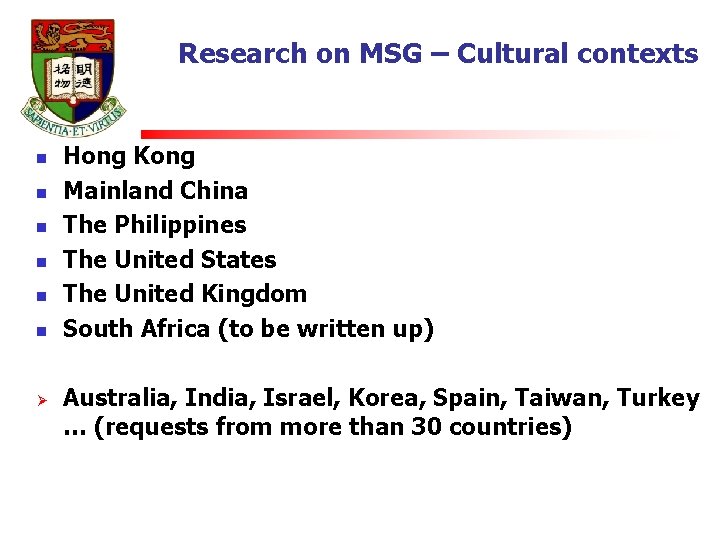
Research on MSG – Cultural contexts n n n Ø Hong Kong Mainland China The Philippines The United States The United Kingdom South Africa (to be written up) Australia, India, Israel, Korea, Spain, Taiwan, Turkey … (requests from more than 30 countries)
General findings on intellectual styles in academic settings Ø Both students and teachers use a variety of intellectual styles depending on personal and situational characteristics Ø Intellectual styles make a difference in teachers’ teaching Ø Intellectual styles make a difference in students’ learning Ø Intellectual styles make a difference in student-teacher interaction Ø The above relationships largely vary across cultures
The Nature of intellectual styles Ø Intellectual styles are malleable Ø Intellectual styles are value-laden
Evidence? v It depends on what you mean by “Giftedness” Achievement, creativity, cognitive complexity, moral maturity, career interest …personality a wider range and more flexible use of intellectual styles
Understanding giftedness from a different perspective v Question: Are gifted students problem-free?
Characteristics of gifted students (Popular views) n Advanced in ü intellectual abilities affective development learning/cognitive/thinking styles moral development perspective taking highly creative ü Critique? ? ? ü ü ü
Common adjustment disorders of gifted students Stress n Depression n Suicide n Perfectionism n Multipotentiality n Underachievement n
What am I getting at? Giftedness, like love, is a manysplendid thing.

Thank You! lfzhang@hku. hk
- Slides: 46