Text Clustering Hongning Wang CSUVa Todays lecture Clustering
- Slides: 34
Text Clustering Hongning Wang CS@UVa
Today’s lecture • Clustering of text documents – Problem overview • Applications – Distance metrics – Two basic categories of clustering algorithms – Evaluation metrics CS@UVa CS 6501: Text Mining 2
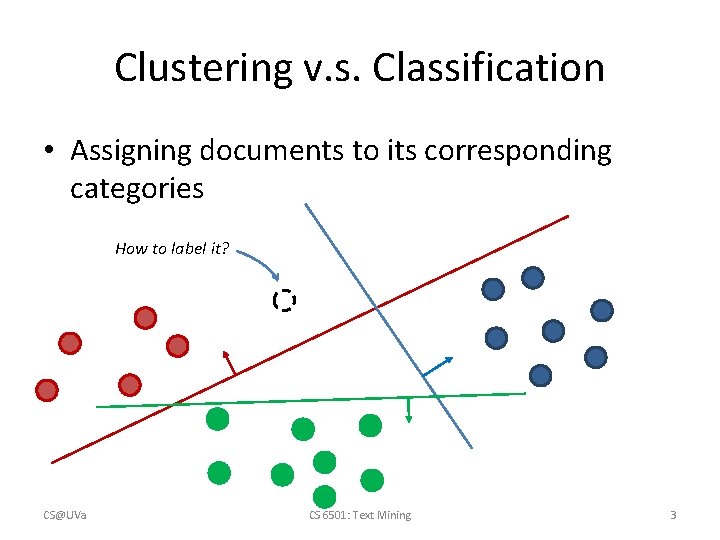
Clustering v. s. Classification • Assigning documents to its corresponding categories How to label it? CS@UVa CS 6501: Text Mining 3
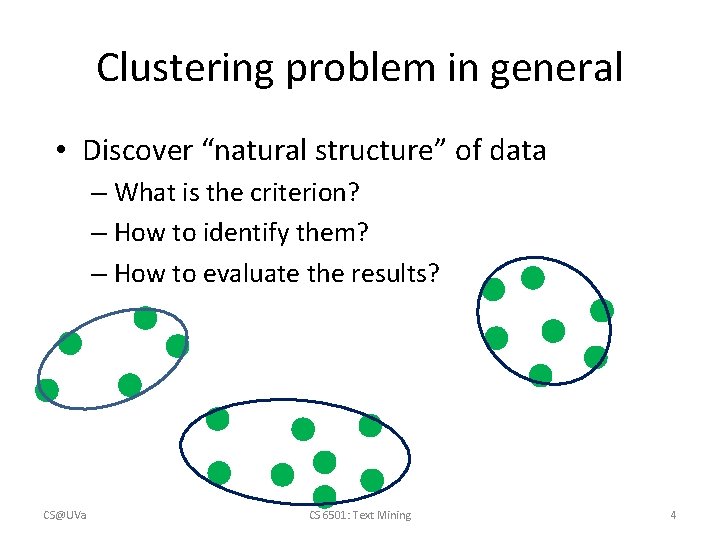
Clustering problem in general • Discover “natural structure” of data – What is the criterion? – How to identify them? – How to evaluate the results? CS@UVa CS 6501: Text Mining 4
Clustering problem in general • Clustering - the process of grouping a set of objects into clusters of similar objects – Basic criteria • high intra-cluster similarity • low inter-cluster similarity – No (little) supervision signal about the underlying clustering structure – Need similarity/distance as guidance to form clusters CS@UVa CS 6501: Text Mining 5
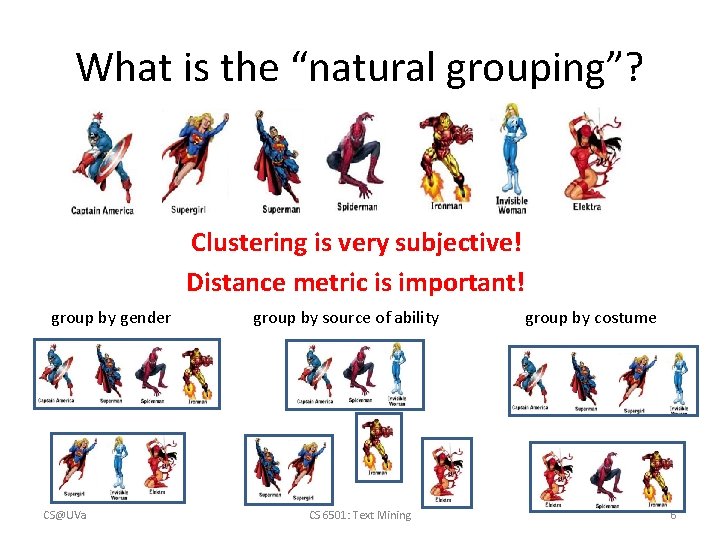
What is the “natural grouping”? Clustering is very subjective! Distance metric is important! group by gender CS@UVa group by source of ability CS 6501: Text Mining group by costume 6
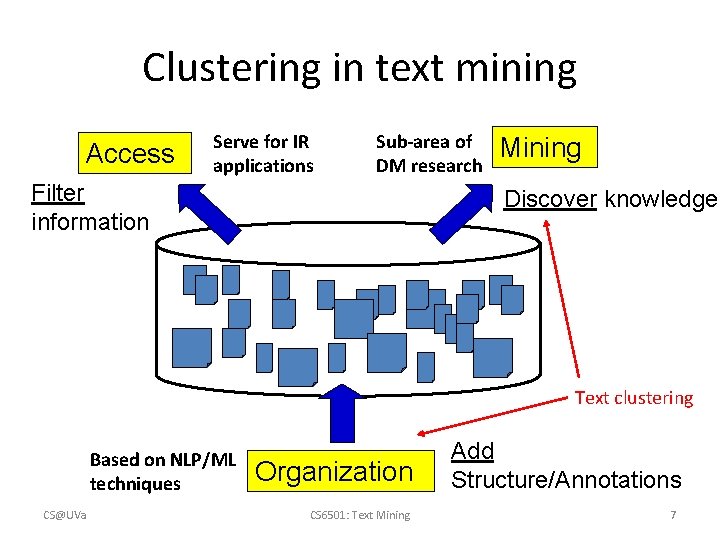
Clustering in text mining Access Serve for IR applications Sub-area of DM research Filter information Mining Discover knowledge Text clustering Based on NLP/ML techniques CS@UVa Organization CS 6501: Text Mining Add Structure/Annotations 7
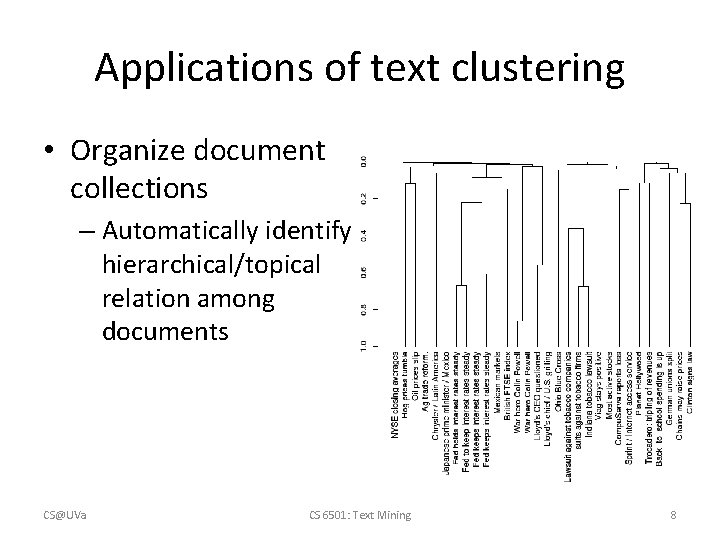
Applications of text clustering • Organize document collections – Automatically identify hierarchical/topical relation among documents CS@UVa CS 6501: Text Mining 8
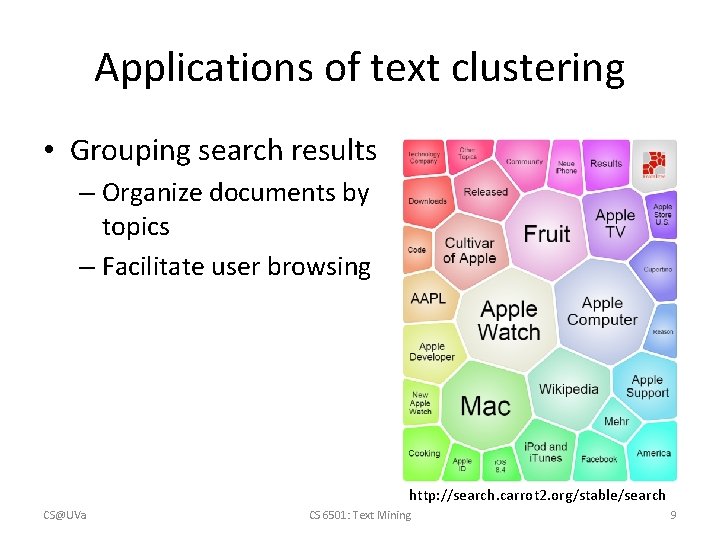
Applications of text clustering • Grouping search results – Organize documents by topics – Facilitate user browsing http: //search. carrot 2. org/stable/search CS@UVa CS 6501: Text Mining 9
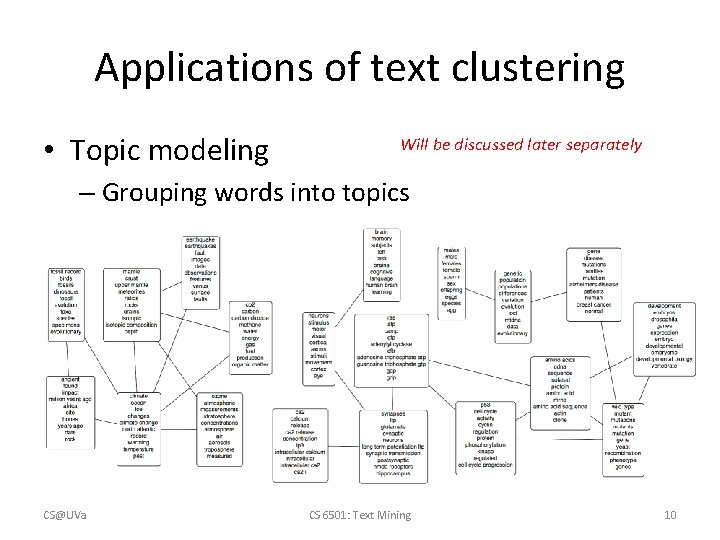
Applications of text clustering • Topic modeling Will be discussed later separately – Grouping words into topics CS@UVa CS 6501: Text Mining 10
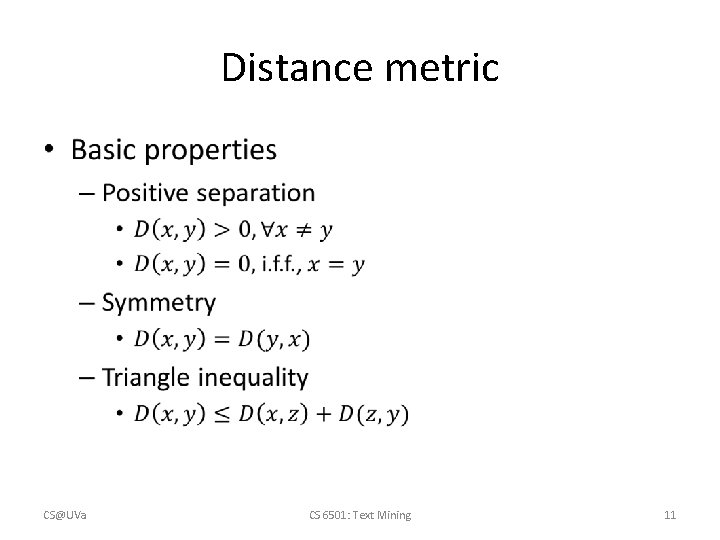
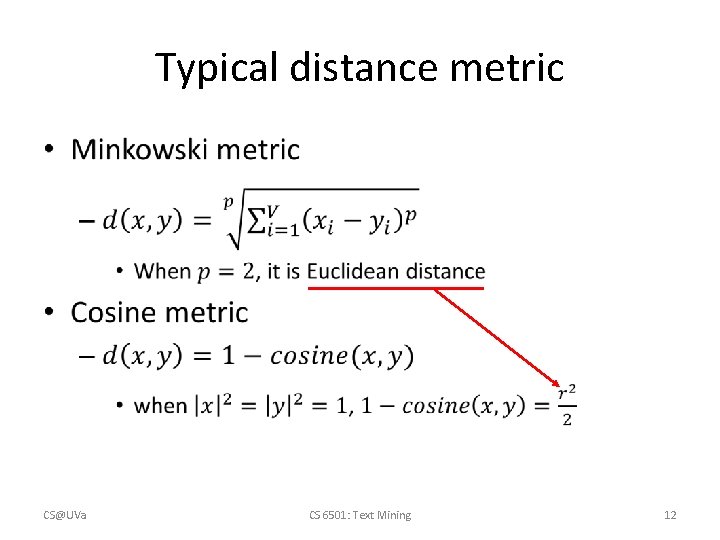
Distance metric • CS@UVa CS 6501: Text Mining 11
Typical distance metric • CS@UVa CS 6501: Text Mining 12
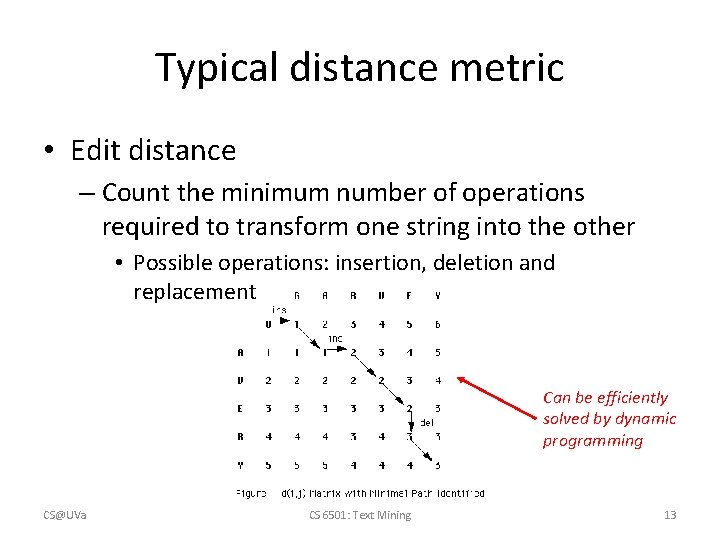
Typical distance metric • Edit distance – Count the minimum number of operations required to transform one string into the other • Possible operations: insertion, deletion and replacement Can be efficiently solved by dynamic programming CS@UVa CS 6501: Text Mining 13
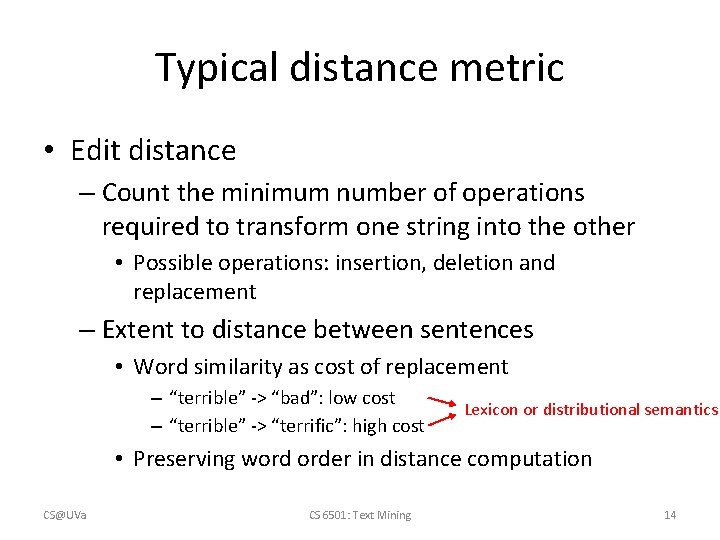
Typical distance metric • Edit distance – Count the minimum number of operations required to transform one string into the other • Possible operations: insertion, deletion and replacement – Extent to distance between sentences • Word similarity as cost of replacement – “terrible” -> “bad”: low cost – “terrible” -> “terrific”: high cost Lexicon or distributional semantics • Preserving word order in distance computation CS@UVa CS 6501: Text Mining 14
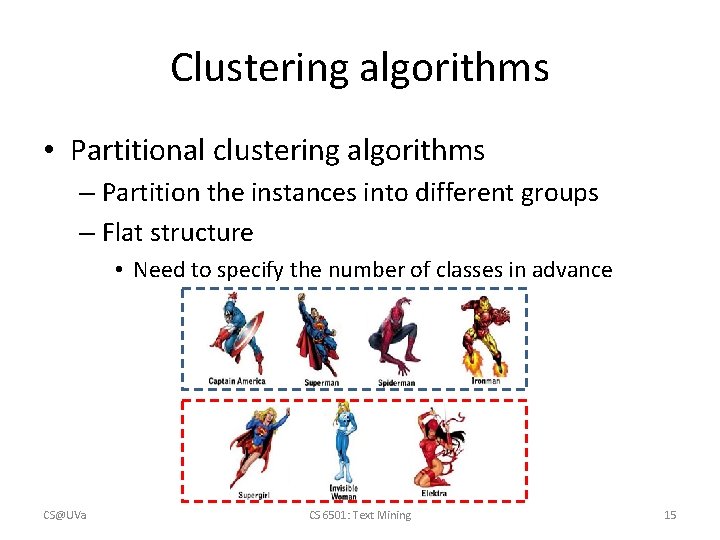
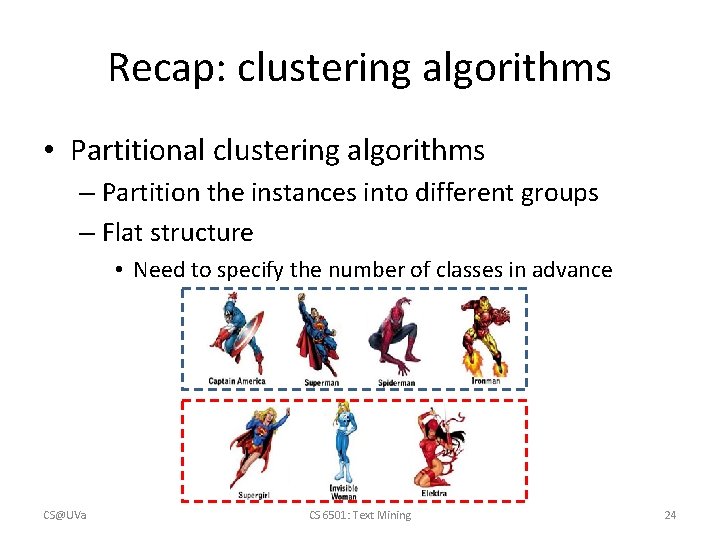
Clustering algorithms • Partitional clustering algorithms – Partition the instances into different groups – Flat structure • Need to specify the number of classes in advance CS@UVa CS 6501: Text Mining 15
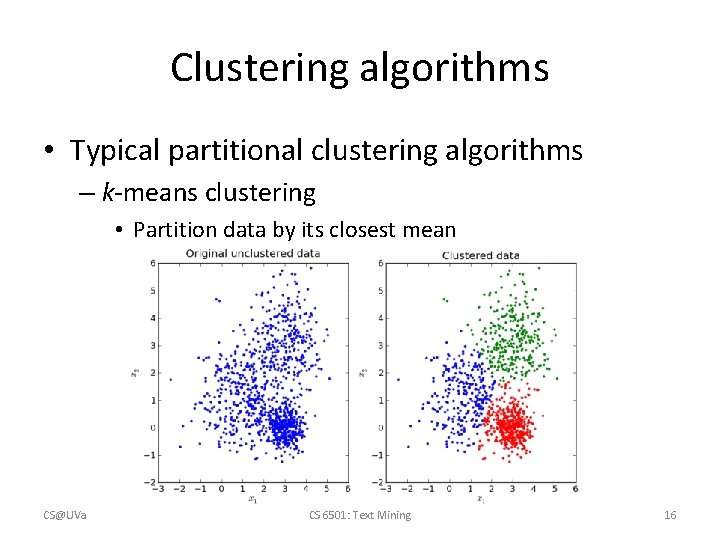
Clustering algorithms • Typical partitional clustering algorithms – k-means clustering • Partition data by its closest mean CS@UVa CS 6501: Text Mining 16
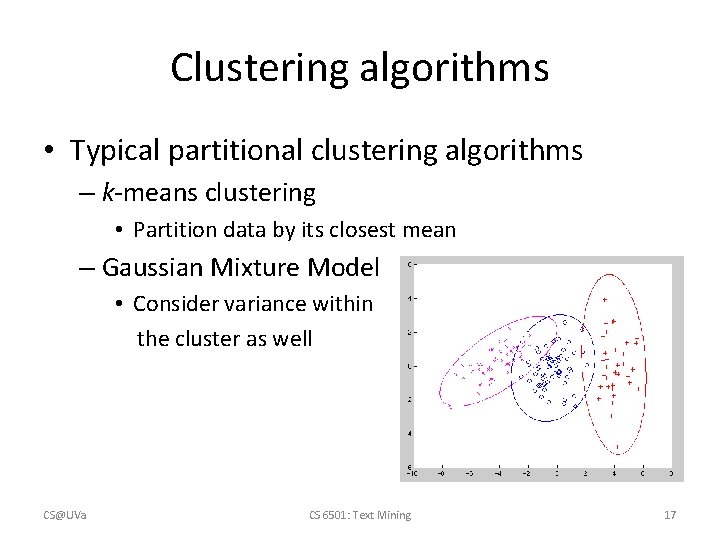
Clustering algorithms • Typical partitional clustering algorithms – k-means clustering • Partition data by its closest mean – Gaussian Mixture Model • Consider variance within the cluster as well CS@UVa CS 6501: Text Mining 17
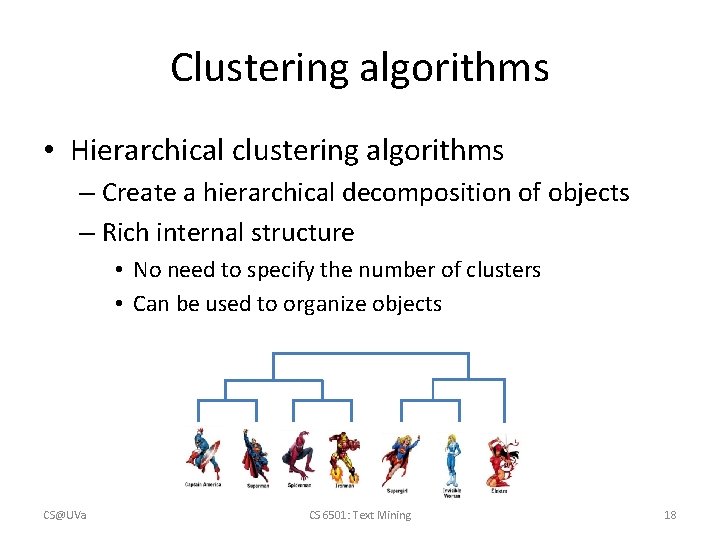
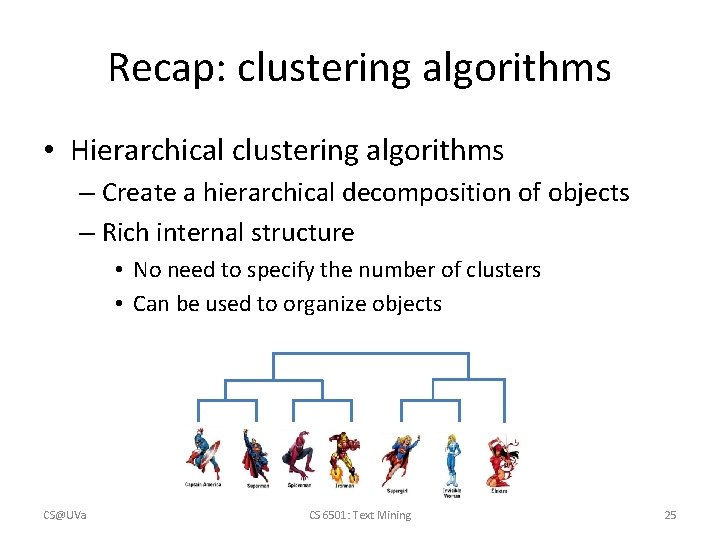
Clustering algorithms • Hierarchical clustering algorithms – Create a hierarchical decomposition of objects – Rich internal structure • No need to specify the number of clusters • Can be used to organize objects CS@UVa CS 6501: Text Mining 18
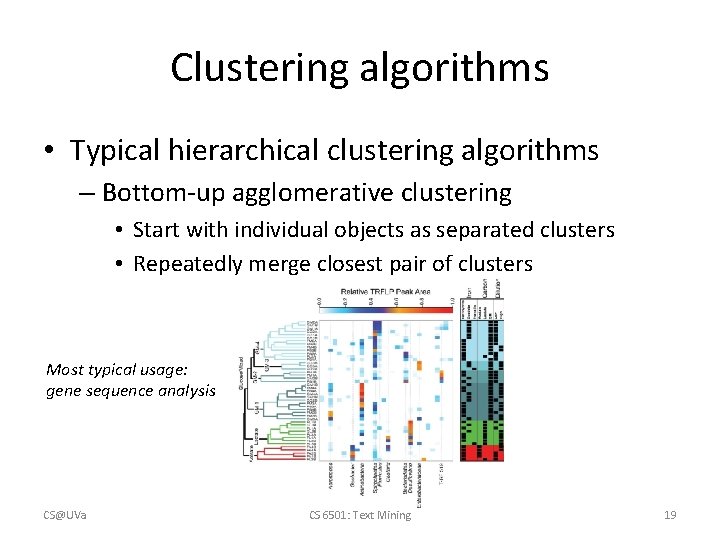
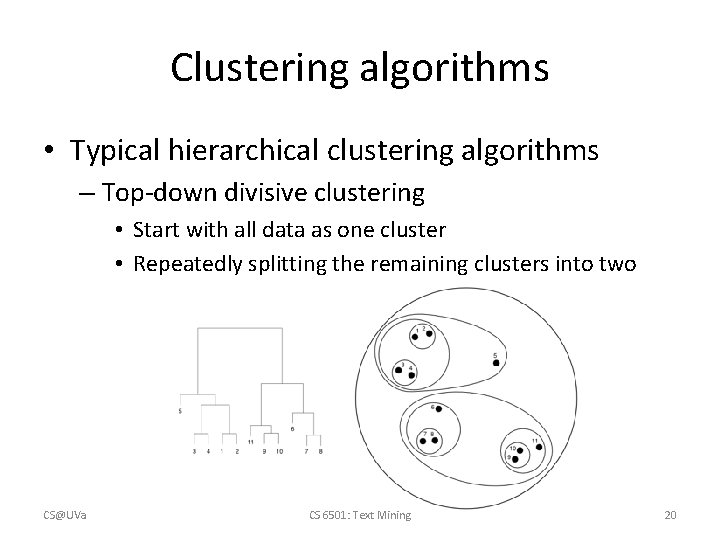
Clustering algorithms • Typical hierarchical clustering algorithms – Bottom-up agglomerative clustering • Start with individual objects as separated clusters • Repeatedly merge closest pair of clusters Most typical usage: gene sequence analysis CS@UVa CS 6501: Text Mining 19
Clustering algorithms • Typical hierarchical clustering algorithms – Top-down divisive clustering • Start with all data as one cluster • Repeatedly splitting the remaining clusters into two CS@UVa CS 6501: Text Mining 20
Desirable properties of clustering algorithms • Scalability – Both in time and space • Ability to deal with various types of data – No/less assumption about input data – Minimal requirement about domain knowledge • Interpretability and usability CS@UVa CS 6501: Text Mining 21
Cluster validation • Criteria to determine whether the clusters are meaningful – Internal validation • Stability and coherence – External validation • Match with known categories CS@UVa CS 6501: Text Mining 22
Recap: clustering problem in general • Clustering - the process of grouping a set of objects into clusters of similar objects – Basic criteria • high intra-cluster similarity • low inter-cluster similarity – No (little) supervision signal about the underlying clustering structure – Need similarity/distance as guidance to form clusters CS@UVa CS 6501: Text Mining 23
Recap: clustering algorithms • Partitional clustering algorithms – Partition the instances into different groups – Flat structure • Need to specify the number of classes in advance CS@UVa CS 6501: Text Mining 24
Recap: clustering algorithms • Hierarchical clustering algorithms – Create a hierarchical decomposition of objects – Rich internal structure • No need to specify the number of clusters • Can be used to organize objects CS@UVa CS 6501: Text Mining 25
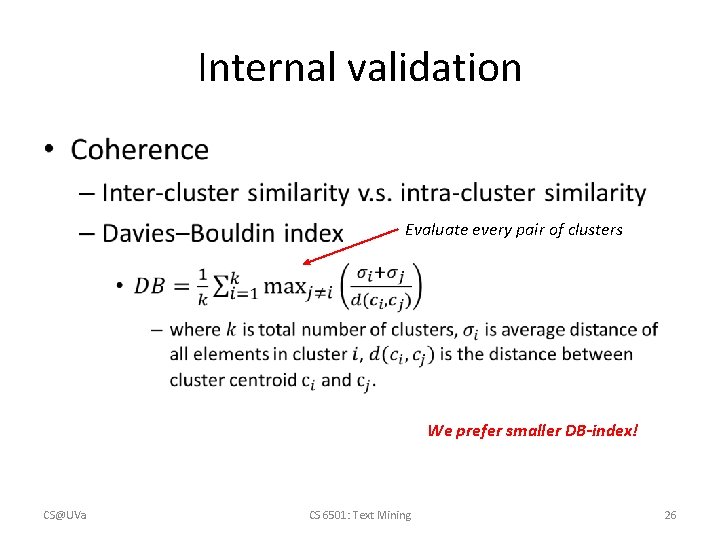
Internal validation • Evaluate every pair of clusters We prefer smaller DB-index! CS@UVa CS 6501: Text Mining 26
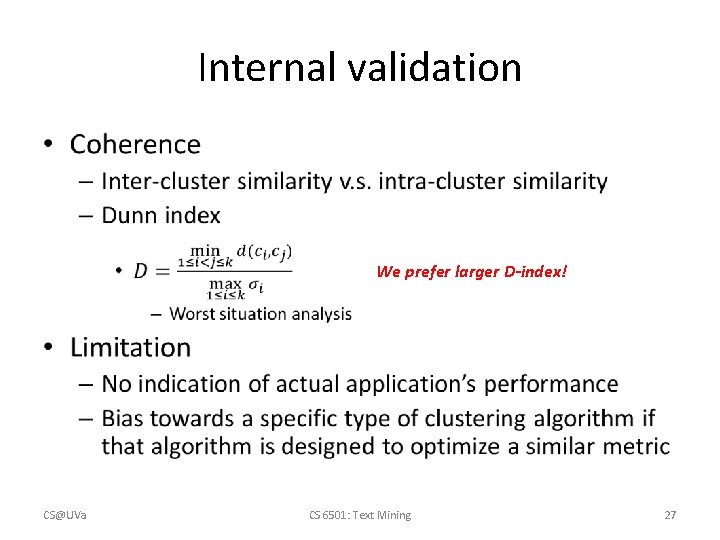
Internal validation • We prefer larger D-index! CS@UVa CS 6501: Text Mining 27
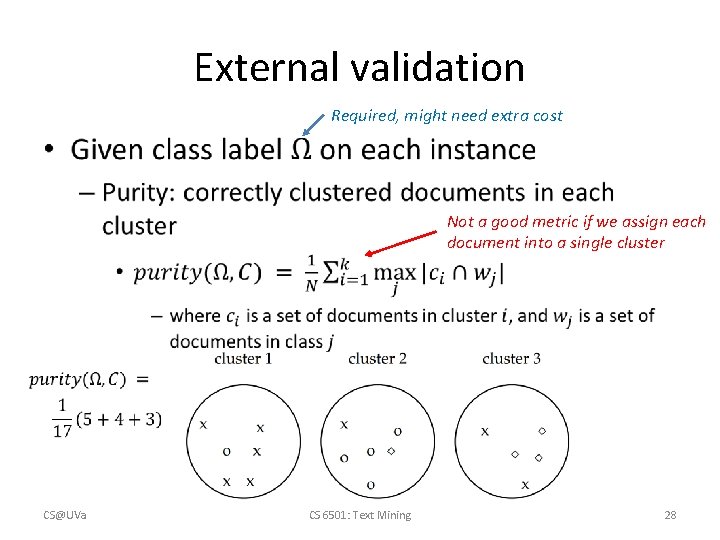
External validation Required, might need extra cost • Not a good metric if we assign each document into a single cluster CS@UVa CS 6501: Text Mining 28
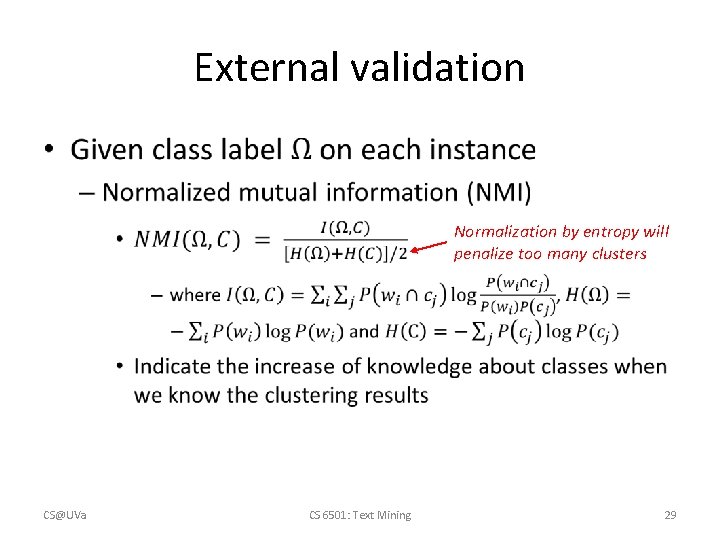
External validation • Normalization by entropy will penalize too many clusters CS@UVa CS 6501: Text Mining 29
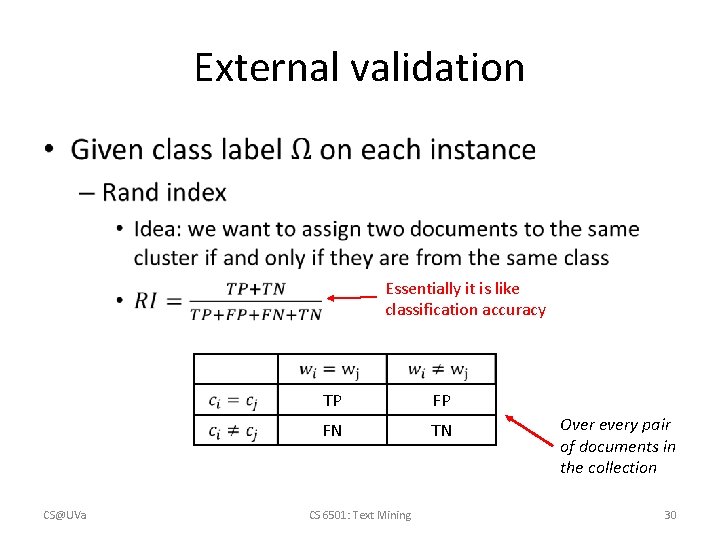
External validation • Essentially it is like classification accuracy CS@UVa TP FP FN TN CS 6501: Text Mining Over every pair of documents in the collection 30
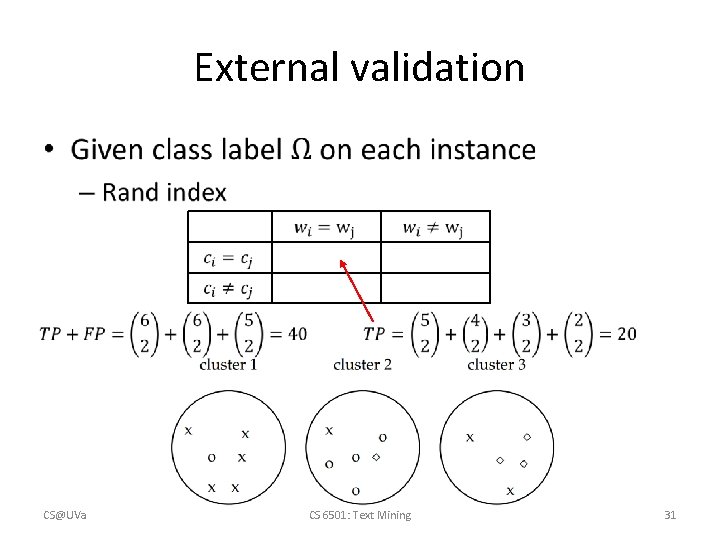
External validation • CS@UVa 20 20 24 72 CS 6501: Text Mining 31
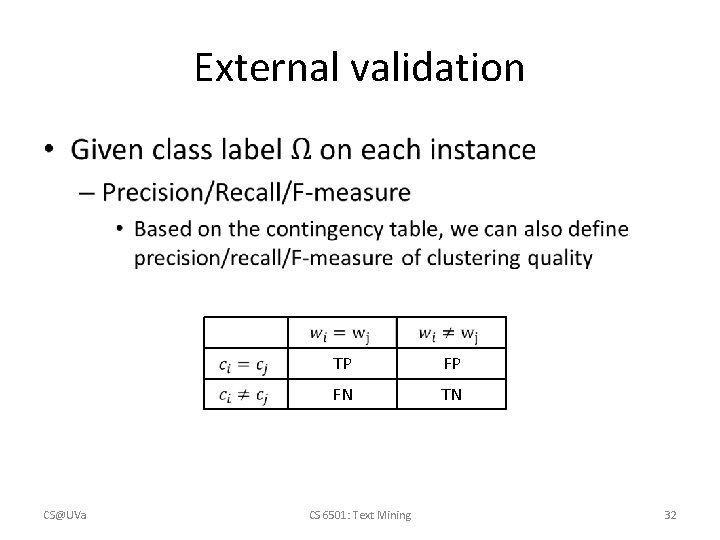
External validation • CS@UVa TP FP FN TN CS 6501: Text Mining 32
What you should know • Unsupervised nature of clustering problem – Distance metric is essential to determine the clustering results • Two basic categories of clustering algorithms – Partitional clustering – Hierarchical clustering • Clustering evaluation – Internal v. s. external CS@UVa CS 6501: Text Mining 33
Today’s reading • Introduction to Information Retrieval – Chapter 16: Flat clustering • 16. 2 Problem statement • 16. 3 Evaluation of clustering CS@UVa CS 6501: Text Mining 34