
Learning by Exploration Qingyun Wu Huazheng Wang Hongning

Learning by Exploration Qingyun Wu, Huazheng Wang, Hongning Wang Department of Computer Science University of Virginia
Outline of this tutorial • Motivation • Classical exploration strategies • Efficient exploration in complicated real-world environments • Exploration in non-stationary environments • Ethical considerations of exploration • Conclusion & future directions Outline 2
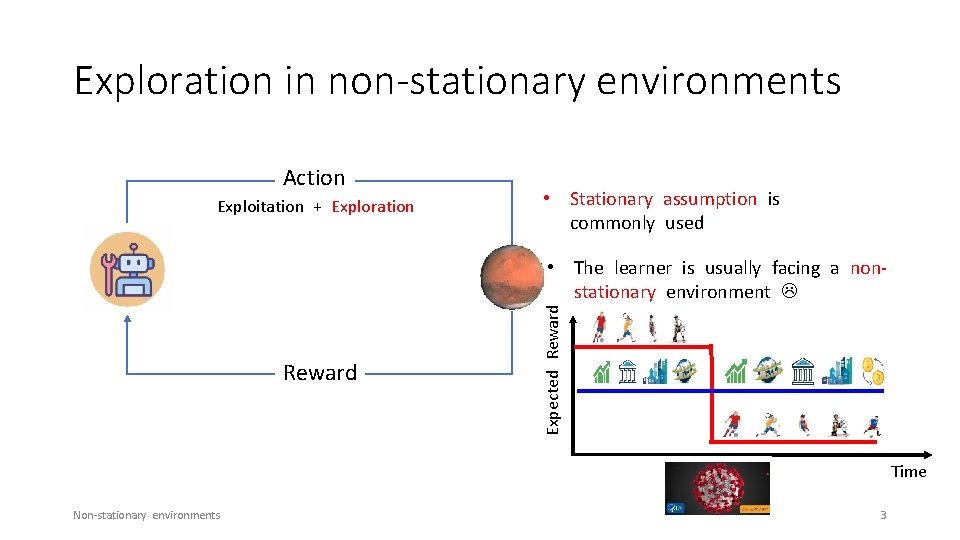
Exploration in non-stationary environments Action Exploitation + Exploration • Stationary assumption is commonly used Reward Expected Reward • The learner is usually facing a nonstationary environment Time Non-stationary environments 3
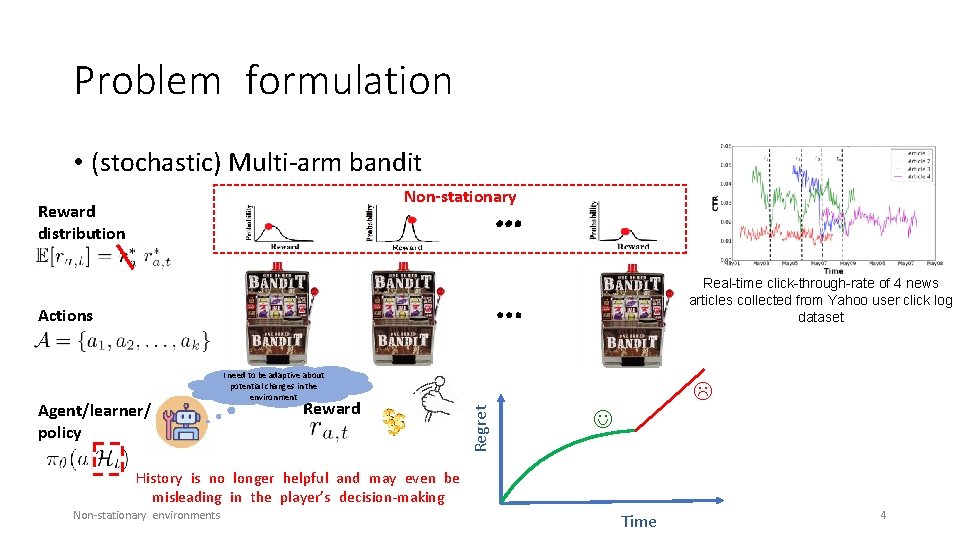
Problem formulation • (stochastic) Multi-arm bandit Non-stationary … Reward distribution Real-time click-through-rate of 4 news articles collected from Yahoo user click log dataset … Actions Reward Regret Agent/learner/ policy I need to be adaptive about potential changes in the environment History is no longer helpful and may even be misleading in the player’s decision-making Non-stationary environments Time 4
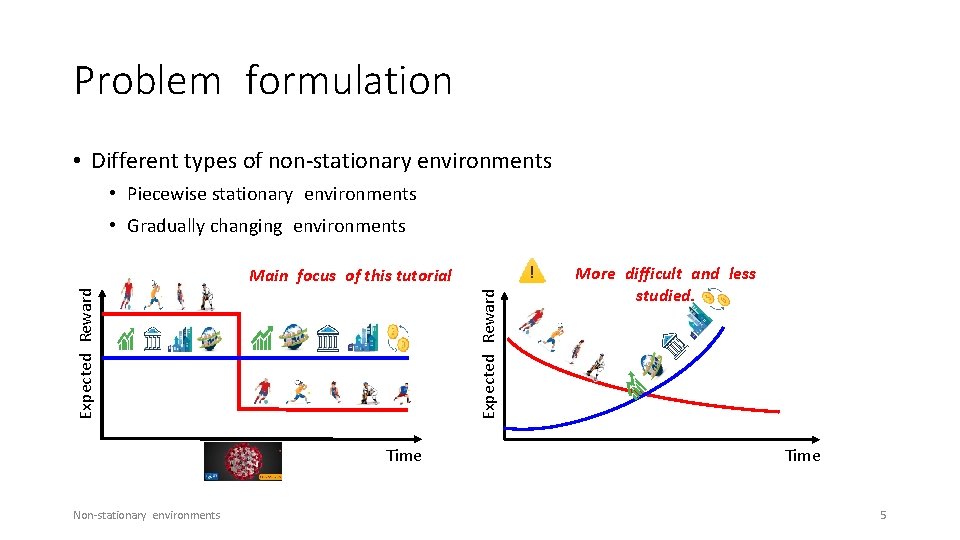
Problem formulation • Different types of non-stationary environments • Piecewise stationary environments • Gradually changing environments Expected Reward Main focus of this tutorial Time Non-stationary environments More difficult and less studied. Time 5
Challenges • Changes (when and how) are unknown to the learner (otherwise we can just restart the learner) • Online learning setting and bandit feedback: incomplete knowledge (change detection in the offline batch setting has been extensively studied in statistics and control theory [BN 93] ) Non-stationary environments 6
Approaches • Passively adaptive approaches • Key idea: design a proper mechanism to forget old observations are less relevant • Assumption: • Actively adaptive approaches • Key idea: actively detect potential changes in the environment during online decision making • Assumption: abrupt changes, i. e. , piece-wise stationary environment Non-stationary environments 7
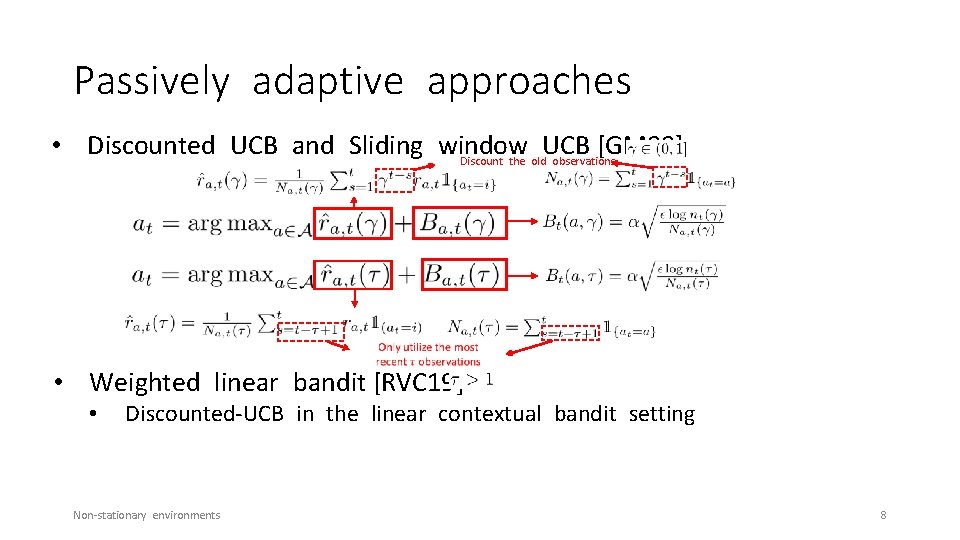
Passively adaptive approaches • Discounted UCB and Sliding window UCB [GM 08] Discount the old observations • Weighted linear bandit [RVC 19] • Discounted-UCB in the linear contextual bandit setting Non-stationary environments 8
Passively adaptive approaches • Pros • Simple: easy to implement and have almost no computation overhead • Have provable theoretical guarantee in piece-wise non-stationary environment and environments with slow changes • Cons • Passive: always assuming old observations are less relevant • Not practical: very sensitive to hyper-parameters discount factor, sliding-window size Non-stationary environments 9
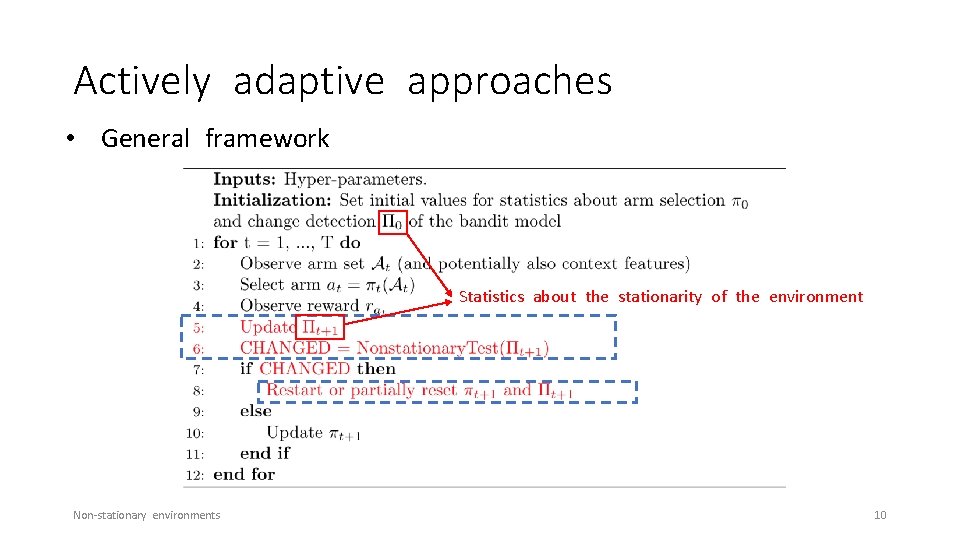
Actively adaptive approaches • General framework Statistics about the stationarity of the environment Non-stationary environments 10
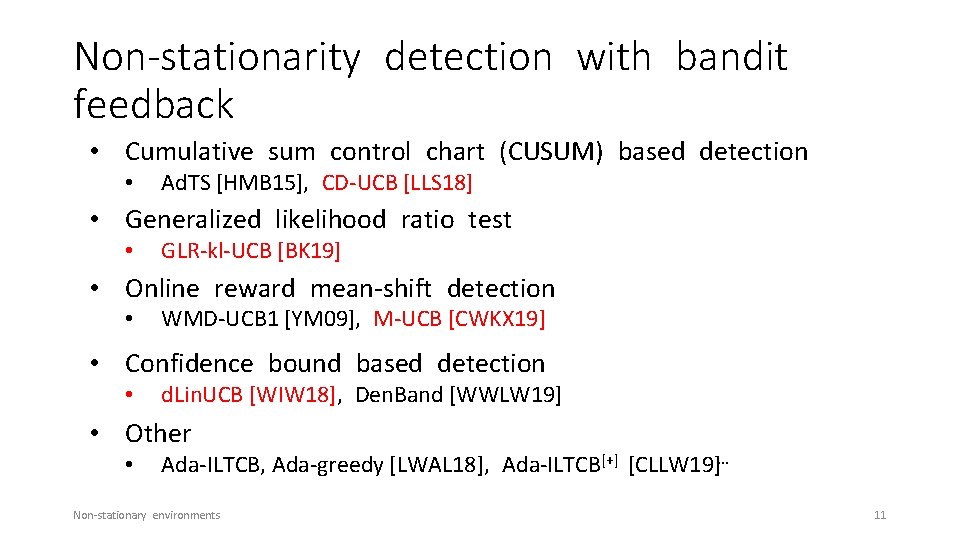
Non-stationarity detection with bandit feedback • Cumulative sum control chart (CUSUM) based detection • Ad. TS [HMB 15], CD-UCB [LLS 18] • Generalized likelihood ratio test • GLR-kl-UCB [BK 19] • Online reward mean-shift detection • WMD-UCB 1 [YM 09], M-UCB [CWKX 19] • Confidence bound based detection • d. Lin. UCB [WIW 18], Den. Band [WWLW 19] • Other • Ada-ILTCB, Ada-greedy [LWAL 18], Ada-ILTCB[+] [CLLW 19]… Non-stationary environments 11
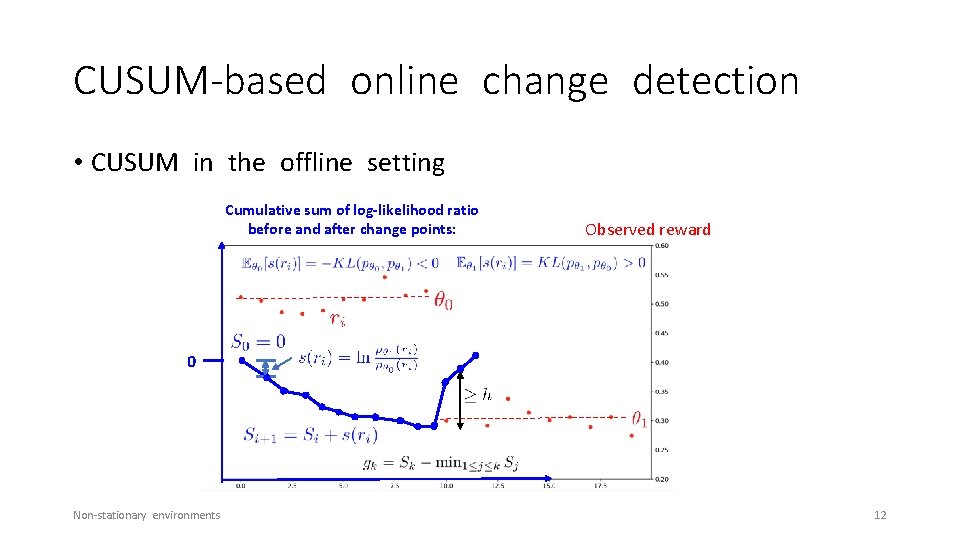
CUSUM-based online change detection • CUSUM in the offline setting Cumulative sum of log-likelihood ratio before and after change points: Observed reward 0 Non-stationary environments 12
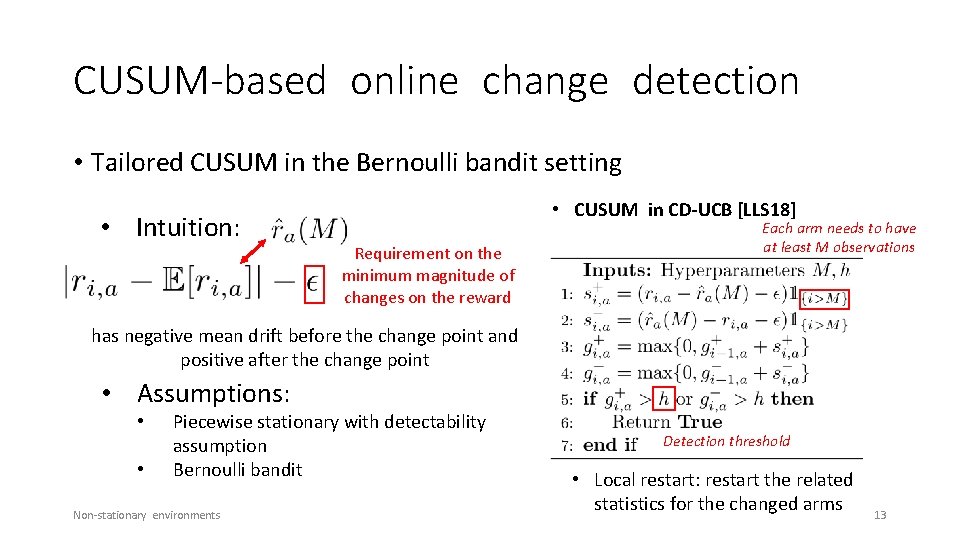
CUSUM-based online change detection • Tailored CUSUM in the Bernoulli bandit setting • Intuition: • CUSUM in CD-UCB [LLS 18] Requirement on the minimum magnitude of changes on the reward Each arm needs to have at least M observations has negative mean drift before the change point and positive after the change point • Assumptions: • • Piecewise stationary with detectability assumption Bernoulli bandit Non-stationary environments Detection threshold • Local restart: restart the related statistics for the changed arms 13
Generalized likelihood ratio test based online change detection • CUSUM requires the pre-change and post-change environment parameters to be known to get the log-likelihood. • Unknown pre-change and/or post-change parameters -> Generalized Likelihood Ratio Test (GLRT) • GLRT with Bernoulli reward -> GLR-kl. UCB [BK 19] • GLRT can achieve asymptotically optimal detection delay with sub-Gaussian reward assumption [Mai 19] Non-stationary environments 14
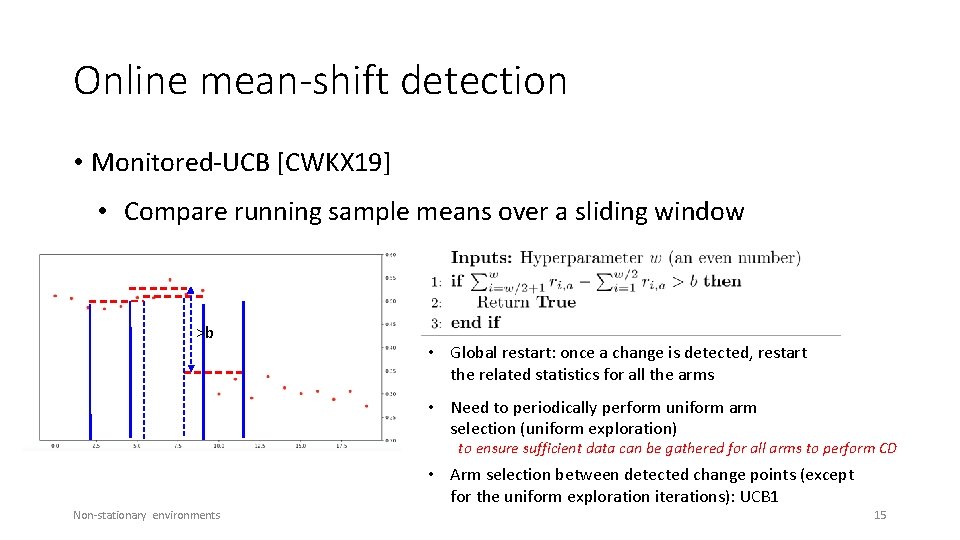
Online mean-shift detection • Monitored-UCB [CWKX 19] • Compare running sample means over a sliding window >b • Global restart: once a change is detected, restart the related statistics for all the arms • Need to periodically perform uniform arm selection (uniform exploration) to ensure sufficient data can be gathered for all arms to perform CD • Arm selection between detected change points (except for the uniform exploration iterations): UCB 1 Non-stationary environments 15
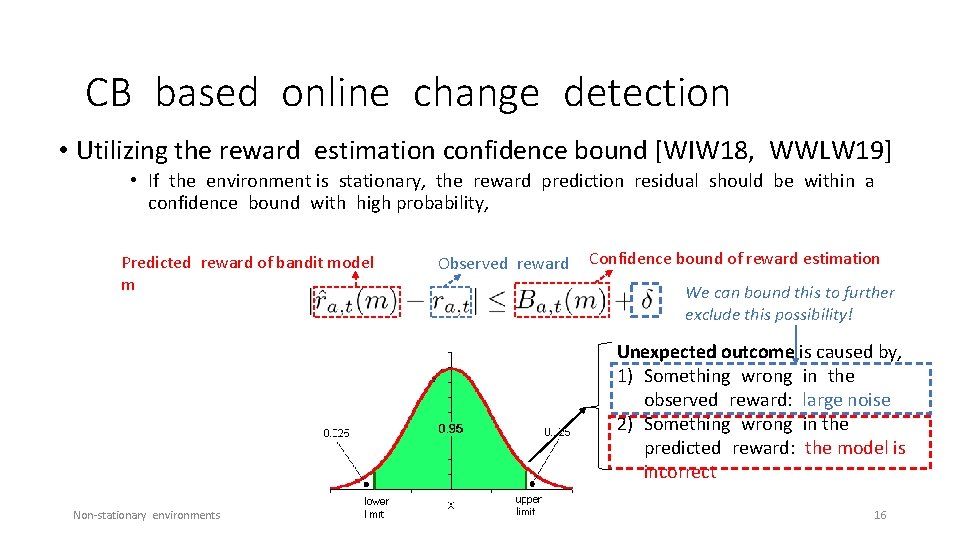
CB based online change detection • Utilizing the reward estimation confidence bound [WIW 18, WWLW 19] • If the environment is stationary, the reward prediction residual should be within a confidence bound with high probability, Predicted reward of bandit model m Observed reward Confidence bound of reward estimation We can bound this to further exclude this possibility! Unexpected outcome is caused by, 1) Something wrong in the observed reward: large noise 2) Something wrong in the predicted reward: the model is incorrect Non-stationary environments 16
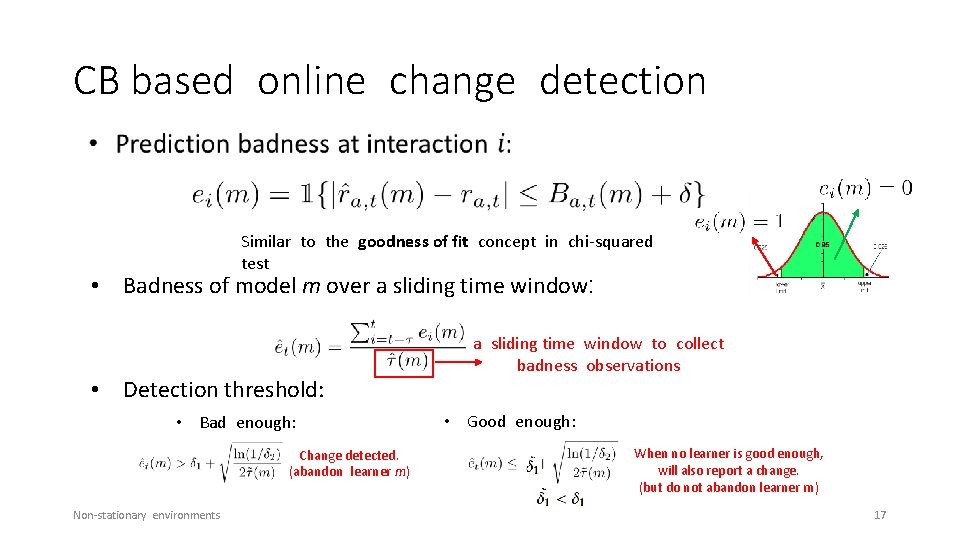
CB based online change detection Similar to the goodness of fit concept in chi-squared test • Badness of model m over a sliding time window: • Detection threshold: • Bad enough: Change detected. (abandon learner m) Non-stationary environments a sliding time window to collect badness observations • Good enough: When no learner is good enough, will also report a change. (but do not abandon learner m) 17
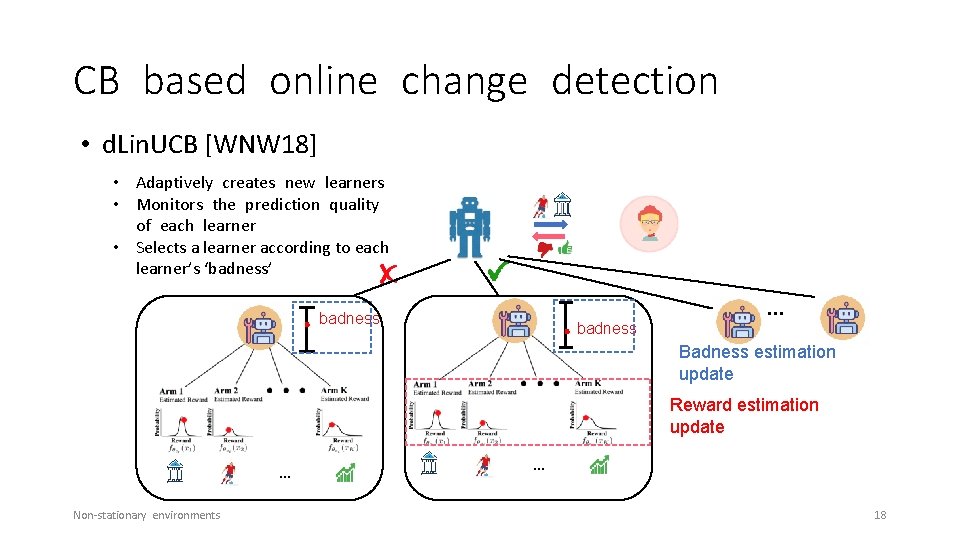
CB based online change detection • d. Lin. UCB [WNW 18] • Adaptively creates new learners • Monitors the prediction quality of each learner • Selects a learner according to each learner’s ‘badness’ . . badness … Badness estimation update Reward estimation update … Non-stationary environments … 18
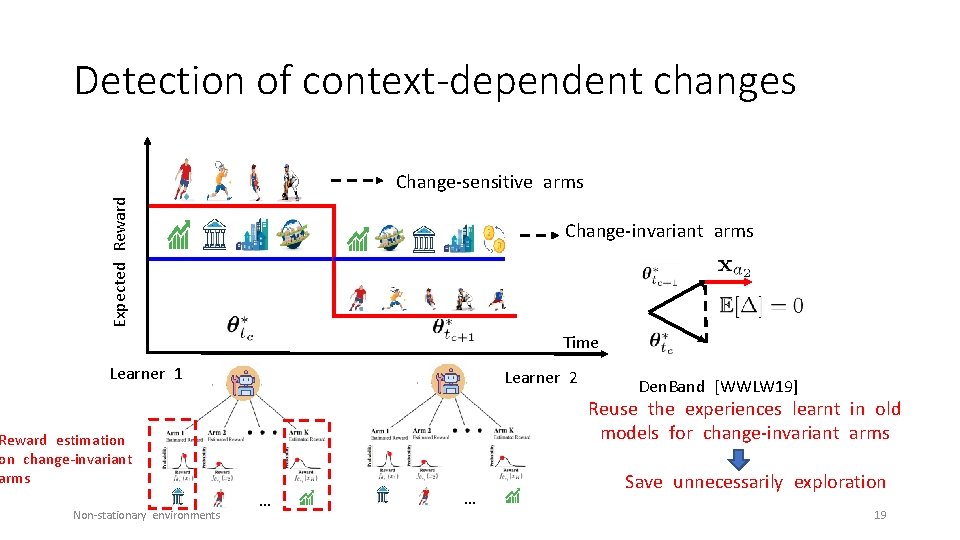
Detection of context-dependent changes Expected Reward Change-sensitive arms Change-invariant arms Time Learner 1 Reward estimation on change-invariant arms Non-stationary environments Learner 2 Den. Band [WWLW 19] Reuse the experiences learnt in old models for change-invariant arms … … Save unnecessarily exploration 19
Empirical evaluations • Simulation-based evaluation • Simulate the non-stationary environment • Evaluation on real-world datasets • On real-world datasets that have non-stationarity (e. g. Yahoo! Front Page Today Module User Click Log Dataset) • Semi-simulation-based evaluation • Real-world datasets (that do not have non-stationarity) + simulated changes Non-stationary environments 20
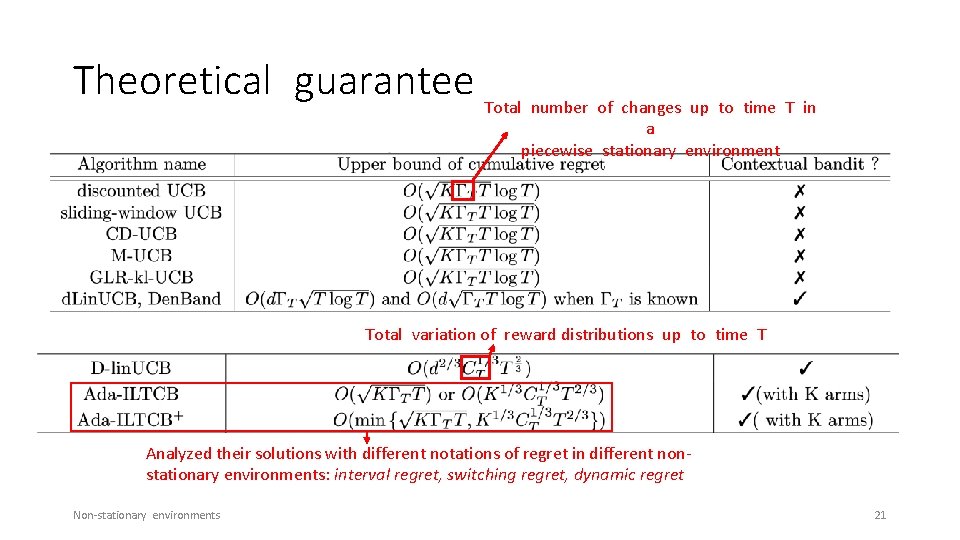
Theoretical guarantee Total number of changes up to time T in a piecewise stationary environment Total variation of reward distributions up to time T Analyzed their solutions with different notations of regret in different nonstationary environments: interval regret, switching regret, dynamic regret Non-stationary environments 21
Open questions • Can we re-use related historical observations (e. g. , recurring environment, or context-dependent changes) and what’s the benefit of it ? • How to handle gradually changing environment • Reinforcement learning in non-stationary environments Non-stationary environments 22
References IV [BN 93] Basseville, M. , & Nikiforov, I. V. (1993). Detection of abrupt changes: theory and application (Vol. 104). Englewood Cliffs: prentice Hall. [GM 08] Garivier, A. , & Moulines, E. (2008). On upper-confidence bound policies for non-stationary bandit problems. ar. Xiv preprint ar. Xiv: 0805. 3415. [RVC 19] Russac, Y. , Vernade, C. , & Cappé, O. (2019). Weighted linear bandits for non-stationary environments. In Advances in Neural Information Processing Systems (pp. 12040 -12049). [YM 09] Yu, J. Y. , & Mannor, S. (2009, June). Piecewise-stationary bandit problems with side observations. In Proceedings of the 26 th annual international conference on machine learning (pp. 1177 -1184). [HMB 15] Hariri, N. , Mobasher, B. , & Burke, R. (2015, June). Adapting to user preference changes in interactive recommendation. In Twenty-Fourth International Joint Conference on Artificial Intelligence. [WNW 18] Wu, Q. , Iyer, N. , & Wang, H. (2018, June). Learning contextual bandits in a non-stationary environment. In The 41 st International ACM SIGIR Conference on Research & Development in Information Retrieval (pp. 495 -504). [LWAL 18] Luo, H. , Wei, C. Y. , Agarwal, A. , & Langford, J. (2018, July). Efficient contextual bandits in non-stationary worlds. In Conference On Learning Theory (pp. 1739 -1776). [CWKX 19] Cao, Y. , Wen, Z. , Kveton, B. , & Xie, Y. (2019, April). Nearly optimal adaptive procedure with change detection for piecewise-stationary bandit. In The 22 nd International Conference on Artificial Intelligence and Statistics (pp. 418 -427). [LLS 18] Liu, Fang, Joohyun Lee, and Ness Shroff. “A change-detection based framework for piecewise-stationary multi-armed bandit problem. ” Thirty-Second AAAI Conference on Artificial Intelligence. 2018. [WWLW 19] Wu, Q. , Wang, H. , Li, Y. , & Wang, H. (2019, May). Dynamic Ensemble of Contextual Bandits to Satisfy Users' Changing Interests. In The World Wide Web Conference (pp. 2080 -2090). [CLLW 19] Chen, Y. , Lee, C. W. , Luo, H. , & Wei, C. Y. (2019). A new algorithm for non-stationary contextual bandits: Efficient, optimal, and parameterfree. ar. Xiv preprint ar. Xiv: 1902. 00980. [BK 19] Besson, L. , & Kaufmann, E. (2019). The generalized likelihood ratio test meets klucb: an improved algorithm for piece-wise non-stationary bandits. ar. Xiv preprint ar. Xiv: 1902. 01575. [Mai 19] Maillard, O. A. (2019). Sequential change-point detection: Laplace concentration of scan statistics and non-asymptotic delay bounds. Background 23
- Slides: 23