
Retrieval Evaluation Hongning Wang CSUVa What we have
- Slides: 50
Retrieval Evaluation Hongning Wang CS@UVa
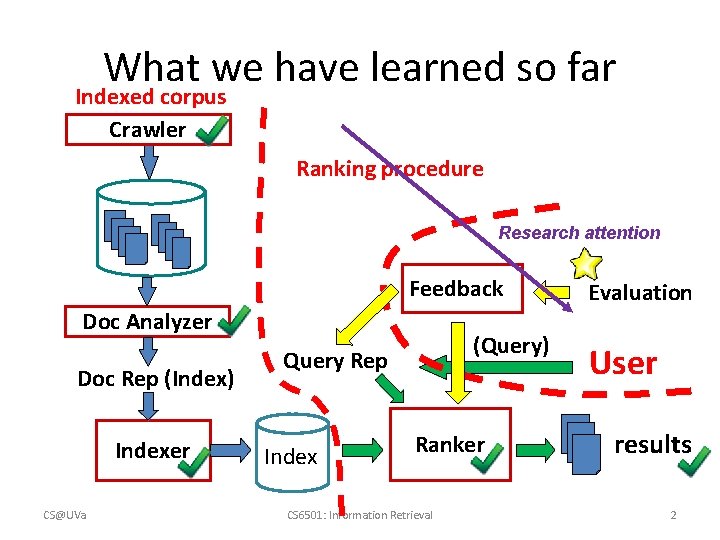
What we have learned so far Indexed corpus Crawler Ranking procedure Research attention Feedback Doc Analyzer Doc Rep (Index) Indexer CS@UVa (Query) Query Rep Index Ranker CS 6501: Information Retrieval Evaluation User results 2
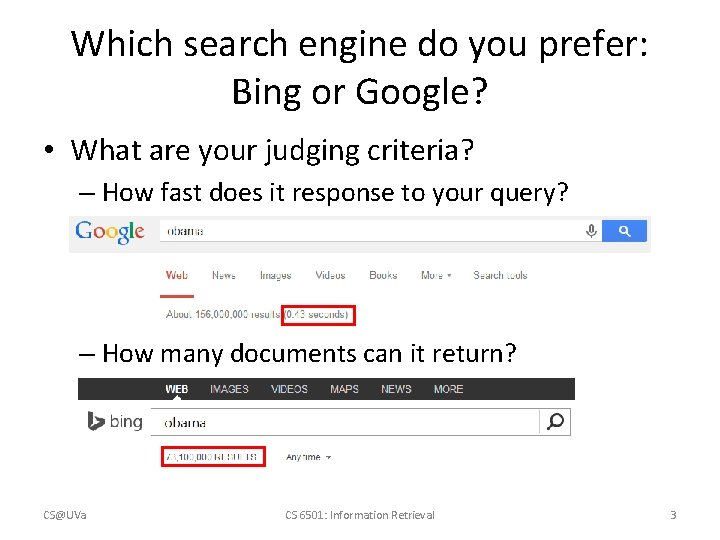
Which search engine do you prefer: Bing or Google? • What are your judging criteria? – How fast does it response to your query? – How many documents can it return? CS@UVa CS 6501: Information Retrieval 3
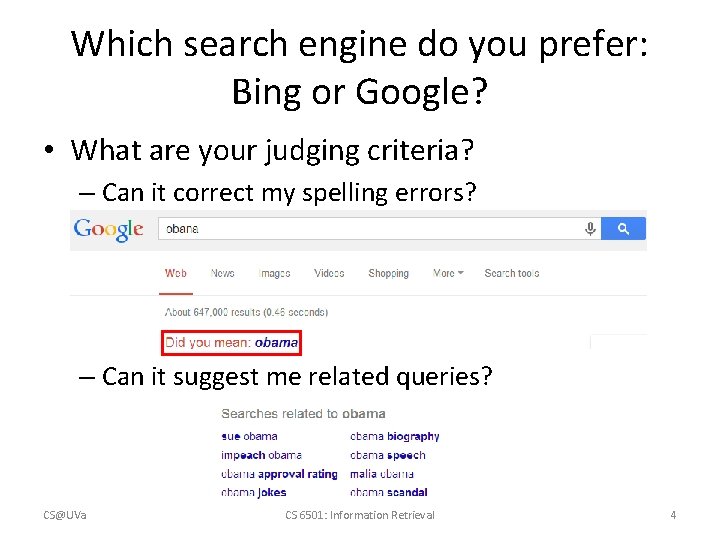
Which search engine do you prefer: Bing or Google? • What are your judging criteria? – Can it correct my spelling errors? – Can it suggest me related queries? CS@UVa CS 6501: Information Retrieval 4
Retrievaluation • Aforementioned evaluation criteria are all good, but not essential – Goal of any IR system • Satisfying users’ information need – Core quality measure criterion • “how well a system meets the information needs of its users. ” – wiki • Unfortunately vague and hard to execute CS@UVa CS 6501: Information Retrieval 5
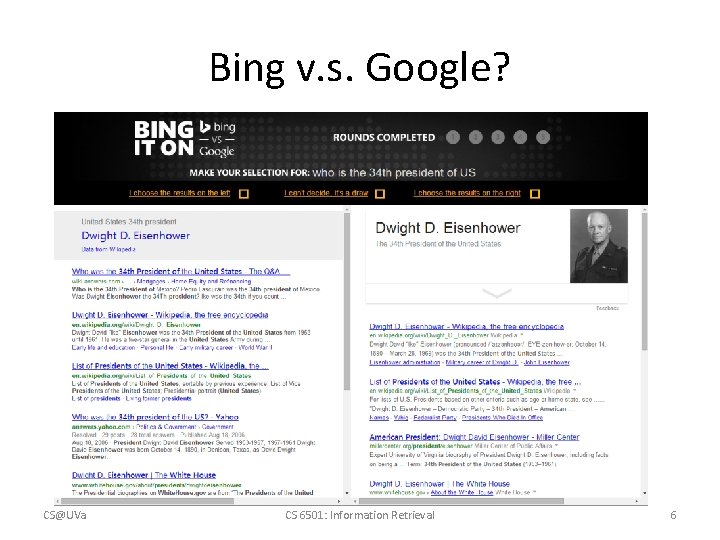
Bing v. s. Google? CS@UVa CS 6501: Information Retrieval 6
Quantify the IR quality measure • Information need – “an individual or group's desire to locate and obtain information to satisfy a conscious or unconscious need” – wiki – Reflected by user query – Categorization of information need • Navigational • Informational • Transactional CS@UVa CS 6501: Information Retrieval 7
Quantify the IR quality measure • Satisfaction – “the opinion of the user about a specific computer application, which they use” – wiki – Reflected by • Increased result clicks • Repeated/increased visits • Result relevance CS@UVa CS 6501: Information Retrieval 8
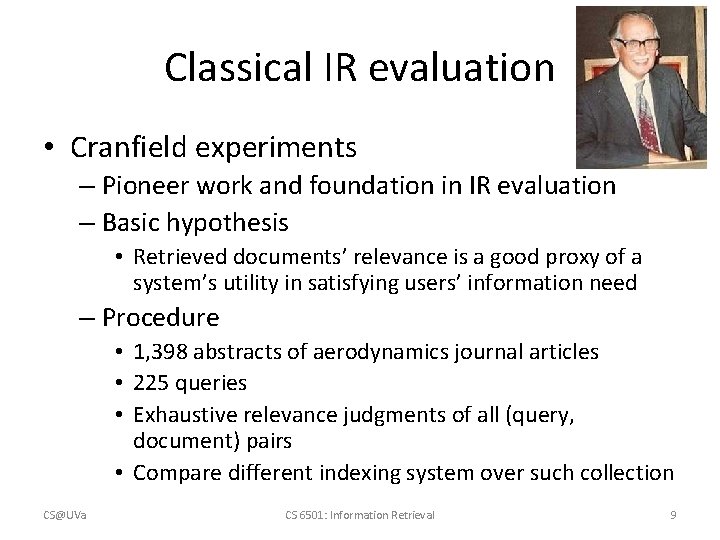
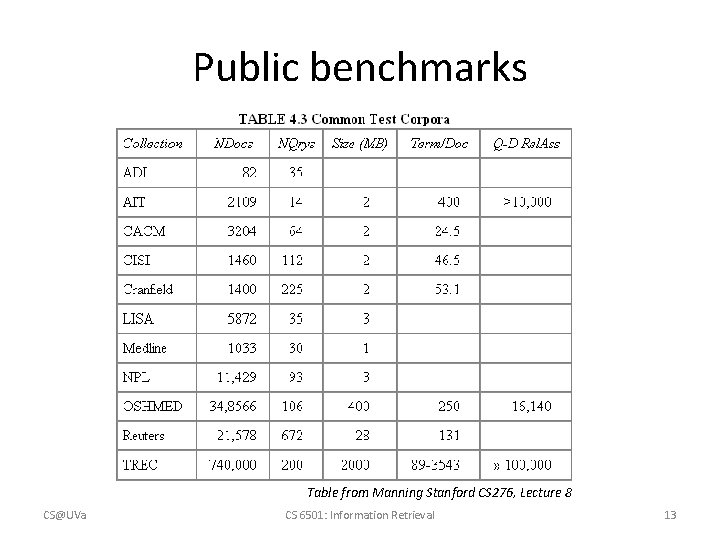
Classical IR evaluation • Cranfield experiments – Pioneer work and foundation in IR evaluation – Basic hypothesis • Retrieved documents’ relevance is a good proxy of a system’s utility in satisfying users’ information need – Procedure • 1, 398 abstracts of aerodynamics journal articles • 225 queries • Exhaustive relevance judgments of all (query, document) pairs • Compare different indexing system over such collection CS@UVa CS 6501: Information Retrieval 9
Classical IR evaluation • Three key elements for IR evaluation 1. A document collection 2. A test suite of information needs, expressible as queries 3. A set of relevance judgments, e. g. , binary assessment of either relevant or nonrelevant for each query-document pair CS@UVa CS 6501: Information Retrieval 10
Search relevance • Users’ information needs are translated into queries • Relevance is judged with respect to the information need, not the query – E. g. , Information need: “When should I renew my Virginia driver’s license? ” Query: “Virginia driver’s license renewal” Judgment: whether a document contains the right answer, e. g. , every 8 years; rather than if it literally contains those four words CS@UVa CS 6501: Information Retrieval 11
Text REtrieval Conference (TREC) • Large-scale evaluation of text retrieval methodologies – Since 1992, hosted by NIST – Standard benchmark for IR studies – A wide variety of evaluation collections • • • CS@UVa Web track Question answering track Cross-language track Microblog track And more… CS 6501: Information Retrieval 12
Public benchmarks Table from Manning Stanford CS 276, Lecture 8 CS@UVa CS 6501: Information Retrieval 13
Evaluation metric • To answer the questions – Is Google better than Bing? – Which smoothing method is most effective? – Is BM 25 better than language models? – Shall we perform stemming or stopword removal? • We need a quantifiable metric, by which we can compare different IR systems – As unranked retrieval sets – As ranked retrieval results CS@UVa CS 6501: Information Retrieval 14
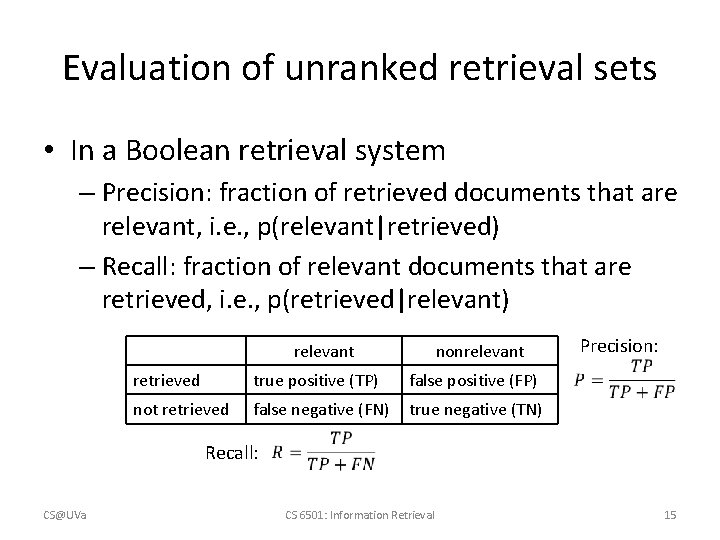
Evaluation of unranked retrieval sets • In a Boolean retrieval system – Precision: fraction of retrieved documents that are relevant, i. e. , p(relevant|retrieved) – Recall: fraction of relevant documents that are retrieved, i. e. , p(retrieved|relevant) relevant nonrelevant retrieved true positive (TP) false positive (FP) not retrieved false negative (FN) true negative (TN) Precision: Recall: CS@UVa CS 6501: Information Retrieval 15
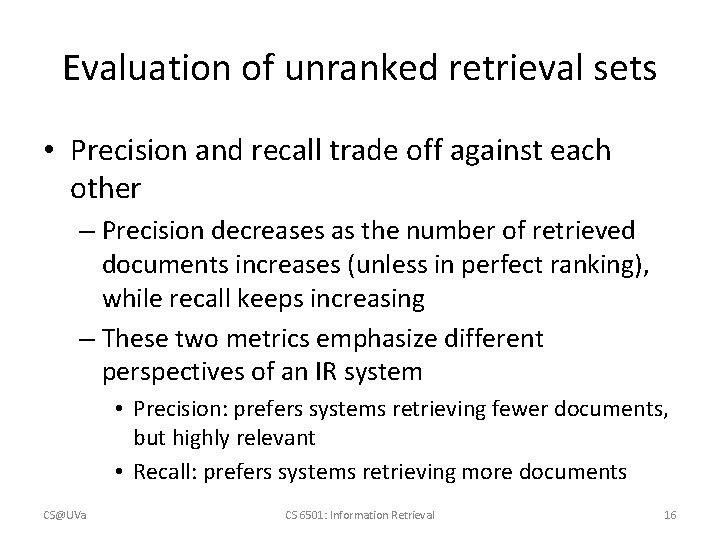
Evaluation of unranked retrieval sets • Precision and recall trade off against each other – Precision decreases as the number of retrieved documents increases (unless in perfect ranking), while recall keeps increasing – These two metrics emphasize different perspectives of an IR system • Precision: prefers systems retrieving fewer documents, but highly relevant • Recall: prefers systems retrieving more documents CS@UVa CS 6501: Information Retrieval 16
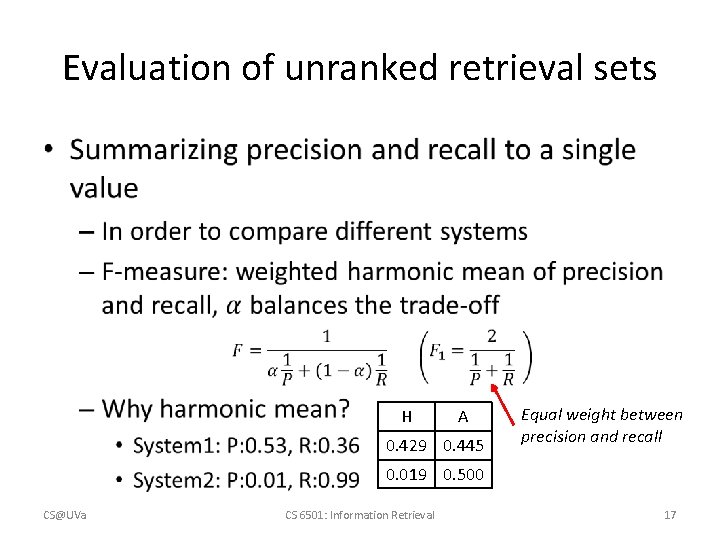
Evaluation of unranked retrieval sets • H A 0. 429 0. 445 Equal weight between precision and recall 0. 019 0. 500 CS@UVa CS 6501: Information Retrieval 17
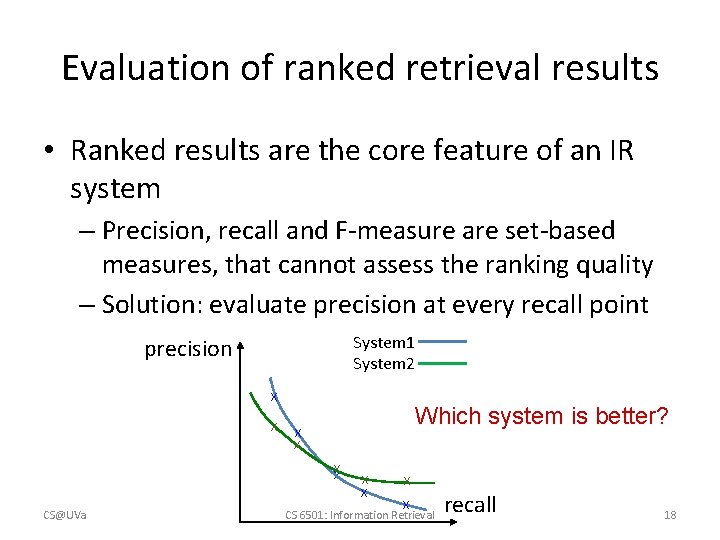
Evaluation of ranked retrieval results • Ranked results are the core feature of an IR system – Precision, recall and F-measure are set-based measures, that cannot assess the ranking quality – Solution: evaluate precision at every recall point System 1 System 2 precision x x Which system is better? x x xx CS@UVa x x CS 6501: Information Retrieval recall 18
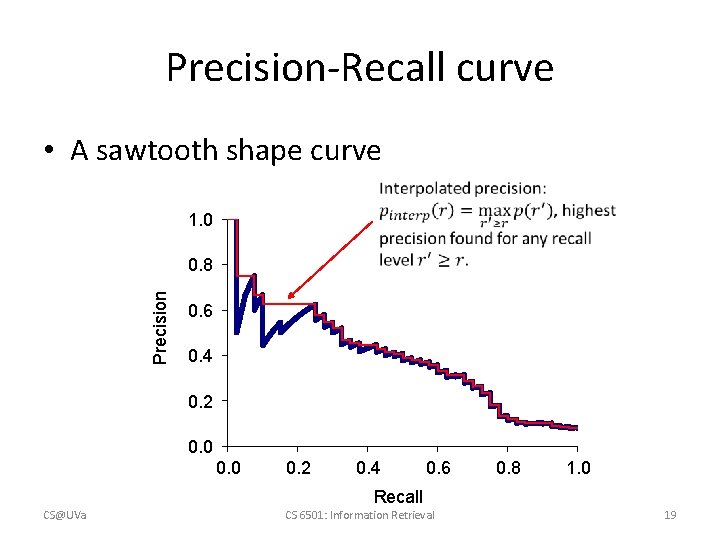
Precision-Recall curve • A sawtooth shape curve 1. 0 Precision 0. 8 0. 6 0. 4 0. 2 0. 0 0. 2 0. 4 0. 6 0. 8 1. 0 Recall CS@UVa CS 6501: Information Retrieval 19
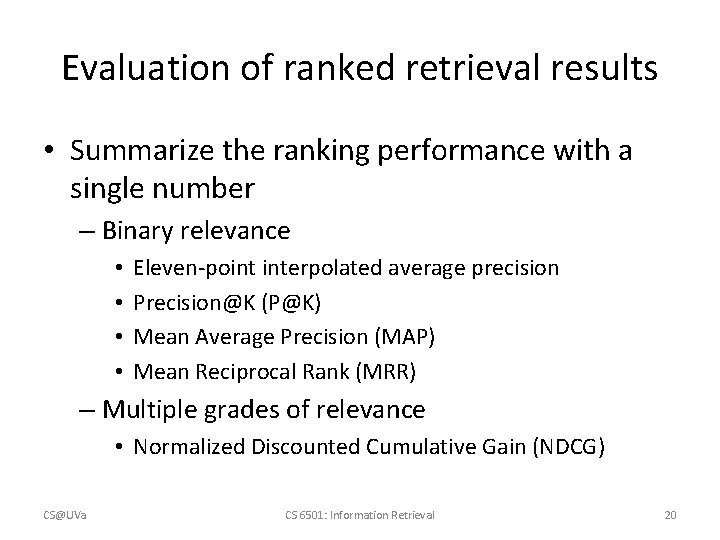
Evaluation of ranked retrieval results • Summarize the ranking performance with a single number – Binary relevance • • Eleven-point interpolated average precision Precision@K (P@K) Mean Average Precision (MAP) Mean Reciprocal Rank (MRR) – Multiple grades of relevance • Normalized Discounted Cumulative Gain (NDCG) CS@UVa CS 6501: Information Retrieval 20
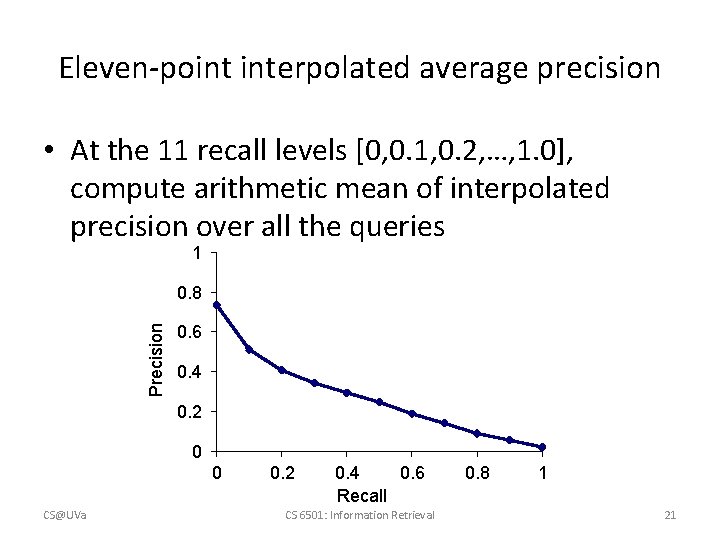
Eleven-point interpolated average precision • At the 11 recall levels [0, 0. 1, 0. 2, …, 1. 0], compute arithmetic mean of interpolated precision over all the queries 1 Precision 0. 8 0. 6 0. 4 0. 2 0 0 CS@UVa 0. 2 0. 4 0. 6 Recall CS 6501: Information Retrieval 0. 8 1 21
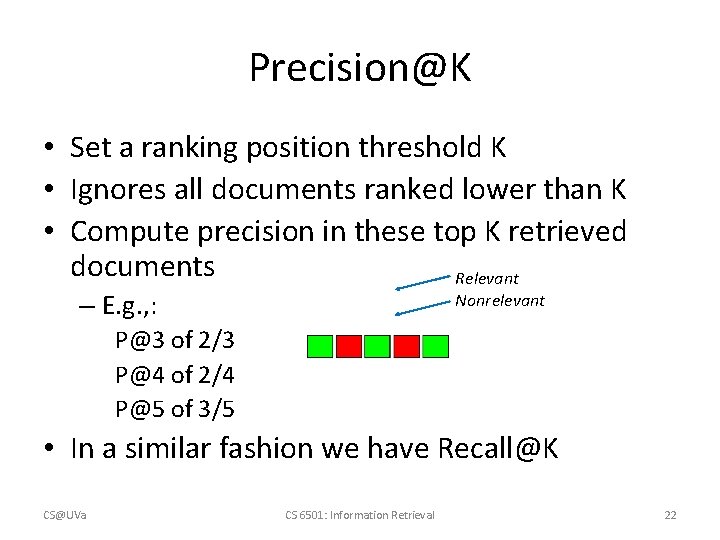
Precision@K • Set a ranking position threshold K • Ignores all documents ranked lower than K • Compute precision in these top K retrieved documents Relevant – E. g. , : Nonrelevant P@3 of 2/3 P@4 of 2/4 P@5 of 3/5 • In a similar fashion we have Recall@K CS@UVa CS 6501: Information Retrieval 22
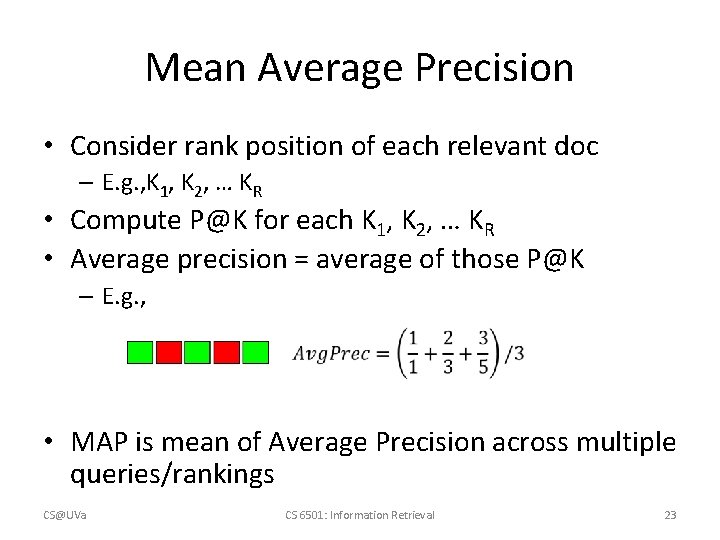
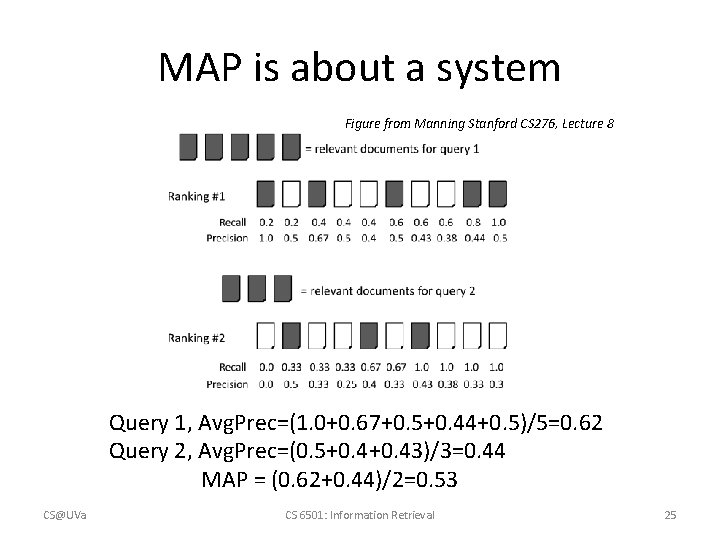
Mean Average Precision • Consider rank position of each relevant doc – E. g. , K 1, K 2, … KR • Compute P@K for each K 1, K 2, … KR • Average precision = average of those P@K – E. g. , • MAP is mean of Average Precision across multiple queries/rankings CS@UVa CS 6501: Information Retrieval 23
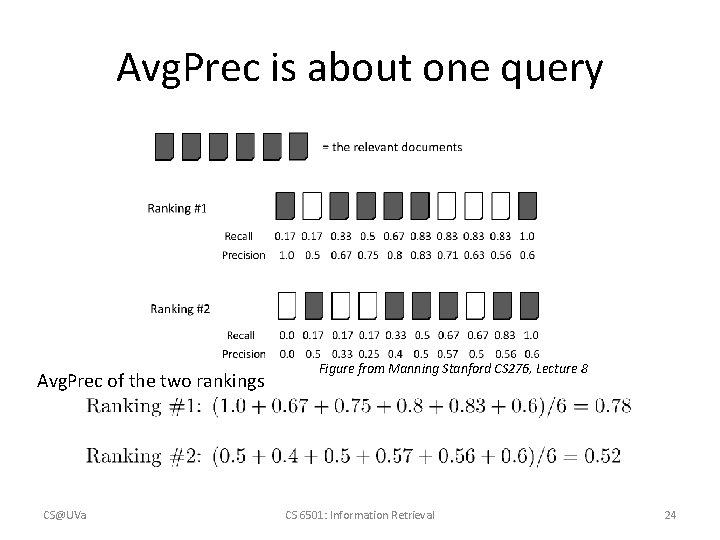
Avg. Prec is about one query Avg. Prec of the two rankings CS@UVa Figure from Manning Stanford CS 276, Lecture 8 CS 6501: Information Retrieval 24
MAP is about a system Figure from Manning Stanford CS 276, Lecture 8 Query 1, Avg. Prec=(1. 0+0. 67+0. 5+0. 44+0. 5)/5=0. 62 Query 2, Avg. Prec=(0. 5+0. 43)/3=0. 44 MAP = (0. 62+0. 44)/2=0. 53 CS@UVa CS 6501: Information Retrieval 25
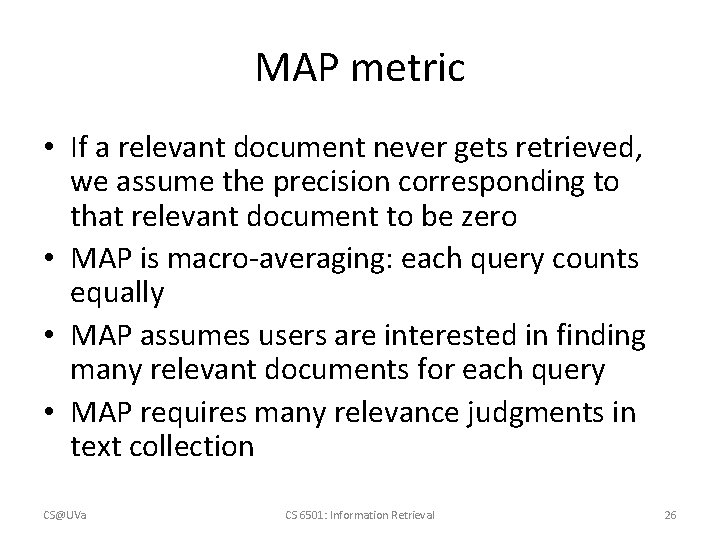
MAP metric • If a relevant document never gets retrieved, we assume the precision corresponding to that relevant document to be zero • MAP is macro-averaging: each query counts equally • MAP assumes users are interested in finding many relevant documents for each query • MAP requires many relevance judgments in text collection CS@UVa CS 6501: Information Retrieval 26
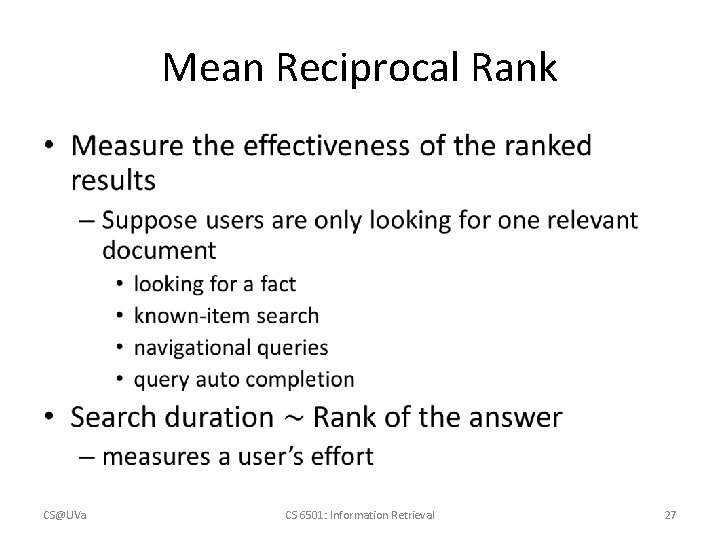
Mean Reciprocal Rank • CS@UVa CS 6501: Information Retrieval 27
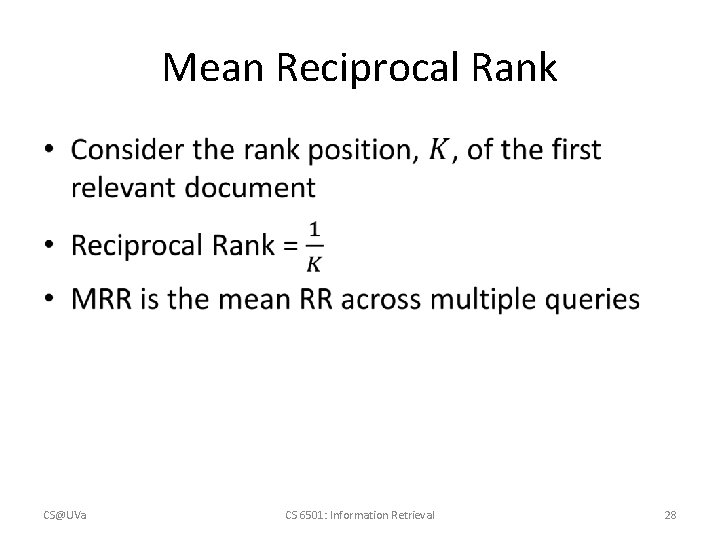
Mean Reciprocal Rank • CS@UVa CS 6501: Information Retrieval 28
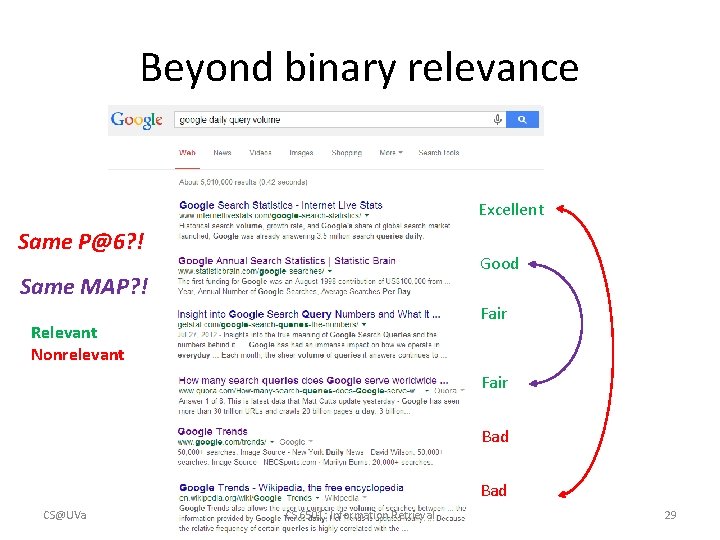
Beyond binary relevance Excellent Same P@6? ! Fair Good Same MAP? ! Fair Bad Relevant Nonrelevant Good Fair Bad CS@UVa CS 6501: Information Retrieval 29
Beyond binary relevance • The level of documents’ relevance quality with respect to a given query varies – Highly relevant documents are more useful than marginally relevant documents – The lower the ranked position of a relevant document is, the less useful it is for the user, since it is less likely to be examined – Discounted Cumulative Gain CS@UVa CS 6501: Information Retrieval 30
Discounted Cumulative Gain • Uses graded relevance as a measure of usefulness, or gain, from examining a document • Gain is accumulated starting at the top of the ranking and discounted at lower ranks • Typical discount is 1/log (rank) – With base 2, the discount at rank 4 is 1/2, and at rank 8 it is 1/3 CS@UVa CS 6501: Information Retrieval 31
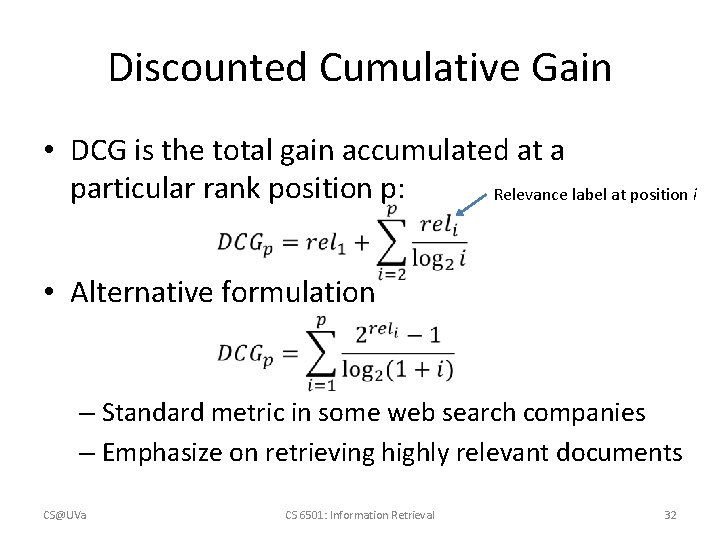
Discounted Cumulative Gain • DCG is the total gain accumulated at a particular rank position p: Relevance label at position i • Alternative formulation – Standard metric in some web search companies – Emphasize on retrieving highly relevant documents CS@UVa CS 6501: Information Retrieval 32
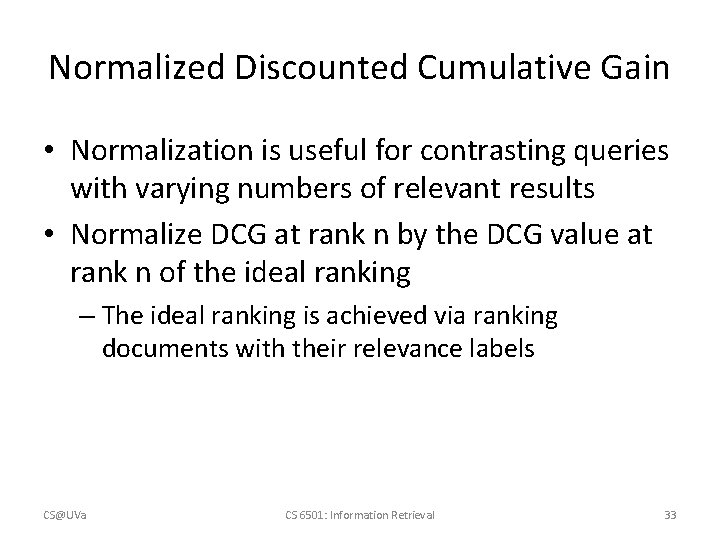
Normalized Discounted Cumulative Gain • Normalization is useful for contrasting queries with varying numbers of relevant results • Normalize DCG at rank n by the DCG value at rank n of the ideal ranking – The ideal ranking is achieved via ranking documents with their relevance labels CS@UVa CS 6501: Information Retrieval 33
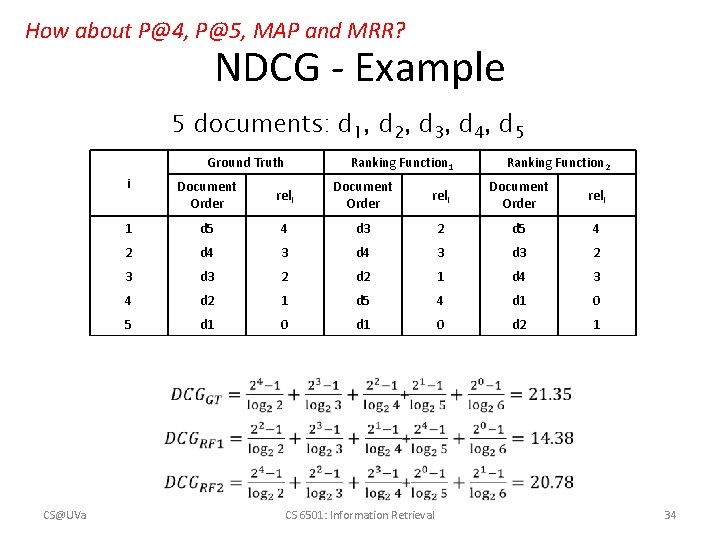
How about P@4, P@5, MAP and MRR? NDCG - Example 5 documents: d 1, d 2, d 3, d 4, d 5 Ground Truth Ranking Function 2 i Document Order reli 1 d 5 4 d 3 2 d 5 4 2 d 4 3 d 3 2 d 2 1 d 4 3 4 d 2 1 d 5 4 d 1 0 5 d 1 0 d 2 1 NDCGGT=1. 00 CS@UVa Ranking Function 1 NDCGRF 1=0. 67 CS 6501: Information Retrieval NDCGRF 2=0. 97 34
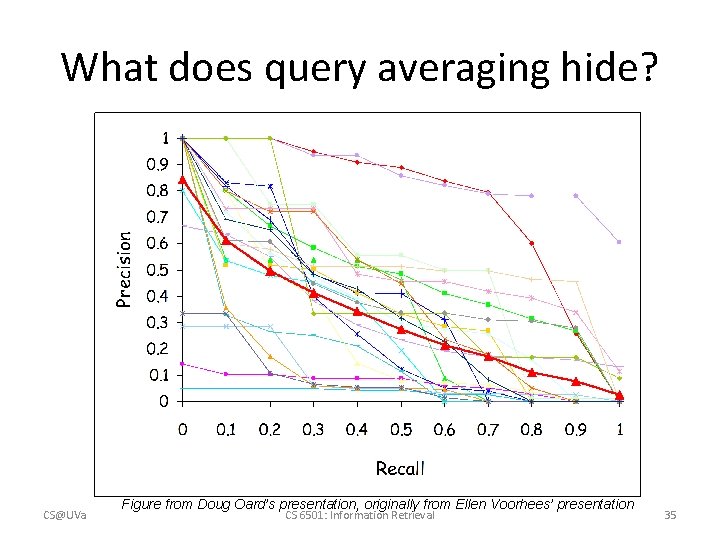
What does query averaging hide? CS@UVa Figure from Doug Oard’s presentation, originally from Ellen Voorhees’ presentation CS 6501: Information Retrieval 35
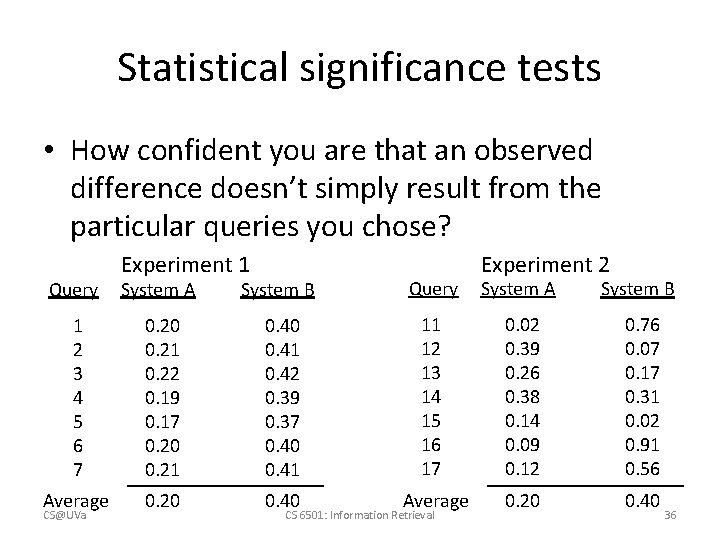
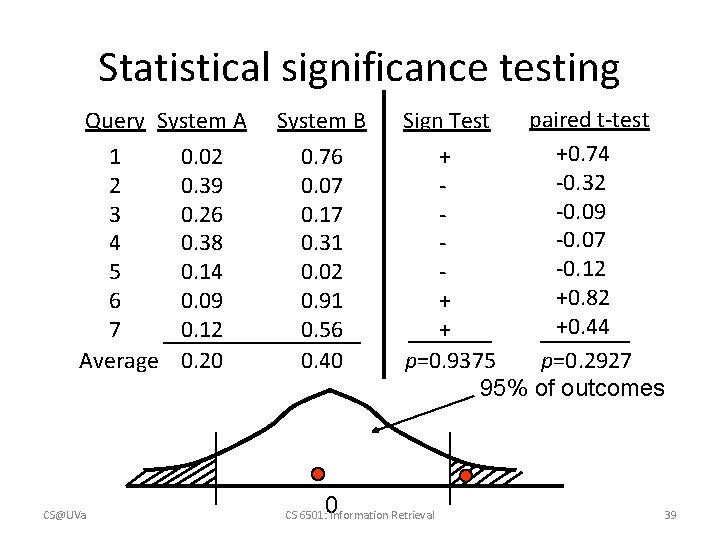
Statistical significance tests • How confident you are that an observed difference doesn’t simply result from the particular queries you chose? Experiment 1 Experiment 2 System A System B Query System A System B 1 2 3 4 5 6 7 0. 20 0. 21 0. 22 0. 19 0. 17 0. 20 0. 21 0. 40 0. 41 0. 42 0. 39 0. 37 0. 40 0. 41 11 12 13 14 15 16 17 0. 02 0. 39 0. 26 0. 38 0. 14 0. 09 0. 12 0. 76 0. 07 0. 17 0. 31 0. 02 0. 91 0. 56 Average 0. 20 0. 40 Query CS@UVa CS 6501: Information Retrieval 36
Background knowledge • p-value in statistic test is the probability of obtaining data as extreme as was observed, if the null hypothesis were true (e. g. , if observation is totally random) • If p-value is smaller than the chosen significance level ( ), we reject the null hypothesis (e. g. , observation is not random) • We seek to reject the null hypothesis (we seek to show that the observation is a random result), and so small p-values are good 37 CS@UVa CS 6501: Information Retrieval 37
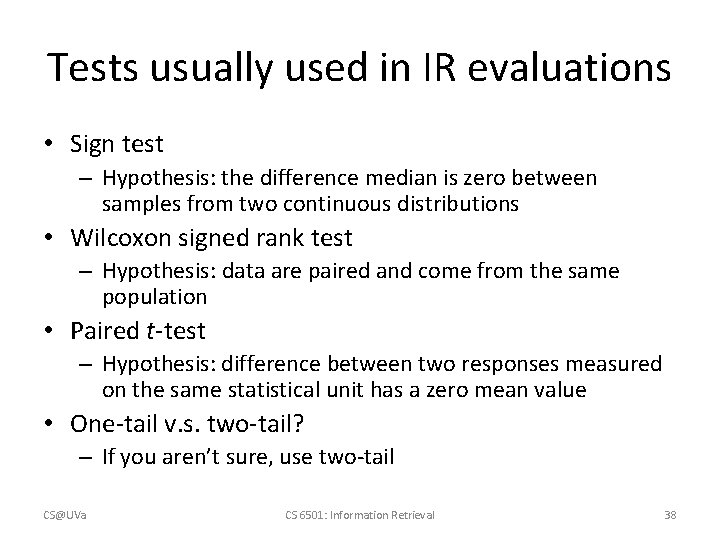
Tests usually used in IR evaluations • Sign test – Hypothesis: the difference median is zero between samples from two continuous distributions • Wilcoxon signed rank test – Hypothesis: data are paired and come from the same population • Paired t-test – Hypothesis: difference between two responses measured on the same statistical unit has a zero mean value • One-tail v. s. two-tail? – If you aren’t sure, use two-tail CS@UVa CS 6501: Information Retrieval 38
Statistical significance testing Query System A 1 2 3 4 5 6 7 Average CS@UVa 0. 02 0. 39 0. 26 0. 38 0. 14 0. 09 0. 12 0. 20 System B 0. 76 0. 07 0. 17 0. 31 0. 02 0. 91 0. 56 0. 40 0 paired t-test +0. 74 + -0. 32 -0. 09 -0. 07 -0. 12 +0. 82 + +0. 44 + p=0. 9375 p=0. 2927 95% of outcomes Sign Test CS 6501: Information Retrieval 39
Where do we get the relevance labels? • Human annotation – Domain experts, who have better understanding of retrieval tasks • Scenario 1: annotator lists the information needs, formalizes into queries, and judges the returned documents • Scenario 2: given query and associated documents, annotator judges the relevance by inferring the underlying information need CS@UVa CS 6501: Information Retrieval 40
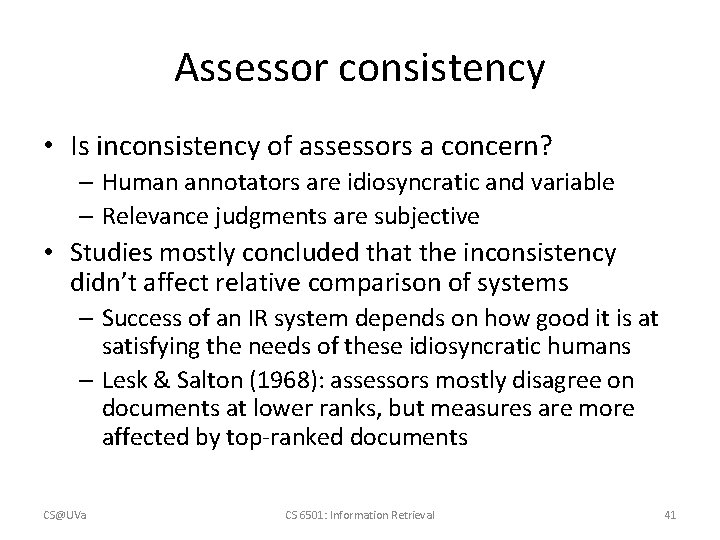
Assessor consistency • Is inconsistency of assessors a concern? – Human annotators are idiosyncratic and variable – Relevance judgments are subjective • Studies mostly concluded that the inconsistency didn’t affect relative comparison of systems – Success of an IR system depends on how good it is at satisfying the needs of these idiosyncratic humans – Lesk & Salton (1968): assessors mostly disagree on documents at lower ranks, but measures are more affected by top-ranked documents CS@UVa CS 6501: Information Retrieval 41
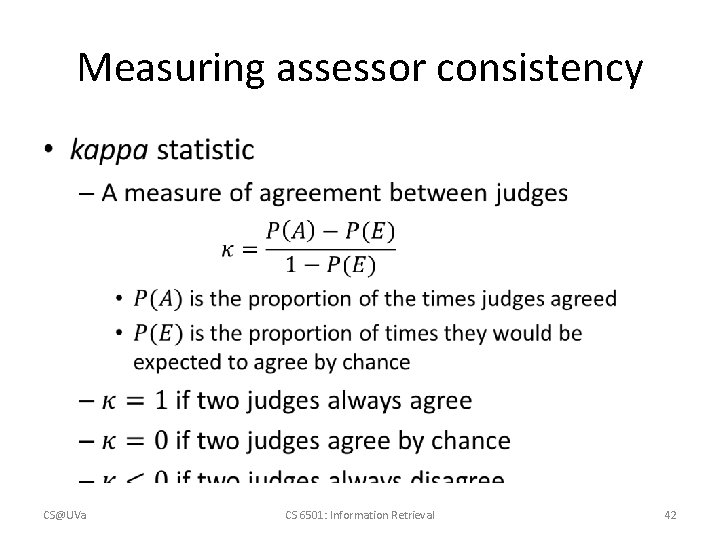
Measuring assessor consistency • CS@UVa CS 6501: Information Retrieval 42
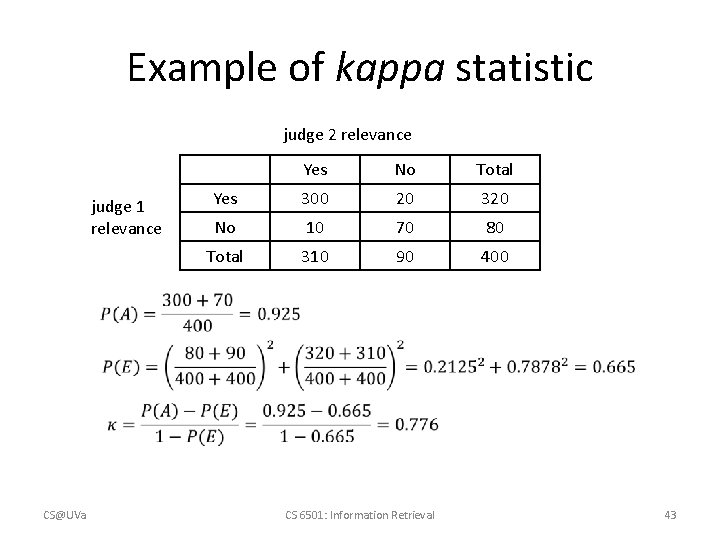
Example of kappa statistic judge 2 relevance judge 1 relevance CS@UVa Yes No Total Yes 300 20 320 No 10 70 80 Total 310 90 400 CS 6501: Information Retrieval 43
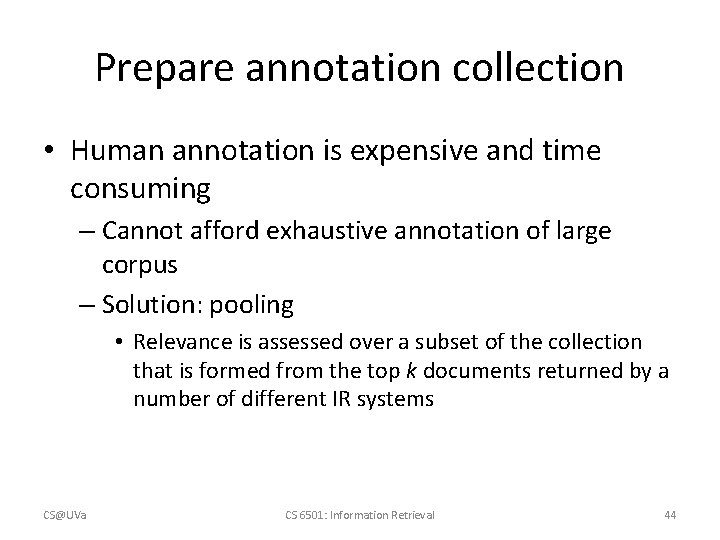
Prepare annotation collection • Human annotation is expensive and time consuming – Cannot afford exhaustive annotation of large corpus – Solution: pooling • Relevance is assessed over a subset of the collection that is formed from the top k documents returned by a number of different IR systems CS@UVa CS 6501: Information Retrieval 44
Does pooling work? • Judgments cannot possibly be exhaustive? – Relative rankings among the systems remain the same • What about documents beyond top k? – Relative rankings among the systems remain the same • A lot of research work can be done here – Effective pool construction – Depth v. s. diversity CS@UVa CS 6501: Information Retrieval 45
Rethink retrievaluation • Goal of any IR system – Satisfying users’ information need • Core quality measure criterion – “how well a system meets the information needs of its users. ” – wiki CS@UVa CS 6501: Information Retrieval 46
What we have considered • The ability of the system to present all relevant documents – Recall-driven measures • The ability of the system to withhold nonrelevant documents – Precision-driven measures CS@UVa CS 6501: Information Retrieval 47
Challenging assumptions in classical IR evaluations • Assumption 1 – Queries sent to an IR system would be the same as those sent to a librarian (i. e. , sentence-length request), and users want to have high recall • Assumption 2 – Relevance = independent topical relevance • Documents are independently judged, and then ranked (that is how we get the ideal ranking) CS@UVa CS 6501: Information Retrieval 48
What we have not considered • The physical form of the output – User interface • The effort, intellectual or physical, demanded of the user – User effort when using the system • Bias IR research towards optimizing relevancecentric metrics CS@UVa CS 6501: Information Retrieval 49
What you should know • • • Core criterion for IR evaluation Basic components in IR evaluation Classical IR metrics Statistical test Annotator agreement CS@UVa CS 6501: Information Retrieval 50