Systematic Review Concept and Tool Development with Application


- Slides: 79
Systematic Review: Concept and Tool Development with Application in the Integrated Risk Information System (IRIS) Assessment Process Michele Taylor, Toxicologist National Center for Environmental Assessment Integrated Risk Information System Risk Assessment Specialty Section Society of Toxicology Webinar November 8, 2017 Office of Research and Development NCEA, IRIS
Disclaimer: The views expressed in this presentation are those of the author(s) and do not necessarily represent the views or policies of the U. S. Environmental Protection Agency. Any mention of trade names, products, or services does not imply an endorsement by the U. S. Government or the U. S. Environmental Protection Agency. The EPA does not endorse any commercial products, services, or enterprises. Office of Research and Development NCEA, IRIS
New Leadership Structure in NCEA • Tina Bahadori (NCEA Director) –Formerly the Director of ORD’s Chemical Safety for Sustainability National Research Program –Significant experience in the chemical industry –Knowledge of TSCA, innovative applications of computational toxicology, and exposure science. • Kris Thayer –Expertise in systematic review, automation, and chemical evaluations –Focus on early partner and stakeholder engagement and input 2
How is IRIS Focusing? • Increase transparency and full implementation of systematic review –implement using approaches that foster consistency across the IRIS program; many active and all new starts address ALL SR-related recommendations of 2014 NRC report • Modernize the IRIS Program –through automation and machine learning to expedite systematic review, incorporation of emerging data types 3
How is IRIS Focusing? • Modularize product lines –implement a portfolio of chemical evaluation products that optimize the application of the best available science and technology. These products will allow IRIS to remain flexible and responsive to clients within the EPA as well the diverse collection of stakeholders beyond EPA, including states, tribal nations, and other federal agencies. –Systematic review is ONE tool in a chemical assessment portfolio 4
How is IRIS Focusing? • Enhance accessibility –provide outreach and training to make systematic review practices ubiquitous and more accessible; enhance data sharing through publicly available software platforms for assessments developed by EPA, other federal and state agencies, industry, academia and other third-parties. 5
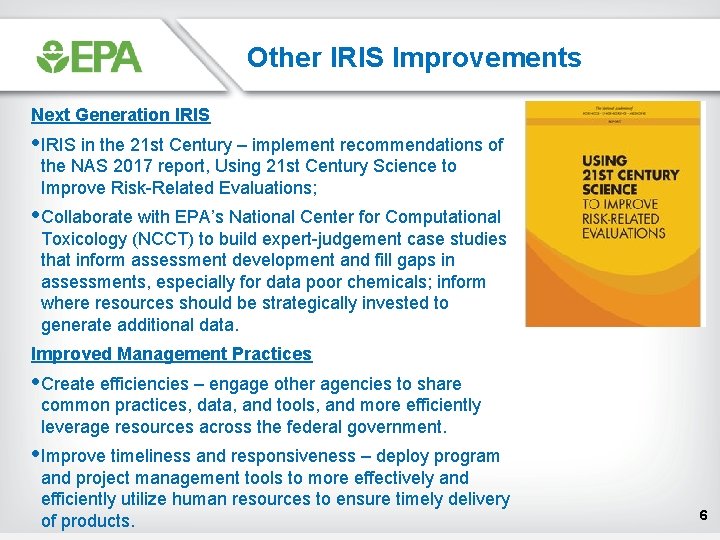
Other IRIS Improvements Next Generation IRIS • IRIS in the 21 st Century – implement recommendations of the NAS 2017 report, Using 21 st Century Science to Improve Risk-Related Evaluations; • Collaborate with EPA’s National Center for Computational Toxicology (NCCT) to build expert-judgement case studies that inform assessment development and fill gaps in assessments, especially for data poor chemicals; inform where resources should be strategically invested to generate additional data. Improved Management Practices • Create efficiencies – engage other agencies to share common practices, data, and tools, and more efficiently leverage resources across the federal government. • Improve timeliness and responsiveness – deploy program and project management tools to more effectively and efficiently utilize human resources to ensure timely delivery of products. 6
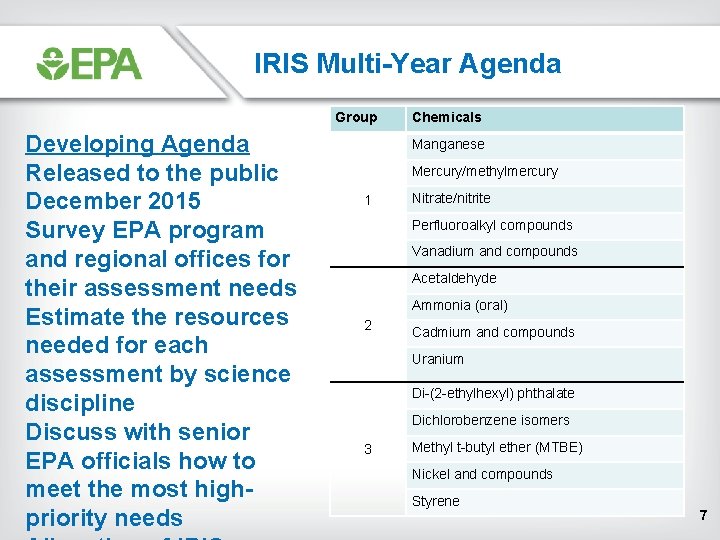
IRIS Multi-Year Agenda Group Developing Agenda Released to the public December 2015 Survey EPA program and regional offices for their assessment needs Estimate the resources needed for each assessment by science discipline Discuss with senior EPA officials how to meet the most highpriority needs Chemicals Manganese Mercury/methylmercury 1 Nitrate/nitrite Perfluoroalkyl compounds Vanadium and compounds Acetaldehyde Ammonia (oral) 2 Cadmium and compounds Uranium Di-(2 -ethylhexyl) phthalate Dichlorobenzene isomers 3 Methyl t-butyl ether (MTBE) Nickel and compounds Styrene 7
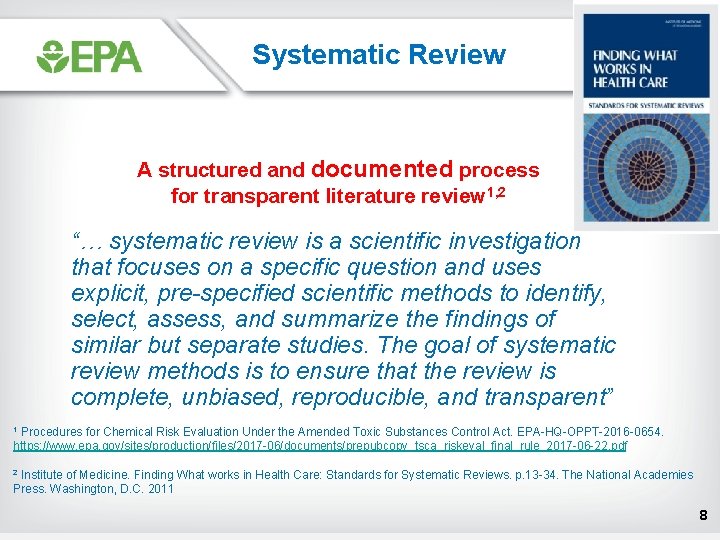
Systematic Review A structured and documented process for transparent literature review 1, 2 “… systematic review is a scientific investigation that focuses on a specific question and uses explicit, pre-specified scientific methods to identify, select, assess, and summarize the findings of similar but separate studies. The goal of systematic review methods is to ensure that the review is complete, unbiased, reproducible, and transparent” 1 Procedures for Chemical Risk Evaluation Under the Amended Toxic Substances Control Act. EPA-HQ-OPPT-2016 -0654. https: //www. epa. gov/sites/production/files/2017 -06/documents/prepubcopy_tsca_riskeval_final_rule_2017 -06 -22. pdf 2 Institute of Medicine. Finding What works in Health Care: Standards for Systematic Reviews. p. 13 -34. The National Academies Press. Washington, D. C. 2011 8
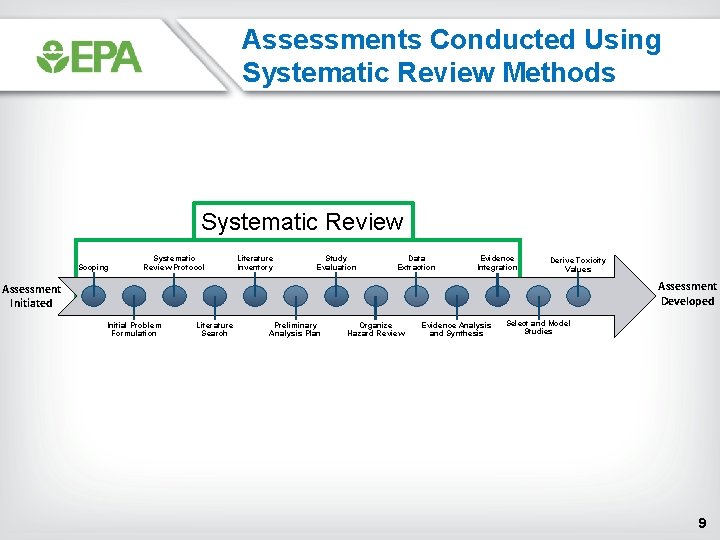
Assessments Conducted Using Systematic Review Methods Systematic Review Scoping Systematic Review Protocol Literature Inventory Study Evaluation Data Extraction Evidence Integration Derive Toxicity Values Assessment Developed Assessment Initiated Initial Problem Formulation Literature Search Preliminary Analysis Plan Organize Hazard Review Evidence Analysis and Synthesis Select and Model Studies 9
NAS (2017): Reflections and Lessons Learned from the Systematic Review “…. one disadvantage in conducting a systematic review is that it can be time and resource intensive, particularly for individuals that have not previously conducted a systematic review. ” [p. 157] “The committee discussed at length whether it could provide EPA with advice about when a systematic review should be performed but decided it could not be more specific because that decision will depend on the availability of data and resources, the anticipated actions, the time frame for decision making, and other factors. ” [p. 157] “The committee also recognized that it might be advantageous for EPA to build on existing systematic reviews that are published in the peer-reviewed literature. ” [p. 157] “The committee recognizes that the methods and role of systematic review and meta-analysis in toxicology are evolving rapidly and EPA will need to stay abreast of these developments, strive for transparency, and use appropriate methods to address its questions. ” [p. 157] 10
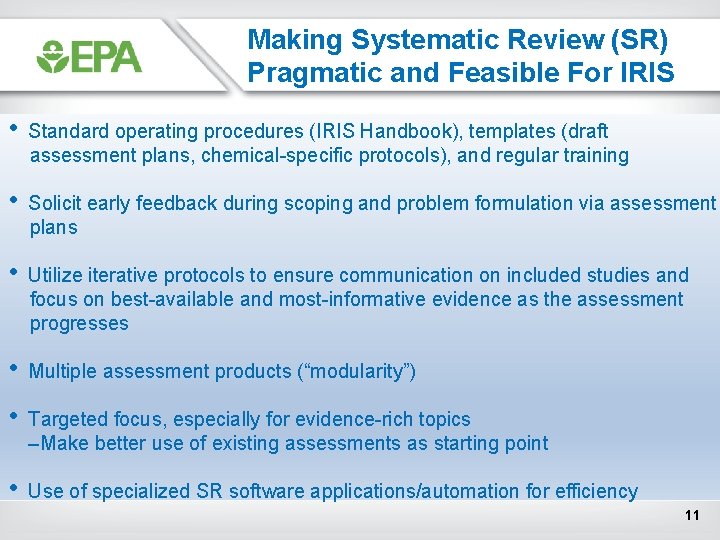
Making Systematic Review (SR) Pragmatic and Feasible For IRIS • Standard operating procedures (IRIS Handbook), templates (draft assessment plans, chemical-specific protocols), and regular training • Solicit early feedback during scoping and problem formulation via assessment plans • Utilize iterative protocols to ensure communication on included studies and focus on best-available and most-informative evidence as the assessment progresses • Multiple assessment products (“modularity”) • Targeted focus, especially for evidence-rich topics – Make better use of existing assessments as starting point • Use of specialized SR software applications/automation for efficiency 11
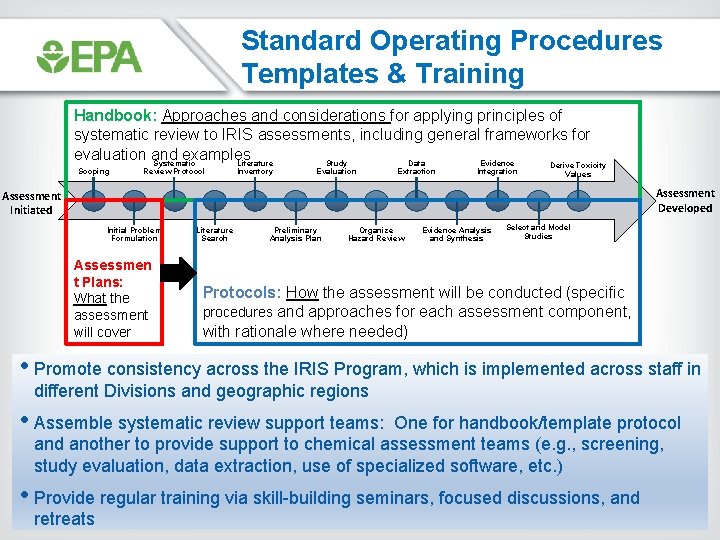
Standard Operating Procedures Templates & Training Handbook: Approaches and considerations for applying principles of systematic review to IRIS assessments, including general frameworks for evaluation and examples Systematic Literature Study Data Evidence Scoping Review Protocol Inventory Evaluation Extraction Integration Derive Toxicity Values Assessment Developed Assessment Initiated Initial Problem Formulation Assessmen t Plans: What the assessment will cover Literature Search Preliminary Analysis Plan Organize Hazard Review Evidence Analysis and Synthesis Select and Model Studies Protocols: How the assessment will be conducted (specific procedures and approaches for each assessment component, with rationale where needed) • Promote consistency across the IRIS Program, which is implemented across staff in different Divisions and geographic regions • Assemble systematic review support teams: One for handbook/template protocol and another to provide support to chemical assessment teams (e. g. , screening, study evaluation, data extraction, use of specialized software, etc. ) • Provide regular training via skill-building seminars, focused discussions, and retreats 12
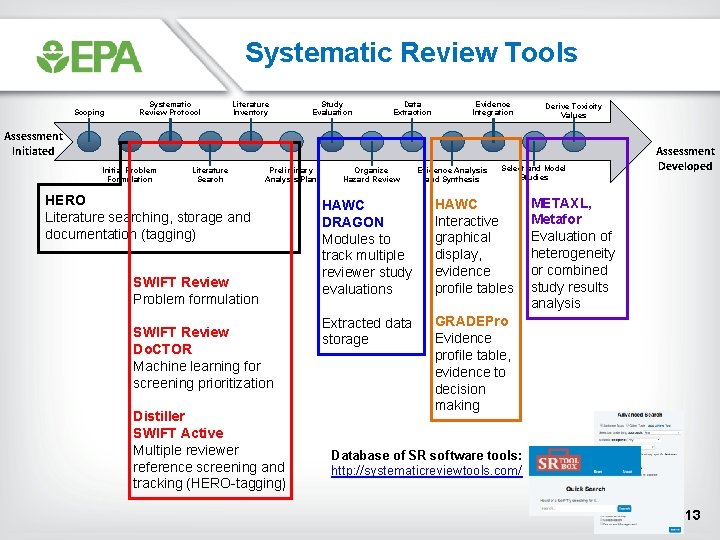
Systematic Review Tools Scoping Systematic Review Protocol Literature Inventory Study Evaluation Data Extraction Evidence Integration Derive Toxicity Values Assessment Initiated Initial Problem Formulation Literature Search Preliminary Analysis Plan HERO Literature searching, storage and documentation (tagging) SWIFT Review Problem formulation SWIFT Review Do. CTOR Machine learning for screening prioritization Distiller SWIFT Active Multiple reviewer reference screening and tracking (HERO-tagging) Organize Hazard Review Evidence Analysis and Synthesis Select and Model Studies HAWC DRAGON Modules to track multiple reviewer study evaluations HAWC Interactive graphical display, evidence profile tables Extracted data storage GRADEPro Evidence profile table, evidence to decision making Assessment Developed METAXL, Metafor Evaluation of heterogeneity or combined study results analysis Database of SR software tools: http: //systematicreviewtools. com/ 13
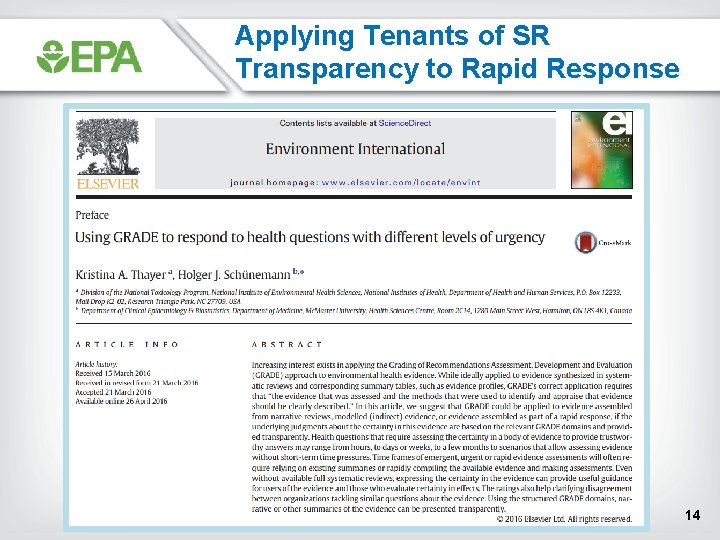
Applying Tenants of SR Transparency to Rapid Response 14
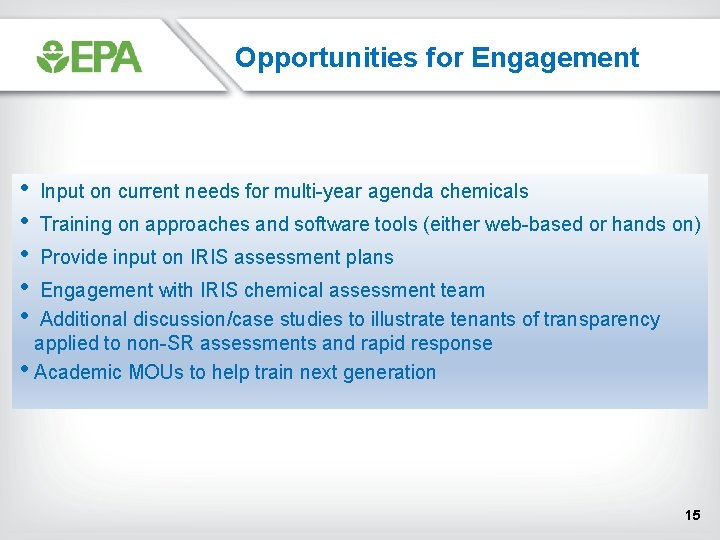
Opportunities for Engagement • Input on current needs for multi-year agenda chemicals • Training on approaches and software tools (either web-based or hands on) • Provide input on IRIS assessment plans • Engagement with IRIS chemical assessment team • Additional discussion/case studies to illustrate tenants of transparency applied to non-SR assessments and rapid response • Academic MOUs to help train next generation 15
Demonstration of Tools for Problem Formulation and Efficient Literature Screening Office of Research and Development NCEA, IRIS
Scoping and Problem Formulation Office of Research and Development NCEA, IRIS
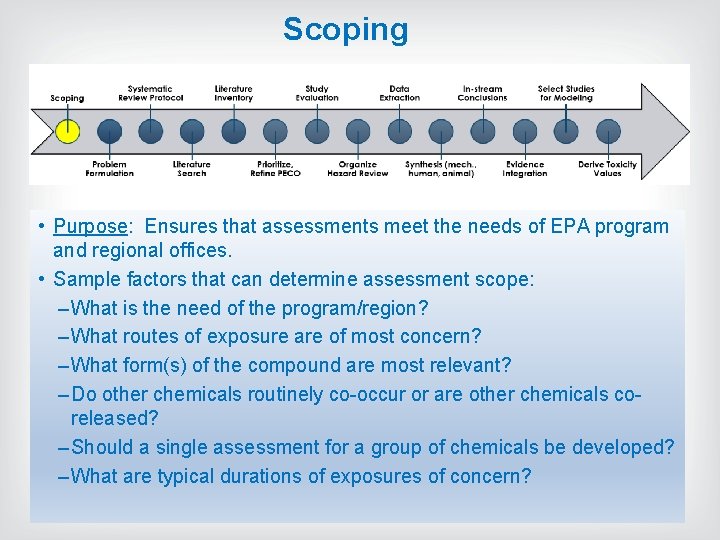
Scoping • Purpose: Ensures that assessments meet the needs of EPA program and regional offices. • Sample factors that can determine assessment scope: – What is the need of the program/region? – What routes of exposure are of most concern? – What form(s) of the compound are most relevant? – Do other chemicals routinely co-occur or are other chemicals coreleased? – Should a single assessment for a group of chemicals be developed? – What are typical durations of exposures of concern?
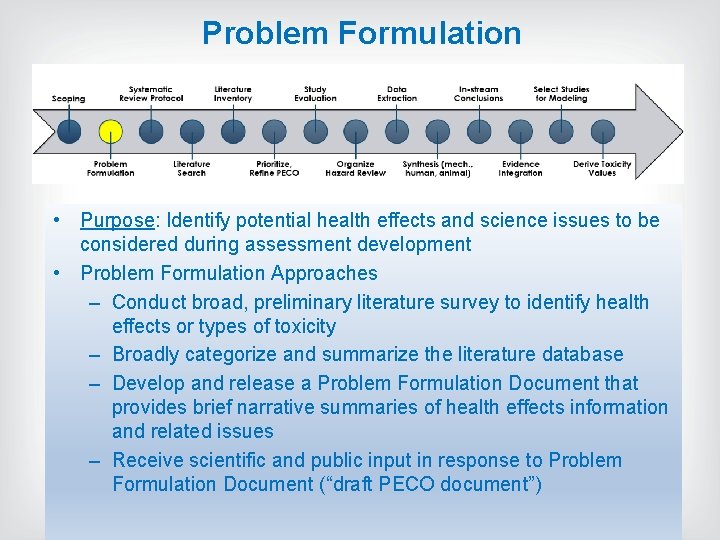
Problem Formulation • Purpose: Identify potential health effects and science issues to be considered during assessment development • Problem Formulation Approaches – Conduct broad, preliminary literature survey to identify health effects or types of toxicity – Broadly categorize and summarize the literature database – Develop and release a Problem Formulation Document that provides brief narrative summaries of health effects information and related issues – Receive scientific and public input in response to Problem Formulation Document (“draft PECO document”)
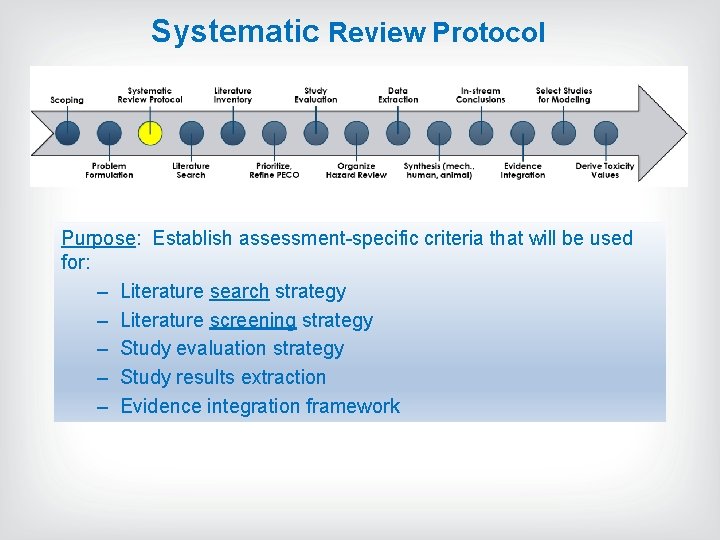
Systematic Review Protocol Purpose: Establish assessment-specific criteria that will be used for: – Literature search strategy – Literature screening strategy – Study evaluation strategy – Study results extraction – Evidence integration framework
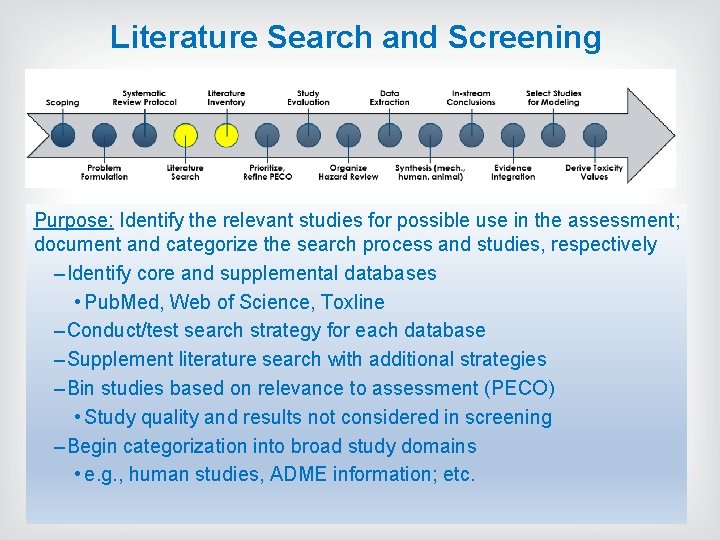
Literature Search and Screening Purpose: Identify the relevant studies for possible use in the assessment; document and categorize the search process and studies, respectively – Identify core and supplemental databases • Pub. Med, Web of Science, Toxline – Conduct/test search strategy for each database – Supplement literature search with additional strategies – Bin studies based on relevance to assessment (PECO) • Study quality and results not considered in screening – Begin categorization into broad study domains • e. g. , human studies, ADME information; etc.
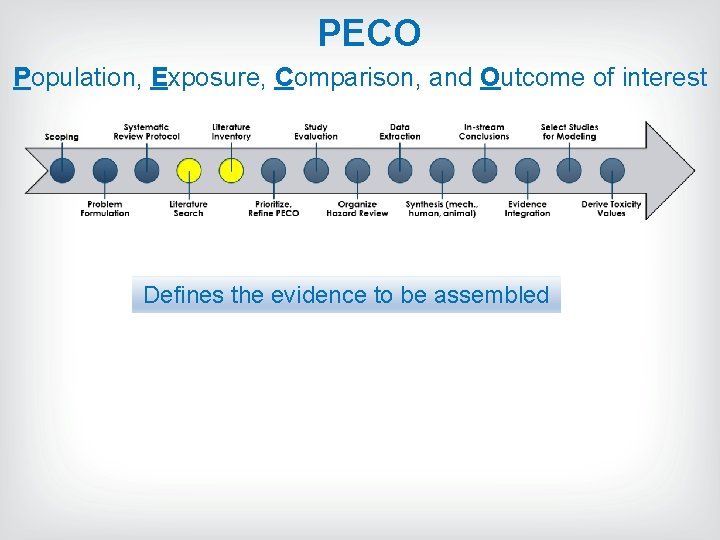
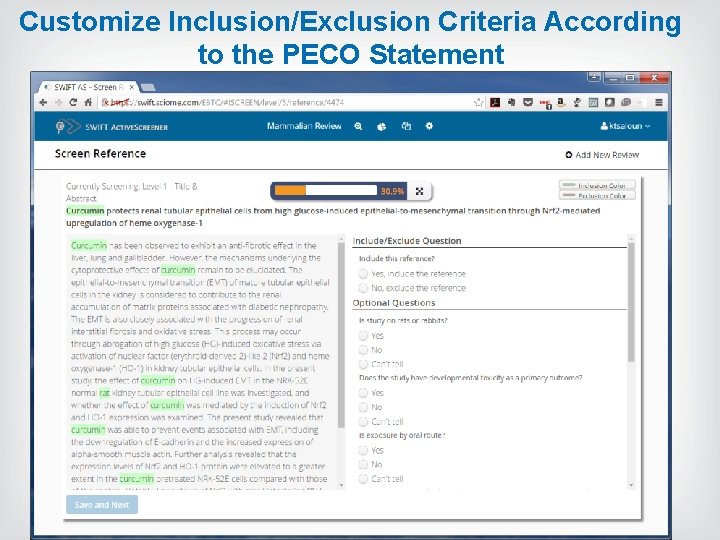
PECO Population, Exposure, Comparison, and Outcome of interest Defines the evidence to be assembled
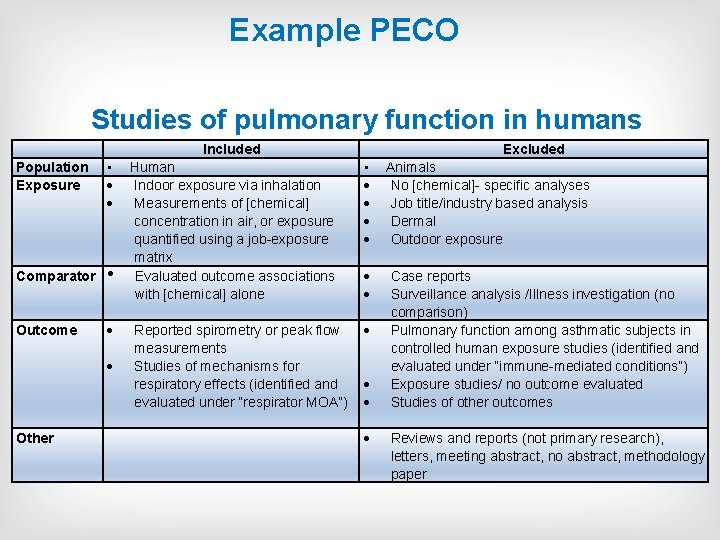
Example PECO Studies of pulmonary function in humans Population Exposure Included • Comparator • Outcome Other Human Indoor exposure via inhalation Measurements of [chemical] concentration in air, or exposure quantified using a job-exposure matrix Evaluated outcome associations with [chemical] alone Reported spirometry or peak flow measurements Studies of mechanisms for respiratory effects (identified and evaluated under “respirator MOA”) Excluded • Animals No [chemical]- specific analyses Job title/industry based analysis Dermal Outdoor exposure Case reports Surveillance analysis /Illness investigation (no comparison) Pulmonary function among asthmatic subjects in controlled human exposure studies (identified and evaluated under “immune-mediated conditions”) Exposure studies/ no outcome evaluated Studies of other outcomes Reviews and reports (not primary research), letters, meeting abstract, no abstract, methodology paper
Implementation of Automated Machine Learning Tools in the Systematic Review Process • Scoping/problem formulation • Screening studies
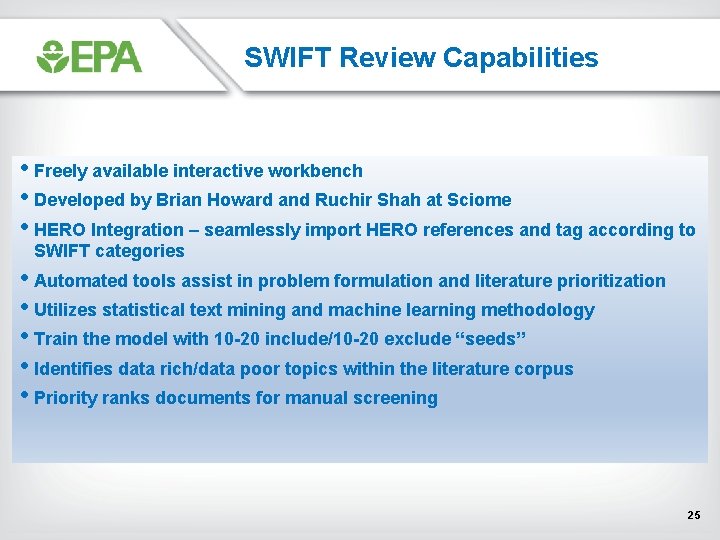
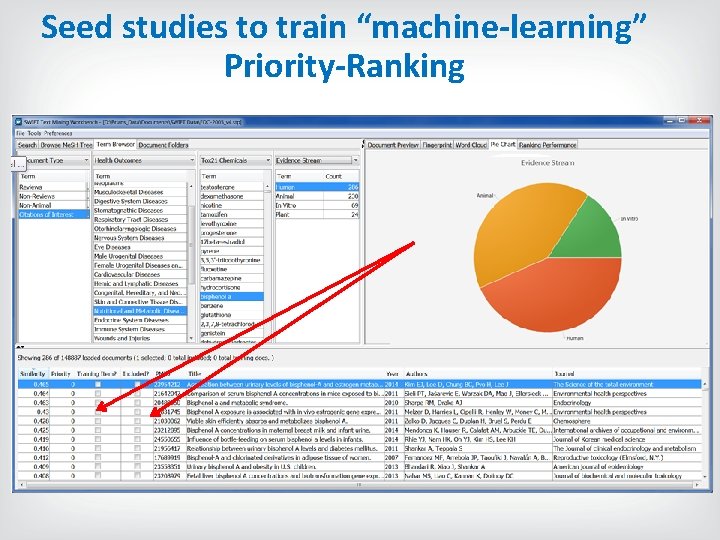
SWIFT Review Capabilities • Freely available interactive workbench • Developed by Brian Howard and Ruchir Shah at Sciome • HERO Integration – seamlessly import HERO references and tag according to SWIFT categories • Automated tools assist in problem formulation and literature prioritization • Utilizes statistical text mining and machine learning methodology • Train the model with 10 -20 include/10 -20 exclude “seeds” • Identifies data rich/data poor topics within the literature corpus • Priority ranks documents for manual screening 25
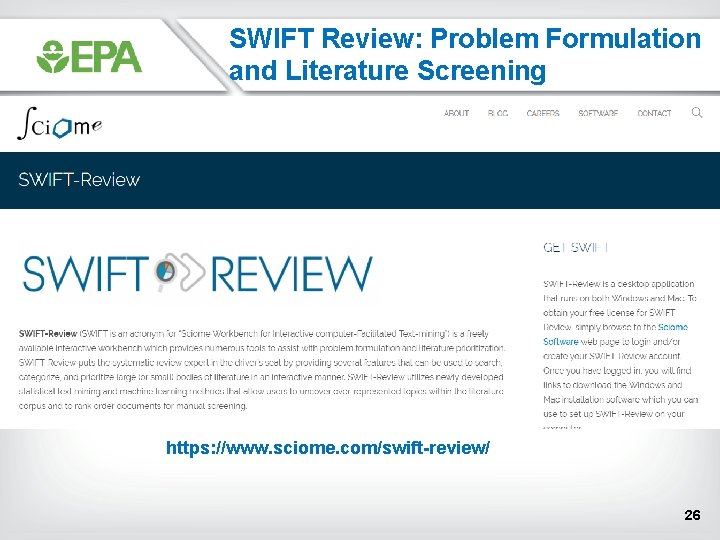
SWIFT Review: Problem Formulation and Literature Screening Health Assessment Workspace Collaborative (HAWC) https: //www. sciome. com/swift-review/ 26
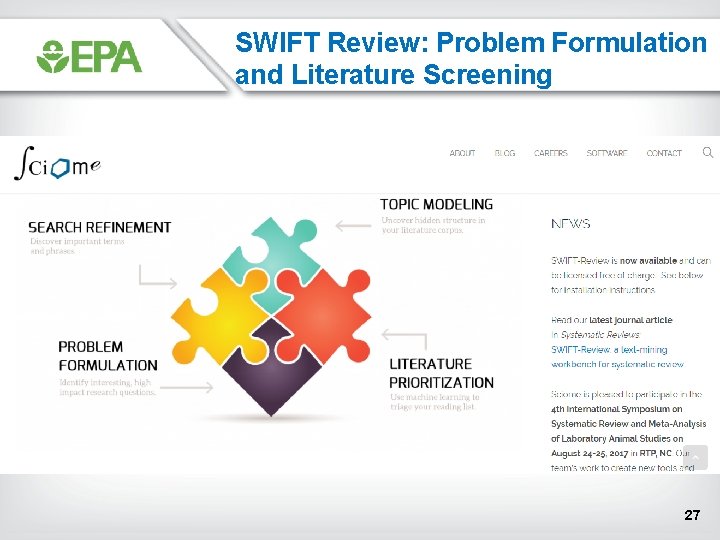
SWIFT Review: Problem Formulation and Literature Screening 27
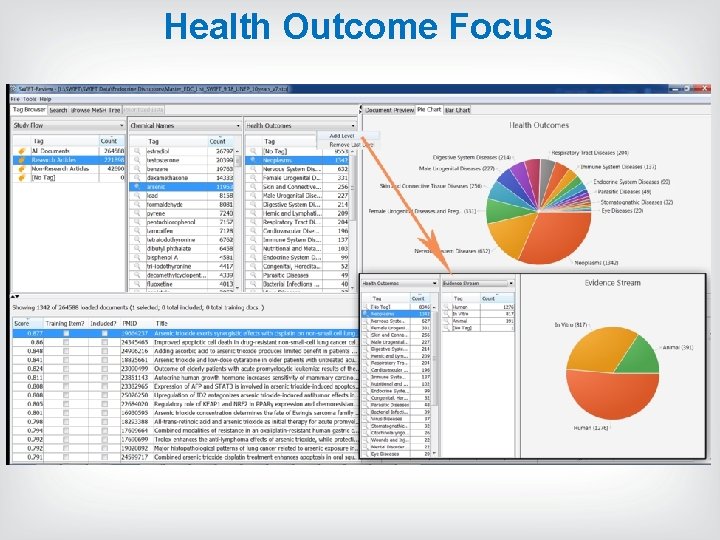
Health Outcome Focus
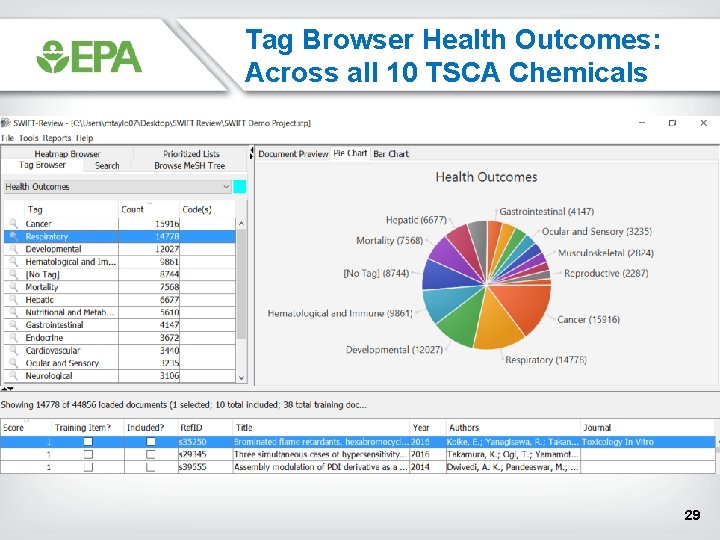
Tag Browser Health Outcomes: Across all 10 TSCA Chemicals 29
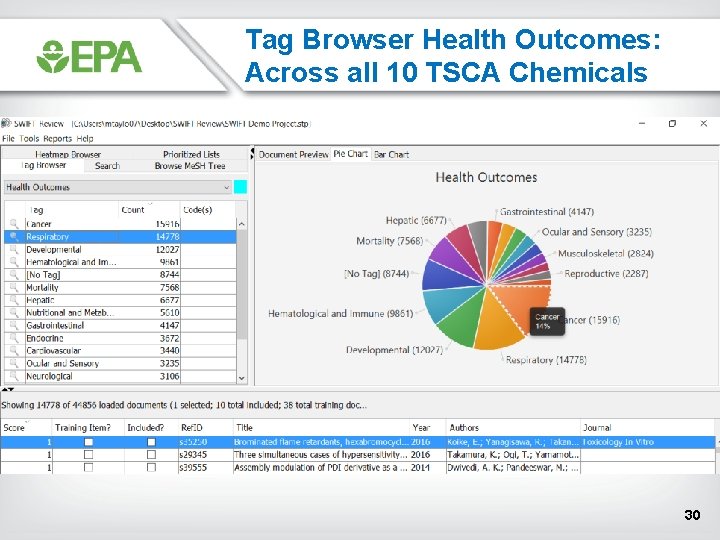
Tag Browser Health Outcomes: Across all 10 TSCA Chemicals 30
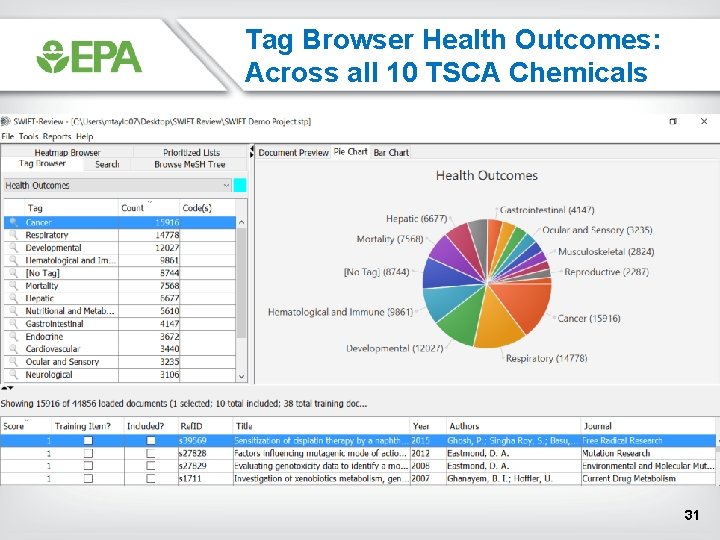
Tag Browser Health Outcomes: Across all 10 TSCA Chemicals 31
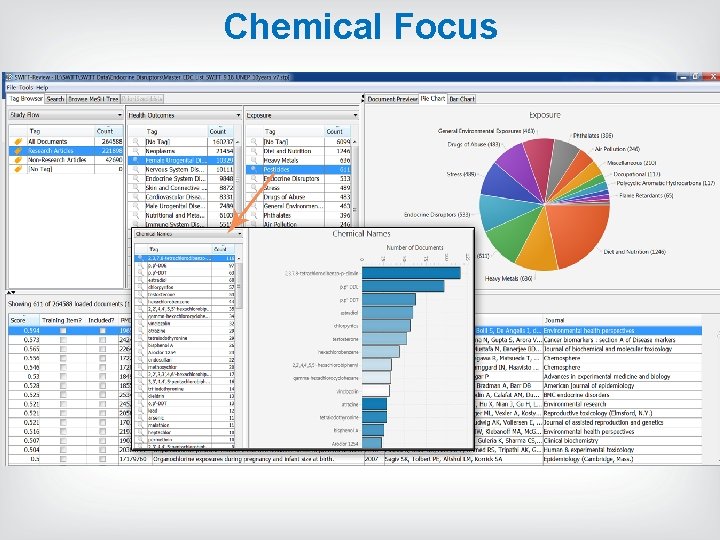
Chemical Focus
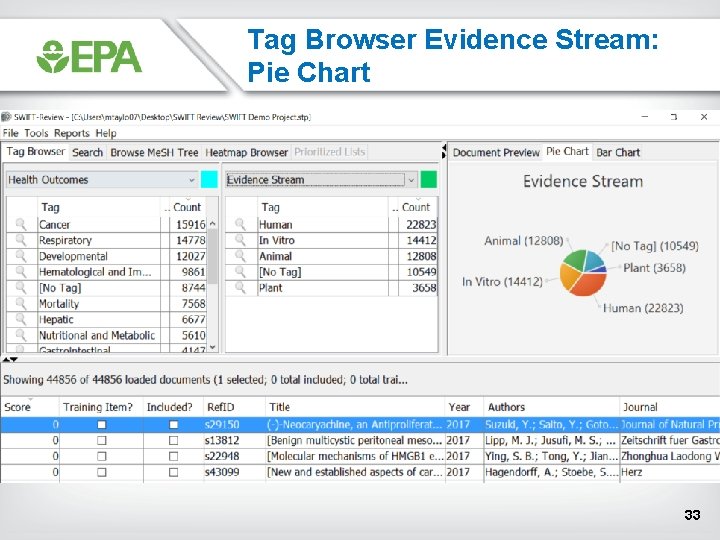
Tag Browser Evidence Stream: Pie Chart 33
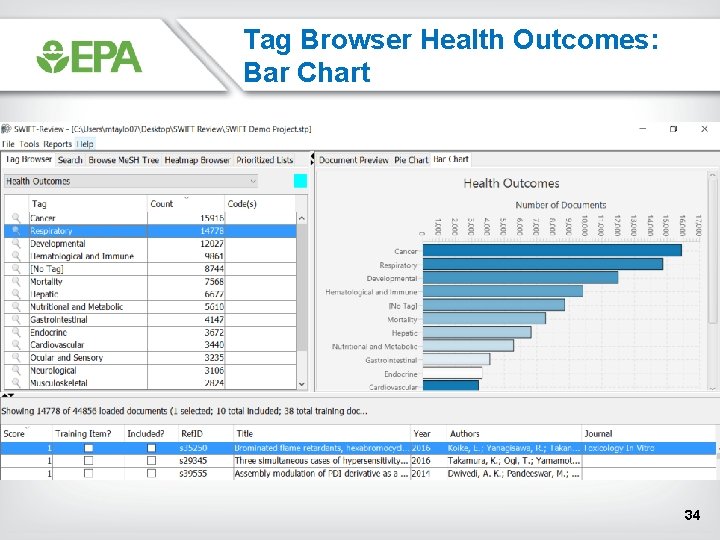
Tag Browser Health Outcomes: Bar Chart 34
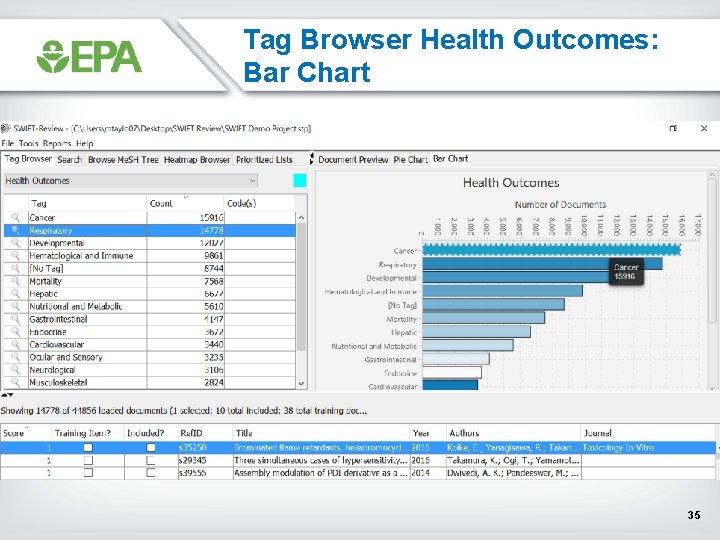
Tag Browser Health Outcomes: Bar Chart 35
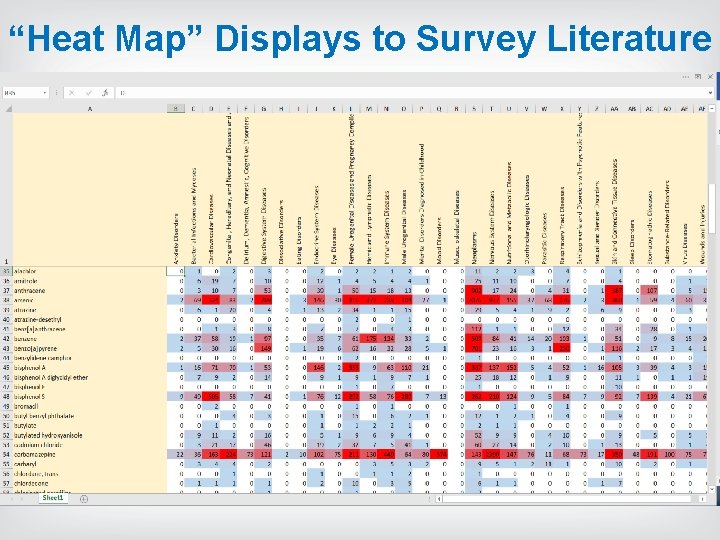
“Heat Map” Displays to Survey Literature
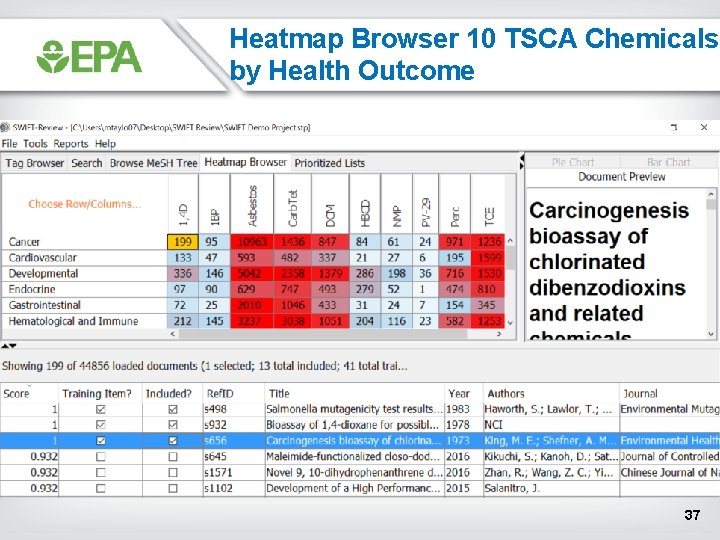
Heatmap Browser 10 TSCA Chemicals by Health Outcome 37
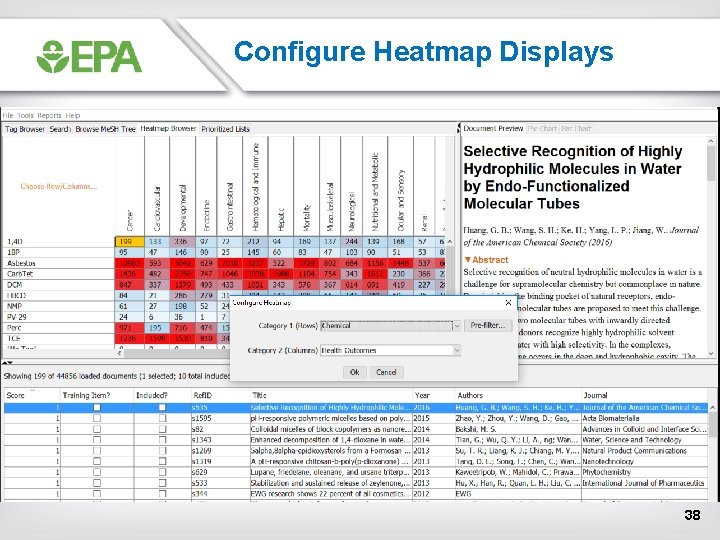
Configure Heatmap Displays 38
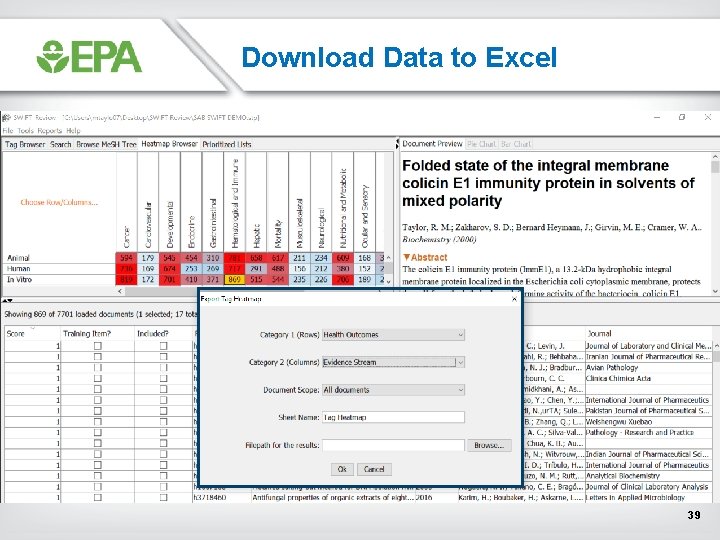
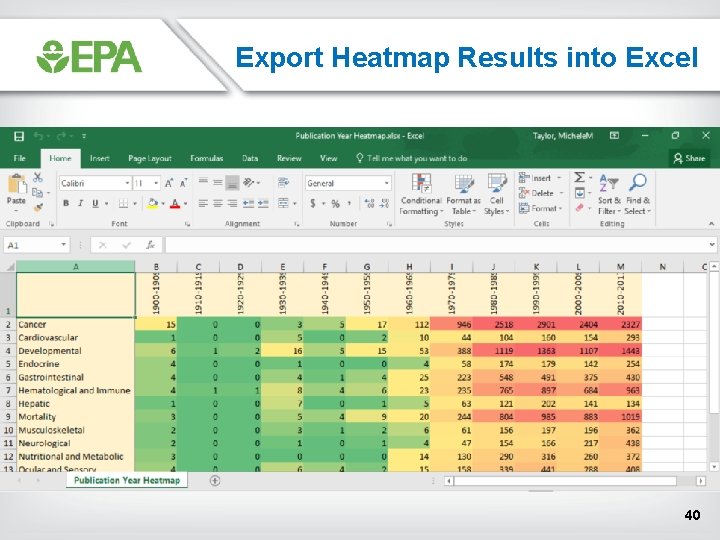
Download Data to Excel 39
Export Heatmap Results into Excel 40
Seed studies to train “machine-learning” Priority-Ranking
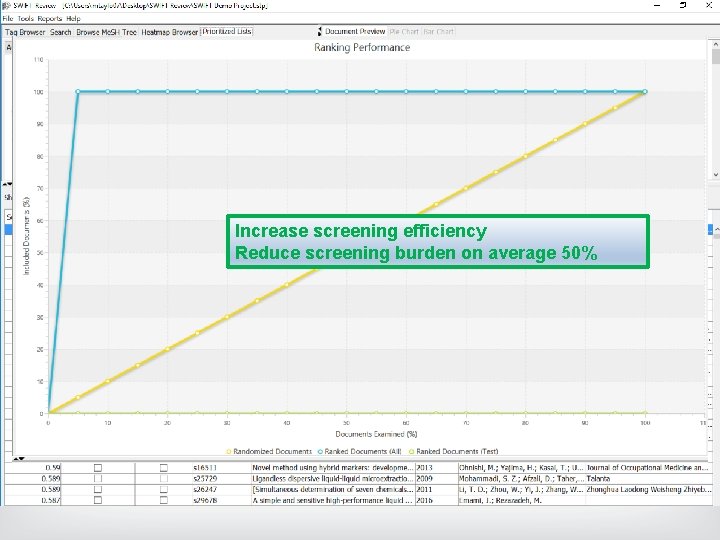
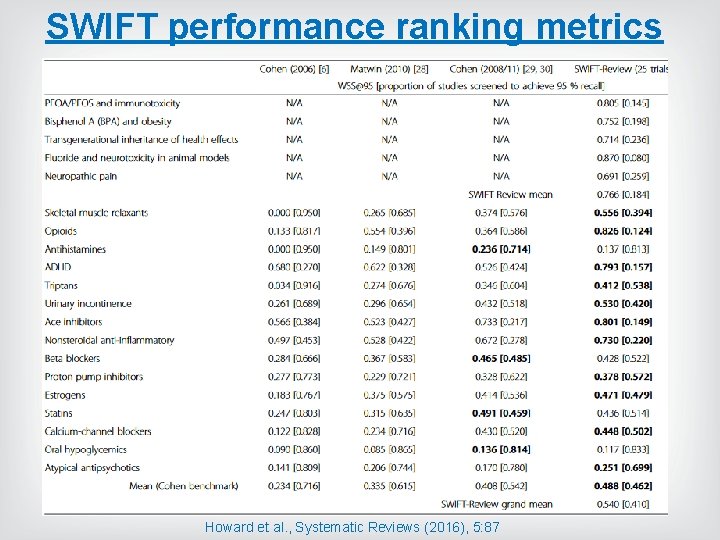
Increase screening efficiency Reduce screening burden on average 50%
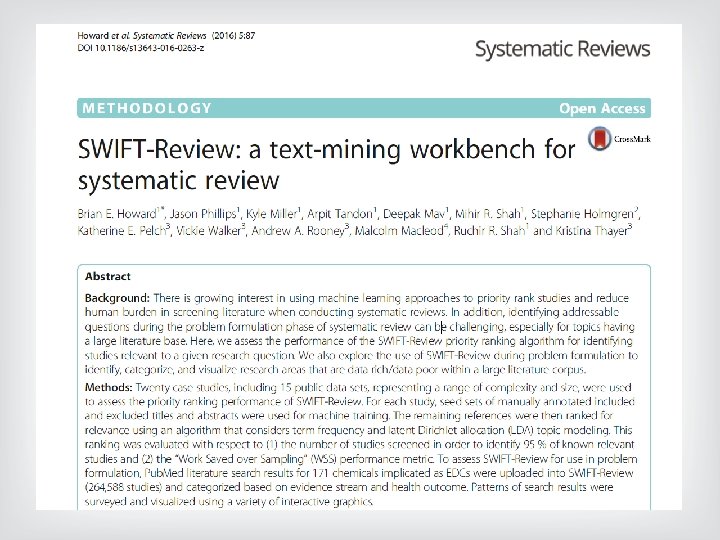
SWIFT performance ranking metrics Howard et al. , Systematic Reviews (2016), 5: 87
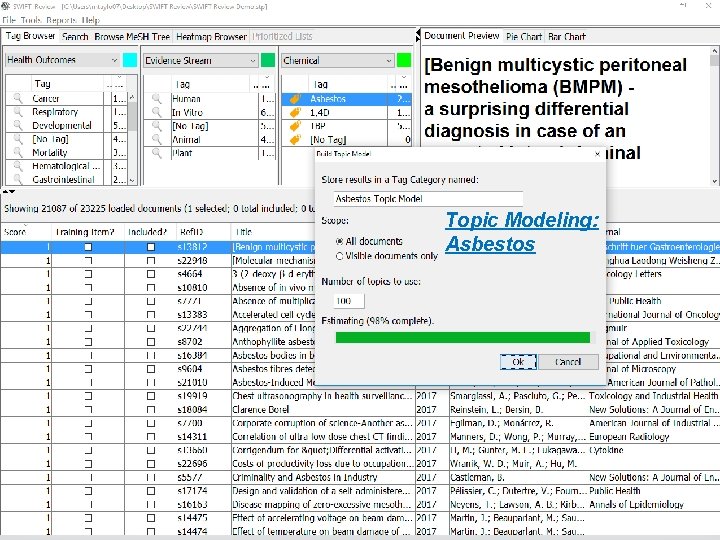
Topic Modeling: Asbestos 45
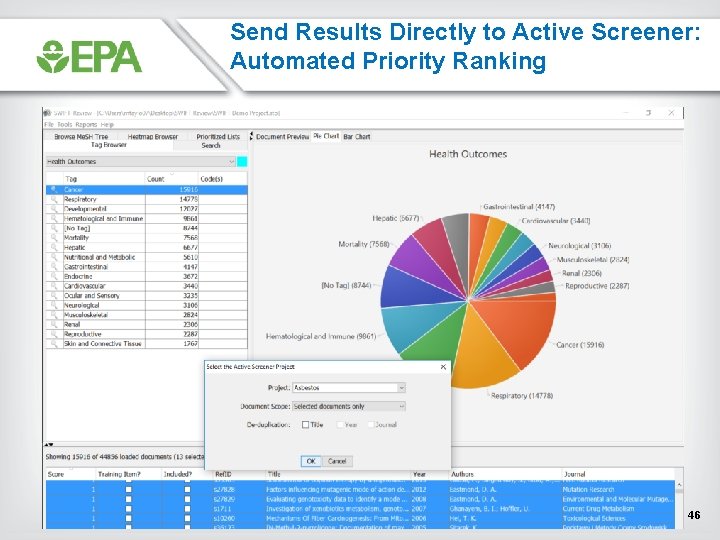
Send Results Directly to Active Screener: Automated Priority Ranking 46
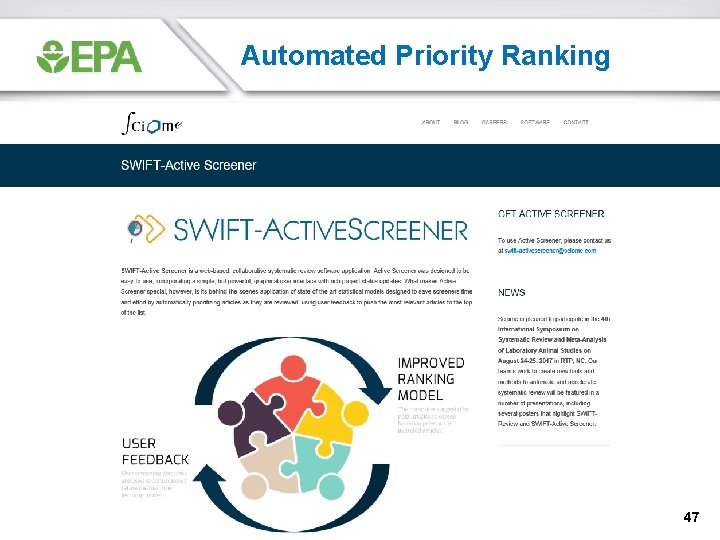
Automated Priority Ranking 47 47
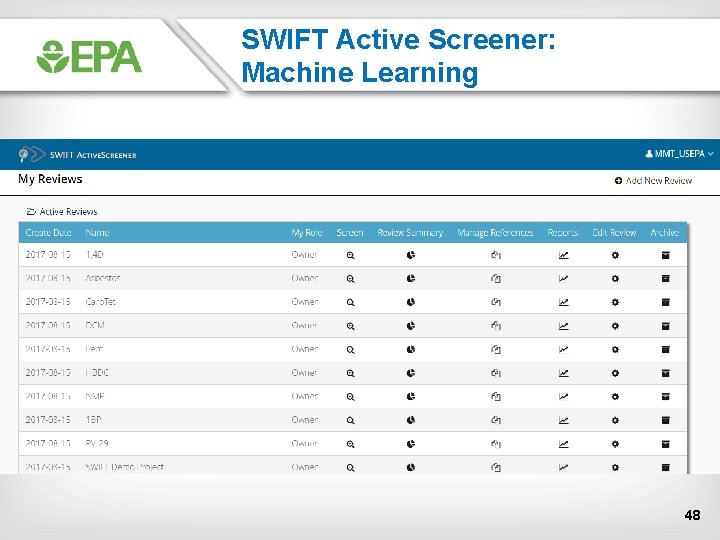
SWIFT Active Screener: Machine Learning 48
Customize Inclusion/Exclusion Criteria According to the PECO Statement
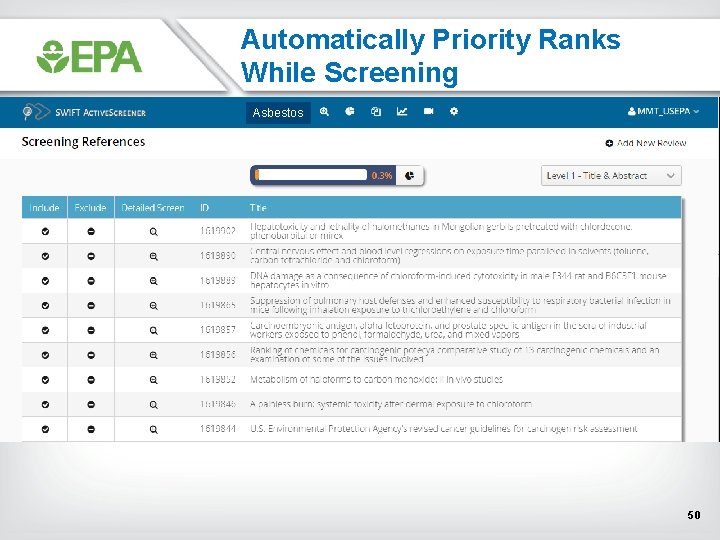
Automatically Priority Ranks While Screening Asbestos 50
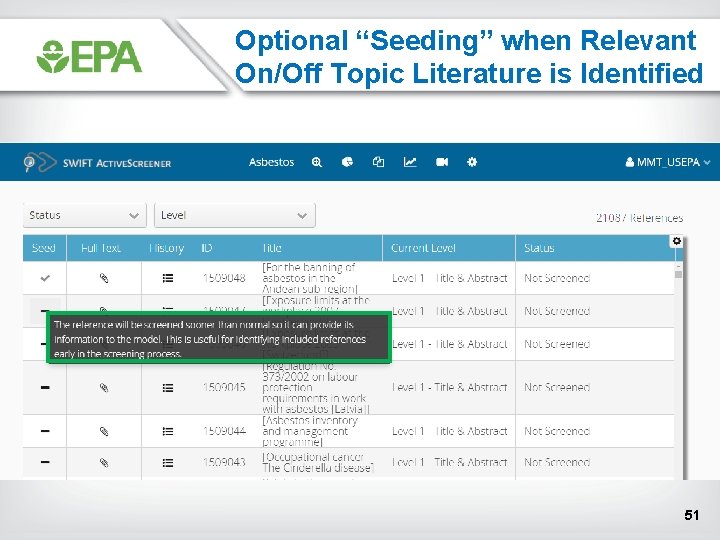
Optional “Seeding” when Relevant On/Off Topic Literature is Identified 51
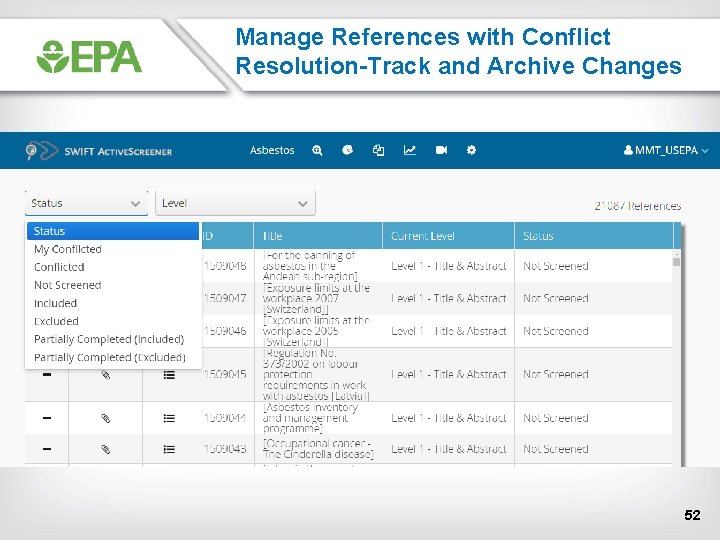
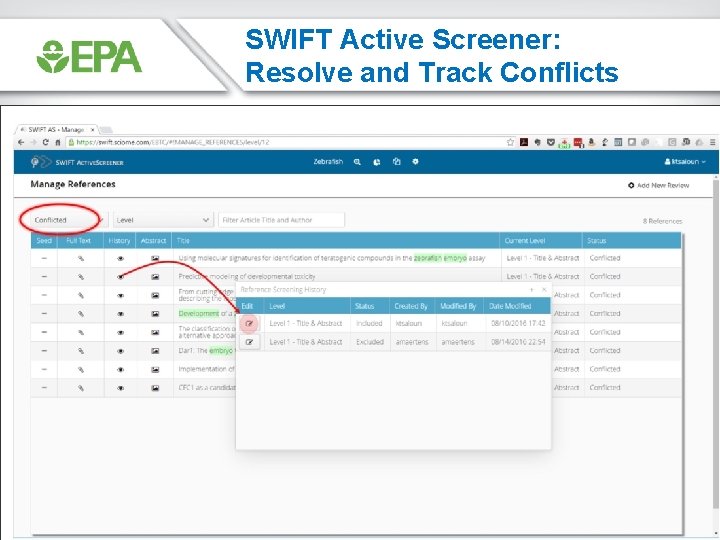
Manage References with Conflict Resolution-Track and Archive Changes 52
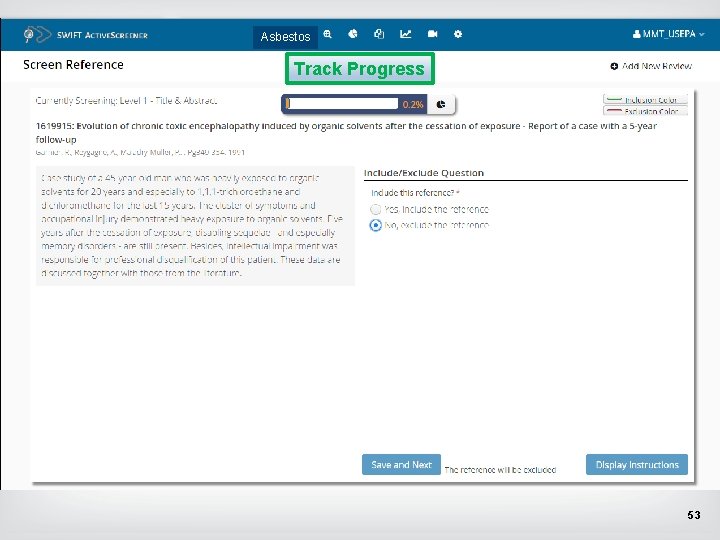
Asbestos Track Progress 53
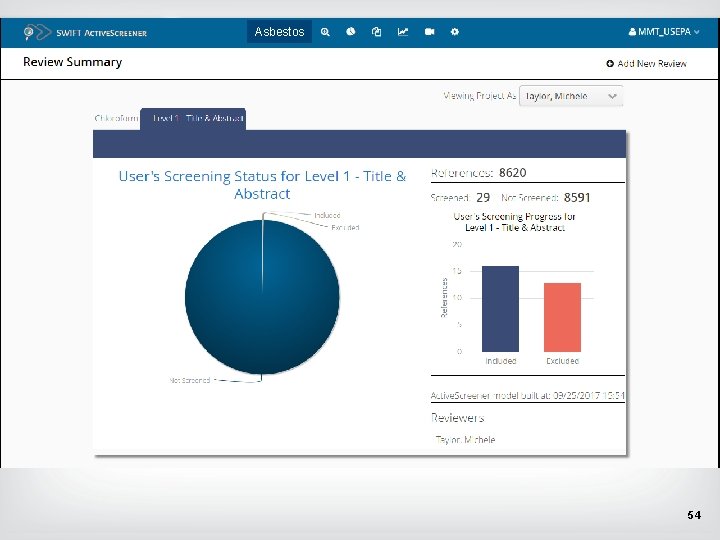
Asbestos 54
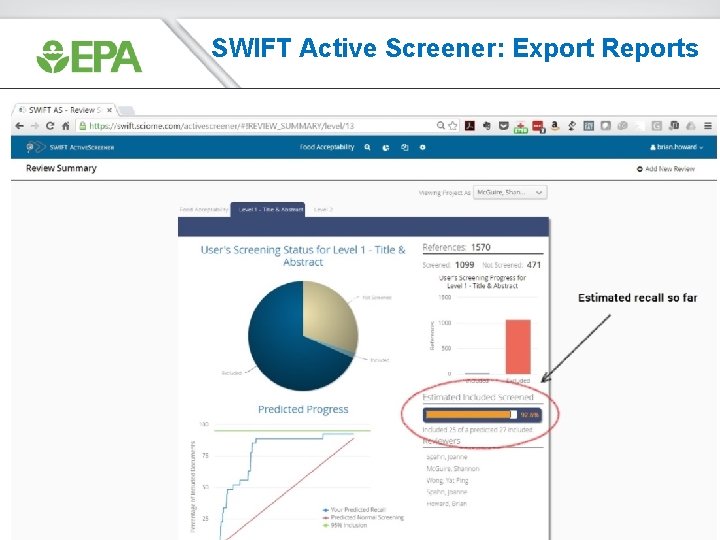
SWIFT Active Screener: Export Reports 55
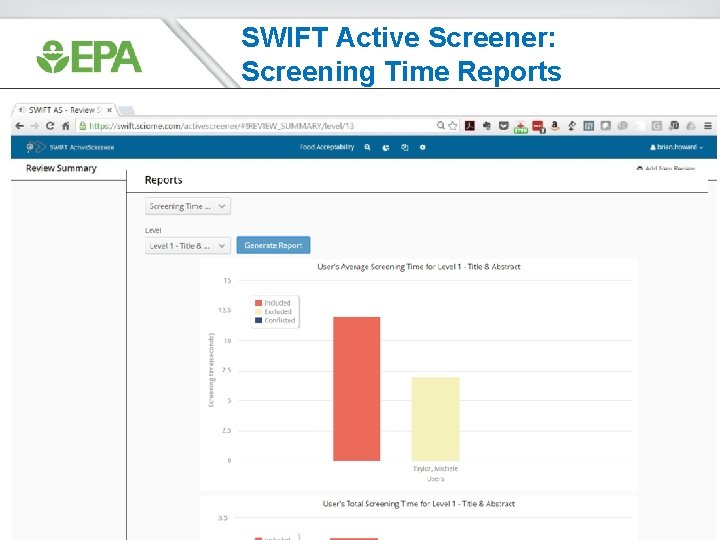
SWIFT Active Screener: Screening Time Reports 56
SWIFT Active Screener: Resolve and Track Conflicts 57
Demonstration of Tools for Study Evaluation, Extraction, Visualization and Data Sharing Office of Research and Development NCEA, IRIS
Office of Research and Development NCEA, IRIS
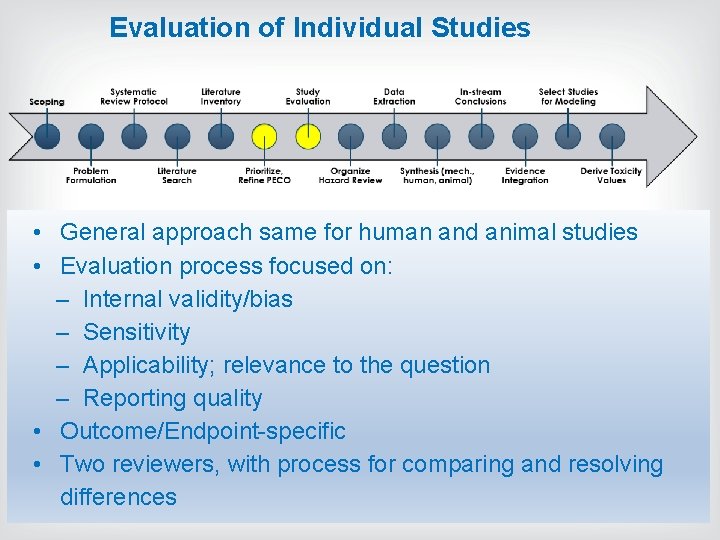
Evaluation of Individual Studies • General approach same for human and animal studies • Evaluation process focused on: – Internal validity/bias – Sensitivity – Applicability; relevance to the question – Reporting quality • Outcome/Endpoint-specific • Two reviewers, with process for comparing and resolving differences
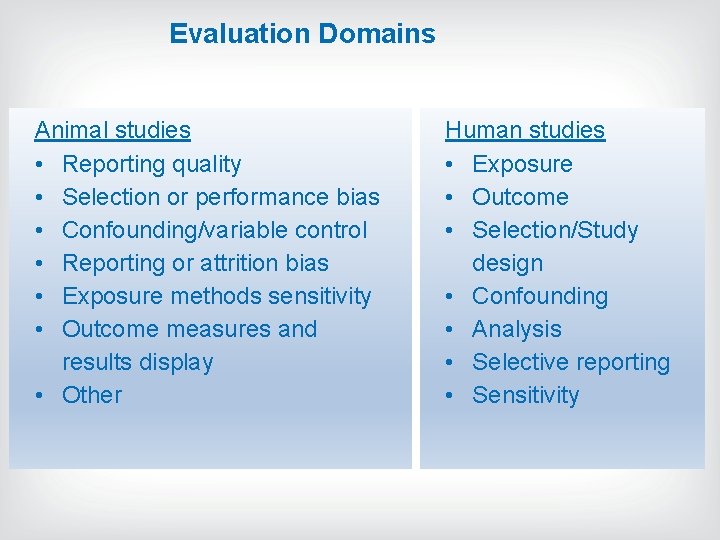
Evaluation Domains Animal studies • Reporting quality • Selection or performance bias • Confounding/variable control • Reporting or attrition bias • Exposure methods sensitivity • Outcome measures and results display • Other Human studies • Exposure • Outcome • Selection/Study design • Confounding • Analysis • Selective reporting • Sensitivity
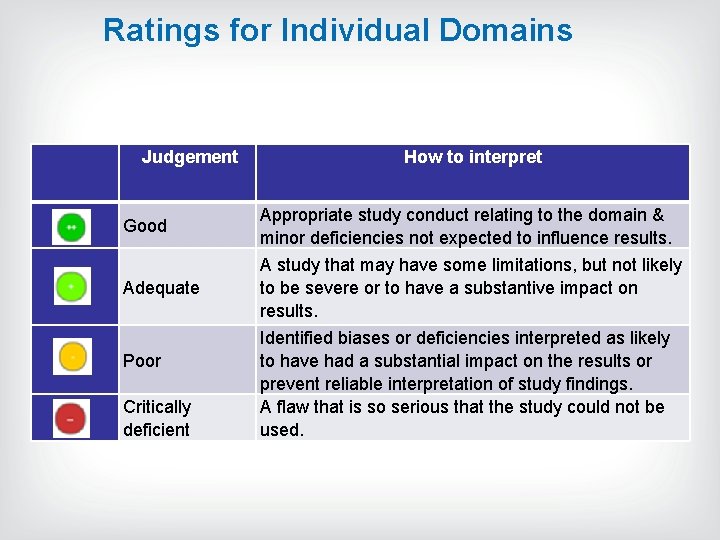
Ratings for Individual Domains Judgement Good Adequate Poor Critically deficient How to interpret Appropriate study conduct relating to the domain & minor deficiencies not expected to influence results. A study that may have some limitations, but not likely to be severe or to have a substantive impact on results. Identified biases or deficiencies interpreted as likely to have had a substantial impact on the results or prevent reliable interpretation of study findings. A flaw that is so serious that the study could not be used.
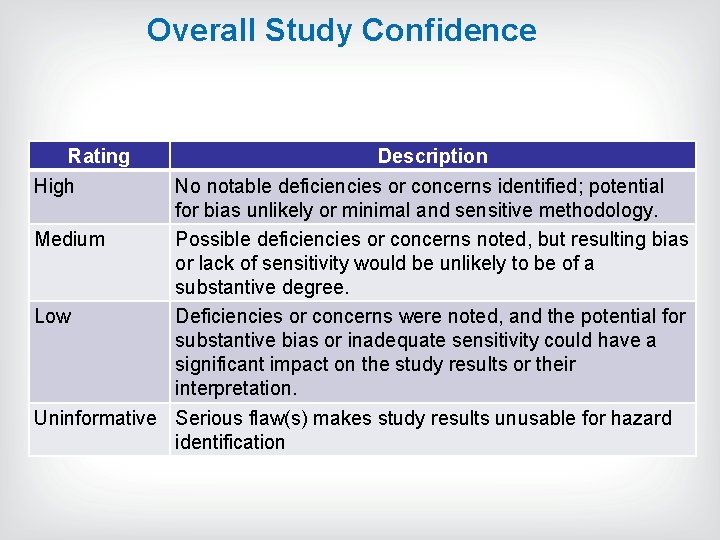
Overall Study Confidence Rating High Description No notable deficiencies or concerns identified; potential for bias unlikely or minimal and sensitive methodology. Medium Possible deficiencies or concerns noted, but resulting bias or lack of sensitivity would be unlikely to be of a substantive degree. Low Deficiencies or concerns were noted, and the potential for substantive bias or inadequate sensitivity could have a significant impact on the study results or their interpretation. Uninformative Serious flaw(s) makes study results unusable for hazard identification
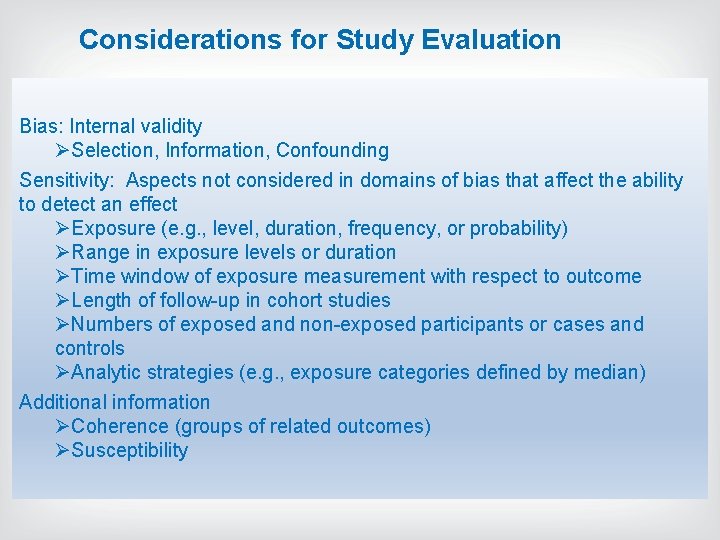
Considerations for Study Evaluation Bias: Internal validity ØSelection, Information, Confounding Sensitivity: Aspects not considered in domains of bias that affect the ability to detect an effect ØExposure (e. g. , level, duration, frequency, or probability) ØRange in exposure levels or duration ØTime window of exposure measurement with respect to outcome ØLength of follow-up in cohort studies ØNumbers of exposed and non-exposed participants or cases and controls ØAnalytic strategies (e. g. , exposure categories defined by median) Additional information ØCoherence (groups of related outcomes) ØSusceptibility
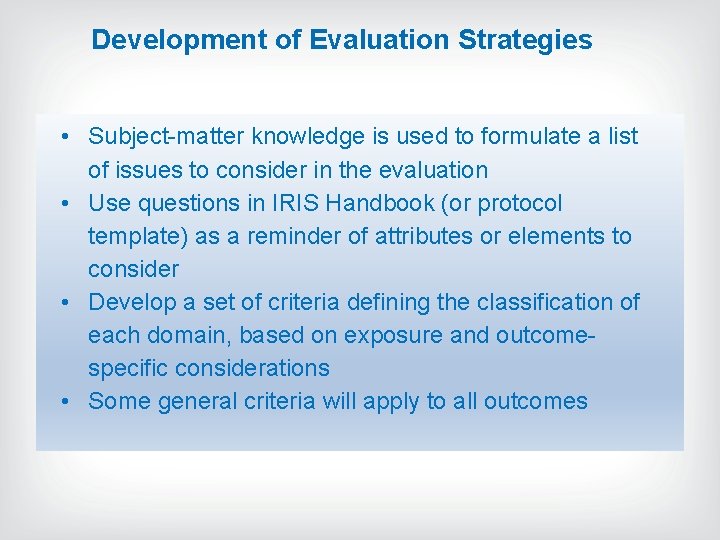
Development of Evaluation Strategies • Subject-matter knowledge is used to formulate a list of issues to consider in the evaluation • Use questions in IRIS Handbook (or protocol template) as a reminder of attributes or elements to consider • Develop a set of criteria defining the classification of each domain, based on exposure and outcomespecific considerations • Some general criteria will apply to all outcomes
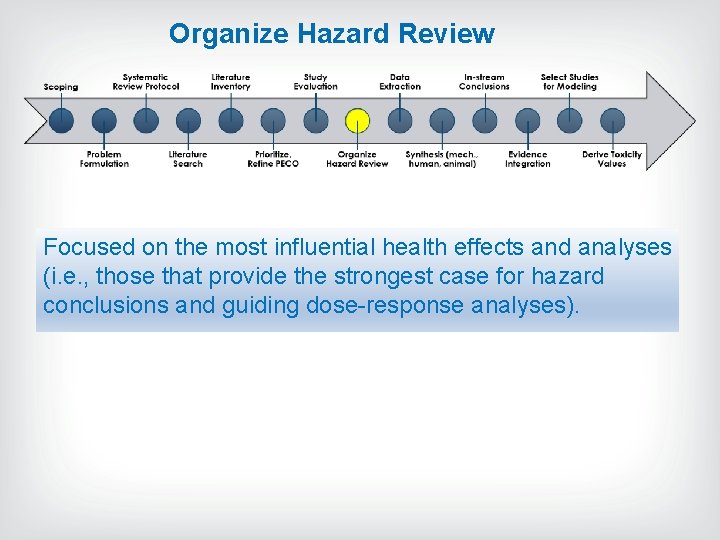
Organize Hazard Review Focused on the most influential health effects and analyses (i. e. , those that provide the strongest case for hazard conclusions and guiding dose-response analyses).
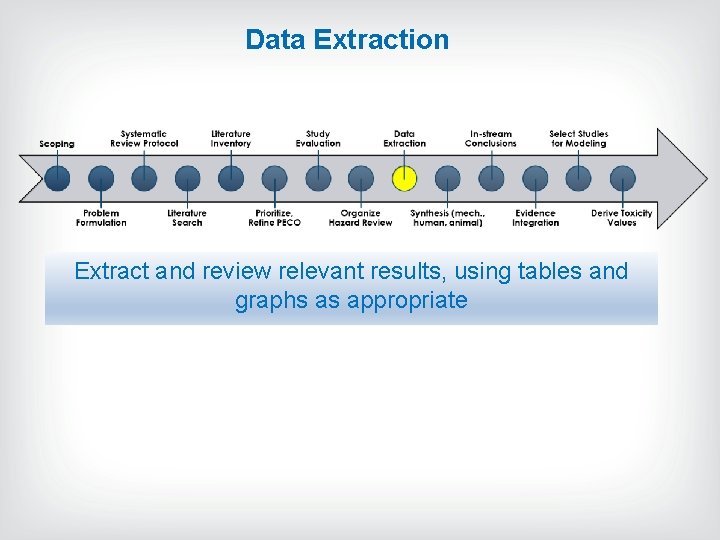
Data Extraction Extract and review relevant results, using tables and graphs as appropriate
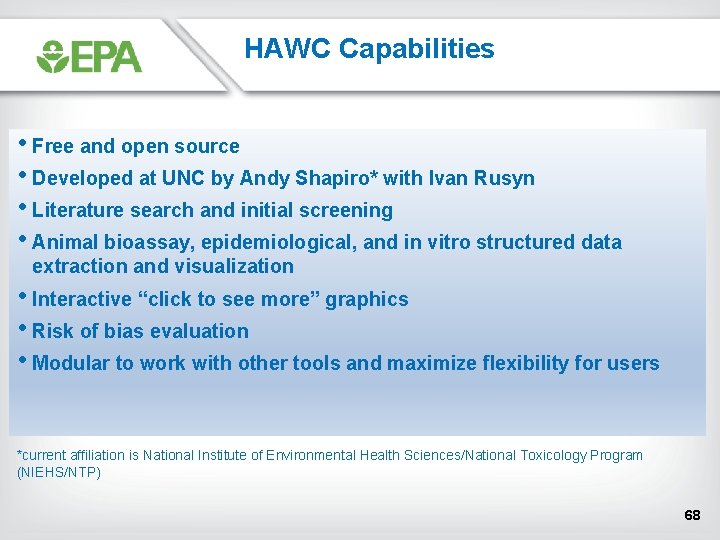
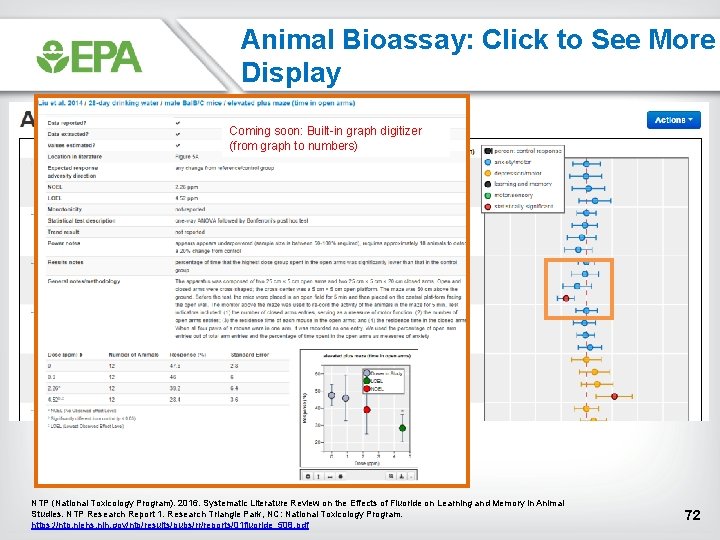
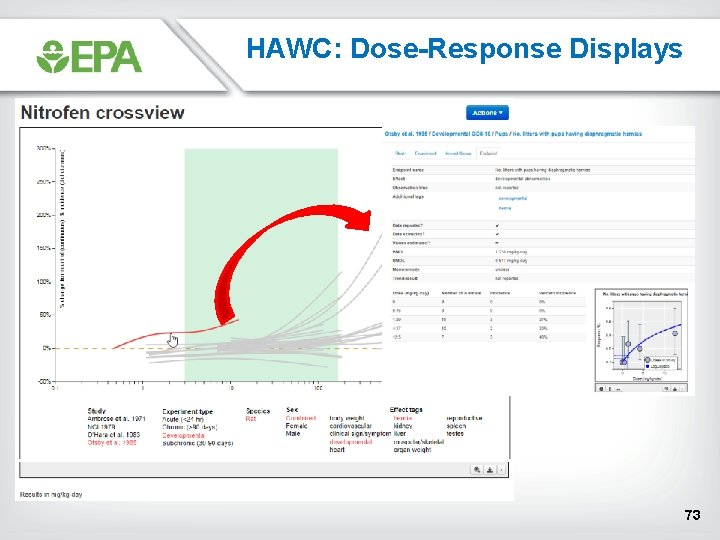
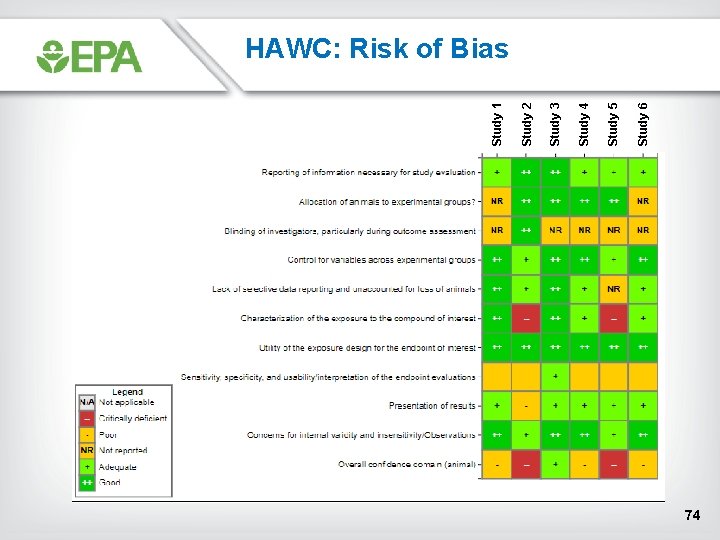
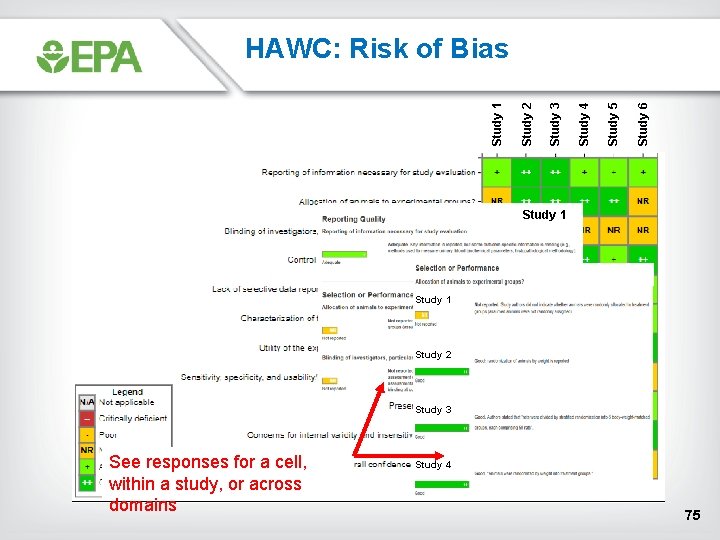
HAWC Capabilities • Free and open source • Developed at UNC by Andy Shapiro* with Ivan Rusyn • Literature search and initial screening • Animal bioassay, epidemiological, and in vitro structured data extraction and visualization • Interactive “click to see more” graphics • Risk of bias evaluation • Modular to work with other tools and maximize flexibility for users *current affiliation is National Institute of Environmental Health Sciences/National Toxicology Program (NIEHS/NTP) 68
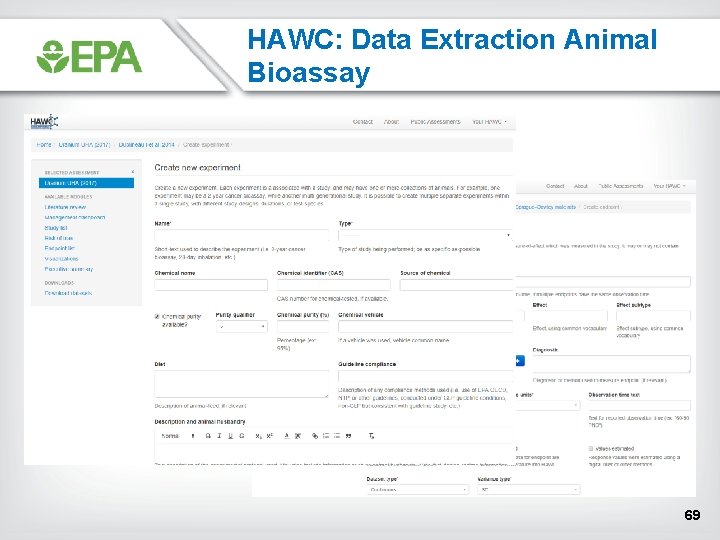
HAWC: Data Extraction Animal Bioassay 69
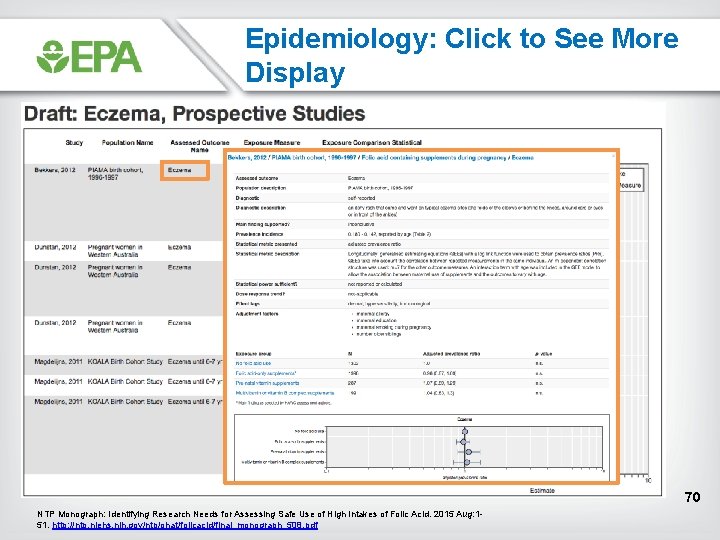
Epidemiology: Click to See More Display 70 NTP Monograph: Identifying Research Needs for Assessing Safe Use of High Intakes of Folic Acid. 2015 Aug: 151. http: //ntp. niehs. nih. gov/ntp/ohat/folicacid/final_monograph_508. pdf
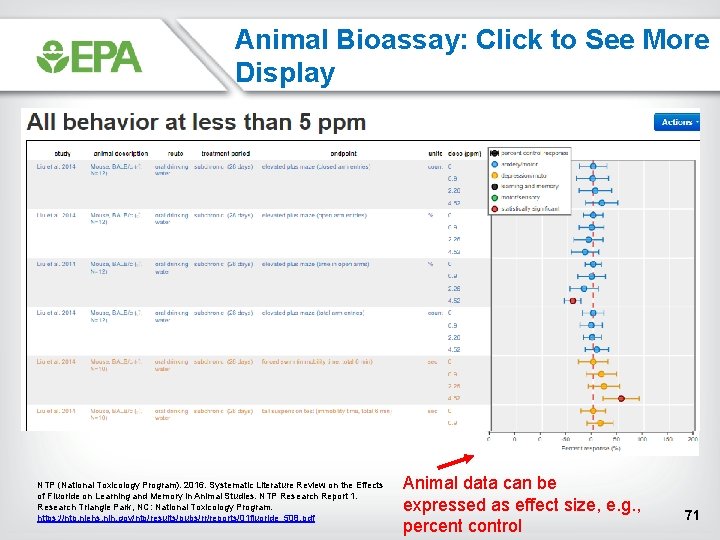
Animal Bioassay: Click to See More Display NTP (National Toxicology Program). 2016. Systematic Literature Review on the Effects of Fluoride on Learning and Memory in Animal Studies. NTP Research Report 1. Research Triangle Park, NC: National Toxicology Program. https: //ntp. niehs. nih. gov/ntp/results/pubs/rr/reports/01 fluoride_508. pdf Animal data can be expressed as effect size, e. g. , percent control 71
Animal Bioassay: Click to See More Display Coming soon: Built-in graph digitizer (from graph to numbers) NTP (National Toxicology Program). 2016. Systematic Literature Review on the Effects of Fluoride on Learning and Memory in Animal Studies. NTP Research Report 1. Research Triangle Park, NC: National Toxicology Program. https: //ntp. niehs. nih. gov/ntp/results/pubs/rr/reports/01 fluoride_508. pdf 72
HAWC: Dose-Response Displays 73
Study 6 Study 5 Study 4 Study 3 Study 2 Study 1 HAWC: Risk of Bias 74
Study 6 Study 5 Study 4 Study 3 Study 2 Study 1 HAWC: Risk of Bias Study 1 Study 2 Study 3 See responses for a cell, within a study, or across domains Study 4 75
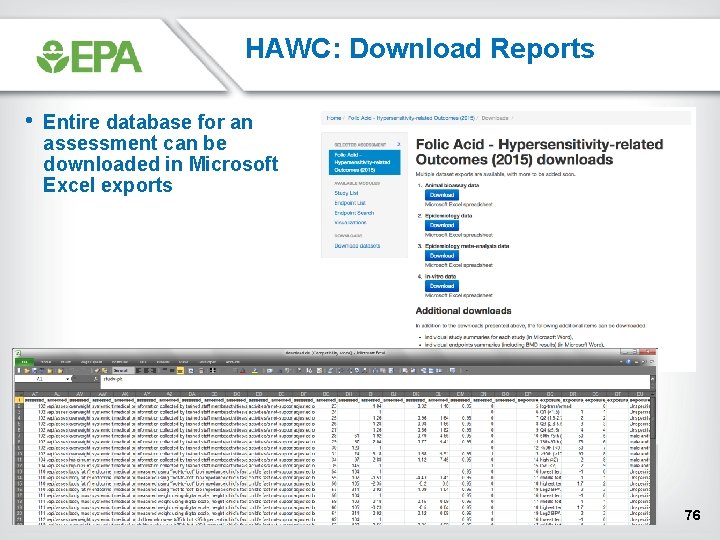
HAWC: Download Reports • Entire database for an assessment can be downloaded in Microsoft Excel exports 76
Advantages • Structured data extraction to promote consistency and completeness • Free, open source and customizable • Enhance database interpretability • Integration with automated data-extraction tools • Web-based to promote team collaboration • Ability to export data files promotes independent analysis of findings and quantification (in assessments or for methods development) – Exploring the creation of meta-analysis using the R metafor library • Creates possibilities for web-based, interactive reports • Systematic review tools like HAWC could be “re-purposed” for next generation of journal submission practices 77
QUESTIONS? Office of Research and Development NCEA, IRIS