Survive and thrive in times of change and

- Slides: 29
Survive and thrive in times of change and uncertainty: Overcoming fear to develop resilience in leadership By Jo Ritchie, Licenced Feel The Fear Trainer
What are you currently most afraid of?
Contents • Background on resilience in leadership • Practical tools & exercises for challenging fears & developing resilience • Summary of take-home messages • Further reading • Contact details
Background • Science & healthcare communications for 17 years • Five+ years in NHS Communications – mainly primary care • Coaching teams & advising senior leaders • Professional personal & business coach • Licenced Feel The Fear Trainer for Susan Jeffers Organisation • Licenced Master Practitioner of Neuro Linguistic Programming (NLP) • Yoga and martial arts instructor • A lot of experience with fear!
Why resilience? “Rapid, disruptive change is today’s normal. It comes in bubbles, waves and sometimes tsunamis. To cope, leaders need to be agile and resilient. For years, the focus has been on speed and agility. But globalisation, technology and social-political changes are disruptive. They require resilient leaders, emotionally intelligent people able to absorb complex change and help others to move forward to achieve success” (Reid, 2008) In the face of change and uncertainty, the resource we need most is our resilience
What is resilience? “No one can completely avoid trouble and potential pitfalls are everywhere, so the real skill is to climb out of the hole and bounce back” (Moss Kanter, 2013) • Allows some people to be knocked down and bounce back stronger • Rise & learn from failure, rather than letting it overcome them and drain their resolve • Change course/adapt and keep moving forwards • Psychologists identified factors that make someone resilient: • • Positive attitude Optimism Ability to regulate emotions Ability to see failure as a form of helpful feedback
Practices of resilient leaders Take care of business – and themselves – whilst taking action in new realities (Allison & Reeves, 2011) • Make time to invest in personal renewal – physical, emotional, spiritual, intellectual – centre yourself to remain in balance, be self-aware • Clear vision – yet remain flexible & positive when plans need to change • Stay optimistic (not naïve) – aware of trends, but not slowed by them • Welcome feedback/data as an opportunity for change – take action • Inspire with positive language & seek others’ views – open culture • Respond quickly to setbacks and move on – not defensive, not about YOU • Cultivate networks BEFORE challenges arise – build relationships, seek support • Control what you can and let the rest go – don’t beat yourself up • Authentic! No masks. Not bulletproof! – use vulnerability as a strength to connect and empathise
Risks of not being a resilient leader “If left unchecked, this condition of imbalance can undermine a leader’s functioning at a crucial time… This risk is compounded if the leader is not aware that she or he is out of balance, as is often the case” (Snyder, 2013) • • Risk averse – blind to precarious situations & defensive (head in sand) Pessimistic – ignore opportunities for growth Scared of change – stop learning & slow down Fearful – cut budgets across the board Afraid to invite feedback – ignore critical performance indicators Overwhelmed, ‘busy’, powerless – don’t get to the important work Untrusting of the motives of others – become isolated Fail to celebrate successes & miss opportunities to learn lessons – remain stuck
What has fear got to do with it? “Mastering any skill usually requires some element of fear-conquering. Leadership is no different” (Gleeson, 2014) • Fear can stop us in our tracks and make us ineffective leaders • Fear can obscure judgement and affect decision-making • Fear stops us being ourselves – instead we wear a mask of invulnerability, which stops us relating to others (empathy) • A Harvard study of leadership studies (HBR ’ 02) identified authenticity as the top leadership success factor, followed by vulnerability, intuitive thinking and decision-making, and tough empathy.
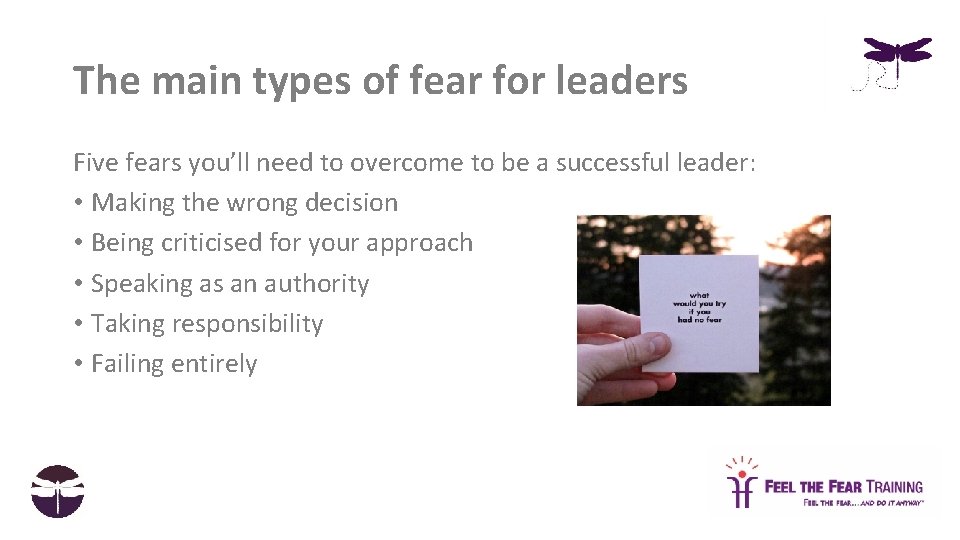
The main types of fear for leaders Five fears you’ll need to overcome to be a successful leader: • Making the wrong decision • Being criticised for your approach • Speaking as an authority • Taking responsibility • Failing entirely
Fearful leaders create fear-driven environments “The reason why so many managers treat their employees as badly as they do and keep them in line with unnecessary rules, policies and punishments is that the managers themselves are in a state of fear. They don’t know who they are behind the business card” (Ryan 2015) “[Fear-based managers] don’t feel whole and healthy. They don’t have the selfesteem to build anyone else up and make the people who work for them feel strong and capable… The false sense of bureaucratic power conferred on them by higherlevel managers becomes a substitute for self-esteem” (Ryan, 2015) • Passing on your own fears and using them to control people creates an unhealthy and non-resilient working environment • If your professional identity is your only source of personal power, that is a fragile power
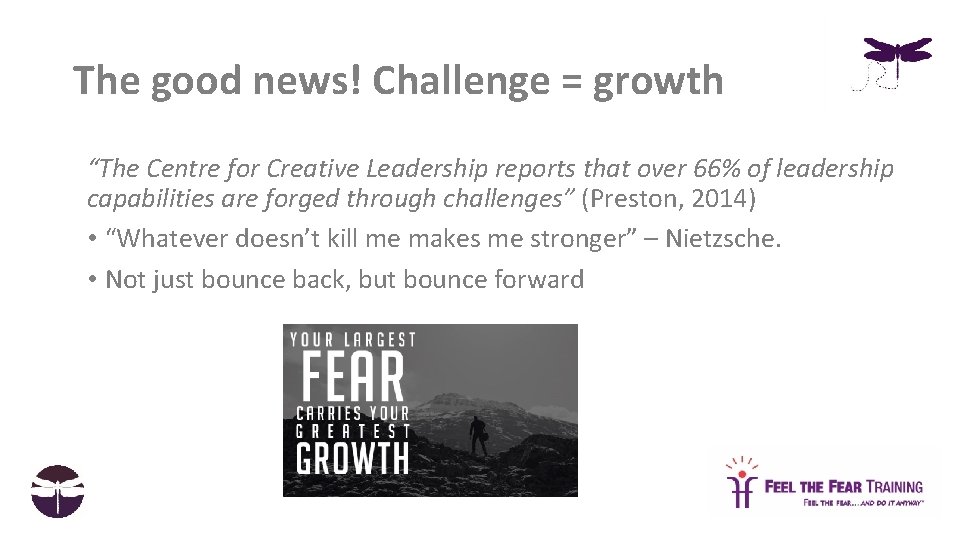
The good news! Challenge = growth “The Centre for Creative Leadership reports that over 66% of leadership capabilities are forged through challenges” (Preston, 2014) • “Whatever doesn’t kill me makes me stronger” – Nietzsche. • Not just bounce back, but bounce forward
“Feel the fear and do it anyway!”® • Susan Jeffers: 1938 -2012 – much-loved author • ‘Feel the fear and do it anyway!’® – landmark selfdevelopment book • Susan Jeffers Organisation • Global network of licenced trainers in 31 countries • www. susanjeffers. com • www. feelthefeartraining. com
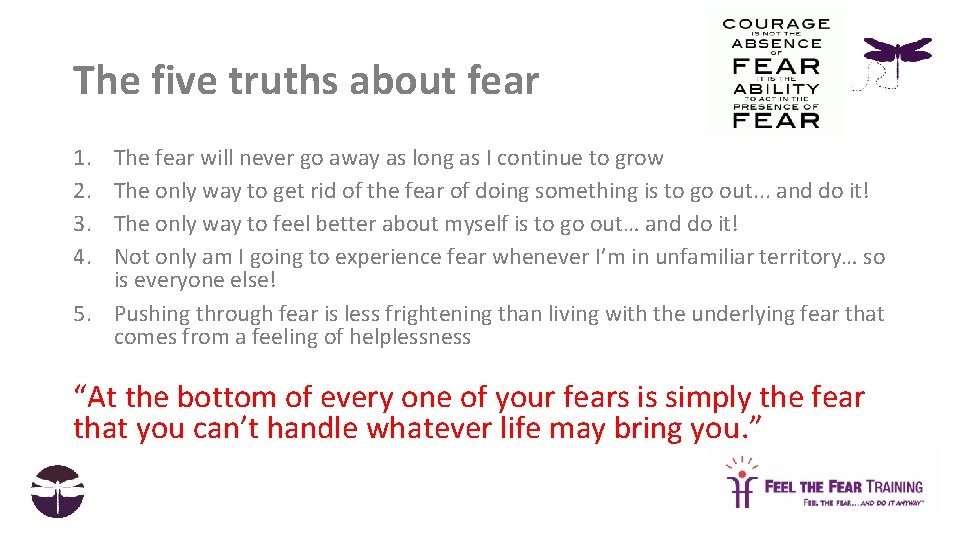
The five truths about fear 1. 2. 3. 4. The fear will never go away as long as I continue to grow The only way to get rid of the fear of doing something is to go out. . . and do it! The only way to feel better about myself is to go out… and do it! Not only am I going to experience fear whenever I’m in unfamiliar territory… so is everyone else! 5. Pushing through fear is less frightening than living with the underlying fear that comes from a feeling of helplessness “At the bottom of every one of your fears is simply the fear that you can’t handle whatever life may bring you. ”
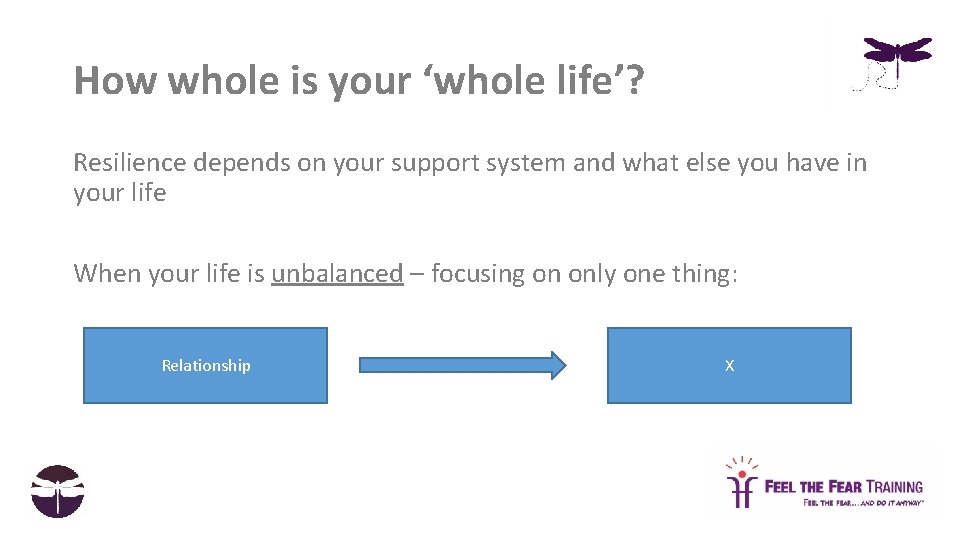
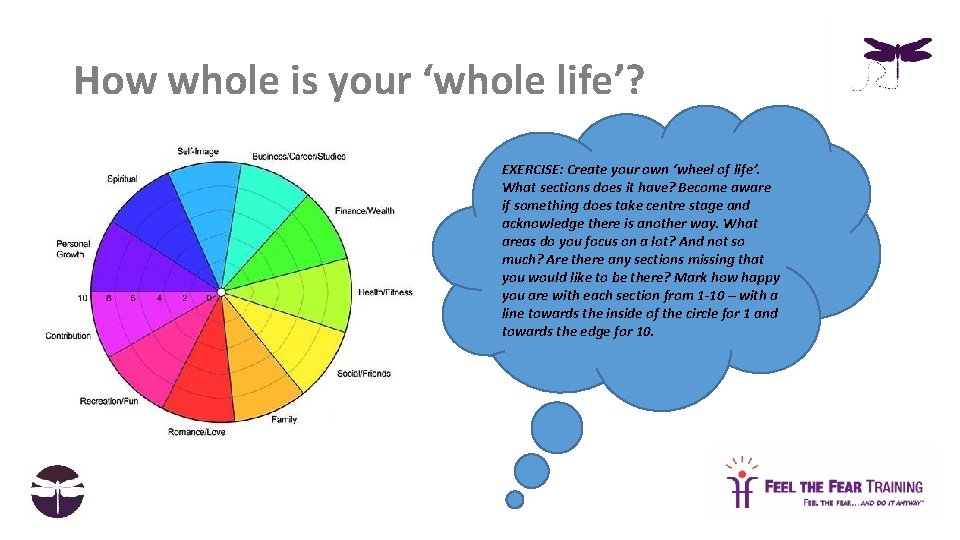
How whole is your ‘whole life’? Resilience depends on your support system and what else you have in your life When your life is unbalanced – focusing on only one thing: Relationship X
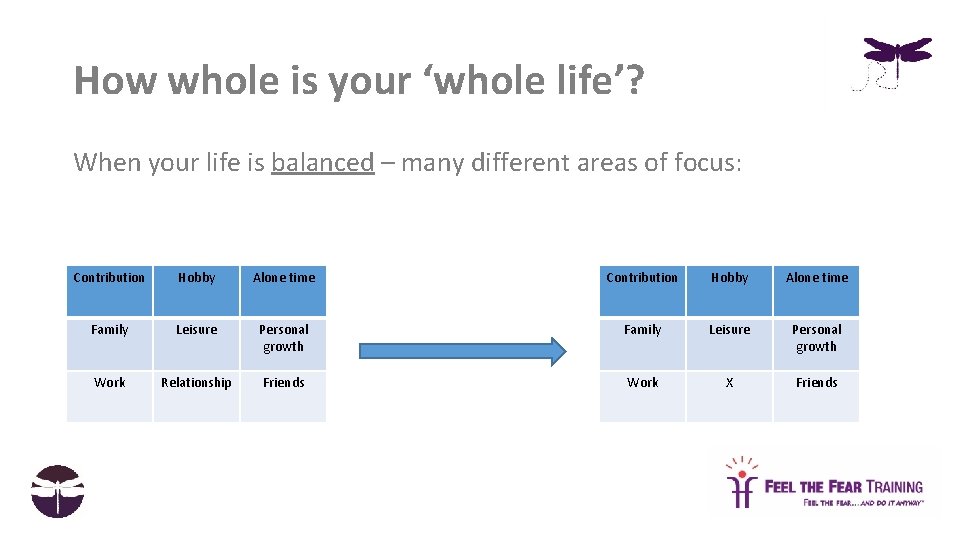
How whole is your ‘whole life’? When your life is balanced – many different areas of focus: Contribution Hobby Alone time Family Leisure Personal growth Work Relationship Friends Work X Friends
How whole is your ‘whole life’? EXERCISE: Create your own ‘wheel of life’. What sections does it have? Become aware if something does take centre stage and acknowledge there is another way. What areas do you focus on a lot? And not so much? Are there any sections missing that you would like to be there? Mark how happy you are with each section from 1 -10 – with a line towards the inside of the circle for 1 and towards the edge for 10.
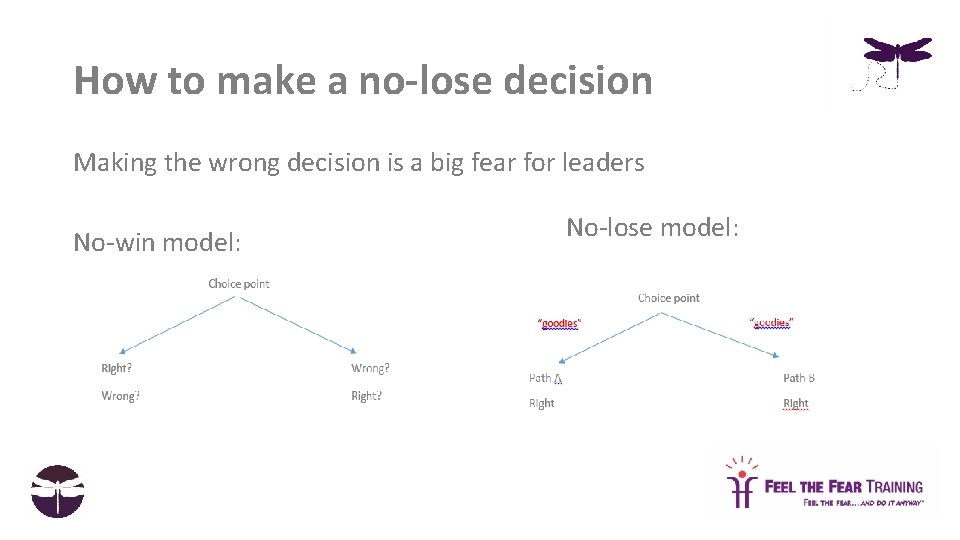
How to make a no-lose decision Making the wrong decision is a big fear for leaders No-win model: No-lose model:
How to make a no-lose decision BEFORE making a decision: • Focus immediately on the no-lose model – focus on what you can gain and not lose • Do your homework – check out the alternatives that lay before you and get feedback (from people who support your growth) • Establish your priorities – what do you want out of life right now? • Trust your impulse – your body gives you clues • Lighten up – avoid taking yourself too seriously. You learn all the time AFTER making a decision: • Throw away your picture – no expectations. It might have helped you when making the decision, but now let it go • Accept total responsibility for your decisions • Don’t protect; correct. Be flexible to change paths and not cling
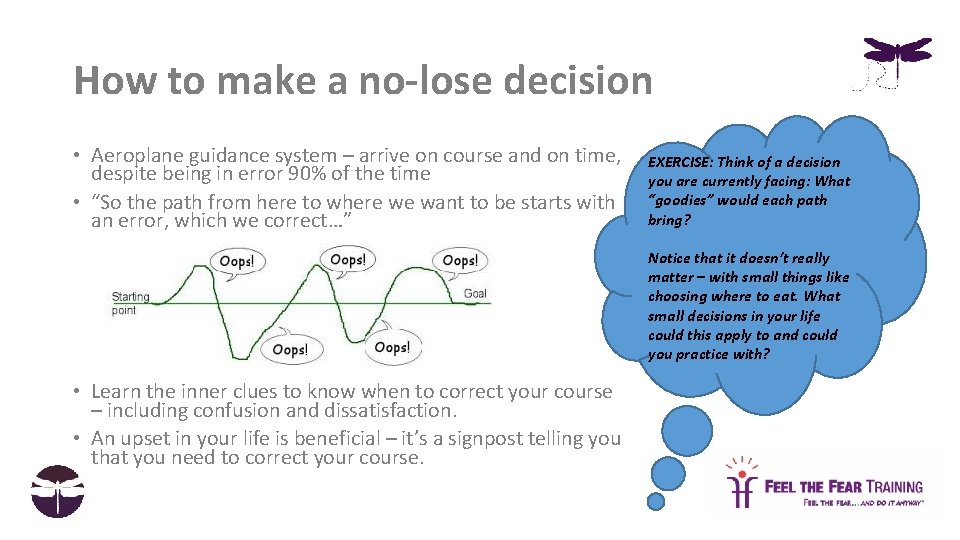
How to make a no-lose decision • Aeroplane guidance system – arrive on course and on time, despite being in error 90% of the time • “So the path from here to where we want to be starts with an error, which we correct…” • Learn the inner clues to know when to correct your course – including confusion and dissatisfaction. • An upset in your life is beneficial – it’s a signpost telling you that you need to correct your course. EXERCISE: Think of a decision you are currently facing: What “goodies” would each path bring? Notice that it doesn’t really matter – with small things like choosing where to eat. What small decisions in your life could this apply to and could you practice with?
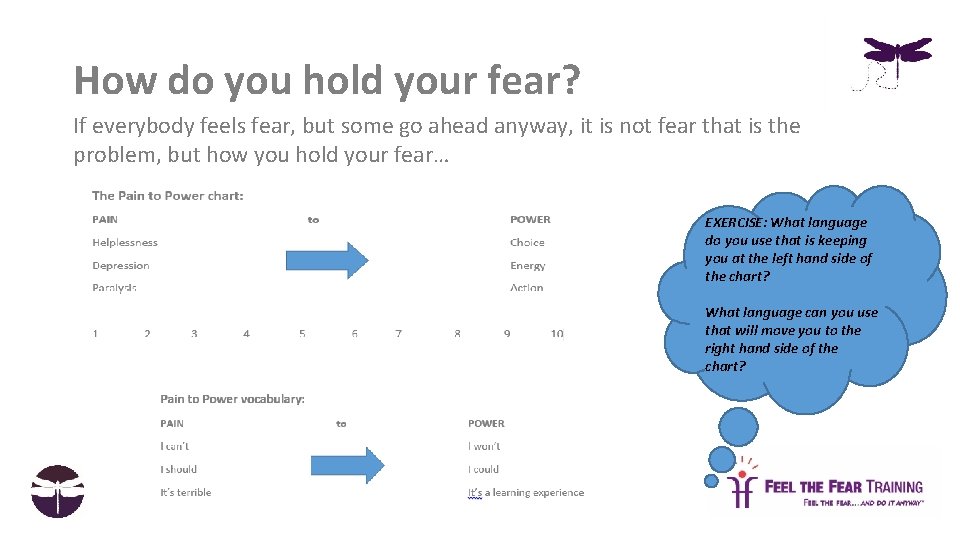
How do you hold your fear? If everybody feels fear, but some go ahead anyway, it is not fear that is the problem, but how you hold your fear… EXERCISE: What language do you use that is keeping you at the left hand side of the chart? What language can you use that will move you to the right hand side of the chart?
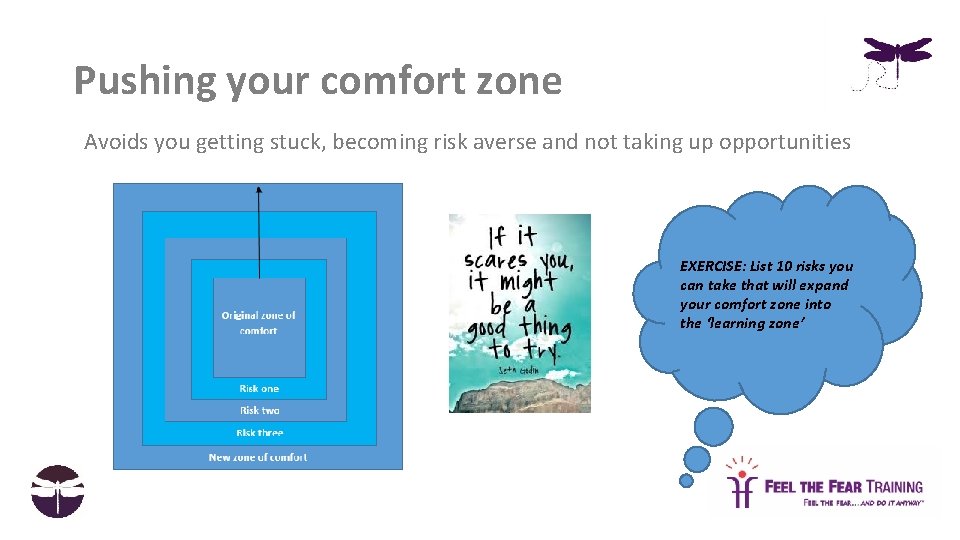
Pushing your comfort zone Avoids you getting stuck, becoming risk averse and not taking up opportunities EXERCISE: List 10 risks you can take that will expand your comfort zone into the ‘learning zone’
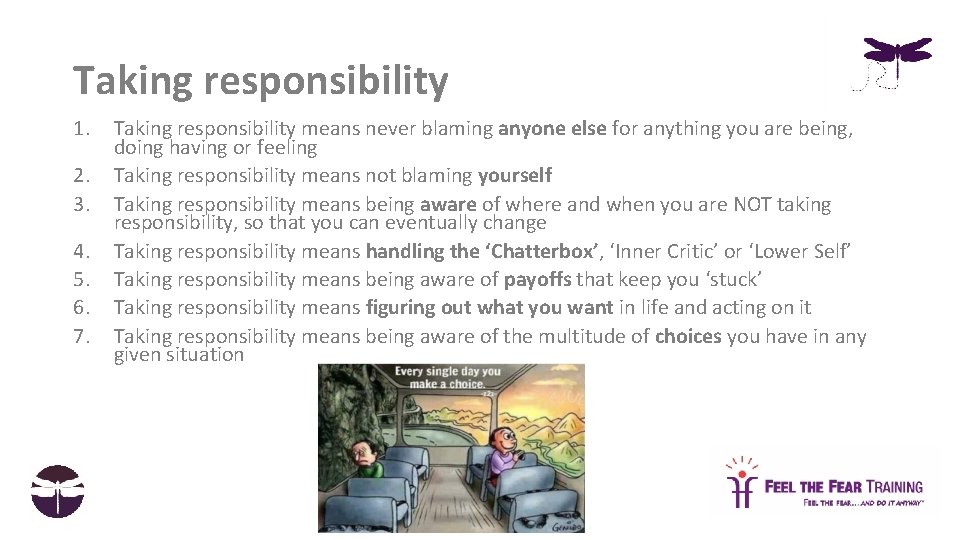
Taking responsibility 1. 2. 3. 4. 5. 6. 7. Taking responsibility means never blaming anyone else for anything you are being, doing having or feeling Taking responsibility means not blaming yourself Taking responsibility means being aware of where and when you are NOT taking responsibility, so that you can eventually change Taking responsibility means handling the ‘Chatterbox’, ‘Inner Critic’ or ‘Lower Self’ Taking responsibility means being aware of payoffs that keep you ‘stuck’ Taking responsibility means figuring out what you want in life and acting on it Taking responsibility means being aware of the multitude of choices you have in any given situation
Taking responsibility EXERCISE: Think of a challenging situation: 1. Who or what are you currently blaming? How can you start to take responsibility over this situation? 2. What are the signals that you are not taking responsibility? 3. What would the voice of your Lower Self say about the challenging situation I am currently facing? And what would the voice of your Higher Self say 4. What are the hidden payoffs? What would you gain by letting go of the payoffs and taking responsibility for pulling yourself out of this situation?
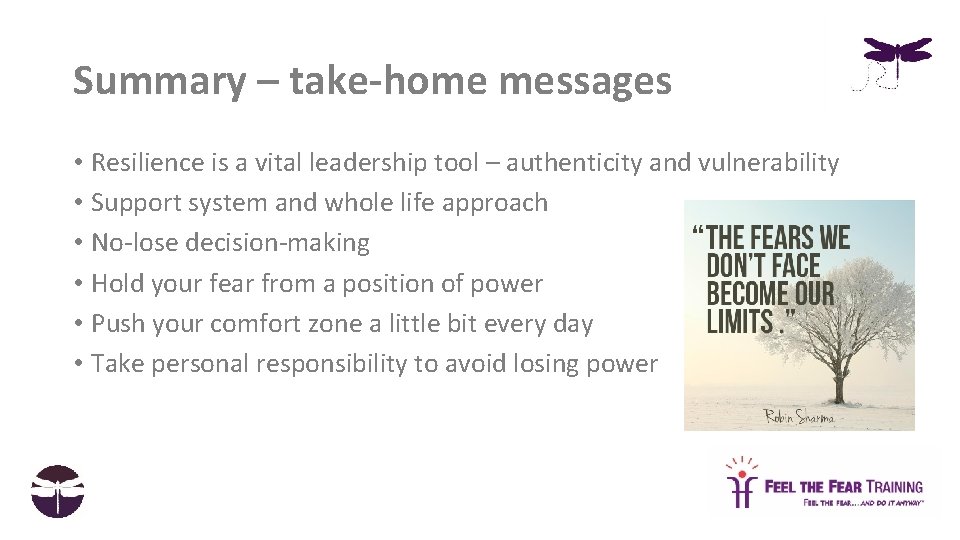
Summary – take-home messages • Resilience is a vital leadership tool – authenticity and vulnerability • Support system and whole life approach • No-lose decision-making • Hold your fear from a position of power • Push your comfort zone a little bit every day • Take personal responsibility to avoid losing power
Further reading • Daniel Goleman – Emotional Intelligence • Joanne Reid (2008) – The resilient leader – Why EQ matters • Harvard Business Review (Nov 2013): Why is resilience so hard? – Steven Snyder • Harvard Business Review (July 2013): Surprises are the new normal; resilience is the new skill – Rosabeth Moss Kanter • 5 fears you’ll need to overcome to be an effective leader (Dec 2015) • The five characteristics of fear-based leaders (Forbes 2015) – Liz Ryan • Conquering the common fears of leadership (Forbes, 2014) – Brent Gleeson
Contact details • Phone: +44 (0)7702 828145 • Email: jo@joritchie. com • Web: www. joritchie. com • Facebook: www. facebook. com/followyourblissalways • Blog: www. followyourblissblog. com • Linked In: http: //www. linkedin. com/in/joritchiecommsandcoaching • Next FTF one-day workshop on November 12 th 2016 – www. joritchie. com/london-ftf-november-2016
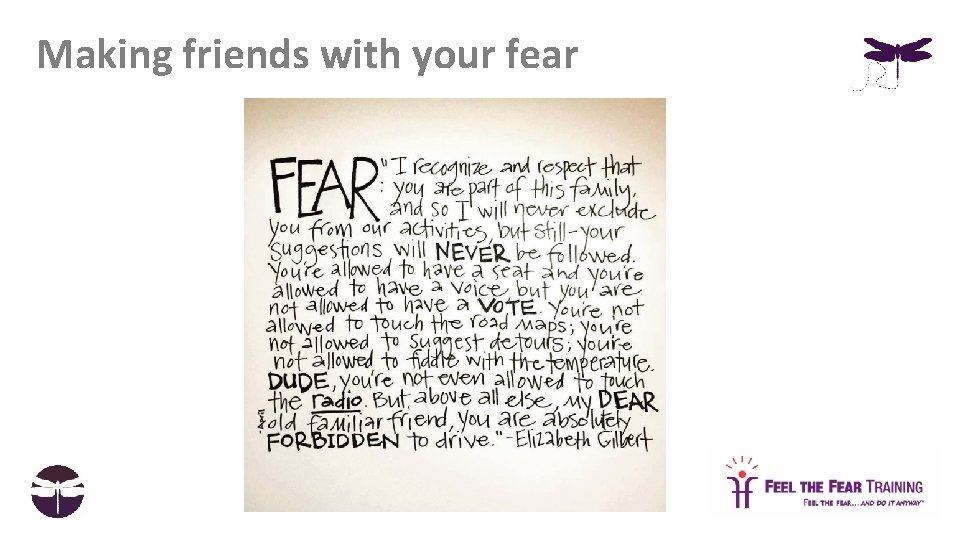
Making friends with your fear
Thank you and feedback forms