Streams and Lazy Evaluation in Lisp and Scheme

- Slides: 30
Streams and Lazy Evaluation in Lisp and Scheme
Overview • Different models of expression evaluation –Lazy vs. eager evaluation –Normal vs. applicative order evaluation • Computing with streams in Lisp and Scheme
Evaluation Order • Functional programs are evaluated following a reduction (or evaluation or simplification) process • There are two common ways of reducing expressions – Applicative order • Eager evaluation – Normal order • Lazy evaluation
Applicative Order • In applicative order, expressions at evaluated following the parsing tree (deeper expressions are evaluated first) • This is the evaluation order used in most programming languages • It’s the default order for Lisp, in particular • All arguments to a function or operator are evaluated before the function is applied e. g. : (square (+ a (* b 2)))
Normal Order • In normal order, expressions are evaluated only when their value is needed • Hence: lazy evaluation • This is needed for some special forms e. g. , (if (< a 0) (print ‘foo) (print ‘bar)) • Some languages use normal order evaluation as their default. – Its sometimes more efficient than applicative order since unused computations need not be done – It can handle expressions that never converge to normal forms
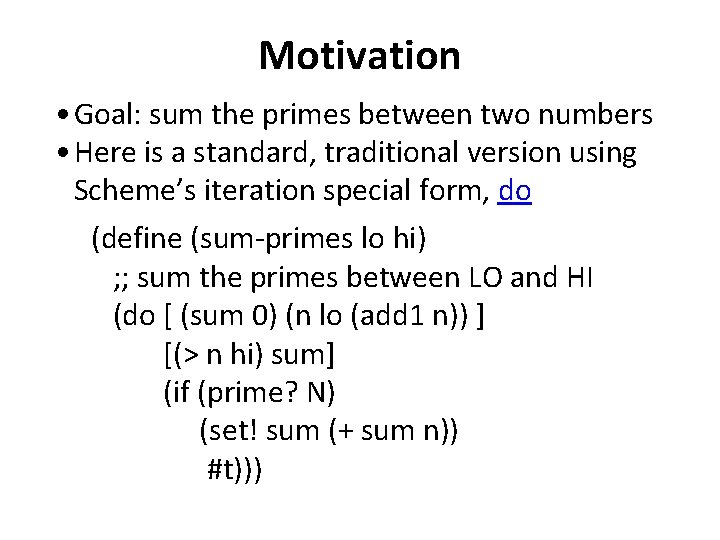
Motivation • Goal: sum the primes between two numbers • Here is a standard, traditional version using Scheme’s iteration special form, do (define (sum-primes lo hi) ; ; sum the primes between LO and HI (do [ (sum 0) (n lo (add 1 n)) ] [(> n hi) sum] (if (prime? N) (set! sum (+ sum n)) #t)))
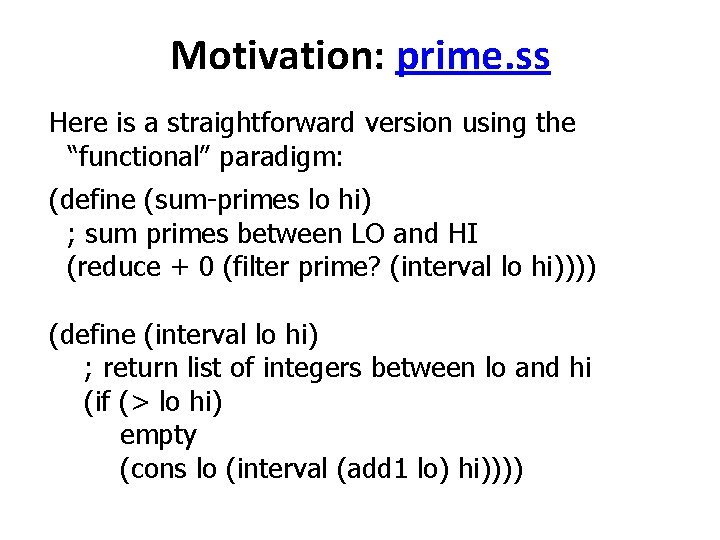
Motivation: prime. ss Here is a straightforward version using the “functional” paradigm: (define (sum-primes lo hi) ; sum primes between LO and HI (reduce + 0 (filter prime? (interval lo hi)))) (define (interval lo hi) ; return list of integers between lo and hi (if (> lo hi) empty (cons lo (interval (add 1 lo) hi))))
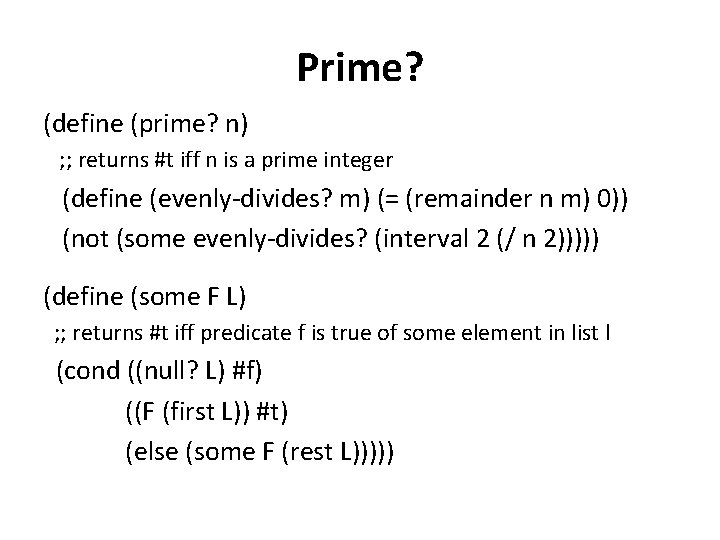
Prime? (define (prime? n) ; ; returns #t iff n is a prime integer (define (evenly-divides? m) (= (remainder n m) 0)) (not (some evenly-divides? (interval 2 (/ n 2))))) (define (some F L) ; ; returns #t iff predicate f is true of some element in list l (cond ((null? L) #f) ((F (first L)) #t) (else (some F (rest L)))))
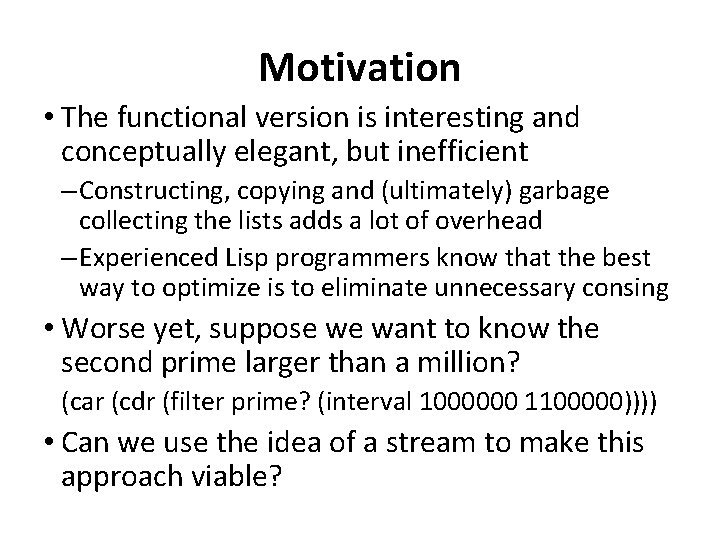
Motivation • The functional version is interesting and conceptually elegant, but inefficient – Constructing, copying and (ultimately) garbage collecting the lists adds a lot of overhead – Experienced Lisp programmers know that the best way to optimize is to eliminate unnecessary consing • Worse yet, suppose we want to know the second prime larger than a million? (car (cdr (filter prime? (interval 1000000 1100000)))) • Can we use the idea of a stream to make this approach viable?
A Stream • A stream will be a collection of values, much like a List • It will have a first element and a stream of remaining elements • However, the remaining elements will only be computed (materialized) as needed –Just in time computing, as it were • So, we can have a stream of (potential) infinite length and use only a part of it without having to materialize it all
Streams in Lisp and Scheme • We can push features for streams into a programming language. • Makes some approaches to computation simple and elegant • The closure mechanism used to implement these features. • Can formulate programs elegantly as sequence manipulators while attaining the efficiency of incremental computation.
Streams in Lisp/Scheme • A stream is like a list, so we’ll need constructors (~cons), and accessors (~ car, cdr) and a test (~ null? ). • We’ll call them: – SNIL: represents the empty stream – (SCONS X S): create a stream whose first element is X and whose remaining elements are the stream S – (SCAR S): returns first element of the stream – (SCDR S): returns remaining elements of the stream – (SNULL? S): returns true iff S is the empty stream
Streams: key ideas • Write scons so that the computation needed to produce the stream is delayed until it is needed – … and then, only as little of the computation possible will be done • Only ways to access parts of a stream are scar & scdr, so they may have to force the computation to be done • We’ll go ahead and always compute the first element of a stream and delay actually computing the rest of a stream until needed by some call to scdr • Two important functions to base this on: delay & force
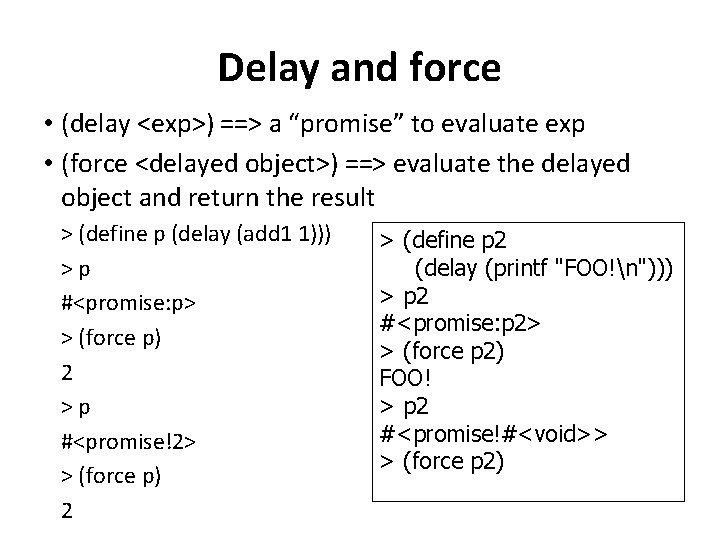
Delay and force • (delay <exp>) ==> a “promise” to evaluate exp • (force <delayed object>) ==> evaluate the delayed object and return the result > (define p (delay (add 1 1))) >p #<promise: p> > (force p) 2 >p #<promise!2> > (force p) 2 > (define p 2 (delay (printf "FOO!n"))) > p 2 #<promise: p 2> > (force p 2) FOO! > p 2 #<promise!#<void>> > (force p 2)
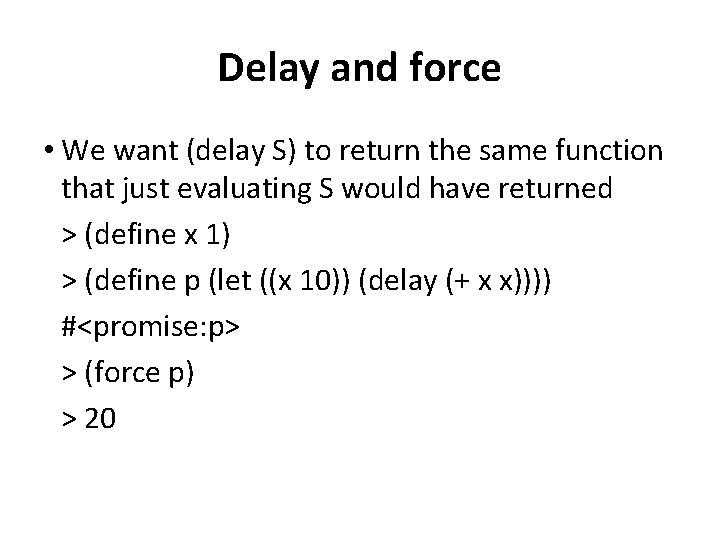
Delay and force • We want (delay S) to return the same function that just evaluating S would have returned > (define x 1) > (define p (let ((x 10)) (delay (+ x x)))) #<promise: p> > (force p) > 20
Delay and force • Delay is built into scheme, but it would have been easy to add • It’s not built into Lisp, but is easy to add • In both cases, we need to use macros • Macros provide a powerful facility to extend the languages
Macros • In Lisp and Scheme macros let us extend the language • They are syntactic forms with associated definition that rewrite the original forms into other forms before evaluating – E. g. , like a compiler • Much of Scheme and Lisp are implemented as macros
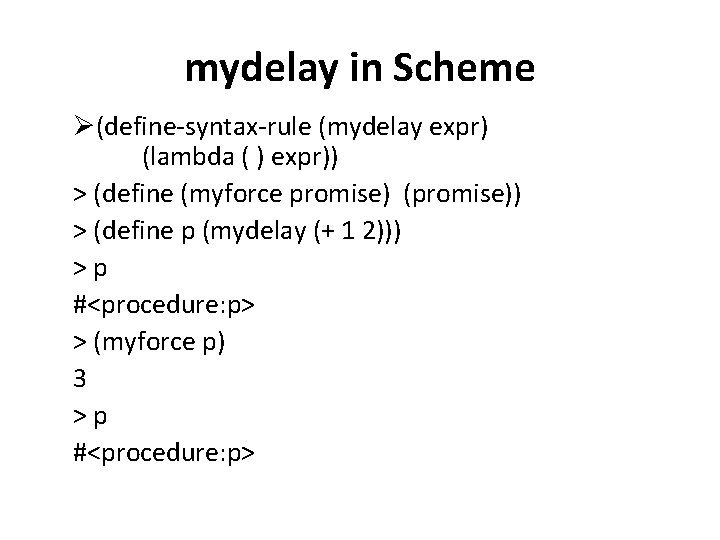
mydelay in Scheme Ø(define-syntax-rule (mydelay expr) (lambda ( ) expr)) > (define (myforce promise) (promise)) > (define p (mydelay (+ 1 2))) >p #<procedure: p> > (myforce p) 3 >p #<procedure: p>
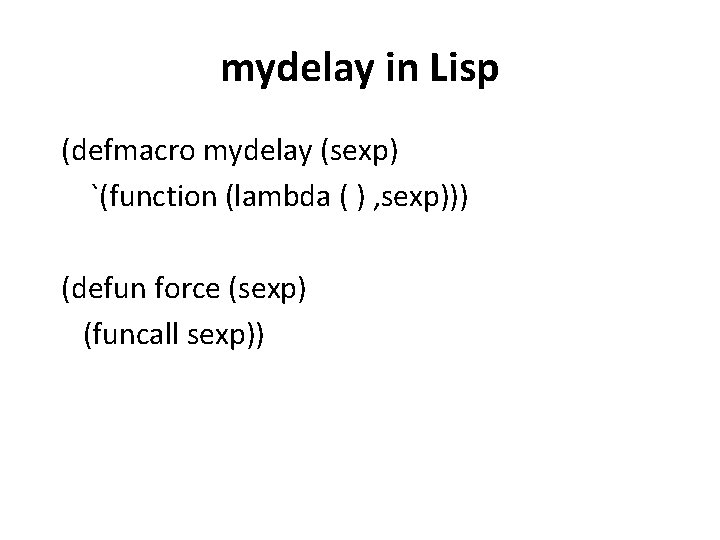
mydelay in Lisp (defmacro mydelay (sexp) `(function (lambda ( ) , sexp))) (defun force (sexp) (funcall sexp))
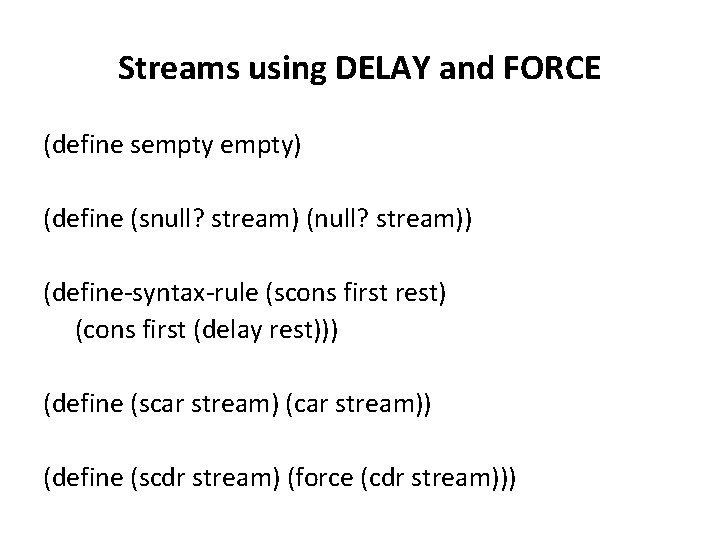
Streams using DELAY and FORCE (define sempty) (define (snull? stream) (null? stream)) (define-syntax-rule (scons first rest) (cons first (delay rest))) (define (scar stream) (car stream)) (define (scdr stream) (force (cdr stream)))
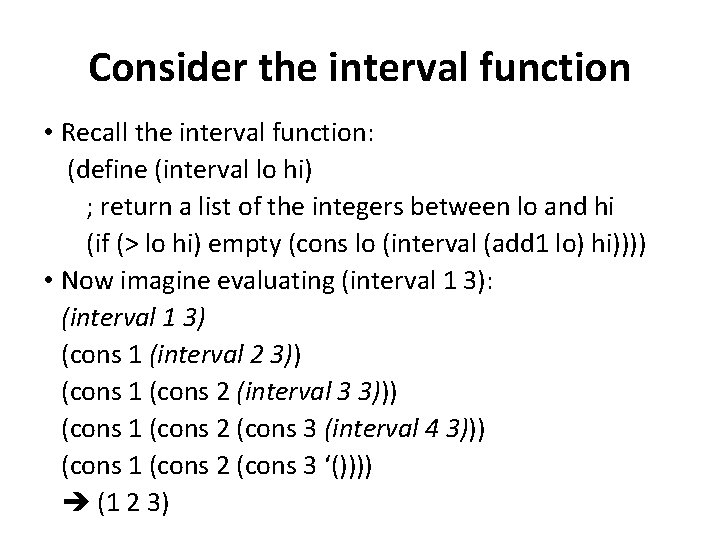
Consider the interval function • Recall the interval function: (define (interval lo hi) ; return a list of the integers between lo and hi (if (> lo hi) empty (cons lo (interval (add 1 lo) hi)))) • Now imagine evaluating (interval 1 3): (interval 1 3) (cons 1 (interval 2 3)) (cons 1 (cons 2 (interval 3 3))) (cons 1 (cons 2 (cons 3 (interval 4 3))) (cons 1 (cons 2 (cons 3 ‘()))) (1 2 3)
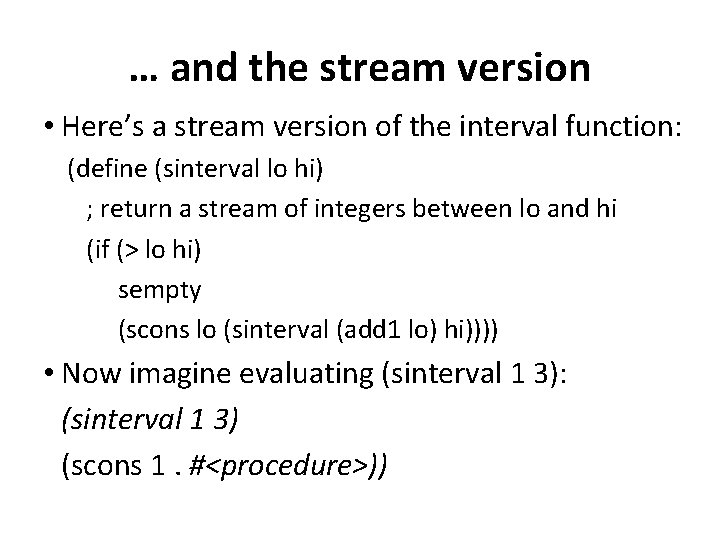
… and the stream version • Here’s a stream version of the interval function: (define (sinterval lo hi) ; return a stream of integers between lo and hi (if (> lo hi) sempty (scons lo (sinterval (add 1 lo) hi)))) • Now imagine evaluating (sinterval 1 3): (sinterval 1 3) (scons 1. #<procedure>))
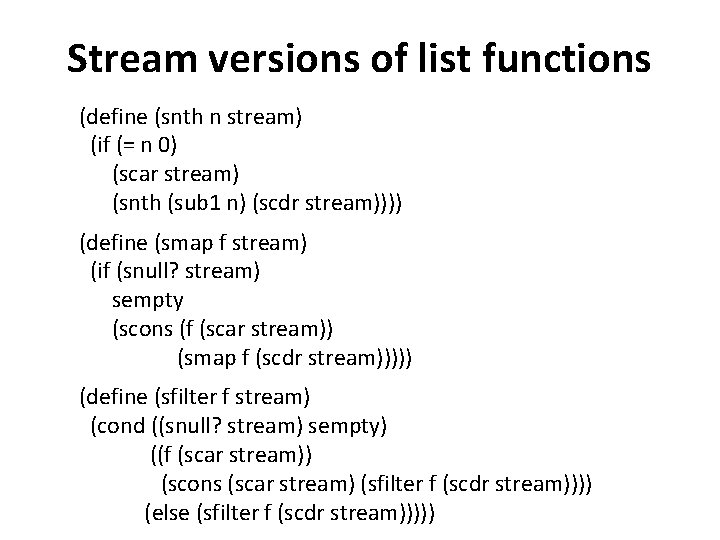
Stream versions of list functions (define (snth n stream) (if (= n 0) (scar stream) (snth (sub 1 n) (scdr stream)))) (define (smap f stream) (if (snull? stream) sempty (scons (f (scar stream)) (smap f (scdr stream))))) (define (sfilter f stream) (cond ((snull? stream) sempty) ((f (scar stream)) (scons (scar stream) (sfilter f (scdr stream)))) (else (sfilter f (scdr stream)))))
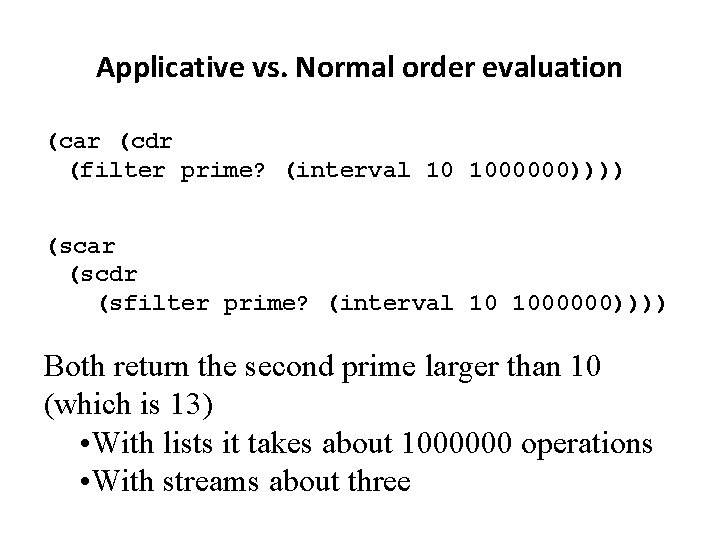
Applicative vs. Normal order evaluation (car (cdr (filter prime? (interval 10 1000000)))) (scar (scdr (sfilter prime? (interval 10 1000000)))) Both return the second prime larger than 10 (which is 13) • With lists it takes about 1000000 operations • With streams about three
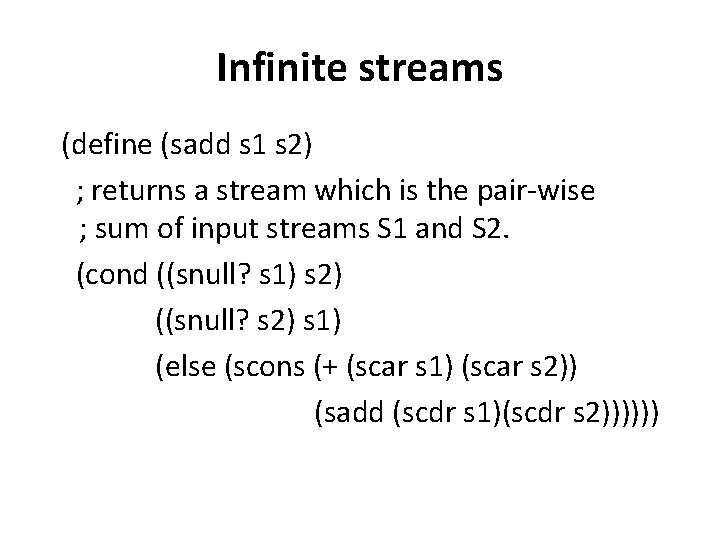
Infinite streams (define (sadd s 1 s 2) ; returns a stream which is the pair-wise ; sum of input streams S 1 and S 2. (cond ((snull? s 1) s 2) ((snull? s 2) s 1) (else (scons (+ (scar s 1) (scar s 2)) (sadd (scdr s 1)(scdr s 2))))))
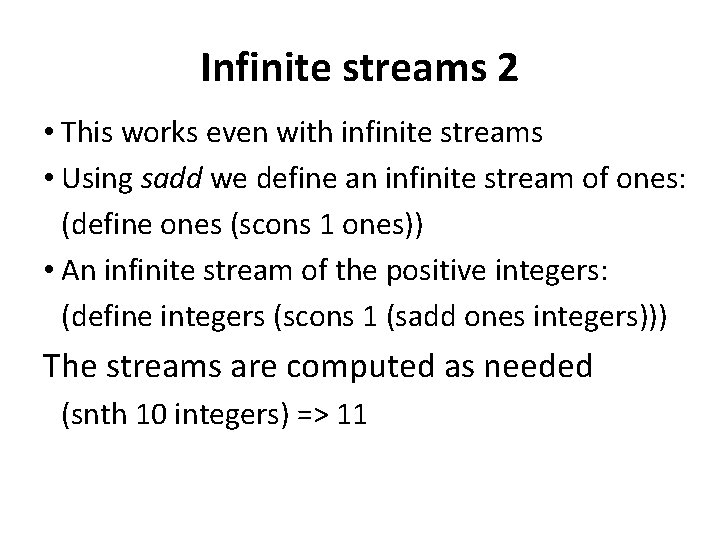
Infinite streams 2 • This works even with infinite streams • Using sadd we define an infinite stream of ones: (define ones (scons 1 ones)) • An infinite stream of the positive integers: (define integers (scons 1 (sadd ones integers))) The streams are computed as needed (snth 10 integers) => 11
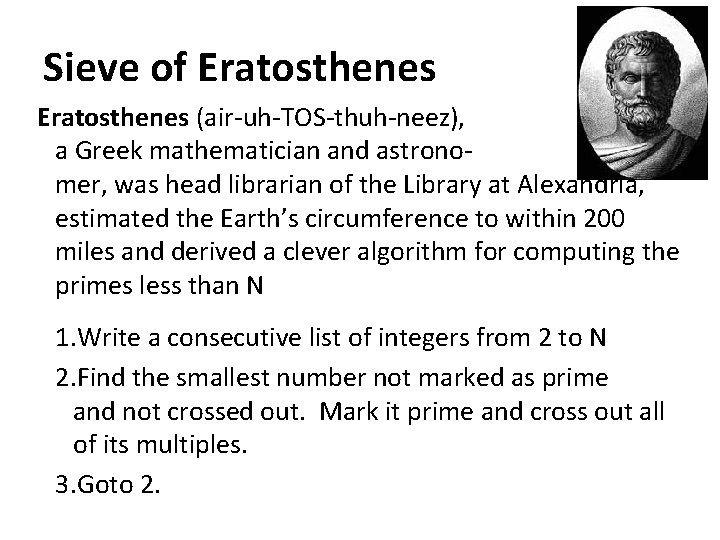
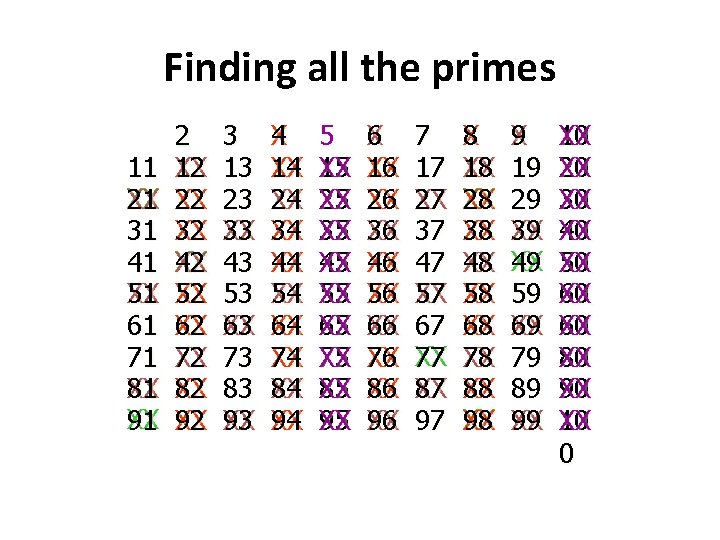
Sieve of Eratosthenes (air-uh-TOS-thuh-neez), a Greek mathematician and astronomer, was head librarian of the Library at Alexandria, estimated the Earth’s circumference to within 200 miles and derived a clever algorithm for computing the primes less than N 1. Write a consecutive list of integers from 2 to N 2. Find the smallest number not marked as prime and not crossed out. Mark it prime and cross out all of its multiples. 3. Goto 2.
Finding all the primes 11 21 XX 31 41 XX 51 61 71 XX 81 XX 91 2 12 XX 22 XX XX 32 XX 42 XX 52 62 XX 72 XX XX 82 XX 92 3 13 23 XX 33 43 53 63 XX 73 83 XX 93 4 X 14 XX 24 XX XX 34 XX 44 XX 54 64 XX 74 XX XX 84 XX 94 5 15 XX 25 XX XX 35 XX 45 XX 55 65 XX 75 XX XX 85 XX 95 X 6 16 XX 26 XX XX 36 XX 46 XX 56 66 XX 76 XX XX 86 XX 96 7 17 27 XX 37 47 XX 57 67 XX 77 XX 87 97 8 X 18 XX 28 XX XX 38 XX 48 XX 58 68 XX 78 XX XX 88 XX 98 X 9 19 29 XX 39 XX 49 59 69 XX 79 89 XX 99 XX 10 20 XX 30 XX XX 40 XX 50 XX 60 60 XX 80 XX XX 90 XX 10 0
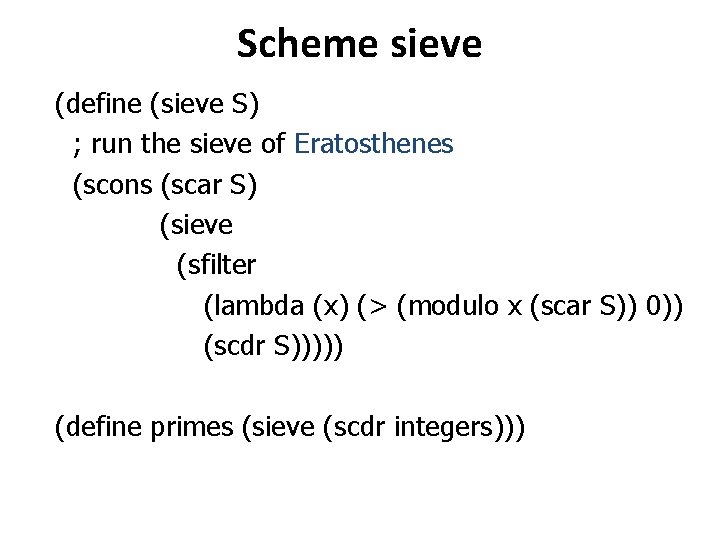
Scheme sieve (define (sieve S) ; run the sieve of Eratosthenes (scons (scar S) (sieve (sfilter (lambda (x) (> (modulo x (scar S)) 0)) (scdr S))))) (define primes (sieve (scdr integers)))
Summary • Scheme’s functional foundation shows its power here • Closures and macros let us define delay and force • Which allows us to handle large, even infinte streams easily • Other languages, including Python, also let us do this