
Lazy Evaluation Infinite data structures set comprehensions CTM
![List Comprehensions in Haskell lc 1 = [(x, y) | x <- [1. .](https://slidetodoc.com/presentation_image_h/0d5a816f5f2c5551071a8b0da6ad2e81/image-32.jpg "List Comprehensions in Haskell lc 1 = [(x, y) | x <- [1. .")
- Slides: 44
Lazy Evaluation: Infinite data structures, set comprehensions (CTM Section 4. 5) Carlos Varela RPI September 22, 2015 Adapted with permission from: Seif Haridi KTH Peter Van Roy UCL C. Varela; Adapted w. permission from S. Haridi and P. Van Roy 1
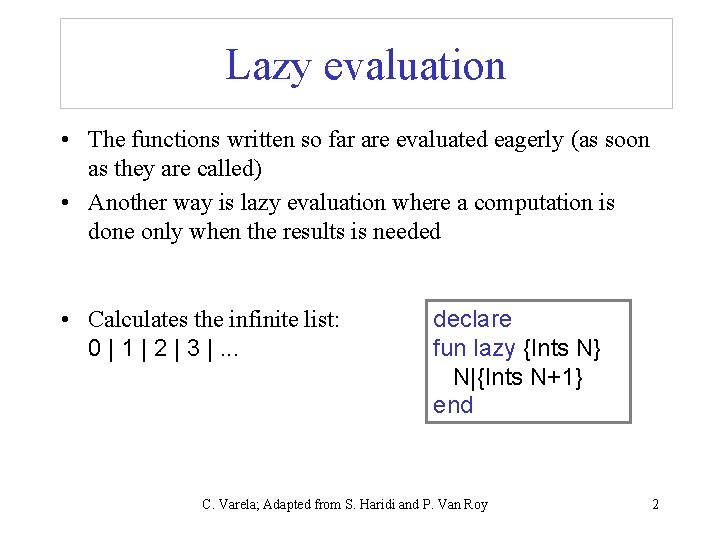
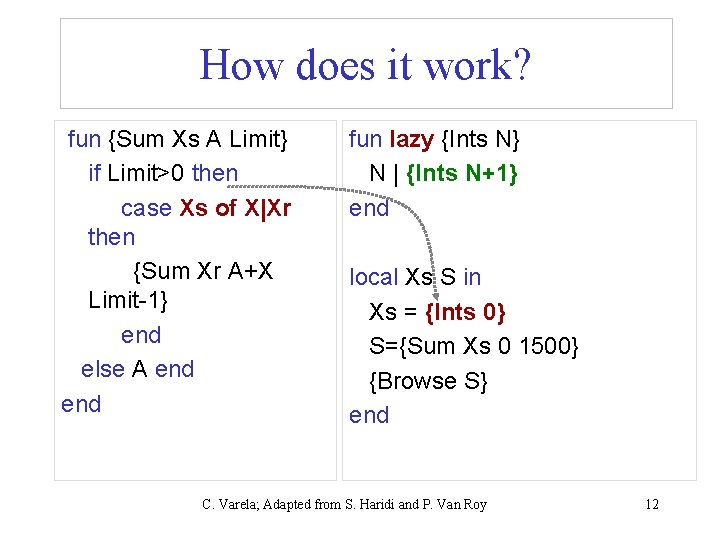
Lazy evaluation • The functions written so far are evaluated eagerly (as soon as they are called) • Another way is lazy evaluation where a computation is done only when the results is needed • Calculates the infinite list: 0 | 1 | 2 | 3 |. . . declare fun lazy {Ints N} N|{Ints N+1} end C. Varela; Adapted from S. Haridi and P. Van Roy 2
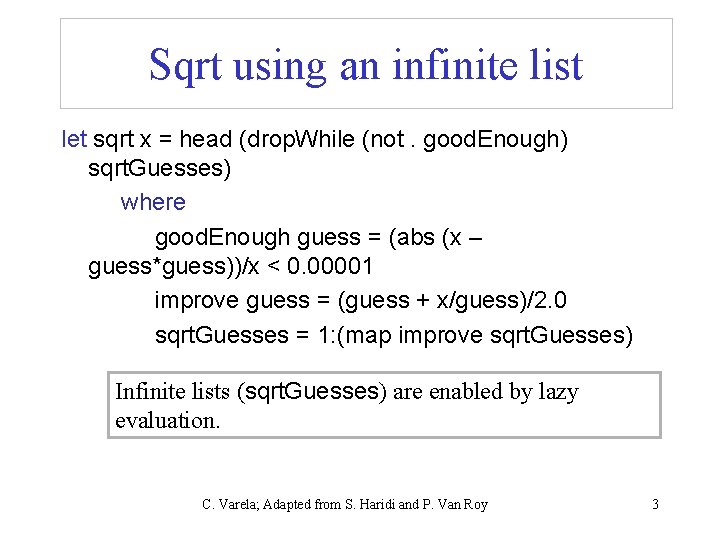
Sqrt using an infinite list let sqrt x = head (drop. While (not. good. Enough) sqrt. Guesses) where good. Enough guess = (abs (x – guess*guess))/x < 0. 00001 improve guess = (guess + x/guess)/2. 0 sqrt. Guesses = 1: (map improve sqrt. Guesses) Infinite lists (sqrt. Guesses) are enabled by lazy evaluation. C. Varela; Adapted from S. Haridi and P. Van Roy 3
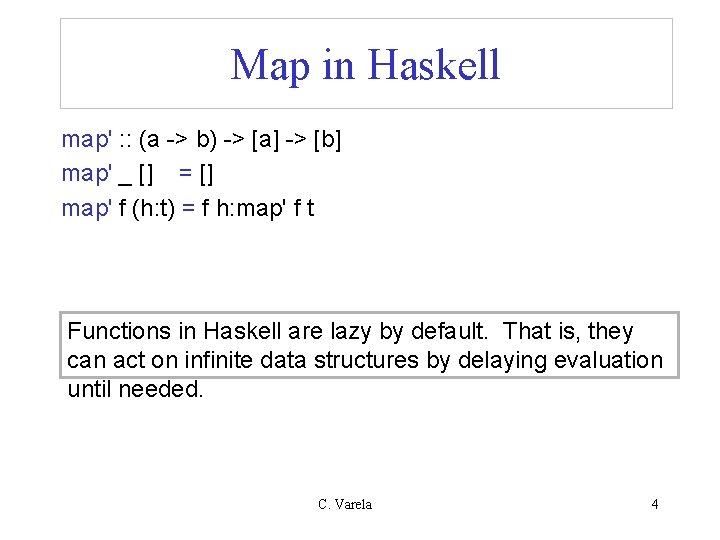
Map in Haskell map' : : (a -> b) -> [a] -> [b] map' _ [] = [] map' f (h: t) = f h: map' f t Functions in Haskell are lazy by default. That is, they can act on infinite data structures by delaying evaluation until needed. C. Varela 4
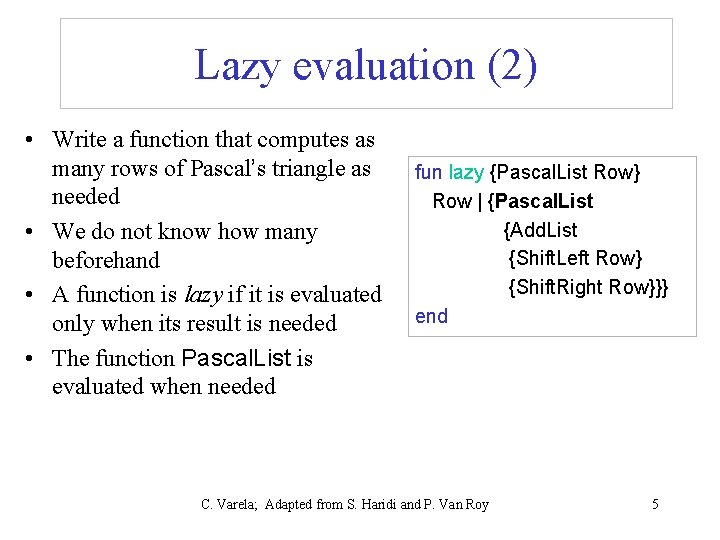
Lazy evaluation (2) • Write a function that computes as many rows of Pascal’s triangle as needed • We do not know how many beforehand • A function is lazy if it is evaluated only when its result is needed • The function Pascal. List is evaluated when needed fun lazy {Pascal. List Row} Row | {Pascal. List {Add. List {Shift. Left Row} {Shift. Right Row}}} end C. Varela; Adapted from S. Haridi and P. Van Roy 5
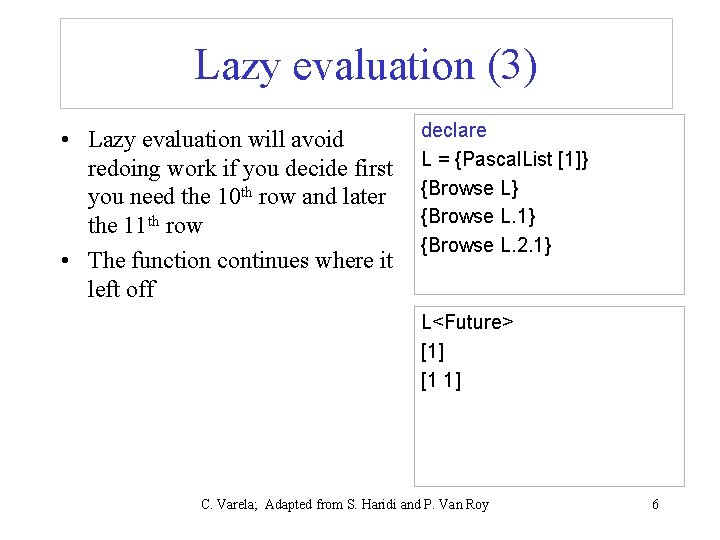
Lazy evaluation (3) • Lazy evaluation will avoid redoing work if you decide first you need the 10 th row and later the 11 th row • The function continues where it left off declare L = {Pascal. List [1]} {Browse L. 1} {Browse L. 2. 1} L<Future> [1] [1 1] C. Varela; Adapted from S. Haridi and P. Van Roy 6
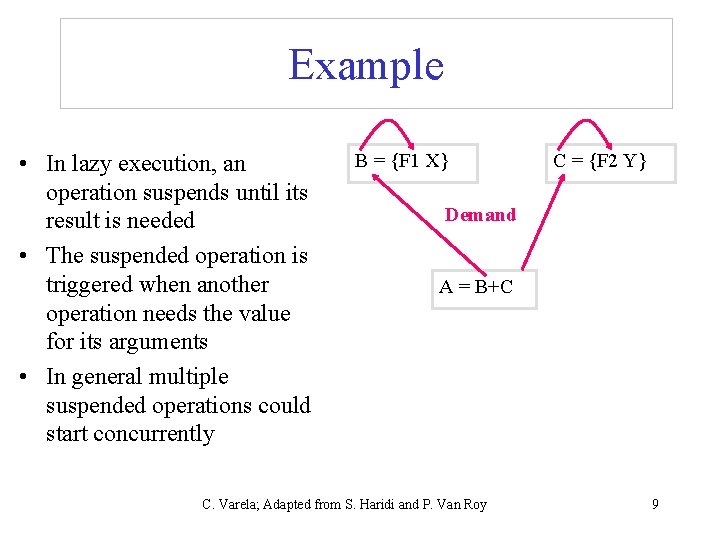
Lazy execution • Without lazyness, the execution order of each thread follows textual order, i. e. , when a statement comes as the first in a sequence it will execute, whether or not its results are needed later • This execution scheme is called eager execution, or supplydriven execution • Another execution order is that a statement is executed only if its results are needed somewhere in the program • This scheme is called lazy evaluation, or demand-driven evaluation (some languages use lazy evaluation by default, e. g. , Haskell) C. Varela; Adapted from S. Haridi and P. Van Roy 7
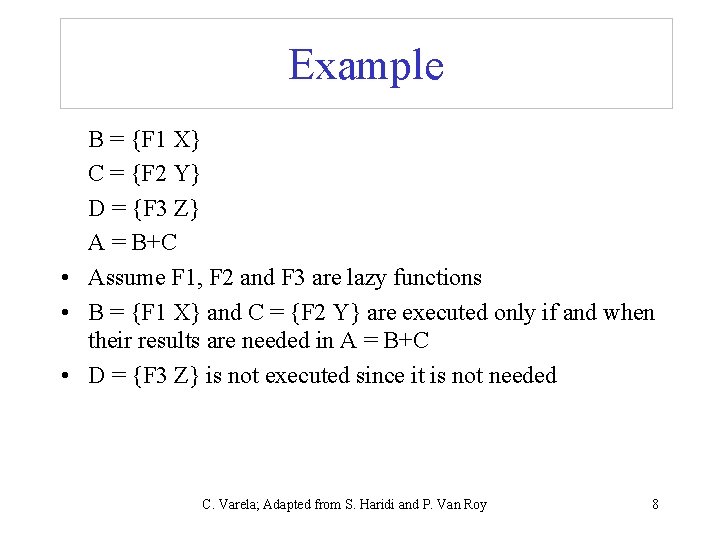
Example B = {F 1 X} C = {F 2 Y} D = {F 3 Z} A = B+C • Assume F 1, F 2 and F 3 are lazy functions • B = {F 1 X} and C = {F 2 Y} are executed only if and when their results are needed in A = B+C • D = {F 3 Z} is not executed since it is not needed C. Varela; Adapted from S. Haridi and P. Van Roy 8
Example • In lazy execution, an operation suspends until its result is needed • The suspended operation is triggered when another operation needs the value for its arguments • In general multiple suspended operations could start concurrently B = {F 1 X} C = {F 2 Y} Demand A = B+C C. Varela; Adapted from S. Haridi and P. Van Roy 9
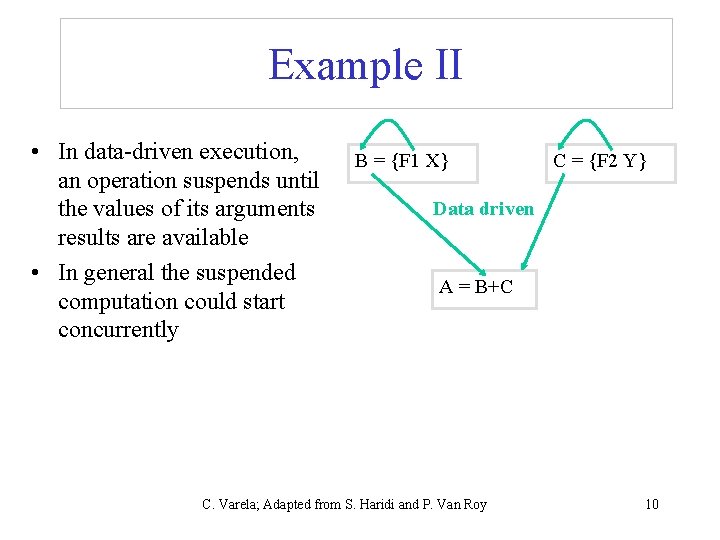
Example II • In data-driven execution, an operation suspends until the values of its arguments results are available • In general the suspended computation could start concurrently B = {F 1 X} C = {F 2 Y} Data driven A = B+C C. Varela; Adapted from S. Haridi and P. Van Roy 10
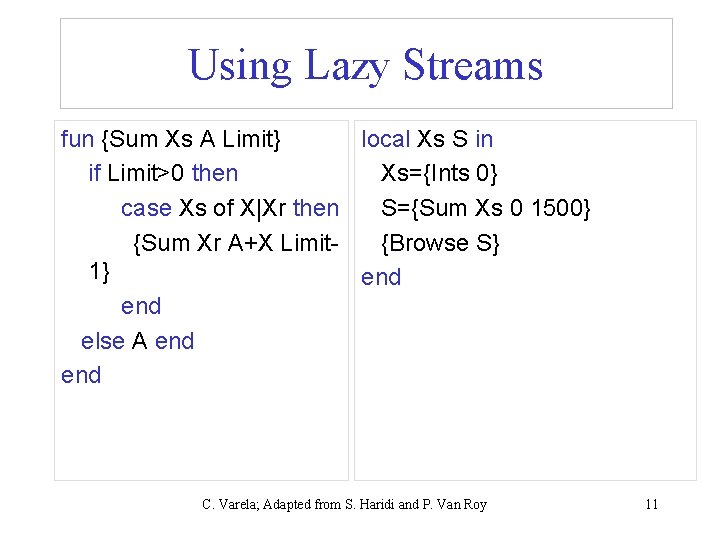
Using Lazy Streams fun {Sum Xs A Limit} local Xs S in if Limit>0 then Xs={Ints 0} case Xs of X|Xr then S={Sum Xs 0 1500} {Sum Xr A+X Limit{Browse S} 1} end else A end C. Varela; Adapted from S. Haridi and P. Van Roy 11
How does it work? fun {Sum Xs A Limit} if Limit>0 then case Xs of X|Xr then {Sum Xr A+X Limit-1} end else A end fun lazy {Ints N} N | {Ints N+1} end local Xs S in Xs = {Ints 0} S={Sum Xs 0 1500} {Browse S} end C. Varela; Adapted from S. Haridi and P. Van Roy 12
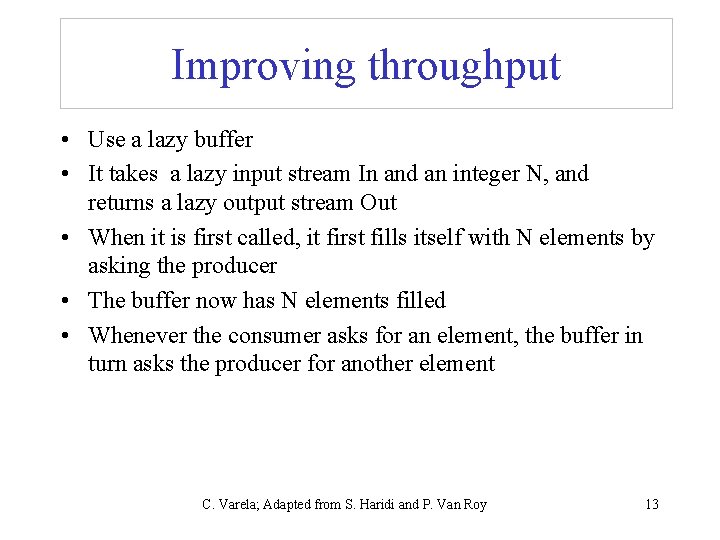
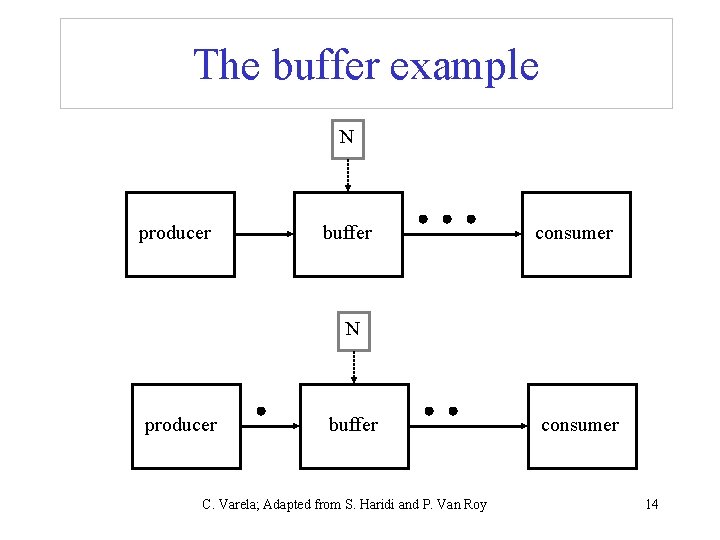
Improving throughput • Use a lazy buffer • It takes a lazy input stream In and an integer N, and returns a lazy output stream Out • When it is first called, it first fills itself with N elements by asking the producer • The buffer now has N elements filled • Whenever the consumer asks for an element, the buffer in turn asks the producer for another element C. Varela; Adapted from S. Haridi and P. Van Roy 13
The buffer example N producer buffer consumer N producer buffer C. Varela; Adapted from S. Haridi and P. Van Roy consumer 14
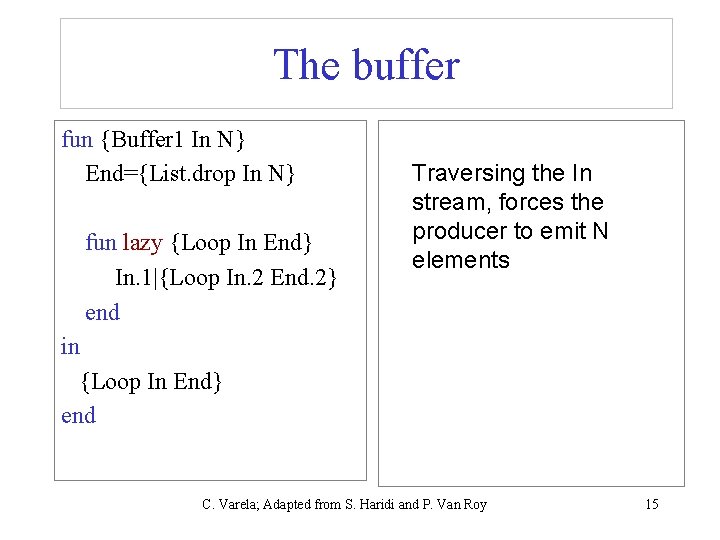
The buffer fun {Buffer 1 In N} End={List. drop In N} fun lazy {Loop In End} In. 1|{Loop In. 2 End. 2} end Traversing the In stream, forces the producer to emit N elements in {Loop In End} end C. Varela; Adapted from S. Haridi and P. Van Roy 15
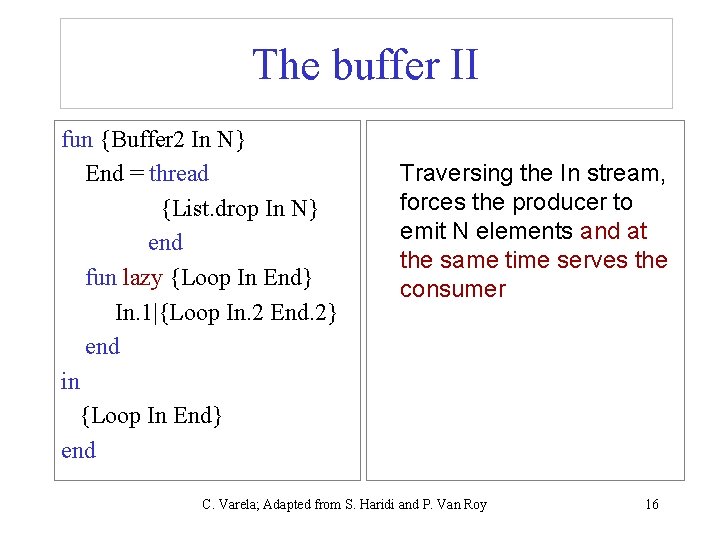
The buffer II fun {Buffer 2 In N} End = thread {List. drop In N} end fun lazy {Loop In End} In. 1|{Loop In. 2 End. 2} end in {Loop In End} end Traversing the In stream, forces the producer to emit N elements and at the same time serves the consumer C. Varela; Adapted from S. Haridi and P. Van Roy 16
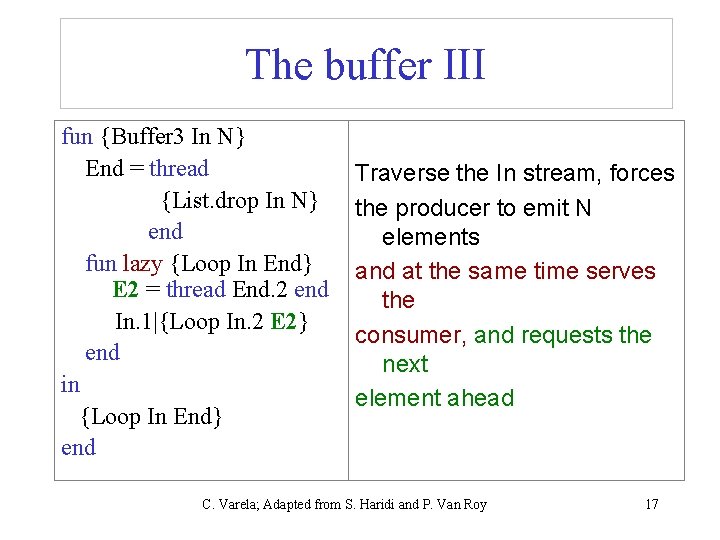
The buffer III fun {Buffer 3 In N} End = thread {List. drop In N} end fun lazy {Loop In End} E 2 = thread End. 2 end In. 1|{Loop In. 2 E 2} end in {Loop In End} end Traverse the In stream, forces the producer to emit N elements and at the same time serves the consumer, and requests the next element ahead C. Varela; Adapted from S. Haridi and P. Van Roy 17
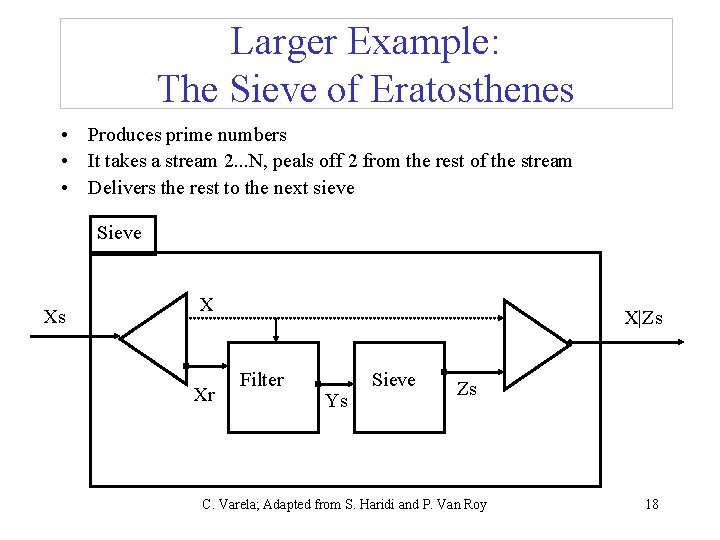
Larger Example: The Sieve of Eratosthenes • Produces prime numbers • It takes a stream 2. . . N, peals off 2 from the rest of the stream • Delivers the rest to the next sieve Sieve Xs X Xr X|Zs Filter Ys Sieve Zs C. Varela; Adapted from S. Haridi and P. Van Roy 18
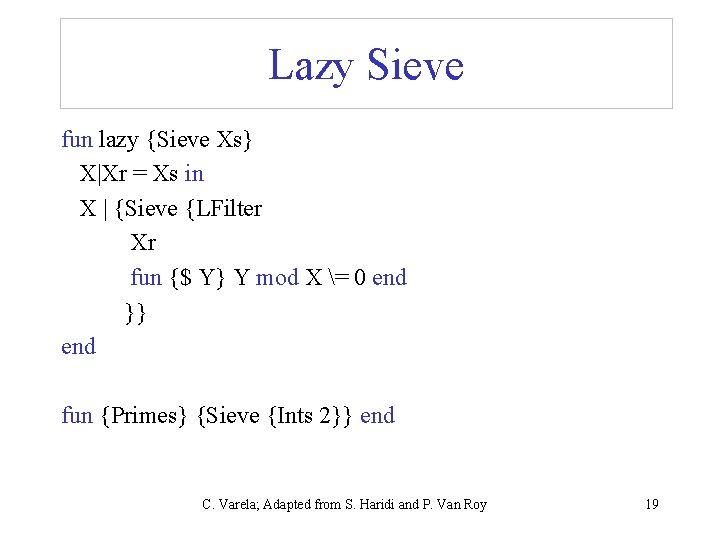
Lazy Sieve fun lazy {Sieve Xs} X|Xr = Xs in X | {Sieve {LFilter Xr fun {$ Y} Y mod X = 0 end }} end fun {Primes} {Sieve {Ints 2}} end C. Varela; Adapted from S. Haridi and P. Van Roy 19
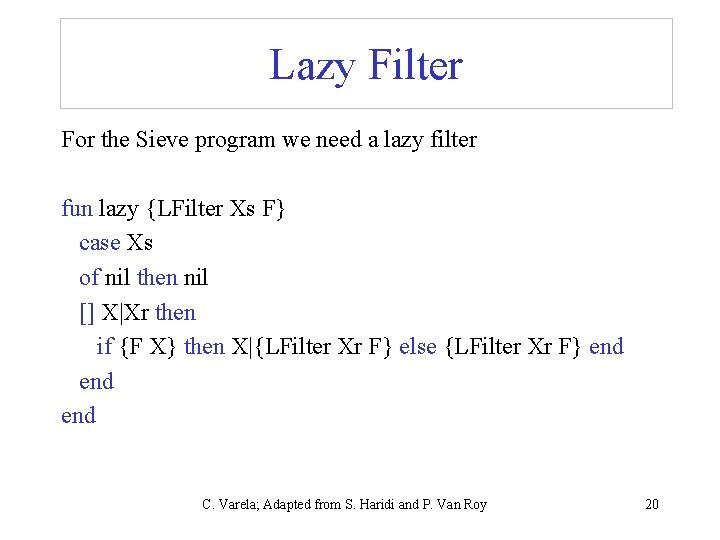
Lazy Filter For the Sieve program we need a lazy filter fun lazy {LFilter Xs F} case Xs of nil then nil [] X|Xr then if {F X} then X|{LFilter Xr F} else {LFilter Xr F} end end C. Varela; Adapted from S. Haridi and P. Van Roy 20
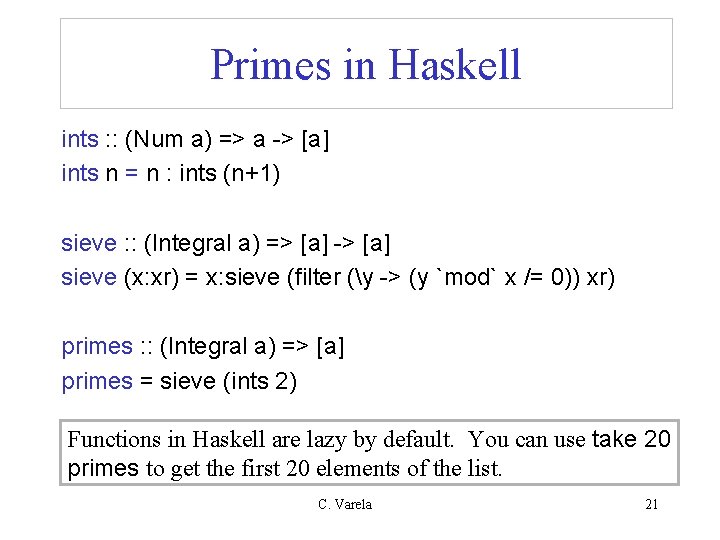
Primes in Haskell ints : : (Num a) => a -> [a] ints n = n : ints (n+1) sieve : : (Integral a) => [a] -> [a] sieve (x: xr) = x: sieve (filter (y -> (y `mod` x /= 0)) xr) primes : : (Integral a) => [a] primes = sieve (ints 2) Functions in Haskell are lazy by default. You can use take 20 primes to get the first 20 elements of the list. C. Varela 21
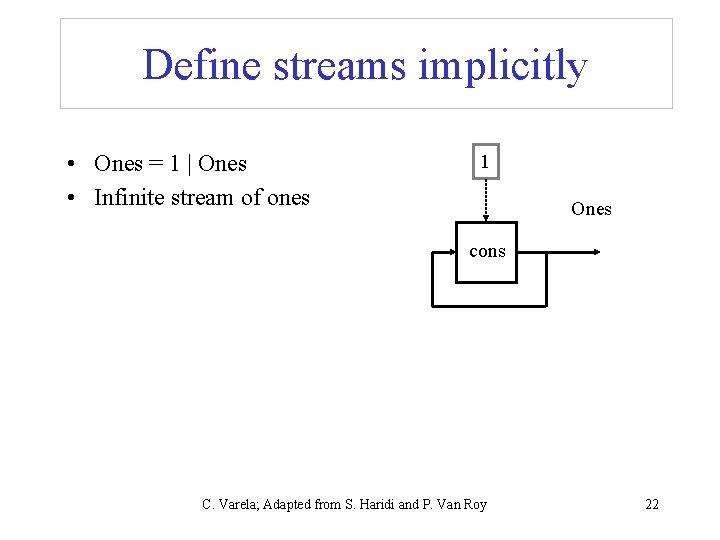
Define streams implicitly • Ones = 1 | Ones • Infinite stream of ones 1 Ones cons C. Varela; Adapted from S. Haridi and P. Van Roy 22
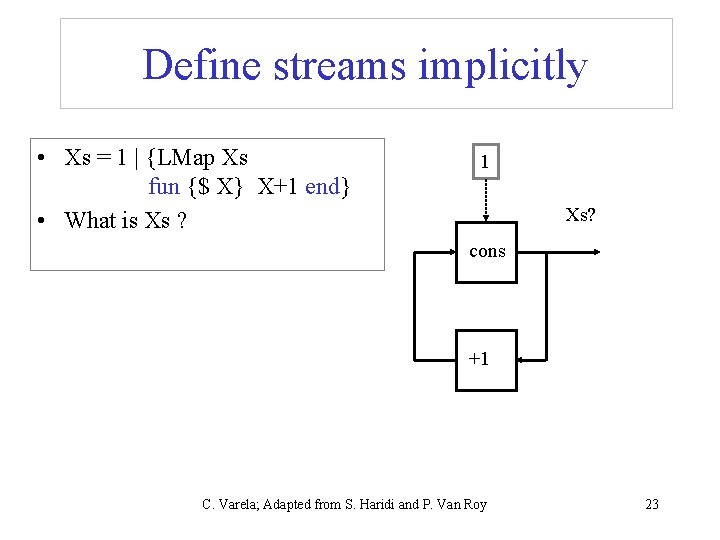
Define streams implicitly • Xs = 1 | {LMap Xs fun {$ X} X+1 end} • What is Xs ? 1 Xs? cons +1 C. Varela; Adapted from S. Haridi and P. Van Roy 23
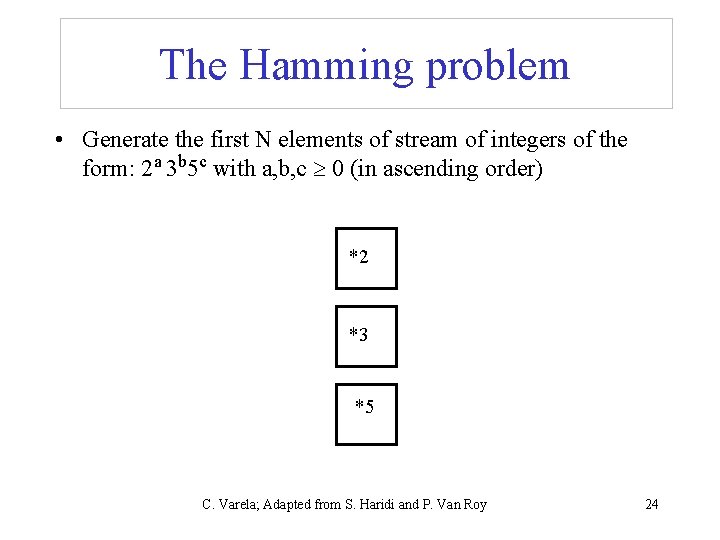
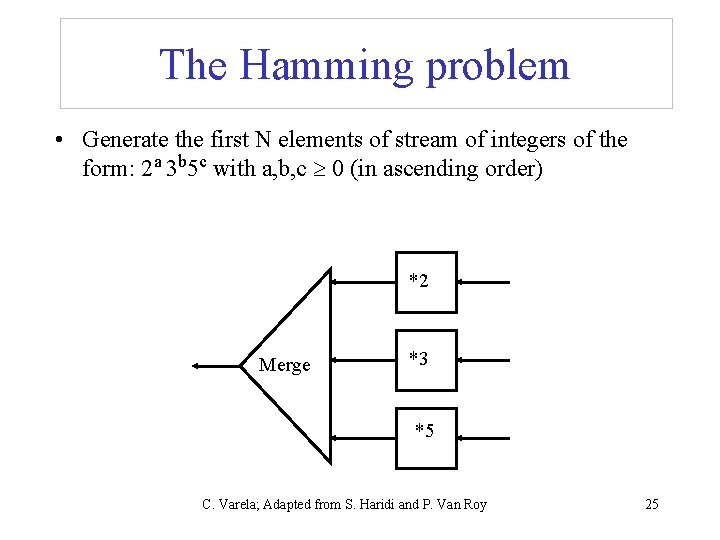
The Hamming problem • Generate the first N elements of stream of integers of the form: 2 a 3 b 5 c with a, b, c 0 (in ascending order) *2 *3 *5 C. Varela; Adapted from S. Haridi and P. Van Roy 24
The Hamming problem • Generate the first N elements of stream of integers of the form: 2 a 3 b 5 c with a, b, c 0 (in ascending order) *2 Merge *3 *5 C. Varela; Adapted from S. Haridi and P. Van Roy 25
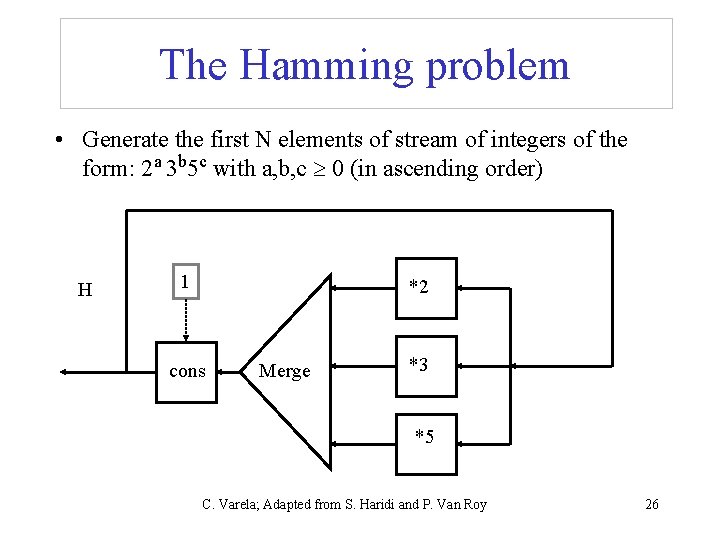
The Hamming problem • Generate the first N elements of stream of integers of the form: 2 a 3 b 5 c with a, b, c 0 (in ascending order) H 1 *2 cons Merge *3 *5 C. Varela; Adapted from S. Haridi and P. Van Roy 26
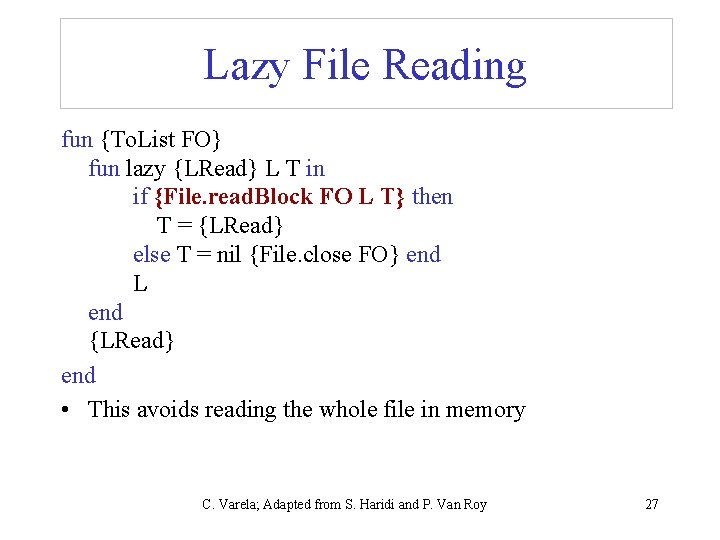
Lazy File Reading fun {To. List FO} fun lazy {LRead} L T in if {File. read. Block FO L T} then T = {LRead} else T = nil {File. close FO} end L end {LRead} end • This avoids reading the whole file in memory C. Varela; Adapted from S. Haridi and P. Van Roy 27
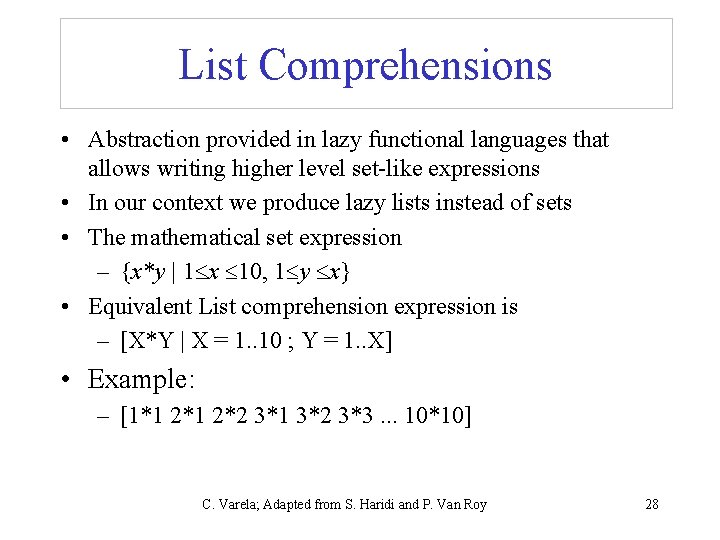
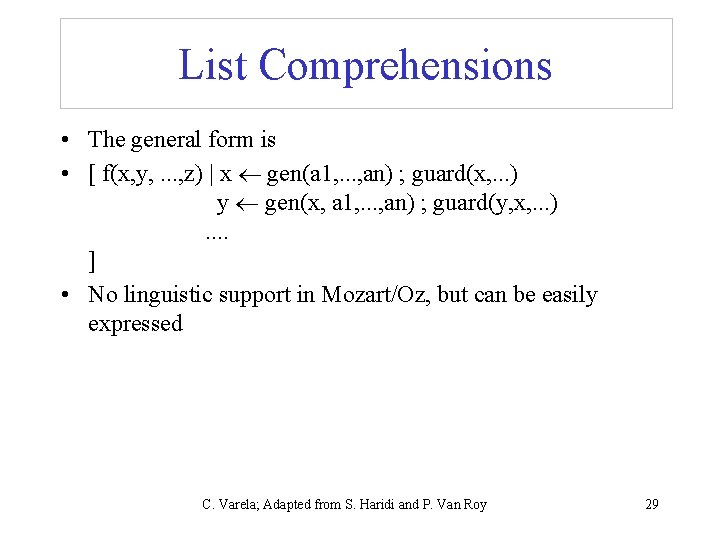
List Comprehensions • Abstraction provided in lazy functional languages that allows writing higher level set-like expressions • In our context we produce lazy lists instead of sets • The mathematical set expression – {x*y | 1 x 10, 1 y x} • Equivalent List comprehension expression is – [X*Y | X = 1. . 10 ; Y = 1. . X] • Example: – [1*1 2*2 3*1 3*2 3*3. . . 10*10] C. Varela; Adapted from S. Haridi and P. Van Roy 28
List Comprehensions • The general form is • [ f(x, y, . . . , z) | x gen(a 1, . . . , an) ; guard(x, . . . ) y gen(x, a 1, . . . , an) ; guard(y, x, . . . ). . ] • No linguistic support in Mozart/Oz, but can be easily expressed C. Varela; Adapted from S. Haridi and P. Van Roy 29
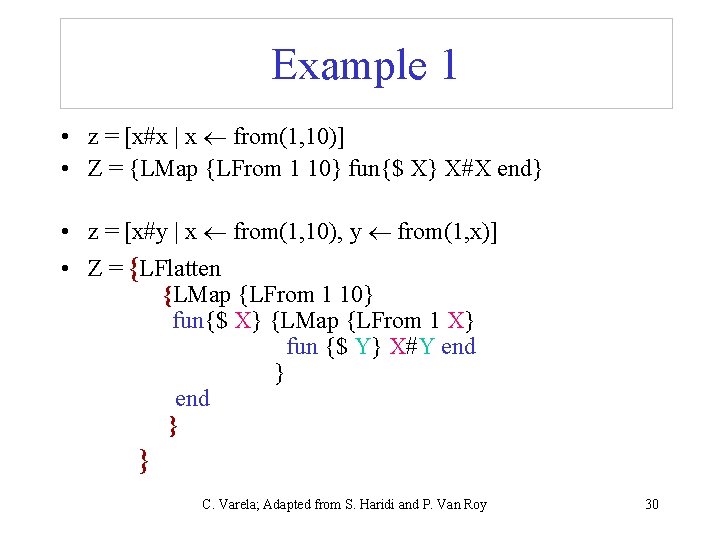
Example 1 • z = [x#x | x from(1, 10)] • Z = {LMap {LFrom 1 10} fun{$ X} X#X end} • z = [x#y | x from(1, 10), y from(1, x)] • Z = {LFlatten {LMap {LFrom 1 10} fun{$ X} {LMap {LFrom 1 X} fun {$ Y} X#Y end } } C. Varela; Adapted from S. Haridi and P. Van Roy 30
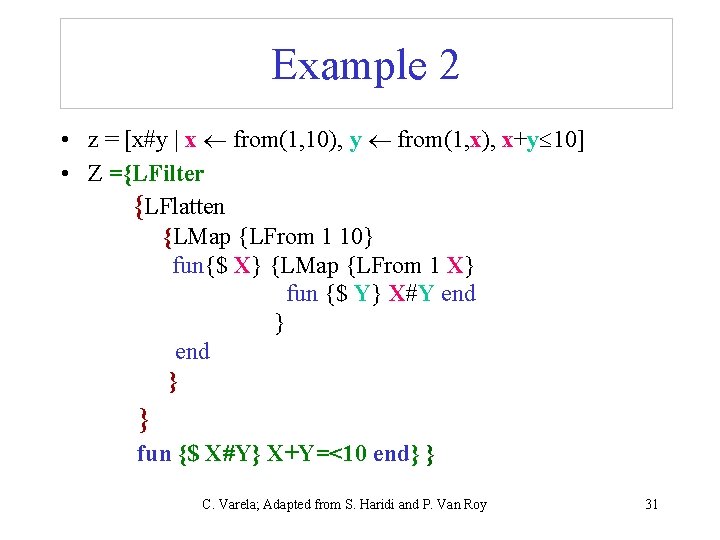
Example 2 • z = [x#y | x from(1, 10), y from(1, x), x+y 10] • Z ={LFilter {LFlatten {LMap {LFrom 1 10} fun{$ X} {LMap {LFrom 1 X} fun {$ Y} X#Y end } } fun {$ X#Y} X+Y=<10 end} } C. Varela; Adapted from S. Haridi and P. Van Roy 31
List Comprehensions in Haskell lc 1 = [(x, y) | x <- [1. . 10], y <- [1. . x]] lc 2 = filter ((x, y)->(x+y<=10)) lc 1 lc 3 = [(x, y) | x <- [1. . 10], y <- [1. . x], x+y<= 10] Haskell provides syntactic support for list comprehensions. List comprehensions are implemented using a built-in list monad. C. Varela 32
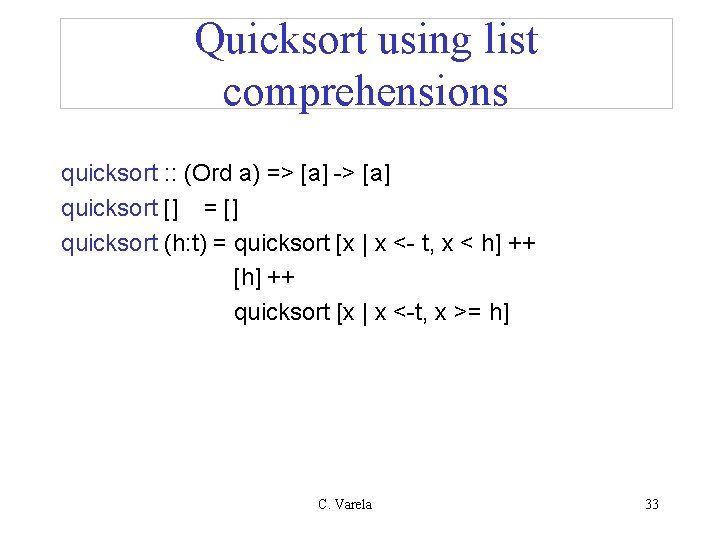
Quicksort using list comprehensions quicksort : : (Ord a) => [a] -> [a] quicksort [] = [] quicksort (h: t) = quicksort [x | x <- t, x < h] ++ [h] ++ quicksort [x | x <-t, x >= h] C. Varela 33
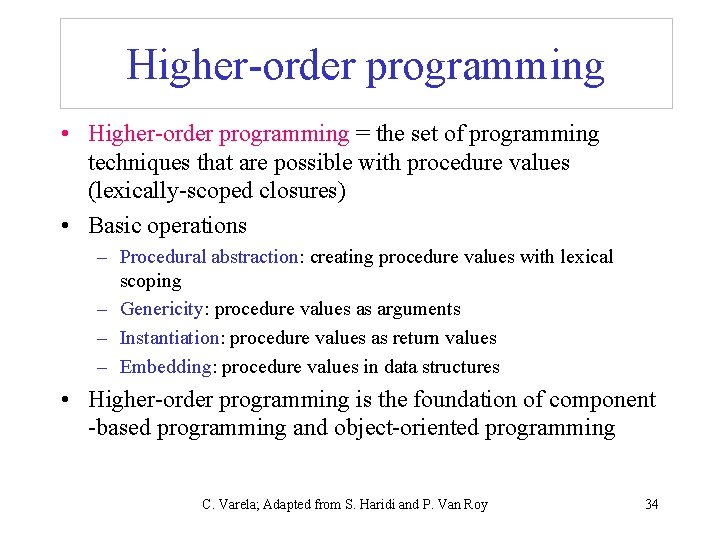
Higher-order programming • Higher-order programming = the set of programming techniques that are possible with procedure values (lexically-scoped closures) • Basic operations – Procedural abstraction: creating procedure values with lexical scoping – Genericity: procedure values as arguments – Instantiation: procedure values as return values – Embedding: procedure values in data structures • Higher-order programming is the foundation of component -based programming and object-oriented programming C. Varela; Adapted from S. Haridi and P. Van Roy 34
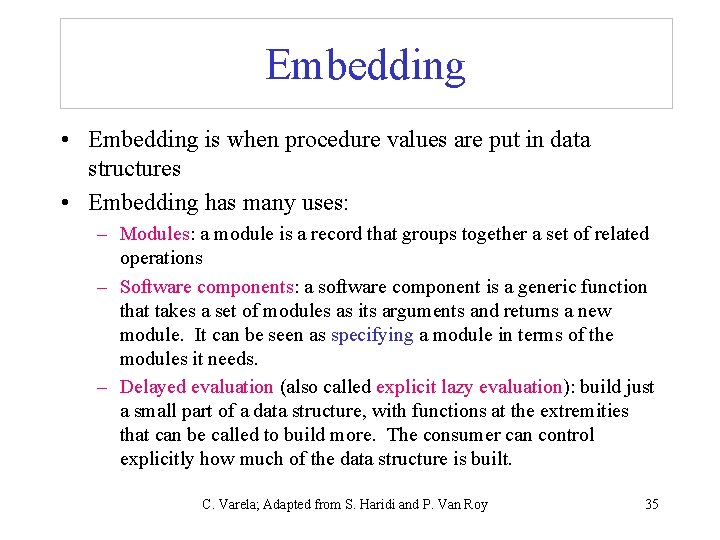
Embedding • Embedding is when procedure values are put in data structures • Embedding has many uses: – Modules: a module is a record that groups together a set of related operations – Software components: a software component is a generic function that takes a set of modules as its arguments and returns a new module. It can be seen as specifying a module in terms of the modules it needs. – Delayed evaluation (also called explicit lazy evaluation): build just a small part of a data structure, with functions at the extremities that can be called to build more. The consumer can control explicitly how much of the data structure is built. C. Varela; Adapted from S. Haridi and P. Van Roy 35
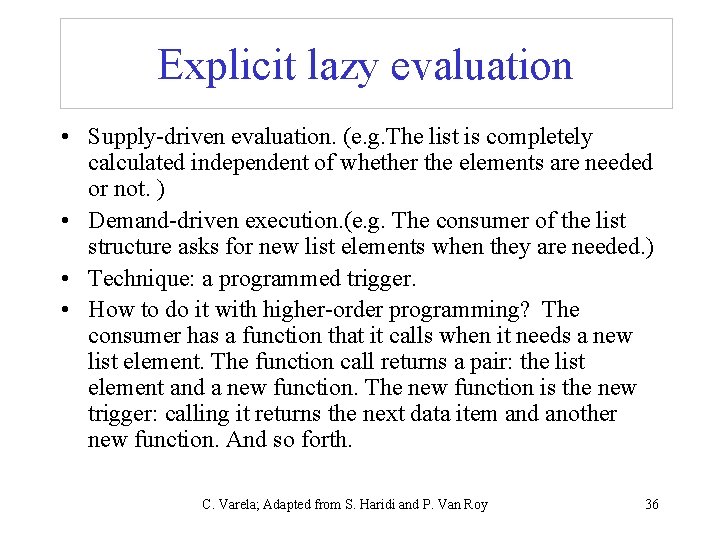
Explicit lazy evaluation • Supply-driven evaluation. (e. g. The list is completely calculated independent of whether the elements are needed or not. ) • Demand-driven execution. (e. g. The consumer of the list structure asks for new list elements when they are needed. ) • Technique: a programmed trigger. • How to do it with higher-order programming? The consumer has a function that it calls when it needs a new list element. The function call returns a pair: the list element and a new function. The new function is the new trigger: calling it returns the next data item and another new function. And so forth. C. Varela; Adapted from S. Haridi and P. Van Roy 36
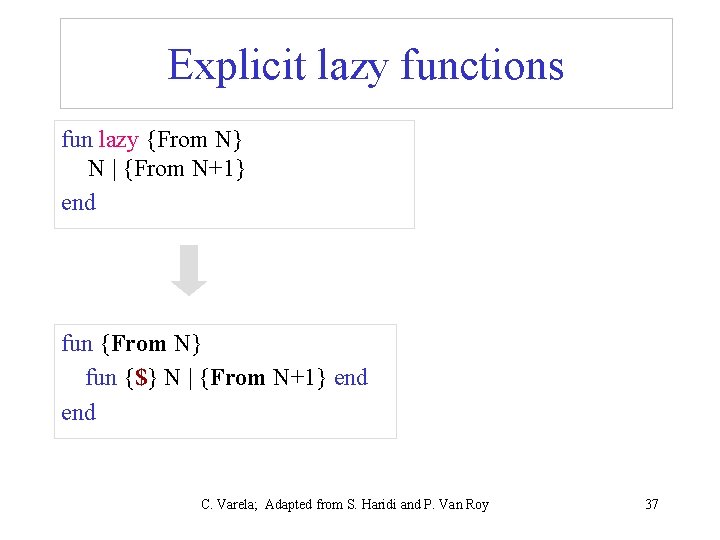
Explicit lazy functions fun lazy {From N} N | {From N+1} end fun {From N} fun {$} N | {From N+1} end C. Varela; Adapted from S. Haridi and P. Van Roy 37
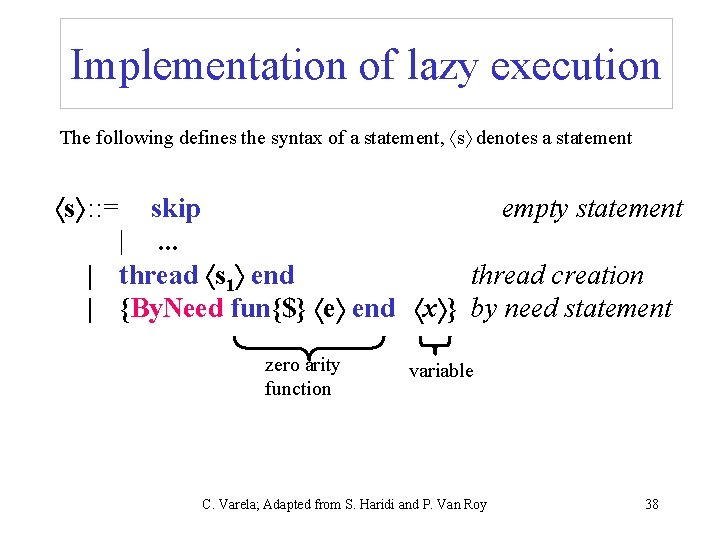
Implementation of lazy execution The following defines the syntax of a statement, s denotes a statement s : : = skip empty statement |. . . | thread s 1 end thread creation | {By. Need fun{$} e end x } by need statement zero arity function variable C. Varela; Adapted from S. Haridi and P. Van Roy 38
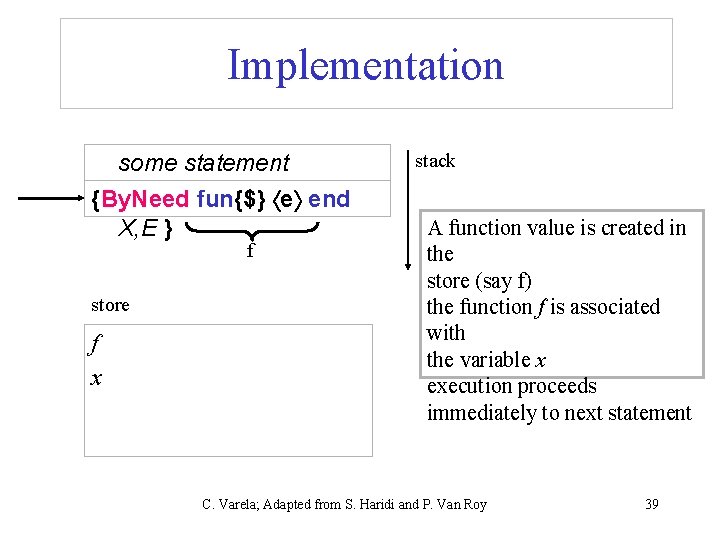
Implementation some statement {By. Need fun{$} e end X, E } f store f x stack A function value is created in the store (say f) the function f is associated with the variable x execution proceeds immediately to next statement C. Varela; Adapted from S. Haridi and P. Van Roy 39
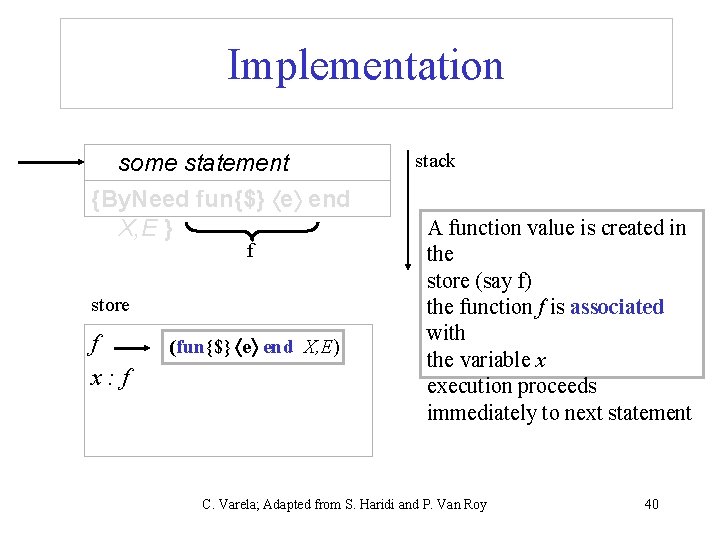
Implementation some statement {By. Need fun{$} e end X, E } f store f x: f (fun{$} e end X, E) stack A function value is created in the store (say f) the function f is associated with the variable x execution proceeds immediately to next statement C. Varela; Adapted from S. Haridi and P. Van Roy 40
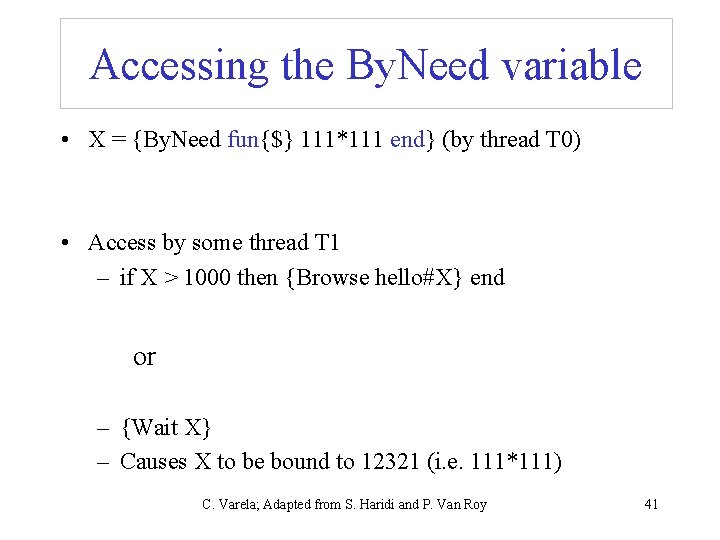
Accessing the By. Need variable • X = {By. Need fun{$} 111*111 end} (by thread T 0) • Access by some thread T 1 – if X > 1000 then {Browse hello#X} end or – {Wait X} – Causes X to be bound to 12321 (i. e. 111*111) C. Varela; Adapted from S. Haridi and P. Van Roy 41
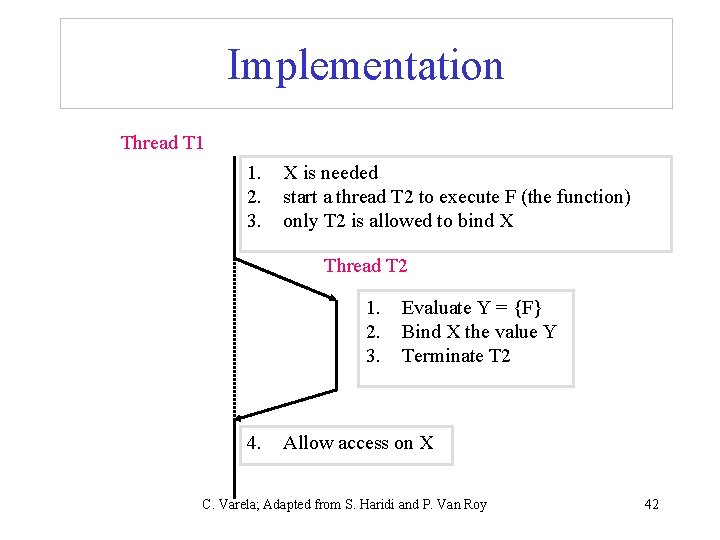
Implementation Thread T 1 1. 2. 3. X is needed start a thread T 2 to execute F (the function) only T 2 is allowed to bind X Thread T 2 1. 2. 3. 4. Evaluate Y = {F} Bind X the value Y Terminate T 2 Allow access on X C. Varela; Adapted from S. Haridi and P. Van Roy 42
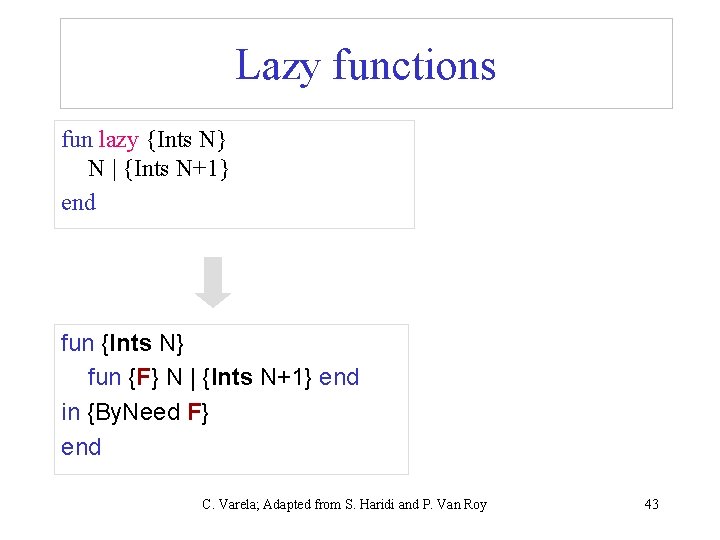
Lazy functions fun lazy {Ints N} N | {Ints N+1} end fun {Ints N} fun {F} N | {Ints N+1} end in {By. Need F} end C. Varela; Adapted from S. Haridi and P. Van Roy 43
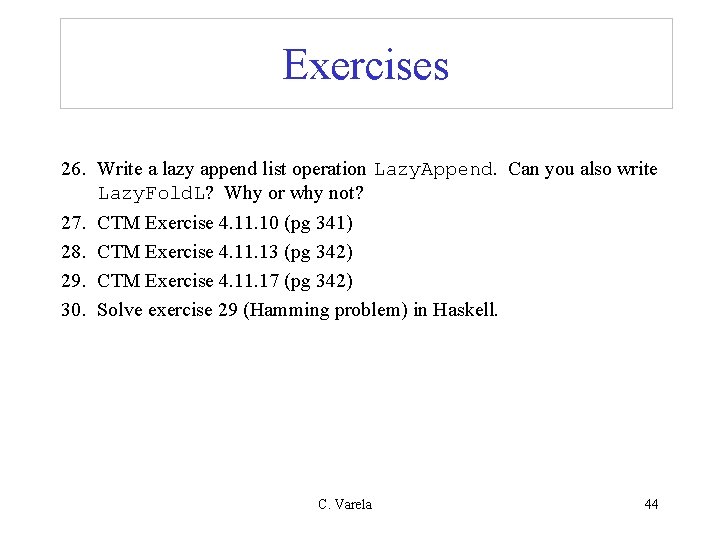
Exercises 26. Write a lazy append list operation Lazy. Append. Can you also write Lazy. Fold. L? Why or why not? 27. CTM Exercise 4. 11. 10 (pg 341) 28. CTM Exercise 4. 11. 13 (pg 342) 29. CTM Exercise 4. 11. 17 (pg 342) 30. Solve exercise 29 (Hamming problem) in Haskell. C. Varela 44