
Once there were brook trout in the streams
Once there were brook trout in the streams in the mountains. You could see them standing in the amber current where the white edges of their fins wimpled softly in the flow. They smelled of moss in your hand. Polished and muscular and torsional. On their backs were vermiculate patterns that were maps of the world in its becoming. Maps and mazes. Of a thing which could not be put back. Not be made right again. In the deep glens where they lived all things were older than man and they hummed of mystery. From “The Road” (2006) by Cormac Mc. Carthy Winner of the Pulitzer Prize
Why Ecological Restoration?
Why Ecological Restoration?
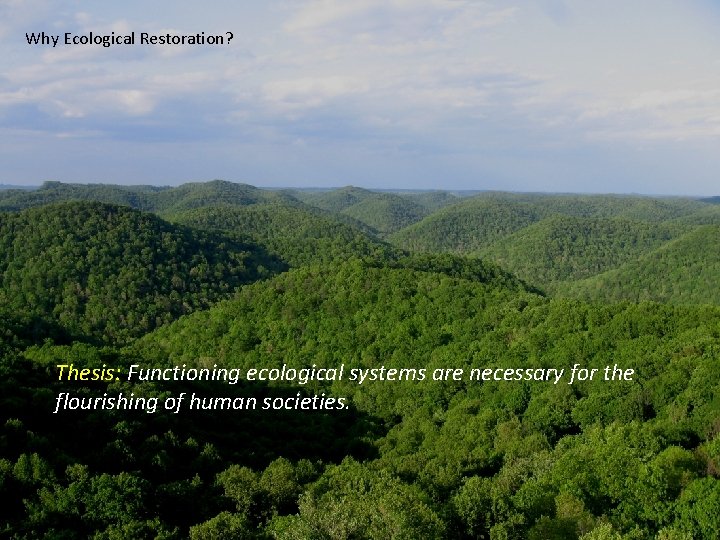
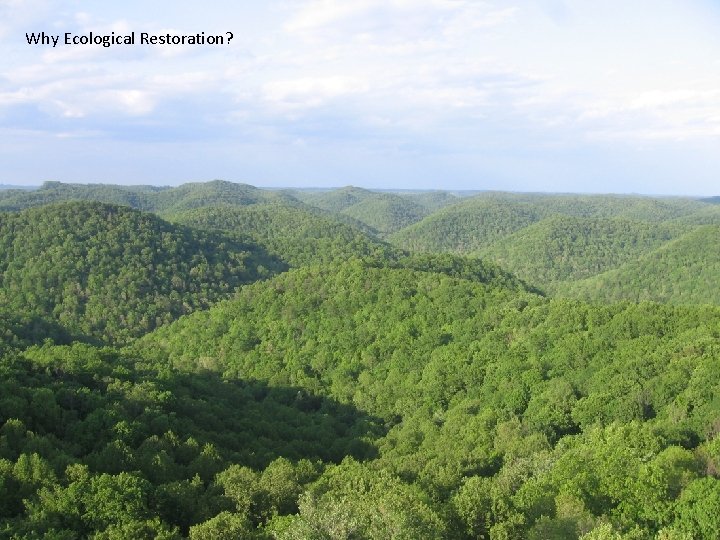
Why Ecological Restoration? Thesis: Functioning ecological systems are necessary for the flourishing of human societies.
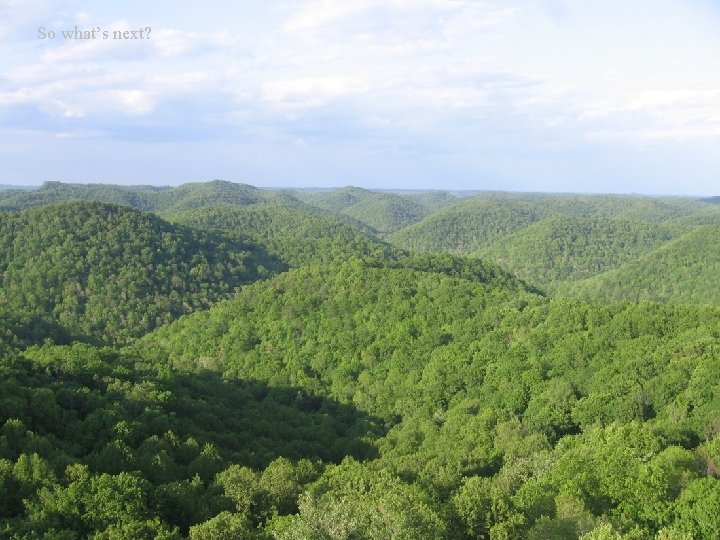
So what’s next?
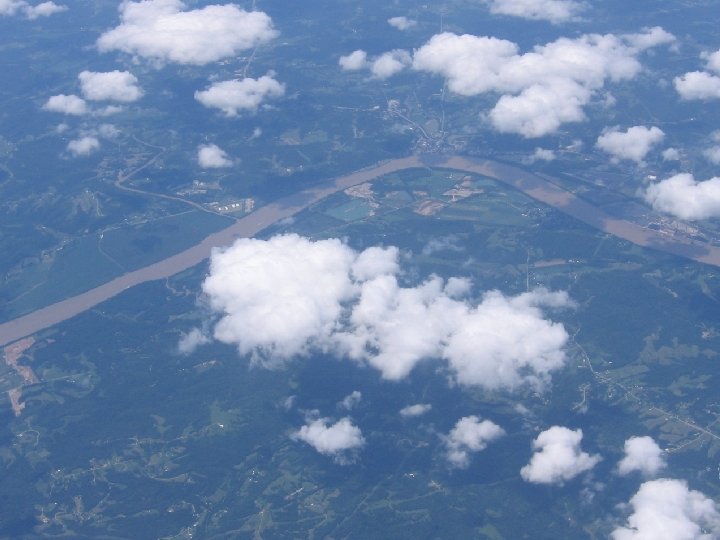
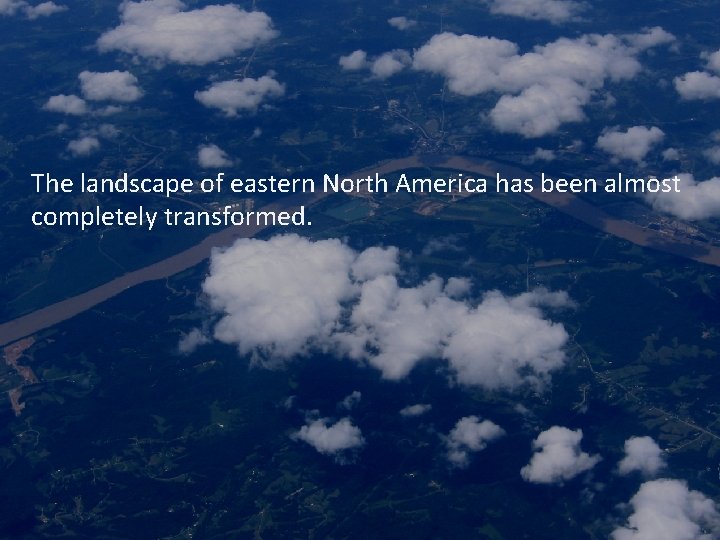
The landscape of eastern North America has been almost completely transformed.
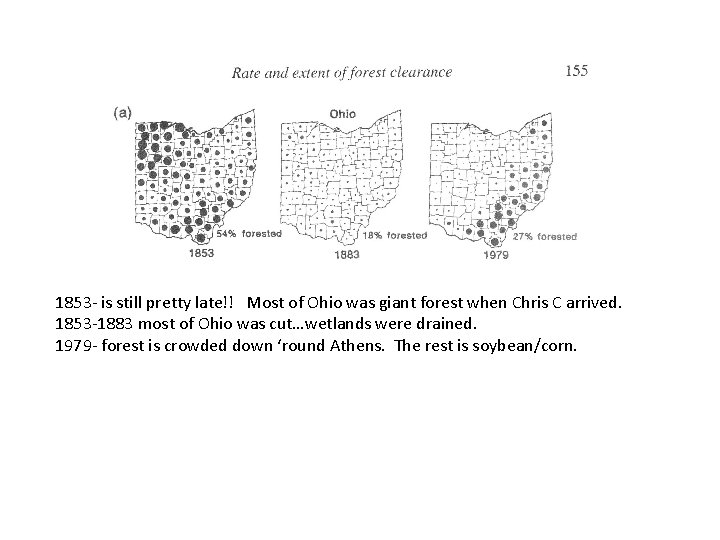
1853 - is still pretty late!! Most of Ohio was giant forest when Chris C arrived. 1853 -1883 most of Ohio was cut…wetlands were drained. 1979 - forest is crowded down ‘round Athens. The rest is soybean/corn.
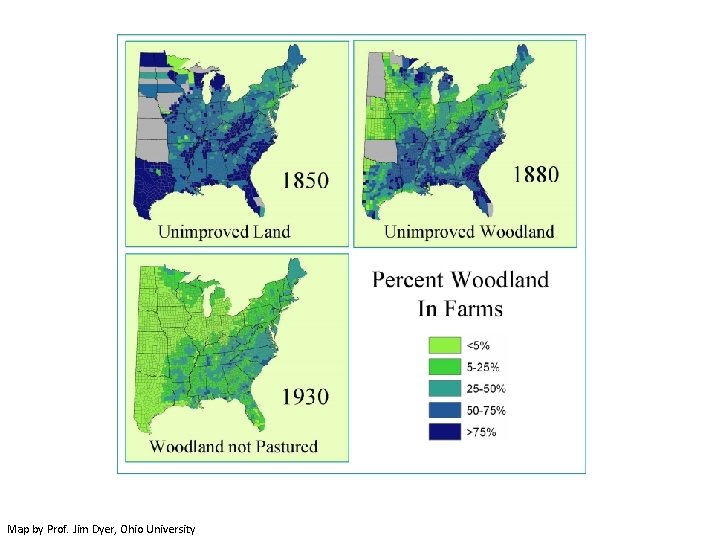
Map by Prof. Jim Dyer, Ohio University
e landscape of eastern North America has been almost completely transfor eed, there is virtually no square centimeter on Earth that has not been in s influenced by anthropogenic processes, in many cases these exceed the ogical and evolutionary “boundaries” of these systems, leaving them in mbles. we accept the argument that ecological systems are essential to the flourish uman societies, then we would logically find this level of disrepair cceptable. en the most conservative approach would seek a an “ecological bulwark” of ctioning ecosystems in an ever-changing world. th most systems in disrepair how to proceed?
cience of ecology has sub-divided into several disciplinary approaches to d he “crisis. ” nservation Biology. As a discipline is focused on who is left, and how do w eserve them. But in practice , this field has also focused on re-introductions rticularly of predators and/or endangered species. storation Ecology. The scientific study of restoring ecosystems. Focused swering questions in ecology, developing theory to inform science, and the e field. ological Restoration. The practice of restoring ecosystems. Field sed…outcomes are ecological not necessarily scientific. conciliation Ecology. A new idea. Holds that we will never succeed in pres d lands sufficient to preserve the systems we should be preserving- so wha lly need is to figure out how to incorporate wildlands into human dominat
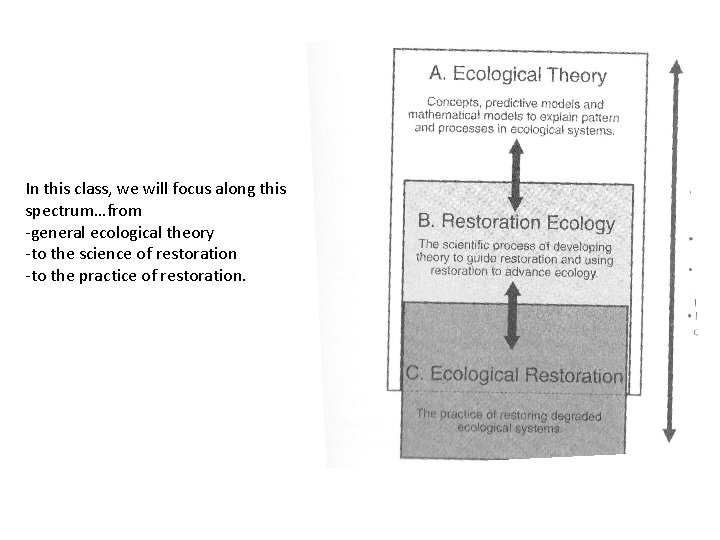
In this class, we will focus along this spectrum…from -general ecological theory -to the science of restoration -to the practice of restoration.
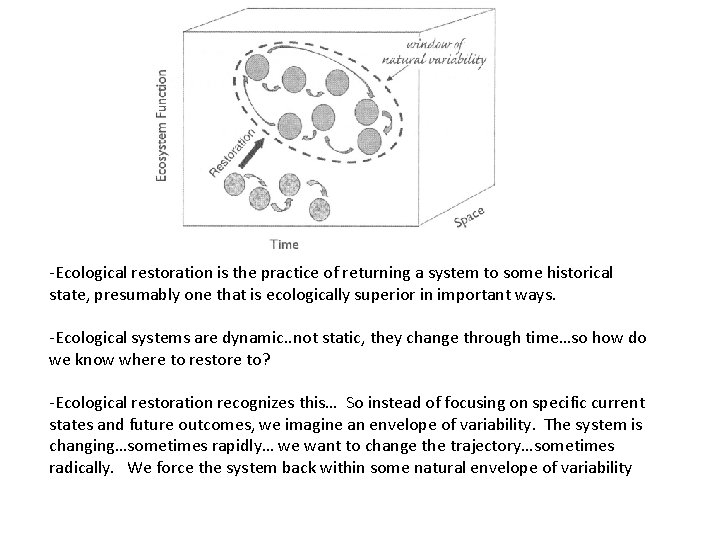
-Ecological restoration is the practice of returning a system to some historical state, presumably one that is ecologically superior in important ways. -Ecological systems are dynamic. . not static, they change through time…so how do we know where to restore to? -Ecological restoration recognizes this… So instead of focusing on specific current states and future outcomes, we imagine an envelope of variability. The system is changing…sometimes rapidly… we want to change the trajectory…sometimes radically. We force the system back within some natural envelope of variability
- Slides: 13