Steganography Archana Sapkota Deepti Reddy 1 CS 691

- Slides: 28
Steganography -Archana Sapkota -Deepti Reddy 1 CS 691 Summer 2009
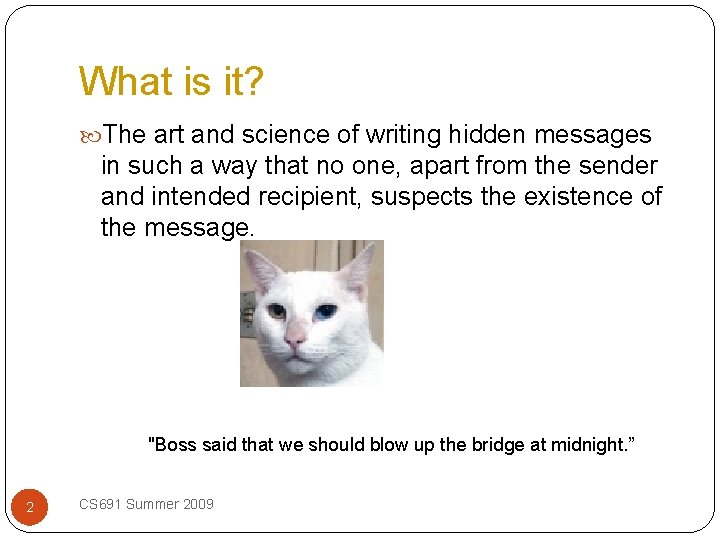
What is it? The art and science of writing hidden messages in such a way that no one, apart from the sender and intended recipient, suspects the existence of the message. "Boss said that we should blow up the bridge at midnight. ” 2 CS 691 Summer 2009
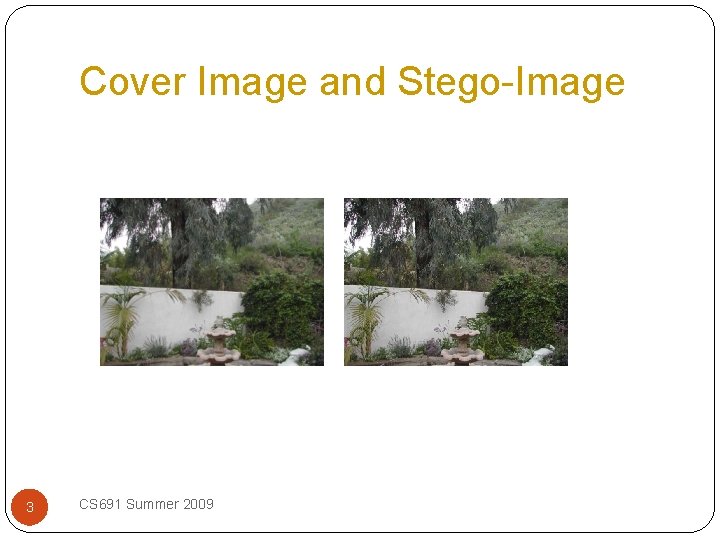
Cover Image and Stego-Image 3 CS 691 Summer 2009
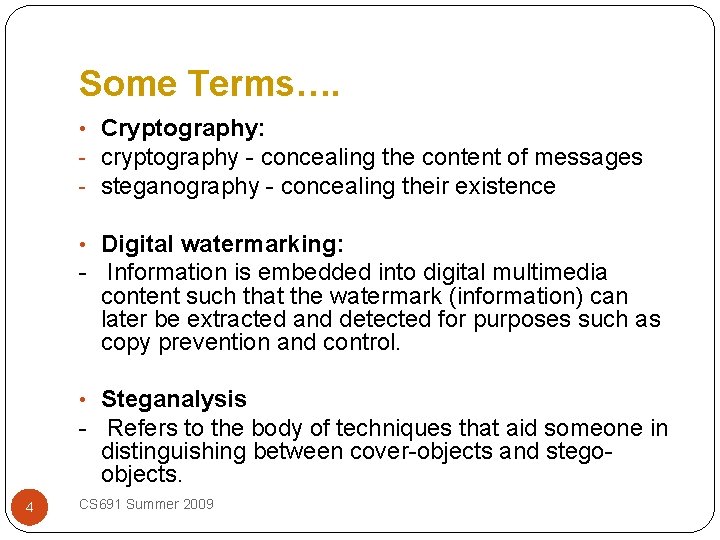
Some Terms…. • Cryptography: - cryptography - concealing the content of messages - steganography - concealing their existence • Digital watermarking: - Information is embedded into digital multimedia content such that the watermark (information) can later be extracted and detected for purposes such as copy prevention and control. • Steganalysis - Refers to the body of techniques that aid someone in distinguishing between cover-objects and stegoobjects. 4 CS 691 Summer 2009
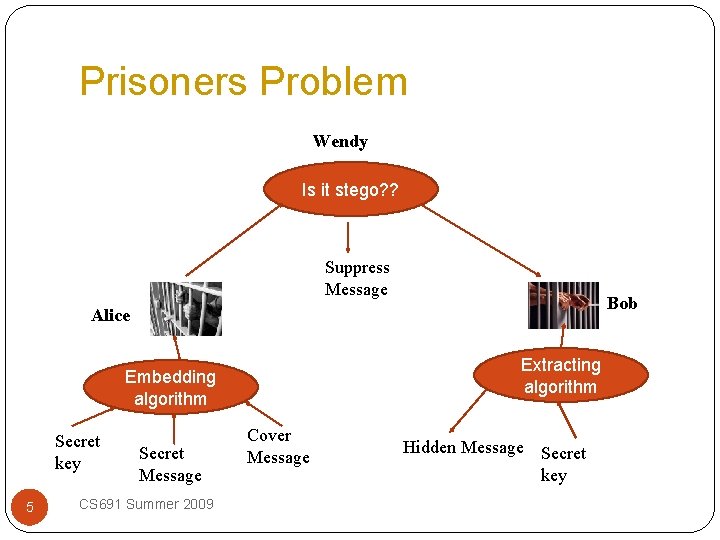
Prisoners Problem Wendy Is it stego? ? Suppress Message Bob Alice Extracting algorithm Embedding algorithm Secret key 5 Secret Message CS 691 Summer 2009 Cover Message Hidden Message Secret key
Some examples from past. . Message tattooed on a slave’s shaved head. Al Qaida might have used it for 9/11. Use of invisible ink. Writing on wooden surface before applying wax in wax table. 6 CS 691 Summer 2009
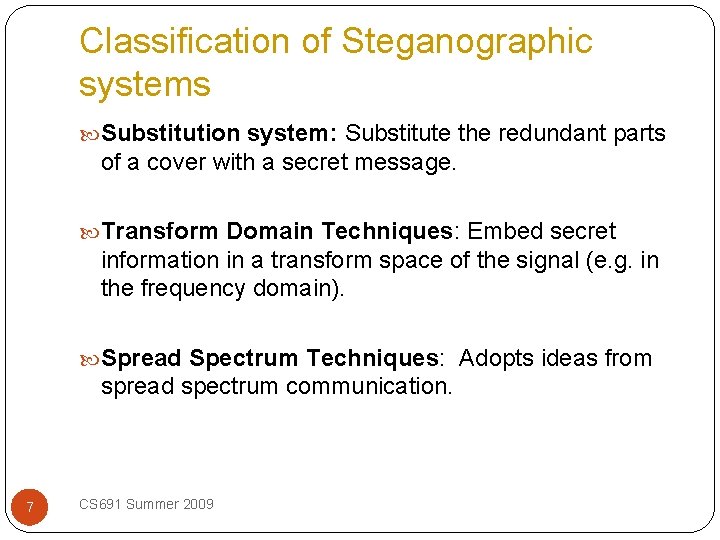
Classification of Steganographic systems Substitution system: Substitute the redundant parts of a cover with a secret message. Transform Domain Techniques: Embed secret information in a transform space of the signal (e. g. in the frequency domain). Spread Spectrum Techniques: Adopts ideas from spread spectrum communication. 7 CS 691 Summer 2009
Classification of Steganographic systems Statistical Methods: Encode information by changing several statistical properties and a cover and use hypothesis testing in the extraction process. Distortion Techniques: Store information by signal distortion and measure the deviation from the original signal in the decoding step. Cover generation method: Encode information in the way a cover for secret communication is created. 8 CS 691 Summer 2009
Secure Steganographic System Kerckhoffs’principle: The embedding algorithm is supposed to be known to the public. Therefore, the embedding process may use an embedding key so that only the legal user can successfully extract the embedded data by using the corresponding extraction key in the extraction process. 9 CS 691 Summer 2009
Least Significant Bit Substitution � Embedding process: - Choose a subset of cover elements - Exchange LSB of each element by 0 or 1 - Another approach is to use a 2 -bit LSB � Extraction process: - Extract LSB of each cover element (either 1 or 2 -bit) - Line them up to reconstruct secret message � Receiver must know the sequence of element indices used in the embedding process. 10 CS 691 Summer 2009
Problems with LSB substitution A strong assumption of a passive attacker that the small changes in the carrier are noticed. The main problem with this is the part of the image in which the information is embedded has different statistical properties than the rest of the image. Most image hiding techniques use uncompressed (BMP) or lossless (GIF) cover images but take a lot of transmission bandwidth and storage space. 11 CS 691 Summer 2009
LSB substitution Pseudorandom- Slightly Better Approach: - Use pseudorandom number generator - Spread secret message over the cover in a random manner - Distance between two embedded bits is determined pseudorandomly - Receiver should be aware of the seed and knowledge of the number generator 12 CS 691 Summer 2009
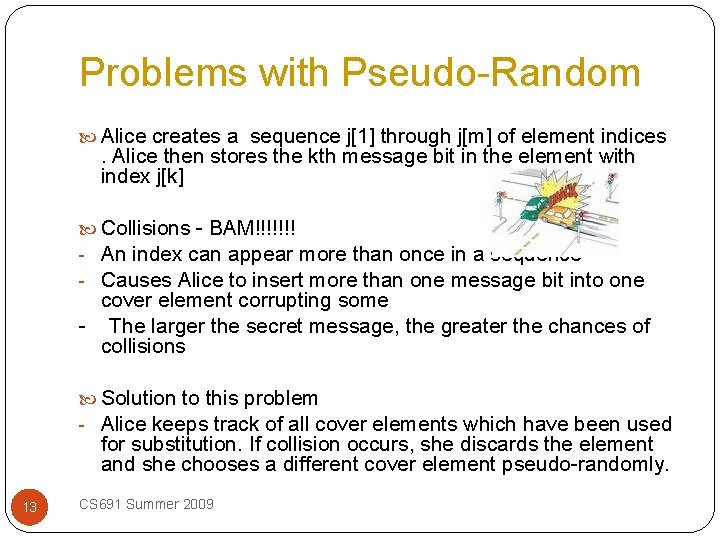
Problems with Pseudo-Random Alice creates a sequence j[1] through j[m] of element indices . Alice then stores the kth message bit in the element with index j[k] Collisions - BAM!!!!!!! - An index can appear more than once in a sequence - Causes Alice to insert more than one message bit into one cover element corrupting some - The larger the secret message, the greater the chances of collisions Solution to this problem - Alice keeps track of all cover elements which have been used for substitution. If collision occurs, she discards the element and she chooses a different cover element pseudo-randomly. 13 CS 691 Summer 2009
JPEG steganography JPEG compression is based on the discrete cosine transform (DCT), and reduces the visual redundancy to achieve good compression performance. JPEG steganography uses the DCT coefficients to embed the secret bits. J-Steg, Out. Guess, F 5 etc. 14 CS 691 Summer 2009
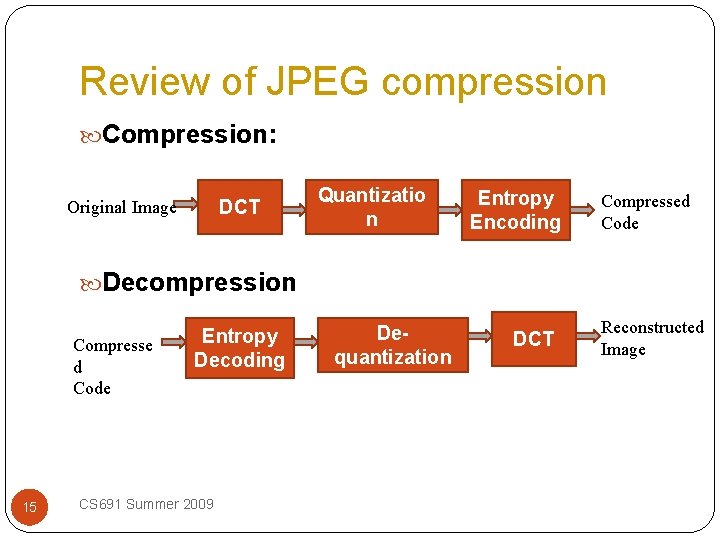
Review of JPEG compression Compression: DCT Original Image Quantizatio n Entropy Encoding Compressed Code Decompression Compresse d Code 15 Entropy Decoding CS 691 Summer 2009 Dequantization DCT Reconstructed Image
JPEG Steganography J-Steg : Embeds the secret data by sequentially flipping the LSB of the quantized DCT coefficients (except 0 s and 1 s) without causing detectable artificial distortion. 16 CS 691 Summer 2009
JPEG Steganography Out. Guess: In the first pass, the secret bits are embedded in the LSBs of the quantized DCT coefficients (skipping 0 s and 1 s) along a random walk. In the second pass, the histogram of the stegoimage is adjusted to match that of the coverimage. 17 CS 691 Summer 2009
JPEG Steganography F 5: Instead of replacing the LSBs of the quantized DCT coefficients with the secret bits, the absolute value of the coefficient is decreased by 1. It also randomly chooses randomly DCT coefficients to embed the secret bits. 18 CS 691 Summer 2009
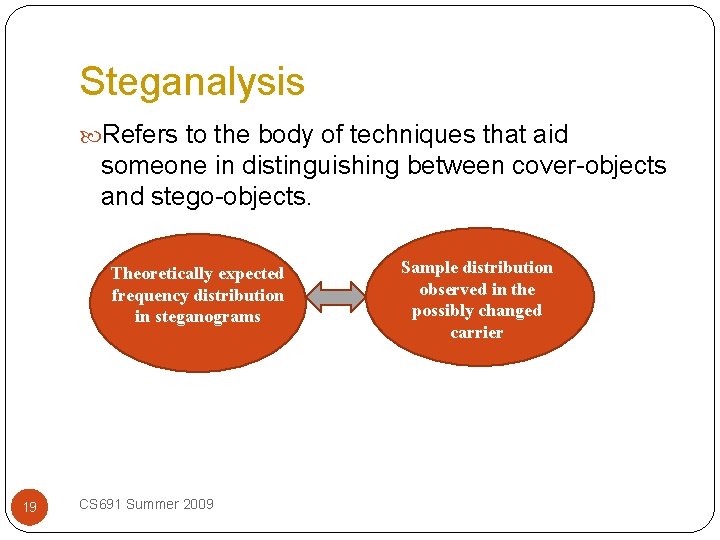
Steganalysis Refers to the body of techniques that aid someone in distinguishing between cover-objects and stego-objects. Theoretically expected frequency distribution in steganograms 19 CS 691 Summer 2009 Sample distribution observed in the possibly changed carrier
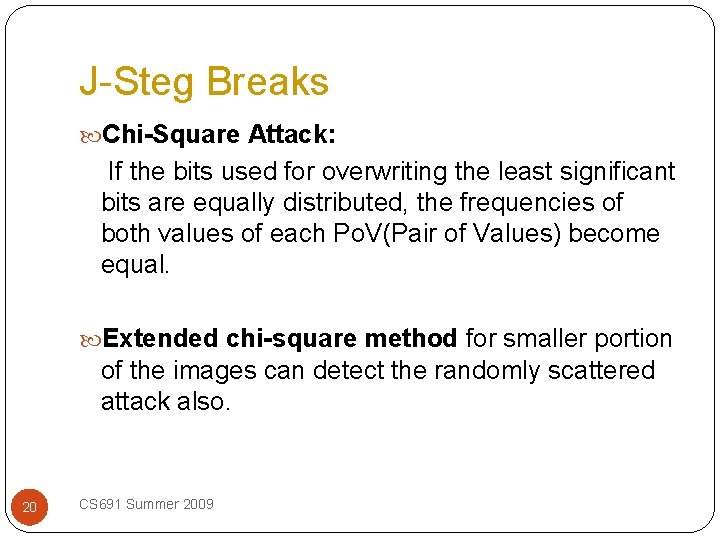
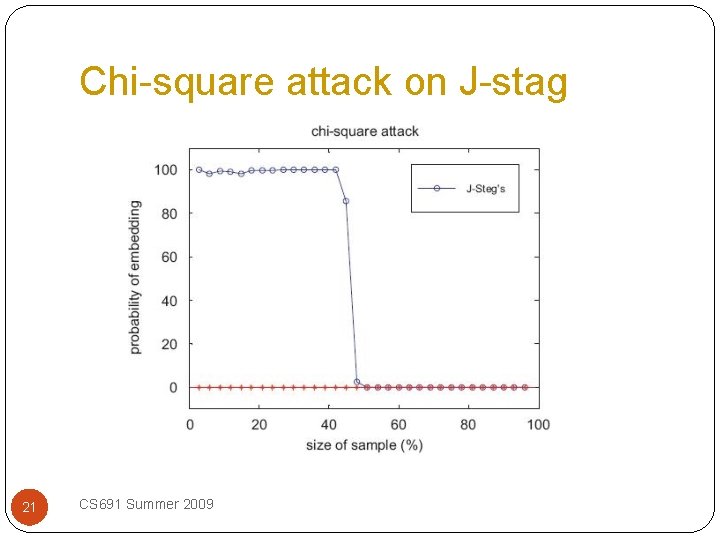
J-Steg Breaks Chi-Square Attack: If the bits used for overwriting the least significant bits are equally distributed, the frequencies of both values of each Po. V(Pair of Values) become equal. Extended chi-square method for smaller portion of the images can detect the randomly scattered attack also. 20 CS 691 Summer 2009
Chi-square attack on J-stag 21 CS 691 Summer 2009
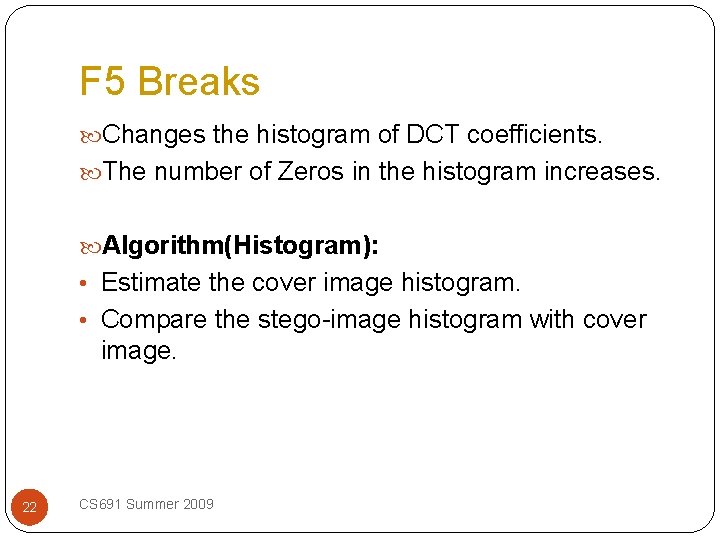
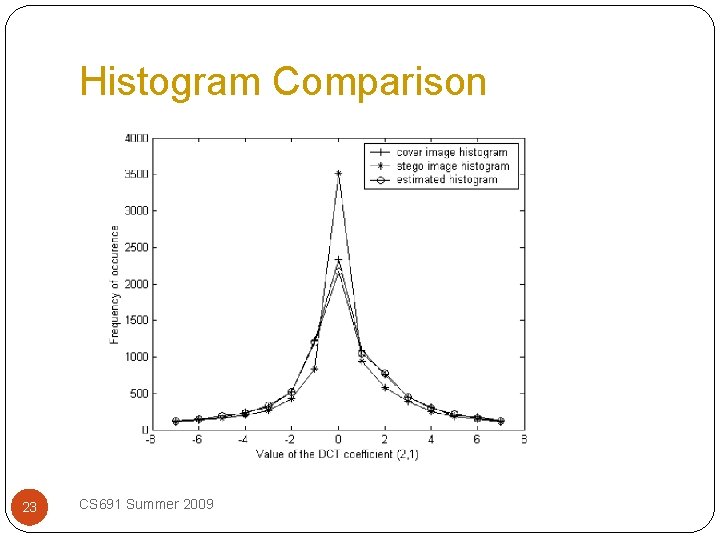
F 5 Breaks Changes the histogram of DCT coefficients. The number of Zeros in the histogram increases. Algorithm(Histogram): • Estimate the cover image histogram. • Compare the stego-image histogram with cover image. 22 CS 691 Summer 2009
Histogram Comparison 23 CS 691 Summer 2009
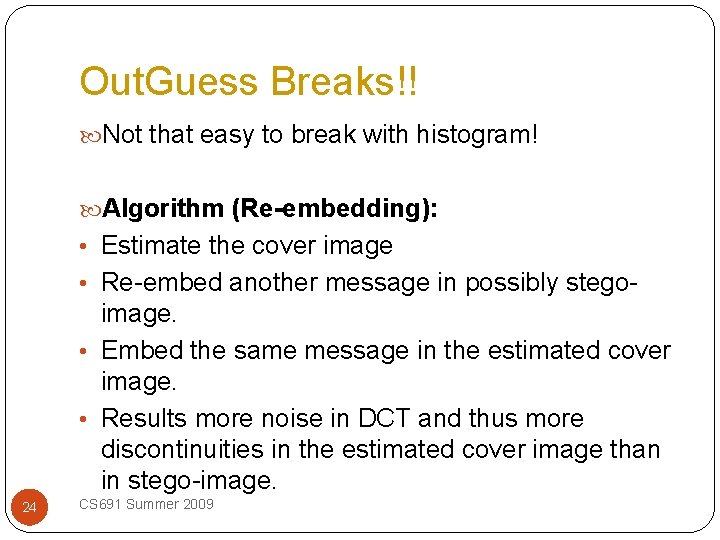
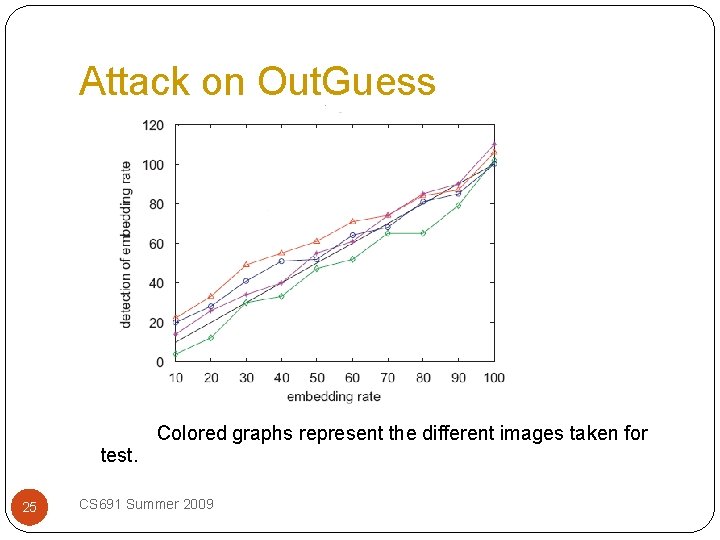
Out. Guess Breaks!! Not that easy to break with histogram! Algorithm (Re-embedding): • Estimate the cover image • Re-embed another message in possibly stego- image. • Embed the same message in the estimated cover image. • Results more noise in DCT and thus more discontinuities in the estimated cover image than in stego-image. 24 CS 691 Summer 2009
Attack on Out. Guess test. 25 Colored graphs represent the different images taken for CS 691 Summer 2009
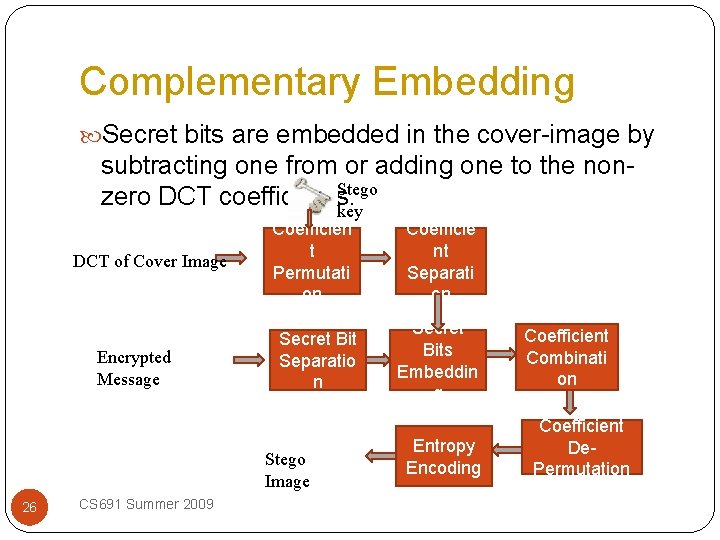
Complementary Embedding Secret bits are embedded in the cover-image by subtracting one from or adding one to the non. Stego zero DCT coefficients. key DCT of Cover Image Encrypted Message Coefficien t Permutati on Coefficie nt Separati on Secret Bit Separatio n Secret Bits Embeddin g Stego Image 26 CS 691 Summer 2009 Entropy Encoding Coefficient Combinati on Coefficient De. Permutation
Applications. . Confidential communication and secret data storing Protection of data alteration Access control system for digital content distribution Media Database systems Reference: http: //www. datahide. com/BPCSe/applicationse. html 27 CS 691 Summer 2009
References Liu, C. and Liao, S. 2008. High-performance JPEG 28 steganography using complementary embedding strategy. Pattern Recogn. 41, 9 (Sep. 2008), 2945 -2955. DOI= http: //dx. doi. org/10. 1016/j. patcog. 2008. 03. 005 New Methodology for Breaking Steganographic Techniques for JPEGs, with M. Goljan and D. Hogea, Proc. SPIE, Electronic Imaging, Security, Steganography, and Watermarking of Multimedia Contents V, Santa Clara, California, pp. 143 -155, 2003 N. F. Johnson and S. Katzenbeisser, “A survey of steganographic techniques, ” in Information Hiding, S. Katzenbeisser and F. Petitcolas, Eds. Norwood, MA: Artech House, 2000, pp. 43– 78. Christian Cachin. An information-theoretic model for steganography. Information and Computation, 192(1): 41 -56, July CS 691 Summer 2009 of this paper appeared in Proc. 2 nd Workshop on 2004. Parts Information Hiding, Springer, 1998