
A TwoInput Polygraph Archana Venkataraman Christopher Buenrostro Isaac

A Two-Input Polygraph Archana Venkataraman Christopher Buenrostro Isaac Rosmarin
Outline n n Introduction Design Overview n n The Physiological Sensors The Digital Decision-Making Unit (DDMU) The Output Display Conclusion
Introduction n The polygraph detects stress-related physiological responses commonly linked with deception n Modern-day polygraphs rely on 4 major variables: n The Foundation of a lie-detector examination is in its structure n n Environmental Setting Experience and Conduct of Examinator Questions: Control, Irrelevant, and Relevant Decisions are based on the assumption that an innocent subject will react more strongly to the control questions and a guilty subject will react more strongly to the relevant questions
Introduction n The project uses 2 inputs to make decision– heart rate and skin conductivity n n n Heart speeds up during times of emotional stress Perspire during times of emotional stress – increases conductivity Project divided into three sections n n n The Physiological Sensors The Digital Decision-Making Unit The Output Display
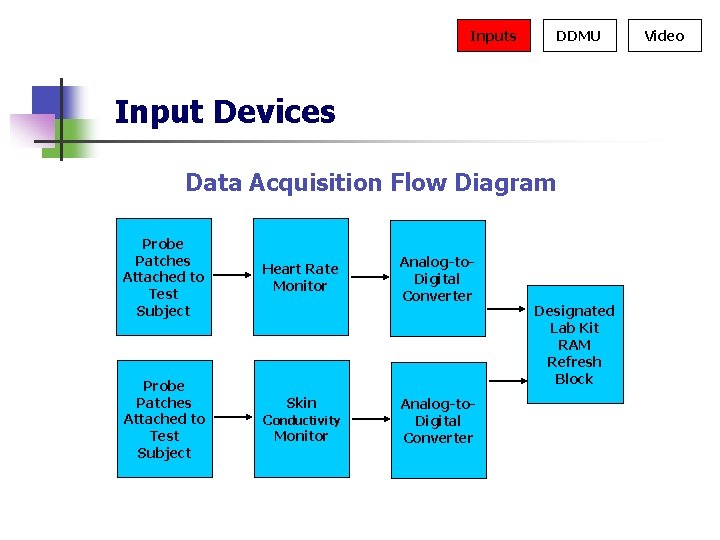
Inputs DDMU Input Devices Data Acquisition Flow Diagram Probe Patches Attached to Test Subject Heart Rate Monitor Skin Conductivity Monitor Analog-to. Digital Converter Designated Lab Kit RAM Refresh Block Video
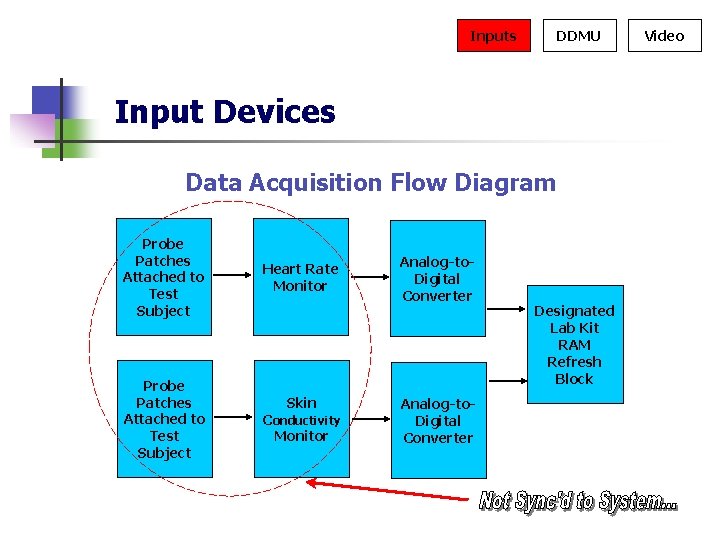
Inputs DDMU Input Devices Data Acquisition Flow Diagram Probe Patches Attached to Test Subject Heart Rate Monitor Skin Conductivity Monitor Analog-to. Digital Converter Designated Lab Kit RAM Refresh Block Video
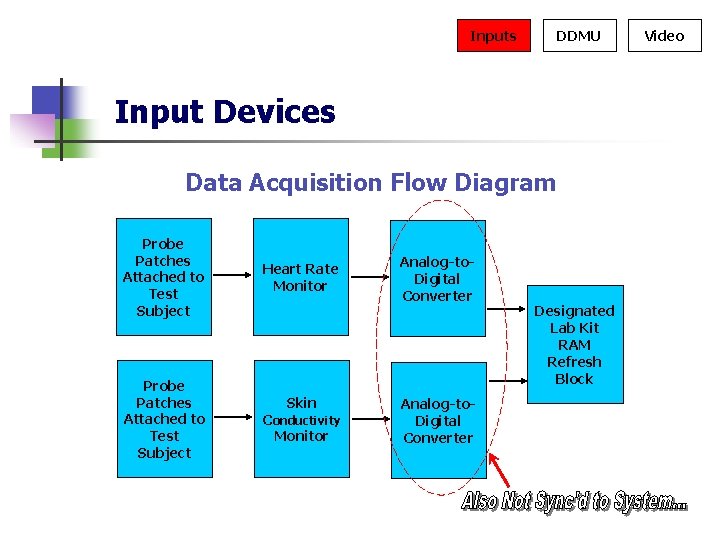
Inputs DDMU Input Devices Data Acquisition Flow Diagram Probe Patches Attached to Test Subject Heart Rate Monitor Skin Conductivity Monitor Analog-to. Digital Converter Designated Lab Kit RAM Refresh Block Video
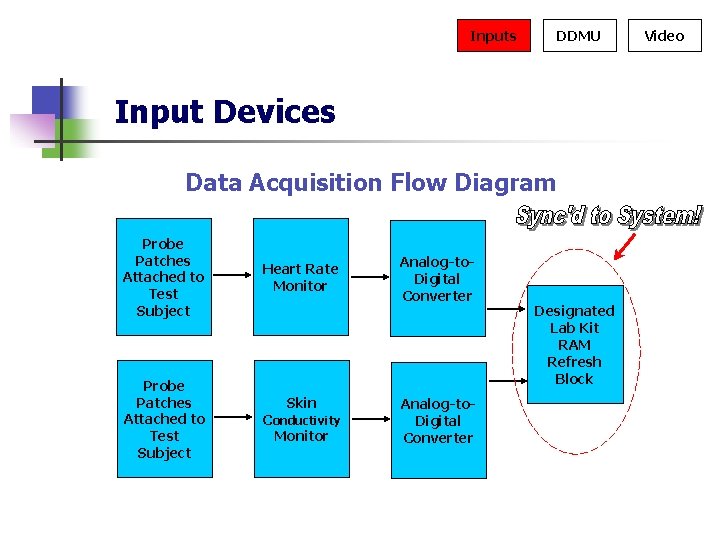
Inputs DDMU Input Devices Data Acquisition Flow Diagram Probe Patches Attached to Test Subject Heart Rate Monitor Skin Conductivity Monitor Analog-to. Digital Converter Designated Lab Kit RAM Refresh Block Video
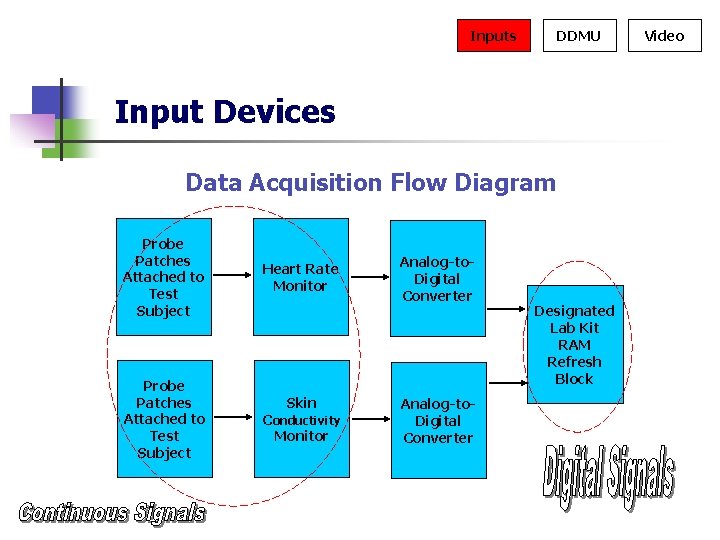
Inputs DDMU Input Devices Data Acquisition Flow Diagram Probe Patches Attached to Test Subject Heart Rate Monitor Skin Conductivity Monitor Analog-to. Digital Converter Designated Lab Kit RAM Refresh Block Video
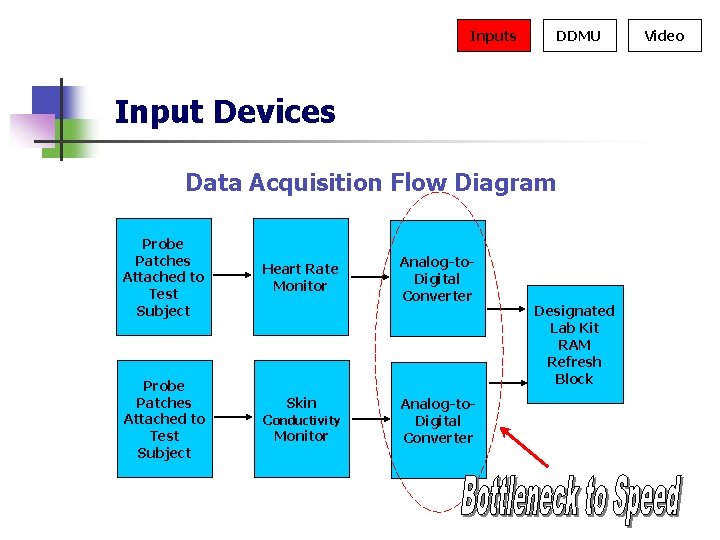
Inputs DDMU Input Devices Data Acquisition Flow Diagram Probe Patches Attached to Test Subject Heart Rate Monitor Skin Conductivity Monitor Analog-to. Digital Converter Designated Lab Kit RAM Refresh Block Video
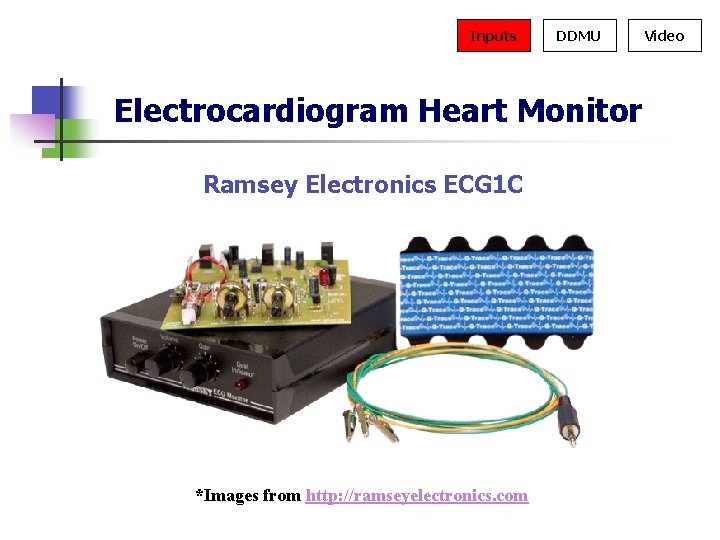
Inputs DDMU Electrocardiogram Heart Monitor Ramsey Electronics ECG 1 C *Images from http: //ramseyelectronics. com Video
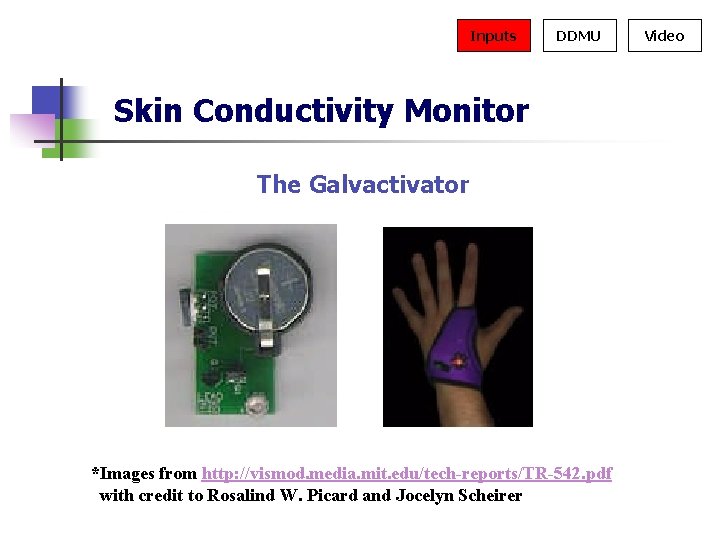
Inputs DDMU Skin Conductivity Monitor The Galvactivator *Images from http: //vismod. media. mit. edu/tech-reports/TR-542. pdf with credit to Rosalind W. Picard and Jocelyn Scheirer Video
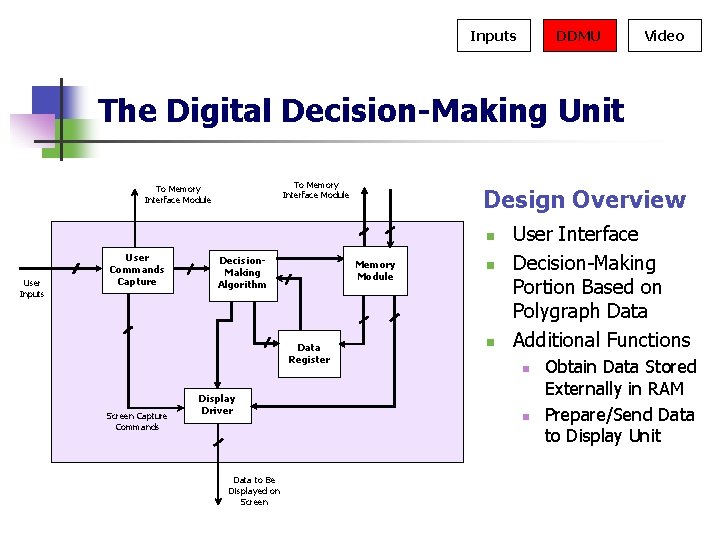
Inputs DDMU Video The Digital Decision-Making Unit To Memory Interface Module Design Overview n User Inputs User Commands Capture Decision. Making Algorithm Memory Module Data Register Screen Capture Commands Display Driver Data to Be Displayed on Screen n n User Interface Decision-Making Portion Based on Polygraph Data Additional Functions n n Obtain Data Stored Externally in RAM Prepare/Send Data to Display Unit
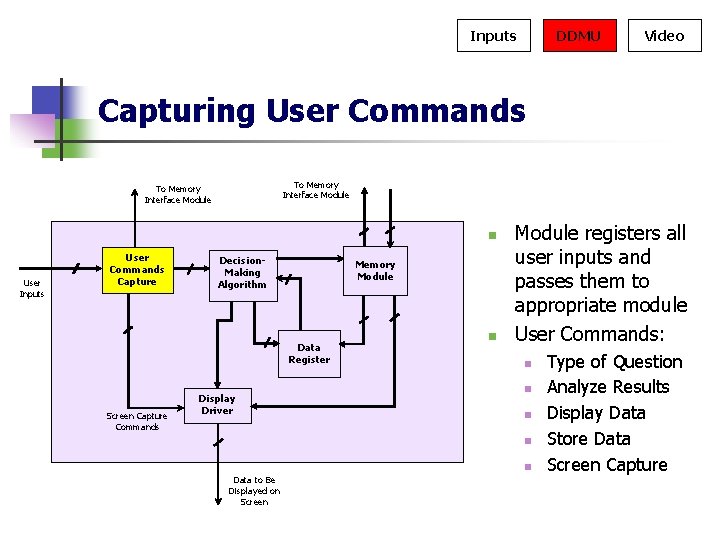
Inputs DDMU Video Capturing User Commands To Memory Interface Module n User Inputs User Commands Capture Decision. Making Algorithm Memory Module Data Register Screen Capture Commands Display Driver n Module registers all user inputs and passes them to appropriate module User Commands: n n n Data to Be Displayed on Screen Type of Question Analyze Results Display Data Store Data Screen Capture
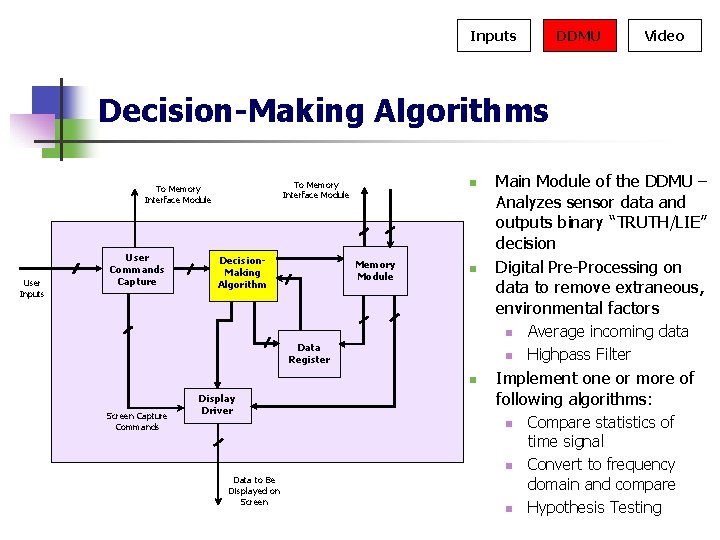
Inputs DDMU Video Decision-Making Algorithms User Inputs User Commands Capture n To Memory Interface Module Decision. Making Algorithm Memory Module n Main Module of the DDMU – Analyzes sensor data and outputs binary “TRUTH/LIE” decision Digital Pre-Processing on data to remove extraneous, environmental factors n Data Register n n Screen Capture Commands Display Driver Implement one or more of following algorithms: n n Data to Be Displayed on Screen Average incoming data Highpass Filter n Compare statistics of time signal Convert to frequency domain and compare Hypothesis Testing
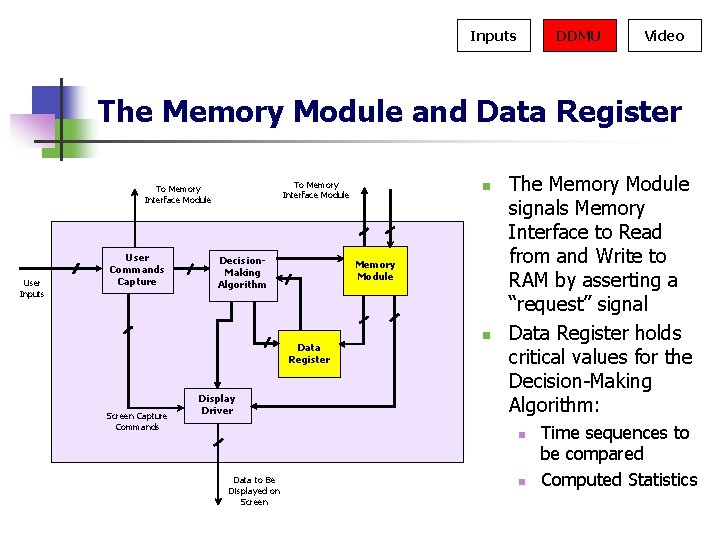
Inputs DDMU Video The Memory Module and Data Register To Memory Interface Module User Inputs User Commands Capture Decision. Making Algorithm Memory Module Data Register Screen Capture Commands Display Driver n n The Memory Module signals Memory Interface to Read from and Write to RAM by asserting a “request” signal Data Register holds critical values for the Decision-Making Algorithm: n Data to Be Displayed on Screen n Time sequences to be compared Computed Statistics
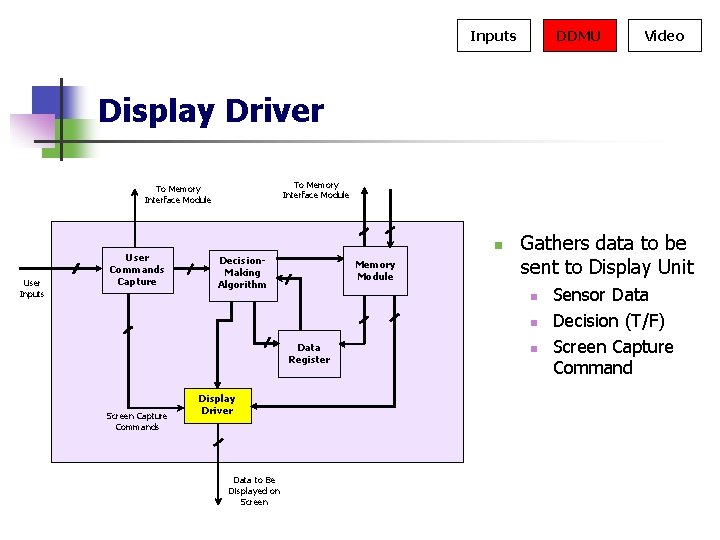
Inputs DDMU Video Display Driver To Memory Interface Module User Inputs User Commands Capture n Decision. Making Algorithm Memory Module Gathers data to be sent to Display Unit n n Data Register Screen Capture Commands Display Driver Data to Be Displayed on Screen n Sensor Data Decision (T/F) Screen Capture Command
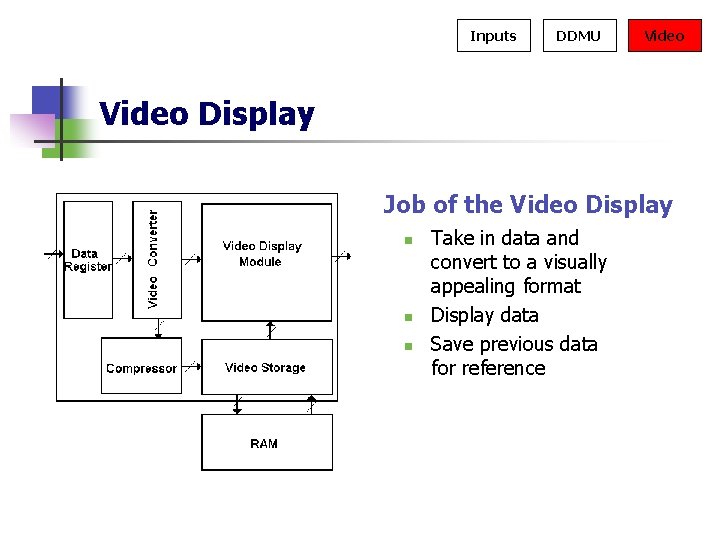
Inputs DDMU Video Display Job of the Video Display n n n Take in data and convert to a visually appealing format Display data Save previous data for reference
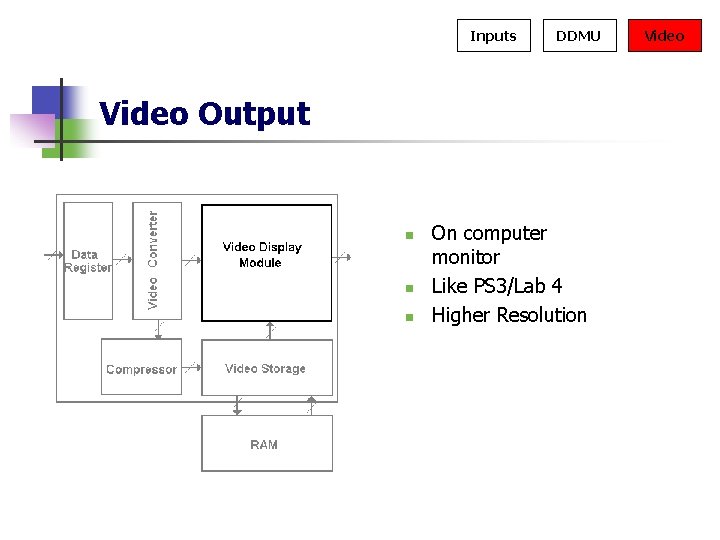
Inputs DDMU Video Output n n n On computer monitor Like PS 3/Lab 4 Higher Resolution Video
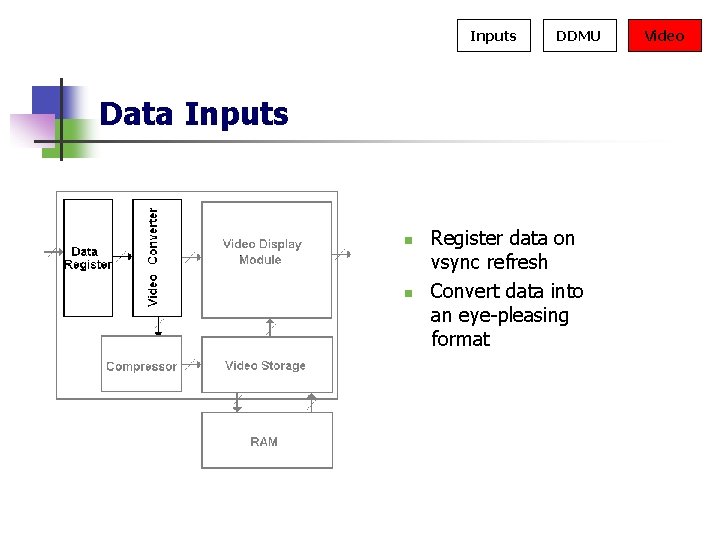
Inputs DDMU Data Inputs n n Register data on vsync refresh Convert data into an eye-pleasing format Video
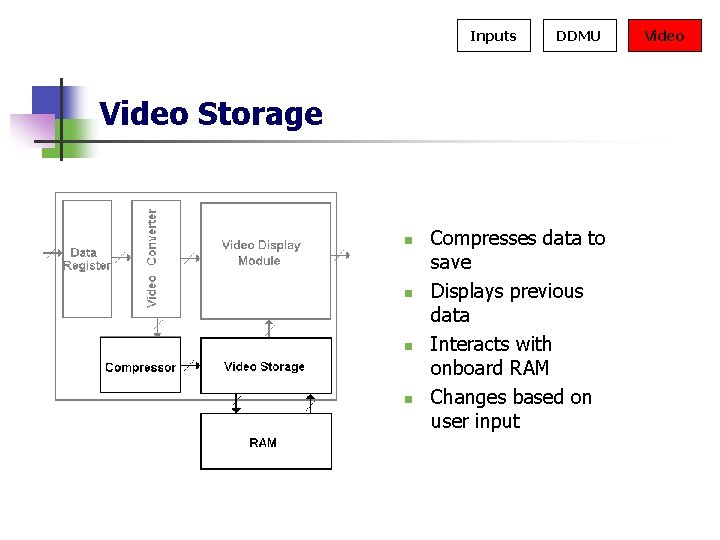
Inputs DDMU Video Storage n n Compresses data to save Displays previous data Interacts with onboard RAM Changes based on user input Video
Conclusion Design is modular n Project is good extension to material presented in class n Polygraph is an interesting realworld application n
- Slides: 22