
The Advanced Prosthetic Hand Project Jessica Reddy IMSURE
- Slides: 20
The Advanced Prosthetic Hand Project Jessica Reddy, IMSURE Fellow Mentor: Dr. William C. Tang
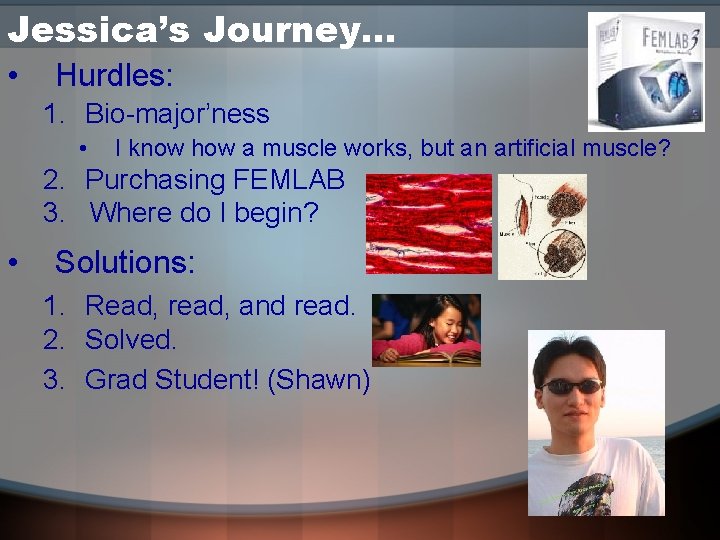
Jessica’s Journey… • Hurdles: 1. Bio-major’ness • I know how a muscle works, but an artificial muscle? 2. Purchasing FEMLAB 3. Where do I begin? • Solutions: 1. Read, read, and read. 2. Solved. 3. Grad Student! (Shawn)
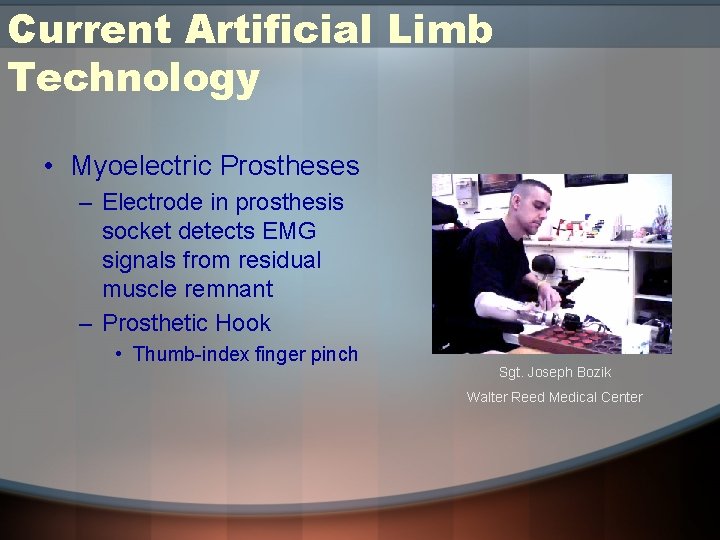
Current Artificial Limb Technology • Myoelectric Prostheses – Electrode in prosthesis socket detects EMG signals from residual muscle remnant – Prosthetic Hook • Thumb-index finger pinch Sgt. Joseph Bozik Walter Reed Medical Center
Proposed Advancements • Implantation of Neural Prosthetic into: – Brachial Plexus nerve (short term goal) – Cortical brain area (long term goal) • Multiple sites • Develop a prosthetic hand with multiple degrees of freedom – Use skeletal model of human hand for frame – Tactile sensing – Low weight, low energy consumption
Pneumatic Artificial Muscle • Contractile and linear motion engine operated by gas pressure • Flexible closed membrane attached at both ends to fittings • Mechanical power is transferred to a load
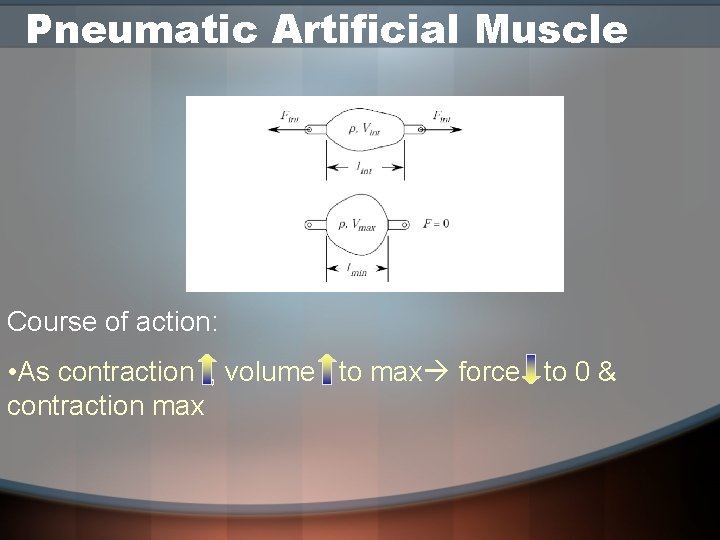
Pneumatic Artificial Muscle Course of action: • As contraction , volume to max force to 0 & contraction max
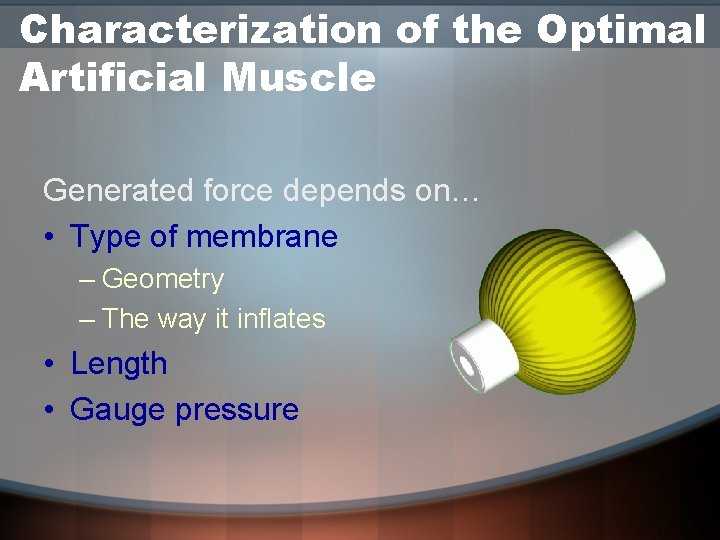
Characterization of the Optimal Artificial Muscle Generated force depends on… • Type of membrane – Geometry – The way it inflates • Length • Gauge pressure
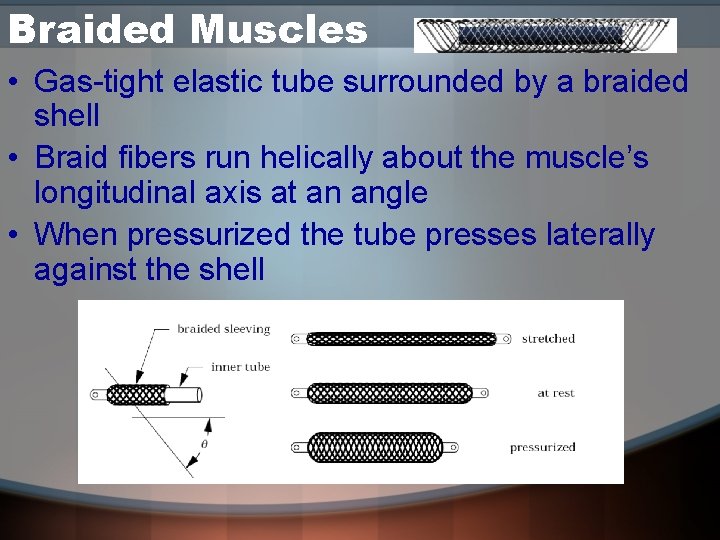
Braided Muscles • Gas-tight elastic tube surrounded by a braided shell • Braid fibers run helically about the muscle’s longitudinal axis at an angle • When pressurized the tube presses laterally against the shell
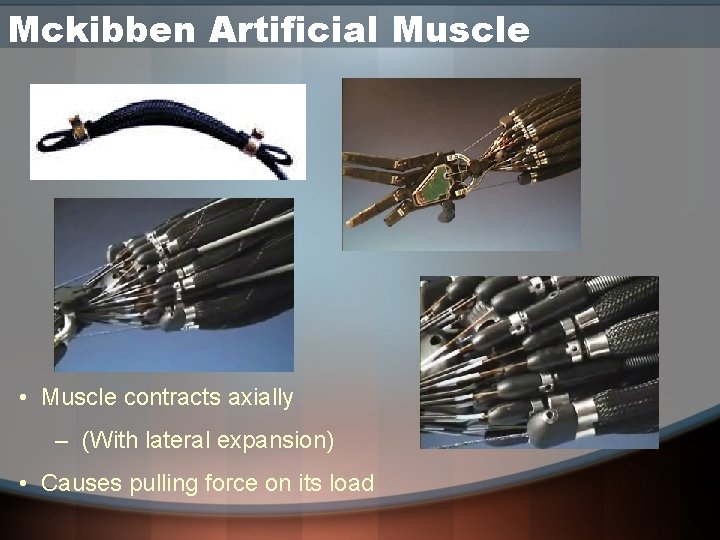
Mckibben Artificial Muscle • Muscle contracts axially – (With lateral expansion) • Causes pulling force on its load
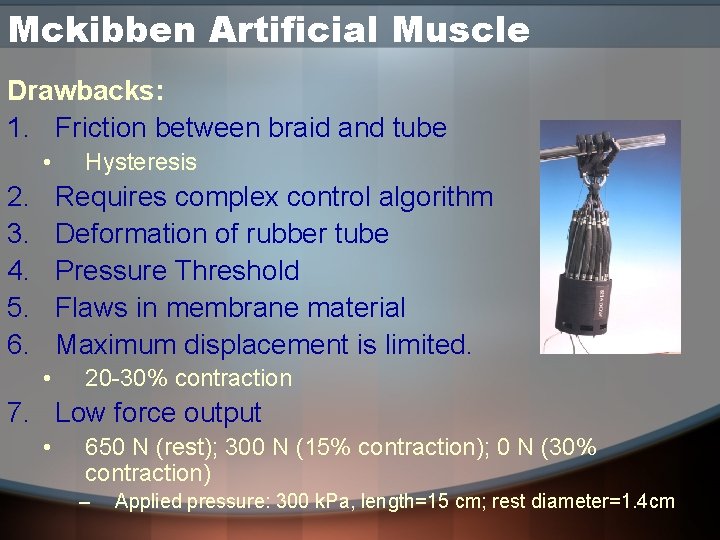
Mckibben Artificial Muscle Drawbacks: 1. Friction between braid and tube • 2. 3. 4. 5. 6. Hysteresis Requires complex control algorithm Deformation of rubber tube Pressure Threshold Flaws in membrane material Maximum displacement is limited. • 20 -30% contraction 7. Low force output • 650 N (rest); 300 N (15% contraction); 0 N (30% contraction) – Applied pressure: 300 k. Pa, length=15 cm; rest diameter=1. 4 cm
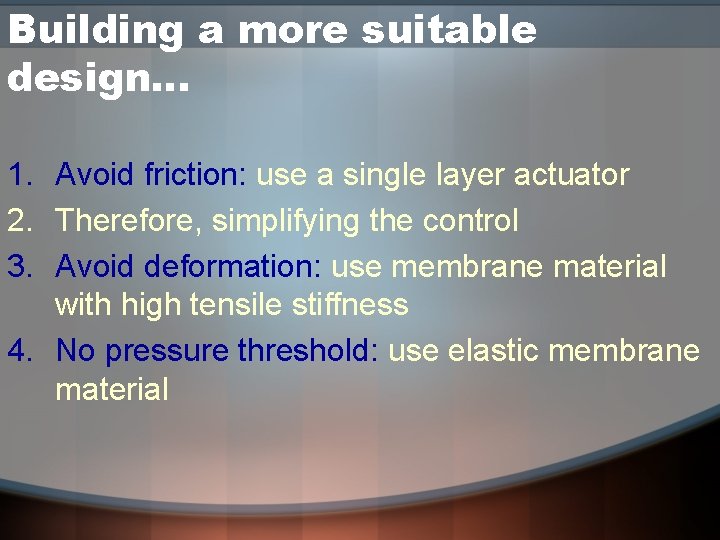
Building a more suitable design… 1. Avoid friction: use a single layer actuator 2. Therefore, simplifying the control 3. Avoid deformation: use membrane material with high tensile stiffness 4. No pressure threshold: use elastic membrane material
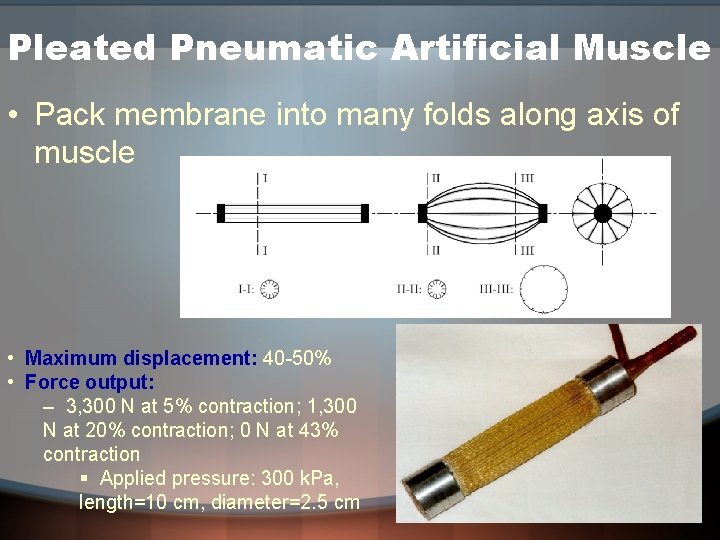
Building a more suitable design… • Want little stress in lateral direction to minimize elastic deformation (strain) • How to achieve lateral expansion with a high tensile stiffness material? • Rotationally repeated pattern Ø Pleats
Pleated Pneumatic Artificial Muscle • Pack membrane into many folds along axis of muscle • Maximum displacement: 40 -50% • Force output: – 3, 300 N at 5% contraction; 1, 300 N at 20% contraction; 0 N at 43% contraction § Applied pressure: 300 k. Pa, length=10 cm, diameter=2. 5 cm
With these considerations in mind, let’s build a model!
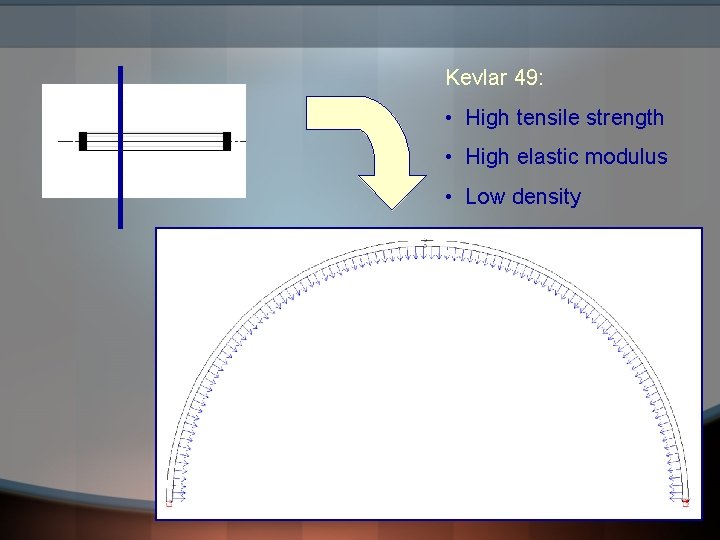
Kevlar 49: • High tensile strength • High elastic modulus • Low density
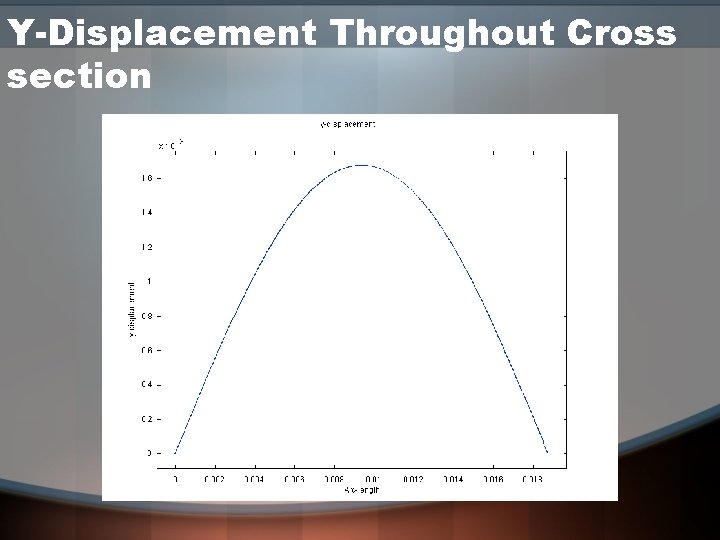
Y-Displacement Throughout Cross section
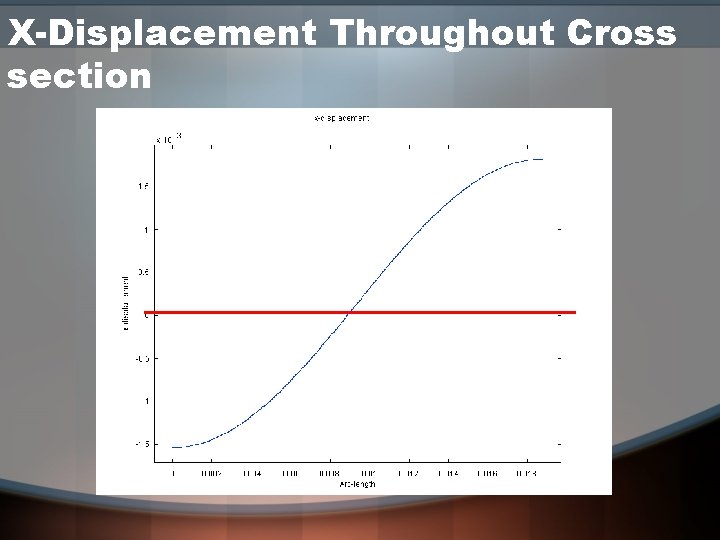
X-Displacement Throughout Cross section
Upcoming endeavors… • Introduce pleats • Represent other layers of muscle – Polyproylene lining • Extend model to 3 D – Include End Fittings • Miniaturization of the Artificial Muscle
UCI Subsystem Development Team Members Pending DARPA Award. Artificial Muscle • William C. Tang (Team Lead), Professor, Biomedical Engineering Department, Electrical Engineering & Computer Science Department – Ryan Langan, UROP SURP Fellowship Neural Interface • William E. Bunney, Distinguished Professor & Co-Chair, Department of Psychiatry & Human Behavior • James H. Fallon, Professor, Department of Anatomy and Neurobiology Communications • Payam Heydari, Assistant Professor, Department of Electrical Engineering & Computer Science Tactile Sensor • Abraham P. Lee, Professor, Biomedical Engineering Department, Mechanical & Aerospace Engineering Department Interface and Algorithm • Zoran Nenadić, Assistant Professor, Biomedical Engineering Department
Please visit our website: www. advancedprosthetichand. com Dr. William C. Tang Webmaster: Ryan Langan