COE 526 Data Privacy Lecture 14 Data Hiding
- Slides: 23
COE 526: Data Privacy Lecture 14: Data Hiding and Steganography References: Data Privacy and Security, Salomon
Agenda n n n 2 Introduction to Data Hiding Steganography and Cryptography Steganography and Watermarking Types of Digital Steganography Network Steganography Steganalysis COE 526: Lecture 14
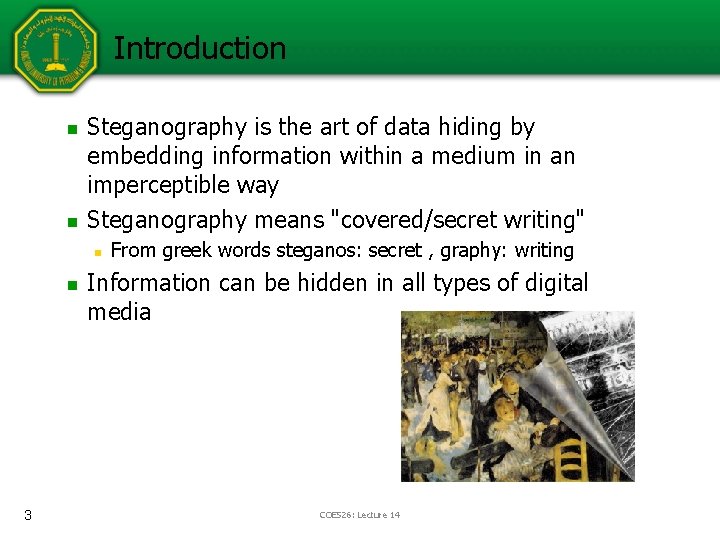
Introduction n n Steganography is the art of data hiding by embedding information within a medium in an imperceptible way Steganography means "covered/secret writing" n n 3 From greek words steganos: secret , graphy: writing Information can be hidden in all types of digital media COE 526: Lecture 14
Motivation n 4 Steganography is example of Undetectability If you hide communications, you can protect your thoughts from censorship or discovery An opponent cannot control your message, if he cannot find it COE 526: Lecture 14
Steganography and Cryptography n n Steganography and Cryptography are closely related The difference is in their objectives n n n 5 Cryptography: although encrypted and unreadable, the existence of data is not hidden Steganography: no knowledge of the existence of the data Steganography and Cryptography can be used together to produce better protection COE 526: Lecture 14
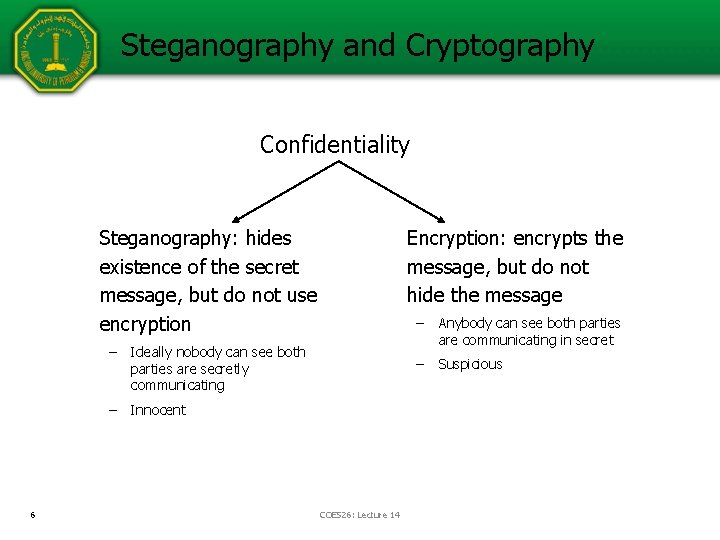
Steganography and Cryptography Confidentiality Encryption: encrypts the message, but do not hide the message Steganography: hides existence of the secret message, but do not use encryption 6 – Ideally nobody can see both parties are secretly communicating – Innocent COE 526: Lecture 14 – Anybody can see both parties are communicating in secret – Suspicious
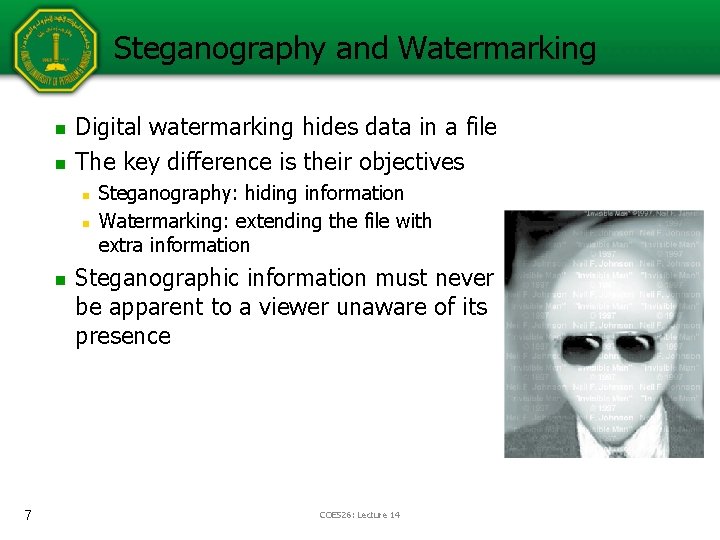
Steganography and Watermarking n n Digital watermarking hides data in a file The key difference is their objectives n n n 7 Steganography: hiding information Watermarking: extending the file with extra information Steganographic information must never be apparent to a viewer unaware of its presence COE 526: Lecture 14
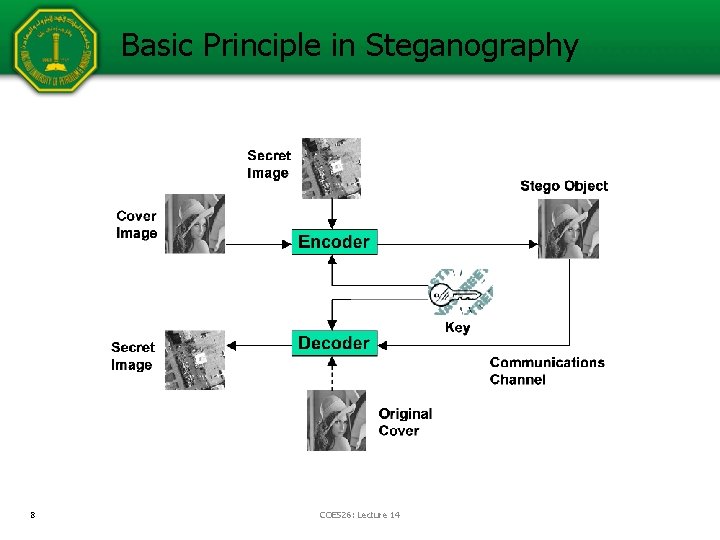
Basic Principle in Steganography 8 COE 526: Lecture 14
Types of Steganography n Fragile n n Robust n n 9 Hidden information destroyed as soon as object is modified Protocols tend to be easy to implement Useful in proving objects have not been manipulated and changed e. g. evidence in a court of law It should be infeasible to remove the hidden data without degrading the perceived quality of the data Protocols are more complex One single protocol may not withstand all object manipulations Useful in copyright watermarking COE 526: Lecture 14
Types of Digital Steganography n Hiding a Message inside Text n n n Hiding a Message inside Images n n n 10 First-letter algorithm Every n-th character Using a publicly available cover source Altering the amount of whitespace Least-significant bit (LSB) modifications Masking and Filtering Hiding a Message inside Audio and Video Files COE 526: Lecture 14
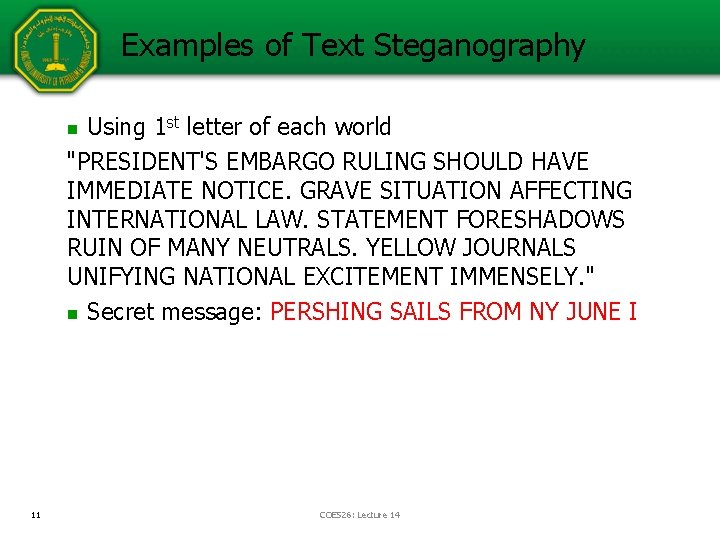
Examples of Text Steganography Using 1 st letter of each world "PRESIDENT'S EMBARGO RULING SHOULD HAVE IMMEDIATE NOTICE. GRAVE SITUATION AFFECTING INTERNATIONAL LAW. STATEMENT FORESHADOWS RUIN OF MANY NEUTRALS. YELLOW JOURNALS UNIFYING NATIONAL EXCITEMENT IMMENSELY. " n Secret message: PERSHING SAILS FROM NY JUNE I n 11 COE 526: Lecture 14
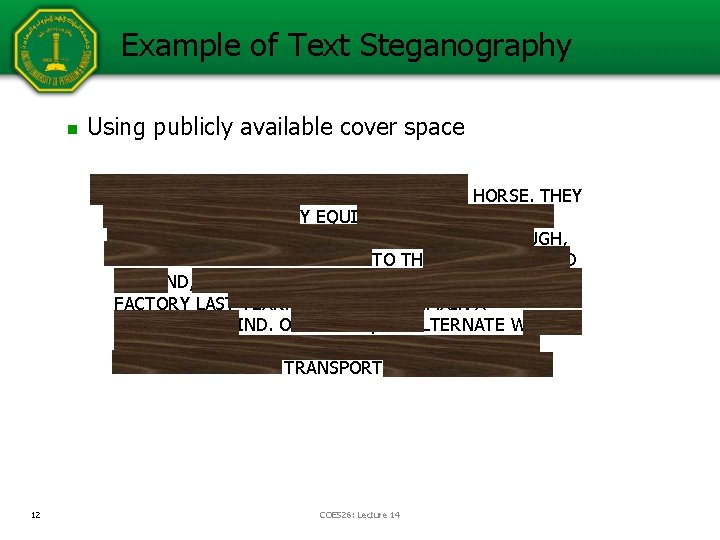
Example of Text Steganography n Using publicly available cover space THE MOST COMMON WORK ANIMAL IS THE HORSE. THEY CAN BE USED TO FERRY EQUIPMENT TO AND FROM WORKERS OR TO PULL A PLOW. BE CAREFUL, THOUGH, BECAUSE SOME HAVE SANK UP TO THEIR KNEES IN MUD OR SAND, SUCH AS AN INCIDENT AT THE BURLINGTON FACTORY LAST YEAR. BUT HORSES REMAIN A SIGNIFICANT FIND. ON A FARM, AN ALTERNATE WORK ANIMAL MIGHT BE A BURRO BUT THEY ARE NOT AS COMFORTABLE AS A TRANSPORT ANIMAL. 12 COE 526: Lecture 14
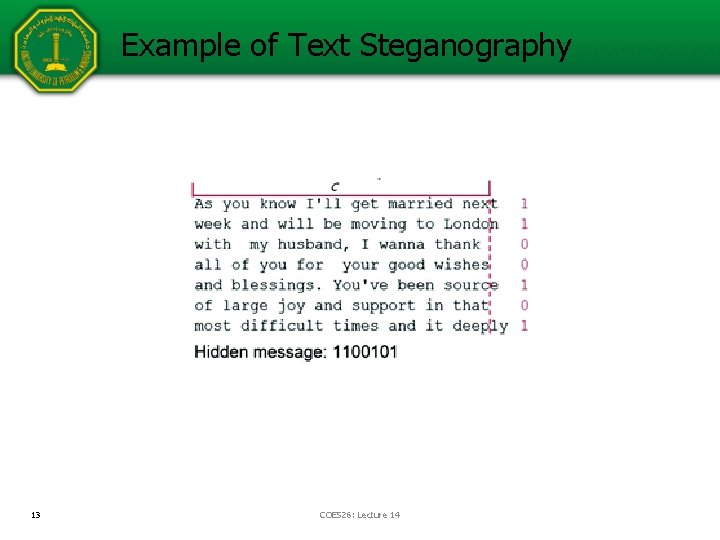
Example of Text Steganography 13 COE 526: Lecture 14
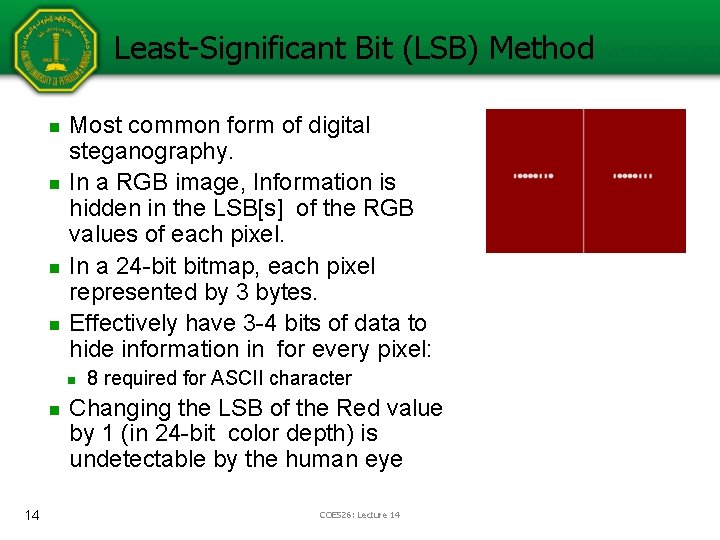
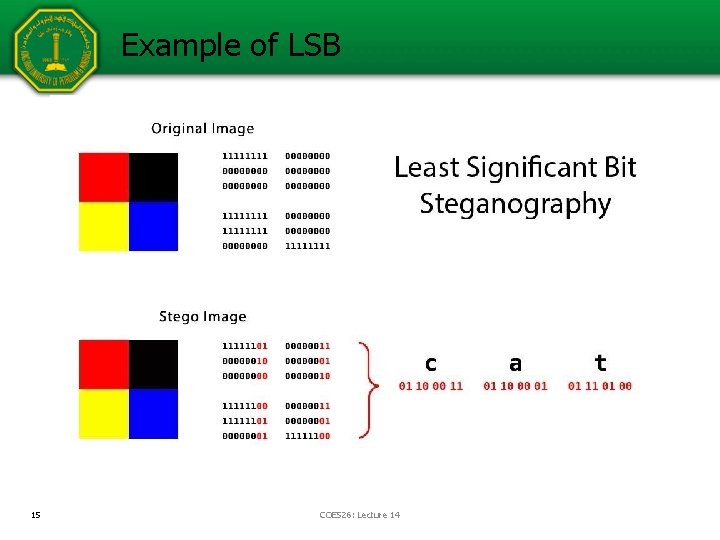
Least-Significant Bit (LSB) Method n n Most common form of digital steganography. In a RGB image, Information is hidden in the LSB[s] of the RGB values of each pixel. In a 24 -bit bitmap, each pixel represented by 3 bytes. Effectively have 3 -4 bits of data to hide information in for every pixel: n n 14 8 required for ASCII character Changing the LSB of the Red value by 1 (in 24 -bit color depth) is undetectable by the human eye COE 526: Lecture 14
Example of LSB 15 COE 526: Lecture 14
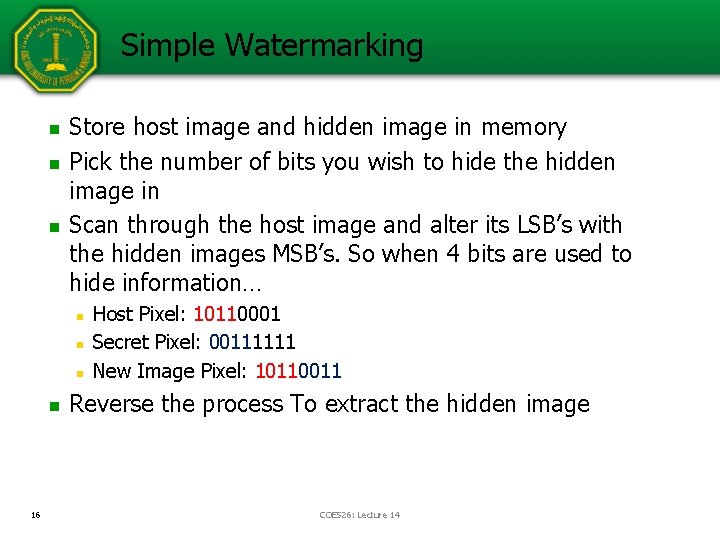
Simple Watermarking n n n Store host image and hidden image in memory Pick the number of bits you wish to hide the hidden image in Scan through the host image and alter its LSB’s with the hidden images MSB’s. So when 4 bits are used to hide information… n n 16 Host Pixel: 10110001 Secret Pixel: 00111111 New Image Pixel: 10110011 Reverse the process To extract the hidden image COE 526: Lecture 14
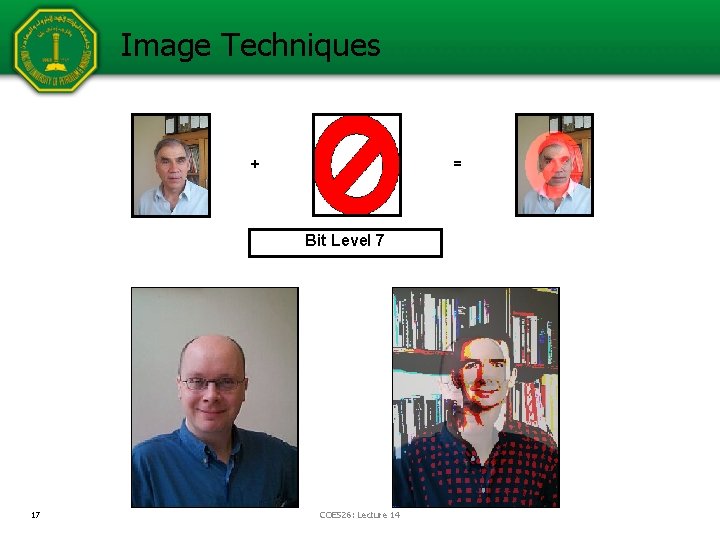
Image Techniques + = Bit Level 1 4 7 Original Images 17 COE 526: Lecture 14
Hiding a Message inside Audio or Videos Files n n n 18 Human limitations – 20. 000 Hz. Large amount of data that can be hidden inside Hard to recognize because of the continuous flow of information (moving stream of images and sound) COE 526: Lecture 14
Network Steganography n Modifying network packet’s header or payload n n Packet based length steganography n n Manipulation of the MTU (Maximum Transmission Unit) Vo. IP - Lost Audio Packets Steganographic Method (LACK) n 19 In TCP/IP networks, unused bits in the IP and TCP header may be used Payload of these lost packets contains the secret information COE 526: Lecture 14
Steganalysis n n Detecting and decoding the hidden data within a given medium. Many algorithms perform a statistical analysis to detect anomalies in the cover object n n 20 E. g. repetitive patterns could indicate use of a steganography tool or hidden message Investigating pixel “neighborhoods” to find inconsistencies with ways files are compressed. COE 526: Lecture 14
Steganography Robustness n n 21 The quality of the media should noticeably degrade upon embedding data Data should be undetectable without secret knowledge typically the key If multiple marks are present they should not interfere with each other The marks should survive attacks that don’t degrade the perceived quality of the work COE 526: Lecture 14
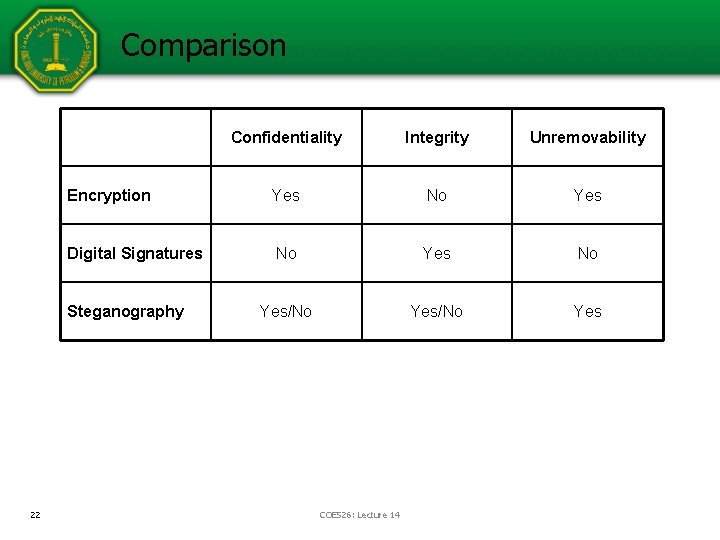
Comparison Confidentiality Integrity Unremovability Encryption Yes No Yes Digital Signatures No Yes/No Yes Steganography 22 COE 526: Lecture 14
Conclusion n 23 Steganography will become increasingly important as more copyrighted material becomes available online Many techniques are not robust enough to prevent detection and removal of embedded data Methods of embedding and detecting are likely to continue to improve COE 526: Lecture 14