
Data Center Basics ENCS 691 K Chapter 5
Data Center Basics (ENCS 691 K – Chapter 5) Roch Glitho, Ph. D Associate Professor and Canada Research Chair My URL - http: //users. encs. concordia. ca/~glitho/
References 1. MD. Bari et al. , Data Center Networking Virtualization: A Survey, IEEE Communications Surveys & Tutorials, Vol. 15, No 2, Second Quarter 2013
Data Center Networking - Basics § Basic Concepts § Data Center Topology § Data Center Virtualization
Basic Concepts
Data Center Consists of: § § § Servers (Physical machines) Storage Network devices (switch, router, cables) Power distribution systems Cooling systems
Data Center Network Communications infrastructure – Could be described by: § Topology § Routing / switching equipment § Protocols
Data Center Network vs. ISP Networks: § Number of nodes § ISPs backbones (hundreds) § 487 for AT&T – Ref. 1 § Data centers (thousands) § Google (12 000) Ref. 1 § Topology with specific properties are used for data center in order to allow topology specific routing optimization
Data Center Network Topology
Conventional Topology Three layers: § Access layer with Top of the Rack (To. R) switches § Aggregation layer § Core layer
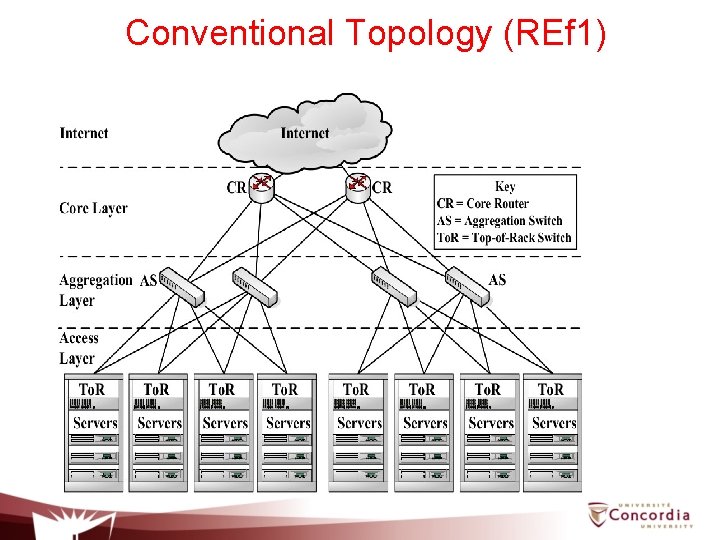
Conventional Topology (REf 1)
Conventional Topology Specific case: § Flat layer 2 topology: Only layer 2 switches
Clos Topology Hierarchical / staged/layered: § Each switch in a stage is connected to all the switches in the next stage § Key benefit: § Extensive path diversity

Clos Topology (Ref. 1)
Clos Topology Specific case: Fat tree § Built in a tree like structure
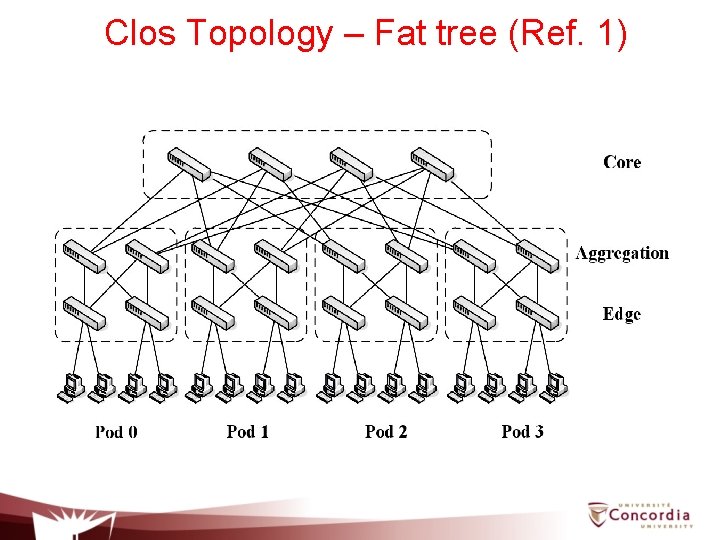
Clos Topology – Fat tree (Ref. 1)
Data Center Virtualization
Virtualized Data Center Data center with some or all the hardware virtualized § § § Servers (Physical machines) Storage Network devices (switch, router) Power distribution systems Cooling systems
Virtual Data Center Collection of virtual resources, e. g. § Virtual machine § Virtual switches § Virtual links
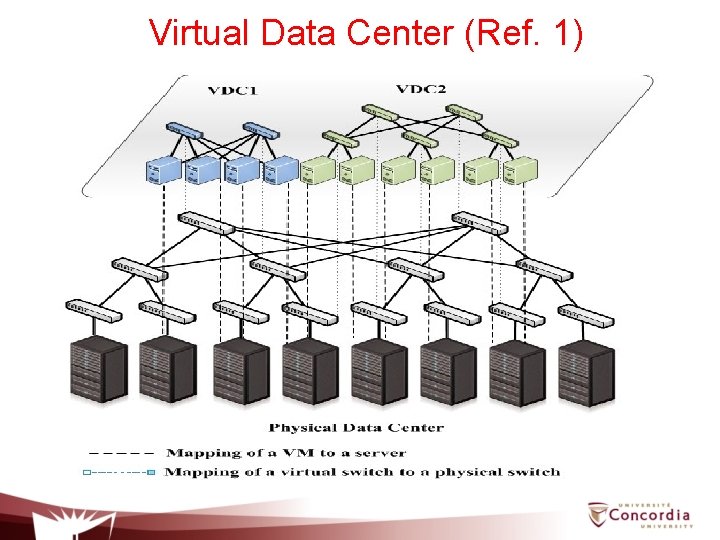
Virtual Data Center (Ref. 1)
• A The End.
- Slides: 20