Statistical Thinking Systems Thought and Mental Models Vinay
- Slides: 32
Statistical Thinking, Systems Thought and Mental Models Vinay P. Kulkarni M. S. Candidate, Industrial Engineering Systems and Industrial Engineering University of Arizona Tucson, Arizona 85721 E-mail: vinay@email. arizona. edu Ph: 520 -624 -7593(Home), 520 -6617593(Mobile) 6/6/2002 Vinay P. Kulkarni, University of Arizona
Presentation Topics • • • Teaching Statistical Thinking-an Experience Mental Models Student Thinking and Teacher Thinking The Shock of the Real World Class Reactions Recommendations for Future Courses 6/6/2002 Vinay P. Kulkarni, University of Arizona 2
The Setting • Introductory course in probability and statistics for engineers • Text: Hogg and Ledolter • Class: 85 engineers, mainly electrical engineers 6/6/2002 Vinay P. Kulkarni, University of Arizona 3
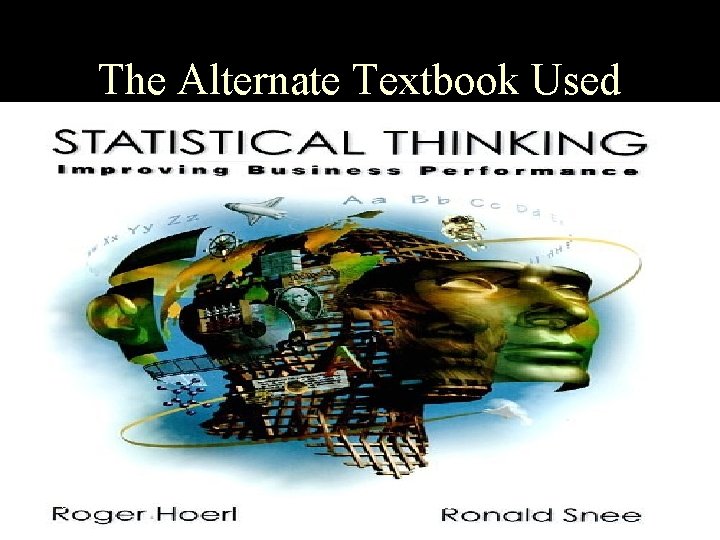
What We Did • • Selected 11 best students at the end of the semester All of them were awarded “A’s” at this point 3 sessions, more than 1 hour each Alternate text: Hoerl and Snee 6/6/2002 Vinay P. Kulkarni, University of Arizona 4
The Alternate Textbook Used 6/6/2002 Vinay P. Kulkarni, University of Arizona 5
Statistical Thinking A philosophy of learning and action : – All work occurs in a system of interconnected processes – Variation exists in all processes – Understanding and reducing variation are the keys to success Glossary of Statistical Terms, Quality Press (1996) 6/6/2002 Vinay P. Kulkarni, University of Arizona 6
Topics • • Systems thinking Mental Models Statistical Thinking & Application Discussion of topics covered in the regular course 6/6/2002 Vinay P. Kulkarni, University of Arizona 7
What We Did • Background on Statistics and Probability • Students were given articles on “team work”, asked to respond by e-mail • Case studies from Hoerl & Snee and others • E. g: The soccer team performance case study • Importance of group learning explained • Communication channels opened 6/6/2002 Vinay P. Kulkarni, University of Arizona 8
Mental Models • Conventional Wisdom, typically not based on fact and frequently wrong • Adversely influences: – How teachers teach – Students learn – How they interact with each other 6/6/2002 Vinay P. Kulkarni, University of Arizona 9
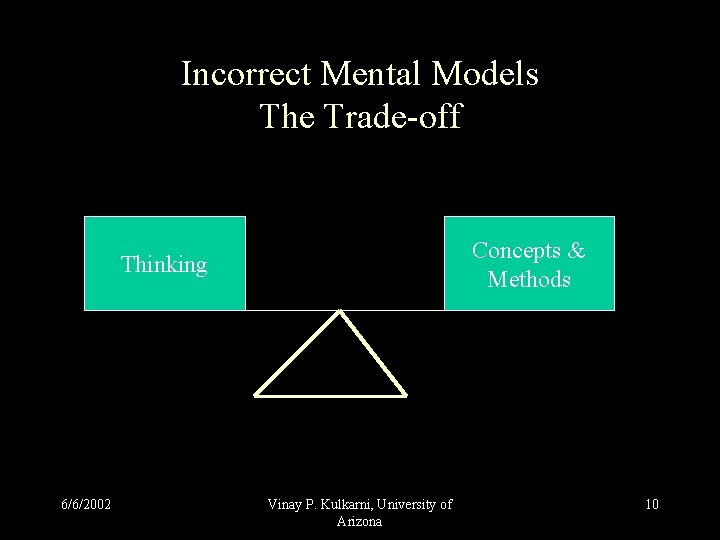
Incorrect Mental Models The Trade-off Concepts & Methods Thinking 6/6/2002 Vinay P. Kulkarni, University of Arizona 10
An Analogy • Mathematical Statistics-Hardware • Statistical Thinking-Software What use is hardware without software? The converse is also true, but, the hardware is “dead” without the software 6/6/2002 Vinay P. Kulkarni, University of Arizona 11
Statistical Thinking Vs. Mathematical Detail “…Good statistics is not equated with mathematical rigor or purity, but is more closely associated with careful thinking” - Robert V. Hogg 6/6/2002 Vinay P. Kulkarni, University of Arizona 12
Incorrect Mental Models: an Example “Faculty in a national study ‘overwhelmingly’ said developing effective thinking was their primary educational purpose, but most of the 4, 000 course goals they submitted related to teaching concepts in their disciplines, rather than developing the intellectual skills they said were so important. ” 6/6/2002 Vinay P. Kulkarni, University of Arizona 13
Dealing With Mental Models (MMs) • Instructors should: – explore their own – list and test the assumptions on which their MMs are built – assist students to discover and change their MMs – replace the wrong MMs with correct ones 6/6/2002 Vinay P. Kulkarni, University of Arizona 14
Student Thinking • In typical statistics courses problems are – completely defined, clearly stated – data already collected, neatly tabulated – causes known, solutions available • Its only a matter of figuring out the right formula/equation to be used • They expect the same when they get out of school 6/6/2002 Vinay P. Kulkarni, University of Arizona 15
Student Thinking • Theory – – – – 6/6/2002 its easy do not waste time with it to be memorized just fill some pages, will get at least half the points reserve these questions for the last on an exam does not require intelligence only counts for 10 -15 points on the exam anyway Vinay P. Kulkarni, University of Arizona 16
The Shock • When they step out into the real world: – – problems are ill-defined rules are unclear no standard solutions insufficient / incomplete / incorrect sometimes useless data – so many roads, which one to take ? • A bunch of tools but no theory to back up their use 6/6/2002 Vinay P. Kulkarni, University of Arizona 17
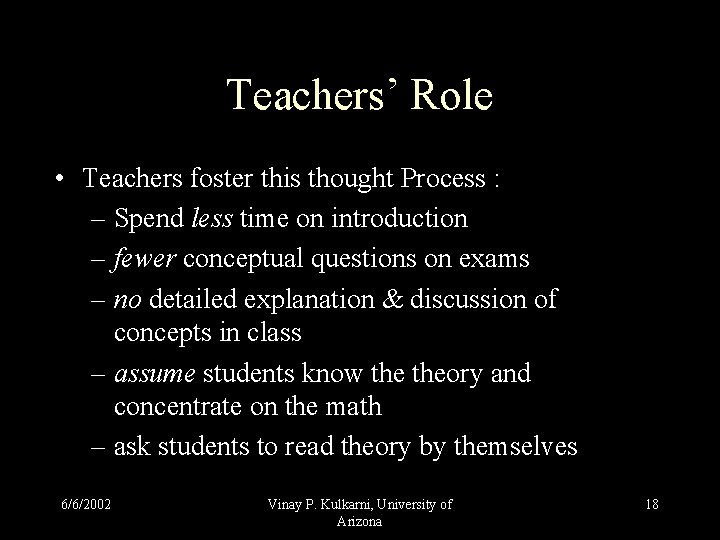
Teachers’ Role • Teachers foster this thought Process : – Spend less time on introduction – fewer conceptual questions on exams – no detailed explanation & discussion of concepts in class – assume students know theory and concentrate on the math – ask students to read theory by themselves 6/6/2002 Vinay P. Kulkarni, University of Arizona 18
Conventional View of Classroom “Teacher is lecturing to the class” 6/6/2002 Vinay P. Kulkarni, University of Arizona 19
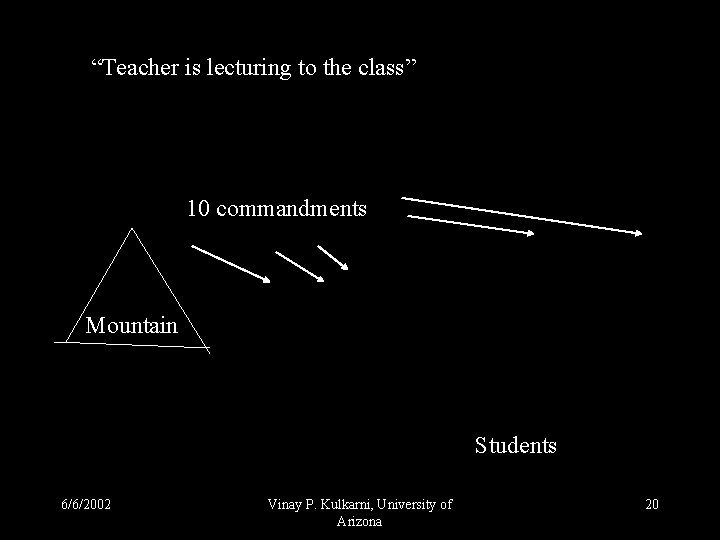
“Teacher is lecturing to the class” 10 commandments Mountain Students 6/6/2002 Vinay P. Kulkarni, University of Arizona 20
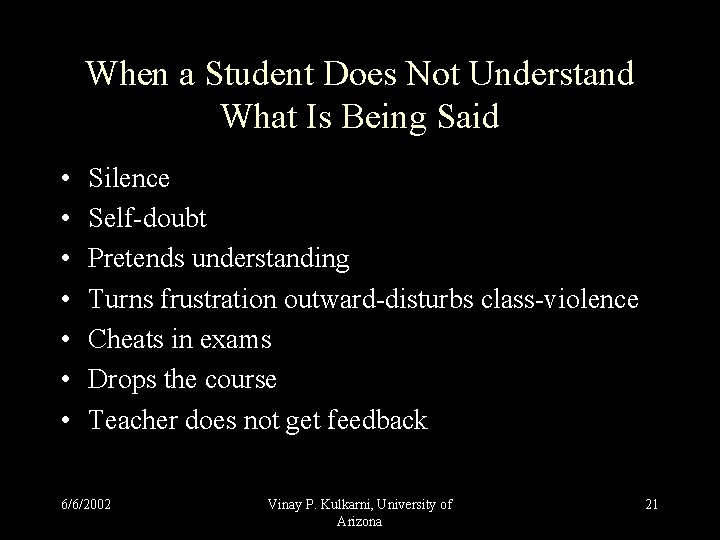
When a Student Does Not Understand What Is Being Said • • Silence Self-doubt Pretends understanding Turns frustration outward-disturbs class-violence Cheats in exams Drops the course Teacher does not get feedback 6/6/2002 Vinay P. Kulkarni, University of Arizona 21
What Students Do During Lectures “If students are not thinking during lectures, what are they doing? Their attention drifts after only 10 to 20 minutes. They are listening, asking or responding to questions, or taking notes only half of the time. Up to 15 percent of their time is spent fantasizing”-Lion F. Gardiner (1998) 6/6/2002 Vinay P. Kulkarni, University of Arizona 22
Teacher Thinking • Students are: – dumb – have an attitude problem – not working hard – not interested in what I am teaching • I do not care about them anymore 6/6/2002 Vinay P. Kulkarni, University of Arizona 23
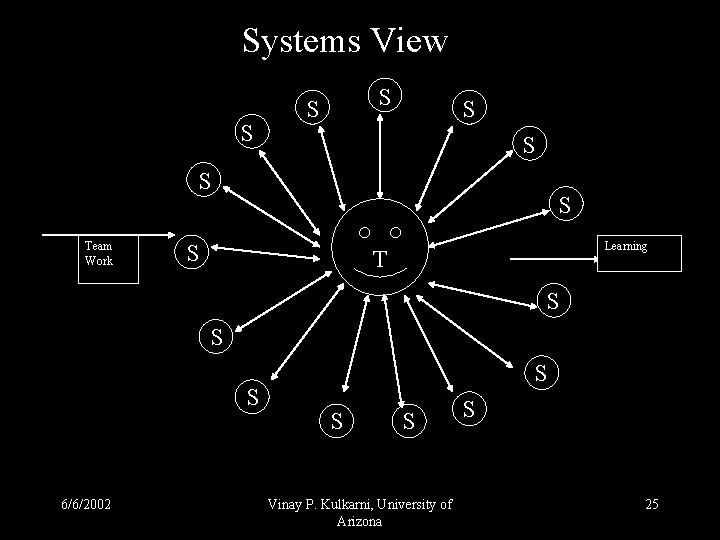
Systems View “Teacher and students are engaged in the process of creating knowledge and understanding. They influence each other and learn from each other. They have a shared vision of their mission in the class-They are a team” 6/6/2002 Vinay P. Kulkarni, University of Arizona 24
Systems View S S S Team Work S S Learning T S S S 6/6/2002 S S S Vinay P. Kulkarni, University of Arizona S 25
Learning by Doing • That is how nature intended us to learn • Driving Lecture Vs. Driving Lessons • The Tulving Memory Model – Semantic, Episodic and Procedural Memories • People with good semantic memories can give an impression of understanding • Often, contents of Procedural Memory cannot be easily put into words 6/6/2002 Vinay P. Kulkarni, University of Arizona 26
Student Buy-in • Buy-in before application of concept • Will you be willing to buy a car without first test driving it? • Create the capacity for change 6/6/2002 Vinay P. Kulkarni, University of Arizona 27
Student Reaction to the Regular Course “…a statistics course should include more topics on the usefulness of the analytical methods… amount of "raw math" taught be decreased and explanations for why we use hypothesis testing, distribution curves, etc. be added to the course curriculum. ” 6/6/2002 Vinay P. Kulkarni, University of Arizona 28
Statistical Thinking Course-Response “…. was easier for me to relate to the soccer field than to relate to a job environment…the questions asked stimulated participation, aided in the learning process, made us think more deeply about what was being said. ” 6/6/2002 Vinay P. Kulkarni, University of Arizona 29
An Insightful Student Response “…. most classes dull your brain and kill any creative process. . …the more time that you spend in classes, the more bored you become with a subject and the less likely you are to learn and succeed. But, I remember more from those two Statistical Thinking lectures than I can recall from any other two lectures in any class--even when I just get out of that class” 6/6/2002 Vinay P. Kulkarni, University of Arizona 30
Recommendations • • • TA & faculty training Faculty Collaboration Empathy, Creativity, Shared responsibility Exams & Laboratories for learning and testing Less lecture, more class activities 6/6/2002 Vinay P. Kulkarni, University of Arizona 31
Recommendations • • Understanding & Retention vs. Width of exposure Encourage ‘Christopherian’ confrontations Increase the efficiency of the learning process Communicate instructions in writing – Students – Teaching Assistants 6/6/2002 Vinay P. Kulkarni, University of Arizona 32