
path Chirp Efficient Available Bandwidth Estimation Vinay Ribeiro
path. Chirp Efficient Available Bandwidth Estimation Vinay Ribeiro Rice University Rolf Riedi Rich Baraniuk (Rice) Jiri Navratil Les Cottrell (SLAC)
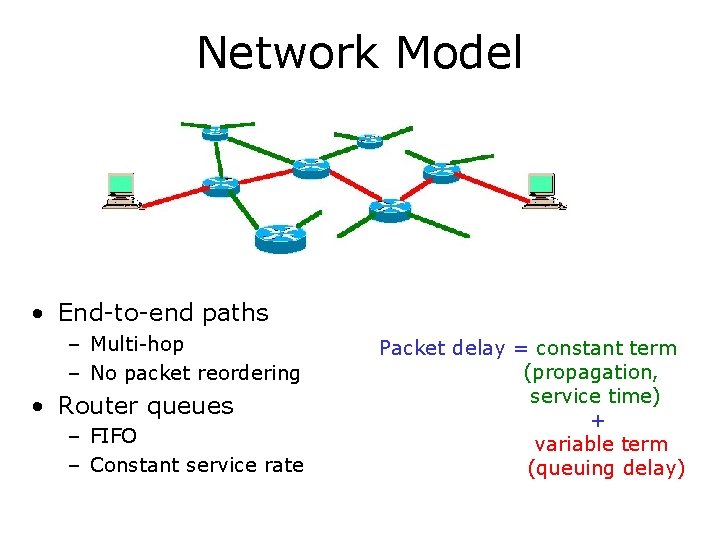
Network Model • End-to-end paths – Multi-hop – No packet reordering • Router queues – FIFO – Constant service rate Packet delay = constant term (propagation, service time) + variable term (queuing delay)
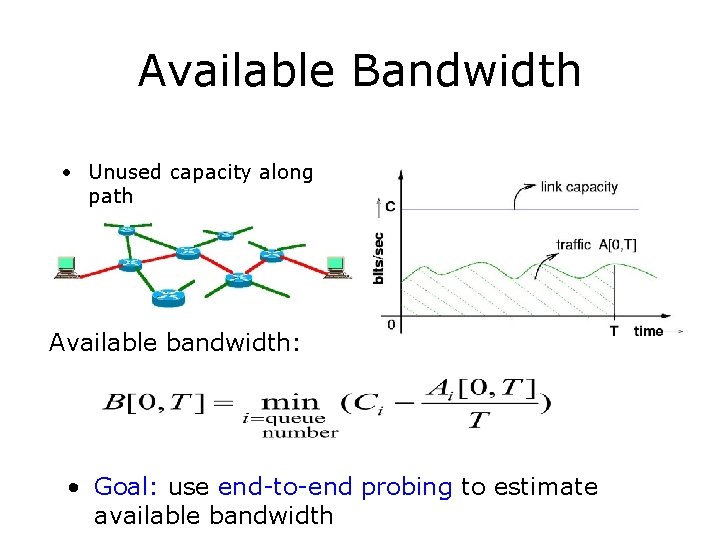
Available Bandwidth • Unused capacity along path Available bandwidth: • Goal: use end-to-end probing to estimate available bandwidth
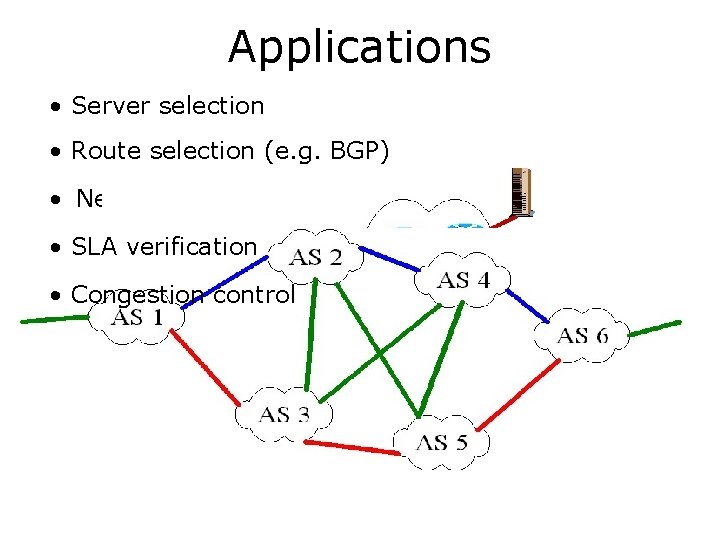
Applications • Server selection • Route selection (e. g. BGP) • Network monitoring • SLA verification • Congestion control
Available Bandwidth Probing Tool Requirements • Fast estimate within few RTTs • Unobtrusive introduce light probing load • Accurate • No topology information (e. g. link speeds) • Robust to multiple congested links
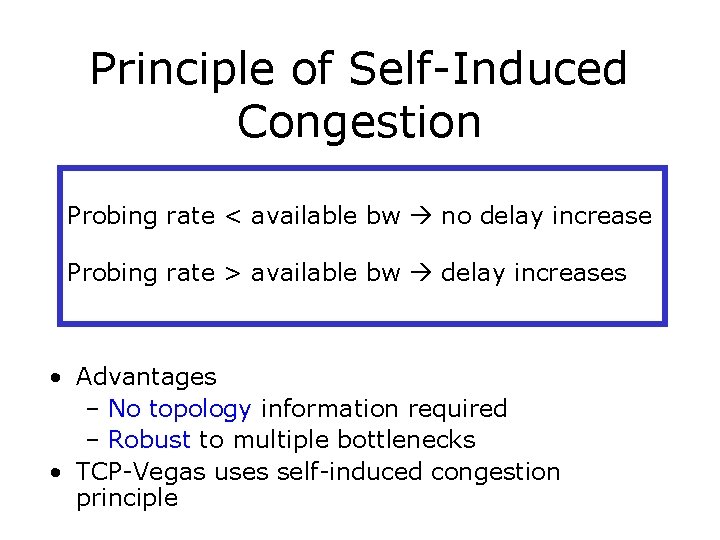
Principle of Self-Induced Congestion Probing rate < available bw no delay increase Probing rate > available bw delay increases • Advantages – No topology information required – Robust to multiple bottlenecks • TCP-Vegas uses self-induced congestion principle
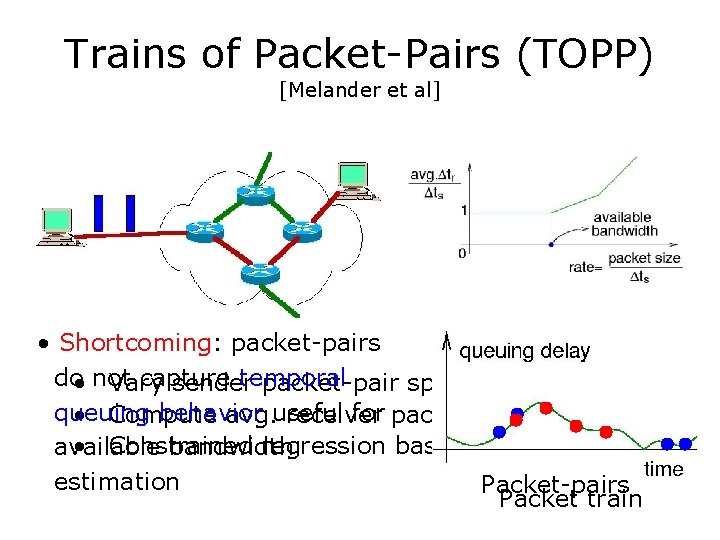
Trains of Packet-Pairs (TOPP) [Melander et al] • Shortcoming: packet-pairs do • not capture temporal Vary sender packet-pair spacing queuing behavior for packet-pair spacing • Compute avg. useful receiver • Constrained regression based estimate available bandwidth estimation Packet-pairs Packet train
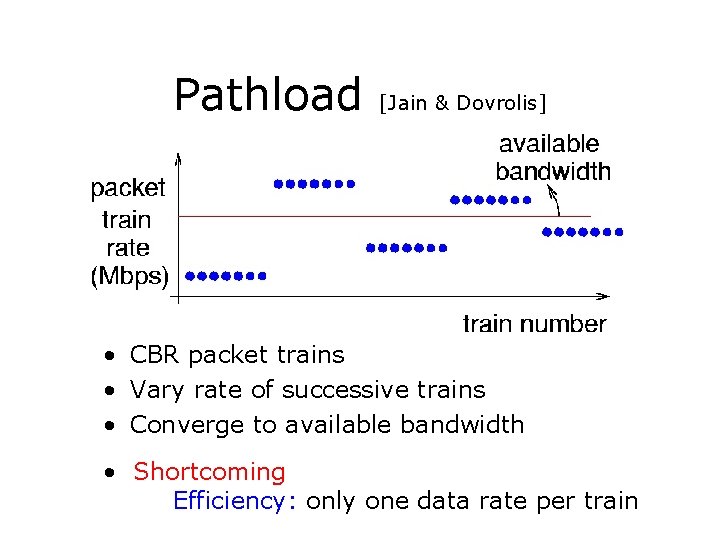
Pathload [Jain & Dovrolis] • CBR packet trains • Vary rate of successive trains • Converge to available bandwidth • Shortcoming Efficiency: only one data rate per train
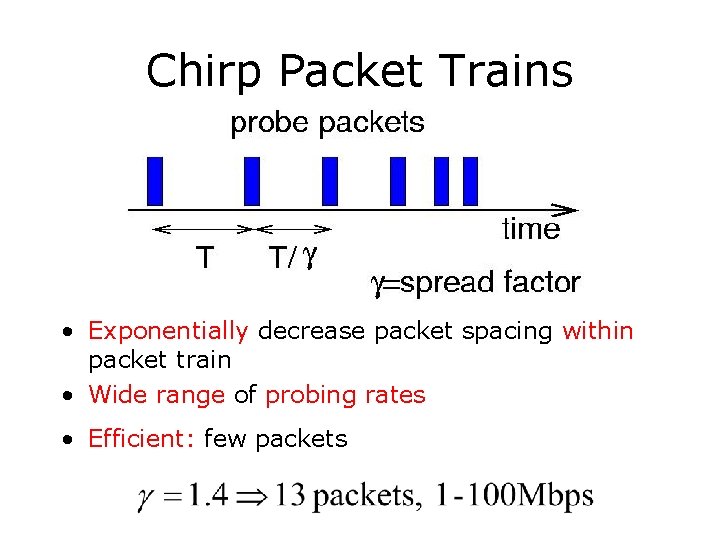
Chirp Packet Trains • Exponentially decrease packet spacing within packet train • Wide range of probing rates • Efficient: few packets
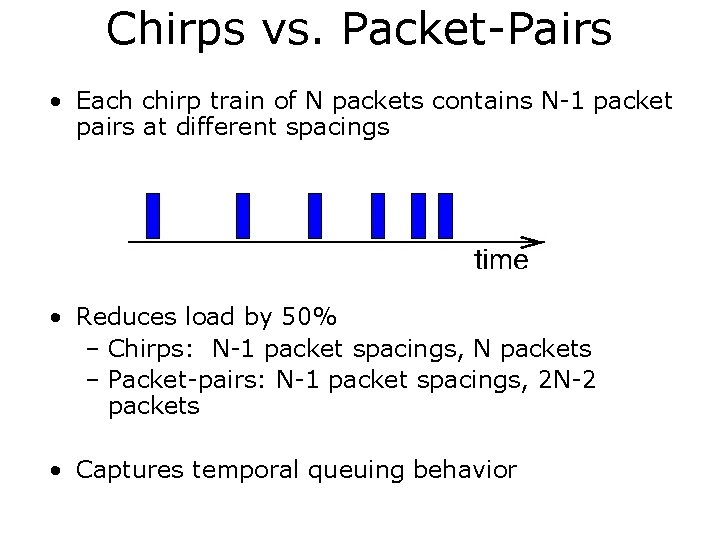
Chirps vs. Packet-Pairs • Each chirp train of N packets contains N-1 packet pairs at different spacings • Reduces load by 50% – Chirps: N-1 packet spacings, N packets – Packet-pairs: N-1 packet spacings, 2 N-2 packets • Captures temporal queuing behavior
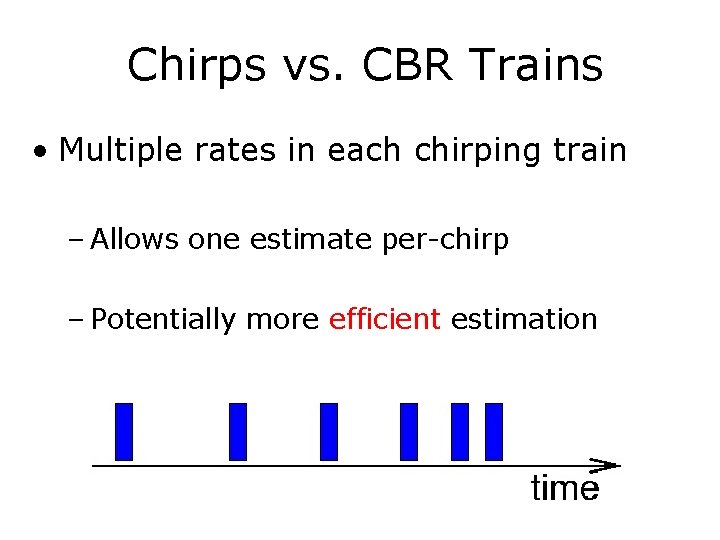
Chirps vs. CBR Trains • Multiple rates in each chirping train – Allows one estimate per-chirp – Potentially more efficient estimation
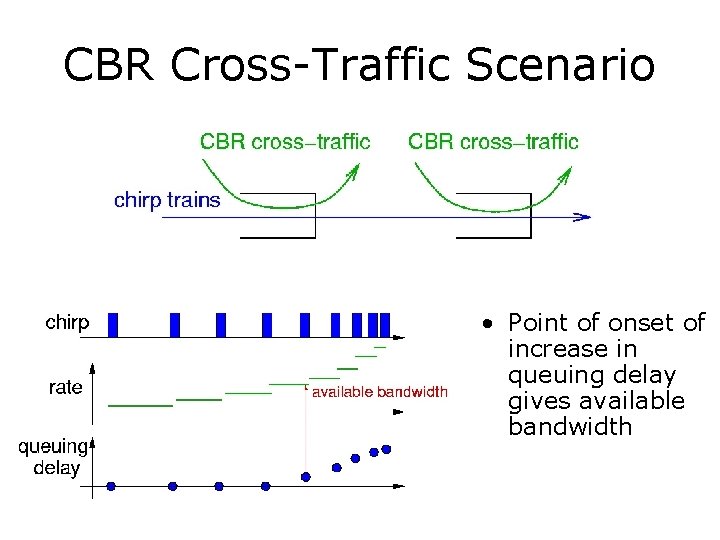
CBR Cross-Traffic Scenario • Point of onset of increase in queuing delay gives available bandwidth
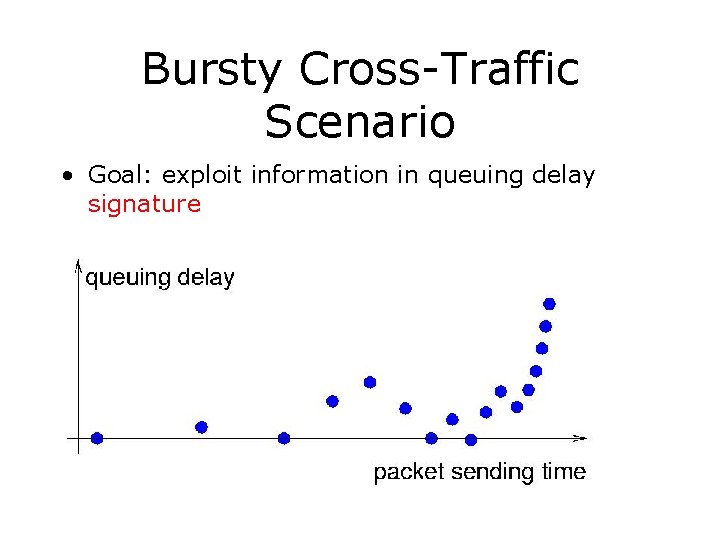
Bursty Cross-Traffic Scenario • Goal: exploit information in queuing delay signature
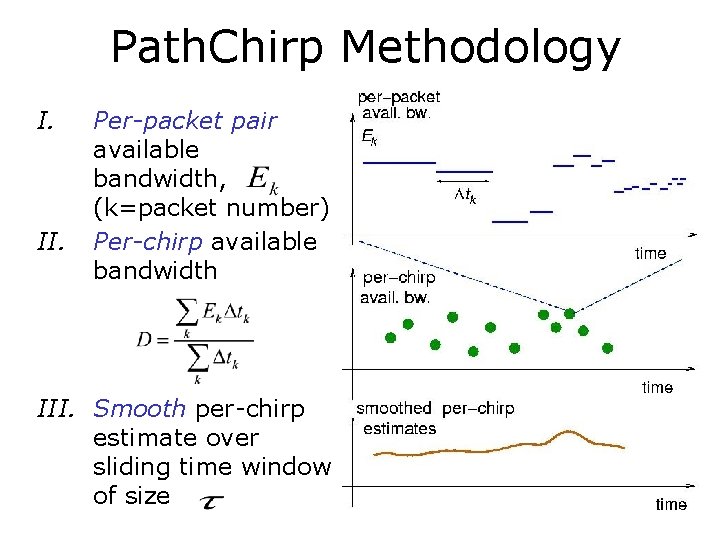
Path. Chirp Methodology I. II. Per-packet pair available bandwidth, (k=packet number) Per-chirp available bandwidth III. Smooth per-chirp estimate over sliding time window of size
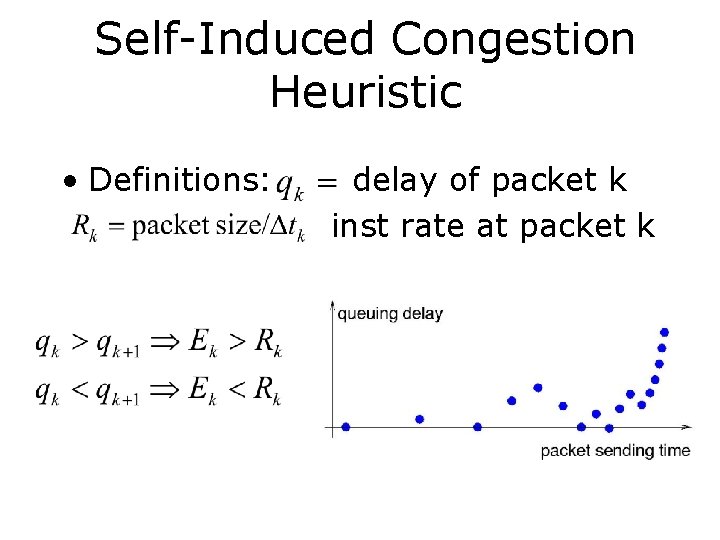
Self-Induced Congestion Heuristic • Definitions: delay of packet k inst rate at packet k
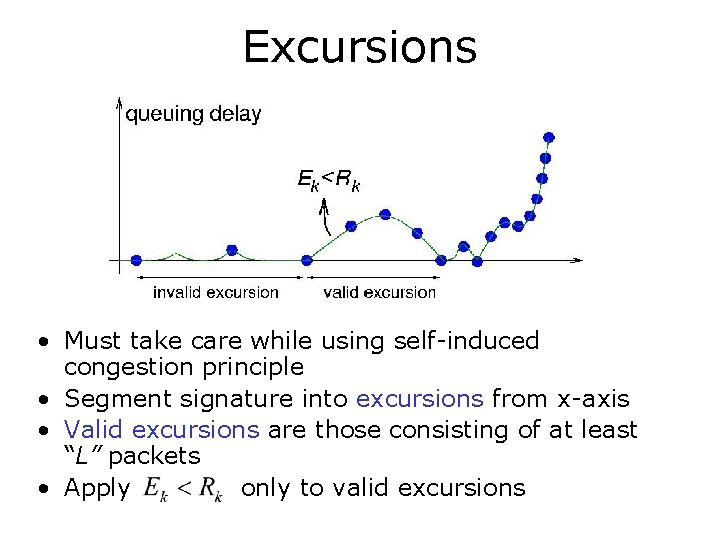
Excursions • Must take care while using self-induced congestion principle • Segment signature into excursions from x-axis • Valid excursions are those consisting of at least “L” packets • Apply only to valid excursions
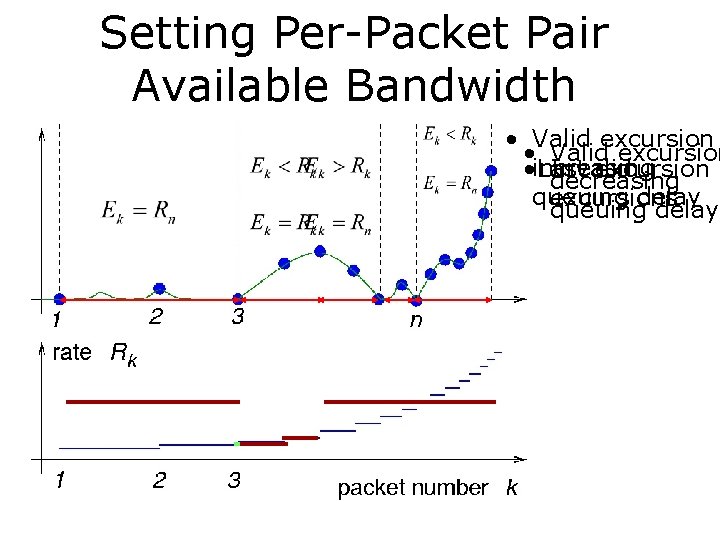
Setting Per-Packet Pair Available Bandwidth • Valid excursion • increasing Last Invalid excursion decreasing queuing delay excursions queuing delay
path. Chirp Tool • UDP probe packets • No clock synchronization required, only uses relative queuing delay within a chirp duration • Computation at receiver • Context switching detection • User specified average probing rate • open source distribution at spin. rice. edu
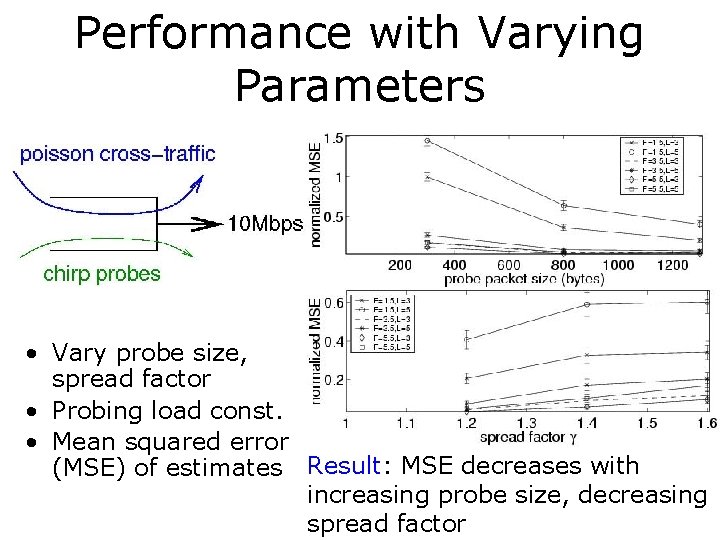
Performance with Varying Parameters • Vary probe size, spread factor • Probing load const. • Mean squared error (MSE) of estimates Result: MSE decreases with increasing probe size, decreasing spread factor
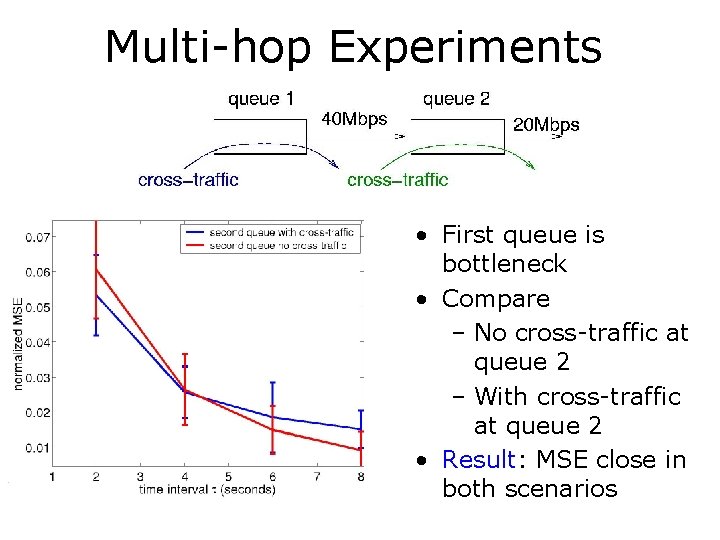
Multi-hop Experiments • First queue is bottleneck • Compare – No cross-traffic at queue 2 – With cross-traffic at queue 2 • Result: MSE close in both scenarios
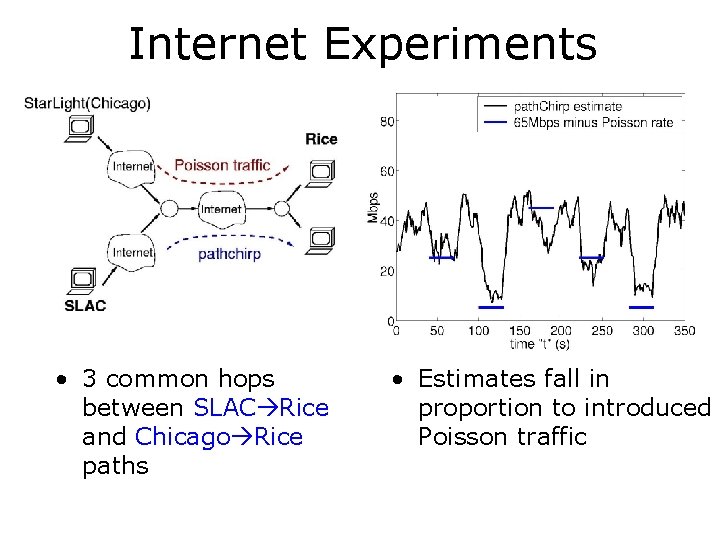
Internet Experiments • 3 common hops between SLAC Rice and Chicago Rice paths • Estimates fall in proportion to introduced Poisson traffic
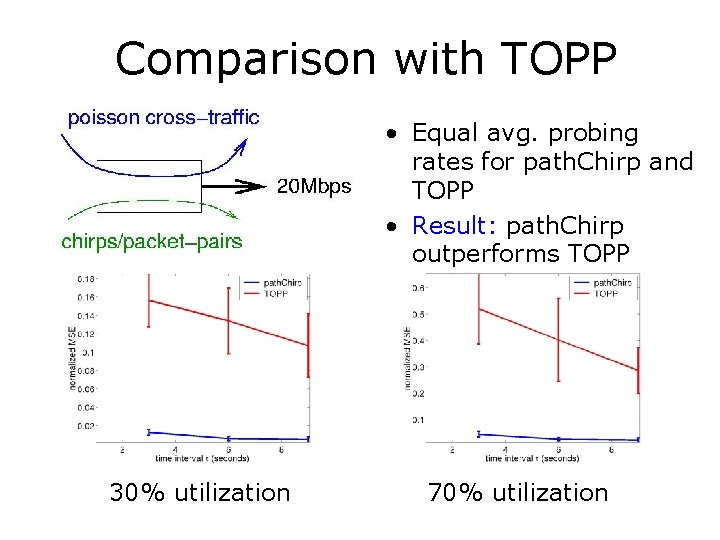
Comparison with TOPP • Equal avg. probing rates for path. Chirp and TOPP • Result: path. Chirp outperforms TOPP 30% utilization 70% utilization
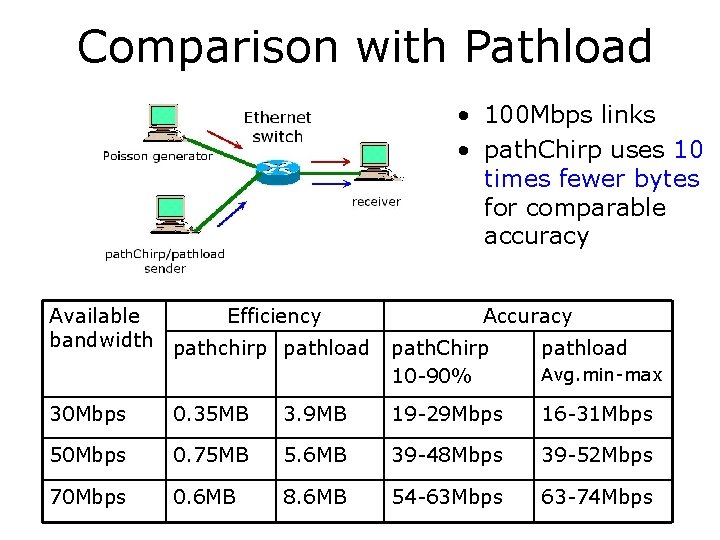
Comparison with Pathload • 100 Mbps links • path. Chirp uses 10 times fewer bytes for comparable accuracy Available Efficiency bandwidth pathchirp pathload Accuracy path. Chirp 10 -90% pathload Avg. min-max 30 Mbps 0. 35 MB 3. 9 MB 19 -29 Mbps 16 -31 Mbps 50 Mbps 0. 75 MB 5. 6 MB 39 -48 Mbps 39 -52 Mbps 70 Mbps 0. 6 MB 8. 6 MB 54 -63 Mbps 63 -74 Mbps
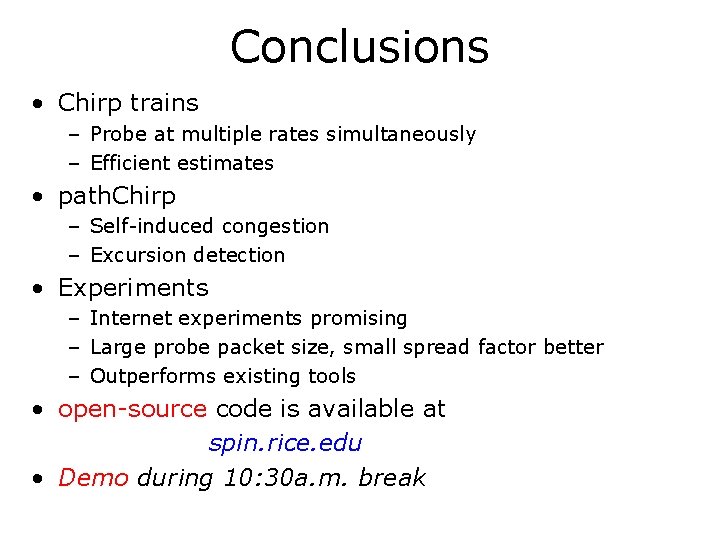
Conclusions • Chirp trains – Probe at multiple rates simultaneously – Efficient estimates • path. Chirp – Self-induced congestion – Excursion detection • Experiments – Internet experiments promising – Large probe packet size, small spread factor better – Outperforms existing tools • open-source code is available at spin. rice. edu • Demo during 10: 30 a. m. break
- Slides: 24