SSE as a Transitional Path Towards a Degrowth


- Slides: 21
SSE as a Transitional Path Towards a Degrowth Society The case of the Geneva Canton Mònica Serlavós 4 th International Degrowth Conference, Leipzig, Germany 2 -6 September 2014 Social & Solidarity Economy
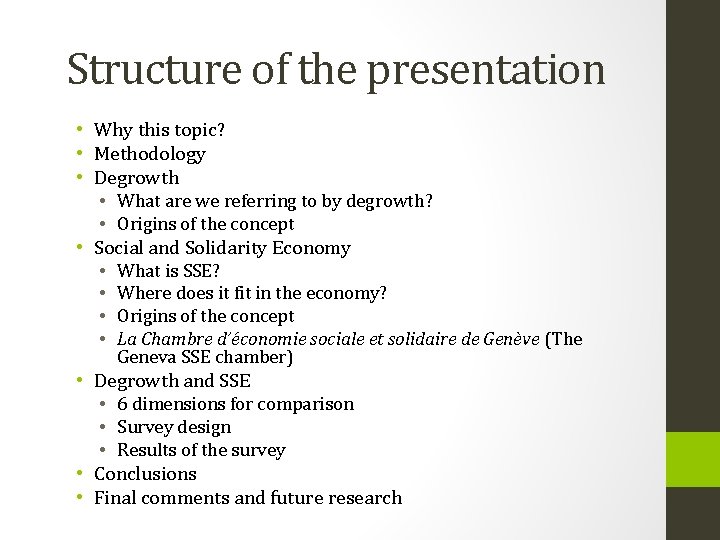
Structure of the presentation • Why this topic? • Methodology • Degrowth • What are we referring to by degrowth? • Origins of the concept • Social and Solidarity Economy • What is SSE? • Where does it fit in the economy? • Origins of the concept • La Chambre d’économie sociale et solidaire de Genève (The Geneva SSE chamber) • Degrowth and SSE • 6 dimensions for comparison • Survey design • Results of the survey • Conclusions • Final comments and future research
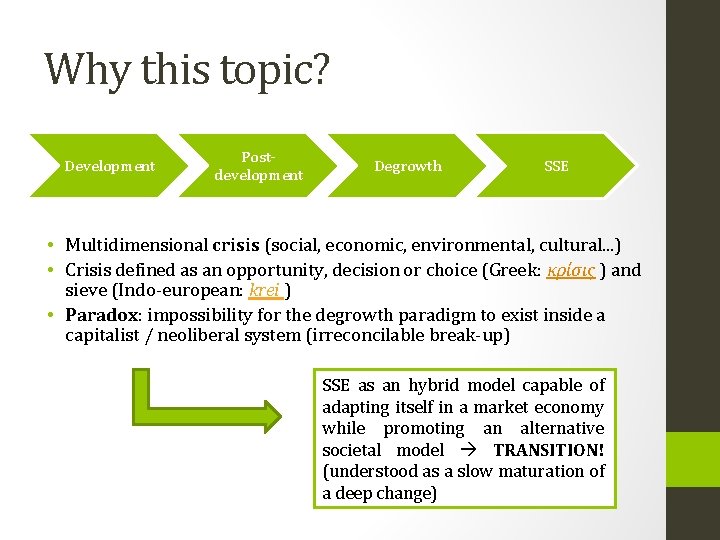
Why this topic? Development Postdevelopment Degrowth SSE • Multidimensional crisis (social, economic, environmental, cultural. . . ) • Crisis defined as an opportunity, decision or choice (Greek: κρίσις ) and sieve (Indo-european: krei ) • Paradox: impossibility for the degrowth paradigm to exist inside a capitalist / neoliberal system (irreconcilable break-up) SSE as an hybrid model capable of adapting itself in a market economy while promoting an alternative societal model TRANSITION! (understood as a slow maturation of a deep change)
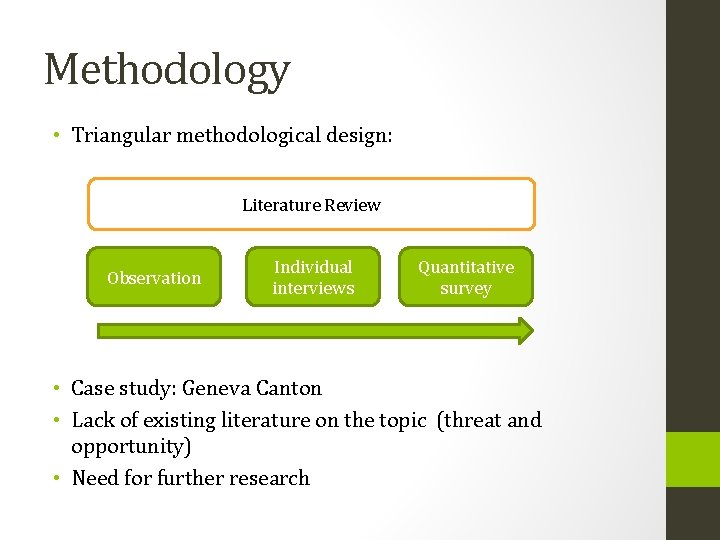
Methodology • Triangular methodological design: Literature Review Observation Individual interviews Quantitative survey • Case study: Geneva Canton • Lack of existing literature on the topic (threat and opportunity) • Need for further research
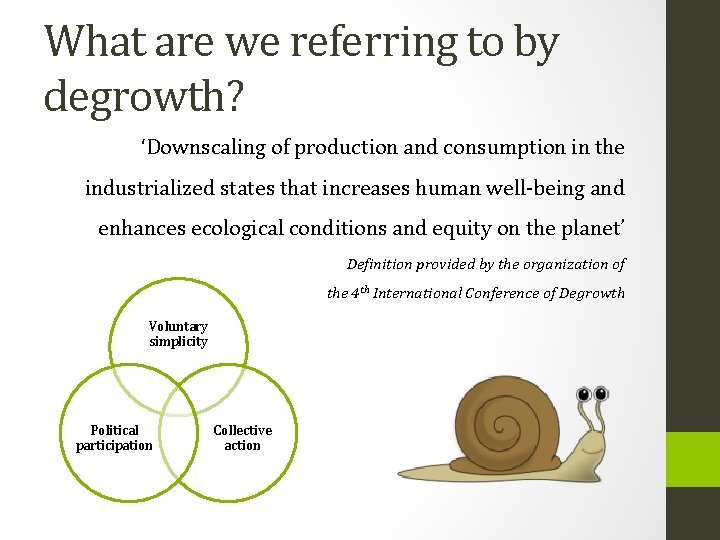
What are we referring to by degrowth? ‘Downscaling of production and consumption in the industrialized states that increases human well-being and enhances ecological conditions and equity on the planet’ Definition provided by the organization of the 4 th International Conference of Degrowth Voluntary simplicity Political participation Collective action
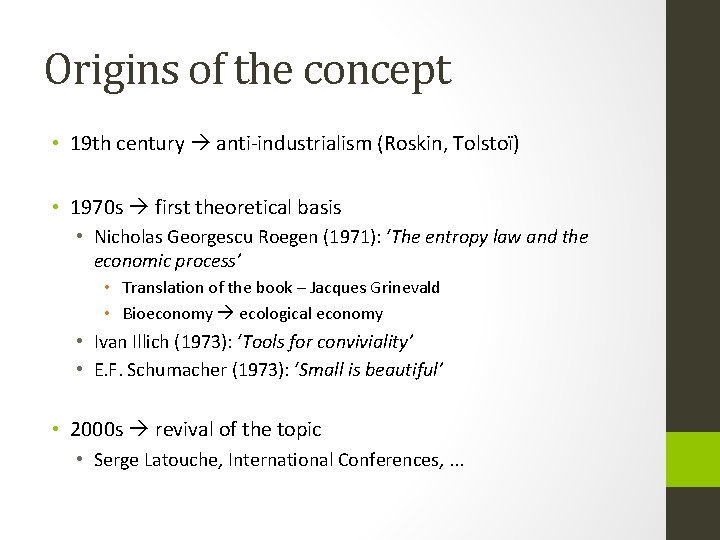
Origins of the concept • 19 th century anti-industrialism (Roskin, Tolstoï) • 1970 s first theoretical basis • Nicholas Georgescu Roegen (1971): ‘The entropy law and the economic process’ • Translation of the book – Jacques Grinevald • Bioeconomy ecological economy • Ivan Illich (1973): ‘Tools for conviviality’ • E. F. Schumacher (1973): ‘Small is beautiful’ • 2000 s revival of the topic • Serge Latouche, International Conferences, . . .
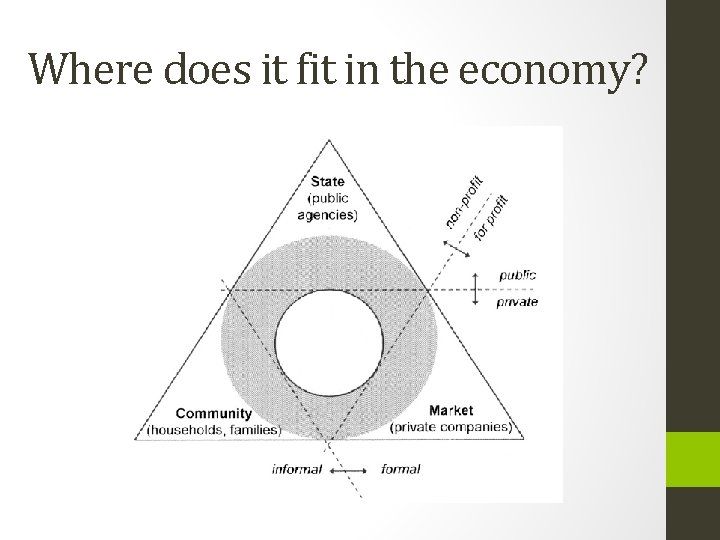
What is SSE? 5 criteria (Lipietz): Social Economy (internal organization) 1. Freedom to adhere Social and Solidarity Economy (public utility) 2. Non-lucrativity 3. Democratic management 4. Collective or social utility 5. Hybridisation of resources
Where does it fit in the economy?
Origins of the concept • 19 th century ‘Social Question’ • 1970 s increase of associations and foundations (self-managed) • From 1980 s – 1990 s resilient model in a context of crisis • Europe = 6. 5% paid employment (UNRISD, conference May 2013) • Switzerland = 10% of paid employment (Pellet, Thierry et al, 2010) • Currently increasingly visible (WSF, RIPESS, EMES, UNRISD, ILO…)
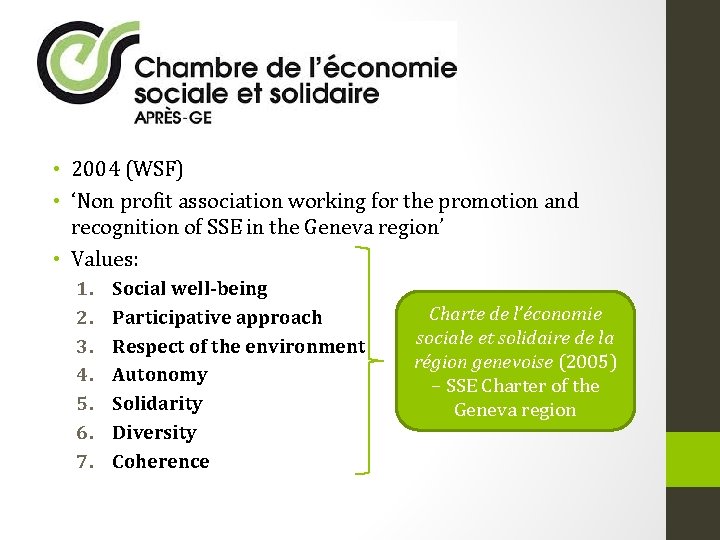
• 2004 (WSF) • ‘Non profit association working for the promotion and recognition of SSE in the Geneva region’ • Values: 1. 2. 3. 4. 5. 6. 7. Social well-being Participative approach Respect of the environment Autonomy Solidarity Diversity Coherence Charte de l’économie sociale et solidaire de la région genevoise (2005) – SSE Charter of the Geneva region
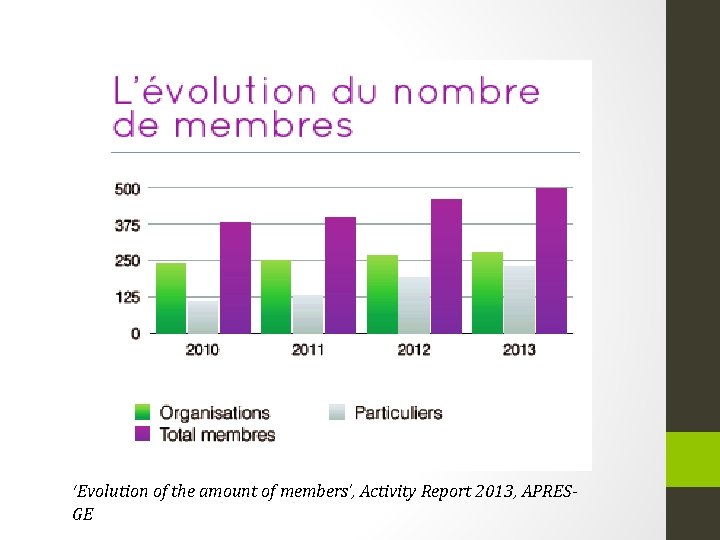
‘Evolution of the amount of members’, Activity Report 2013, APRESGE
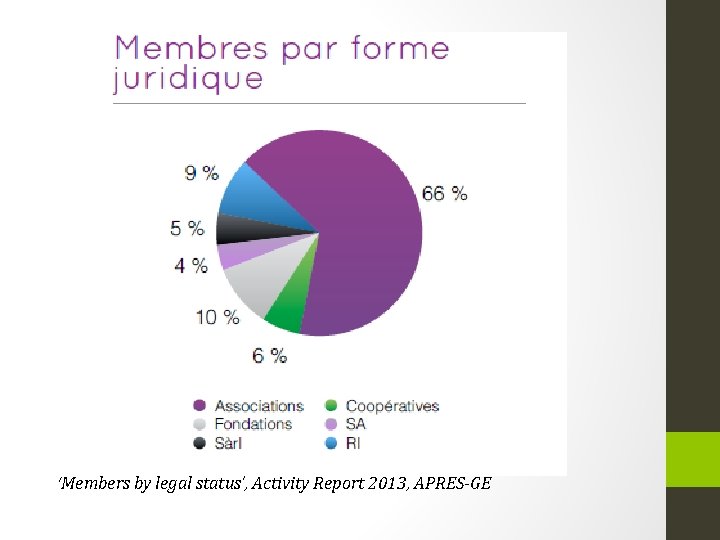
‘Members by legal status’, Activity Report 2013, APRES-GE
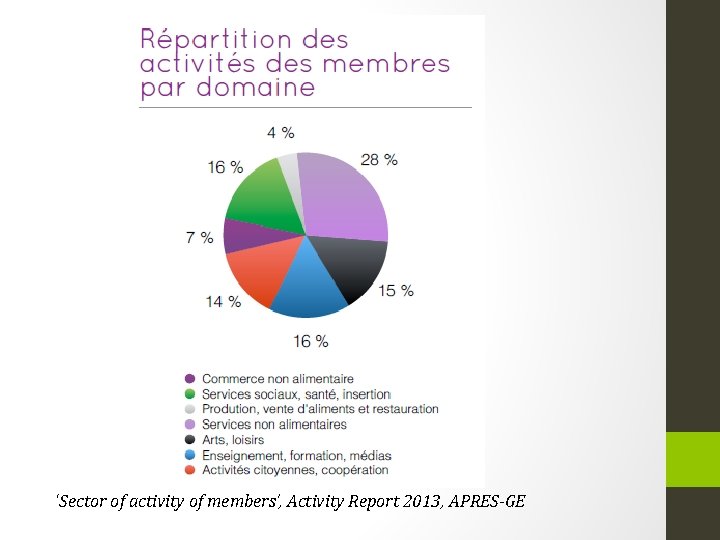
‘Sector of activity of members’, Activity Report 2013, APRES-GE
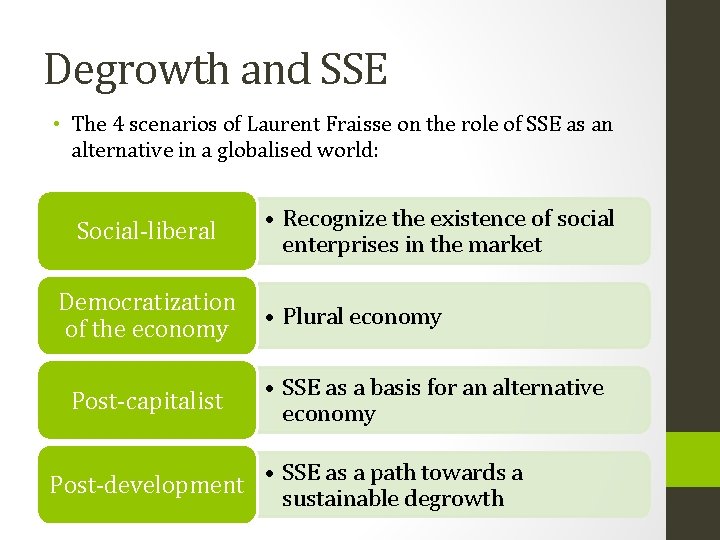
Degrowth and SSE • The 4 scenarios of Laurent Fraisse on the role of SSE as an alternative in a globalised world: Social-liberal Democratization of the economy Post-capitalist • Recognize the existence of social enterprises in the market • Plural economy • SSE as a basis for an alternative economy • SSE as a path towards a Post-development sustainable degrowth
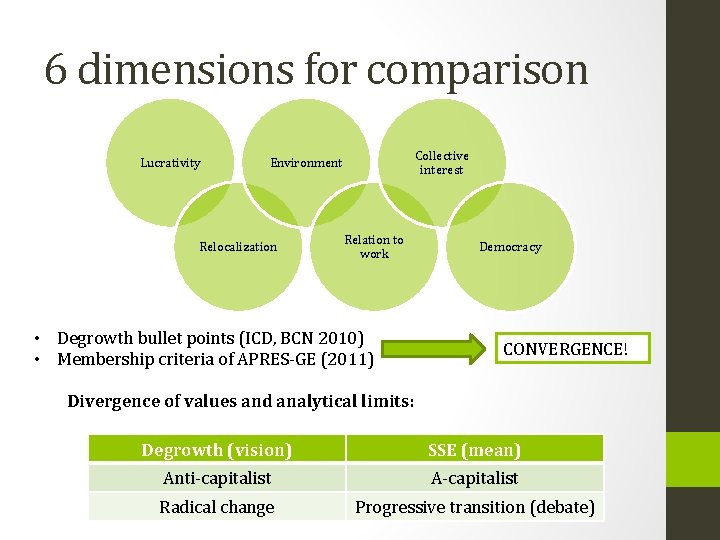
6 dimensions for comparison Lucrativity Collective interest Environment Relocalization Relation to work • Degrowth bullet points (ICD, BCN 2010) • Membership criteria of APRES-GE (2011) Democracy CONVERGENCE! Divergence of values and analytical limits: Degrowth (vision) SSE (mean) Anti-capitalist A-capitalist Radical change Progressive transition (debate)
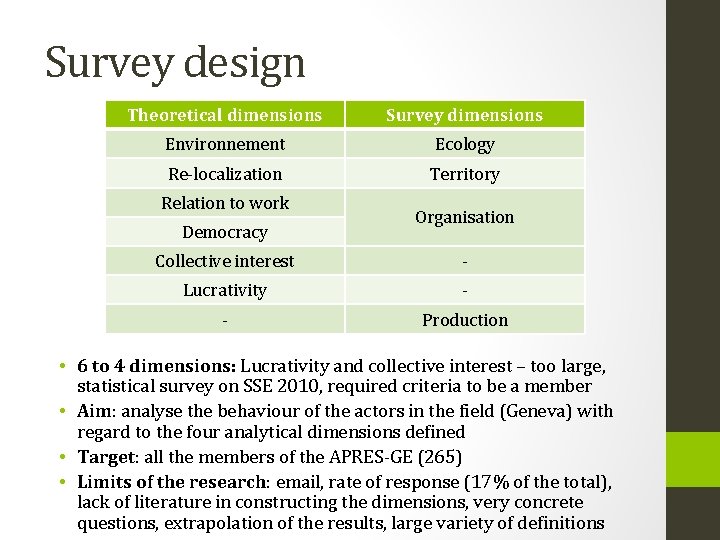
Survey design Theoretical dimensions Survey dimensions Environnement Ecology Re-localization Territory Relation to work Democracy Organisation Collective interest - Lucrativity - - Production • 6 to 4 dimensions: Lucrativity and collective interest – too large, statistical survey on SSE 2010, required criteria to be a member • Aim: analyse the behaviour of the actors in the field (Geneva) with regard to the four analytical dimensions defined • Target: all the members of the APRES-GE (265) • Limits of the research: email, rate of response (17% of the total), lack of literature in constructing the dimensions, very concrete questions, extrapolation of the results, large variety of definitions
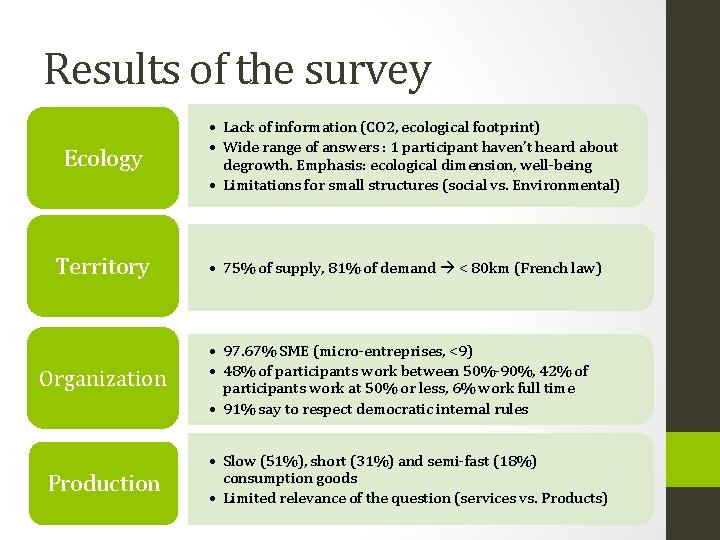
Results of the survey Ecology Territory Organization Production • Lack of information (CO 2, ecological footprint) • Wide range of answers : 1 participant haven’t heard about degrowth. Emphasis: ecological dimension, well-being • Limitations for small structures (social vs. Environmental) • 75% of supply, 81% of demand < 80 km (French law) • 97. 67% SME (micro-entreprises, <9) • 48% of participants work between 50%-90%, 42% of participants work at 50% or less, 6% work full time • 91% say to respect democratic internal rules • Slow (51%), short (31%) and semi-fast (18%) consumption goods • Limited relevance of the question (services vs. Products)
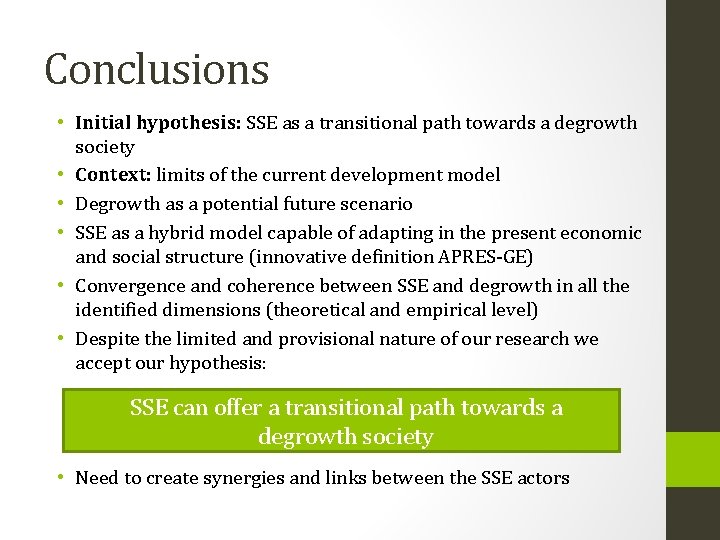
Conclusions • Initial hypothesis: SSE as a transitional path towards a degrowth society • Context: limits of the current development model • Degrowth as a potential future scenario • SSE as a hybrid model capable of adapting in the present economic and social structure (innovative definition APRES-GE) • Convergence and coherence between SSE and degrowth in all the identified dimensions (theoretical and empirical level) • Despite the limited and provisional nature of our research we accept our hypothesis: SSE can offer a transitional path towards a degrowth society • Need to create synergies and links between the SSE actors
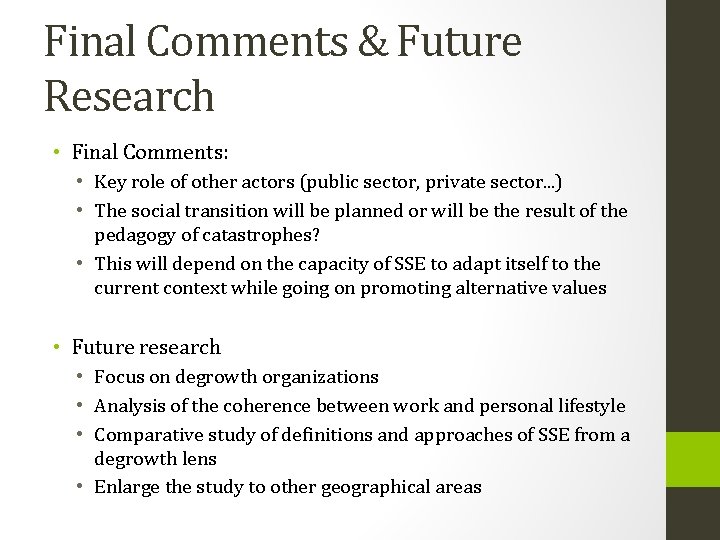
Final Comments & Future Research • Final Comments: • Key role of other actors (public sector, private sector. . . ) • The social transition will be planned or will be the result of the pedagogy of catastrophes? • This will depend on the capacity of SSE to adapt itself to the current context while going on promoting alternative values • Future research • Focus on degrowth organizations • Analysis of the coherence between work and personal lifestyle • Comparative study of definitions and approaches of SSE from a degrowth lens • Enlarge the study to other geographical areas
‘A elle seule, elle ne pourra pas régler toutes les questions centrales qui se posent à l’humanité, c’est certain, mais sans doute est-elle en mesure d’apporter sa pierre à l’édifice d’une économie au service des hommes et non au service de la financiarisation du monde’ ~ ‘By itself, (SSE) won’t be able to fix all the challenges faced by humanity, that’s for sure, but it will undoubtedly contribute to build an economy in the service of people rather than in the service of the world financiarisation’ Thierry Jeantet (2008): ‘L’économie sociale, une alternative au capitalisme’
Questions and remarks. . . ? THANK YOU!