Solids Solid is a state of matter in




- Slides: 23
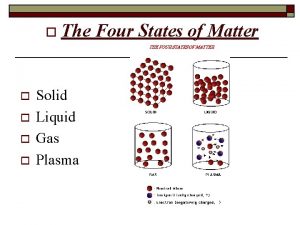
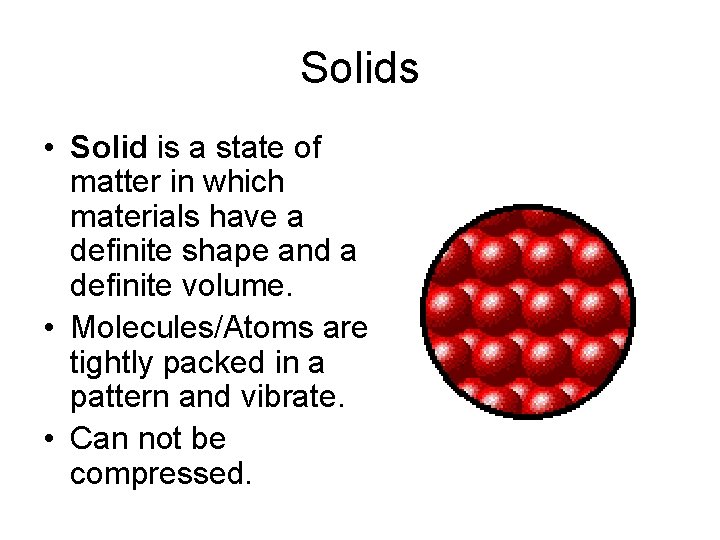
Solids • Solid is a state of matter in which materials have a definite shape and a definite volume. • Molecules/Atoms are tightly packed in a pattern and vibrate. • Can not be compressed.
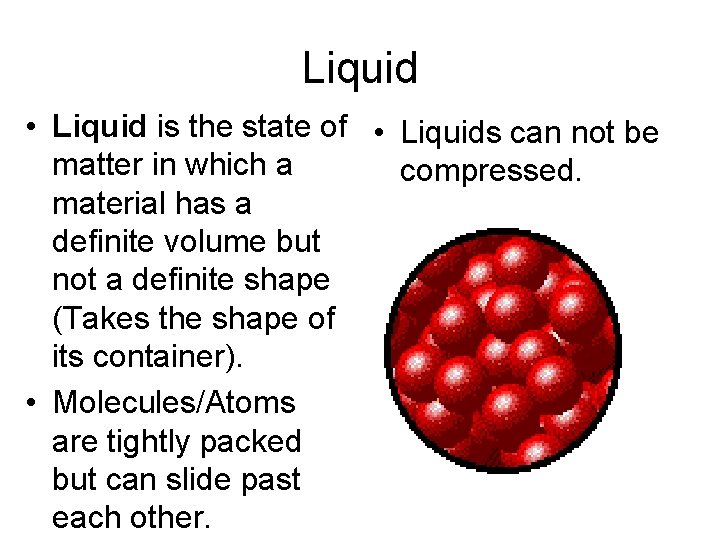
Liquid • Liquid is the state of • Liquids can not be matter in which a compressed. material has a definite volume but not a definite shape (Takes the shape of its container). • Molecules/Atoms are tightly packed but can slide past each other.
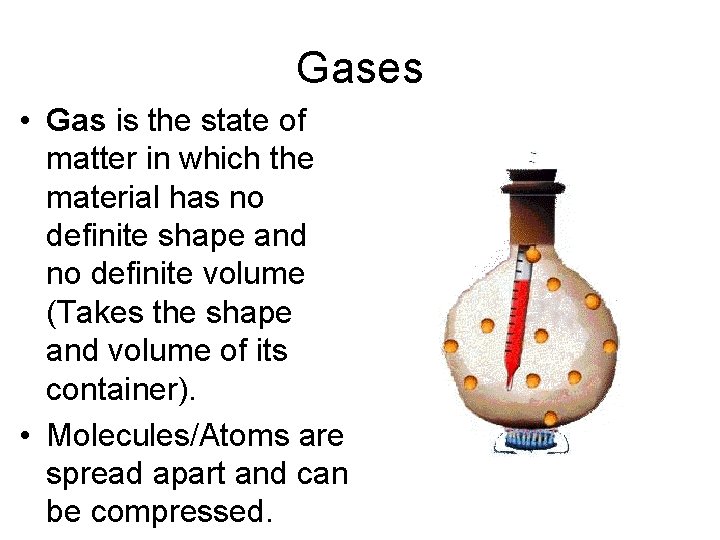
Gases • Gas is the state of matter in which the material has no definite shape and no definite volume (Takes the shape and volume of its container). • Molecules/Atoms are spread apart and can be compressed.
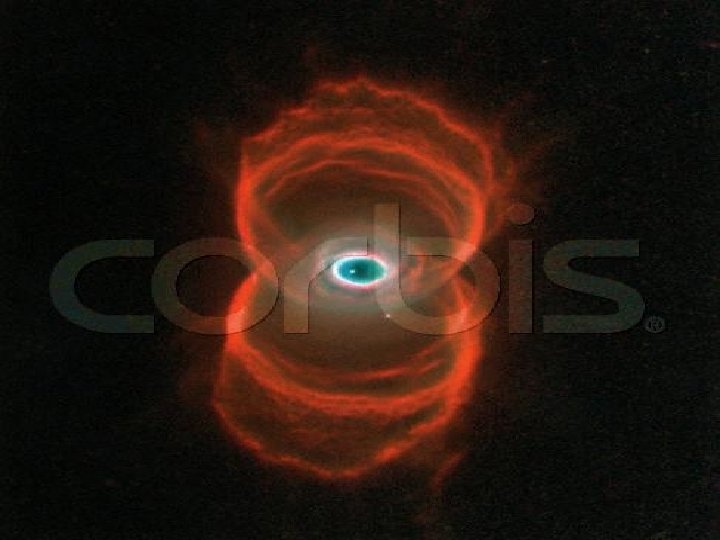
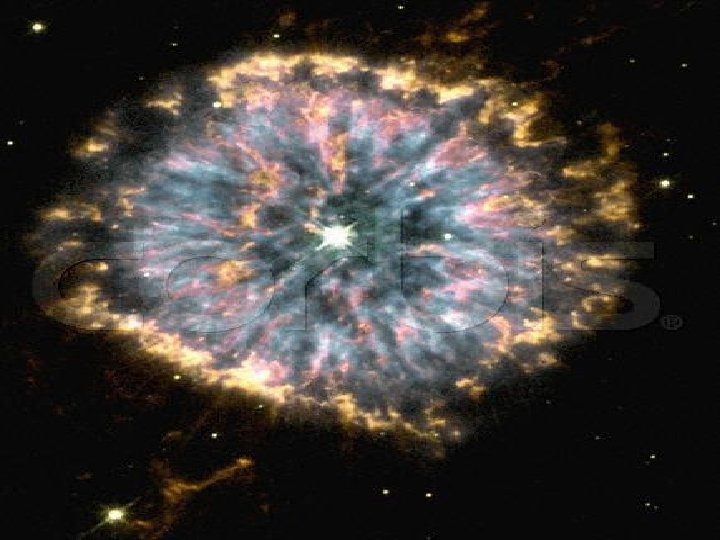
Other States/Phases • Plasma is the most • Bose-Einstein Condensate – at common state of very low matter in the temperatures (near universe (99%). 273°C) atoms • It is a highly behave as though charged (ionized) they were a single gas. particle. • Present in stars. • Check it out http: //www. colorado. edu/physics/2000/bec/what_is_it. html
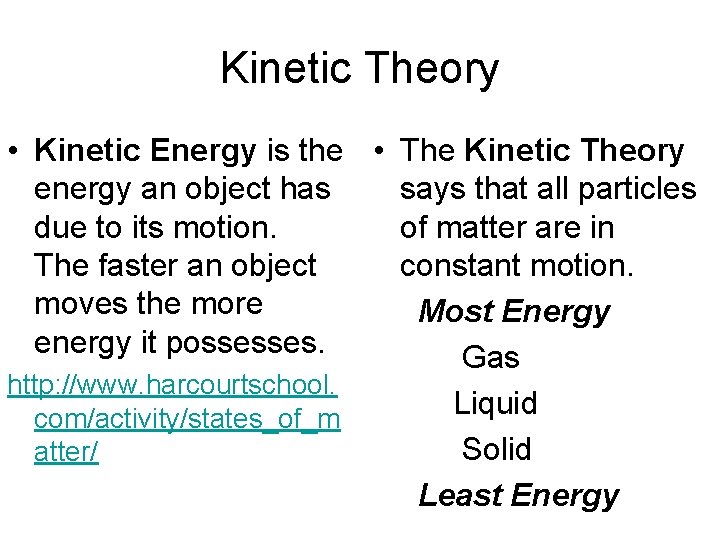
Kinetic Theory • Kinetic Energy is the • The Kinetic Theory energy an object has says that all particles due to its motion. of matter are in The faster an object constant motion. moves the more Most Energy energy it possesses. Gas http: //www. harcourtschool. Liquid com/activity/states_of_m Solid atter/ Least Energy
Kinetic Theory of Gas • Gas – Particles in a gas are in constant, random motion. – The motion of one particle in unaffected by the motion of other particles unless the particles collide. – Forces of attraction among particles in a gas can be ignored under ordinary conditions.
Kinetic Theory for Liquids and Solids • Liquids take the shape of the container because particles in a liquid can flow to new locations. The volume of a liquid is constant because the force of attraction keep the particles close together. • Solids have a definite volume and shape because particles in a solid vibrate around a fixed point.
Gas Laws • Pressure is the result of a force (Push) distributed over an area. – Unit pascal (Pa) or Newton/meter 2 (N/m 2) • Collisions between particles of a gas and the walls of the container cause the pressure in a closed container of gas. • Raising the temperature of a gas will increase its pressure if the volume and the number of particles are constant. • Reducing the volume of a gas will increase the pressure if the volume and the number of particles are constant.
Charles’s Law V 1/T 1=V 2/T 2 • Charles’s Law states that a volume of gas is directly proportional to its temperature in kelvins if the pressure and the number of particles remains constant. • V = Volume • T = Temperature • 1 = before the change • 2 = after the change • Absolute Zero (0 K) is the temperature at which the atoms/molecules of matter stop moving. • 0 K = -273°C • 273 K = 0°C • 373 K = 100°C
Boyle’s Law P 1 V 1=P 2 V 2 • Boyle’s Law states that the volume of a gas is inversely proportional to its pressure if the temperature and the number of particles are constant. • P = Pressure • V = Volume • Combination of the two laws. P 1 V 1 = P 2 V 2 T 1 T 2
Phase Change • A Phase Change is • the reversible physical change that occurs when a substance • changes from one state of matter to another. The temperature of a substance does not change during a phase change. Energy is either absorbed or released during a phase change. • http: //Weather Related News http: //Atoms Family
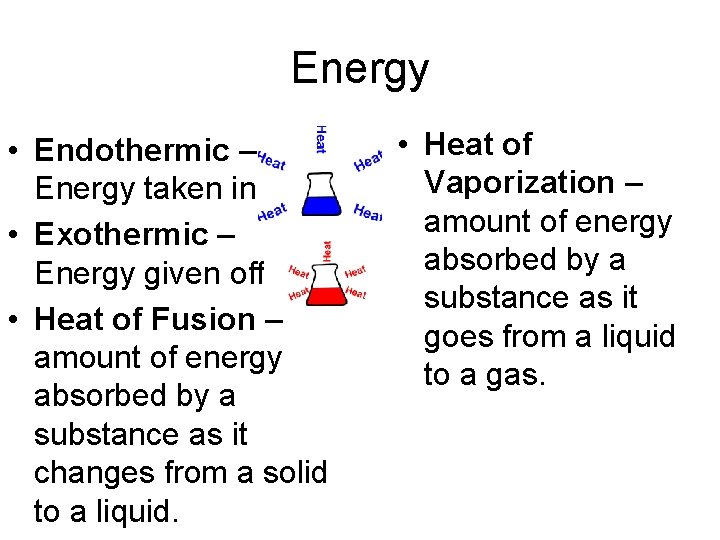
Energy • Endothermic – Energy taken in • Exothermic – Energy given off • Heat of Fusion – amount of energy absorbed by a substance as it changes from a solid to a liquid. • Heat of Vaporization – amount of energy absorbed by a substance as it goes from a liquid to a gas.
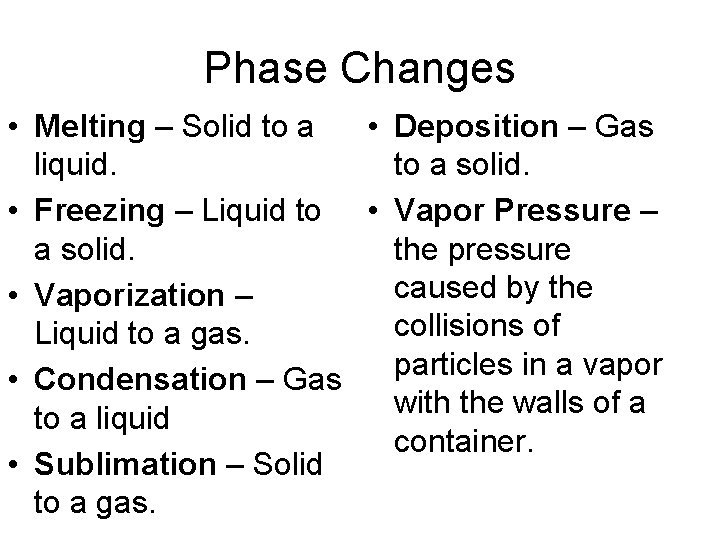
Phase Changes • Melting – Solid to a • Deposition – Gas liquid. to a solid. • Freezing – Liquid to • Vapor Pressure – a solid. the pressure caused by the • Vaporization – collisions of Liquid to a gas. particles in a vapor • Condensation – Gas with the walls of a to a liquid container. • Sublimation – Solid to a gas.