SOCIOLINGUISTICS Anisa Larassati M Ling Lecture 1 Introduction





- Slides: 63
SOCIOLINGUISTICS Anisa Larassati, M. Ling
Lecture 1 Introduction 2018/2019
KEY CONCEPTS • What is sociolinguistics? • Sociolinguistics vs Sociology of Language • What does sociolinguist study?
WHAT IS SOCIOLINGUISTICS? • Sociolinguistics is the field that studies the relation between language and society, between the uses of language and the social structures in which the users of language live (Spolsky, 1988, p. 3). • Sociolinguistics “deals with the inter-relationships between language and society. It has strong connections […] to sociology, through the crucial role that language plays in the organization of social groups and institutions. ” (Yule 1996, p. 239)
WHAT IS SOCIOLINGUISTICS? • By society, we mean a group of people who are drawn together for a certain purpose or purposes; • The term language means a system of linguistic communication particular to a group; this includes spoken, written, and signed modes of communication. (Wardhaugh, 2015, p. 2)
WHAT IS SOCIOLINGUISTICS? • Thus, while in sociolinguistics we do analyze speech with the goal of making generalizations, we also question these generalizations and examine how they, in turn, influence how we use language. • Sociolinguistics is not a study of facts (e. g. , men call each other nicknames) , but the study of ideas about how societal norms are intertwined with our language use (e. g. what it means to be a male or female member of a particular society may influence the terms we use to address each other) • (Wardhaugh, 2015, p. 1)
WHAT DOES SOCIOLINGUISTS STUDY? HOW? • Sociolinguists study the way that language is used in normal life, by all kinds of people, to accomplish all manner of goals is the subject of our attention. Language lets us do things and as such can be used to exercise or resist power. • Sociolinguists use a range of methods to analyse patterns of language in use and attitudes towards language in use.
WHAT DOES SOCIOLINGUISTS STUDY? HOW? Study language pattern trough: • Close examination of recorded speech, speaker’s background/ place in community (ex: research on dialects) • Library research, archive, newspaper, magazine, school textbooks (ex: research on language planning)
WHAT DOES SOCIOLINGUISTS STUDY? HOW? • Sociolinguists are interested in both ‘social’ and ‘linguistic’ questions. • Some sociolinguistics research has more to say about social issues, and some sociolinguistic research has more to say about linguistic matters. Regardless of its emphasis, it has something to say about both linguistic structure and social structure. (Meyerhoff, 2006, p. 3)
HOW DO SOCIOLINGUISTS WORK? What are the social factors involved? What social dimensions are involved in sociolinguistic analysis? • Participants: who talks to whom? • Solidarity / social distance: intimacy vs. distance of interlocutors • Setting: where are they speaking? • Status / power: superiority vs. subordination of interlocutors • Topic: what are they talking about? • Function: why are they speaking? • Formality: high vs. low formality (setting / type of interaction) • Function: referential (“objective” information content, e. g. news report) vs. affective function (subjective, affective content, e. g. tell about feelings)
MICRO-SOCIOLINGUISTICS VS MACRO-SOCIOLINGUISTICS (WARDHAUGH, 2015, P. 15) Sociolinguistics (Micro-Sociolinguistics) • ‘the study of language in relation to society’ • how social structure influences the way people talk and how language varieties and patterns of use correlate with social attributes such as class, sex, and age • Goal: better understanding the structure of language and how languages function in communication • The structure of language Sociology of Language (Macro. Sociolinguistics) • ‘the study of society in relation to language’ • studies what societies do with their languages, that is, attitudes and attachments that account for the functional distribution of speech forms in society, language shift, maintenance, and replacement, the delimitation and interaction of speech communities’ • Goal: discover how social structure can be better understood through the study of language • The structure of society
TYPES OF SOCIOLINGUISTICS STUDIES • Correlational studies : relate two or more variables (e. g. , certain linguistic forms and social-class differences, e. g. : “ndes”) • Micro-linguistic studies : i. e. focuses on very specific linguistic items or individual differences and uses in order to search for possibly wide ranging linguistic and/or social implication (e. g. the distribution of singing and singin’) • Discourse analysis : i. e. studies of conversational structure and how speakers use language for their special purposes (how we begin and end conversations, how this depend on the relationship between interlocutors)
TYPES OF SOCIOLINGUISTICS STUDIES • Macro-linguistic studies : i. e. studies that examine large amounts of language data to draw broad conclusions about group relationships ( e. g. choices made in language planning, language shift) • Critical analyses : i. e. how language is used to create and perpetuate power structures. May overlap with discourse analysis and macro-linguistic studies (e. g. how people talk about multilingualism could be analyzed in discourse, or language planning and policies related to multilingualism)
SCOPE OF SOCIOLINGUISTICS • Language varieties • Language attitude • Language choice • Language planning and standardization (mostly related to prescriptive) • Language shift • Language and identity (gender, age, ethnicity) • Language documentation and maintenance • Language and power • etc
PRESCRIPTIVISM VS DESCRIPTIVISM Prescriptivism • Recommends how language should be use Descriptivism • Observe and records how language actually is used (ex. Malaysian English Video) • Example: • I’m right behind you, aren’t I? • I’m right behind you, what? • I can’t see you also.
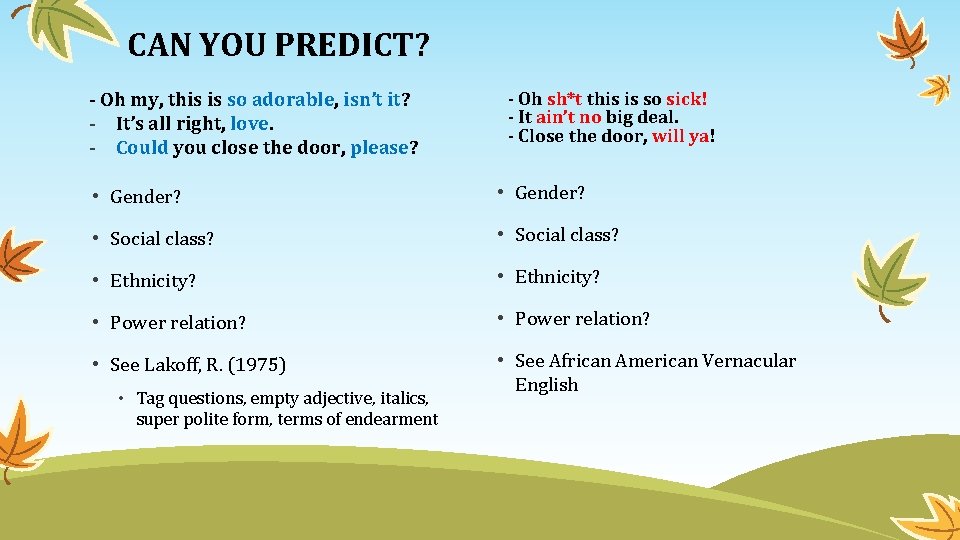
CAN YOU PREDICT? - Oh my, this is so adorable, isn’t it? - It’s all right, love. - Could you close the door, please? - Oh sh*t this is so sick! - It ain’t no big deal. - Close the door, will ya! • Gender? • Social class? • Ethnicity? • Power relation? • See Lakoff, R. (1975) • See African American Vernacular English • Tag questions, empty adjective, italics, super polite form, terms of endearment
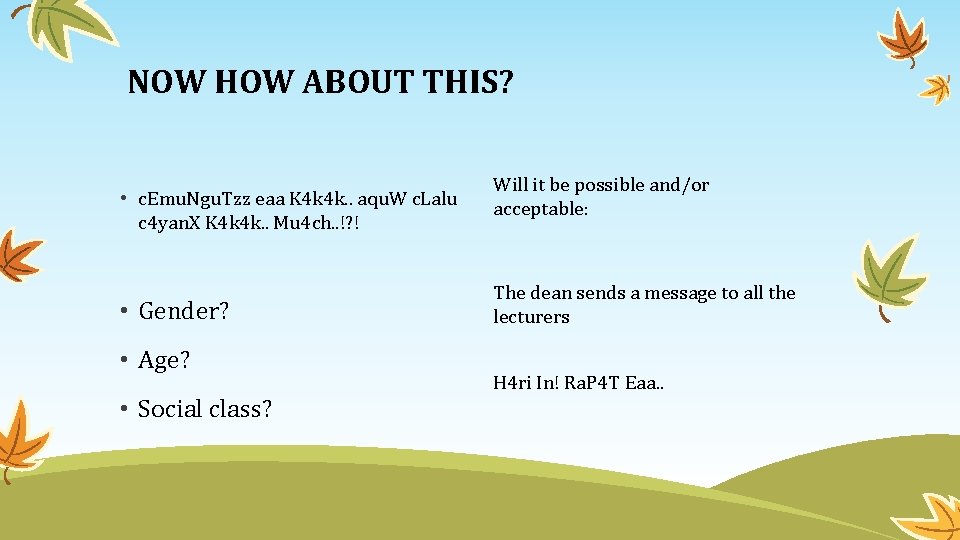
NOW HOW ABOUT THIS? • c. Emu. Ngu. Tzz eaa K 4 k 4 k. . aqu. W c. Lalu c 4 yan. X K 4 k 4 k. . Mu 4 ch. . !? ! • Gender? • Age? • Social class? Will it be possible and/or acceptable: The dean sends a message to all the lecturers H 4 ri In! Ra. P 4 T Eaa. .
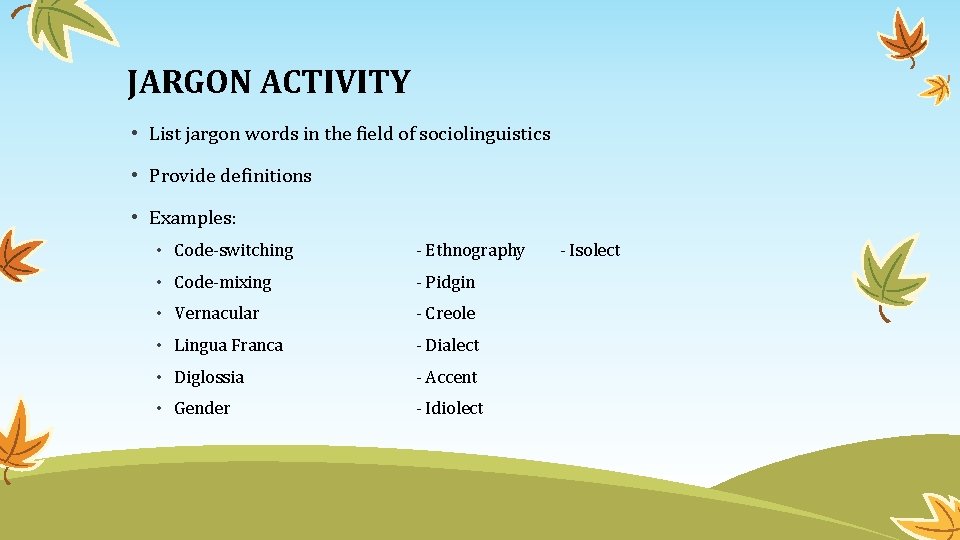
JARGON ACTIVITY • List jargon words in the field of sociolinguistics • Provide definitions • Examples: • Code-switching - Ethnography • Code-mixing - Pidgin • Vernacular - Creole • Lingua Franca - Dialect • Diglossia - Accent • Gender - Idiolect - Isolect
Lecture 2 Variation and Language 2019/2020
LANGUAGE AND VARIETIES • All languages exhibit internal variation • Each language exists in a number of varieties • Variety: general term for a way of speaking
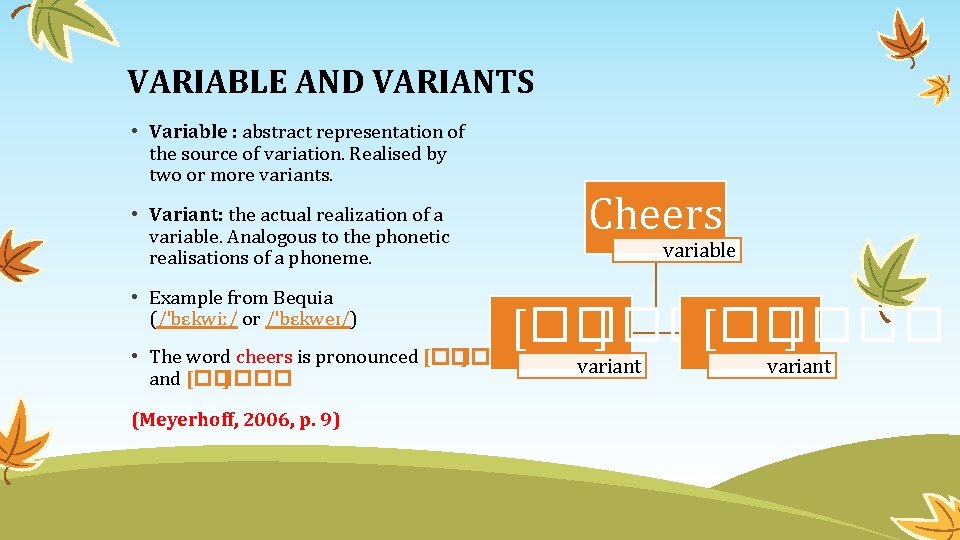
VARIABLE AND VARIANTS • Variable : abstract representation of the source of variation. Realised by two or more variants. • Variant: the actual realization of a variable. Analogous to the phonetic realisations of a phoneme. Cheers variable • Example from Bequia (/ˈbɛkwiː/ or /ˈbɛkweɪ/) [����� ] • The word cheers is pronounced [����� ] and [����� ] (Meyerhoff, 2006, p. 9) variant
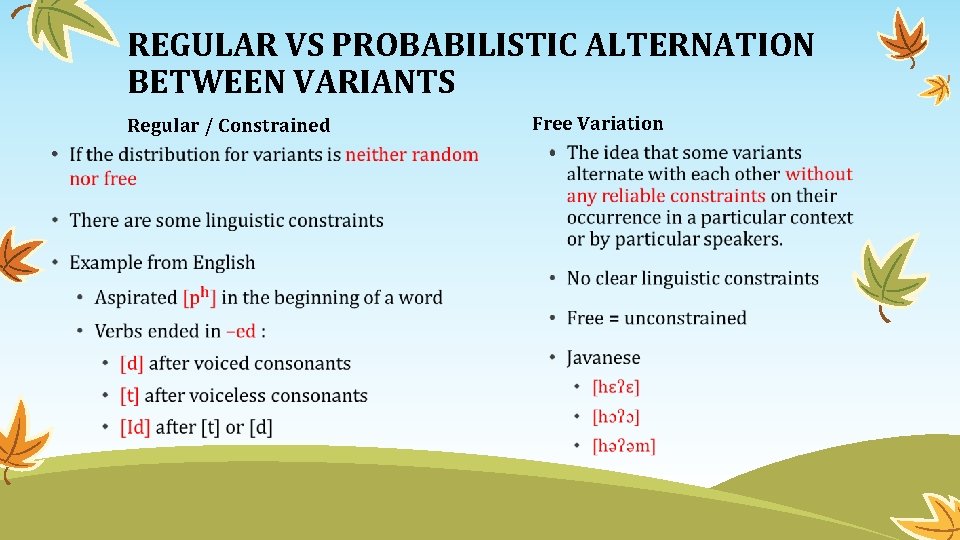
REGULAR VS PROBABILISTIC ALTERNATION BETWEEN VARIANTS Regular / Constrained • Free Variation •
REGULAR VS PROBABILISTIC ALTERNATION BETWEEN VARIANTS Regular / Constrained Verbs ending in -ed [P] • [� ] = played [pl�� d] • [� ] = brushed [b���� ] [p] in [st� p] • [�� ] = painted [������ d] variant variable [p� ] in [p��� ] variant
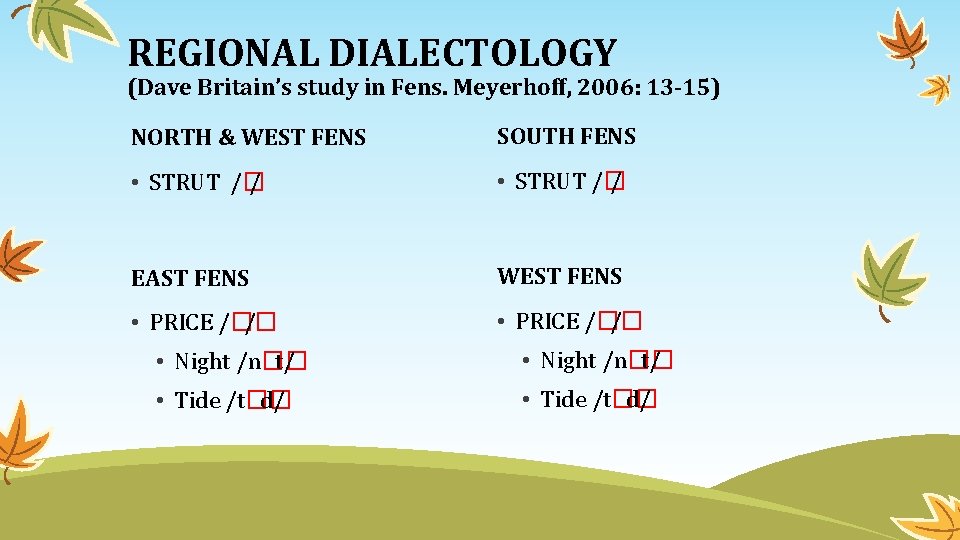
REGIONAL DIALECTOLOGY • The identification and mapping of boundaries between different varieties on the basis of clusters of similar and different features in particular region, towns or villages • Atlas Linguistique de la France or ‘Alf’ • Jules Gillieron & Edmond Edmont • Anibal Otero (1911 – 1974) in Spain 1936 • Dave Britain’s study of English spoken in Fens, London
REGIONAL DIALECTOLOGY (Dave Britain’s study in Fens. Meyerhoff, 2006: 13 -15) NORTH & WEST FENS SOUTH FENS • STRUT /� / EAST FENS WEST FENS • PRICE /�� / • Night /n�� t/ • Tide /t�� d/
REGIONAL DIALECTOLOGY (Dave Britain’s study in Fens. Meyerhoff, 2006: 13 -15) • Starting in the 18 th century the swampy areas of the Fens began to be drained, and communication between villages became much easier and increasingly frequent • Some of the regional differences began to disappear • Regional variation can highlight the importance of non-linguistic factors • Sociolinguists have to think about a whole range of different issues when analyzing data: • Linguistic structure • Aspect of social structure • How speaker conceive of themselves and relate to others • Britain’s study provides an excellent entry point for exploring more closely how regional dialectology expanded into social dialectology.
SOCIAL DIALECTOLOGY • The study of linguistic variation in relation to speaker’s participation or membership in social groups, or in relation to other non-linguistic factors. • Labov’s Martha’s Vineyard study 1960 s • Zane Goebel’s Study in Semarang (1990 s)
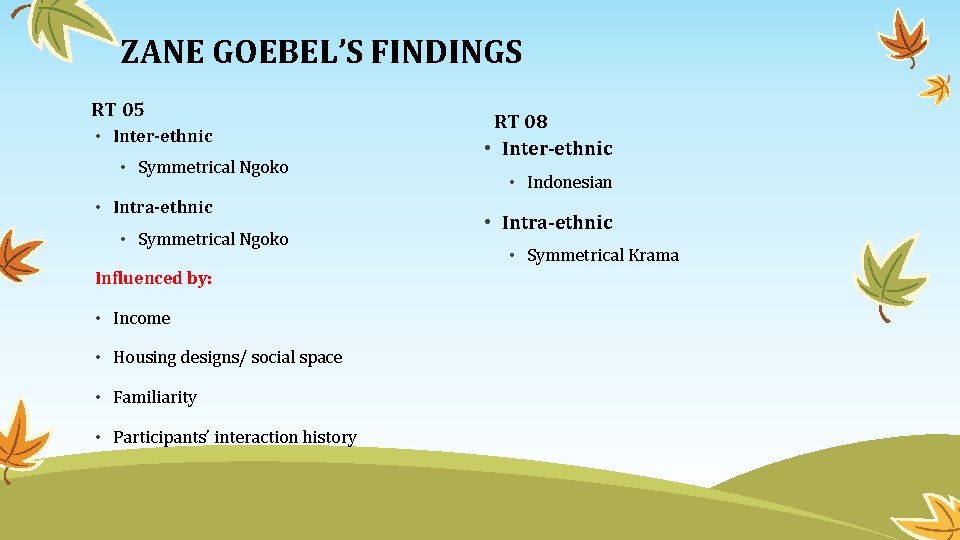
ZANE GOEBEL’S FINDINGS RT 05 • Inter-ethnic • Symmetrical Ngoko • Intra-ethnic • Symmetrical Ngoko Influenced by: • Income • Housing designs/ social space • Familiarity • Participants’ interaction history RT 08 • Inter-ethnic • Indonesian • Intra-ethnic • Symmetrical Krama
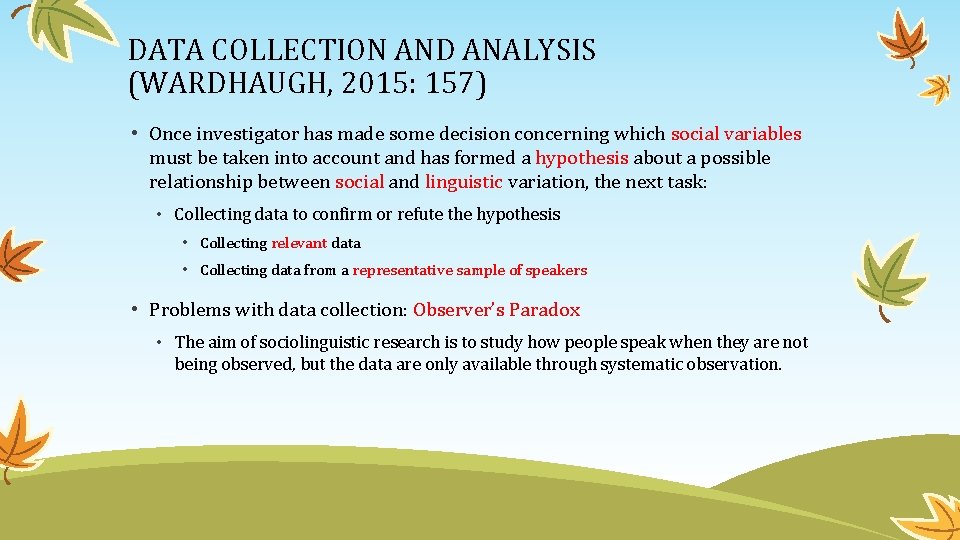
DATA COLLECTION AND ANALYSIS (WARDHAUGH, 2015: 157) • Once investigator has made some decision concerning which social variables must be taken into account and has formed a hypothesis about a possible relationship between social and linguistic variation, the next task: • Collecting data to confirm or refute the hypothesis • Collecting relevant data • Collecting data from a representative sample of speakers • Problems with data collection: Observer’s Paradox • The aim of sociolinguistic research is to study how people speak when they are not being observed, but the data are only available through systematic observation.
Lecture 3 Variation & Style 2019/2020
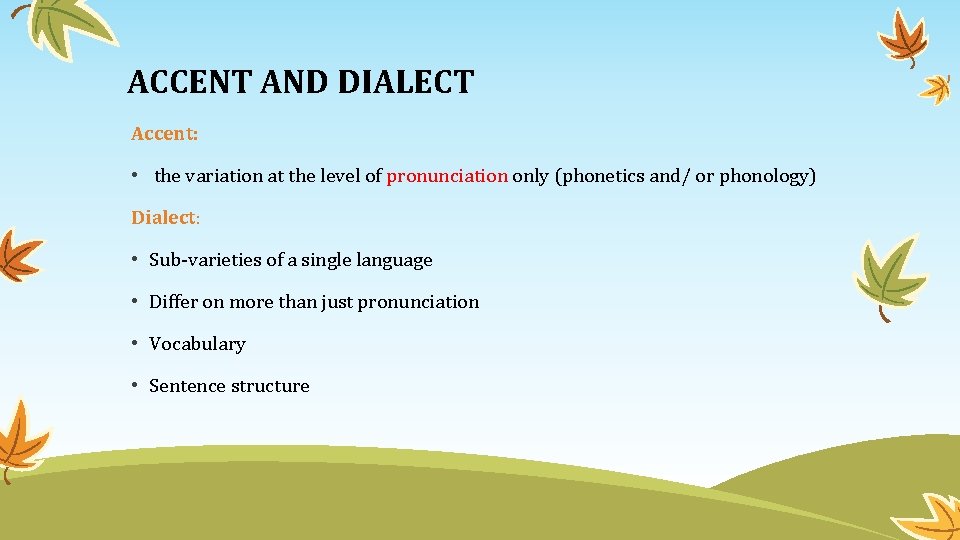
ACCENT AND DIALECT Accent: • the variation at the level of pronunciation only (phonetics and/ or phonology) Dialect: • Sub-varieties of a single language • Differ on more than just pronunciation • Vocabulary • Sentence structure
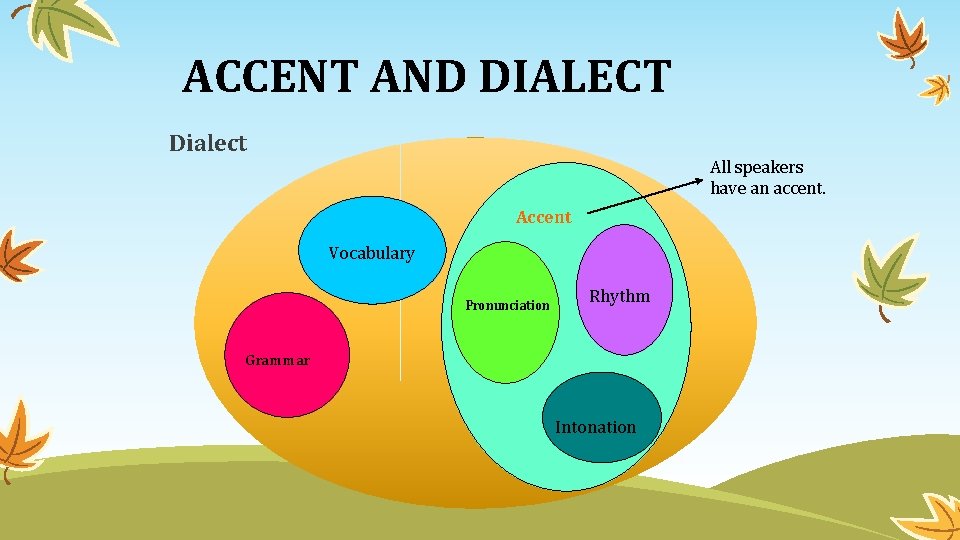
ACCENT AND DIALECT Dialect All speakers have an accent. Accent Vocabulary Pronunciation Rhythm Grammar Intonation
LANGUAGE OR DIALECT? (Wardhaugh, 2015: 29 -32) The common criterion used to determine if two varieties are dialects of the same language or distinct languages is that of mutual intelligibility. Mutual intelligibility: if speakers can understand each other, they are speaking dialects of the same language, if they cannot, they are speaking different languages. • Javanese Semarangan and Banyumasan (Ngelih, Kencot) • Javanese Semarangan and Pati (Nggonmu, Nggonem) • What about Bahasa Indonesia in Indonesia and Bahasa Melayu in Malaysia?
LANGUAGE OR DIALECT? (Wardhaugh, 2015: 29 -32) Problems with mutual intelligibility: 1. It’s not an objectively determined fact. Some speakers of (standard) German can understand (standard) Dutch, while others may find it incomprehensible. One’s ability to understand someone who speak. differently may vary. 2. Dialect continuum Speakers of some varieties of German can understand varieties of Dutch better than they can understand other varieties of German. It makes it apparent that the lines drawn between languages are not based on linguistic criteria. http: //www. heardutchhere. net/duengero. html
LANGUAGE OR DIALECT? (Wardhaugh, 2015: 29 -32) Problems with mutual intelligibility: 3. Distinct languages that are mutually intelligible Hindi and Urdu are very similar in spoken form, but there are political and religious reasons that make them considered as different language. The difference is based on sociopolitical ideology of language, not on any clear and objective linguistic difference. Hindi written left to right in the Devanagari script used in India. Urdu written right to left in Arabic –Persian Script used in Pakistan. 4. Unintelligible dialects which are identified by speakers as being the same language Example in China: Cantonese and Mandarin share the same writing system but very different in spoken form, yet the speakers considered Cantonese and Mandarin are dialects of the same language. For the Chinese, a shared writing system and a strong tradition of political, social, and cultural unity form essential parts of their definition of language.
The Standard-Dialect Hierarchy (Wardhaugh, 2015: 37 -38) • Standard variety of any language is actually only the preferred dialect of that language: Parisian French, Florentine Italian, and the Zanzibar variety of Swahili in Tanzania. • It is the variety that has been chosen for some reason, perhaps political, social, religious, or economic, or some combination of reasons, to serve as either the model or the norm for other varieties. • As a result, the standard is often not called a dialect at all, but is regarded as the language itself. • Calling something a dialect of particular language implies that language has at least two dialects, • But calling something a language does not necessarily entail that it has subordinate dialects.
SOCIAL DIALECT (WARDHAUGH, 2015 : 42 – 43) • Whereas regional dialects are geographically based, social dialects originate among social groups and are related to a variety of factors: • Social class • Religion • Race/ethnicity • Example: • India, caste become the factor determining which language varieties the people use • Baghdad • The Christians, Jews, and Muslims use different varieties of Arabic • The Muslim variety is the lingua franca • The Jews and Christian use two varieties, their own at home and the lingua franca
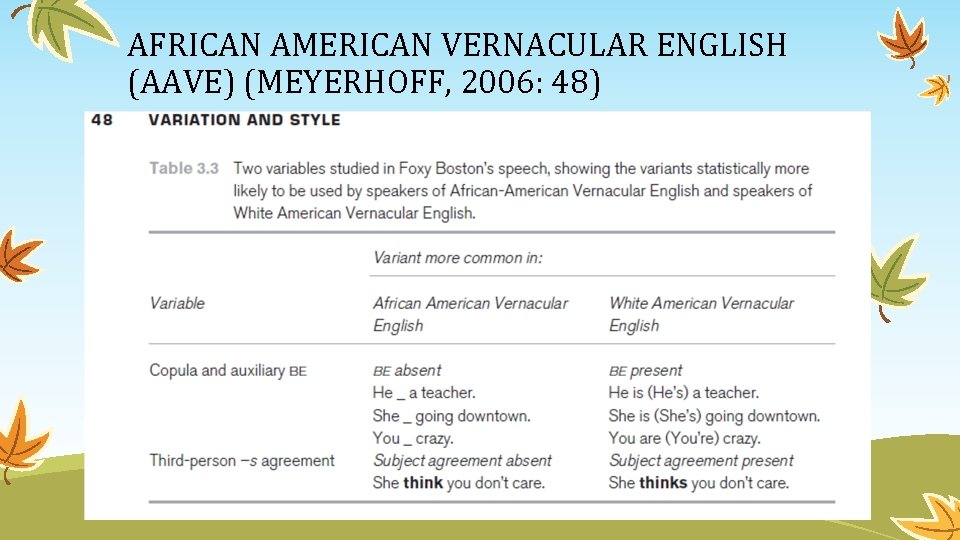
AFRICAN AMERICAN VERNACULAR ENGLISH (AAVE) (MEYERHOFF, 2006: 48)
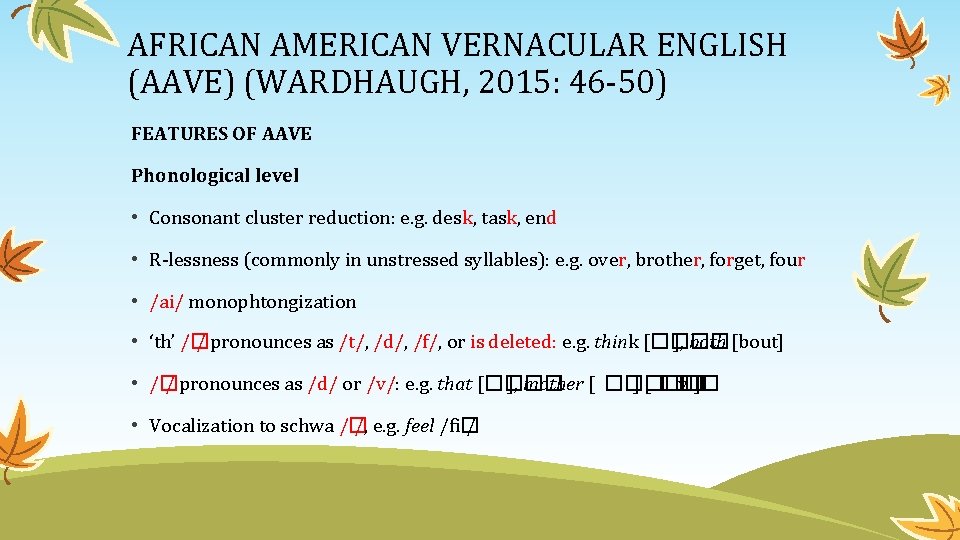
AFRICAN AMERICAN VERNACULAR ENGLISH (AAVE) (WARDHAUGH, 2015: 46 -50) FEATURES OF AAVE Phonological level • Consonant cluster reduction: e. g. desk, task, end • R-lessness (commonly in unstressed syllables): e. g. over, brother, forget, four • /ai/ monophtongization • ‘th’ /� / pronounces as /t/, /d/, /f/, or is deleted: e. g. think [���� ], both [bout] • /� / pronounces as /d/ or /v/: e. g. that [���� ], mother [ ����� ] [ ��� v� ] • Vocalization to schwa /� /, e. g. feel /fi� /
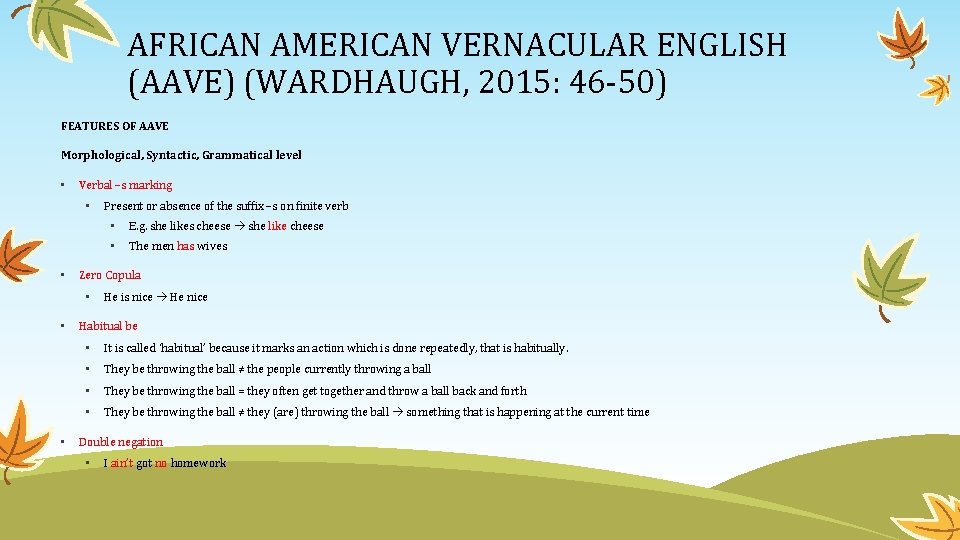
AFRICAN AMERICAN VERNACULAR ENGLISH (AAVE) (WARDHAUGH, 2015: 46 -50) FEATURES OF AAVE Morphological, Syntactic, Grammatical level • Verbal –s marking • • E. g. she likes cheese she like cheese • The men has wives Zero Copula • • Present or absence of the suffix –s on finite verb He is nice He nice Habitual be • It is called ‘habitual’ because it marks an action which is done repeatedly, that is habitually. • They be throwing the ball ≠ the people currently throwing a ball • They be throwing the ball = they often get together and throw a ball back and forth • They be throwing the ball ≠ they (are) throwing the ball something that is happening at the current time Double negation • I ain’t got no homework
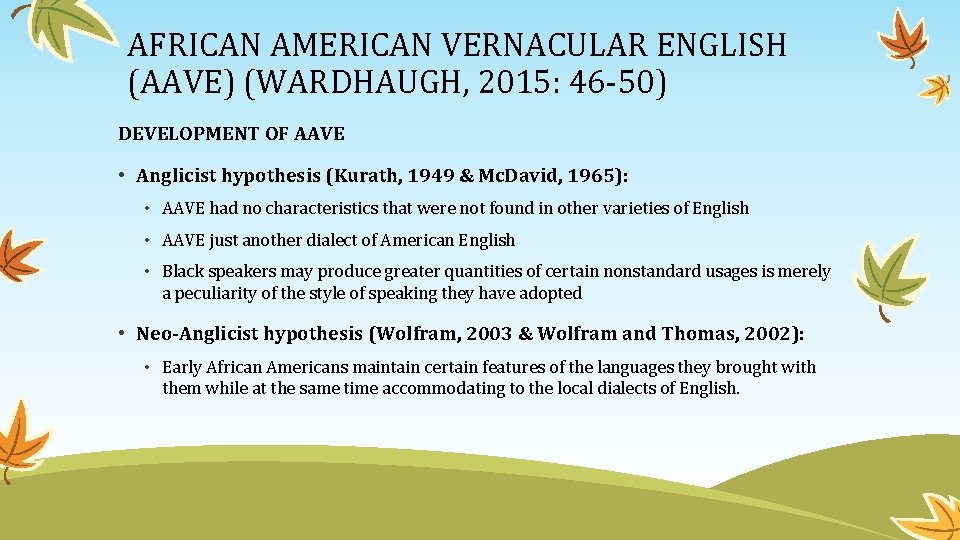
AFRICAN AMERICAN VERNACULAR ENGLISH (AAVE) (WARDHAUGH, 2015: 46 -50) DEVELOPMENT OF AAVE • Anglicist hypothesis (Kurath, 1949 & Mc. David, 1965): • AAVE had no characteristics that were not found in other varieties of English • AAVE just another dialect of American English • Black speakers may produce greater quantities of certain nonstandard usages is merely a peculiarity of the style of speaking they have adopted • Neo-Anglicist hypothesis (Wolfram, 2003 & Wolfram and Thomas, 2002): • Early African Americans maintain certain features of the languages they brought with them while at the same time accommodating to the local dialects of English.
AFRICAN AMERICAN VERNACULAR ENGLISH (AAVE) (WARDHAUGH, 2015: 46 -50) DEVELOPMENT OF AAVE • Creolist • AAVE is of creole origin, and therefore a variety of English which originated quite independently of Standard English • AAVE is not a dialect of English but a creolized variety of English • Divergence Hypothesis • Claims that AAVE is diverging from other dialects of English, particularly standard varieties • Butters (1989) argues that there is no solid evidence to support such a claim, pointing that there are both divergent and convergent features. AAVE is just like any other dialect of English; it has its own innovations but remains strongly influenced by the standard variety.
Lecture 4 Language Attitudes 2019/2020
Language Attitude • When you talk to someone, you start to form opinions about them, sometimes solely on the basis of the way they talk (Chambers 2003: 2 -11). • Language provides many windows on speakers’ attitudes to themselves and others. Our everyday speech encodes a surprising amount of information on our attitudes.
GENDER, LANGUAGE AND ATTITUDES: Semantic shift and semantic derogation How attitudes to women and men are reflected in language? Semantic shift Gay • Early meaning: joy and mirth • 19 th century: related to sexual promiscuity, women who were sexually promiscuous • 20 th century: homosexual Pretty • Cunning, skillful • Gallant or brave • Pleasant
GENDER, LANGUAGE AND ATTITUDES: Semantic shift and semantic derogation Semantic derogation: when a word’s meaning shifts and acquires more negative connotations. There was a distinct tendency for words describing women to have acquired negative overtones (bitch, tart, minx) while this was not true for words about men. The word for women also linked some kind of sexual activity with negative attitudes, in a way that was not paralleled by the words for men. e. g. master vs mistress See. Meyerhoff, 2006, p. 58
GENDER, LANGUAGE AND ATTITUDES: Semantic shift and semantic derogation The linguistic derogation of women can be seen in may cultures. E. g. aphorisms and sayings in Moroccan Arabic: 1. Only death can control girls 2. Your mother, then your mother and then your father. 3. The old woman is worse than the devil. A mother is to be treasured beyond all others, but before she starts having children and after she stops, a woman is seen in very negative terms.
LINGUISTIC RELATIVISM or SAPIR-WORF HYPOTHESIS The way we talk about others, and the words we use, does more than simply denote entities or events in the world. The way we perceive the world plays a part in how language is structured.
Gender Bias & Sexist Language • Biased language makes unnecessary distinctions about gender, race, age, economic class, sexual orientation, religion, politics, or any other personal information that's not necessary to a text's argument or intent. http: //www. wilkes. edu • “Gender-biased language implies that people are male unless 'proven' to be female. Female gender may be designated by either tagging on a feminine descriptor (e. g. lady professor, women doctor, female engineer) or by belonging to a stereotypically female group (e. g. , kindergarten teacher, social worker). “ (Janet B. Ruscher, Prejudiced Communication: A Social Psychological Perspective. Guilford, 2001)
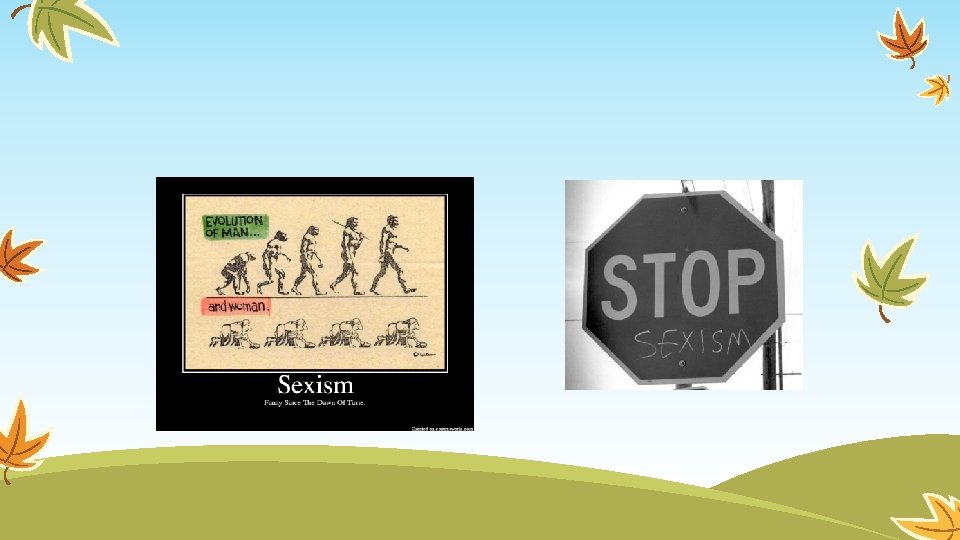
Gender Bias & Sexist Language (Cont’) • Sexism is the belief that one sex is innately superior to the other. • It underlies patriarchy and harms men, women, and the society as a whole. • It is discrimination on the basis of gender. • The tendency to speak of people as cultural stereotypes of their gender
Gender Bias & Sexist Language (Cont’) What is sexism in language? • It is the use of language which devalues members of one sex, almost invariably women, and thus fosters gender inequality. • It discriminates against women by rendering them invisible or trivializing them at the same time that it perpetuates notions of male supremacy. • E. g Robin Lakoff (1975) 'master' vs 'mistress' • "Sexist language also includes the depiction of women in the position of passive object rather than active subject, such as on the basis of their appearance ('a blonde') or domestic roles ('a mother of two') when similar depictions in similar contexts would not be made of men. These representations of women trivialize their lives and place an extra level of personal judgment on them. " (Allyson Jule, A Beginner's Guide to Language and Gender. Multilingual Matters, 2008
Gender Bias & Sexist Language (Cont’) Why is gender bias important? a. It‘s imprecise vague, misleading, confusing and can be quite comical Ex: "Some humans are female" - makes sense "Some men are female" - ridiculous. b. It’s offensive c. Miller and Swift (1976: 21) – when we use the generic ‘man’, we are bound to think of it as men rather than women d. It perpetuates stereotypes. Language influences one’s mind and belief. The following statements strengthen the notion of stereotype that signals sexist. "A doctor should respect his patients" "A nurse should respect her patients"
Gender Bias & Sexist Language (Cont’) • Why the concern about mere words? Language articulates consciousness give It is not only orders our thought but from infancy, we learn to use language to utterance to our basic needs and feelings. Language reflects culture It encodes and transmits cultural meanings and values in our society.
Gender Bias & Sexist Language (Cont’) Language affects socialization Children learning a language absorb the cultural assumptions and biases underlying language use and see these as an index to their society's values and attitudes. Social inequity reflected in language can thus powerfully affect a child's later behavior and beliefs.
HOW CAN YOU AVOID GENDER BIAS? The National Council of Teachers of English (NCTE) suggests the following guidelines:
NON-SEXIST LANGUAGE • Avoid using language that is stereotypical or biased in any way. • Writing in a non-sexist, non-biased way is both ethically sound and effective. • Non-sexist writing is necessary for most audiences; if you write in a sexist manner and alienate much of your audience from your discussion, your writing will be much less effective.
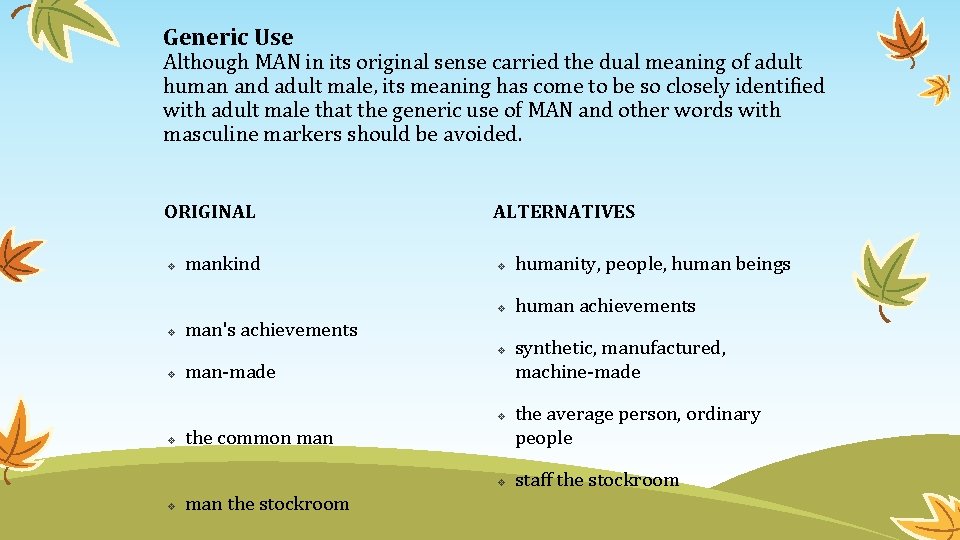
Generic Use Although MAN in its original sense carried the dual meaning of adult human and adult male, its meaning has come to be so closely identified with adult male that the generic use of MAN and other words with masculine markers should be avoided. ORIGINAL v v mankind ALTERNATIVES v humanity, people, human beings v human achievements man's achievements v v man-made v v the common man v v man the stockroom synthetic, manufactured, machine-made the average person, ordinary people staff the stockroom
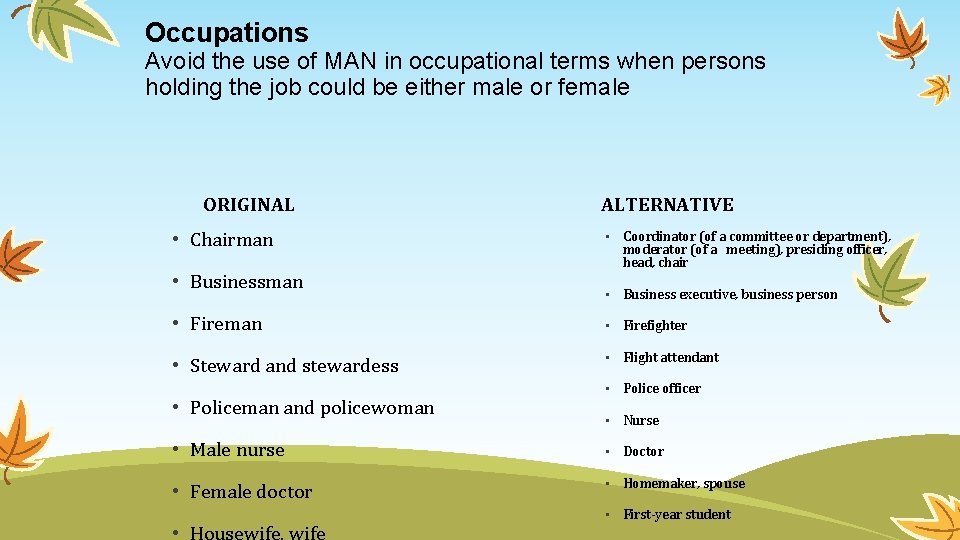
Occupations Avoid the use of MAN in occupational terms when persons holding the job could be either male or female ORIGINAL • Chairman • Businessman ALTERNATIVE • Coordinator (of a committee or department), moderator (of a meeting), presiding officer, head, chair • Business executive, business person • Fireman • Firefighter • Steward and stewardess • Flight attendant • Policeman and policewoman • Police officer • Nurse • Male nurse • Doctor • Female doctor • Homemaker, spouse • First-year student
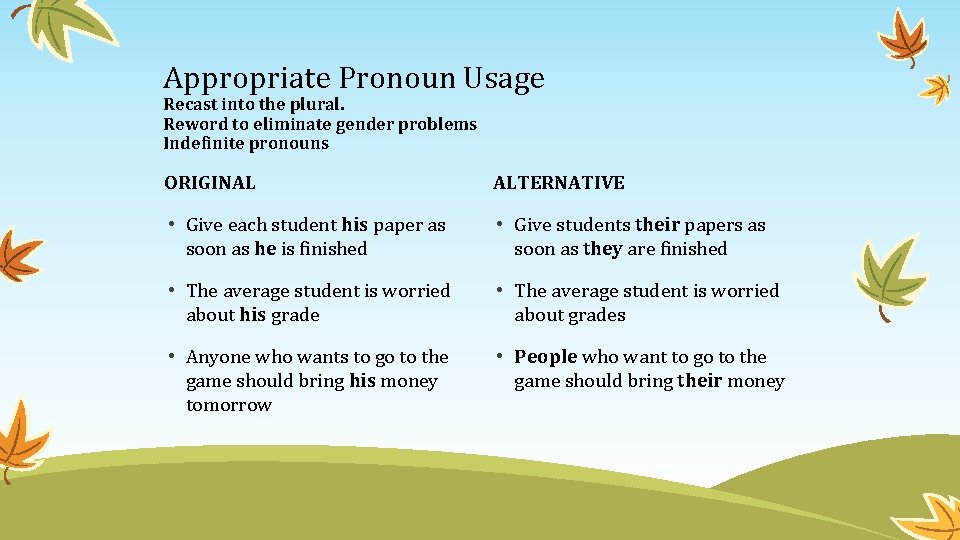
Appropriate Pronoun Usage Recast into the plural. Reword to eliminate gender problems Indefinite pronouns ORIGINAL ALTERNATIVE • Give each student his paper as soon as he is finished • Give students their papers as soon as they are finished • The average student is worried about his grade • The average student is worried about grades • Anyone who wants to go to the game should bring his money tomorrow • People who want to go to the game should bring their money
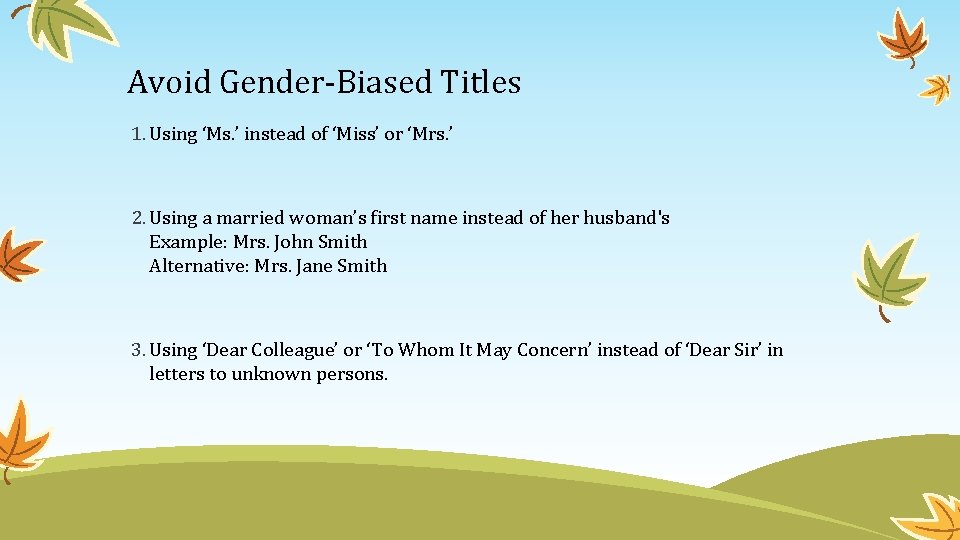
Avoid Gender-Biased Titles 1. Using ‘Ms. ’ instead of ‘Miss’ or ‘Mrs. ’ 2. Using a married woman’s first name instead of her husband's Example: Mrs. John Smith Alternative: Mrs. Jane Smith 3. Using ‘Dear Colleague’ or ‘To Whom It May Concern’ instead of ‘Dear Sir’ in letters to unknown persons.
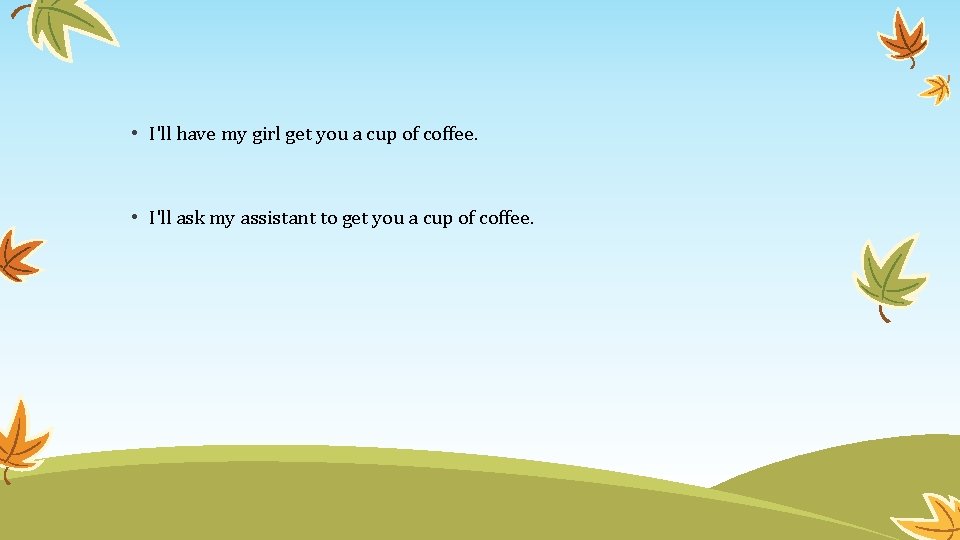
• I'll have my girl get you a cup of coffee. • I'll ask my assistant to get you a cup of coffee.
ACCOMODATION THEORY Howard Giles (1973) • The original statement of theory focused on speech behaviors alone, but it has expanded the scope so as to include strategies in non-verbal communication behaviors as well. • Speech Accommodation Theory, or Communication Accommodation Theory • Converge: Accommodation towards the speech of one interlocutors. Accentuates similarities between interlocutors speech styles, and/or makes the speaker sound more like their interlocutor. • Divergence: accommodation away from the speech of one interlocutors. Accentuates differences between interlocutors