Sep 21 16 20 16 40 Calculation of

- Slides: 36
대한신장학회 전해질고혈압 연구회 심포지움 Sep 21, 16: 20 -16: 40 Calculation of sodium and water deficit Seon Ha Baek, MD. Ph. D Hallym University Dongtan Sacred Heart Hospital
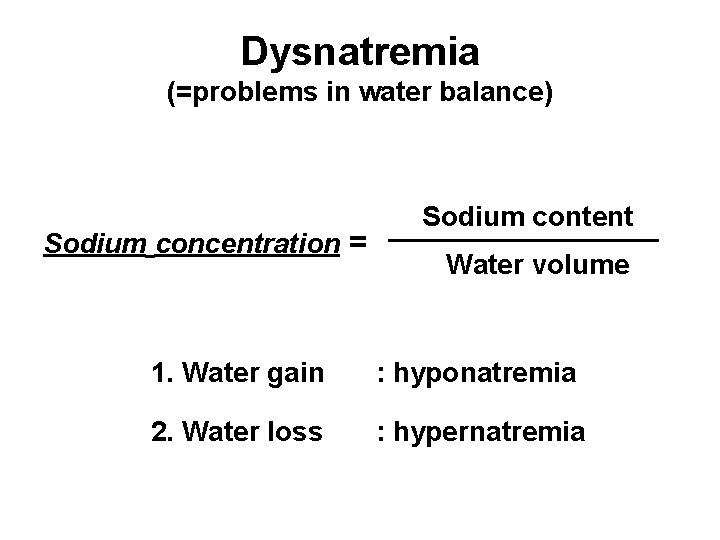
Dysnatremia (=problems in water balance) Sodium concentration = Sodium content Water volume 1. Water gain : hyponatremia 2. Water loss : hypernatremia
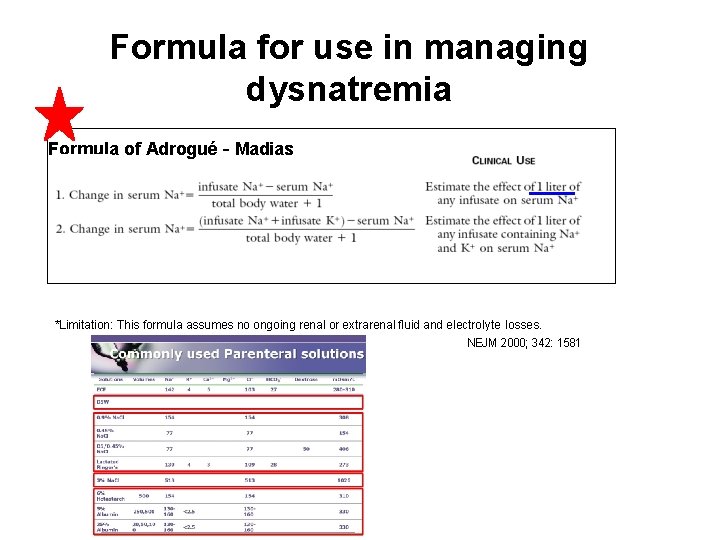
Formula for use in managing dysnatremia Formula of Adrogué‐Madias *Limitation: This formula assumes no ongoing renal or extrarenal fluid and electrolyte losses. NEJM 2000; 342: 1581
Hyper. Natremia
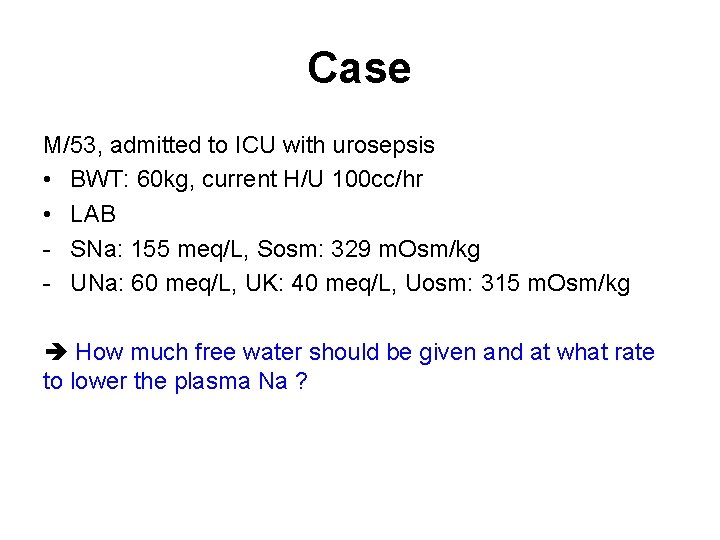
Case M/53, admitted to ICU with urosepsis • BWT: 60 kg, current H/U 100 cc/hr • LAB - SNa: 155 meq/L, Sosm: 329 m. Osm/kg - UNa: 60 meq/L, UK: 40 meq/L, Uosm: 315 m. Osm/kg How much free water should be given and at what rate to lower the plasma Na ?
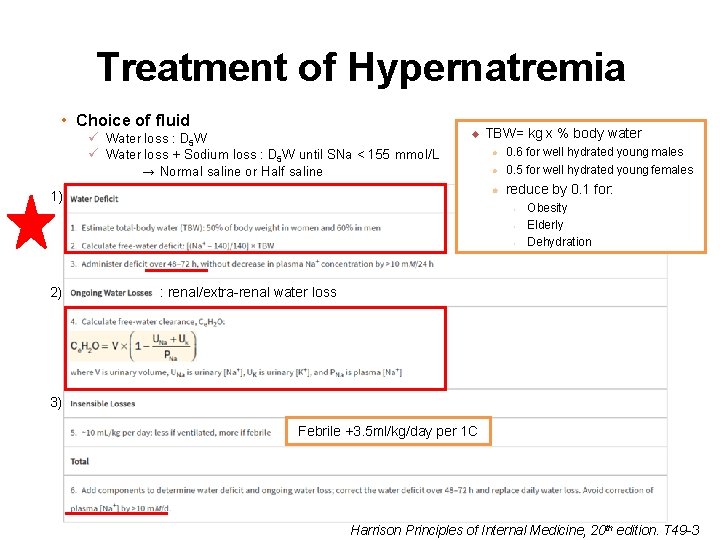
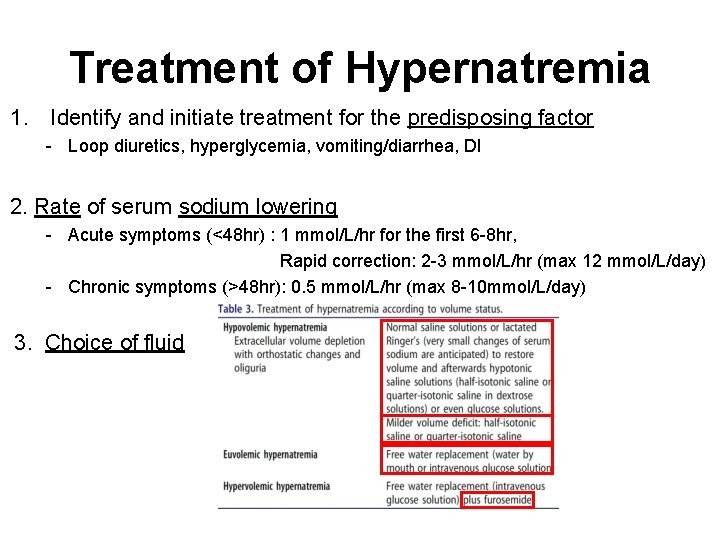
Treatment of Hypernatremia • Choice of fluid Water loss : D 5 W Water loss + Sodium loss : D 5 W until SNa < 155 mmol/L → Normal saline or Half saline 1) TBW= kg x % body water 0. 6 for well hydrated young males 0. 5 for well hydrated young females reduce by 0. 1 for: • • • 2) Obesity Elderly Dehydration : renal/extra-renal water loss 3) Febrile +3. 5 ml/kg/day per 1 C Harrison Principles of Internal Medicine, 20 th edition. T 49 -3
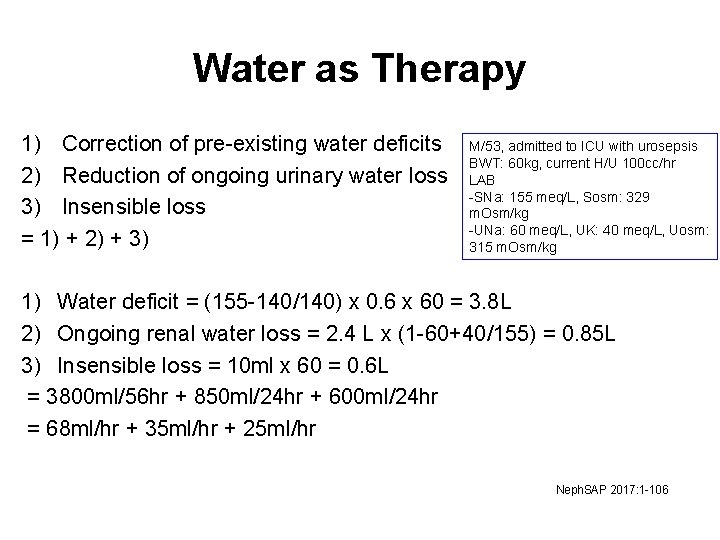
Water as Therapy 1) Correction of pre-existing water deficits 2) Reduction of ongoing urinary water loss 3) Insensible loss = 1) + 2) + 3) M/53, admitted to ICU with urosepsis BWT: 60 kg, current H/U 100 cc/hr LAB -SNa: 155 meq/L, Sosm: 329 m. Osm/kg -UNa: 60 meq/L, UK: 40 meq/L, Uosm: 315 m. Osm/kg 1) Water deficit = (155 -140/140) x 0. 6 x 60 = 3. 8 L 2) Ongoing renal water loss = 2. 4 L x (1 -60+40/155) = 0. 85 L 3) Insensible loss = 10 ml x 60 = 0. 6 L = 3800 ml/56 hr + 850 ml/24 hr + 600 ml/24 hr = 68 ml/hr + 35 ml/hr + 25 ml/hr Neph. SAP 2017: 1 -106
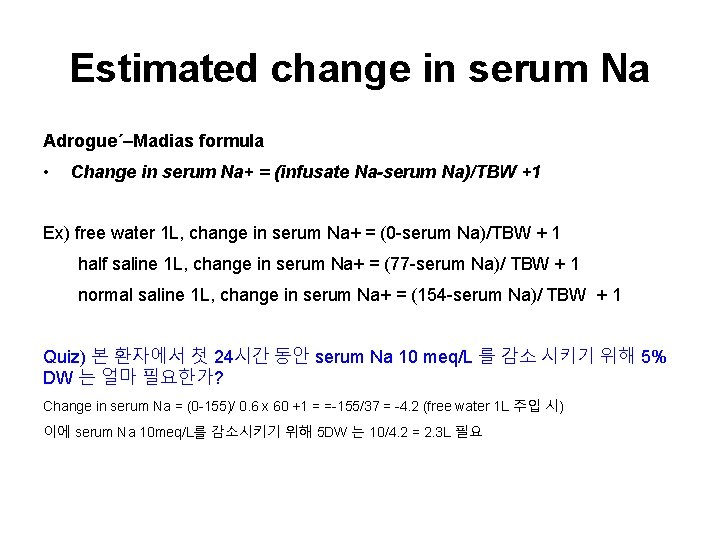
Estimated change in serum Na Adrogue´–Madias formula • Change in serum Na+ = (infusate Na-serum Na)/TBW +1 Ex) free water 1 L, change in serum Na+ = (0 -serum Na)/TBW + 1 half saline 1 L, change in serum Na+ = (77 -serum Na)/ TBW + 1 normal saline 1 L, change in serum Na+ = (154 -serum Na)/ TBW + 1 Quiz) 본 환자에서 첫 24시간 동안 serum Na 10 meq/L 를 감소 시키기 위해 5% DW 는 얼마 필요한가? Change in serum Na = (0 -155)/ 0. 6 x 60 +1 = =-155/37 = -4. 2 (free water 1 L 주입 시) 이에 serum Na 10 meq/L를 감소시키기 위해 5 DW 는 10/4. 2 = 2. 3 L 필요
Treatment of Hypernatremia 1. Identify and initiate treatment for the predisposing factor - Loop diuretics, hyperglycemia, vomiting/diarrhea, DI 2. Rate of serum sodium lowering - Acute symptoms (<48 hr) : 1 mmol/L/hr for the first 6 -8 hr, Rapid correction: 2 -3 mmol/L/hr (max 12 mmol/L/day) - Chronic symptoms (>48 hr): 0. 5 mmol/L/hr (max 8 -10 mmol/L/day) 3. Choice of fluid
Hypo. Natremia
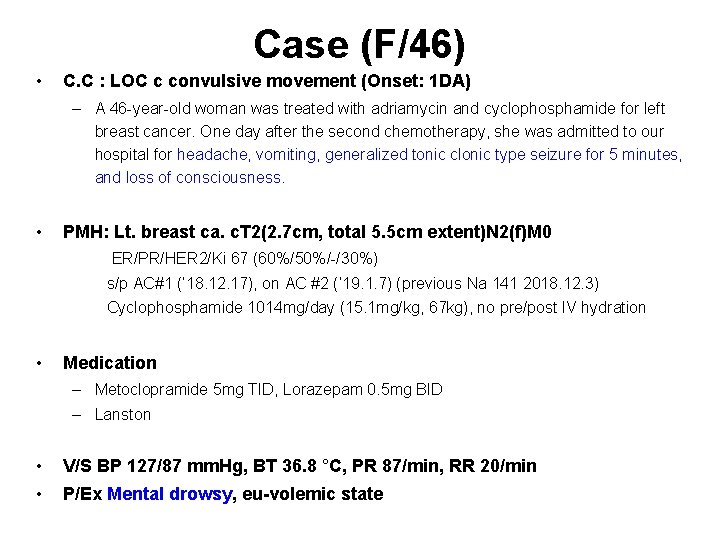
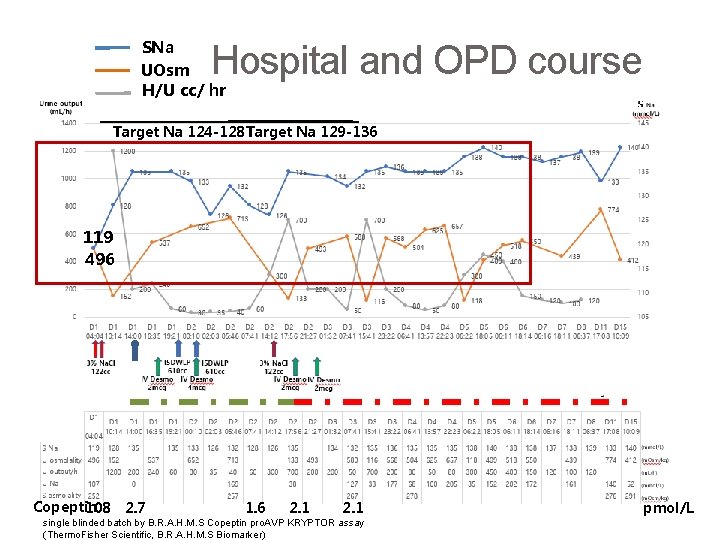
Case (F/46) • C. C : LOC c convulsive movement (Onset: 1 DA) – A 46 -year-old woman was treated with adriamycin and cyclophosphamide for left breast cancer. One day after the second chemotherapy, she was admitted to our hospital for headache, vomiting, generalized tonic clonic type seizure for 5 minutes, and loss of consciousness. • PMH: Lt. breast ca. c. T 2(2. 7 cm, total 5. 5 cm extent)N 2(f)M 0 ER/PR/HER 2/Ki 67 (60%/50%/-/30%) s/p AC#1 (‘ 18. 12. 17), on AC #2 (‘ 19. 1. 7) (previous Na 141 2018. 12. 3) Cyclophosphamide 1014 mg/day (15. 1 mg/kg, 67 kg), no pre/post IV hydration • Medication – Metoclopramide 5 mg TID, Lorazepam 0. 5 mg BID – Lanston • V/S BP 127/87 mm. Hg, BT 36. 8 °C, PR 87/min, RR 20/min • P/Ex Mental drowsy, eu-volemic state
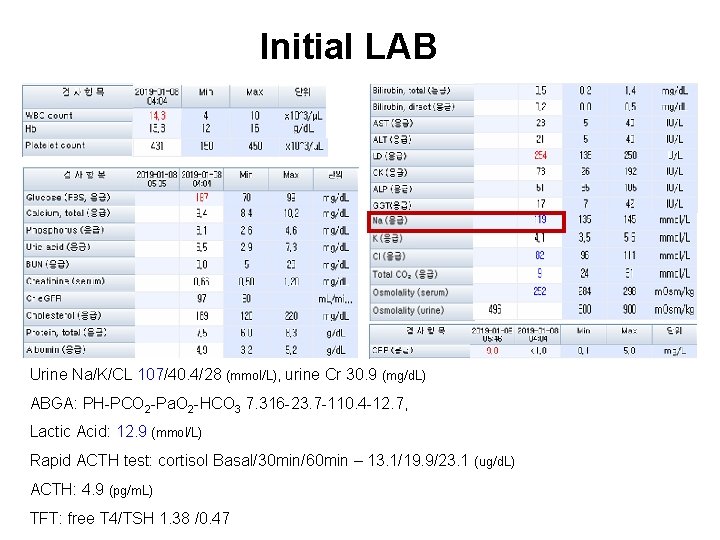
Initial LAB Urine Na/K/CL 107/40. 4/28 (mmol/L), urine Cr 30. 9 (mg/d. L) ABGA: PH-PCO 2 -Pa. O 2 -HCO 3 7. 316 -23. 7 -110. 4 -12. 7, Lactic Acid: 12. 9 (mmol/L) Rapid ACTH test: cortisol Basal/30 min/60 min – 13. 1/19. 9/23. 1 (ug/d. L) ACTH: 4. 9 (pg/m. L) TFT: free T 4/TSH 1. 38 /0. 47
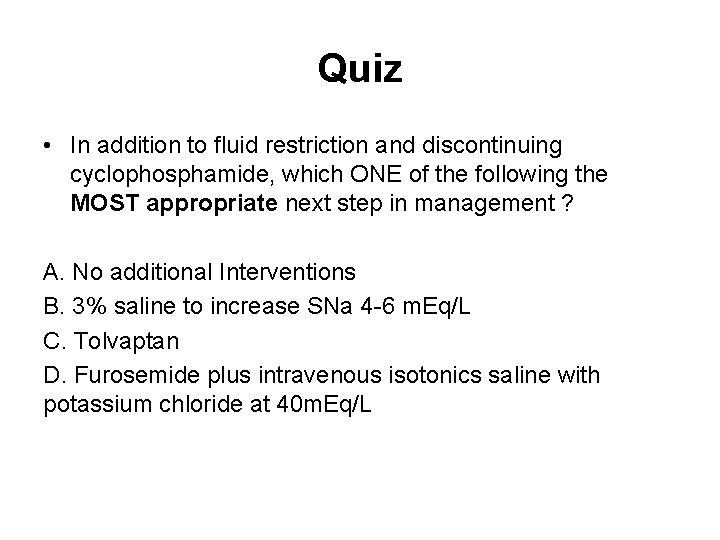
Quiz • In addition to fluid restriction and discontinuing cyclophosphamide, which ONE of the following the MOST appropriate next step in management ? A. No additional Interventions B. 3% saline to increase SNa 4 -6 m. Eq/L C. Tolvaptan D. Furosemide plus intravenous isotonics saline with potassium chloride at 40 m. Eq/L
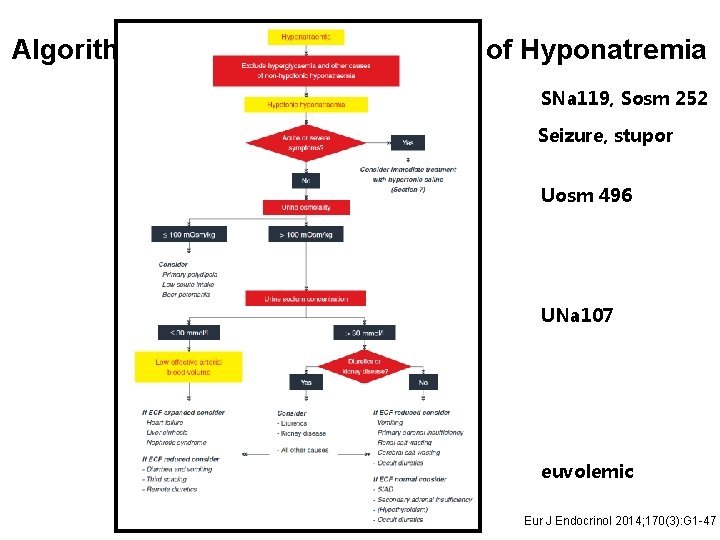
Algorithm for differential diagnosis of Hyponatremia SNa 119, Sosm 252 Seizure, stupor Uosm 496 UNa 107 euvolemic Eur J Endocrinol 2014; 170(3): G 1 -47
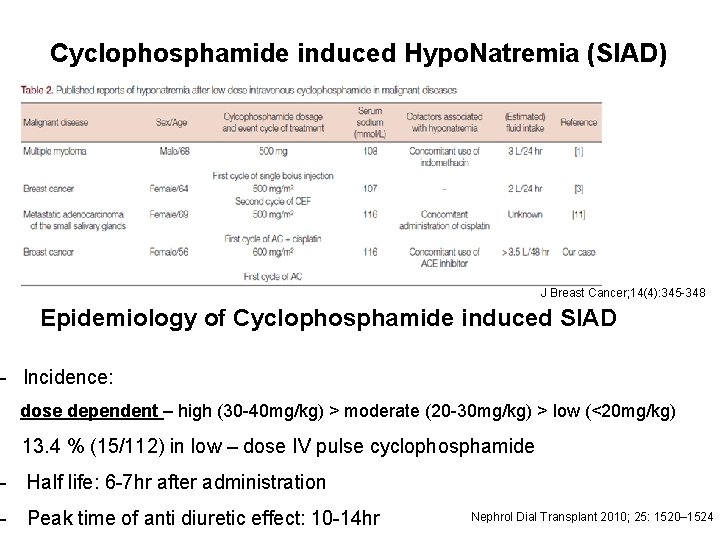
Cyclophosphamide induced Hypo. Natremia (SIAD) J Breast Cancer; 14(4): 345 -348 Epidemiology of Cyclophosphamide induced SIAD - Incidence: dose dependent – high (30 -40 mg/kg) > moderate (20 -30 mg/kg) > low (<20 mg/kg) 13. 4 % (15/112) in low – dose IV pulse cyclophosphamide - Half life: 6 -7 hr after administration - Peak time of anti diuretic effect: 10 -14 hr Nephrol Dial Transplant 2010; 25: 1520– 1524
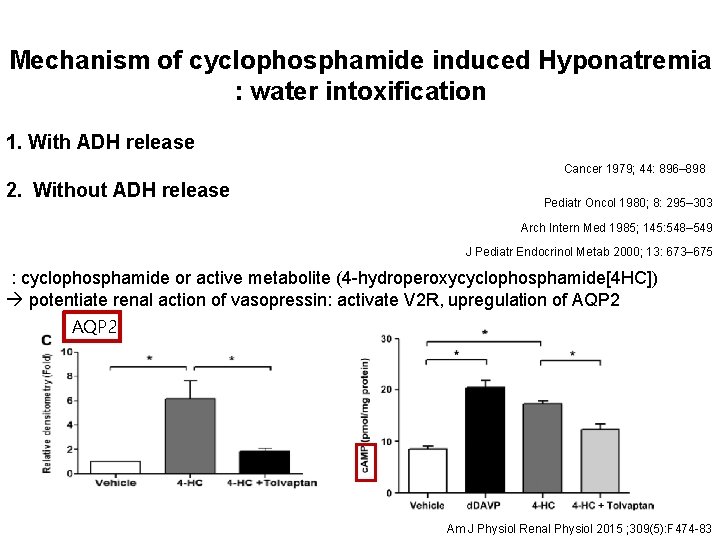
Mechanism of cyclophosphamide induced Hyponatremia : water intoxification 1. With ADH release Cancer 1979; 44: 896– 898 2. Without ADH release Pediatr Oncol 1980; 8: 295– 303 Arch Intern Med 1985; 145: 548– 549 J Pediatr Endocrinol Metab 2000; 13: 673– 675 : cyclophosphamide or active metabolite (4 -hydroperoxycyclophosphamide[4 HC]) potentiate renal action of vasopressin: activate V 2 R, upregulation of AQP 2 Am J Physiol Renal Physiol 2015 ; 309(5): F 474 -83
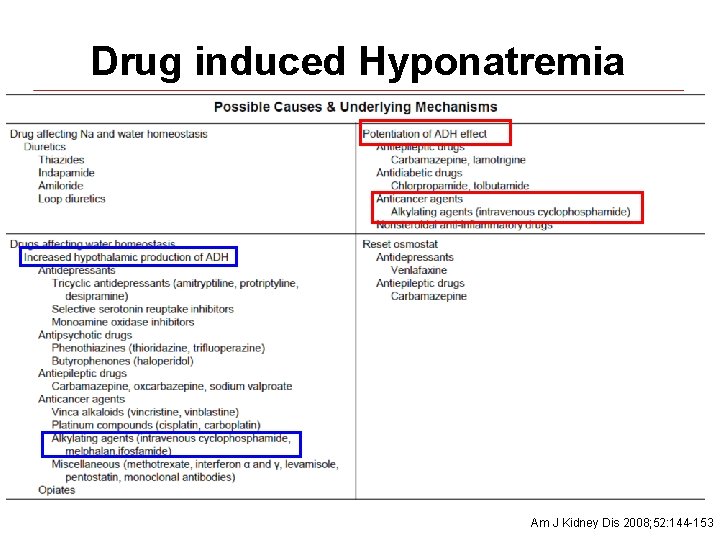
Drug induced Hyponatremia Am J Kidney Dis 2008; 52: 144 -153
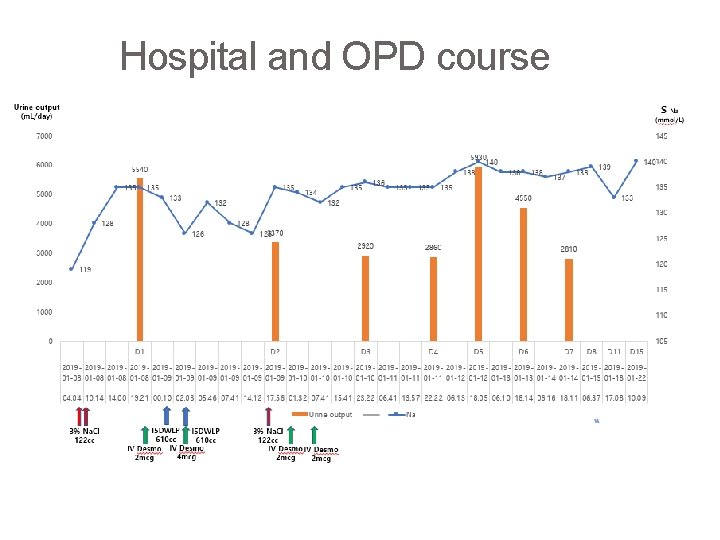
Hospital and OPD course
SNa UOsm H/U cc/ hr Hospital and OPD course Target Na 124 -128 Target Na 129 -136 119 496 Copeptin 108 2. 7 1. 6 2. 1 single blinded batch by B. R. A. H. M. S Copeptin pro. AVP KRYPTOR assay (Thermo. Fisher Scientific, B. R. A. H. M. S Biomarker) pmol/L
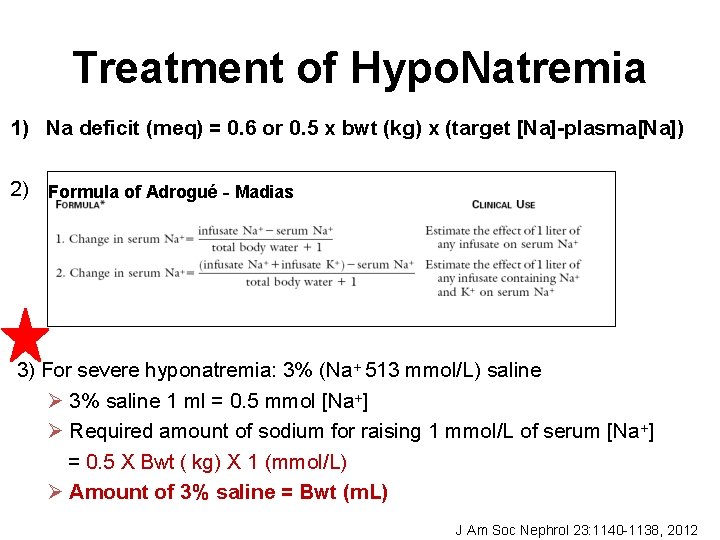
Treatment of Hypo. Natremia 1) Na deficit (meq) = 0. 6 or 0. 5 x bwt (kg) x (target [Na]-plasma[Na]) 2) Formula of Adrogué‐Madias 3) For severe hyponatremia: 3% (Na+ 513 mmol/L) saline 3% saline 1 ml = 0. 5 mmol [Na+] Required amount of sodium for raising 1 mmol/L of serum [Na+] = 0. 5 X Bwt ( kg) X 1 (mmol/L) Amount of 3% saline = Bwt (m. L) J Am Soc Nephrol 23: 1140 -1138, 2012
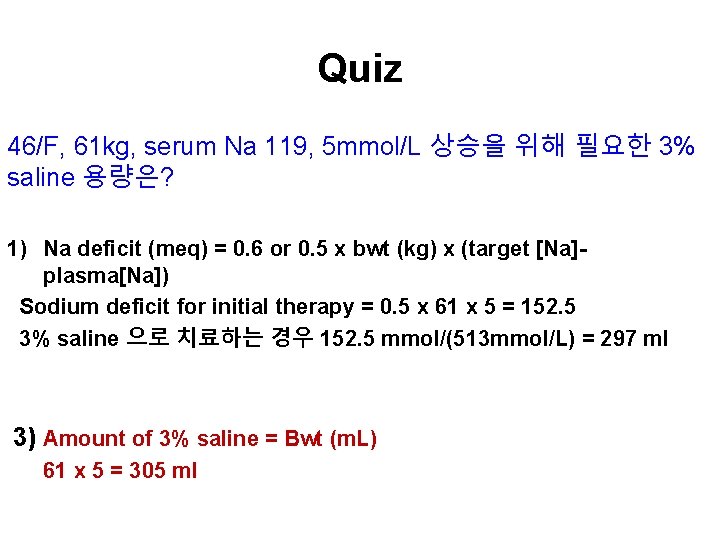
Quiz 46/F, 61 kg, serum Na 119, 5 mmol/L 상승을 위해 필요한 3% saline 용량은? 1) Na deficit (meq) = 0. 6 or 0. 5 x bwt (kg) x (target [Na]plasma[Na]) Sodium deficit for initial therapy = 0. 5 x 61 x 5 = 152. 5 3% saline 으로 치료하는 경우 152. 5 mmol/(513 mmol/L) = 297 ml 3) Amount of 3% saline = Bwt (m. L) 61 x 5 = 305 ml
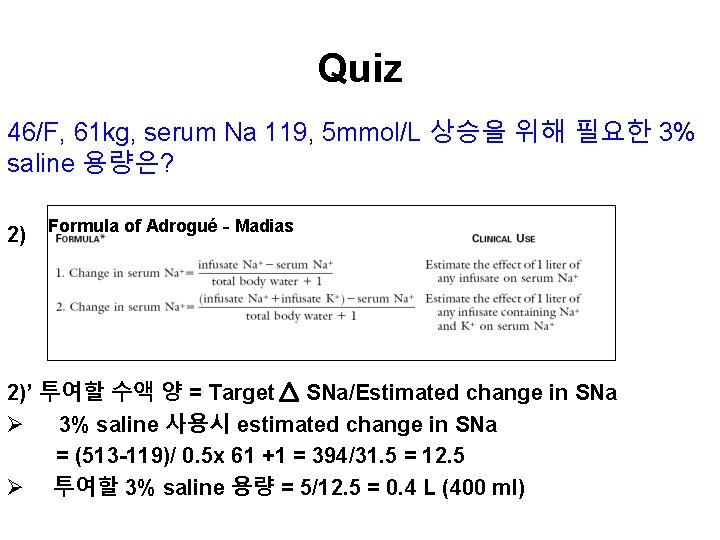
Quiz 46/F, 61 kg, serum Na 119, 5 mmol/L 상승을 위해 필요한 3% saline 용량은? 2) Formula of Adrogué‐Madias 2)’ 투여할 수액 양 = Target SNa/Estimated change in SNa 3% saline 사용시 estimated change in SNa = (513 -119)/ 0. 5 x 61 +1 = 394/31. 5 = 12. 5 투여할 3% saline 용량 = 5/12. 5 = 0. 4 L (400 ml)
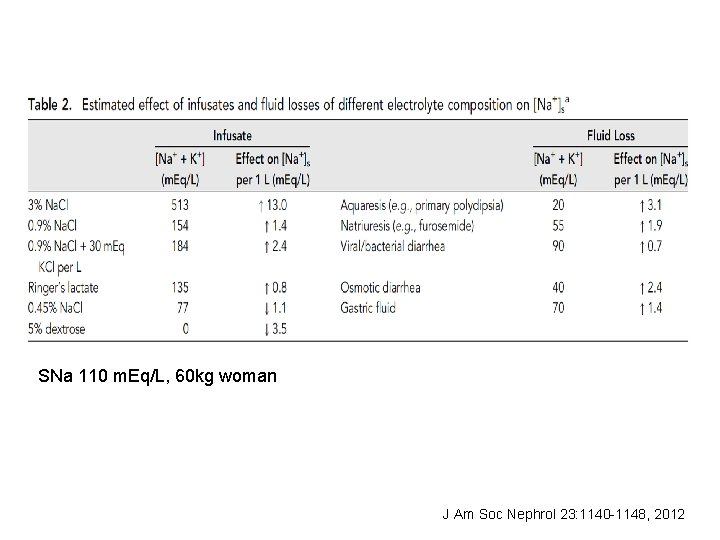
SNa 110 m. Eq/L, 60 kg woman J Am Soc Nephrol 23: 1140 -1148, 2012
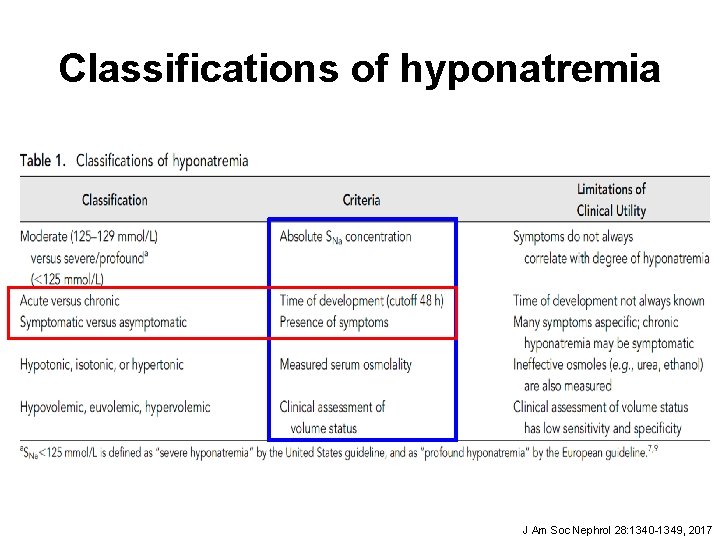
Classifications of hyponatremia J Am Soc Nephrol 28: 1340 -1349, 2017
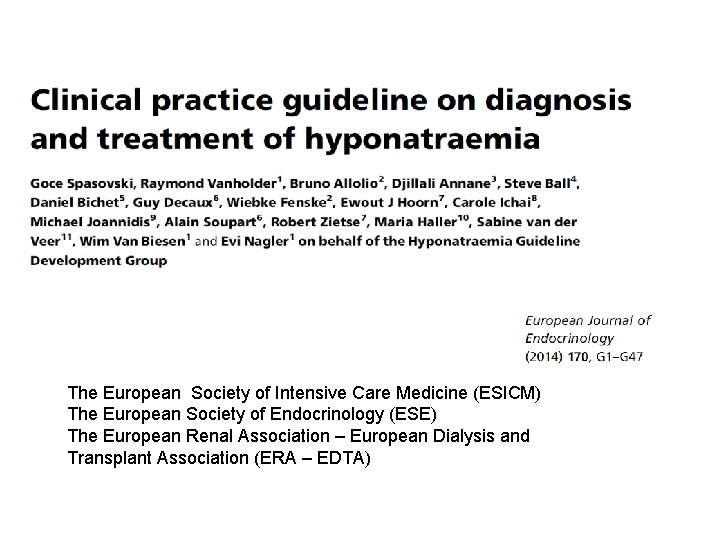
The European Society of Intensive Care Medicine (ESICM) The European Society of Endocrinology (ESE) The European Renal Association – European Dialysis and Transplant Association (ERA – EDTA)
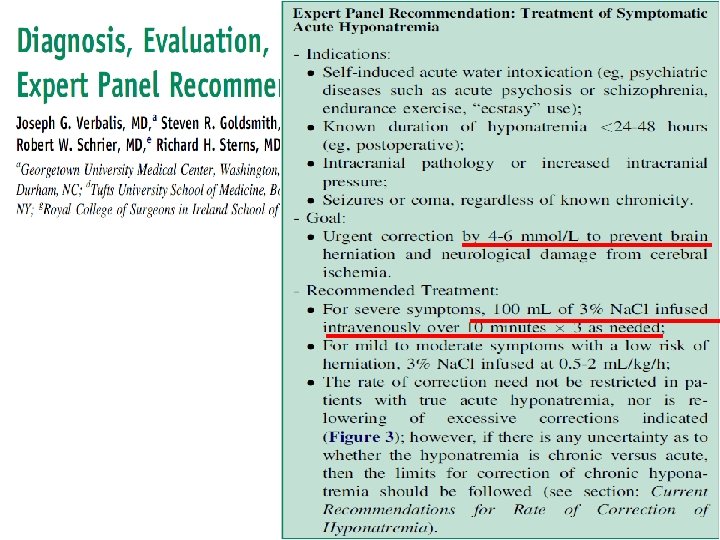
The American Journal of Medicine 126: S 1 -S 42, 2013
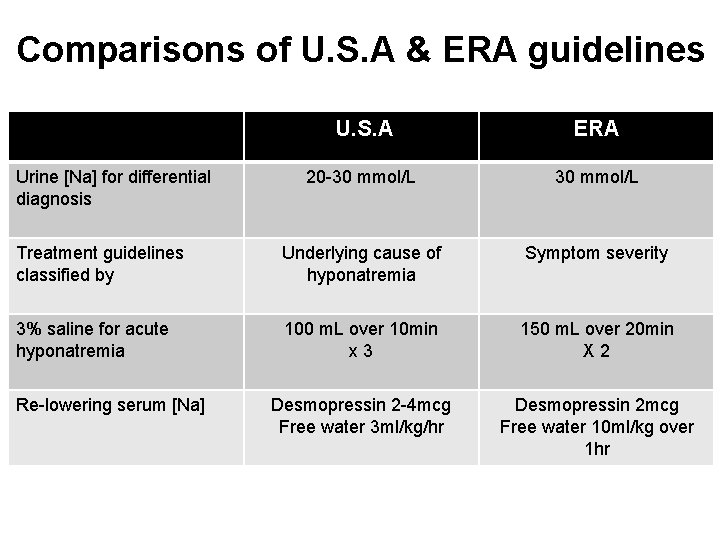
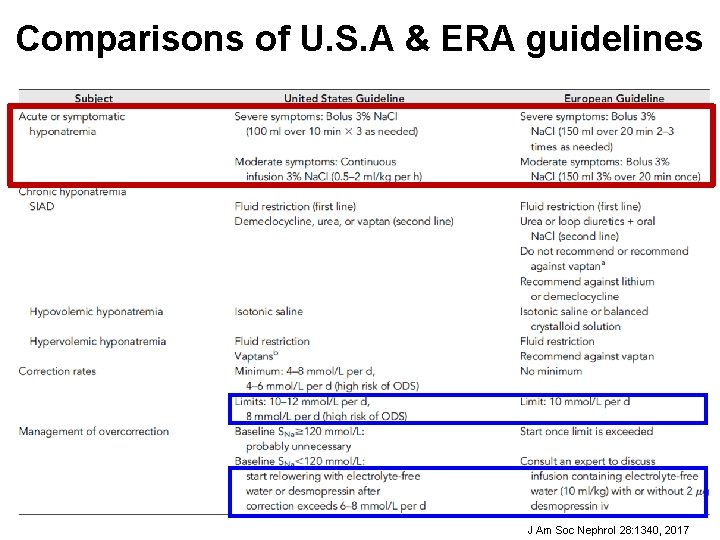
Comparisons of U. S. A & ERA guidelines U. S. A ERA 20 -30 mmol/L Treatment guidelines classified by Underlying cause of hyponatremia Symptom severity 3% saline for acute hyponatremia 100 m. L over 10 min x 3 150 m. L over 20 min X 2 Desmopressin 2 -4 mcg Free water 3 ml/kg/hr Desmopressin 2 mcg Free water 10 ml/kg over 1 hr Urine [Na] for differential diagnosis Re-lowering serum [Na]
Comparisons of U. S. A & ERA guidelines J Am Soc Nephrol 28: 1340, 2017
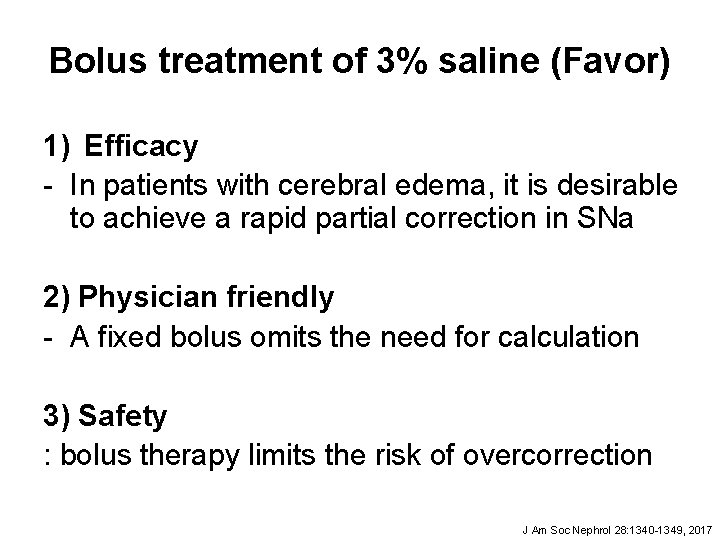
Bolus treatment of 3% saline (Favor) 1) Efficacy - In patients with cerebral edema, it is desirable to achieve a rapid partial correction in SNa 2) Physician friendly - A fixed bolus omits the need for calculation 3) Safety : bolus therapy limits the risk of overcorrection J Am Soc Nephrol 28: 1340 -1349, 2017
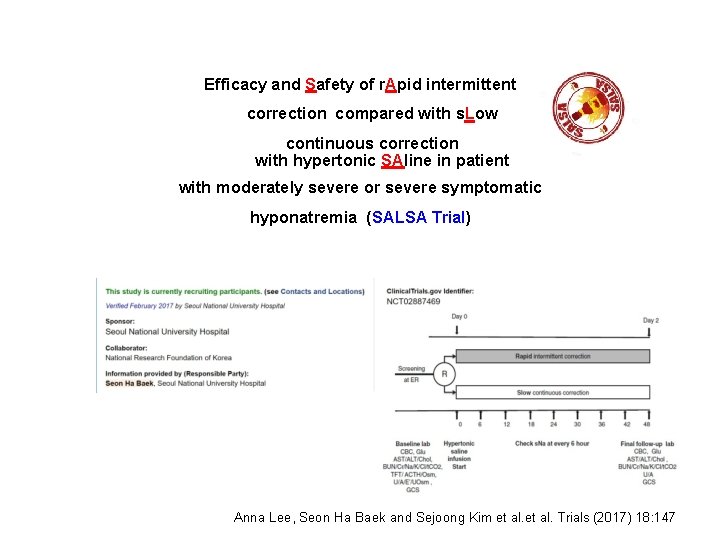
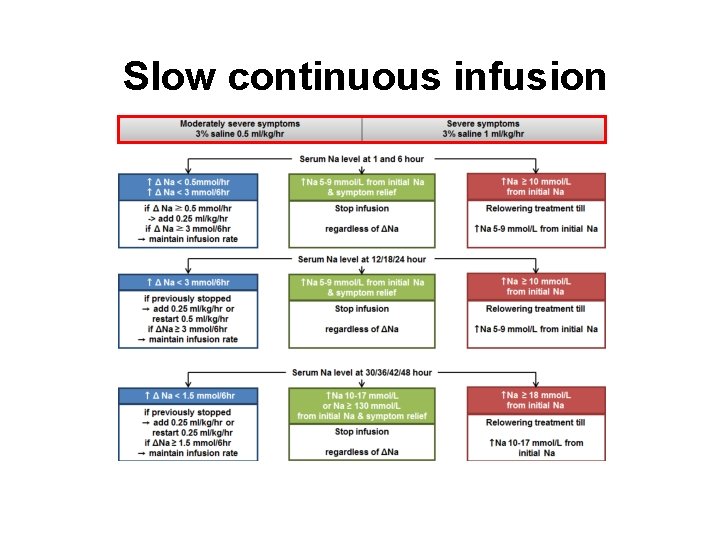
Efficacy and Safety of r. Apid intermittent correction compared with s. Low continuous correction with hypertonic SAline in patient with moderately severe or severe symptomatic hyponatremia (SALSA Trial) Anna Lee, Seon Ha Baek and Sejoong Kim et al. Trials (2017) 18: 147
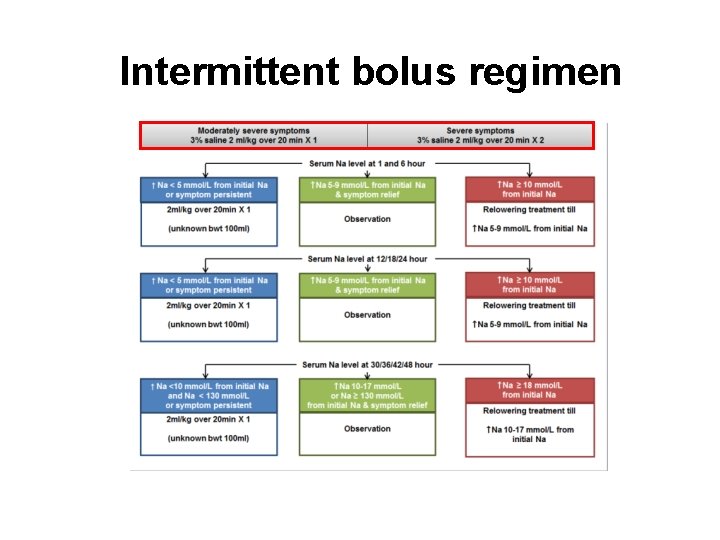
Intermittent bolus regimen
Slow continuous infusion
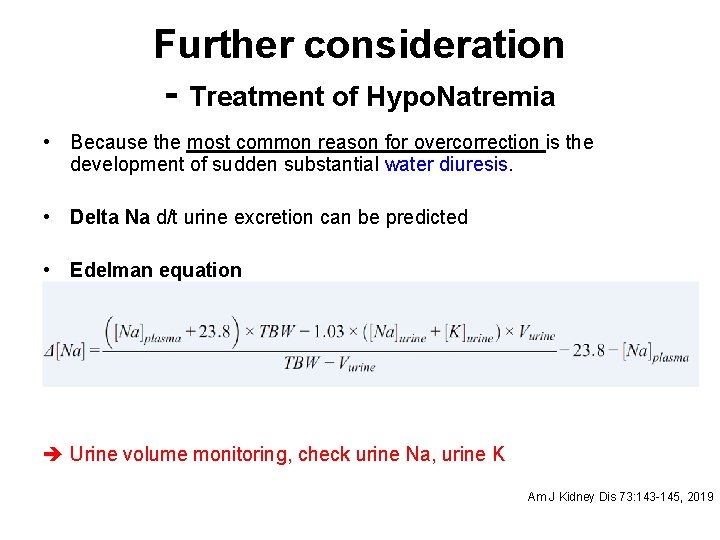
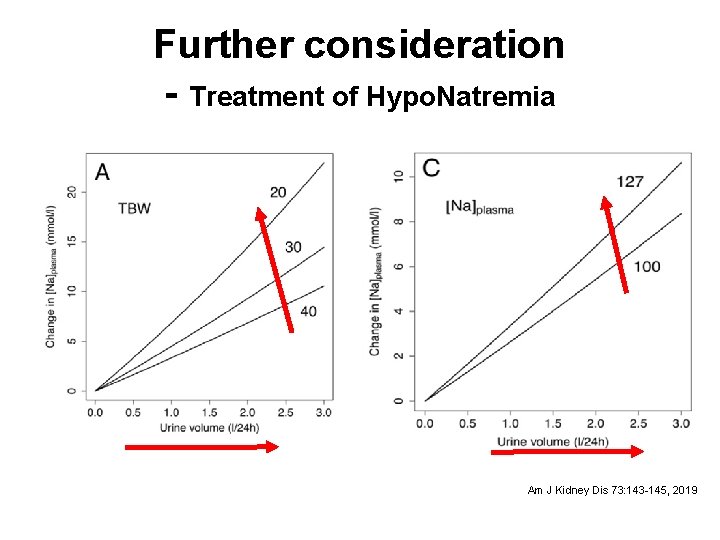
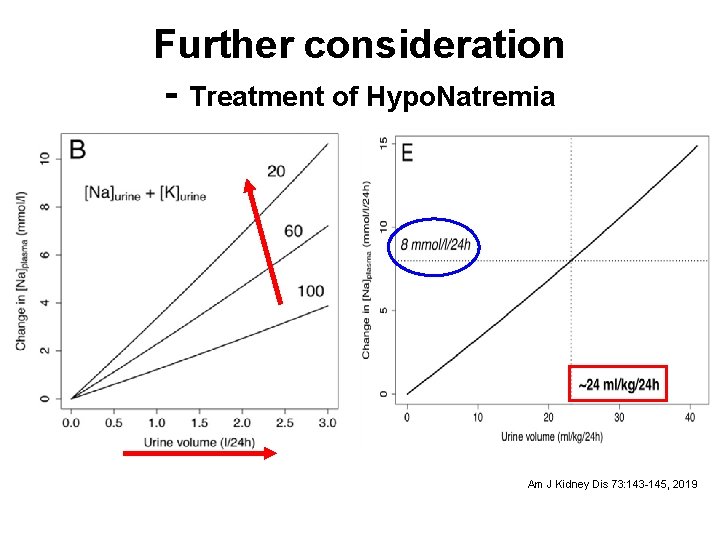
Further consideration - Treatment of Hypo. Natremia • Because the most common reason for overcorrection is the development of sudden substantial water diuresis. • Delta Na d/t urine excretion can be predicted • Edelman equation Urine volume monitoring, check urine Na, urine K Am J Kidney Dis 73: 143 -145, 2019
Further consideration - Treatment of Hypo. Natremia Am J Kidney Dis 73: 143 -145, 2019
Further consideration - Treatment of Hypo. Natremia Am J Kidney Dis 73: 143 -145, 2019
Thank you for your attention