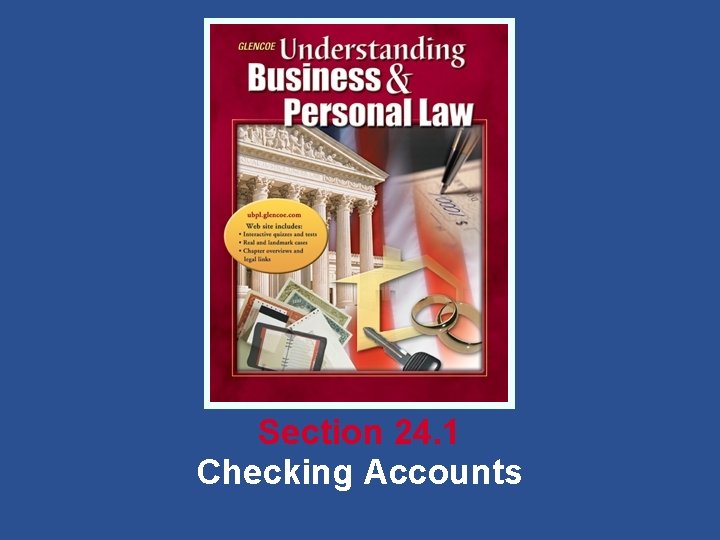
Section 24 1 Checking Accounts Section 24 1
- Slides: 58
Section 24. 1 Checking Accounts
Section 24. 1 Checking Accounts Writing Checks Chapter 24 Section 24. 1 Checking Accounts Section 24. 2 Other Payment Methods Understanding Business and Personal Law Writing Checks
Section 24. 1 Checking Accounts What You’ll Learn How to describe the process of opening a checking account and some of the depositor’s rights (p. 522) Understanding Business and Personal Law Writing Checks
Section 24. 1 Checking Accounts What You’ll Learn How to explain the proper way to write a check and discuss problems associated with checking accounts (p. 524) How to summarize the procedure for balancing a checkbook (p. 523) Understanding Business and Personal Law Writing Checks
Section 24. 1 Checking Accounts Why It’s Important Knowing about checking accounts and writing checks will help you use your money wisely. Understanding Business and Personal Law Writing Checks
Section 24. 1 Checking Accounts Legal Terms stale check (p. 522) outstanding checks (p. 523) bad check (p. 526) forgery (p. 527) uttering (p. 528) Understanding Business and Personal Law Writing Checks
Section 24. 1 Checking Accounts Section Outline Using a Checking Account Opening a Checking Account Balancing Your Checkbook Writing Checks Understanding Business and Personal Law Writing Checks
Section 24. 1 Checking Accounts Pre-Learning Question How would you use a checking account? Understanding Business and Personal Law Writing Checks
Section 24. 1 Checking Accounts Using a Checking Account Checks are: the most common kind of negotiable instrument in use a safe way to send funds through the mail convenient receipts for the people who write them Understanding Business and Personal Law Writing Checks
Section 24. 1 Checking Accounts Opening a Checking Account To open a checking account, you deposit money in a bank sign a signature card Understanding Business and Personal Law Writing Checks
Section 24. 1 Checking Accounts Opening a Checking Account Then the bank agrees to pay money out, up to the amount you have deposited, when you write a check. Understanding Business and Personal Law Writing Checks
Section 24. 1 Checking Accounts Opening a Checking Account A bank may refuse to pay a check that is more than six months old without incurring liability. Such a check is known as a stale check. Understanding Business and Personal Law Writing Checks
Section 24. 1 Checking Accounts Balancing Your Checkbook You should balance, or reconcile, your bank statement as soon as possible after receiving it. Carefully compare the check register balance with the bank statement balance to make sure that they agree. Understanding Business and Personal Law Writing Checks
Section 24. 1 Checking Accounts Balancing Your Checkbook Don’t forget to take into consideration outstanding checks, or checks you have written that have not yet been returned to the bank for payment. Understanding Business and Personal Law Writing Checks
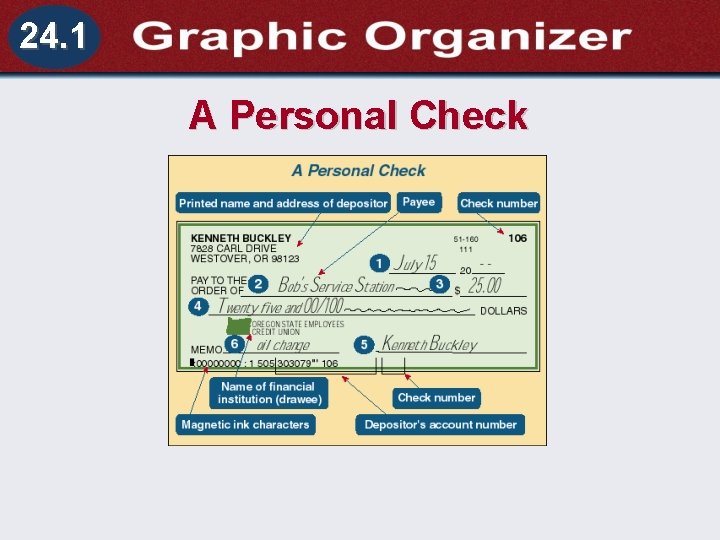
Section 24. 1 Checking Accounts Writing a Check Banks provide regular and special printed check forms. These checks display a series of numbers printed in magnetic ink that make it possible for computers to process the checks quickly and accurately. Understanding Business and Personal Law Writing Checks
24. 1 Checking Accounts Section A Personal Check Understanding Business and Personal Law Writing Checks
Section 24. 1 Checking Accounts Parities to a Check A check is a draft drawn on a bank and payable on demand. Drawer—person who writes the check Drawee—bank ordered to pay the money Payee—person to whom the check is made payable Understanding Business and Personal Law Writing Checks
Section 24. 1 Checking Accounts Avoiding Negligence To avoid negligence, you should write checks that cannot be changed easily or signed by a forger. Understanding Business and Personal Law Writing Checks
Section 24. 1 Checking Accounts Steps for Writing a Check print the figures very close to the dollar sign keep all of the figures close together always start at the extreme left when writing amounts of money in words Understanding Business and Personal Law Writing Checks
Section 24. 1 Checking Accounts Steps for Writing a Check draw a line through any extra space that remains after you’ve written the amount this prevents someone from putting in words and figures to alter the value of the check Understanding Business and Personal Law Writing Checks
Section 24. 1 Checking Accounts Steps for Writing a Check be sure figures are the same as written amounts (if there is a difference, the bank will honor the written amount) write the name of the payee close to the words “Pay to the order of” Understanding Business and Personal Law Writing Checks
Section 24. 1 Checking Accounts Steps for Writing a Check fill in all unused space with a line make a note of the reason for the check Understanding Business and Personal Law Writing Checks
Section 24. 1 Checking Accounts Steps for Writing a Check sign your name so that it looks as much as possible like the on the bank signature card never sign a blank check Understanding Business and Personal Law Writing Checks
Section 24. 1 Checking Accounts Steps for Writing a Check never cross out or change a check once it has been written if you make a mistake, print VOID across the incorrect check and write a new check Understanding Business and Personal Law Writing Checks
Section 24. 1 Checking Accounts Bad Checks A bad check is a check drawn on an account in which you have insufficient funds. Understanding Business and Personal Law Writing Checks
Section 24. 1 Checking Accounts Bad Checks Writing a check on an account with insufficient funds is larceny or attempted larceny, unless it is accidental. Understanding Business and Personal Law Writing Checks
Section 24. 1 Checking Accounts Forged Checks A forged check is a check that is signed by someone other than the drawer without the drawer’s authority. Forgery is a crime, subject to a fine and imprisonment. Understanding Business and Personal Law Writing Checks
Section 24. 1 Checking Accounts Forged Checks You are guilty of a crime if you knowingly offer a forged check, even if you did not personally commit the act of forgery. Understanding Business and Personal Law Writing Checks
Section 24. 1 Checking Accounts Forged Checks When an offeror deliberately submits a forged instrument to another, the resulting crime is called uttering. Understanding Business and Personal Law Writing Checks
Section 24. 1 Checking Accounts Stopping Payment of a Check You may order your bank to stop payment on a check that has not yet been paid by the bank. Understanding Business and Personal Law Writing Checks
Section 24. 1 Checking Accounts Stopping Payment of a Check However, if the check is given in payment of an amount actually owed, you still owe the amount of the debt. Understanding Business and Personal Law Writing Checks
Section 24. 1 Checking Accounts Fill in the blanks in the statements below. 1. A _____ check is one that is signed by someone other than the drawer without the drawer’s authority. Understanding Business and Personal Law Writing Checks
Section 24. 1 Checking Accounts ANSWER Forged Understanding Business and Personal Law Writing Checks
Section 24. 1 Checking Accounts 2. A _____ check is one that is more than six months old. Understanding Business and Personal Law Writing Checks
Section 24. 1 Checking Accounts ANSWER Stale Understanding Business and Personal Law Writing Checks
Section 24. 1 Checking Accounts 3. A _____ check is one that is drawn on an account in which there is insufficient funds. Understanding Business and Personal Law Writing Checks
Section 24. 1 Checking Accounts ANSWER Bad Understanding Business and Personal Law Writing Checks
Section 24. 1 Checking Accounts ANSWER 4. A _____ check is one that has been written but not yet returned to the bank for payment. Understanding Business and Personal Law Writing Checks
Section 24. 1 Checking Accounts ANSWER outstanding Understanding Business and Personal Law Writing Checks
Section 24. 1 Checking Accounts Section 24. 1 Assessment Reviewing What You Learned 1. How is a checking account opened? Understanding Business and Personal Law Writing Checks
Section 24. 1 Checking Accounts Section 24. 1 Assessment Reviewing What You Learned Answer By depositing money in the bank and signing a signature card. Understanding Business and Personal Law Writing Checks
Section 24. 1 Checking Accounts Section 24. 1 Assessment Reviewing What You Learned 2. Describe the proper way to write a check. Understanding Business and Personal Law Writing Checks
Section 24. 1 Checking Accounts Section 24. 1 Assessment Reviewing What You Learned Answer When handwriting a check, place the figures very close to the dollar sign and keep all figures close together. Always start at the extreme left when writing amounts of money in words. Understanding Business and Personal Law Writing Checks
Section 24. 1 Checking Accounts Section 24. 1 Assessment Reviewing What You Learned Answer Draw a line in any part of the space not needed for the amount. This prevents someone from putting in words and figures to alter the value of the check. Understanding Business and Personal Law Writing Checks
Section 24. 1 Checking Accounts Section 24. 1 Assessment Reviewing What You Learned Answer Write the name of the payee close to the words “Pay to the order of” and fill in all unused space with a line. Make a note of the reason for the check. Understanding Business and Personal Law Writing Checks
Section 24. 1 Checking Accounts Section 24. 1 Assessment Reviewing What You Learned Answer Sign your name so that it looks as much as possible like the on the bank signature card. Understanding Business and Personal Law Writing Checks
Section 24. 1 Checking Accounts Section 24. 1 Assessment Reviewing What You Learned Answer Never sign a blank a check. Never cross out or change a check once it has been written. Understanding Business and Personal Law Writing Checks
Section 24. 1 Checking Accounts Section 24. 1 Assessment Reviewing What You Learned 3. Summarize the process of balancing your checkbook. Understanding Business and Personal Law Writing Checks
Section 24. 1 Checking Accounts Section 24. 1 Assessment Reviewing What You Learned Answer Compare the check register balance with the bank statement balance to be sure they agree. When balancing the account, it is necessary to take into consideration outstanding checks. Understanding Business and Personal Law Writing Checks
Section 24. 1 Checking Accounts Section 24. 1 Assessment Critical Thinking Activity Banking Fees Why do you think banks charge a fee to process an order to stop payment? Understanding Business and Personal Law Writing Checks
Section 24. 1 Checking Accounts Section 24. 1 Assessment Critical Thinking Activity Answer Banking Fees Answers may vary but should recognize that the bank is charging for the time that its employees spend processing the order. Understanding Business and Personal Law Writing Checks
Section 24. 1 Checking Accounts Section 24. 1 Assessment Legal Skills in Action Calculating Costs You deposit a $100 check from your friend Ted into your checking account and then write a $46. 18 check to pay for groceries. Understanding Business and Personal Law Writing Checks
Section 24. 1 Checking Accounts Section 24. 1 Assessment Legal Skills in Action Calculating Costs Four days later, you receive a notice from the bank that Ted’s check was bad and your account was debited $25 for the unpaid deposit. Understanding Business and Personal Law Writing Checks
Section 24. 1 Checking Accounts Section 24. 1 Assessment Legal Skills in Action Calculating Costs Because the funds from your deposit did not become available, your check was returned to the grocer unpaid. Your account is debited another $25 for the unpaid check. Understanding Business and Personal Law Writing Checks
Section 24. 1 Checking Accounts Section 24. 1 Assessment Legal Skills in Action Calculating Costs The next day you receive notice from your grocer that you must pay a fee of $25 for the returned check and replace it with a bank check or money order. You pay 75 cents for the money order. Understanding Business and Personal Law Writing Checks
Section 24. 1 Checking Accounts Section 24. 1 Assessment Legal Skills in Action Calculating Costs Calculate how much you really spent to purchase $46. 18 worth of groceries. Understanding Business and Personal Law Writing Checks
Section 24. 1 Checking Accounts Section 24. 1 Assessment Legal Skills in Action Answer Calculating Costs $121. 93. Original check amount, $46. 18. Bank fees, $50. Grocer’s returned check fee, $25. Cost of money order, . 75. Understanding Business and Personal Law Writing Checks
End of Section 24. 1 Checking Accounts