PPL Applicative and Normal Form Verification Type Checking
- Slides: 20
PPL Applicative and Normal Form Verification, Type Checking and Inference
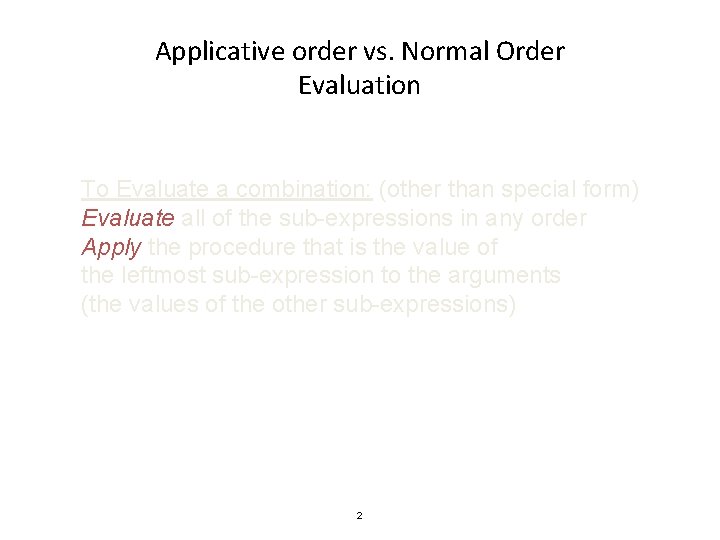
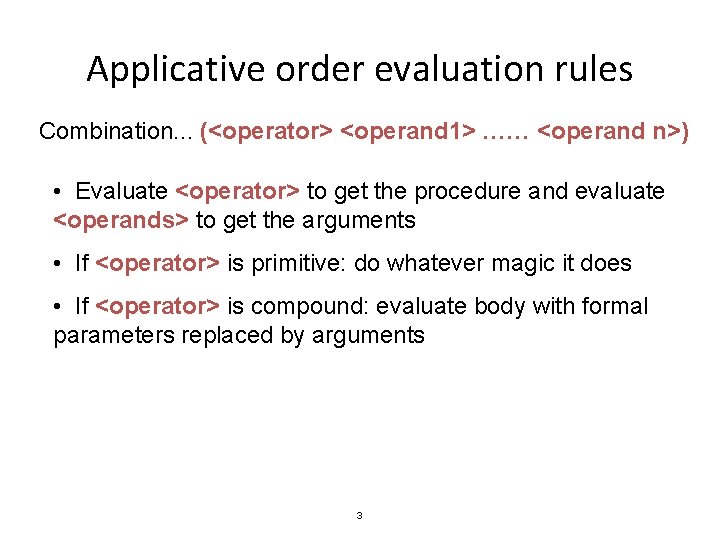
Applicative order vs. Normal Order Evaluation To Evaluate a combination: (other than special form) Evaluate all of the sub-expressions in any order Apply the procedure that is the value of the leftmost sub-expression to the arguments (the values of the other sub-expressions) 2
Applicative order evaluation rules Combination. . . (<operator> <operand 1> …… <operand n>) • Evaluate <operator> to get the procedure and evaluate <operands> to get the arguments • If <operator> is primitive: do whatever magic it does • If <operator> is compound: evaluate body with formal parameters replaced by arguments 3
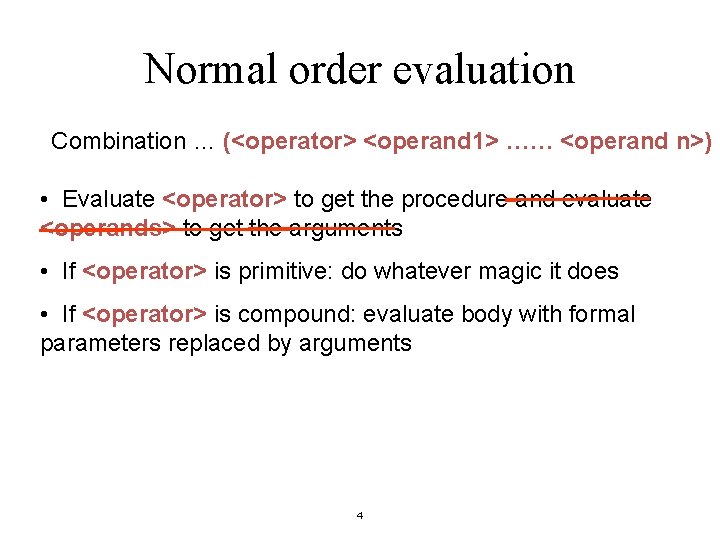
Normal order evaluation Combination … (<operator> <operand 1> …… <operand n>) • Evaluate <operator> to get the procedure and evaluate <operands> to get the arguments • If <operator> is primitive: do whatever magic it does • If <operator> is compound: evaluate body with formal parameters replaced by arguments 4
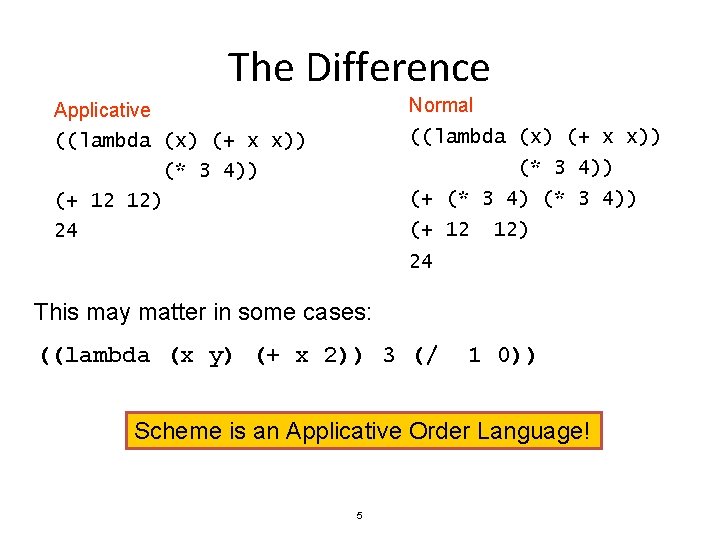
The Difference Normal Applicative ((lambda (x) (+ x x)) (* 3 4)) (+ 12 12) 24 ((lambda (x) (+ x x)) (* 3 4)) (+ 12 12) 24 This may matter in some cases: ((lambda (x y) (+ x 2)) 3 (/ 1 0)) Scheme is an Applicative Order Language! 5
Using let to define functions • Can we use let to define functions? • What about recursive functions?
Type Checking and Inference • Based on S. Krishnamurthi. Programming Languages: Application and Interpretation. 2007 Chapters 24 -26
Verification • Type correctness – Verify that the types of expressions in the program are “correct” – E. g. + is applied to numbers – In other languages: we should also check that the type of value stored in a variable correspond to the variable declared type • Program Verification – Verify that the program halts and produces the “correct” output – Somewhat easier with design-by-contract, where it can be done in a modular fashion
Languages and Types • Fully typed – C, Pascal, Java. . • Semi-typed – Scheme • Untyped – Prolog • Well-typing rules – Define relationships between types
Type Checking and Inference Type Checking. Given an expression, and a “goal” type T, verify that the expression type is T Example: Given the expression (+ (f 3) 7), we need to verify that (f 3) is a number Type Inference. Infer the type of an expression Example: (define x (f 3))
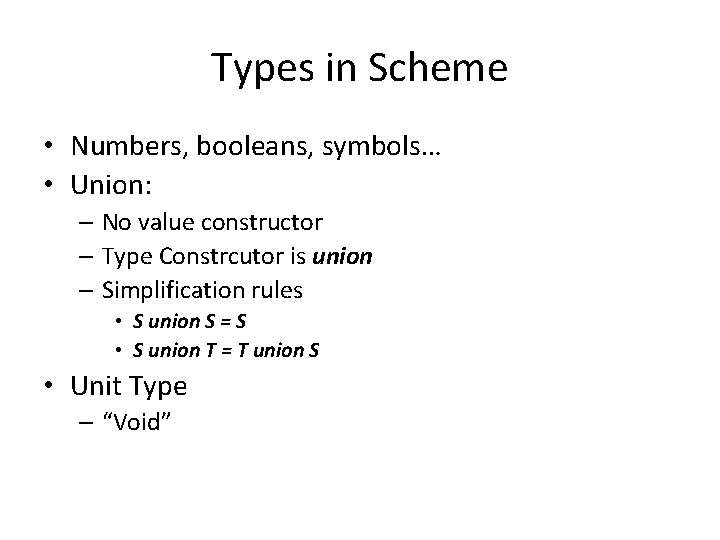
Types in Scheme • Numbers, booleans, symbols… • Union: – No value constructor – Type Constrcutor is union – Simplification rules • S union S = S • S union T = T union S • Unit Type – “Void”
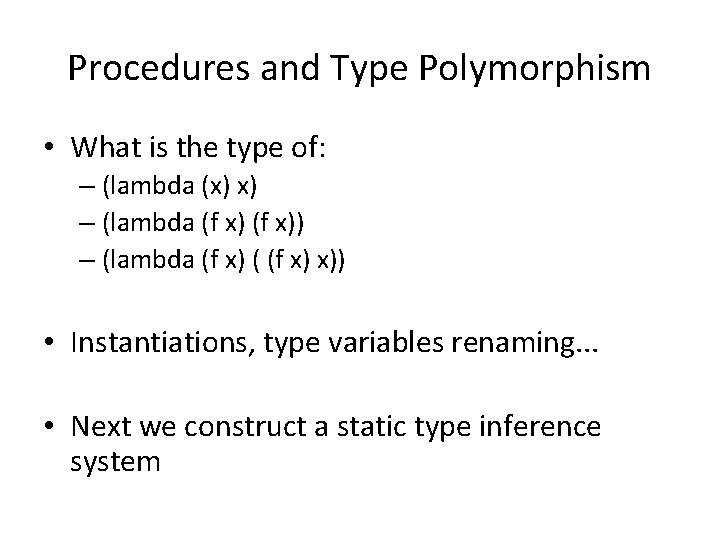
Procedures and Type Polymorphism • What is the type of: – (lambda (x) x) – (lambda (f x)) – (lambda (f x) ( (f x) x)) • Instantiations, type variables renaming. . . • Next we construct a static type inference system
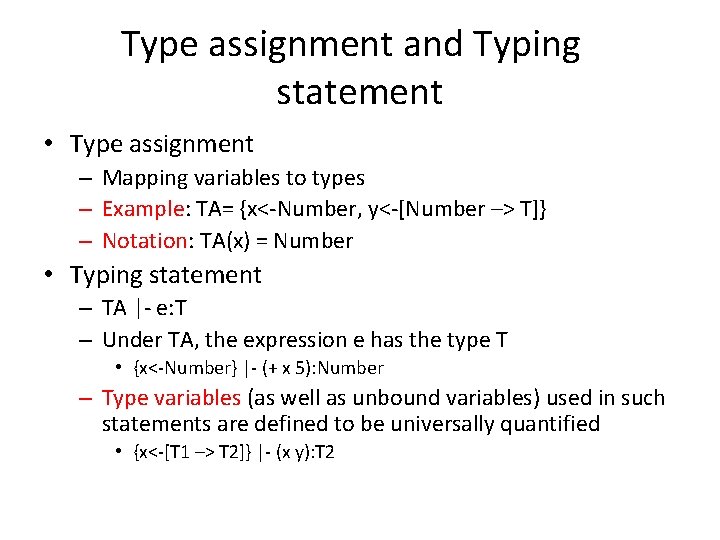
Type assignment and Typing statement • Type assignment – Mapping variables to types – Example: TA= {x<-Number, y<-[Number –> T]} – Notation: TA(x) = Number • Typing statement – TA |- e: T – Under TA, the expression e has the type T • {x<-Number} |- (+ x 5): Number – Type variables (as well as unbound variables) used in such statements are defined to be universally quantified • {x<-[T 1 –> T 2]} |- (x y): T 2
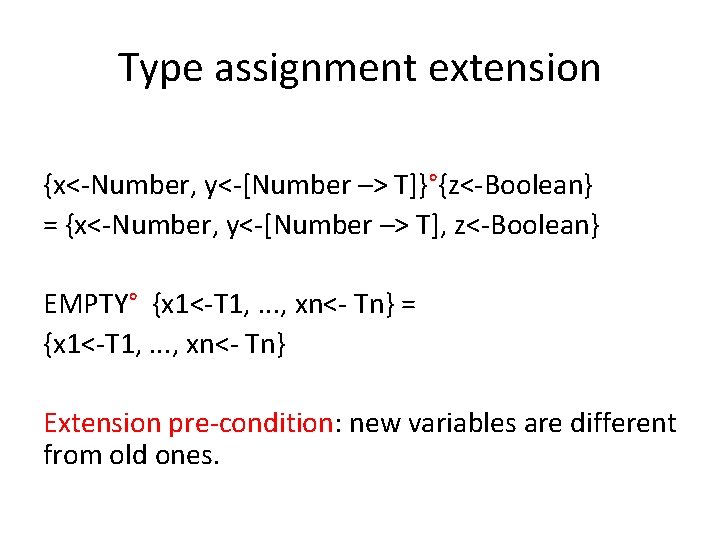
Type assignment extension {x<-Number, y<-[Number –> T]}°{z<-Boolean} = {x<-Number, y<-[Number –> T], z<-Boolean} EMPTY° {x 1<-T 1, . . . , xn<- Tn} = {x 1<-T 1, . . . , xn<- Tn} Extension pre-condition: new variables are different from old ones.
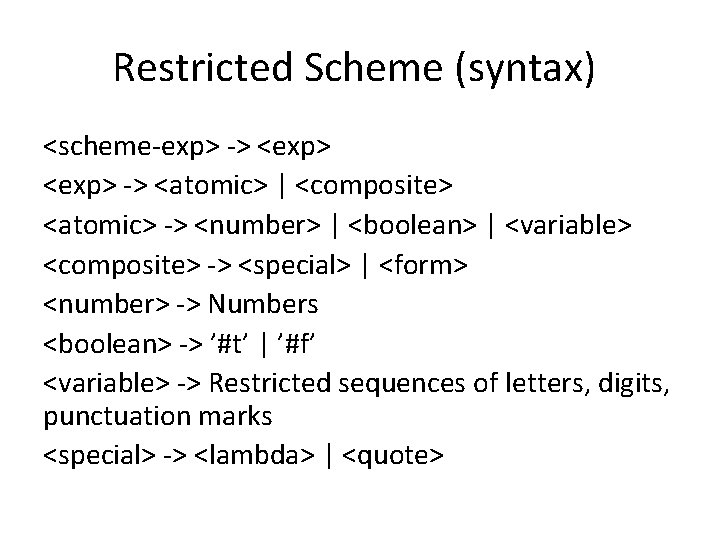
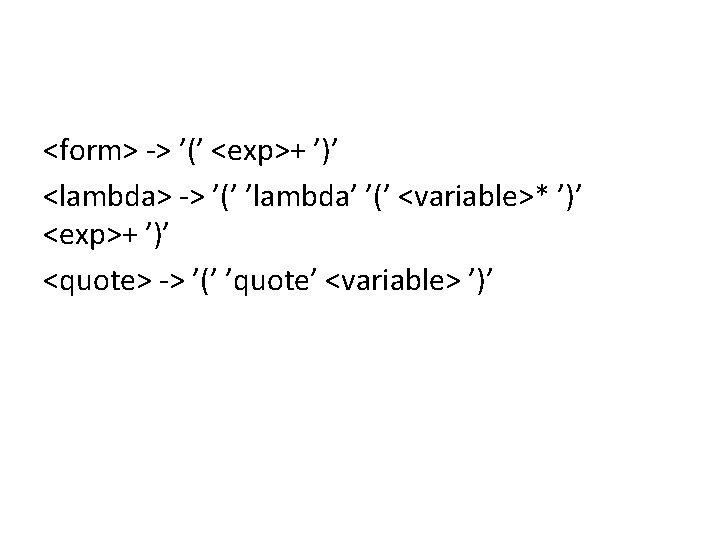
Restricted Scheme (syntax) <scheme-exp> -> <exp> -> <atomic> | <composite> <atomic> -> <number> | <boolean> | <variable> <composite> -> <special> | <form> <number> -> Numbers <boolean> -> ’#t’ | ’#f’ <variable> -> Restricted sequences of letters, digits, punctuation marks <special> -> <lambda> | <quote>
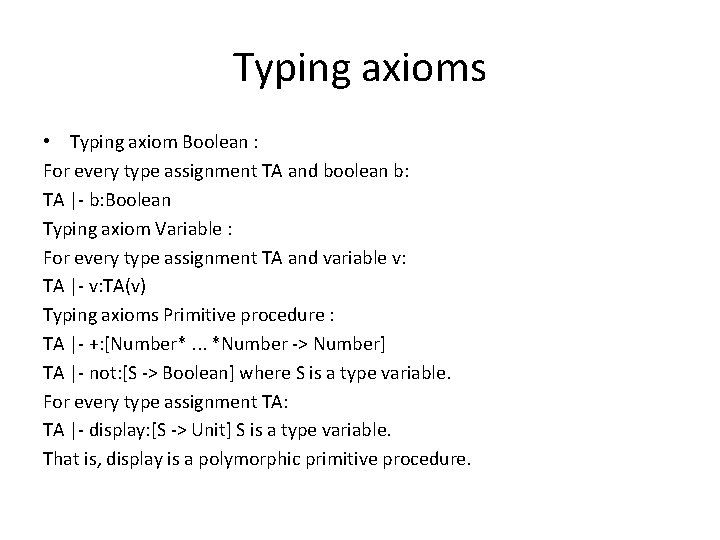
Typing axioms • Typing axiom Boolean : For every type assignment TA and boolean b: TA |- b: Boolean Typing axiom Variable : For every type assignment TA and variable v: TA |- v: TA(v) Typing axioms Primitive procedure : TA |- +: [Number*. . . *Number -> Number] TA |- not: [S -> Boolean] where S is a type variable. For every type assignment TA: TA |- display: [S -> Unit] S is a type variable. That is, display is a polymorphic primitive procedure.
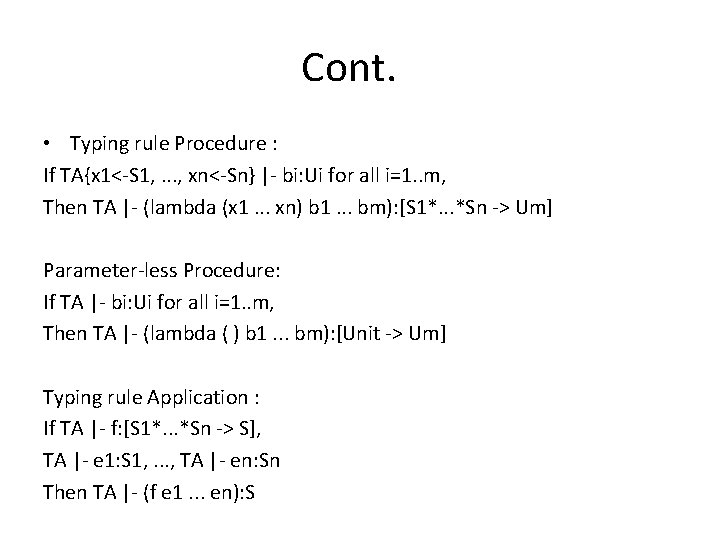
Cont. • Typing rule Procedure : If TA{x 1<-S 1, . . . , xn<-Sn} |- bi: Ui for all i=1. . m, Then TA |- (lambda (x 1. . . xn) b 1. . . bm): [S 1*. . . *Sn -> Um] Parameter-less Procedure: If TA |- bi: Ui for all i=1. . m, Then TA |- (lambda ( ) b 1. . . bm): [Unit -> Um] Typing rule Application : If TA |- f: [S 1*. . . *Sn -> S], TA |- e 1: S 1, . . . , TA |- en: Sn Then TA |- (f e 1. . . en): S
Expression Trees The nesting of expressions can be viewed as a tree Sub-trees correspond to composite expressions Leaves correspond to atomic ones.
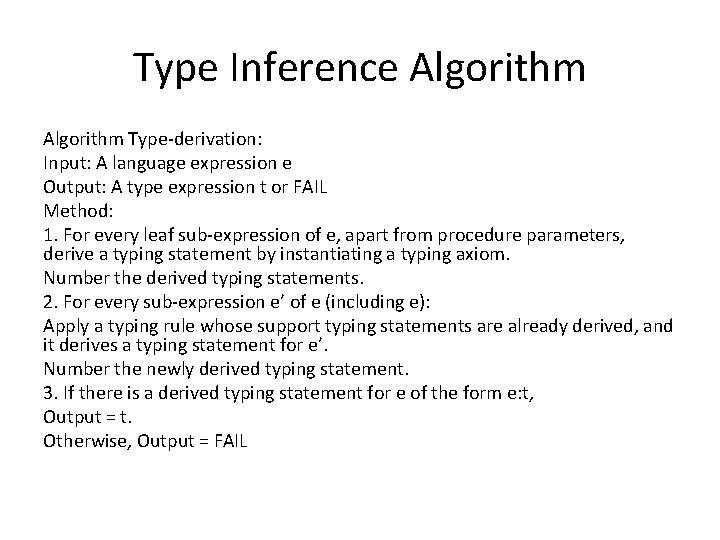
Type Inference Algorithm Type-derivation: Input: A language expression e Output: A type expression t or FAIL Method: 1. For every leaf sub-expression of e, apart from procedure parameters, derive a typing statement by instantiating a typing axiom. Number the derived typing statements. 2. For every sub-expression e’ of e (including e): Apply a typing rule whose support typing statements are already derived, and it derives a typing statement for e’. Number the newly derived typing statement. 3. If there is a derived typing statement for e of the form e: t, Output = t. Otherwise, Output = FAIL