COMMUNICATION AND IDENTITY CHAPTER TOPICS 2 SelfDisclosure in
- Slides: 37
COMMUNICATION AND IDENTITY CHAPTER TOPICS 2 Self-Disclosure in Relationships Alternatives to Self Disclosure Looking Out/Looking In Fourteenth Edition
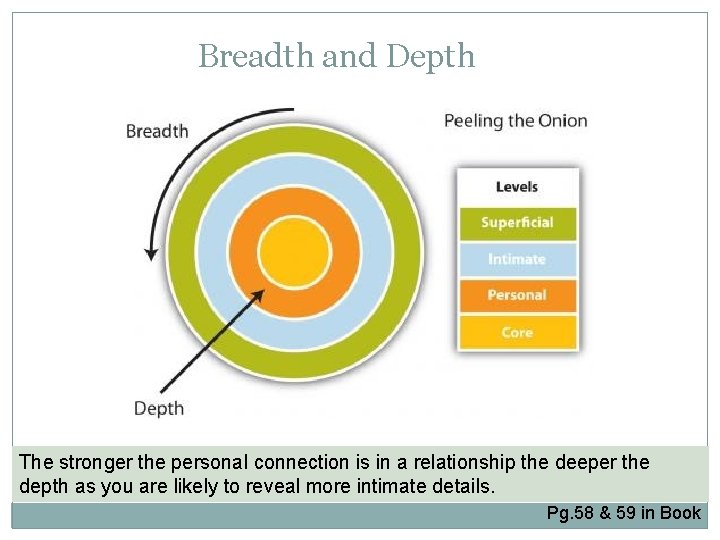
Breadth and Depth The stronger the personal connection is in a relationship the deeper the depth as you are likely to reveal more intimate details. Pg. 58 & 59 in Book
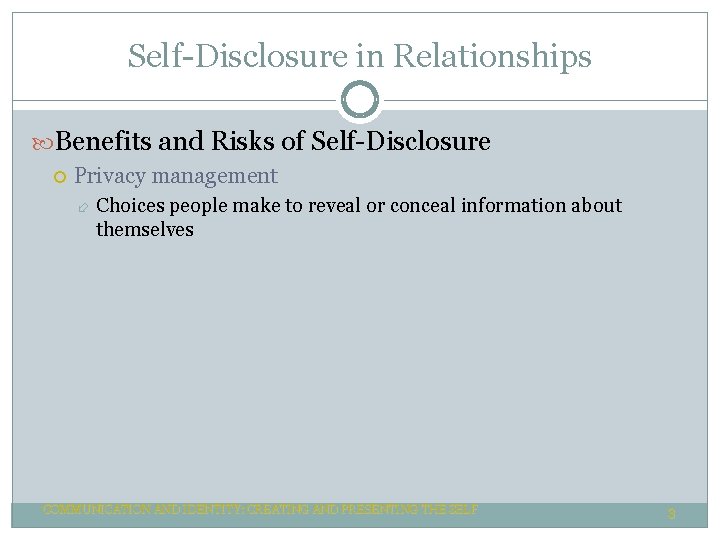
Self-Disclosure in Relationships Benefits and Risks of Self-Disclosure Privacy management Choices people make to reveal or conceal information about themselves COMMUNICATION AND IDENTITY: CREATING AND PRESENTING THE SELF 3
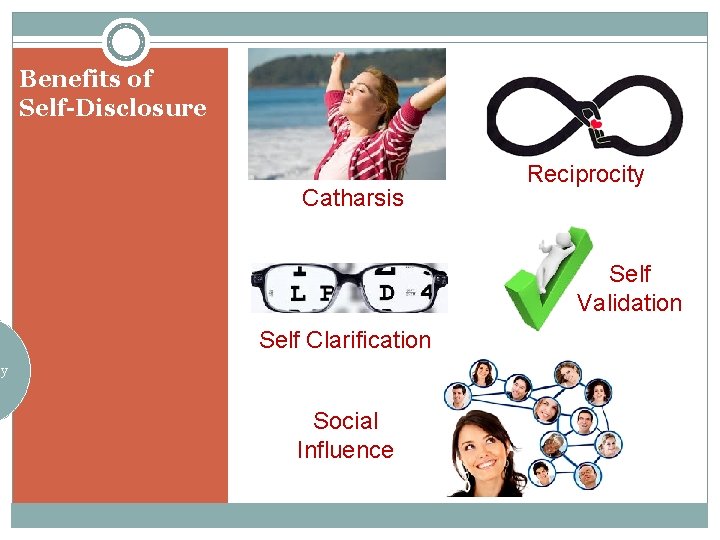
Benefits of Self-Disclosure Catharsis Reciprocity Self Validation Self Clarification ty Social Influence
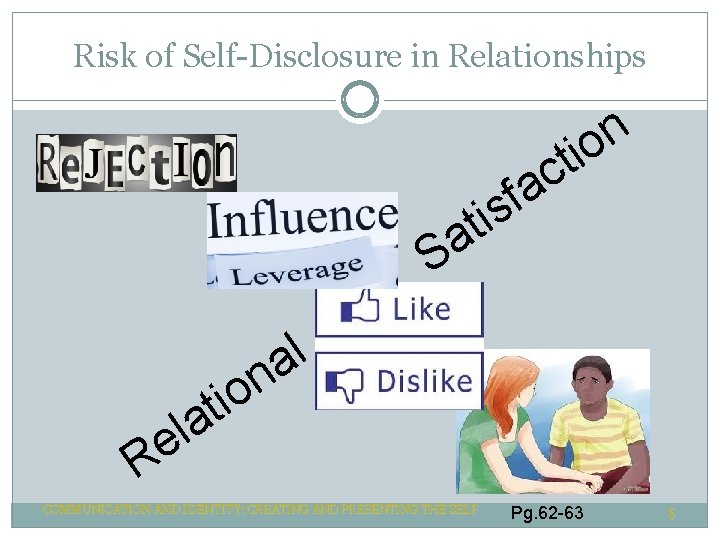
Risk of Self-Disclosure in Relationships n io t c fa s i at S l a n R o i t a l e COMMUNICATION AND IDENTITY: CREATING AND PRESENTING THE SELF Pg. 62 -63 5
Self-Disclosure in Relationships Guidelines for Self-Disclosure Is the other person important to you? Are the amount and type of disclosure appropriate? Is the risk of disclosing reasonable? Will the effect be constructive? Is the self-disclosure reciprocated? Do you have a moral obligation to disclose? COMMUNICATION AND IDENTITY: CREATING AND PRESENTING THE SELF Pg 63 - 64 6
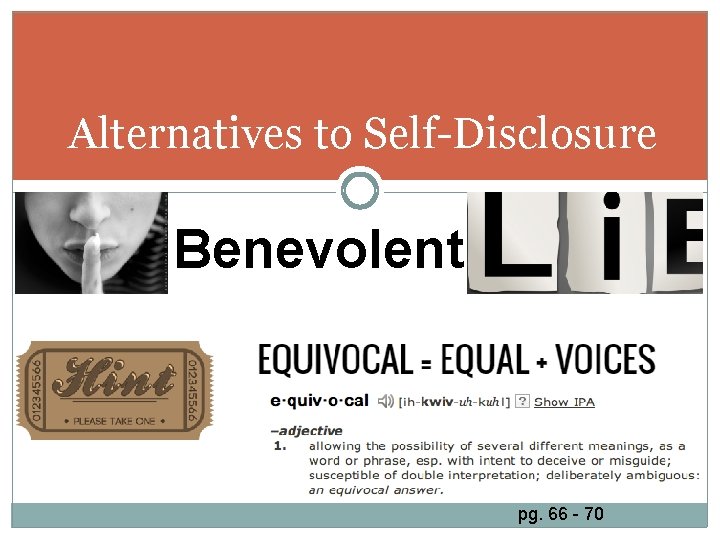
Alternatives to Self-Disclosure Benevolent pg. 66 - 70
Alternatives to Self-Disclosure The Ethics of Evasion interests of the receiver? Is an indirect message in the Is this sort of evasion the only or best way to behave? COMMUNICATION AND IDENTITY: CREATING AND PRESENTING THE SELF Pg. 70 -71 8
Chap. 3 Perception What You See is What You Get Describe how communication is shaped based on circumstances Influences on Perception and the Effect on Communication Perception Checking Pillow Method COMMUNICATION AND IDENTITY: CREATING AND PRESENTING THE SELF 9
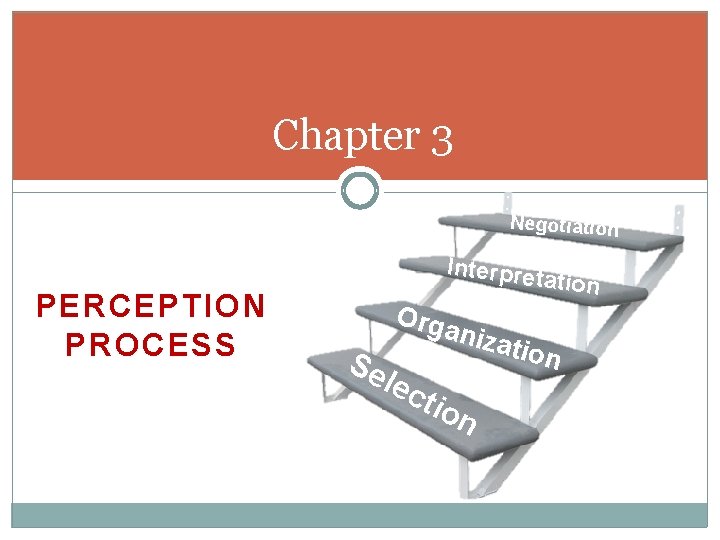
Chapter 3 Negotiation PERCEPTION PROCESS Interpre tation Se Orga lec niza ti tio n on
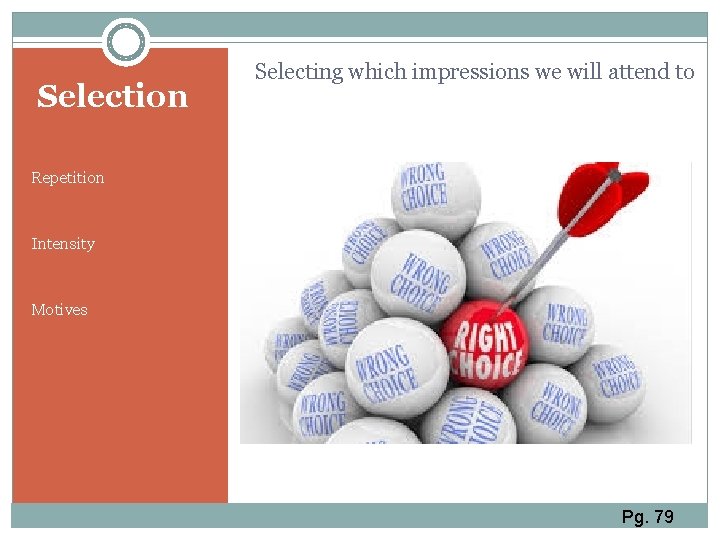
Selection Selecting which impressions we will attend to Repetition Intensity Motives Pg. 79
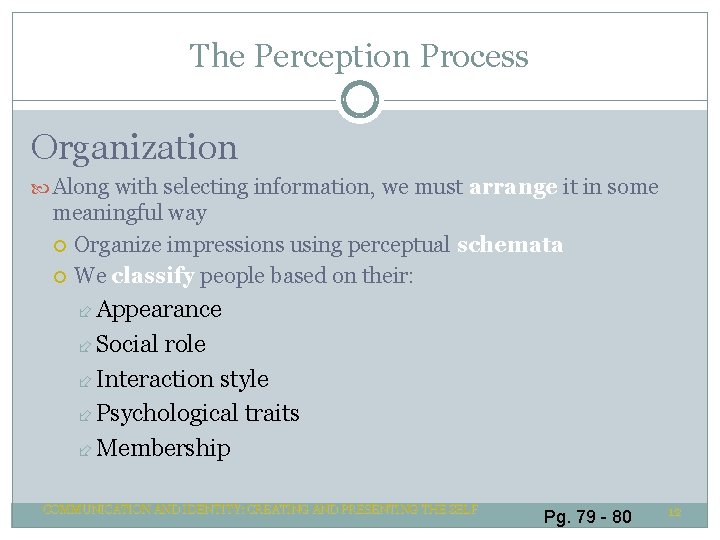
The Perception Process Organization Along with selecting information, we must arrange it in some meaningful way Organize impressions using perceptual schemata We classify people based on their: Appearance Social role Interaction style Psychological traits Membership COMMUNICATION AND IDENTITY: CREATING AND PRESENTING THE SELF Pg. 79 - 80 12
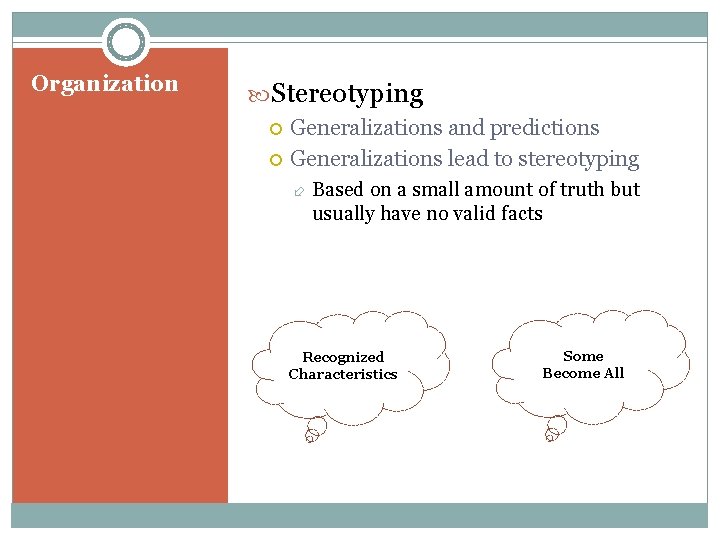
Organization Stereotyping Generalizations and predictions Generalizations lead to stereotyping Based on a small amount of truth but usually have no valid facts Recognized Characteristics Some Become All
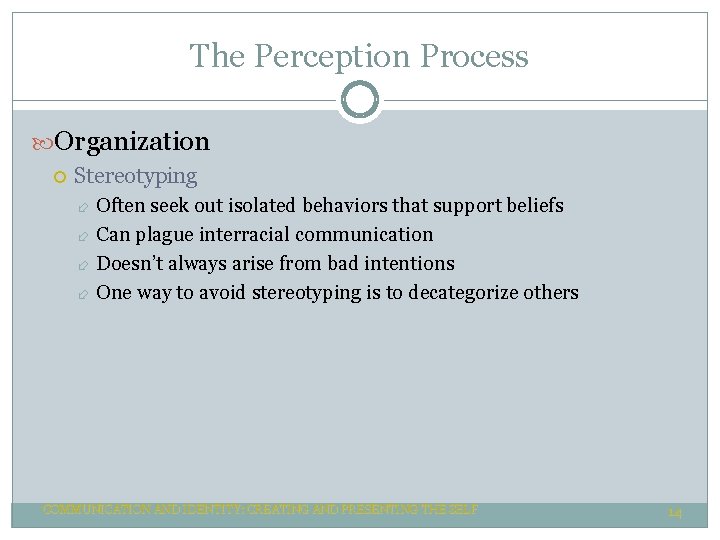
The Perception Process Organization Stereotyping Often seek out isolated behaviors that support beliefs Can plague interracial communication Doesn’t always arise from bad intentions One way to avoid stereotyping is to decategorize others COMMUNICATION AND IDENTITY: CREATING AND PRESENTING THE SELF 14
The Perception Process Interpretation After we organize information we interpret it Interpretation plays a role in nearly every interpersonal act COMMUNICATION AND IDENTITY: CREATING AND PRESENTING THE SELF 15
The Perception Process Interpretation Several factors cause us to interpret an event in one way or another: Degree of involvement with the other person Personal experience Assumptions about human behavior Attitudes Expectations Knowledge Self-concept Relational satisfaction COMMUNICATION AND IDENTITY: CREATING AND PRESENTING THE SELF 16
The Perception Process Negotiation Sense-making occurs between people as they influence one another’s perception Narratives Every interaction can be described by more than one narrative When narratives clash we often hang on to our own point of view or try to negotiate common ground Shared narratives don’t have to be accurate to be powerful COMMUNICATION AND IDENTITY: CREATING AND PRESENTING THE SELF 17
Influences on Perception Access to Information When new information becomes available perceptions change Often gain access to new information when roles overlap Social media can provide new information that can affect perceptions COMMUNICATION AND IDENTITY: CREATING AND PRESENTING THE SELF 18
Influences on Perception Physiological Influences Each of us perceives the world in a unique way The Senses How we experience our senses changes the way we interact and shape our perception COMMUNICATION AND IDENTITY: CREATING AND PRESENTING THE SELF 19
Influences on Perception Physiological Influences Psychological challenges Some differences rooted in neurology COMMUNICATION AND IDENTITY: CREATING AND PRESENTING THE SELF 20
Influences on Perception Physiological Influences Age Health and fatigue Hunger Biological cycles COMMUNICATION AND IDENTITY: CREATING AND PRESENTING THE SELF 21
Influences on Perception Cultural Differences Every culture has its own world view The range of cultural differences is wide Beliefs about the value of talk differ Can lead to communication problems COMMUNICATION AND IDENTITY: CREATING AND PRESENTING THE SELF 22
Influences on Perception Cultural Differences Ethnocentrism The attitude that one’s own culture is superior to others Within this country there are many subcultures Open-minded communicators can overcome stereotypes COMMUNICATION AND IDENTITY: CREATING AND PRESENTING THE SELF 23
Influences on Perception Social Roles Gender Roles Sex refers to biological characteristics Gender refers to psychological dimensions of masculine and feminine behavior Gender roles are socially approved ways that men and women are expected to behave Androgynous Gender Role Combines masculine and feminine traits COMMUNICATION AND IDENTITY: CREATING AND PRESENTING THE SELF 24
Influence on Perception Social Roles Occupational roles The kind of work we do influences our view of the world Even within the same occupational setting, different roles participants have can affect perceptions COMMUNICATION AND IDENTITY: CREATING AND PRESENTING THE SELF 25
Influence on Perception Social Roles Relational roles Roles you play in relation to others The role of parent The roles involved in romantic love COMMUNICATION AND IDENTITY: CREATING AND PRESENTING THE SELF 26
Common Tendencies in Perception Attribution Process of explaining people’s behavior Attribute meaning to our own actions and to actions of others Often use different yardsticks COMMUNICATION AND IDENTITY: CREATING AND PRESENTING THE SELF 27
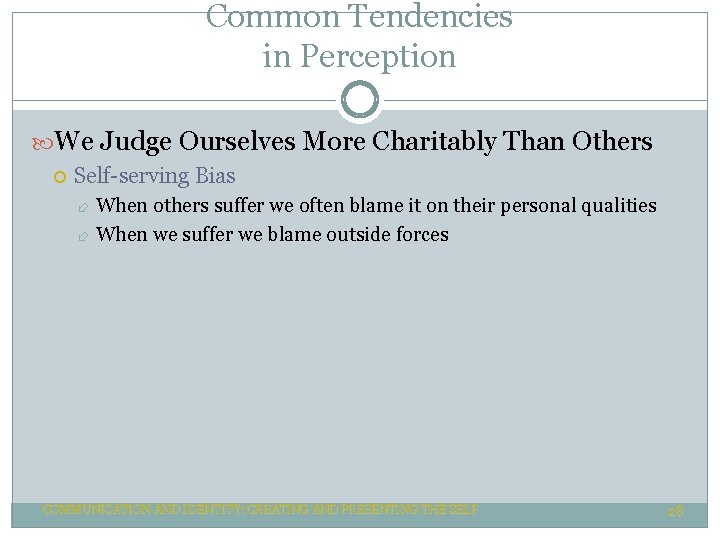
Common Tendencies in Perception We Judge Ourselves More Charitably Than Others Self-serving Bias When others suffer we often blame it on their personal qualities When we suffer we blame outside forces COMMUNICATION AND IDENTITY: CREATING AND PRESENTING THE SELF 28
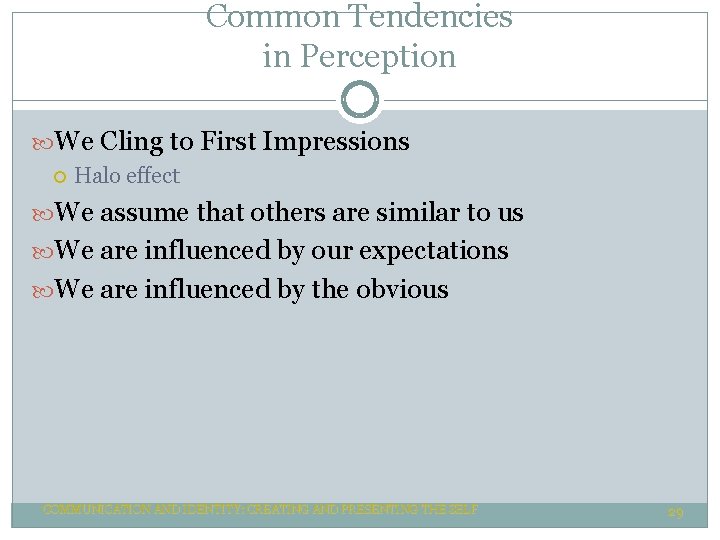
Common Tendencies in Perception We Cling to First Impressions Halo effect We assume that others are similar to us We are influenced by our expectations We are influenced by the obvious COMMUNICATION AND IDENTITY: CREATING AND PRESENTING THE SELF 29
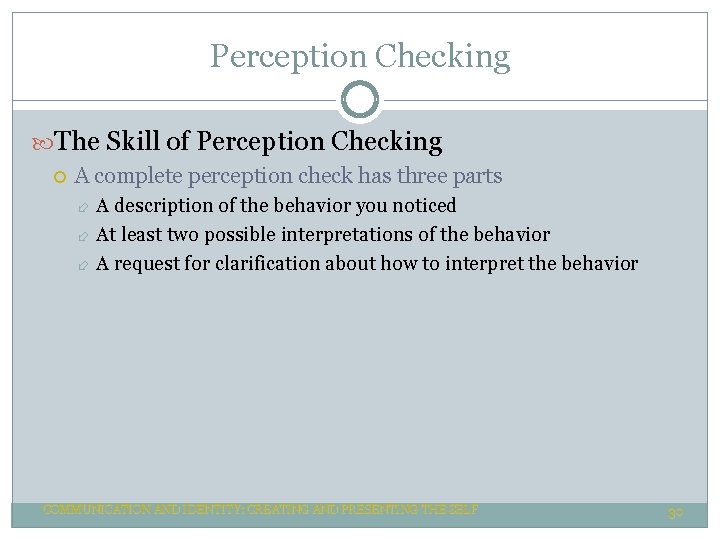
Perception Checking The Skill of Perception Checking A complete perception check has three parts A description of the behavior you noticed At least two possible interpretations of the behavior A request for clarification about how to interpret the behavior COMMUNICATION AND IDENTITY: CREATING AND PRESENTING THE SELF 30
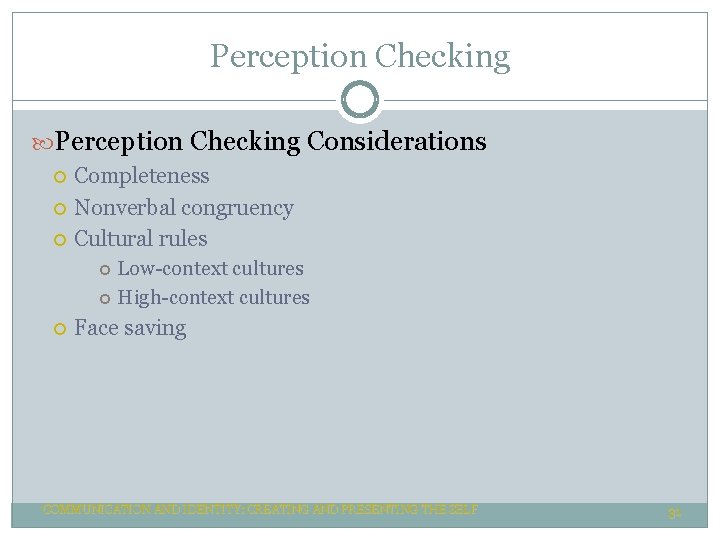
Perception Checking Considerations Completeness Nonverbal congruency Cultural rules Low-context cultures High-context cultures Face saving COMMUNICATION AND IDENTITY: CREATING AND PRESENTING THE SELF 31
Empathy, Cognitive Complexity, and Communication Empathy The ability to re-create another person’s perspective, to experience the world from the other’s point of view Three dimensions Perspective taking Emotional dimension Genuine concern COMMUNICATION AND IDENTITY: CREATING AND PRESENTING THE SELF 32
Empathy, Cognitive Complexity, and Communication Sympathy Viewing another person’s situation from your point of view COMMUNICATION AND IDENTITY: CREATING AND PRESENTING THE SELF 33
Empathy, Cognitive Complexity, and Communication Cognitive Complexity The ability to construct a variety of frameworks for viewing an issue Connection between cognitive complexity and empathy COMMUNICATION AND IDENTITY: CREATING AND PRESENTING THE SELF 34
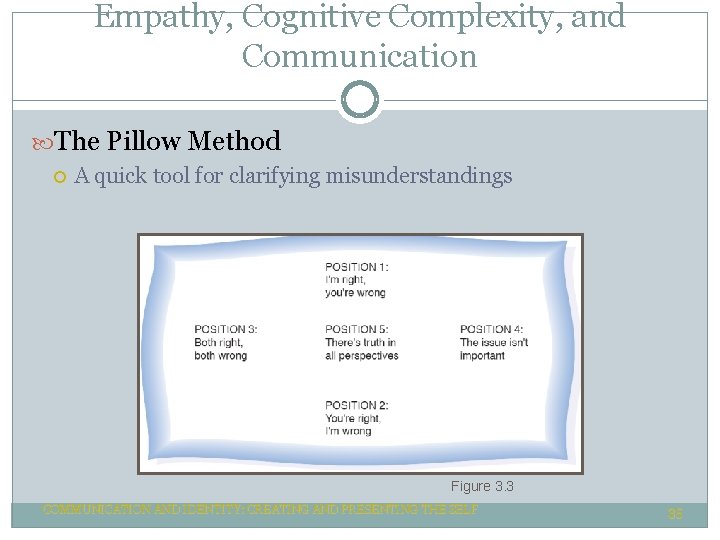
Empathy, Cognitive Complexity, and Communication The Pillow Method A quick tool for clarifying misunderstandings Figure 3. 3 COMMUNICATION AND IDENTITY: CREATING AND PRESENTING THE SELF 35
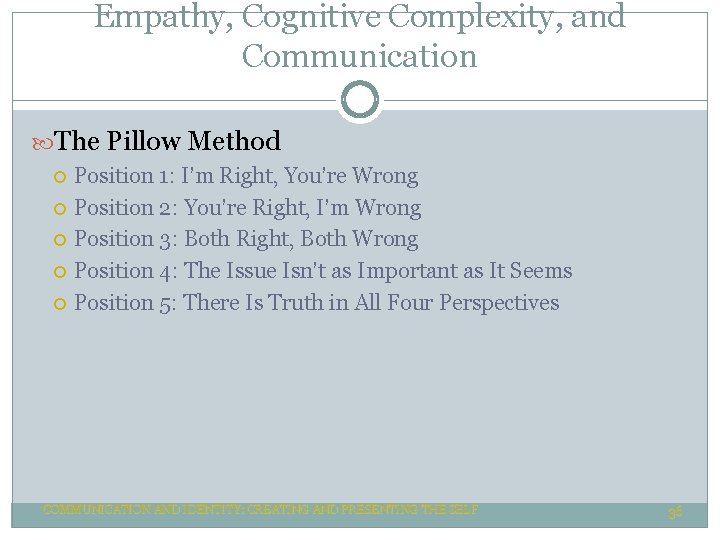
Empathy, Cognitive Complexity, and Communication The Pillow Method Position 1: I’m Right, You’re Wrong Position 2: You’re Right, I’m Wrong Position 3: Both Right, Both Wrong Position 4: The Issue Isn’t as Important as It Seems Position 5: There Is Truth in All Four Perspectives COMMUNICATION AND IDENTITY: CREATING AND PRESENTING THE SELF 36
Chapter Review The Perception Process Influences on Perception Common Tendencies in Perception Checking Empathy, Cognitive Complexity, and Communication COMMUNICATION AND IDENTITY: CREATING AND PRESENTING THE SELF 37