Section 2 Isotopes and Radioactive Elements Lesson 13



- Slides: 27
Section 2: Isotopes and Radioactive Elements Lesson 13 Subatomic Heavyweights Lesson 14 Isotopia
Lesson 13: Subatomic Heavyweights Isotopes
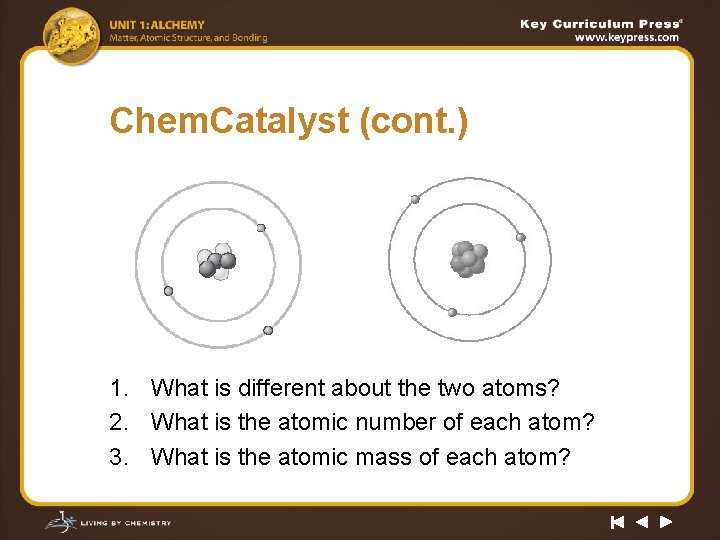
Chem. Catalyst A chemist investigating a sample of lithium found that some lithium atoms have a lower mass than other lithium atoms. The chemist drew models of the two different types of lithium atoms, as shown on the following slide.
Chem. Catalyst (cont. ) 1. What is different about the two atoms? 2. What is the atomic number of each atom? 3. What is the atomic mass of each atom?
Key Question How can atoms of the same element be different?
You will be able to: • • • define isotope and write and interpret the symbol for a specific isotope determine the average atomic mass of an element based on the natural abundance of isotopes of that element predict the number of protons, neutrons, and electrons in the most abundant isotope of an atom, based on average atomic mass
Prepare for the Activity Work in pairs.
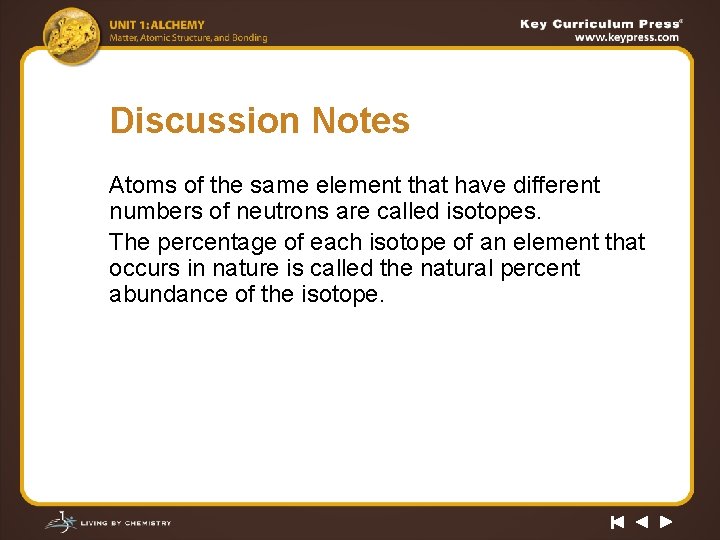
Discussion Notes Atoms of the same element that have different numbers of neutrons are called isotopes. The percentage of each isotope of an element that occurs in nature is called the natural percent abundance of the isotope.
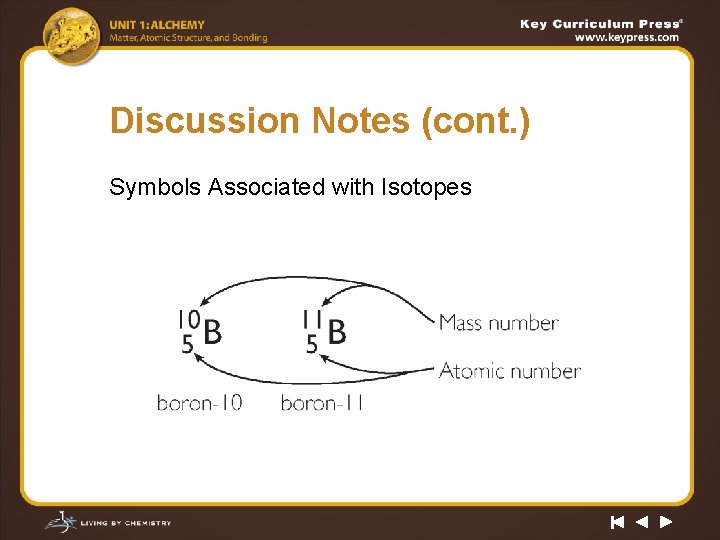
Discussion Notes (cont. ) Symbols Associated with Isotopes
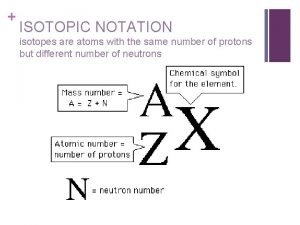
Discussion Notes (cont. ) Chemists use a special notation to symbolize an isotope. One way to refer to isotopes is to use their mass numbers.
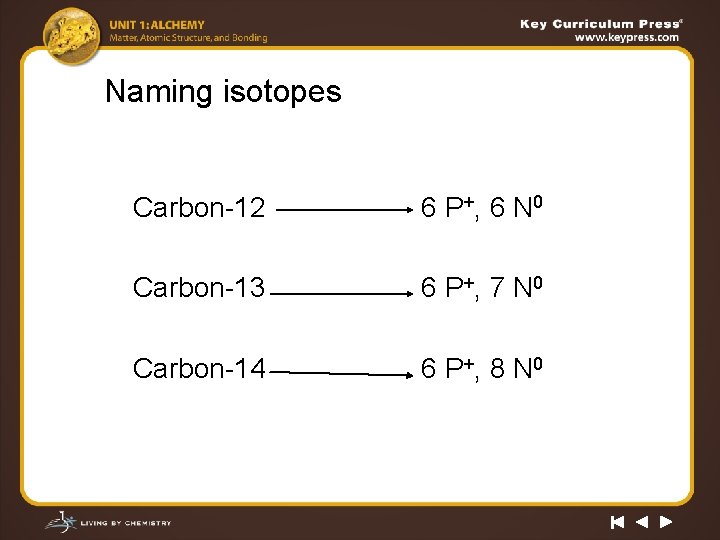
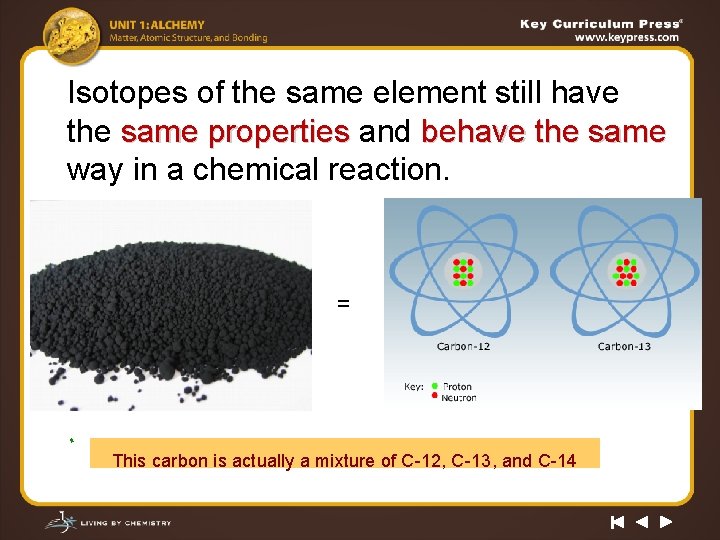
Naming isotopes Carbon-12 6 P +, 6 N 0 Carbon-13 6 P +, 7 N 0 Carbon-14 6 P +, 8 N 0
Isotopes of the same element still have the same properties and behave the same way in a chemical reaction. = This carbon is actually a mixture of C-12, C-13, and C-14
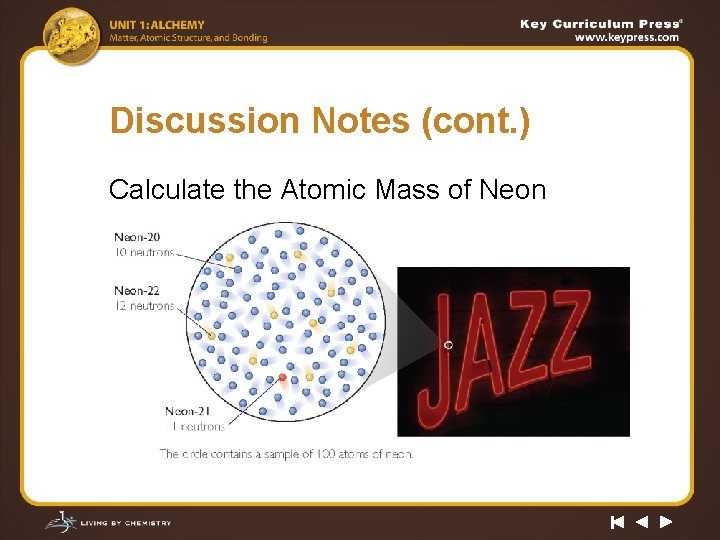
Discussion Notes (cont. ) Calculate the Atomic Mass of Neon
Discussion Notes (cont. ) The average atomic mass of an element is the weighted average of the masses of the isotopes in a sample of the element. The most common isotope of an element, frequently has a mass that is close to the average atomic mass given in the periodic table.
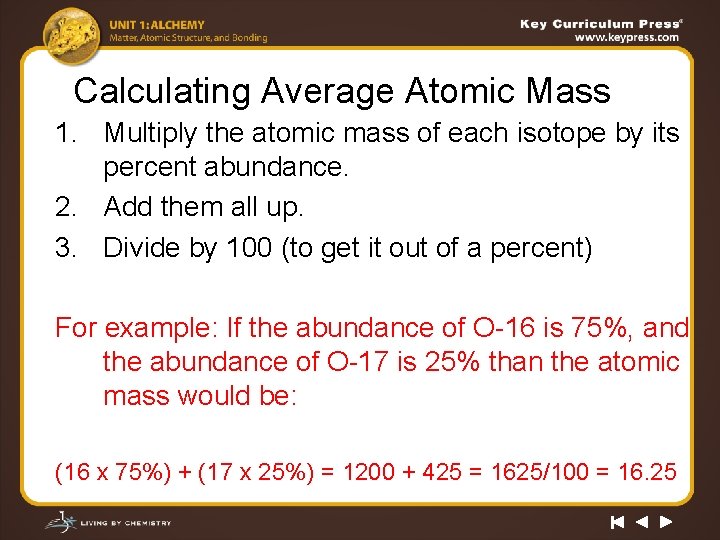
Calculating Average Atomic Mass 1. Multiply the atomic mass of each isotope by its percent abundance. 2. Add them all up. 3. Divide by 100 (to get it out of a percent) For example: If the abundance of O-16 is 75%, and the abundance of O-17 is 25% than the atomic mass would be: (16 x 75%) + (17 x 25%) = 1200 + 425 = 1625/100 = 16. 25
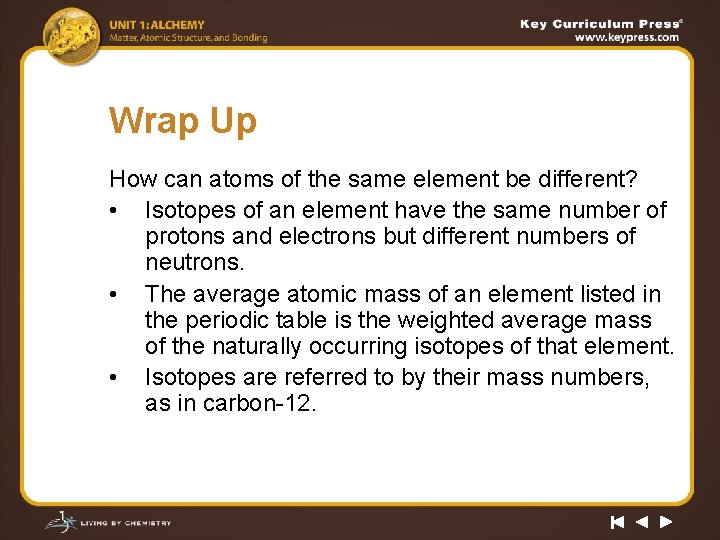
Wrap Up How can atoms of the same element be different? • Isotopes of an element have the same number of protons and electrons but different numbers of neutrons. • The average atomic mass of an element listed in the periodic table is the weighted average mass of the naturally occurring isotopes of that element. • Isotopes are referred to by their mass numbers, as in carbon-12.
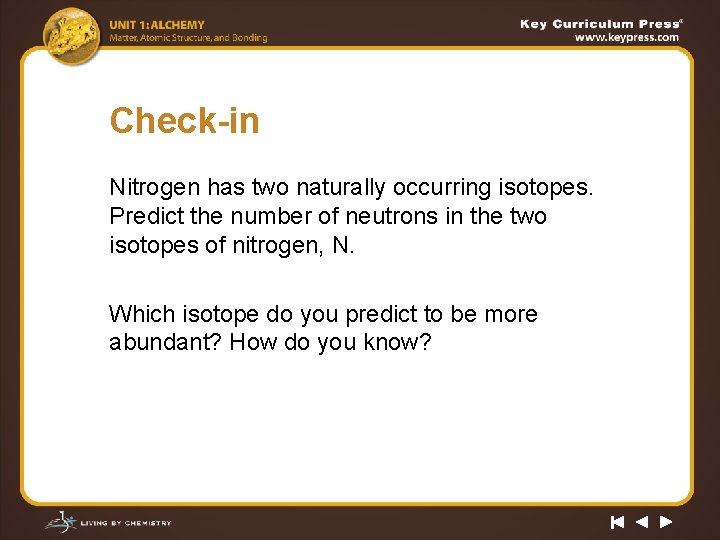
Check-in Nitrogen has two naturally occurring isotopes. Predict the number of neutrons in the two isotopes of nitrogen, N. Which isotope do you predict to be more abundant? How do you know?
Lesson 14: Isotopia Stable and Radioactive Isotopes
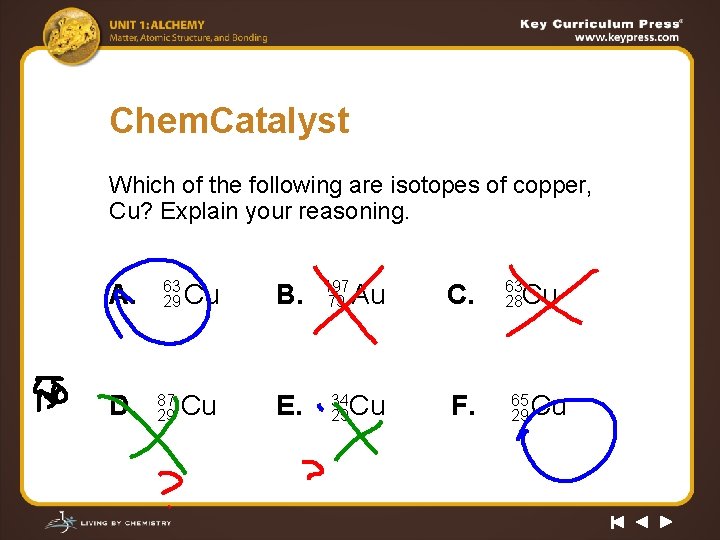
Chem. Catalyst Which of the following are isotopes of copper, Cu? Explain your reasoning. A. D. 63 29 87 29 Cu B. 197 79 Au C. Cu E. 34 29 Cu F. 63 28 Cu 65 29 Cu
Key Question What types of isotopes do the various elements have?
You will be able to: • • • interpret a graph of naturally occurring isotopes describe the general nuclear composition of a stable nucleus differentiate between a stable isotope and a radioactive isotope
Prepare for the Activity Work in pairs. You should each have a copy of the periodic table.
Discussion Notes The graph of naturally occurring isotopes gives us an idea of how many different isotopes of the elements are found in nature. The words atom, isotope, and element are interrelated. Nearly all atoms have at least one neutron for every proton in the nucleus.
Discussion Notes (cont. ) Many isotopes have more neutrons than protons. A handful of the isotopes on the chart are unstable. Some elements have a naturally occurring radioactive isotope. The isotopes of the elements after bismuth (atomic number 84 and up) are all radioactive.
Discussion Notes (cont. ) Radioactive isotope: Any isotope that has an unstable nucleus and decays over time.
Wrap Up What types of isotopes do the various elements have? • Each element found in nature has somewhere between one and ten isotopes. • The neutron-to-proton ratio is an important factor in determining the stability of the nucleus of an isotope. Atoms with small masses have a neutronto-proton ratio of about 1: 1. The most massive atoms have a neutron-to-proton ratio of about 3: 2. • Some elements have isotopes that are radioactive. The nuclei of radioactive isotopes are unstable and decay over time.
Check-in � 1. Use the chart to determine how many neutrons you would need to make a stable element with 79 protons. 2. What element is this? Write its isotope symbol.