
Aim What are the two types of Nuclear

- Slides: 12
Aim: What are the two types of Nuclear Reactions? Do Now: 1. Get into your groups and compare your answers to your homework.
Nuclear Energy • In nuclear reaction, mass is converted into energy; there is no conservation of mass. • Two types of nuclear reactions • Fission • Fusion
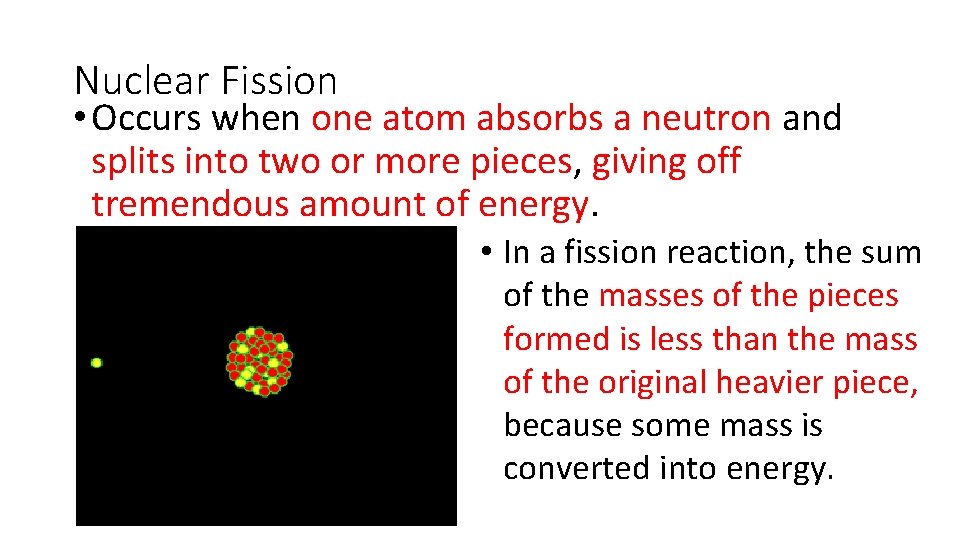
Nuclear Fission • Occurs when one atom absorbs a neutron and splits into two or more pieces, giving off tremendous amount of energy. • In a fission reaction, the sum of the masses of the pieces formed is less than the mass of the original heavier piece, because some mass is converted into energy.
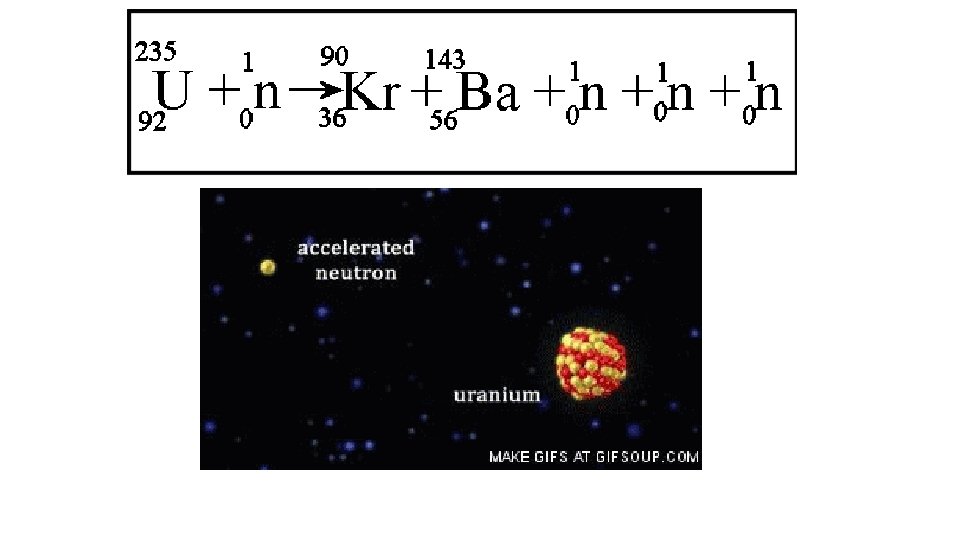
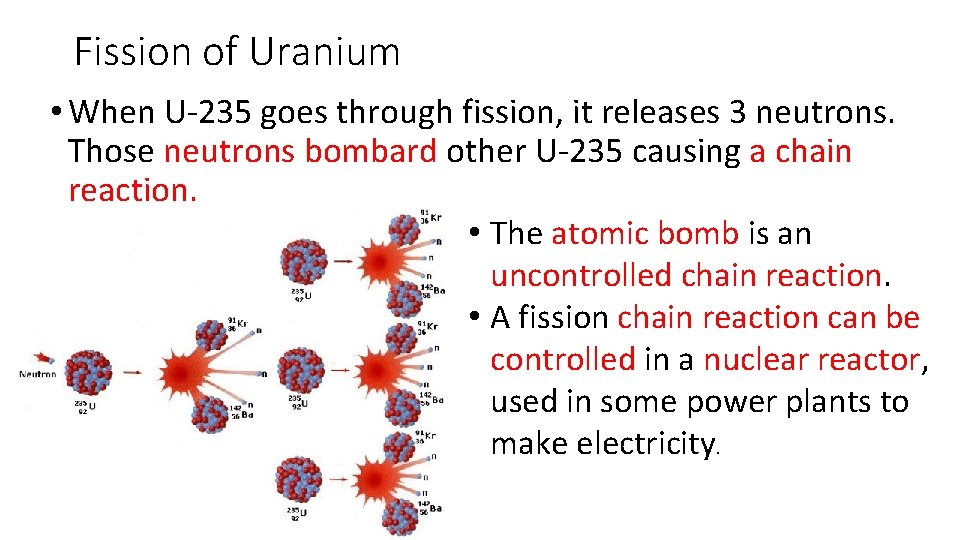
Fission of Uranium • When U-235 goes through fission, it releases 3 neutrons. Those neutrons bombard other U-235 causing a chain reaction. • The atomic bomb is an uncontrolled chain reaction. • A fission chain reaction can be controlled in a nuclear reactor, used in some power plants to make electricity.
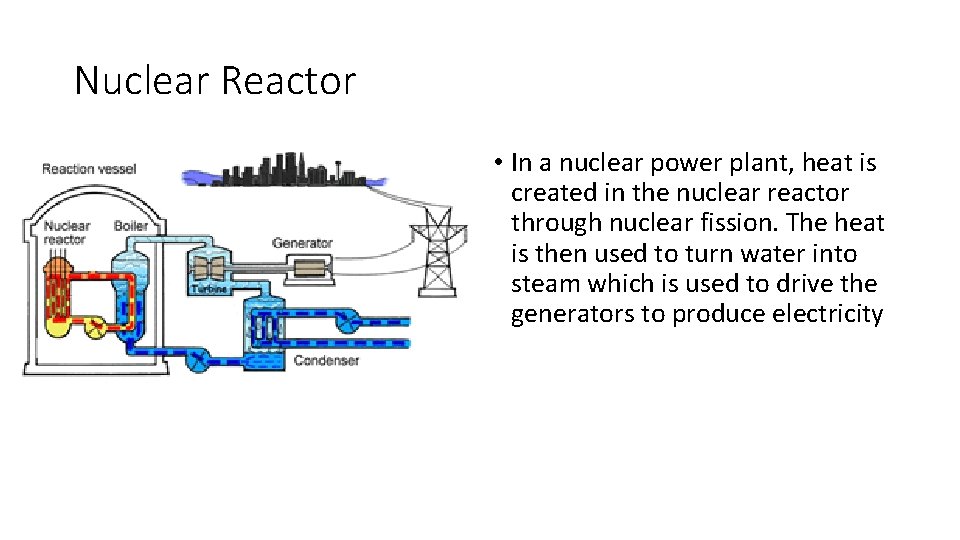
Nuclear Reactor • In a nuclear power plant, heat is created in the nuclear reactor through nuclear fission. The heat is then used to turn water into steam which is used to drive the generators to produce electricity
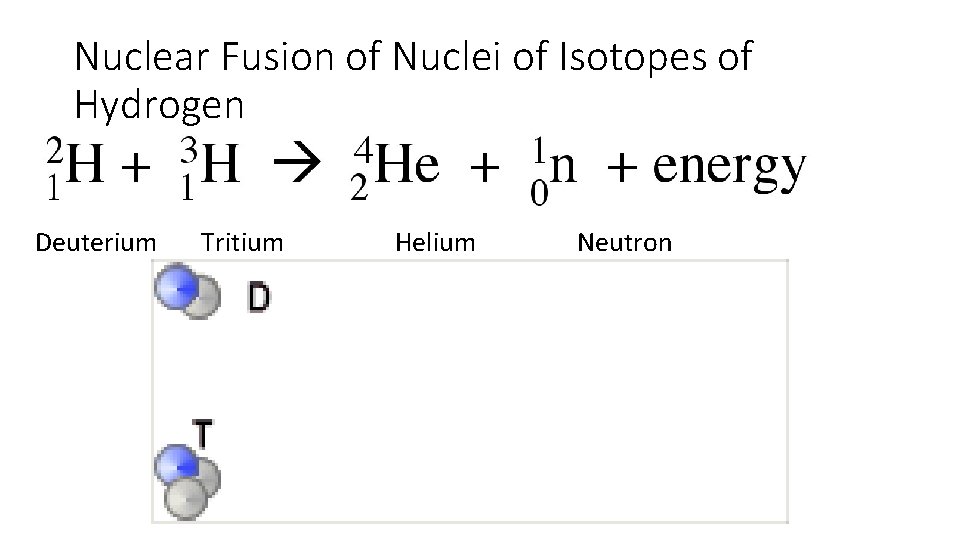
Nuclear Fusion • Nuclear fusion is the joining (or fusing) of the nuclei of two atoms to form a single heavier atom. • At extremely high temperatures and high pressure, the nuclei (positively charged) can readily combine to form heavier elements and in the process release considerable energy. • This reaction occurs on the sun.
Nuclear Fusion • The mass of the nucleus formed after fusion is less than the sum of the mass of the two substances fused, because some mass is converted to energy. • The energy generated in a fusion reaction is greater than the energy generation in a fission reaction.
Nuclear Fusion of Nuclei of Isotopes of Hydrogen Deuterium Tritium Helium Neutron
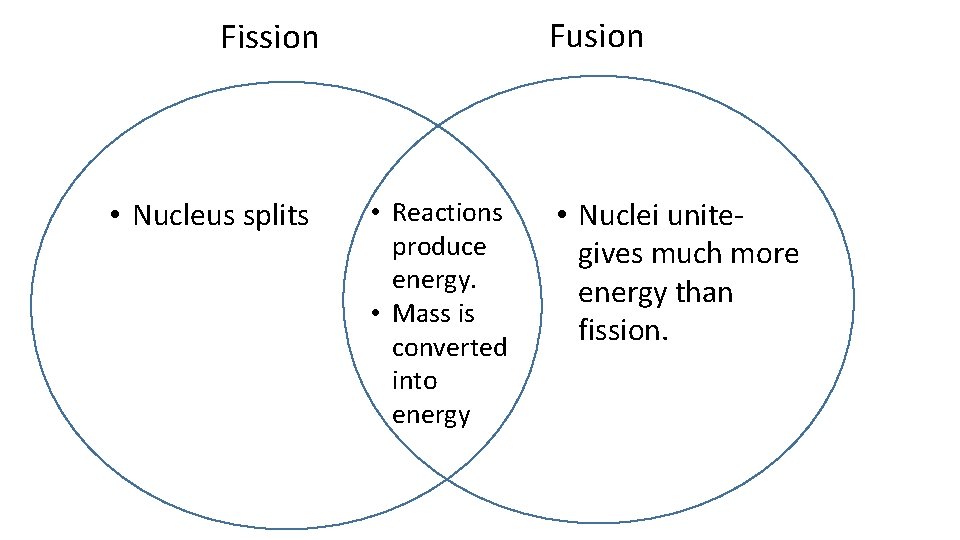
Fusion Fission • Nucleus splits • Reactions produce energy. • Mass is converted into energy • Nuclei unitegives much more energy than fission.
Radioactive Isotopes Benefits Risks 1. Tracers 2. Medical: radioactive iodine can be used to diagnose and treat thyroid. 3. Food can be stored longer. 4. Nuclear Power 5. Radioactive dating 1. Biological Damage: damage or destroy cells 2. Long Term Storage 3. Accidents: nuclear explosion 4. Pollution: nuclear waste 1. U-238 and Pb-206 are used for geological dating. 2. C-14 used for dating living material.
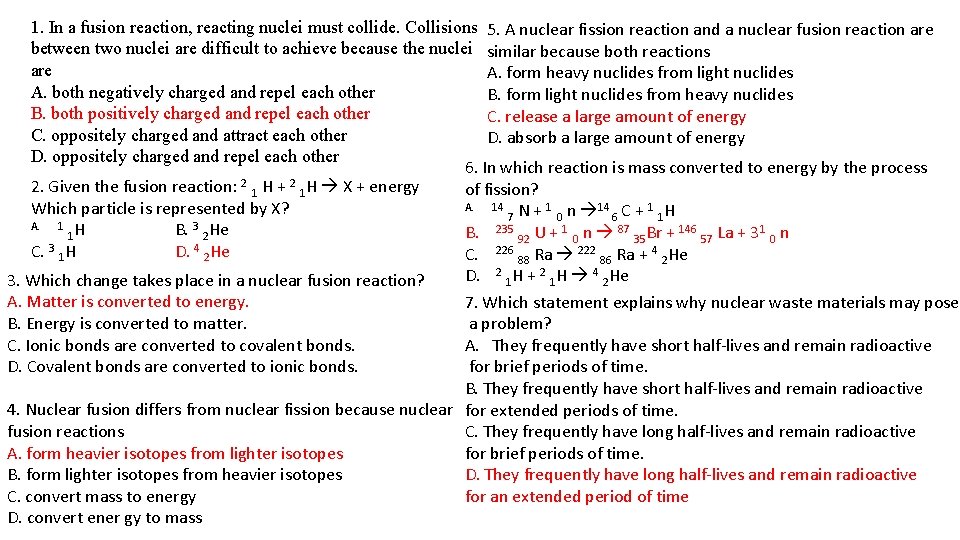
1. In a fusion reaction, reacting nuclei must collide. Collisions 5. A nuclear fission reaction and a nuclear fusion reaction are between two nuclei are difficult to achieve because the nuclei similar because both reactions are A. form heavy nuclides from light nuclides A. both negatively charged and repel each other B. form light nuclides from heavy nuclides B. both positively charged and repel each other C. release a large amount of energy C. oppositely charged and attract each other D. absorb a large amount of energy D. oppositely charged and repel each other 6. In which reaction is mass converted to energy by the process 2 2 2. Given the fusion reaction: 1 H + 1 H X + energy of fission? A. 14 N + 1 n 14 C + 1 H Which particle is represented by X? 7 0 6 1 A. 1 H 3 He 235 1 87 146 1 B. B. 1 2 92 U + 0 n 35 Br + 57 La + 3 0 n C. 3 1 H D. 4 2 He C. 226 88 Ra 222 86 Ra + 4 2 He D. 2 1 H + 2 1 H 4 2 He 3. Which change takes place in a nuclear fusion reaction? A. Matter is converted to energy. 7. Which statement explains why nuclear waste materials may pose B. Energy is converted to matter. a problem? C. Ionic bonds are converted to covalent bonds. A. They frequently have short half-lives and remain radioactive D. Covalent bonds are converted to ionic bonds. for brief periods of time. B. They frequently have short half-lives and remain radioactive 4. Nuclear fusion differs from nuclear fission because nuclear for extended periods of time. fusion reactions C. They frequently have long half-lives and remain radioactive A. form heavier isotopes from lighter isotopes for brief periods of time. B. form lighter isotopes from heavier isotopes D. They frequently have long half-lives and remain radioactive C. convert mass to energy for an extended period of time D. convert ener gy to mass